



Abstract
Statements by alleged victims are important when child abuse is prosecuted; triers-of-fact often attend to nonverbal emotional expressions when evaluating those statements. This study examined the associations among interviewer supportiveness, children’s nonverbal emotions, and informativeness during 100 forensic interviews with alleged victims of child abuse. Raters coded the silent videotapes for children’s nonverbal emotional expressions while other raters coded the transcripts for interviewer support, children’s verbal emotions, and informativeness. Results showed that children’s nonverbal signals were more common than and preceded the verbal signs. Interviewer support was associated with children’s expressivity. When children expressed more nonverbal emotions, they were more responsive during the pre-substantive phases and more informative about the abuse. Nonverbal emotions partially mediated the association between support and informativeness. The findings underline the value of nonverbal emotional expression during forensic interviews and demonstrate how the interviewers’ supportive demeanor can facilitate children’s emotional displays and increase informativeness.
Background
Legal practitioners commonly pay special attention to the levels of children’s emotionality when they are testifying (Castelli & Goodman, 2014; Golding et al., 2003; Regan & Baker, 1998), with nonverbal signals often used to judge the credibility of verbal testimony in the courtroom (Hillman et al., 2012; Nortje & Tredoux, 2019; Vrij et al., 2019). Similarly, researchers have shown that expressions of negative emotions by alleged victims of abuse (e.g., crying) were associated with increased perceptions of credibility by laypersons (Bederian-Gardner & Goldfarb, 2014; Golding et al., 2003). Moreover, emotional expressiveness is sometimes viewed as an indicator of children’s cooperation (Matsumoto et al., 1986; Schug et al., 2010) and of the coherence of forensic statements (Snow et al., 2009; Westcott & Kynan, 2004), which in turn predict whether prosecutors file charges (Castelli & Goodman, 2014).
Both verbal expressions and nonverbal behaviors may act as signals that communicate or reflect emotional experiences. Communicating, especially in face-to-face contexts, is a multi-faceted process in which vocal and visual channels are typically coordinated and mutually complementary (e.g., Denham & Onwuegbuzie, 2013; Jones & LeBaron, 2002). However, nonverbal signals appear to be more common than verbal signals: it has been estimated that as much as 93% of interpersonal communications are nonverbal (Mehrabian, 1981). Nonverbal signals comprise a central communicative channel from early childhood (Bullowa, 1979) and thus play an important role when alleged victims discuss traumatic events (Bonanno et al., 2002).
Katz and colleagues (Katz et al., 2012) compared nonverbal expressions of reluctance by suspected sexual abuse victims who did and did not make allegations of abuse. Children in the nondisclosure group were more disengaged physically than children in the disclosure group during both the introductory and substantive phases of the interview. Because studies of verbal reluctance showed that it was often displayed later in the interview (Hershkowitz et al., 2006), Katz and colleagues (2012) speculated that children’s nonverbal signals may precede verbal messages. They also emphasized the importance of attending to nonverbal signs of reluctance in order to address any reluctance as early as possible and thus avoid or attenuate negative dynamics which might prevent children from revealing possible abuse.
Although nonverbal signals clearly affect the assessment of children’s reports, few field studies have addressed this issue (van Ham et al., 2020). Most of the existing research has explored nonverbal behaviors associated with deceit, showing that most do not differentiate liars from truth-tellers (Hillman et al., 2012; Nortje & Tredoux, 2019; Vrij et al., 2019). Other studies have examined the prevalence of nonverbal displays, noting that children often show little or no emotion when talking about abusive events during forensic interviews (Castelli & Goodman, 2014; Katz et al., 2012; Sayfan et al., 2008; Wood et al., 1996). However, Goodman and her colleagues (1992) reported that most children looked quite upset when testifying in criminal court (Goodman et al., 1992) while Katz and her colleagues showed that many children expressed positive emotions in forensic interviews before interviewers switched focus to the abusive events (Katz et al., 2012).
The interviewer’s demeanor can facilitate children’s emotional expressions. Professionals attuned to emotional signals can better assess children’s feelings and needs and act accordingly (Karni-Visel et al., 2019; Kennedy-Moore & Watson, 2001; Vatne et al., 2012). Laboratory analog (Ahern & Lyon, 2013; Klemfuss et al., 2013) and field studies (Karni-Visel et al., 2019; Lyon et al., 2012) have both shown that supportive interviewers elicit more reports of internal processes as well as more informative narratives than do less supportive interviewers. A recent revision of The National Institute of Child Health and Human Development (NICHD) Investigative Interview Protocol was designed to assist interviewers conduct more supportive forensic interviews (Hershkowitz et al., 2013; Hershkowitz et al., 2017; Lamb et al., 2018) by including guidance on enhanced rapport building and support. The RP instructions advise interviewers to help children engage and explore their emotions when describing experienced events in both the pre-substantive and substantive portions of the interview. Recent studies have revealed enhanced levels of interviewer support and higher rate of disclosure in RP-guided interviews (Hershkowitz et al., 2014; Hershkowitz & Lamb, 2020) which are also characterized by more spontaneous (Ahern et al., 2019), informative, and coherent (Blasbalg et al., 2018a, 2018b, 2019) statements than are SP (Standard Protocol) guided interviews. In a sequence analysis, Ahern and colleagues (2014) showed that supportively addressing signs of reluctance immediately was associated with greater cooperativeness in the children’s next utterance. Most relevant to the current study, interviewer support is associated with children’s more extensive and varied emotional expressions, both about the interview situation as well as about the abusive events (Karni-Visel et al., 2019).
Referring to emotions in forensic interviews may enhance children’s memory recall (Dolcos et al., 2020; Hamann & Stevens, 2014). Liwag and Stein (1995) were the first to demonstrate that emotional cueing assisted children provide rich narratives. Recently, Karni-Visel and her colleagues showed that the verbal expression of emotions was associated with the enhanced retrieval of abuse-related details and mediated the effects of supportive interviewing on informativeness (Karni-Visel et al., 2019).
However, the potentially beneficial role of nonverbal emotional expressions in children’s informativeness has not yet been examined. The goal of the present study was to assess the relationships among interviewer support, children’s emotional expressions, and children’s informativeness in forensic interviews. In the current study, we focused on investigative interviews with children suspected of being abused by family members because previous research shows that such children may be more susceptible to pressure from adults on whom they are dependent (Malloy et al., 2007) and thus more reluctant to cooperate with forensic interviewers and provide information regarding alleged abusive events (e.g., Hershkowitz & Lamb, 2020; Hershkowitz et al., 2014). We hypothesized that nonverbal emotional expressions would be associated with and would precede verbal emotional expressions. We expected that support would be associated with an increase in the expression of nonverbal emotions, which in turn would be associated with better performance by the child: higher responsiveness in the pre-substantive phases of the interview and greater informativeness in the substantive phase. Finally, we expected that nonverbal emotional expression would mediate the association between interviewer support and children’s responsiveness/informativeness just as verbal emotional expressiveness did in Karni-Visel et al.’s (2019) study.
Method
Participants
A total of 100 interviews of 3.46- to 13.90-year-old (M = 8.63, SD = 2.45) children allegedly abused by an adult family member were examined. All interviews were conducted in Israel between August 2014 and February 2016 by 42 investigators in the Ministry of Welfare and Social Services (for more details see Hershkowitz et al., 2017). The interviews were selected from an archive comprising all child interviews conducted within this time frame using the following selection criteria: (a) there was an accessible and complete Digital Video Disc (DVD), (b) the suspects were family members, and (c) the case files included one or more of the following forms of corroboration: evidence independent of the interview, prior disclosure to professionals/disinterested persons, or forensic statements by another victim. From the resulting pool, we selected equal numbers of sexual and physical abuse allegations, equal numbers of male and female interviewees, and a diverse range of ages.
The children were allegedly abused by a biological family member (58%), step-parent (4%), or other relative (28%). 59% of allegations were substantiated based on independent evidence (30% eyewitness reports, 9% evidence of wounds and bruises, 20% suspect admissions). Other cases (41%) involved prior disclosures (15% to professionals; 26% to disinterested figures such as friends or their parents). The interviews took place in educational settings (47%), child protection centers (25%), or other agencies (e.g., offices, hospitals, social service agencies, police stations) (28%). The study was approved by the authors’ university and the Ministry of Social Services ethics committees.
The Revised NICHD Protocol
The Revised NICHD Protocol (RP) represents a revision of the Standard NICHD Investigative Protocol (SP) and is characterized by an enhanced emphasis on supportive interviewing (for a detailed description of the principles, see Lamb et al., 2018; for a detailed description and a list of supportive comments, see Karni-Visel et al., 2019). In addition, interviewers were specifically shown how to recognize nonverbal cues as part of their training to use the RP. This designated training included a day-long group session, in which the coding scheme was presented and illustrated by analyzing forensic interview videos followed by a two-hour individual supervision focused on nonverbal displays, their different forms, and their characteristics. The interviewers received personal feedback in order to improve their evaluation skills (Ahern et al., 2019).
Data Coding
DVD-recorded and transcribed interviews of 100 alleged victims of child abuse were coded as follows: Children’s verbal and nonverbal emotions as well as their verbal responsivity and production of details were recorded, while supportive comments by the interviewers were also identified. The transcribed interviews were examined by two separate teams:
Two raters coded the silent videotapes for nonverbal indices of children’s nonverbal emotions in each utterance (as elaborated below). Two other raters independently identified and rated the interviewers’ supportive comments, children’s verbal emotions, and forensic information. The members of the two teams were blind to (unaware of) the ratings made by the raters in the other team and all raters were unaware of the study hypotheses. Members of both teams only coded the pre-substantive phases and explorations of the first investigated event in the substantive phase.
Children’s nonverbal emotions were coded following a technique first developed by Katz and her colleagues (Katz et al., 2012) which included a focus on specific facial muscle movements. The coders noted the presence or absence of nonverbal emotions in each conversational turn. Nonverbal emotional expressions included displays of one of the following: (1) anger was coded when eyebrows were lowered and drawn together and lips were pressed together or parted in a square shape, (2) fear was coded when eyebrows were raised and drawn together, eyes were wide open, and lips were stretched, (3) sadness was coded when inner eyebrows were drawn together and lip corners pulled down (including when crying and gazing down), (4) shame was coded when gazing down co-occurred with downward head movements, (5) disgust was coded when the nose was wrinkled and the upper lip was retracted, and (6) happiness was coded when children raised their inner eyebrows, cheeks, and upper lip with the lip corners turned upward whether or not the teeth were visible (including when smiling or laughing).
Children’s verbal expressions of emotion were coded whenever the children used words describing emotions including all morphological variants of the word (for a detailed description of the coding procedures, see Karni-Visel et al., 2019).
Each of the children’s utterances was coded as either responsive or not depending on whether it provided any relevant information and whether or not it was novel. In addition, we coded each child utterance for the presence or absence of forensic detail. Details were counted if children provided new information and descriptions of individuals, objects, or events (for more details see Lamb, 1996; Yuille & Cutshall, 1986). The interviewer interventions and child responses described below were coded as present or absent in each conversational turn as in Hershkowitz et al.’s (2017) study and as in Karni-Visel et al.’s (2019) study. Indices of support included: (a) Expressions of emotional support by accepting, echoing, or asking children about their feelings (“Tell me more about being embarrassed to say that” [after the child indicated s/he felt embarrassed]), (b) Initiating rapport by expressing interest in knowing the child (“I want to know more about you”) or by being hospitable (“Would you like a glass of water/to take a short break?”), (c) Emphasizing rapport by expressing care or concern for the child (“I care about you and want to help”) or by presenting him/herself as someone to whom children could disclose because it was their duty to ensure children’s welfare (“My job is to keep children safe”), (d) Positive reinforcements of the child’s efforts by praising/thanking him/her for listening to questions or for providing many details (“Thanks for telling me about so many things”), and (e) Encouragement by emphasizing the importance of reporting and the fact that the child was a unique source of knowledge, expressing confidence in his or her abilities, legitimizing his/her reports (“Here you can talk about everything”) or offering assistance (“Would you prefer to write or to spell instead of saying it?” and “Would it help if your teacher joined our conversation?”).
Inter-Rater Reliability
Two pairs of raters first established inter-rater reliability on a separate set of DVDs or transcripts in order to assess inter-coder reliability. Once they had attained levels of agreement that exceeded 90%, the coders began working with the target interviews. Reliability was re-checked for 20% of the interviews by having one rater in each pair recode randomly selected DVDs or transcripts previously coded by the other rater. K alpha inter-rater index coefficients (Hayes & Krippendorff, 2007) for indices of support, verbal emotions, nonverbal emotions, responsiveness, and informativeness were .88, .89, .80, .81, and .83, respectively. All coders were blind to the research hypotheses.
Analytic Approach
For the current study, the Generalized Linear Mixed Models (GLMM) approach was tested (for more details see Karni-Visel et al., 2019). In order to examine the order in which emotional expressions appeared, we used a lag-sequential analysis referring to the position of a target code relative to a given criterion code: first, the proportion of nonverbal emotional expressions occurring at lag 1 were calculated, then the proportion of verbal emotional expressions occurring at lag 1 were calculated. Two GLMM analyses tested the order in which emotional expressions appeared: whether verbal emotions preceded nonverbal emotions and then whether nonverbal emotions preceded verbal emotions. In order to examine the effects of supportive comments that followed the nonverbal expression of emotions, conditional support was coded when a supportive comment was made immediately after the child expressed an emotion. In each of these analyses, the outcome variables were dichotomous (the presence or absence of emotions or details in each utterance). Child’s age, gender, and type of abuse (physical, sexual) were controlled for statistically in all the analyses reported below. The Monte-Carlo method was used to determine whether children’s nonverbal emotional expressiveness mediated the effects of interviewer support on the child’s responsiveness and informativeness (Preacher & Selig, 2012).
Results
Interrelations of Nonverbal and Verbal Expressions
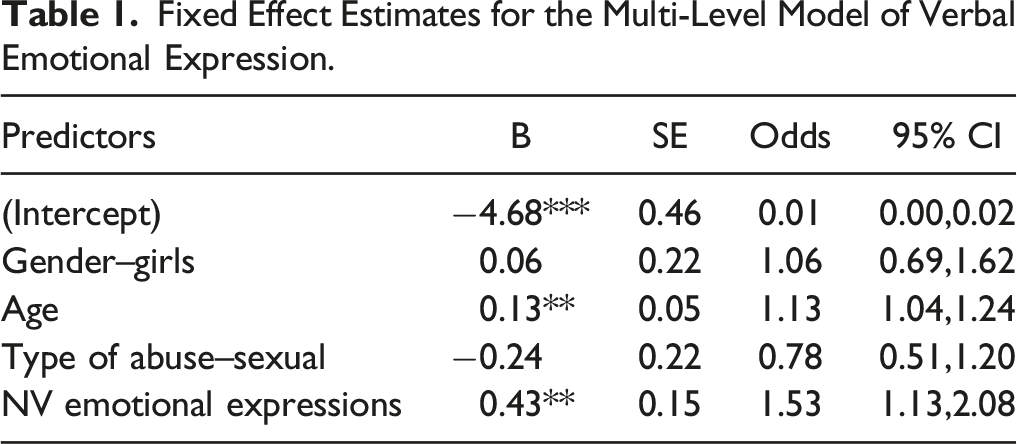
Children expressed nonverbal emotions in approximately half (M = .49, SD = .49) and verbal emotions in only .04 (SD = .20) of their utterances. In the substantive phase, children provided forensically relevant new details in approximately one third of their utterances (M = .34, SD = .47). Supportive comments, collapsed across all categories, were provided in approximately one eighth of the interviewers’ utterances (M = .12, SD = .33).
Fixed Effect Estimates for the Multi-Level Model of Verbal Emotional Expression.
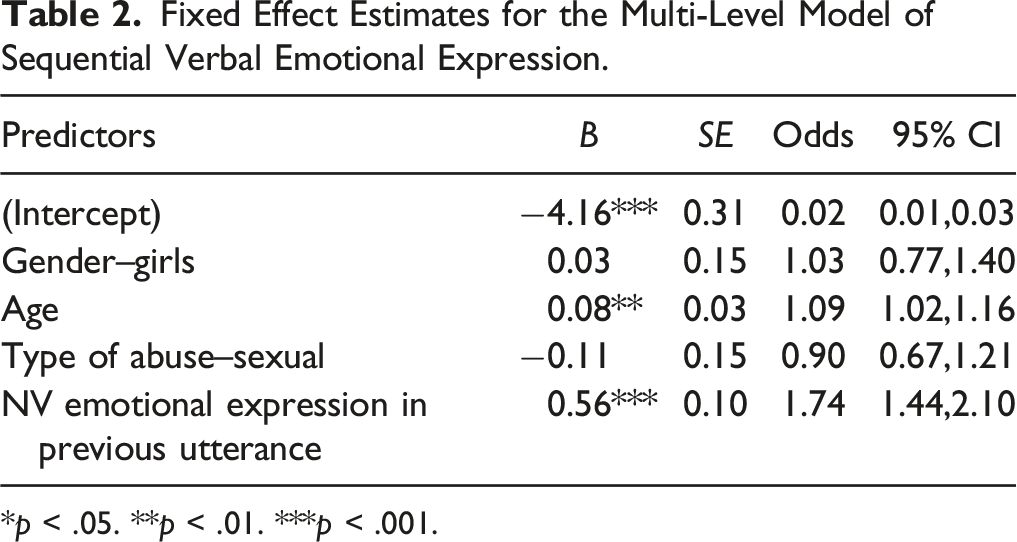
Fixed Effect Estimates for the Multi-Level Model of Sequential Verbal Emotional Expression.
*p < .05. **p < .01. ***p < .001.
Conditional Support and Nonverbal Emotional Expressions
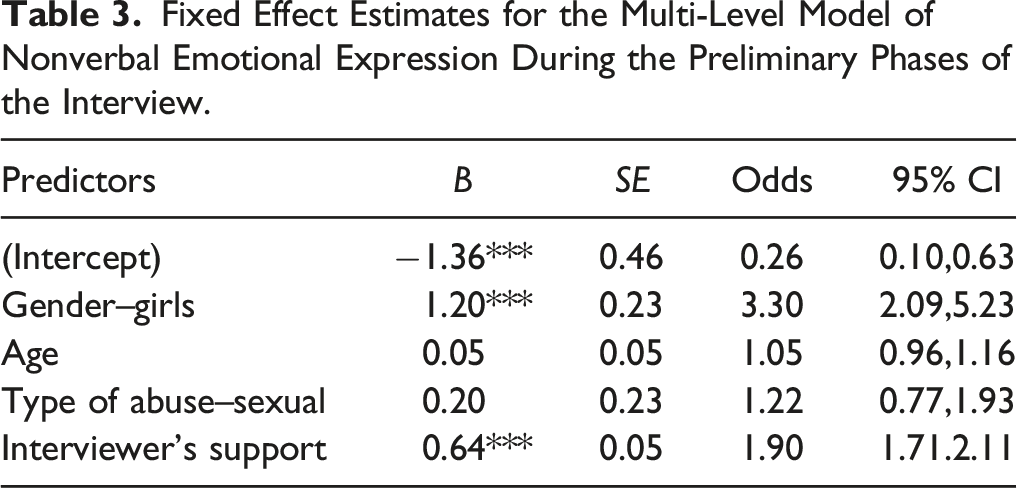
The association between conditional support and nonverbal emotional expressions in the next utterance was then examined. Analyses revealed that conditional support in a given utterance was associated with an increase in the nonverbal expression of emotions in the next utterance (β = .54, SE = .14, p < .001, 95% CI [1.31, 2.23]).
Responsiveness During the Preliminary Phases of the Interview (Rapport Building and Transitional phases)
Fixed Effect Estimates for the Multi-Level Model of Nonverbal Emotional Expression During the Preliminary Phases of the Interview.
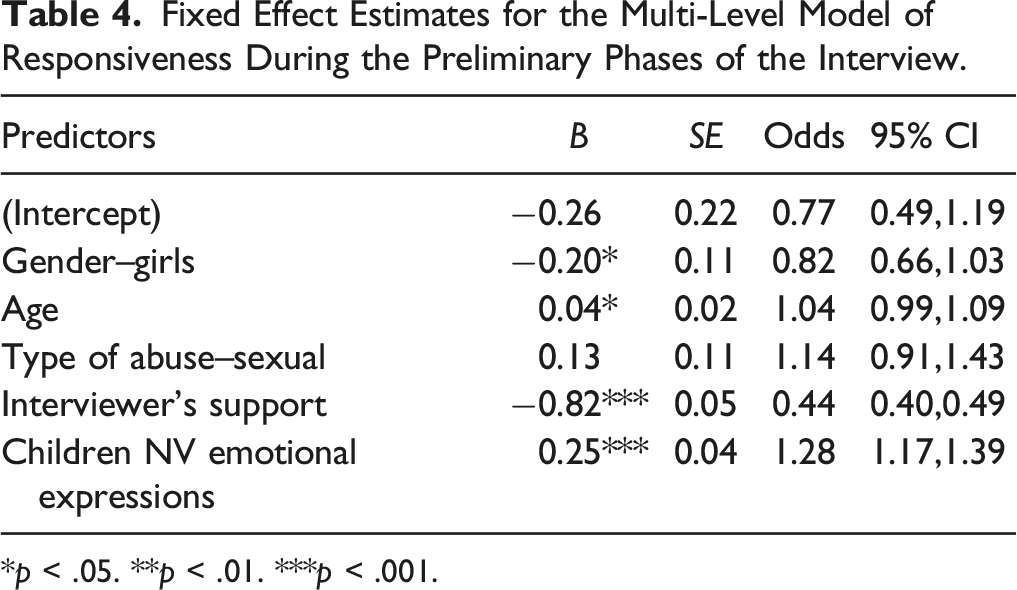
Fixed Effect Estimates for the Multi-Level Model of Responsiveness During the Preliminary Phases of the Interview.
*p < .05. **p < .01. ***p < .001.
Forensic Informativeness in the Substantive Phase
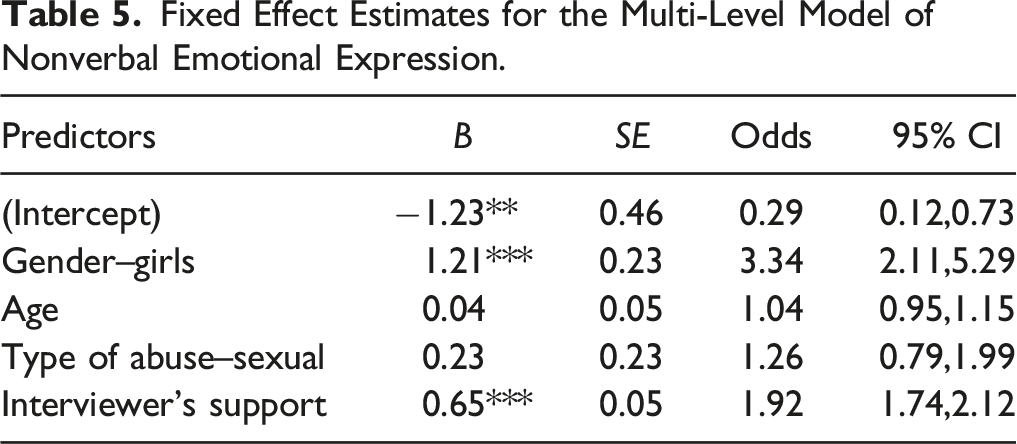
Fixed Effect Estimates for the Multi-Level Model of Nonverbal Emotional Expression.
Fixed Effect Estimates for the Multi-Level Model of Forensic Informativeness.
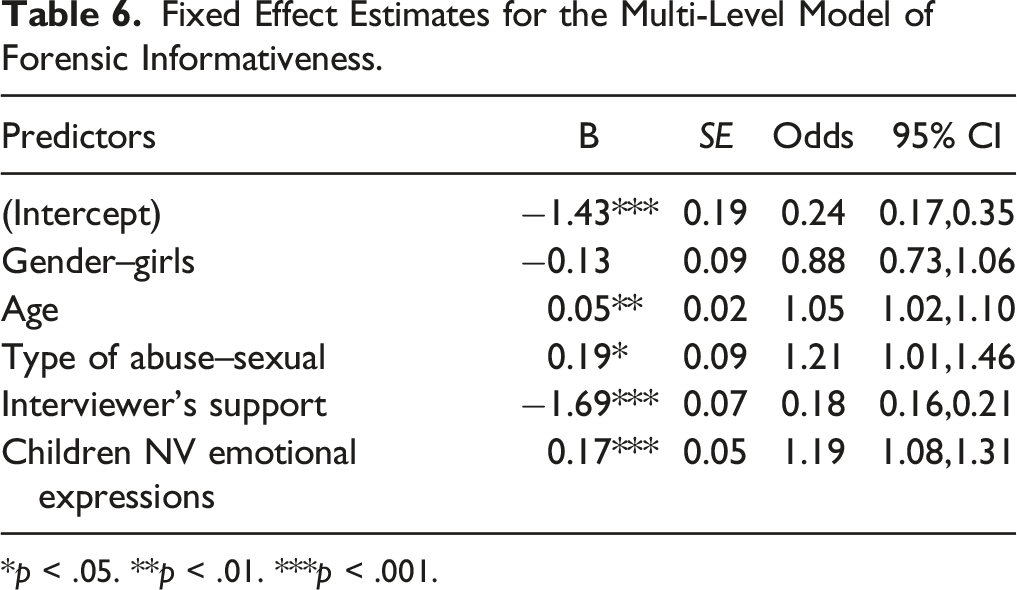
*p < .05. **p < .01. ***p < .001.
Child and Abuse Characteristics
Fixed Effect Estimates for the Multi-Level Model of Nonverbal Emotional Expression.
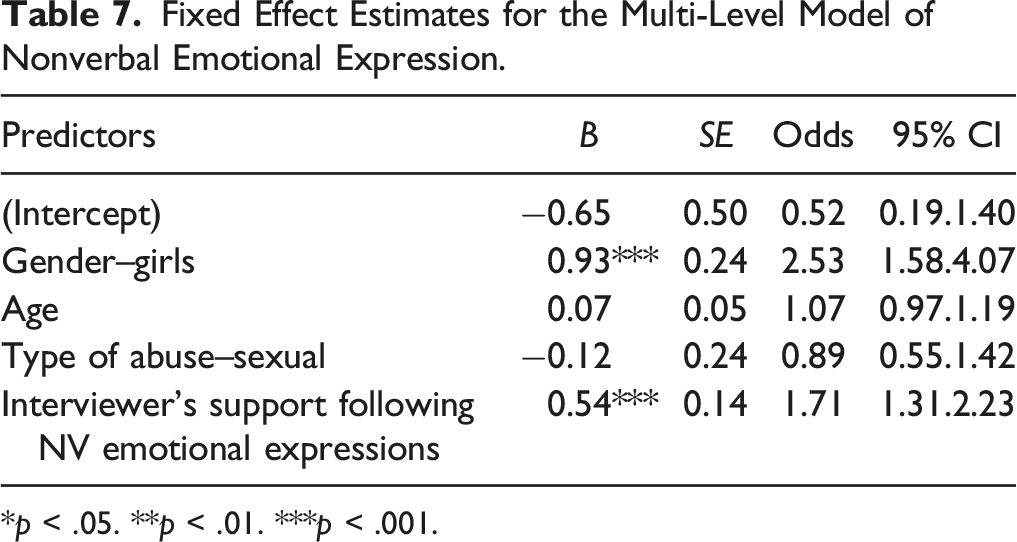
*p < .05. **p < .01. ***p < .001.
Discussion
In legal contexts, practitioners often rely on children’s subjective reactions when assessing their statements (Castelli & Goodman, 2014; Golding et al., 2003; Regan & Baker, 1998). Emotional reactions expressed both verbally and (especially) nonverbally are used as indicators of cooperation (Schug et al., 2010) and as indicators of narrative coherence (Snow et al., 2009; Westcott & Kynan, 2004) and credibility (Vrij et al., 2004; Vrij et al., 2019) in the forensic arena. This study aimed to examine, for the first time, the associations among interviewer support, the nonverbal expression of emotions, and informativeness in the course of forensic interviews with suspected victims of child abuse.
The data showed that the nonverbal and verbal expression of emotions were significantly correlated, suggesting that the verbal and nonverbal channels often co-occur and should not be seen as alternative means of expression. Our results are consistent with other evidence that verbal and nonverbal channels are often coordinated when communicating emotions (e.g., Denham & Onwuegbuzie, 2013; Jones & LeBaron, 2002). However, nonverbal expressions were 10 times more common than verbal expressions, underlining the superiority of nonverbal communication especially by children (e.g., Bullowa, 1979; Mehrabian, 1981).
Our results also shed light on the controversy about children’s displays of emotion when testifying. Although Goodman and her colleagues (1992) reported that most children were quite upset when testifying in criminal court, other studies found that children showed little or no emotion when reporting abusive events in forensic interview contexts (Castelli & Goodman, 2014; Katz et al., 2012; Sayfan et al., 2008; Wood et al., 1996). This inconsistency can be related to differences in methodology; the current study used a micro-level approach and closely analyzed sequences during the interview, whereas many previous studies examined global impressions at a macro-level (e.g., Sayfan et al., 2008). Micro-level observation can capture the subtle expressions that are common (e.g., Gerholm, 2011; Vatne et al., 2012) but may be missed when macro-level approaches are adopted (Katz et al., 2012).
Importantly, the current study also showed that nonverbal signals often preceded verbal expressions of emotion. No previous studies have examined both verbal and nonverbal expressions of emotion, there has only been indirect evidence that nonverbal signs of reluctance (e.g., changes in posture) precede verbal signs (Katz et al., 2012).
This sequence was clearly evident in the current study, suggesting that nonverbal signals can guide interviewers’ responses before children say anything about their emotions. Relying on nonverbal expressions of emotion, which appear earlier and are much more frequent, can assist interviewers in evaluating and formulating their reactions as early as possible, before children’s reluctance grows. Researchers studying cooperative and reluctant child witnesses have recommended that forensic interviewers should respond supportively to the earliest signs of emotion in order to prevent the escalation of negative dynamics (Hershkowitz et al., 2006; Katz et al., 2012). The current data show that it is possible to catch potentially inhibiting negative emotions early and address them more effectively if interviewers are sensitive to nonverbal displays.
Children’s characteristics also predicted their emotional expressions. Although verbal emotional expressiveness increased with age, there were no age differences in nonverbal emotional expression. These results are consistent with previous research (Karni-Visel et al., 2019; Katz et al., 2016). As expected, girls expressed their emotions nonverbally more than boys (for meta-analytic review see Chaplin & Aldao, 2013). However, gender was not significantly associated with the use of emotional language (as also reported by Ahern & Lyon, 2013; Sayfan et al., 2008), contradicting reports that girls tend to mention verbal emotions more often than boys do (Karni-Visel et al., 2019; Katz et al., 2016). Further research exploring the associations among gender, emotional valance (positive vs. negative), and type of emotion (internalizing vs. externalizing) may shed light on the differential effects of gender on types of emotional expression.
The current study also showed that responding to nonverbal expressions of emotion with support encouraged children to increase their expressiveness. This is consistent with previous findings from laboratory (Ahern & Lyon, 2013; Klemfuss et al., 2013) and field (Karni-Visel et al., 2019; Lyon et al., 2012) studies examining the role of interviewer support in facilitating the verbal expressions of emotion. For example, Karni-Visel and colleagues (2019) showed that a supportive approach facilitated the extensive and varied expression of emotions about both the interview situation and the abusive events. Moreover, the current results are consistent with Ahern et al.’s (2014) findings that immediate support in response to children’s expressions leads to reductions in their expressions of reluctance (Ahern et al., 2014). However, whereas the beneficial effects of support were previously documented in studies focused on verbal displays, we showed similar effects in a study of nonverbal expressions, suggesting the importance of nonverbal communication during forensic interviews with children.
The more nonverbal emotions were expressed, the more responsive children were during the pre-substantive phases of the interview and the more informative they were about the alleged abuse. The current results are consistent with those obtained in a previous field study (Karni-Visel et al., 2019) as well as in previous analog studies in which attention to emotions enhanced the retrieval of information from memory about personally relevant events (Hamann & Stevens, 2014). Our results are also consistent with previous studies showing how emotions modulate children’s recollection of personally relevant events (Ackil et al., 2003; Bauer & Larkina, 2017; Fivush et al., 2003; reviewed by Goodman et al., 2010).
However, in examining the association between emotional displays and responsiveness in the courtroom, Goodman and colleagues showed that children who appeared more frightened to face the defendant while testifying were less able to answer the prosecutors’ questions (Goodman et al., 1992). This difference can be explained by the different settings (forensic interviews vs. courtroom testimony) and the specific stressors that challenge children when testifying in a courtroom (e.g., encountering the defendant, testifying in front of a jury). Our results are especially relevant for those countries in which recordings of forensic interviews are used as evidence in court, while future studies should explore whether the beneficial effects of support might be also relevant when children are required to testify in person.
Further analyses showed that nonverbal expressions partially mediated the association between support and forensic informativeness. Supportive comments were negatively associated with verbal responsiveness during the pre-substantive parts and also associated with less detailed reporting during the substantive part. We assume that interviewers responded with more supportive comments when children were unresponsive or not providing many details as they were instructed by the RP Protocol (Hershkowitz et al., 2017). As previously mentioned, children in the sample were suspected of being abused by family members and thus were likely to be especially reluctant to provide information during forensic interviews (e.g., Hershkowitz & Lamb, 2020; Hershkowitz et al., 2014). Importantly, the mediation model suggests that the beneficial effects of support on informativeness depend on the extent to which support elicits nonverbal displays of emotion. Prior literature has suggested that memory retrieval is not directly derived from interviewer support but occurs via a number of emotional mechanisms (Saywitz et al., 2016) including perceived self-efficacy (Bottoms et al., 2007; Davis & Bottoms, 2002), decreased anxiety (Quas et al., 2004), or reluctance (Blasbalg et al., 2019). Similarly, in a recent field study, Karni-Visel et al. (2019) showed that emotional expressiveness accounted for the association between supportive interviewing and informativeness. However, their study only focused on verbally expressed emotions, whereas the current study showed the same mediation when examining the nonverbal emotions that appear earlier and more frequently and are therefore easier to address effectively.
The direct and indirect associations between nonverbal expressions and responsiveness in the pre-substantive part and informativeness in the substantive part can be explained in several ways. As mentioned earlier, theoretical predictions (e.g., Boone & Buck, 2003) and research (e.g., Schug et al., 2010) suggest that emotional expressivity in itself can serve as a marker of an individual’s cooperative disposition, suggesting that both verbal and nonverbal reactions are indicators of cooperation. However, other explanations may be related to the role of emotional expressions in intra- and inter-individual regulation processes. For example, expressing emotions nonverbally may have helped children to regulate their emotions (Izard, 1990). Effective processes of self-regulation may have helped the children better cope with the interviews’ emotional and cognitive challenges and thereby improved the children’s performance (Izard & Ackerman, 2000). Furthermore, it is possible that children who reveal their emotions using facial expressions signaled their needs to the interviewer (e.g., Frith, 2009; Kaiser & Wehrle, 2001; Parkinson, 2005). As elaborated above, the interviewer’s supportive demeanor may in turn have helped the children to regulate their (negative) emotions and better perform cognitively during the interview (Parkinson, 2005). Further testing of these possible mechanisms in controlled studies is needed.
To our knowledge, this study was the first to examine the advantages of responding supportively to nonverbal signals and provided additional evidence that it may be beneficial to use the RP. The RP encourages interviewers to pay attention to emotions throughout the interview and to respond nonsuggestively to children’s expressions of emotion (Hershkowitz et al., 2017; Karni-Visel et al., 2019). Encouraging and supporting children’s expressions of feelings may help them feel comfortable and secure, perhaps allowing then to better regulate their emotions and provide sensitive information about their abusive experiences.
Limitations
The present findings should be interpreted in light of several limitations. First, nonverbal expressions can include additional indicators such as the direction of gaze, verbal tone, and timing (Argyle, 1969), all of which were not examined in the current study but may affect communication. In addition, because coding was extremely demanding and time consuming, and at the same time yielded enormous amounts of information, the study focused on reports of the first abusive event described. The first described event is usually the best recalled event, and thus the one on which interviewers tend to focus when attempting to obtain event-specific information (Brubacher et al., 2014; Fivush et al., 2003). Finally, the current study only included interviews that were conducted in Israel and the sample was relatively homogenous ethnically. Although nonverbal emotions are considered universal, emotional displays may be different in other cultural contexts (Hamilton et al., 2016; Marsh et al., 2003).
Implications for Practice and Policy
The study demonstrated the important role played by children’s nonverbal expressions of emotion during forensic interviews. We showed that providing support during the interview encouraged children to express emotional signals and be more informative. Although most previous research has explored nonverbal behaviors as indicators of deceit, the current study demonstrated that nonverbal emotions may signal active engagement in the interview context. Encouraging children’s subjective reactions was associated with increases in informativeness, both of which may convey greater coherence and credibility. Because attention to nonverbal displays of emotion appears to be strategically important, forensic interviewers should be trained to incorporate this strategy into their everyday work. Specifically, we recommend guidance that explains and describes common nonverbal displays, their different forms, and their characteristics, and includes practice analyzing recordings of forensic interviews with feedback designed to improve evaluation skills. Future efforts should include the development and evaluation of supportive interviewing techniques that while not being suggestive, foster nonverbal communication in children, especially boys, known to be more reticent in emotional expression (Chaplin & Aldao, 2013).
Finally, the current study showed that children frequently display emotions nonverbally when describing their experiences. Close and continuous assessment of children’s facial expressions throughout the interview may enable interviewers to capture the subtle and passing expressions of emotion (e.g., Gerholm, 2011; Vatne et al., 2012). Practitioners should minimize possible distractions (e.g., simultaneous writing, camera operation), focus on children’s facial expressions, and maintain eye contact with the children. Minimizing distraction may make it easier to appraise children’s emotional signals and respond to them appropriately.
Conclusion
Children tend to express emotions nonverbally more often and earlier than they do so verbally when disclosing abuse. Interviewer support enhances the level of nonverbal communication, and this increases informativeness. Supporting children while they are describing abuse can help them express their emotions and enhance the quality of their forensic statements in numerous ways.
Footnotes
Acknowledgments
We would like to thank the youth investigators who made this study possible, and the children whose statements made this study both possible and necessary. We also thank Ella Pud, Izees Kabiya, and Noga Schiff for their assistance with data coding.
Declaration of Conflicting Interests
The author(s) declared no potential conflicts of interest with respect to the research, authorship, and/or publication of this article.
Funding
The author(s) disclosed receipt of the following financial support for the research, authorship, and/or publication of this article: This research was supported by grants from the Nuffield and Jacobs Foundations, whose generous assistance is gratefully acknowledged. Dr. Uri Blasbalg was supported by the Haruv Institute.
