




Abstract
In an experimental within-subjects research design, we studied the theoretical assumption that stress predicts negative parental attributions, which until now was mainly studied using cross-sectional study designs. During home visits to 105 families, mothers and fathers were subjected to two experimental conditions and two control conditions. In the experimental conditions, parents completed the Parental Attributions of Child behavior Task (PACT, a computerized attribution task) under two different stressful conditions (i.e., cognitive load and white noise); in the control conditions, the PACT was completed without additional stressors. Furthermore, parents completed questionnaires about existing risk factors (i.e., partner-related stress, parenting stress, and abuse risk). There were no main effects of induced stress on attributions for fathers and mothers, but we found that a combination of induced situational stress (cognitive load) and high risk resulted in the most negative parental attributions in mothers. The discussion focuses on intensity and origin of stressors, comparison between mother and father attributions, implications for interventions, and possible future research directions.
Keywords
According to the Social Information Processing (SIP) model, negative parental attributions (i.e., negative interpretations and evaluations of child behavior) are important predictors of subsequent disciplinary actions and potentially harsh and abusive parenting (Milner, 1993, 2003). The SIP model hypothesizes that high-risk and abusive parents have a high predisposition to attribute responsibility and hostile intent to the child (e.g., “she spilled her food to get back at me”) and evaluate negative child behavior as being more serious, wrong, and blameworthy (e.g., “spilling food is serious wrongdoing of my child, she should know better”; Milner, 1993, 2003). Additionally, these parents are less likely to think about alternative explanations for their child’s behavior (e.g., “she spilled her food by accident because she is too young to eat properly with a spoon”) than other parents (Milner, 1993, 2003). According to the model, these attributional differences between physically abusive parents and nonabusing parents will be greatest when the child’s behavior in question is ambiguous in nature, when it concerns challenging but age-appropriate child behavior, and/or minor transgressions (Milner, 1993, 2003). A large number of studies have confirmed these hypothesized differences in attributions of parents at risk of abuse or parents who are abusing versus low-risk and nonabusing parents (e.g., De Paúl, Asla, Perez-Albeniz, & De Cadiz, 2006; Irwin, Skowronski, Crouch, Milner, & Zengel, 2014). However, far less is known about the origins of differences in parental attributions. The SIP model reasons that stress experience is an important risk factor for parental attributions to become biased (Milner, 1993, 2003). Some empirical evidence was found for this theoretical assumption (Beckerman, Van Berkel, Mesman, & Alink, 2017; Berlin, Dodge, & Reznick, 2013; Haskett, Scott, Willoughby, Ahern, & Nears, 2006), although primarily based on cross-sectional data, precluding conclusions about causality. The current study aims to shed more light on the possible causal relation between stress and attributions using an experimental research design.
The hypothesized effect of stress on parental attributions would be a result of the increasing tendency to process information more automatically, instead of in a controlled and flexible manner (i.e., controlled processing) once stress increases (Milner, 1993, 2003; Seng & Prinz, 2008). During automatic processing, parents rely more on fixed and rigid beliefs (e.g., “children should not spill food”) and are less likely to take situational information into account (e.g., age-related constraints in child skills). When parents attribute their child’s behavior automatically, they are less able to understand the child’s behavior within the actual context, therefore attribute more responsibility to the child, and evaluate the child’s behavior as more wrong (Azar, Reitz, & Goslin, 2008; Johnston, Mash, Miller, & Ninowski, 2012; Milner, 1993, 2003; Seng & Prinz, 2008). Empirical evidence shows that people who are (chronically) stressed are indeed more likely to process information automatically and habitually instead of in a controlled and flexible manner (Hermans, Henckens, Joëls, & Fernández, 2014; Vogel et al., 2015). There is evidence that stress impairs cognitive functions such as executive attention, self-control, and memory (Diamond, 2013; Lupien, Maheu, Tu, Fiocco, & Schramek, 2007). Stress-related impairment in each of these cognitive functions increases the likelihood of automatic processing versus controlled processing. Parents experiencing high stress levels and having problems regulating their attention are likely to find it difficult to be attentive to situational factors and to appraise the situation in its actual context (Diamond, 2013; Johnston et al., 2012; Milner, 1993, 2003). Parents with low self-control (particularly inhibitory control) may take less time to think before they evaluate the situation or reevaluate their initial responses, and as a consequence, they will rely more on fixed and rigid beliefs while attributing child behavior (Diamond, 2013; Johnston et al., 2012; Milner, 1993, 2003). Parents with an impaired working memory have difficulties seeing connections, incorporating new information into thinking, and considering alternatives (Diamond, 2013; Johnston et al., 2012; Milner, 1993, 2003).
There is some empirical evidence that heightened stress levels are indeed related to more negative parental attributions. For example, stress experienced as a consequence of socioeconomic strain (Berlin et al., 2013; Clement & Chamberland, 2009), parenting stress (Beckerman et al., 2017; Clement & Chamberland, 2009; Haskett et al., 2006), and partner-related stress (Beckerman, Van Berkel, Alink, & Mesman, 2018) was found to be related to more negative parental attributions. However, the study designs were cross-sectional which preclude causality claims. Theoretically, negative parental attributions are predicted by stress, but an alternative explanation could be that negative attributions cause stress. Parents with more negative parental attributions could also experience more stress because of their negative attributions. When parents’ attributions are negatively biased it could be that in general they perceive things more negatively than other parents and as a consequence will experience more stress. To our knowledge, only two studies have manipulated stress in order to experimentally examine the effect on parental attributions. One study examined stress as a within-subject factor (i.e., the same group of parents attributed child behavior with and without a stressor; Caselles & Milner, 2000), the other examined stress as a between-subject factor (one group of parents attributed child behavior with a stressor, another without; De Paúl et al., 2006). In both studies, the same infant cry sound was used to elevate stress levels while parents evaluated vignettes of child behavior. Neither study found an effect of the infant cry stressor on negative attributions. The authors offer multiple explanations for their findings. For example, perhaps the stimulus was not stressful enough for parents because the cry sound of 3 min was too short or because the crying infant was not their own (De Paúl et al., 2006). The stressor could also have been more stressful to some parents than others, based on experience (e.g., more stressful when the parent’s child cried frequently during infancy). Furthermore, the authors propose that future research should study situational stressors in combination with existing stressors (i.e., risk) to expect a more robust effect on parental attributions (Caselles & Milner, 2000) and that the situational stressor should be presented simultaneously with the parental attributions rather than in advance (De Paúl et al., 2006).
Finally, effects of stress on negative attributions may differ between fathers and mothers given their different socialization roles (father: discipline, exploration vs. mother: emotional well-being, communication), different experiences with children (in general, mothers still spend more time with children), and different biological makeup (e.g., different physiological response to stress; Kudielka & Kirschbaum, 2005; Lamb, 2010). For example, spending more time with the child may facilitate taking the child’s history and situational factors into account or a higher vulnerability to stress may lead to more automatic processing and more negative attributions. Kudielka and Kirschbaum (2005) reported that women subjectively experience more stress and show higher stress vulnerability than men. Moreover, they speculate that the type of stress might influence differences in stress responses, with men being more reactive to psychological stress (achievement challenges) and women more to psychosocial/interpersonal stress (e.g., conflict, social rejection).
Studies that compare fathers’ versus mothers’ attributions are rare, and results of various studies are difficult to compare because of variation in measurement methods. In general, more similarities than differences between parents seem to exist (e.g., Bornstein, Putnick, & Lansford, 2011; Miller, 1995; Smith Slep & O’Leary, 2007). Nevertheless, some studies suggest that there are dissimilarities in maternal and paternal attributions (e.g., Chen, Seipp, & Johnston, 2008; Lansford et al., 2011) and that they might predict child and parenting outcomes differently (Rodriguez, Silvia, & Gaskin, 2017; Werner, 2012; Williamson & Johnston, 2015). For example, Lansford et al. (2011) found that fathers reported both higher adult-controlled failure attributions (i.e., I as a parent used the wrong approach for this child) and child-controlled failure (i.e., This child was too stubborn to accept my efforts) attributions compared to mothers. In addition, Rodriguez, Silvia, and Gaskin. (2017) found that poor empathy played a stronger role in predicting negative attributions for mothers than for fathers and that the effect of negative attributions on child abuse risk was weaker for fathers than for mothers.
Taking into account these previous findings and directions, the aim of the current study was to extend knowledge about the relation between stress and negative attributions, overcoming previous study limitations and taking into account suggestions based on prior research. To be more specific, the first objective was to study situational stress and negative attributions in an experimental within-subjects design. Two conditions were designed to elevate stress levels: white noise and cognitive load. White noise is a random sound that has an equal intensity at different frequencies and covers the entire range of human hearing (Carter & Mancini, 2009). Cognitive load refers to the total amount of mental effort being used in the working memory (Ayres & Paas, 2012; Sweller, 1988). Both of these conditions are used and manipulated in cognitive psychology to induce stress (e.g., Hillier, Alexander, & Beversdorf, 2006; Hiraoka & Nomura, 2017). We selected these situational stressors because they mirror real-life situational stress that parents may encounter when interacting with their child (i.e., loud noises, having to think about many things at the same time) and do not give meaning to the child’s behavior per se (as is the case with crying as a stressor). Moreover, we presented the stressors while parents were attributing child behavior.
The second objective was to study situational stressors in combination with existing risk factors. In two of our previous studies (Beckerman et al., 2017, 2018), we examined different types of risk factors (i.e., socioeconomic strain, partner-related stress, parenting stress, past childhood maltreatment, and abuse risk) in combination with negative parental attributions and found that partner-related stress, parenting stress, and abuse risk were positively related to negative parental attributions. Therefore, we expected to replicate the finding that high-risk parents’ attribute more negatively compared to low-risk parents, in both the experimental and control conditions. In addition, in the current study, we examined the interaction effects of experimentally induced stress (i.e., situational stressors) and an accumulative risk factor of partner-related stress, parenting stress, and abuse risk (i.e., existing risk factors). Finally, all hypotheses were tested for mothers and fathers separately.
In sum, we experimentally tested whether stress affected parental attributions. We expected that both situational stress and existing risk factors (i.e., accumulative risk) were individually related to more negative parental attributions (Hypotheses 1 and 2, respectively). In addition, a more prominent effect of the induced situational stress was expected on parental attributions for high-risk parents, compared to low-risk parents (Hypothesis 3).
Method
Sample
Families were eligible for participation if they had a child in the age range of 1.5
The recruitment resulted in a total number of 105 participating families. In all families, both mothers and fathers participated. Educational level was distributed as follows for mothers: 1% low (highest education: primary school or partly secondary school), 43% average (highest education: secondary school or vocational school), 56% high (highest education: bachelor’s or master’s degree); and for fathers: 5% low, 38% average, and 57% high. Parents reported their monthly net family income in categories ranging from 1 (<€1,000) to 8 (>€4,000), with intermediate steps each increasing €500. Monthly net family income was on average between €2,500 and €3,000 (Category 5; SD = 1.63, range 2–8), which is around the average family income of the Dutch population (Statistics Netherlands, 2017). The mothers were between 23.7 and 44.2 years old (M = 32.7, SD = 4.4). The fathers were between 23.6 and 51.9 years old (M = 35.1, SD = 5.0). Parents of 97% of the families reported being married. Most of the families had two children (58%), whereas 28% had one child and 14% had three or more children. The participating children were between 1.7 and 6.0 years old (M = 3.4, SD = 1.1); 51% were boys.
Procedure
Data were collected during six home visits; three visits were planned with the mother and three visits with the father. The order of mother and father visits was counterbalanced (i.e., MFMFMF or FMFMFM), and parents were explicitly requested not to talk about the tasks and questionnaires to each other. During the first home visit, parent
Measures
PACT
To assess negative parental attributions of ambiguous child behavior, the PACT (Beckerman et al., 2017) was used. This computerized task consists of presentations of 10 ambiguous illustrations of child behavior that can be interpreted as being either naughty or clumsy and five drawings of neutral child behavior. The children in the drawings were gender neutral and were drawn without any facial expressions, to prevent interference of these features with the interpretation of the behavior in the picture. After presenting the illustration for 4,000 ms, parents were asked to answer a series of eight attribution questions as quickly as possible with a maximum of 3,500 ms each, four negative questions (e.g., “Do you think this is naughty?”) and four positive questions (e.g., “Do you think this is cute?”). By forcing parents to choose between a simple YES or NO, instead of using a scale measure, we could elicit fast responses, thereby simulating a realistic representation of the parent’s thinking process. The frequency of affirmative responses to the four negative attribution questions for each of the 10 ambiguous drawings was used as a measure of the parent’s level of negative attributions (ranging from 0 to 40). All questions were answered within 3,500 ms. Cronbach’s αs for negative parental attributions were .95 for mothers and .94 for fathers. More detailed information about the PACT can be found in Beckerman et al. (2017). Vignettes have been used before to measure parental hostile intent (e.g., Crouch et al., 2017), and several studies have shown convergence between how parents respond to vignettes describing ambiguous parenting situations and behave during parent–child interactions (e.g., De Paúl, et al., 2006; Haskett et al., 2006). In addition, construct and predictive validity have been indicated by replication of the relations between negative attributions measured by the PACT and both parenting stress and harsh parenting (Beckerman et al., 2017, 2018).
Two versions of the PACT were used, versions A and B. These two versions differed only in the pictures that were used (e.g., a child spilling chocolate cake vs. a child spilling ice cream) but both contained 10 ambiguous and 5 neutral pictures. In total, the PACT was administered to each parent 4 times: twice in the control condition during one home visit (versions A and B) and twice in the experimental condition with additional components (i.e., cognitive load and white noise) in the other home visit (versions A and B).
Control condition: PACT—standard
In the control condition, parents completed versions A and B of the PACT without induced stress. The first administered version of the task in the control condition was matched with the first administered version of the task in the experimental condition (i.e., the pictures were the same) and the second version of the task in the control condition with the second version of the task in the experimental condition. From this point onward, any comparison between an experimental and control condition always refers to the matched condition.
Experimental condition: PACT—cognitive load
In this experimental condition, parents completed the PACT that included induction of cognitive load by asking parents to remember 10 daily groceries (e.g., bread, lemonade, bananas) during the task. At the start of the task, four pictures of groceries were separately displayed for 500 ms each, the other six groceries appeared during the task, one after every two series of attribution questions. At the end of the task, parents were asked to write down as many groceries as they could remember. Cronbach’s αs for negative parental attributions were .89 for mothers and .91 for fathers.
Experimental condition: PACT—white noise
In this experimental condition, parents completed the PACT while wearing headphones that distributed a constant white noise (85 dB; stressful without causing damage to hearing; legislation on working conditions, 1997; Hillier et al., 2006). The experimenter monitored whether the parents did not lower the volume or take off the headphone, which none of the participants did. Cronbach’s αs for negative parental attributions were .92 for mothers and .93 for fathers.
Within the sessions, the two tasks of the same condition (i.e., two experimental or two control PACT’s) were separated by a 5-min break in which parents watched a movie with relaxing nature images (e.g., sunny beach, soft waterfall, quiet lake). The order in which the two sets of attribution drawings were used was counterbalanced between families. For each parent, the same order of sets was used across conditions. No significant differences were found in negative attribution scores between the two different sets within the two control conditions and the two experimental conditions; for mothers (ps > .11) or fathers (ps > .08). The order in which parents received the cognitive load component and the white noise component and the two matching control tasks (i.e., task order) was also counterbalanced between families. Task order was added as a covariate to control for possible order effects.
Risk
A risk score was computed by the standardized sum of partner-related stress, parenting stress, and child abuse potential, because in our previous studies, these factors were related to negative parental attributions (Beckerman et al., 2017, 2018).
Partner-related stress
Parents individually completed the marital scale of the Maudsley Marital Questionnaire (MMQ; Crowe, 1978). The scale asked parents to rate 10 items about their satisfaction of the relationship with their partner on an 8
Parenting stress
Parenting stress was measured with the Parenting Daily Hassles Scale (PDH; Crnic & Greenberg, 1990). Parents rated 20 statements about potential hassles related to challenging child behavior and parenting tasks that occurred in their family in the previous week on a 5
Child abuse risk
The short version of the Child Abuse Potential Inventory (CAPI, also referred to as the Childcare Screening Questionnaire, Bouwmeester-Landweer, 2006; Milner, 2004) was used to measure child abuse risk. This scale contains a main abuse scale with 70 statements divided over five subscales (Distress, Rigidity, Unhappiness, Problems With Family, and Problems With Others) of which parents can agree or disagree with. The dichotomous answering options were scored using the item-weighted scoring protocol of the CAPI (Milner, 1990) that provides a continuous risk score for abuse potential ranging from 0 to a maximum score of 450. Although this scale has not yet been used often, it has shown high correlation to the initial instrument as well as a high internal consistency (Milner, 2004). Cronbach’s αs in this sample were .86 for mothers and .85 for fathers.
Risk composite
Based on the abovementioned risk factors, a composite risk factor was calculated for both mothers and fathers. For mothers, correlations between the risk factors were r(104) = .21, p = .03, for partner-related stress and parenting stress; r(104) = .54, p < .001, for partner-related stress and child abuse risk; and r(104) = .39, p < .001, for parenting stress and child abuse risk. For fathers, correlations between the risk factors were r(104) = .24, p = .01, for partner-related stress and parenting stress; r(104) = .53, p < .001, for partner-related stress and child abuse risk; and r(104) = .12, p = .22, for parenting stress and child abuse risk. The risk composite was computed as the standardized sum of partner-related stress, parenting stress, and child abuse risk.
Data Analyses
Data inspection revealed three missing values (due to computer failure) on the PACT: one mother and one father had no data for the control task of the cognitive load condition and one other father did not have data on the experimental condition of cognitive load. These cases were deleted from the analyses. Furthermore, one outlier (i.e., a standardized individual score lower than −3.29 or higher than 3.29; Tabachnick & Fidell, 2012) in the mother’s risk composite was winsorized, making it the subsequent highest score within the particular variable. All study variables were normally distributed. Repeated measures analysis of covariances (ANCOVAs) were used to test differences between the condition of the attribution tasks (experimental vs. matched control) for mothers and fathers. Given the interdependence of father and mother data, their scores are included as repeated measures in this 2 × 2 ANCOVA. In addition, repeated measures ANCOVAs for mothers and fathers separately were used to investigate interaction effects between risk and test condition with the risk composite as between-subjects factor. Finally, interaction effects for mothers and fathers were compared by transforming the η2 into correlations and comparing the latter with an equality of coefficients test (Clogg, Petkova, & Haritou, 1995).
Results
Preliminary Analysis
As previously mentioned, comparison between an experimental and control condition always refers to the matched condition, tasks are labeled as follows: Cognitive Load (CL), Control CL, White Noise (WN), Control WN. Pearson’s correlations and descriptive statistics of the study variables and relevant background variables are shown in Tables 1 and 2. For mothers and fathers, all four attribution tasks were positively correlated (rs ≥ .55, ps < . 001), meaning that a higher score for negative attributions on one of the attribution tasks related to a higher score for negative attributions on one of the other attribution tasks. This indicates relative stability among the different versions of the PACT. For each task, negative attributions were also positively correlated between parents (rs ≥ .40, ps < .001). In addition, paired t tests showed that mothers and fathers did not significantly differ in their negative attribution scores on the four different tasks (Table 1), which indicates within-family congruence in parental negative attributions. The means and standard deviations of the three risk factors (i.e., parenting stress, partner-related stress, and child abuse risk; Table 1) show relatively low-risk scores and little variability, as can be expected in a general population sample. All risk scores were positively related between parents, r(104) = .33–.55, ps < .001, and paired t tests indicated no difference in the three risk scores between fathers and mothers showing within-family congruence in risk factors (Table 1).
Comparison of Means and Standard Deviations of Background and Study Variables.
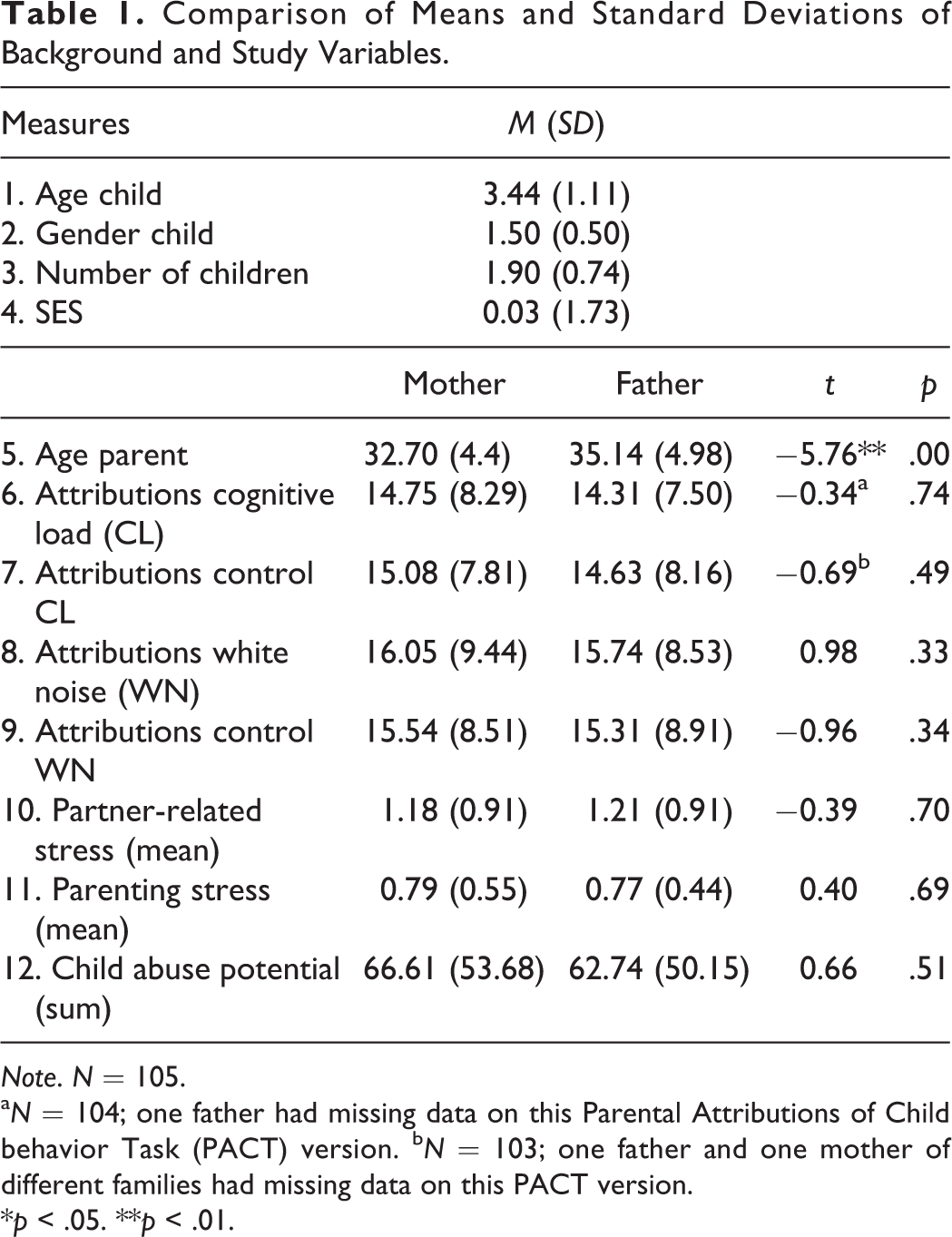
Note. N = 105.
a N = 104; one father had missing data on this Parental Attributions of Child behavior Task (PACT) version. b N = 103; one father and one mother of different families had missing data on this PACT version.
*p < .05. **p < .01.
Correlations of Background and Study Variables.
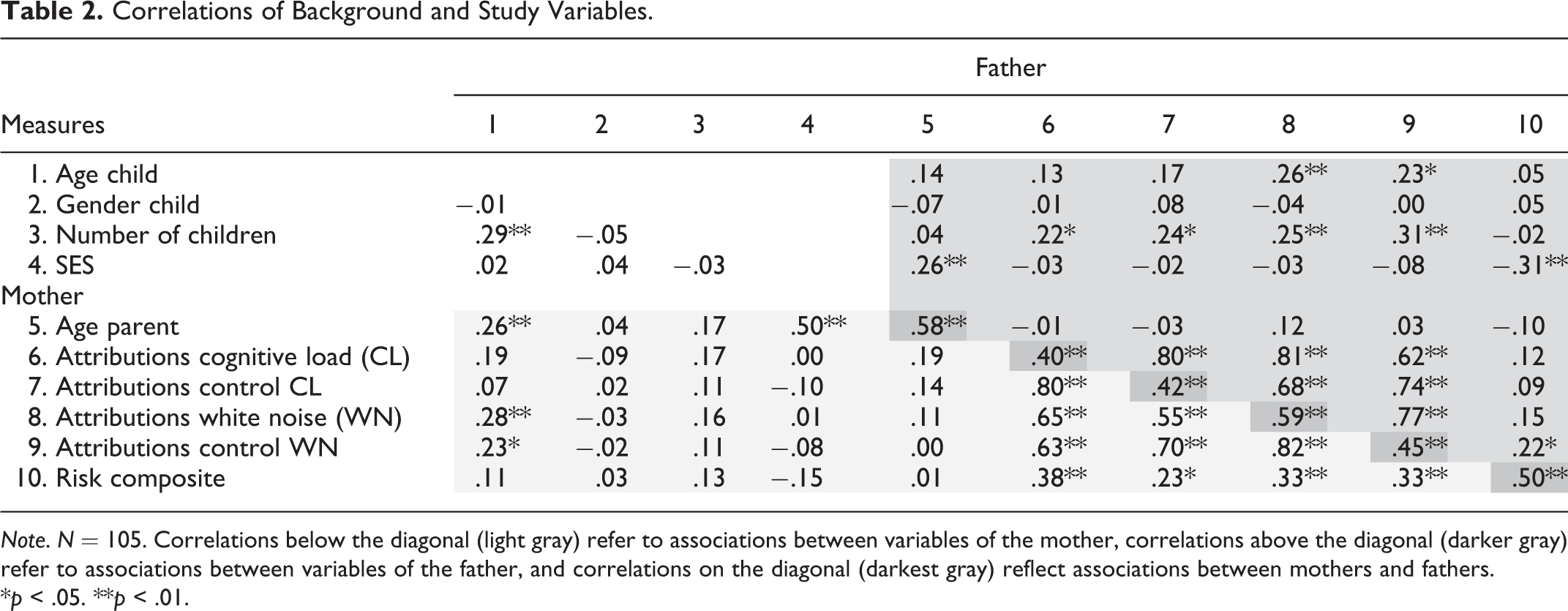
Note. N = 105. Correlations below the diagonal (light gray) refer to associations between variables of the mother, correlations above the diagonal (darker gray) refer to associations between variables of the father, and correlations on the diagonal (darkest gray) reflect associations between mothers and fathers.
*p < .05. **p < .01.
Of the background variables (i.e., child age, gender child, number of children, socioeconomic status, number of children, and parent age), number of children was related to fathers’ negative attributions in all four conditions, and child age was related to negative attributions in both conditions of the white noise PACT of mothers and fathers. In addition, SES was positively related to a higher risk composite only for fathers. Therefore, these variables were added as covariates in subsequent analyses.
Effects of Cognitive Load and White Noise Manipulations
To investigate the effect of the two experimental conditions on negative attributions, two 2 (mothers and fathers) × 2 (experimental and control condition) Repeated Measures ANCOVAs, with background variables and task order as control variables, were conducted, one for cognitive load and one for white noise. Neither for cognitive load nor for white noise, a main effect was found for condition or for parent gender on negative attributions (Table 3). In addition, no interaction effect of condition by gender on negative attributions was found for both manipulations (Table 3).
Effects of Cognitive Load and White Noise Manipulations on Negative Attributions.
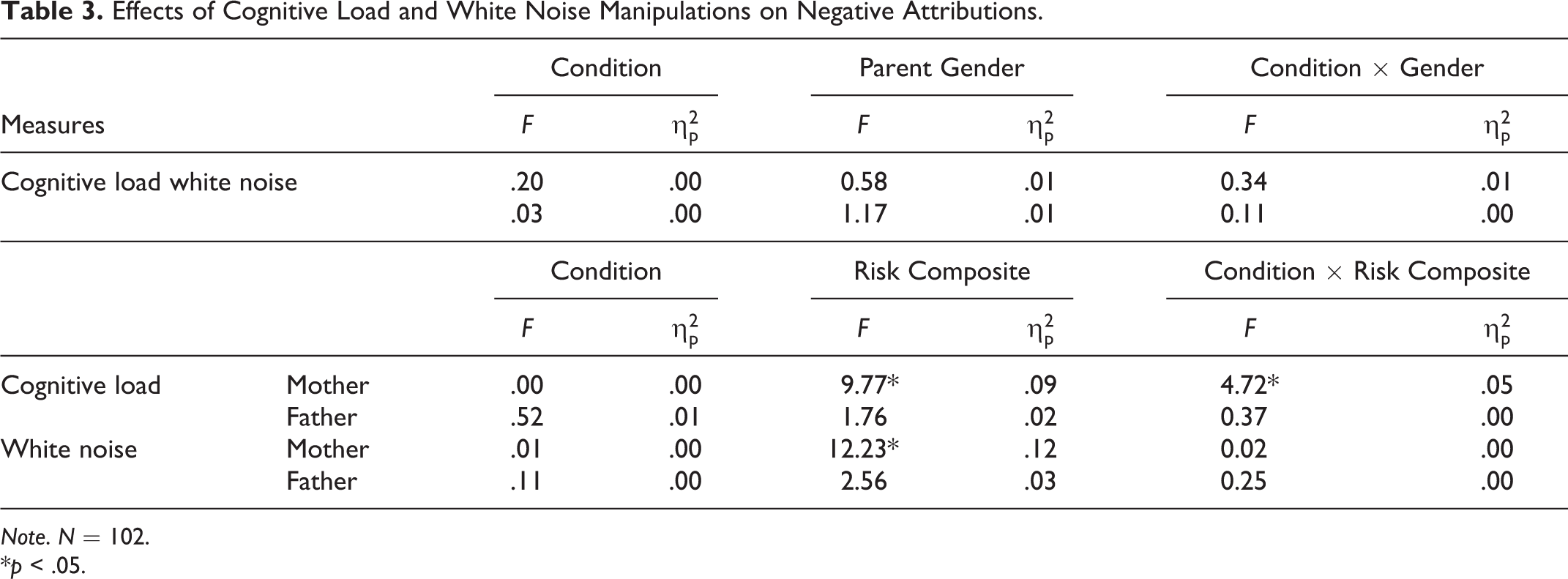
Note. N = 102.
*p < .05.
Subsequently, to investigate the interaction effect of condition and the personal risk composite, two repeated measures-ANCOVAs with only repeated measures of negative attributions in the two conditions (i.e., experimental and control condition) and background variables and task order as control variables were conducted for mothers and fathers separately, with the risk composite as additional between-subjects measure. For mothers, a main effect of the risk composite was found indicating that mothers with higher risk scores had more negative attributions in both the experimental and the control conditions for both versions of the PACT (Table 3). Furthermore, a significant interaction effect between condition (experimental vs. control) and the risk composite was found for cognitive load only (Table 3), meaning that a combination of experimentally induced stress, in the form of cognitive load, and high risk yielded the highest scores on negative attributions (Figure 1). For fathers, no main or interaction effects were found for the risk composite in both versions of the PACT.
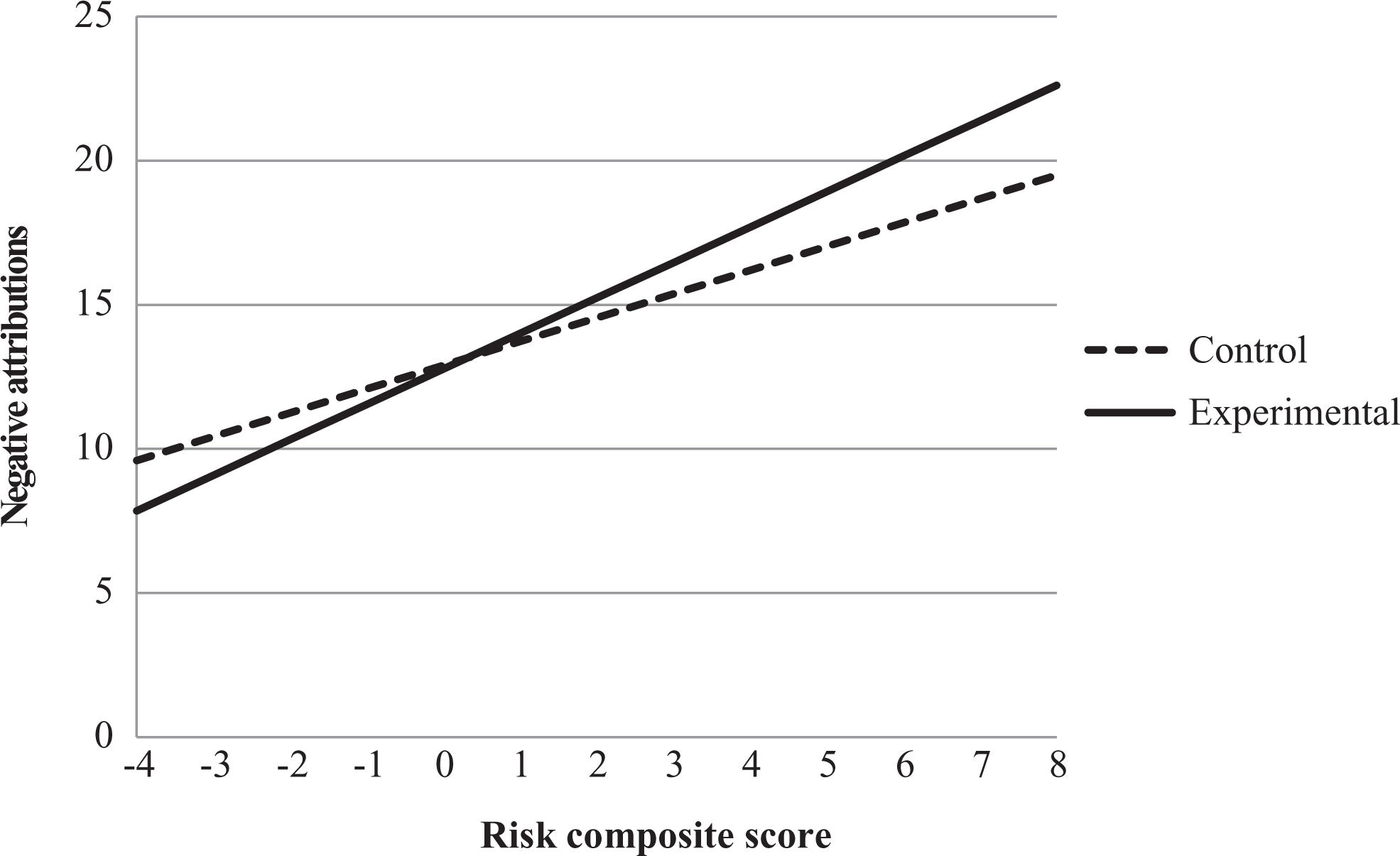
Interaction effect between cognitive load condition (control vs. experimental) and risk composite score on maternal negative attributions. Risk composite scores are total sum scores of standardized values.
Comparison of the η2 for the interaction effect of the risk composite by condition of the cognitive load version—for mothers, η2 = .048, and for fathers, η2 = .004—and of the white noise version—for mothers, η2 = .0002, and for fathers, η2 = .004—revealed no significant differences, z cognitive load = 1.56, p = .059; z white noise = 0.45, p = .34. In none of the analyses, task order showed significant main or interaction effects, Fs ≤ 3.09, ps > .08, indicating that there were no effects of the order in which experimental and control conditions were administered.
Discussion
This study showed no overall evidence for a causal effect of situational stress on negative attributions, but results did show an effect only for high-risk mothers. The general effects of induced stress, as expected in Hypothesis 1, were not found; parents did not attribute child behavior more negatively in the experimental conditions compared to the control conditions. Considering mothers, we found some evidence for our other two hypotheses: We replicated our previous finding that high-risk mothers reported more negative attributions compared to low-risk mothers, across both the experimental (white noise and cognitive load) and control conditions (Hypothesis 2) and found that the effect of induced situational stress (only for cognitive load) on negative parental attributions was more pronounced for high-risk mothers, compared to low-risk mothers (Hypothesis 3). For fathers, results did not confirm Hypotheses 2 or 3; risk was not related to more negative parental attributions nor did it influence fathers’ responses to the experimental conditions.
With this experimental study, we shed more light on the theoretically assumed causal relation between stress and negative parental attributions (Milner, 1993, 2003), which until now has been primarily studied in cross-sectional research designs. Previous studies found that high-risk parents attributed child behavior more negatively compared to low-risk parents (e.g., Beckerman et al., 2017; Berlin et al., 2013; Haskett et al., 2006), but an effect of induced situational stress on parental attributions was not found (Caselles & Milner, 2000; De Paúl et al., 2006). In this study, we replicated these findings in mothers and did not find evidence for a general causal effect of stress on attributions. This might suggest that there is no causal relation between stress and negative attributions and that the association between high risk and negative attributions indicates that mothers who attribute child behavior more negatively are also mothers who experience more stress. However, we did find an interaction effect between risk (e.g., existing stress) and induced situational stress. Although induced situational stress did not seem to affect mothers overall, we did find that the combination of high risk and experiencing situational stress led to more negative parental attributions. Nevertheless, this relation was not found for fathers and only for one of the two types of induced stress (i.e., cognitive load); therefore, these results should be interpreted with caution, and replication studies should provide more insight into these processes.
Even though no firm conclusions can be drawn from these results, we can speculate what might explain the possible combined effect of induced and existing stress on negative attributions. First, it could be that there is a threshold in the amount of stress a mother needs to experience before it taxes parental information processing; the situational stressor alone might not have been stressful enough, but the combination of existing risk and situational stress might have added up affecting parental attributions.
A second explanation could be that high-risk mothers compared to low-risk mothers experienced more stress when exposed to the stressor, which might have caused differences in automatic processing and subsequently differences in negative parental attributions. The SIP model indeed reasons that high-risk parents compared to low-risk parents might be more physiologically reactive to stressful stimuli and therefore may use more automatic processing, making them less attentive to situational factors and thereby negatively affecting their parental attributions (Milner, 1993, 2003). Yet another possible explanation is that automatic processing in high-risk mothers may lead to different outcomes than in low-risk mothers because of differences in preexisting schemata (i.e., general beliefs about children and parenting behavior). As a consequence of automatic processing, parents are less likely to take situational information into account and rely more on fixed beliefs, ingrained thought patterns that also have been referred to as preexisting schemata (i.e., general beliefs about children and parenting behavior) in the SIP model (Milner, 1993, 2003), and these schemata are thought to be negatively biased in high-risk parents. Of course, a combination of these explanations might also be at work here.
The interaction effect between risk and induced stress was found for the cognitive load condition only. In line with the previous threshold argumentation, this might indicate that only the cognitive load condition was sufficiently stressful to negatively influence parental attributions in high-risk mothers. While white noise has been found to elevate stress levels and to lower cognitive performance (e.g., Hillier et al., 2006; Ising et al., 2000), there is also evidence that white noise only negatively affects information processing from an intensity of 90 dB upward (Hillier et al., 2006) and that white noise at the level of background noise might even improve cognitive performances, a process called stochastic resonance (e.g., McDonnell & Ward, 2011; Ohbayashi, Kakigi, & Nakata, 2017). This might indicate that our white noise stressor (85 dB; stressful without causing damage to hearing; legislation on working conditions, 1997; Hillier et al., 2006) could have been too trivial to negatively influence the parental attribution.
Additionally, in comparison to white noise, cognitive load might have been a stressor that is more realistically related to daily-life situations in which parents attribute child behavior (i.e., remembering groceries, having many things on your mind). Manipulated stress that resembles real-life stress may have a greater impact than other forms of induced stress. This could be seen in line with previous findings that showed that stress related to the child or parenting is particularly related to negative parental attributions (Beckerman et al., 2017, 2018; Dopke & Milner, 2000; Rodriguez, Russa, & Kirchner, 2015). Additionally, it is possible that high-risk mothers have poorer working memory to begin with, which may make the cognitive load task more demanding for high-risk mothers compared to low-risk mothers. Working memory has been found to play a role in the etiology of harsh and abusive parenting (e.g., Deater-Deckard, Sewell, Petrill, & Thomson, 2010; Deater-Deckard, Wang, Chen, & Bell, 2012). To ensure the task is equally stressful for all parents, future research could use a more personalized task (i.e., tuning the amount of load according to the parent’s baseline of working memory).
For fathers, no main effects were found for induced stress and risk nor an interaction effect between induced stress and risk. A comparison between mother and father attributions within both conditions revealed that they did not differ in overall negative attributions and that they did not react differently regarding the different stressors (i.e., no difference in amount of negative attributions). In addition, a comparison between effect sizes for the stress by risk interaction also revealed no significant differences between fathers and mothers. These results are in line with previous studies that concluded that, in general, more similarities than differences seem to exist between fathers and mothers regarding parental attributions (e.g., Bornstein et al., 2011; Lansford et al., 2011; Smith Slep & O’Leary, 2007). Assortative mating, mutual socialization, and responding to the same “child effects” have been given as possible explantions for those similarities (Bornstein et al., 2011). Men and women might select each other based on similar features like cognitions, and once they are a couple, they might further reinforce each other’s thinking. In addition they could be influenced by the same cultural values, like taking equal responsibility in caregiving (what would apply for the Dutch culture) and having certain attitudes considering parenting. Moreover, they react to (i.e., make attributions about) the same child, leading to more interparental similiarity. Nevertheless, some studies suggest that mothers and fathers are different in their attributional style, that they predict parenting outcomes differently (e.g., Chen et al., 2008; Lansford et al., 2011; Rodriguez et al., 2017, Miller, 1995) and that they respond differently to stress (Kudielka & Kirschbaum, 2005). More research is needed to further explore possible differences in mother and father attributions in relation to stress.
Some limitatons should be mentioned. First, we used convenience sampling to recruit families to participate in our study (see Beckerman et al., 2018). Although we tried to include families with different socioeconomic backgrounds, for example, by recruiting in different neighborhoods and using social media, most of the families that enrolled had a relatively high SES. In addition, the fact that both parents were required to participate to be eligible for the study is a selection criteria that led to constraints in representativeness of the sample and may partially explain the low-risk nature of our sample. Additionally, we chose to select only families who self-identified as having a Dutch cultural background because culture might influence parental attributions. Prior research demonstrated that there are differences in cultural values concerning appropriate child behavior and optimal parenting practices (e.g., Gershoff et al., 2010; Korbin, 2003). This is especially important given that the effect of (dysfunctional) parenting practices on children may depend on the perceived normativeness of the particular practice (e.g., Gershoff et al., 2010). Taking the above into consideration, generalization claims should be made cautiously and only focus on Dutch high SES families or families with a comparable background. Similarly, the fact that our study included a low-risk sample is also a limitation. As previously suggested, to explain the absence of a main effect for induced situational stress and the interaction effect between risk and induced situational stress, it is imaginable that there is some kind of threshold of stress needed to bias parental attributions. This might also explain the small effects and the trivial differences between mothers and fathers that were found. The majority of the population experienced mild stress daily, which might even be beneficial for cognitive functioning (Kirby et al., 2013; Parihar, Hattiangady, Kuruba, Shuai, & Shetty, 2011), but when this stress becomes more severe, it can have detrimental effects on cognitive performance (Kirby et al., 2013). Thus, for parental attributions to become biased, the parent needs to experience a serious amount of stress when we apply this reasoning. This is also in line with the theoretical framework of the cumulative risk model, which entails that the accumulation of risk factors predicts child abuse risk instead of individual risk scores (a risk factor is counted as such when a parent scores above a certain cutoff point/percentile; Appleyard, Egeland, Van Dulmen, & Sroufe, 2005; Begle, Dumas, & Hanson, 2010).
Moreover, the absence of a main effect for induced situational stress might also tell us that the task manipulations were not stressful enough or that existing stress is more important for negative attribution. As previously discussed, the intensity of the white noise stressor might have been too limited to be stressful. In addition, the cognitive load manipulation might not have been equally stressful during the whole task because the load increased with each additional grocery to remember. The white noise condition might have been more stressful when not only the intensity was amplified but also when the noise was infrequently presented during the task, making it more difficult to ignore. The cognitive load condition might be presented with the same amount of load during the whole task, to make the condition more stressful. We advise future research to add (physiological) measures of perceived stress to get insight into the stressfulness of a manipulation.
A final limitation is that we did not include child factors into our analyses. Child effects might play a role regarding the interpretation of the effect of the risk composite and negative attributions; high-risk mothers may have children who are more difficult than low-risk mothers and as a consequence they may attribute child behavior more negatively. Concerning the experimental part of the design, child factors could not have been a factor of influence since we used a within-subjects design (i.e., parents were compared to themselves). Incorporating data on child factors and/or experimentally manipulating child behavior is advised in future research to overcome this limitation.
In conclusion, this study contributes to the knowledge about the relation between stress and negative parental attributions. In an experimental design, we found some evidence that high-risk mothers may be more negatively affected in their parental attributions by situational stress, compared to low-risk mothers. Although effects were small and were found in only one condition, this may imply that stress at least partially predicts negative attributions as proposed by the SIP model (Milner, 1993, 2003). Moreover, we discussed the absence of a main effect for induced situational stress (i.e., there might not be a causal effect, task manipulation may not be stressful enough), and several explanations for the risk by situational stress interaction were proposed (i.e., stress threshold, physiological responsiveness to stress, and preexisting schemata). It is important to unravel the cause of this interaction effect and gain fundamental knowledge on how parental attributions are affected, to become able to subsequently effectively intervene. For instance, if negative parental attributions are caused by high amounts of stress, it is important to reduce stress. If negative attributions are actually causing stress (preventive), interventions should focus on attributions (e.g., Bugental et al., 2002). And if physiological responsiveness to stress and preexisting schemata also play a role in affecting parental attributions under (minor) stressful conditions, stress reduction alone might be insufficient and interventions should also focus on becoming more resilient to stress and changing preexisting schemata. Future research can help to unravel these issues by experimentally studying the effect of stressors with different intensities on parental attributions, measuring physiological and perceived stress responses and preexisting schemata, in both high- and low-risk samples.
Footnotes
Declaration of Conflicting Interests
The author(s) declared no potential conflicts of interest with respect to the research, authorship, and/or publication of this article.
Funding
The author(s) received no financial support for the research, authorship, and/or publication of this article.
