




Abstract
In this article, the exact free vibration of porous functionally graded rotating blades is investigated. The nonlinear 3D dynamics of the blade is simulated using the geometrically exact fully intrinsic beam equations, and the corresponding cross-sectional properties of the FG beam are developed. The material properties of the functionally graded material blade are graded through the thickness using a power law distribution. Furthermore, it is assumed that due to the manufacturing process, a level of porosity exists in the material which in turn can affect the material properties of the blade. Two porosity models resembling the even and uneven distributions of porosity are considered. First, the obtained results for a functionally graded material rotating blade are compared with those reported in the literature, and a very good agreement is observed. Furthermore, the effect of various parameters on the vibration of the functionally graded material beam is investigated. It is obtained that the dynamics of the rotating blade is sensitive to the type of the porosity due to manufacturing flaws. Moreover, the numerical results show that the blade length to height ratio, power law index, rotating speed and porosity distribution model affect the dynamics of the beam significantly.
Keywords
1. Introduction
Understanding the dynamic behaviour of rotating structures such as helicopter blades, wind turbine blades and gas turbine blades is an important step in design process of such structures. Furthermore, the noise and vibration of rotating blades is one of the main challenges, that the designers face with, which could limit the performance of final design (Dibble et al., 2019; Friedmann and Hodges, 2003; Romani and Casalino, 2019; Tamer et al., 2019; Vouros et al., 2019). It is widely accepted that for high aspect ratio structures, the dynamics of the structure can be modelled, using a beam theory, and, hence, many researchers considered the vibration of rotating beams by considering the effects of rotating speed, blade pre-twist, blade taper, material, etc. (Carnegie, 1959; Dubey et al., 2020; Han et al., 2020; Li et al., 2014; Swaminathan and Rao, 1977). Bossak and Zienkiewicz (1973) studied the effect of centrifugal forces on the free vibration of rotating structures. They showed that the centrifugal force changes the stiffness characteristics of the structure and hence affects the dynamics of beam. The flexural vibration of pre-twisted blade with tapered cross-section was considered by Swaminathan and Rao (1977). They showed that the pre-twist of the blade combined with the rotating speed influences the frequencies of the blade. The dynamic response of rotating tapered blades simulated using Timoshenko beam theory was investigated by Bazoune et al. (2001). A model reduction approach was incorporated, and the accuracy of the reduced-order model was demonstrated by comparing the results with the full-order model. The dynamic stability of pre-twisted rotating beams modelled using the Timoshenko beam theory subjected to lateral excitation was studied by Sabuncu and Evran (2006). It was concluded that the pre-twist of the blade, the coupling and the shear coefficient can influence the dynamics of the beam. There are many other studies concerning the dynamics of rotating structures. Rafiee et al. (2017) presented an extensive literature review on the vibration of rotating blades. More recently, Dubey et al. (2020) investigated the stability of rotating sandwich blades with the effects of pre-twist, taper and temperature gradient. They highlighted that the angular speed and pre-twist of the blade change the dynamic stability of the beam.
Functionally graded materials (FGMs) are first proposed in early 1980s to be used in high-temperature environments (Koizumi, 1997). The FGMs are normally made from isotropic materials (metals and ceramics) and have remarkable properties such as high strength, low weight, long fatigue life and wear resistance. Therefore, these materials have extensively been used in different applications, and hence, various analyses (static, dynamics…) on the behaviour of structures made of FGMs have been carried out (Cong et al., 2018; Jin et al., 2019; Khaneh Masjedi et al., 2019; Lee and Lee, 2017; Pradhan and Chakraverty, 2013; Sarkar and Ganguli, 2014; Zahedinejad et al., 2020). The dynamic behaviour of FGM structures is an active research area and has attracted the interest of many researchers (Amoozgar et al., 2017; Giunta et al., 2011; Lü et al., 2008; Şimşek and Kocatürk, 2009; Sina et al., 2009; Vo et al., 2014). The free vibration of Euler and Timoshenko beams made of functionally graded materials was considered by Pradhan and Chakraverty (2013). They concluded that different beam theories might result in different frequency values depending on the power law index. Fang et al. (2017) determined the three-dimensional vibration and response of rotating functionally graded beams using Chebyshev polynomial trial functions. It was shown that the rotating speed and power law index affect the frequencies and mode veering of the beam. The free vibration of FGM Euler–Bernoulli beams using an exact transfer matrix expression was analysed by Lee and Lee (2017). The effect of dynamic stiffening on the free vibration of rotating functionally graded beams was considered by Li et al. (2014). They showed that the lag-extension coupling results in mode shift and frequency veering.
The existence of micro-voids and porosities due to the manufacturing processes can affect the mechanical properties of the final product. Therefore, understating the behaviour of the structure due to possible manufacturing flaws is crucial specially for rotating structures. Ebrahimi and Mokhtari (2015) determined the transverse linear vibration of evenly distributed porous FGM rotating blades using the differential transform method. It was highlighted that the porosity distribution and power law index can affect the dynamic properties of the beam. Shahsavari et al. (2018) investigated the free vibration of FG porous plates resting on elastic foundation using a quasi-3D hyperbolic theory. The effect of evenly and unevenly distributed porosity on the large amplitude vibration of FGM thin plates has been studied by Wang and Zu (2017). They highlighted that the porosity affects the vibration amplitude of the plate. The quasi-3D dynamic behaviour of functionally graded beams using Carrera unified beam formulation was studied by Jin et al. (2019). Zahedinejad et al. (2020) presented a comprehensive literature review of the research studies carried out on the vibration of FGM beams. More recently, Tian et al. (2019) studied the effect of porosity and material grading on the fundamental frequencies of rotating FGM beams and showed that the rotational speed, hub radius and porosity affect the dynamics of the beam significantly.
To add to the aforementioned bulk of literature, in this study, the effect of evenly and unevenly distributed porosity and material grading on the nonlinear 3D vibration of rotating functionally graded beams are investigated. The rotating blade is modelled using the exact fully intrinsic beam formulation (Hodges, 2003) which is relatively new and has been used to analyse various beam-like structures (Amoozgar and Shahverdi, 2016, 2019; Mardanpour et al., 2013; Sotoudeh and Hodges, 2013). In none of the studies presented above, the exact 3D vibration of rotating FGM beams with porosity has not been considered. Therefore, in this study, a novel 3D model based on fully intrinsic theory is developed for analysis of porous functionally graded rotating beams. Also, two types of porosity distribution models are considered, and the effects of various geometrical and material properties on the 3D dynamic behaviour of the rotating beam are studied.
2. Problem statement
A rotating blade attached to a rigid hub, as shown in Figure 1(a), is considered, where the length of the blade is denoted by L. The blade is rotating by a constant angular velocity of Ω. Owing to the aspect ratio of the blade, it is simulated using a beam model. It is assumed that the main load carrying part of the blade is a solid rectangular box spar, which is made of functionally graded material. Also, it is considered that the blade is rotating by a constant angular velocity and the hub radius is very small in comparison with the blade length. The reference coordinate system is fixed at the centre of the hub, in which x1 axis lies in the span direction, x2 is towards the chord of the blade and x
3
is upwards in the thickness direction. The material properties of the blade are considered to be graded through the thickness by using a simple power law distribution. Furthermore, to take into account the effect of porosity, two models of porosity distribution are considered. These two models, as shown in Figure 1 (b) and (c), resemble the even and uneven porosity distributions, where the width and height of the rectangular cross-section are denoted by b and h, respectively. Finally, the effects of material grading, blade geometry and porosity distribution on the frequencies of the rotating blade are studied. This is of high significance to investigate the impacts of manufacturing flaws on the dynamic behaviour of rotating blades accurately. (a) Schematic of the functionally graded material rotating blade; (b) even porosity distribution (model I); (c) uneven porosity distribution (model II).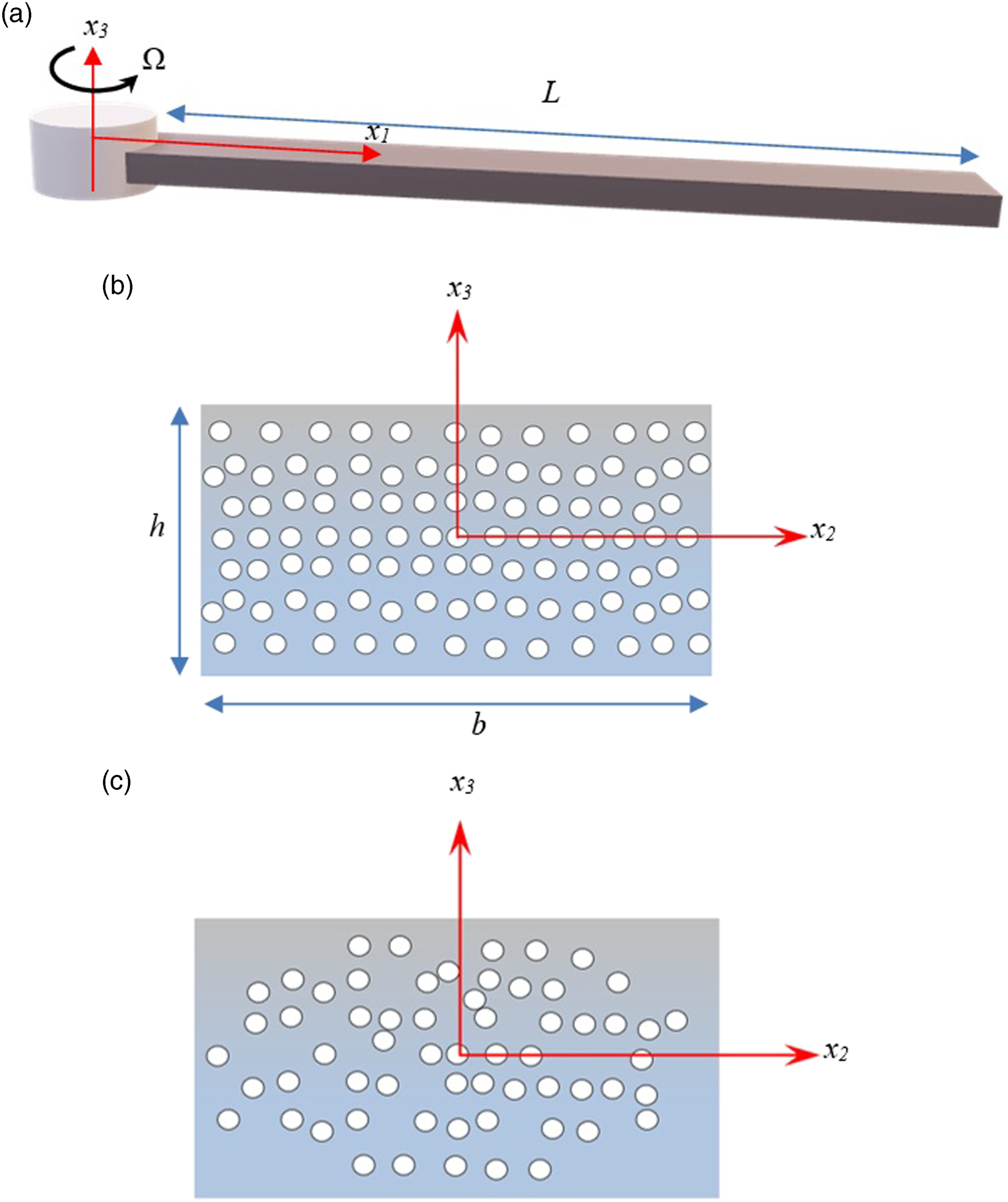
3. Governing equations of rotating porous FGM beams
3.1. FGMs with porosities
A functionally graded beam, composed of metal and ceramic materials, is considered here. It is assumed that the porosity is distributed equally in both ceramic and metal phases, and, hence, the general material properties of an FGM beam with evenly distributed porosity can be written as (Cong et al., 2018)

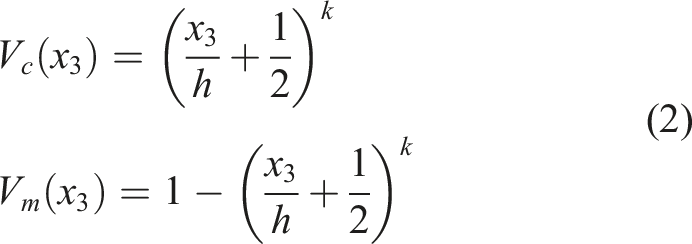
The volume fractions of ceramic
Finally, the Young’s modulus (E), shear modulus (G) and density
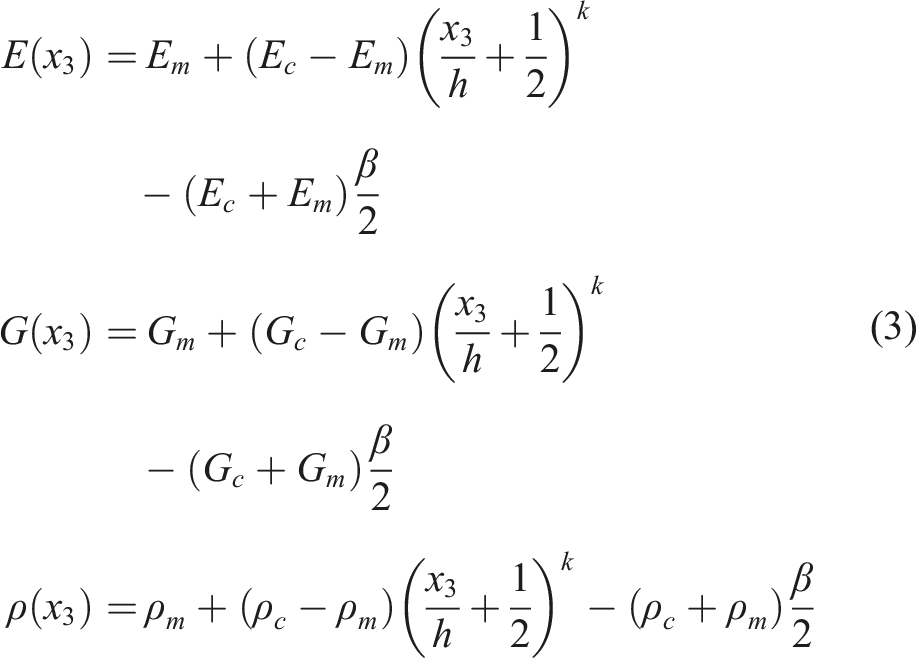
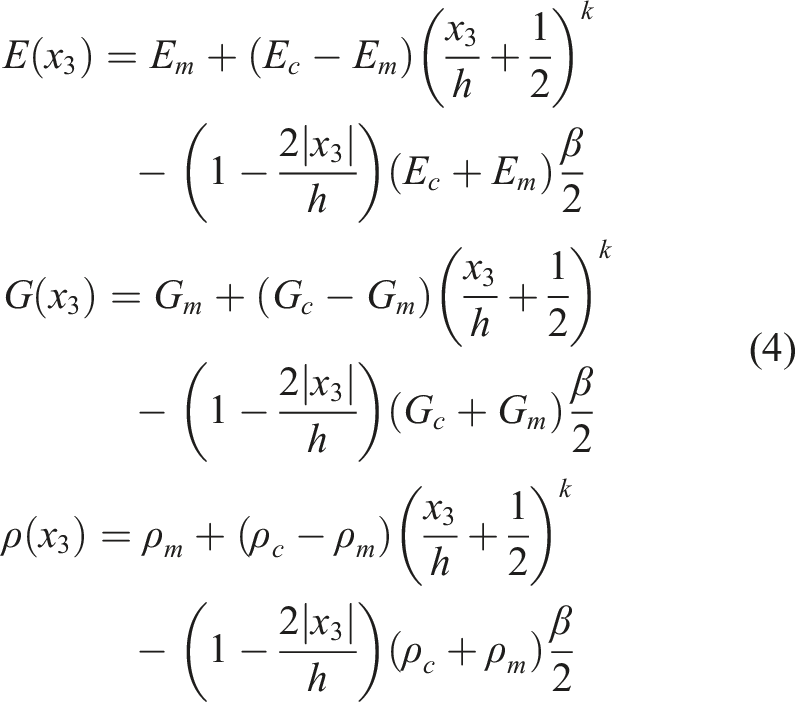
It is noted that Poisson’s ratio is considered to be constant along the thickness. Furthermore, the material properties of the FGM beam with uneven porosity distribution (model II) can be written as (Cong et al., 2018)
3.2. Exact fully intrinsic beam formulation for FGM rotating blades
The dynamics of the rotating FGM blade is modelled by combining the 1D geometrically exact fully intrinsic beam equations (Hodges, 2003) with a 2D cross-sectional analysis. It is noted that in this formulation, no assumption is made for developing the beam equations, except the small strain assumption (the effects of material nonlinearities are ignored). The exact fully intrinsic beam equations for a straight beam without any external force can be written as (Hodges, 2003)
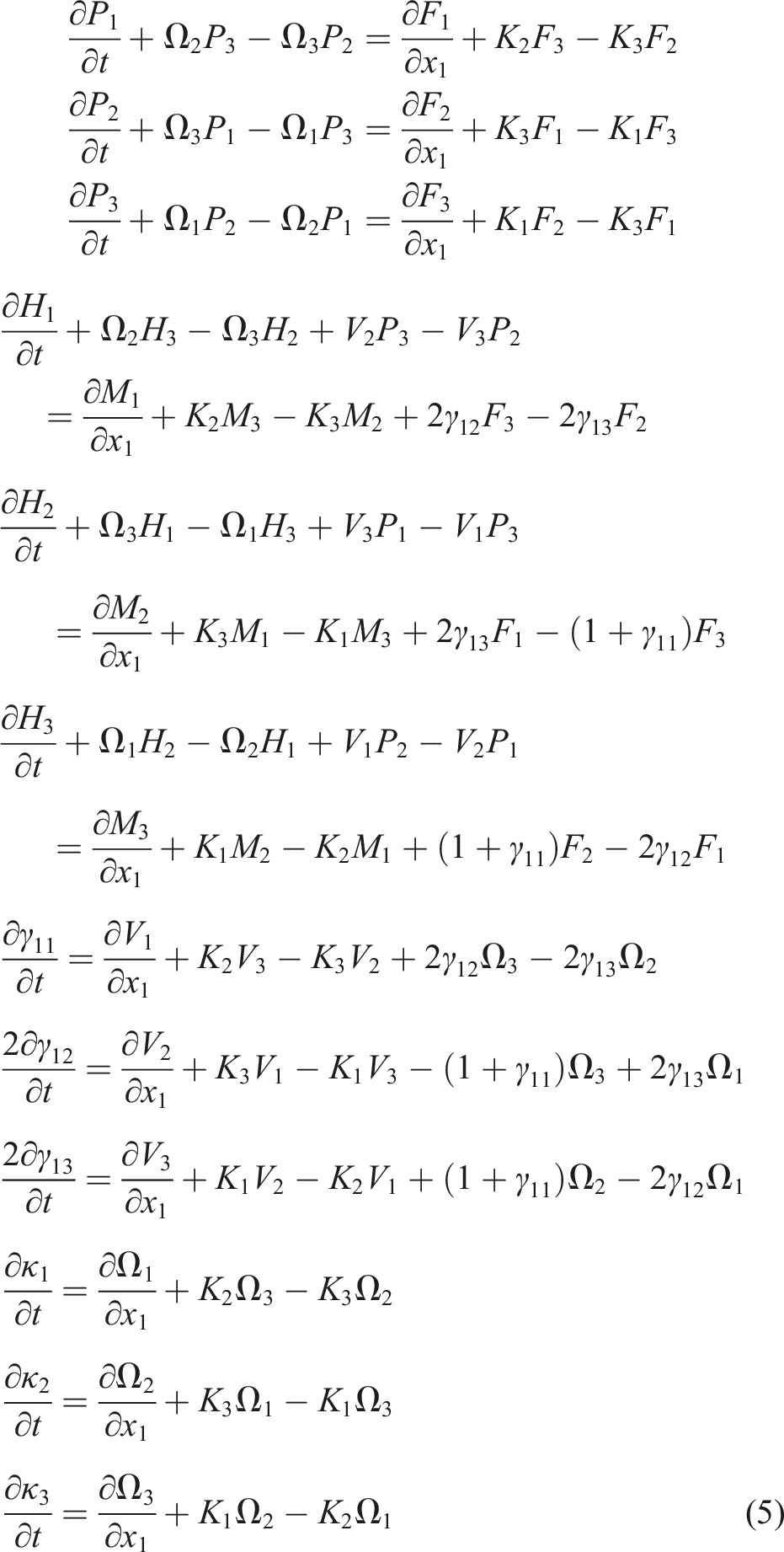

The generalized linear (

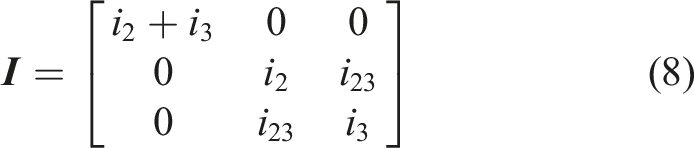
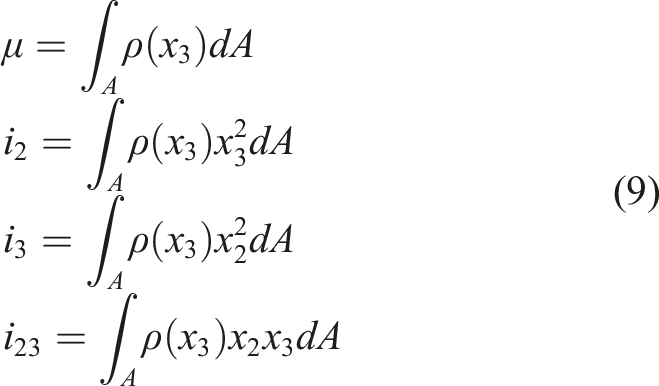
It is noted that in this study, it is assumed that the beam reference axis coincides with the mass centre
The internal force and moment vectors can be obtained from the generalized strain measures, using the cross-sectional stiffness matrix as follows (Hodges, 2003)
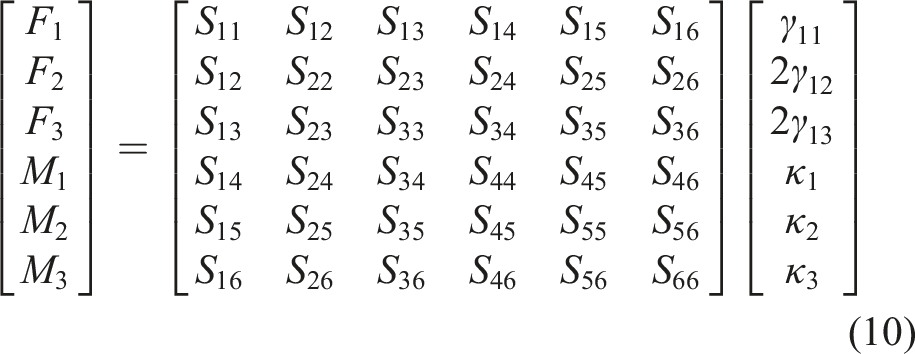
It is noted, that in this study, the Euler–Bernoulli beam has been considered and, therefore, the effects of shear strains are ignored (
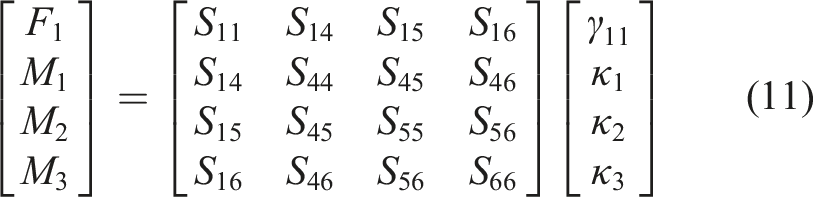
The nonzero cross-sectional stiffness values of the above stiffness matrix for the FGM straight prismatic beam with rectangular solid cross-section can be written as
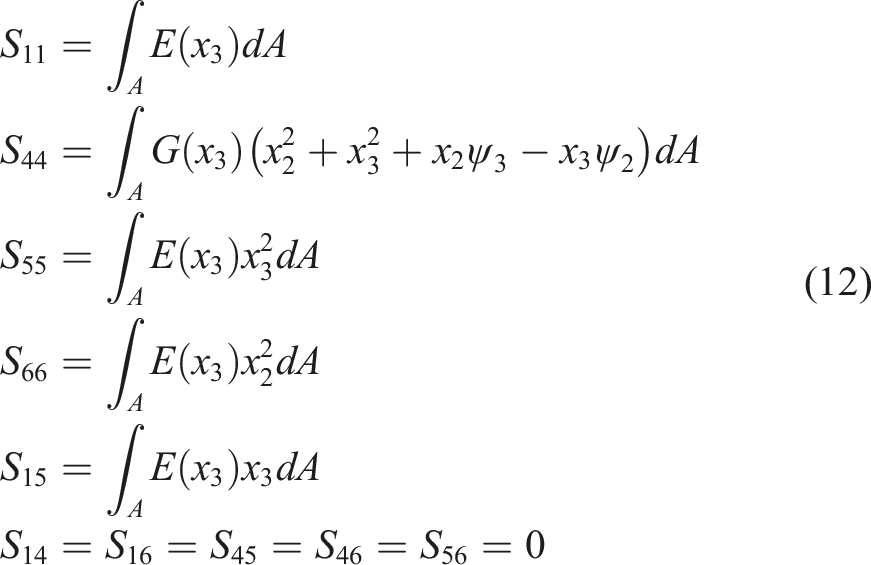
Furthermore,
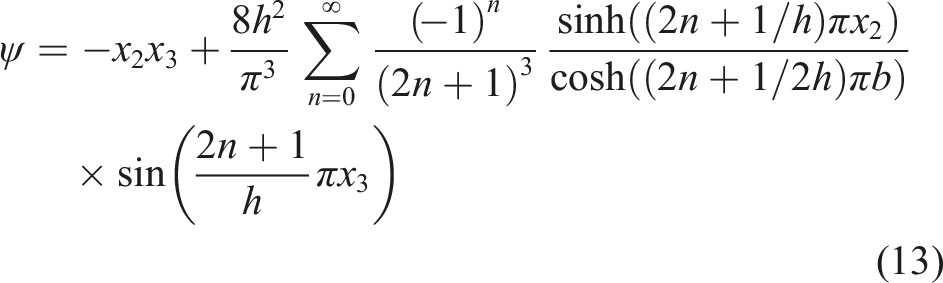
This shows that all nonzero values within the stiffness matrix are dependent to the power law index of the FGM and, hence, will affect the dynamics of the beam.
The final dynamic equations are discretized here using a space–time scheme (Hodges, 2003). In this method, all variables (


Then, the linearized equations about this steady-state condition can be obtained (as shown in equation (16)), and the eigenvalues of this linearized system are determined

4. Numerical results
4.1. Modelling validation
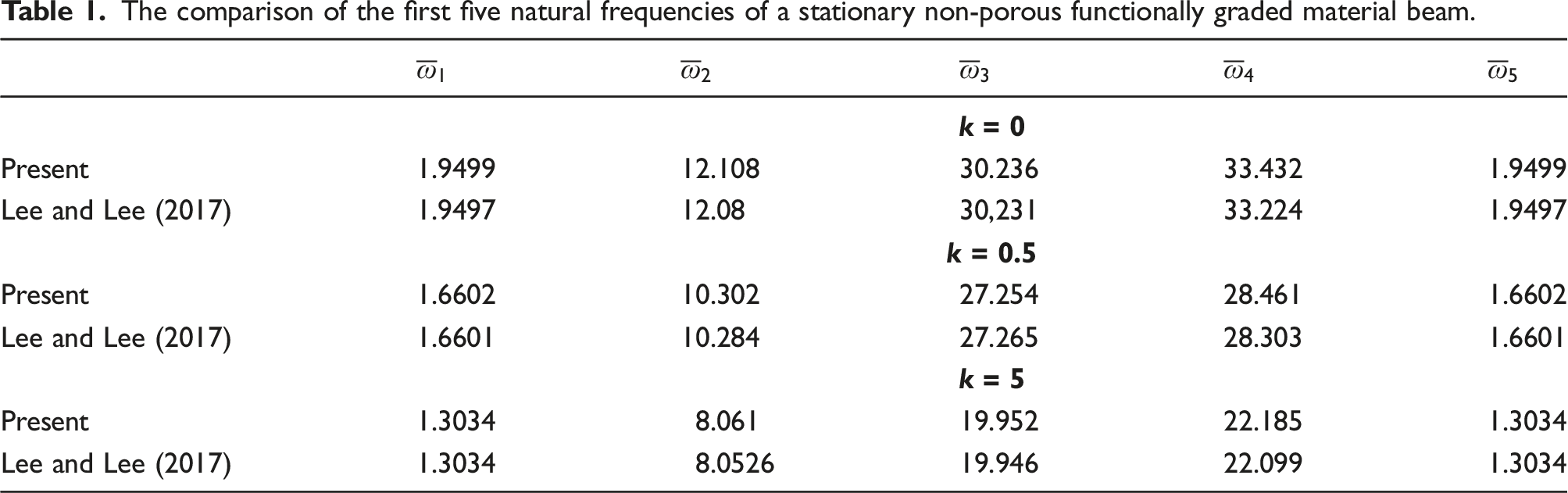
The comparison of the first five natural frequencies of a stationary non-porous functionally graded material beam.
The comparison of the natural frequencies of a rotating non-porous functionally graded material beam (k = 5,

The nondimensional natural frequencies and rotating speed are considered using the following equations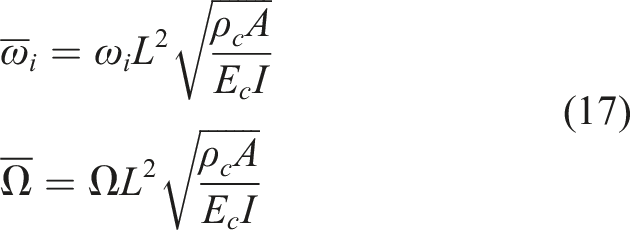
It is clear that the results are in very good agreement. It is noted that here the third frequency, which is the first torsion mode, was not reported in Jin et al. (2019).
By considering above two comparisons, it is clear that the developed formulation can accurately predict free vibration of rotating FGM beams. In what follows, the free vibration of FGM rotating beams with and without porosity is considered.
4.2. The effect of rotation on the free vibration of non-porous FGM blades
A square FGM blade (b/h = 1) with the following material properties is considered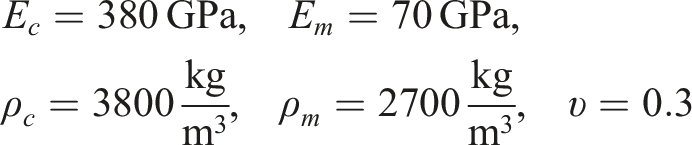
The blade is rotating with a constant angular speed, and the frequencies are determined. For simplicity, the nondimensional angular speed and frequency, defined in equation (16), are used.
First, the effect of cross-sectional warping on the natural frequencies of the rotating FGM blade is studied, and the results are shown in Figure 2, ignoring the cross-sectional warping in the formulation results in overpredicting the torsional frequency. Furthermore, it also affects the mode veering and hence changes the frequencies of modes which are coupled with torsion. This is important as mode veering indicates the direction of eigenvectors. This highlights the importance of including the cross-sectional warping in vibration analysis of FGM rotating beams. In all cases from here on, the effect of cross-sectional warping is retained in the formulation. The effect of cross-sectional warping and rotating speed on the frequencies of the functionally graded material beam for k = 1 and L/h = 10.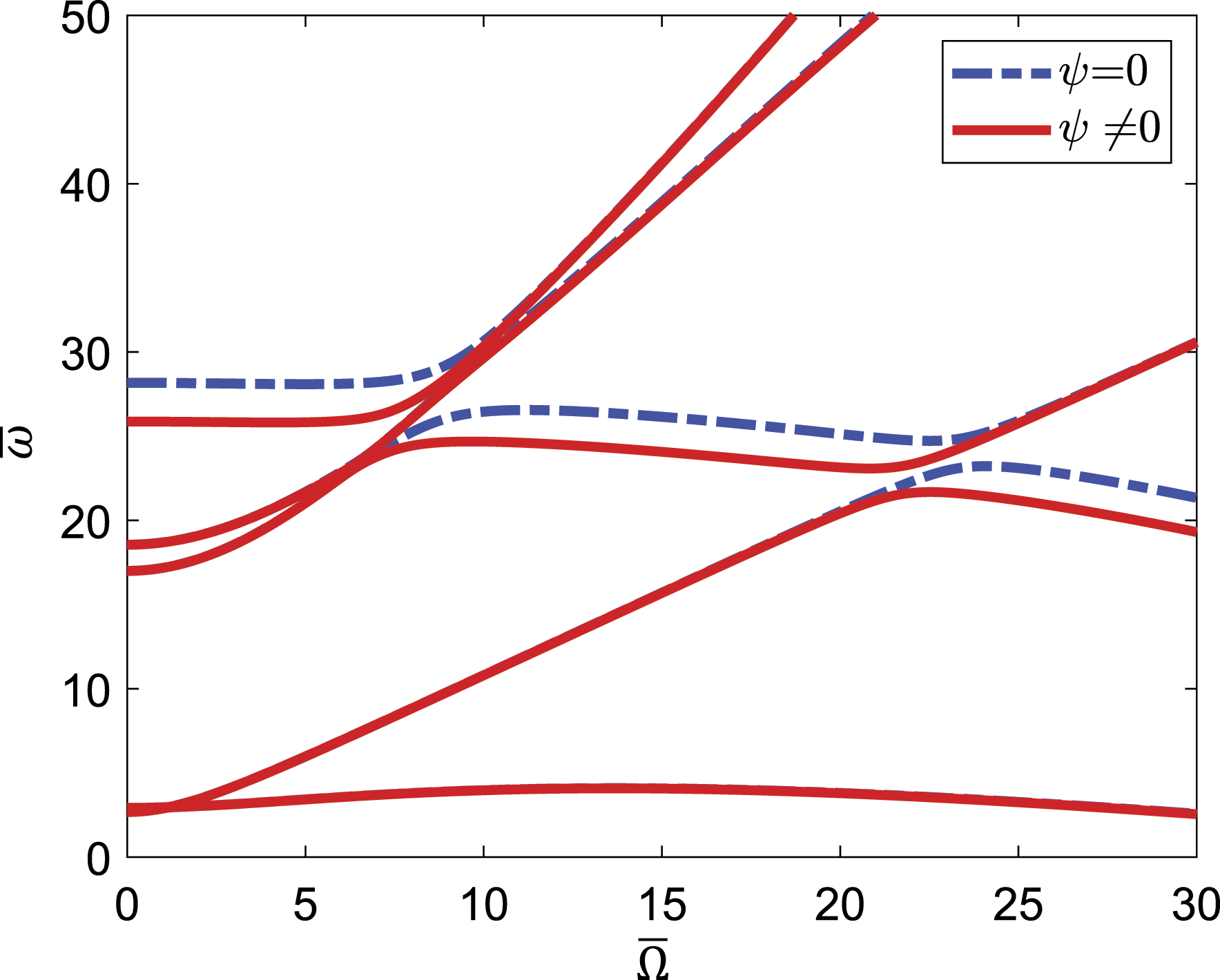
The effect of the rotating speed on the FGM beam frequencies with a length to height ratio of L/b = 10 and for various power law indices is investigated first and shown in Figure 3. It is clear that both rotating speed and power law index not only affect the frequency values, but also change the dynamic behaviour of the beam. When the power law index is k = 0, the veering happens between the fourth and fifth modes, whereas for other cases, the modes contributing in the veering are different. Furthermore, the rotating speed, at which the mode veering happens, is also dependent to the value of k. The effect of rotating speed on the frequencies of functionally graded material beam for various power law indices and for L/h = 10.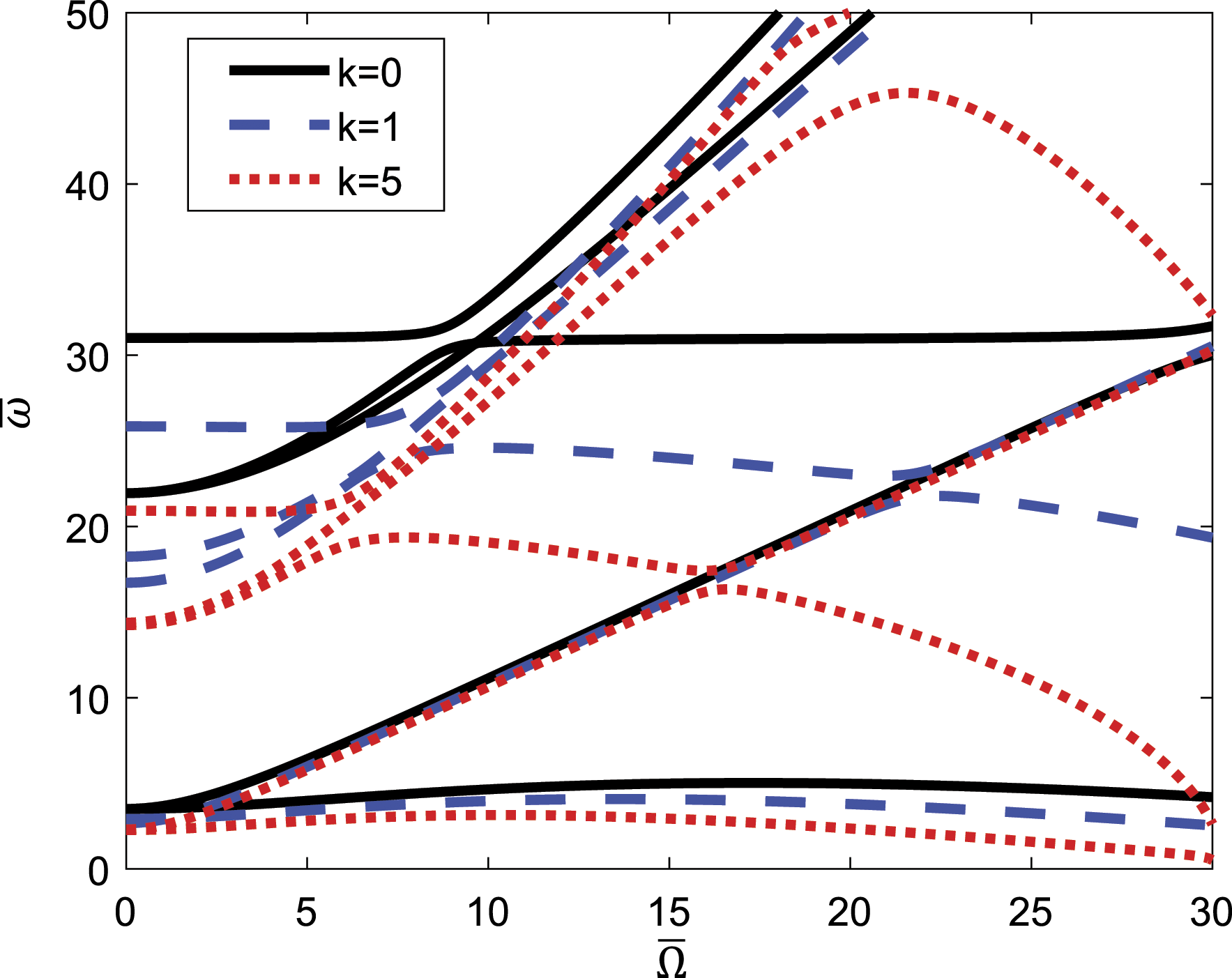
Figure 4 shows the mode shapes of the stationary FGM beam for various power law indices (k = 0, k = 1, k = 5). To this aim, the torsion, flap and lag components of the modes, which have been normalized so that the 2-norm of each mode to be equal to 1, are shown. Figure 4(a) shows the mode shapes of the beam for k = 0. For this case, the first and third modes are lag, the second and fourth modes are flap and the fifth mode is torsion. This is slightly different when the power law index (k) is not zero. The mode shapes of the FGM beam for k = 1 are determined and shown in Figure 4(b). Unlike the previous case, the first and third modes are flap, and the second and fourth modes are lag, and the fifth mode is a combination of torsion and lag. Figure 4(c) shows the mode shape of the FGM beam for k = 5. The modes for this case are the same as the first case (k = 0), except that the fifth mode again is a combination of torsion and lag. This highlights that the power law index of the FGM affects the dynamic behaviour of rotating beams. The first five mode shapes of the blade for 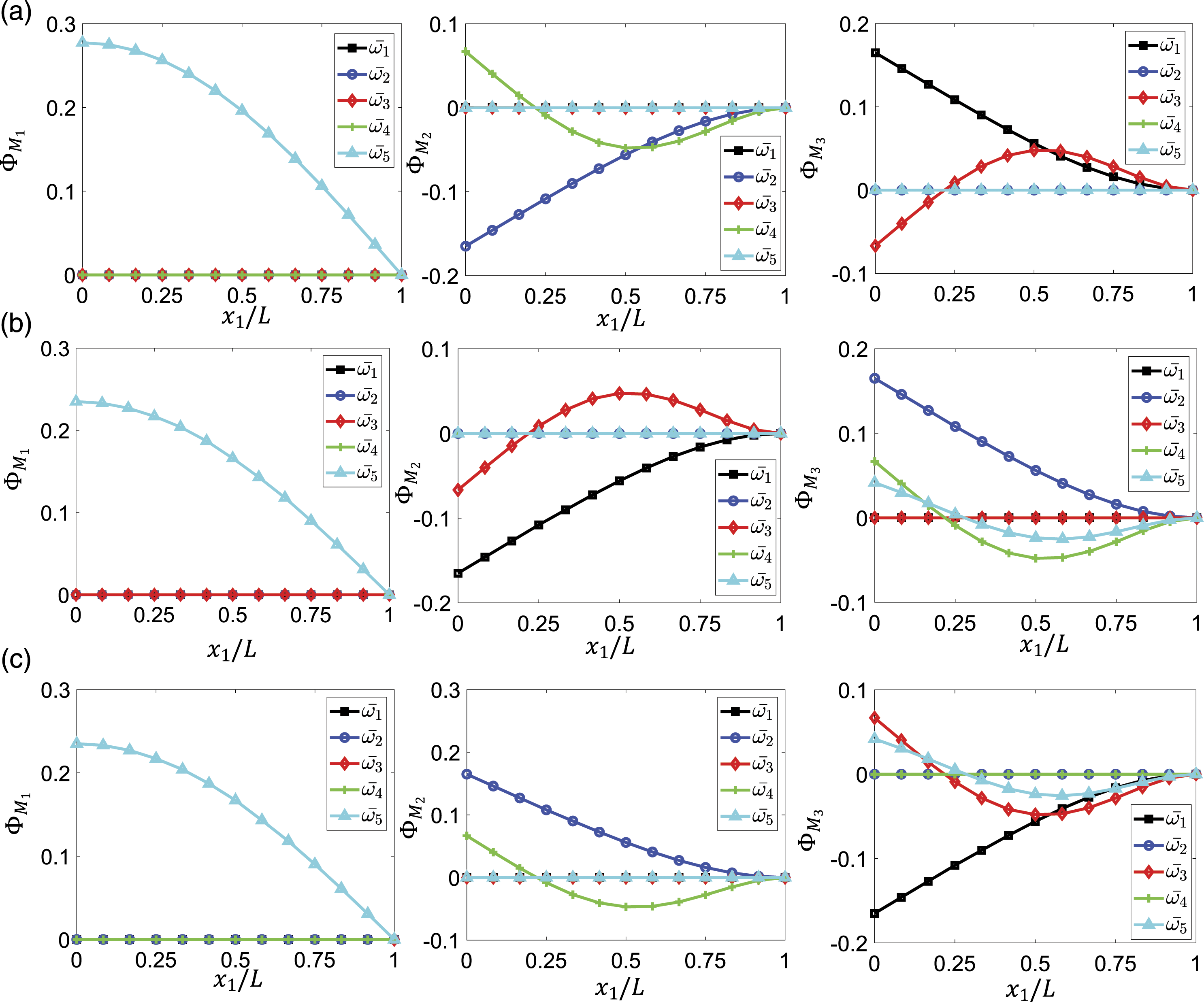
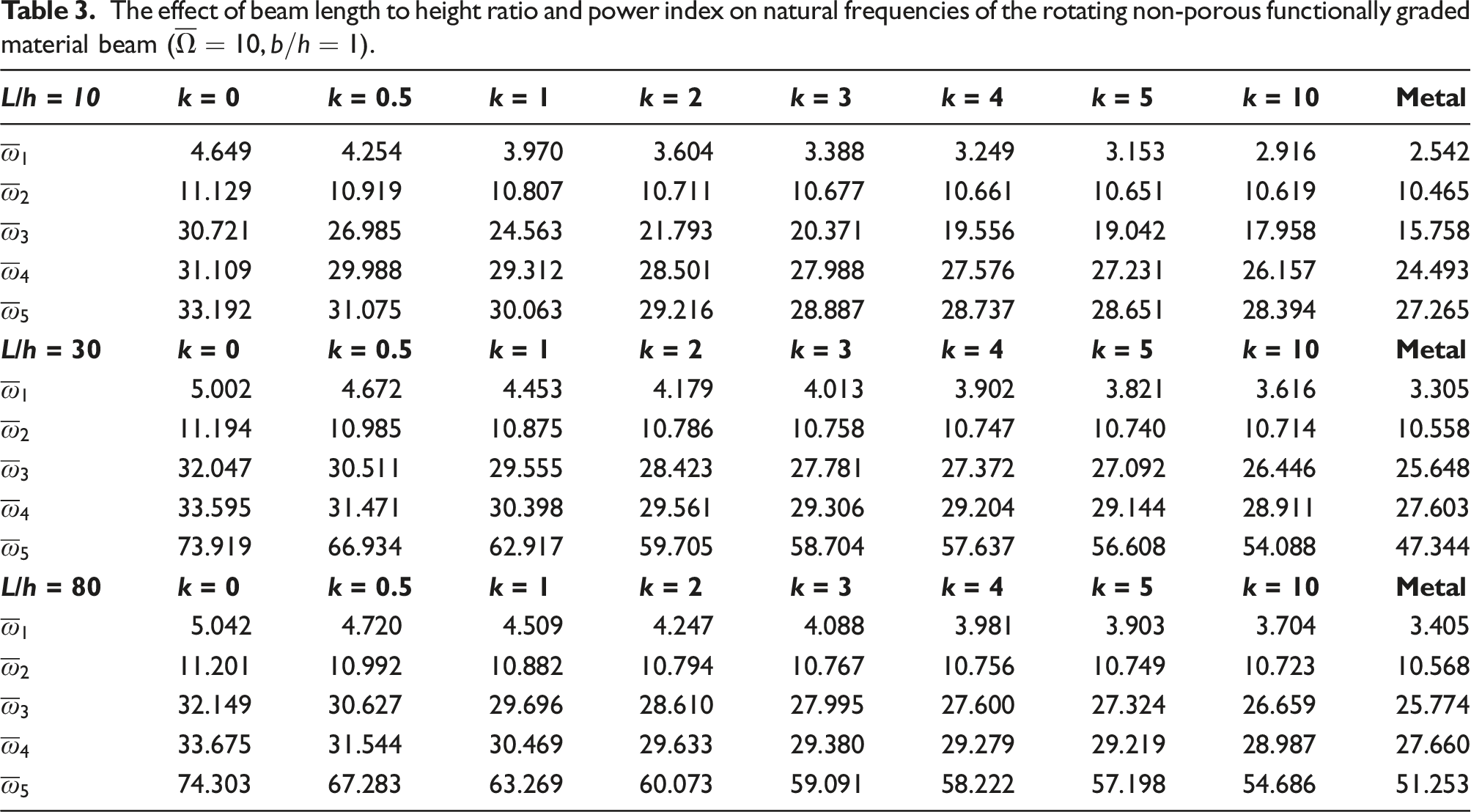
The effect of beam length to height ratio and power index on natural frequencies of the rotating non-porous functionally graded material beam (
4.3. The free vibration of evenly distributed porous rotating FGM beam (Model I)
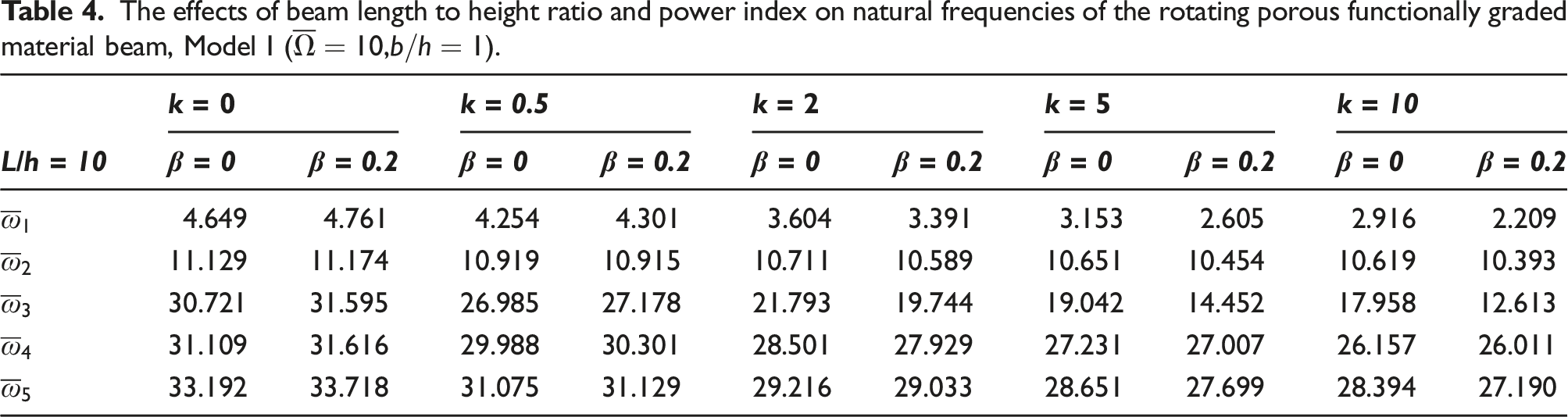
The effects of beam length to height ratio and power index on natural frequencies of the rotating porous functionally graded material beam, Model I (
Next, the effect of rotating speed on the frequencies of the beam with and without porosity is studied. Figure 5 shows the variation of first five frequencies of the FG beam for k = 2 and L/h = 10. It is noted that as the porosity directly affects the material properties (equations (3) and (4)), it could also affect the beam frequencies. As shown in Figure 5, the first and fifth modes are affected less than the other modes by the porosity. The third mode is affected the most by the porosity among all modes, and the frequency increase is dependent to the value of rotating speed. Furthermore, the porosity volume fraction shifts the rotating speed at which the mode veering happens. The effect of rotating speed and porosity volume fraction (model I) on the frequencies of the beam with L/h = 10, h/b = 1 and k = 2.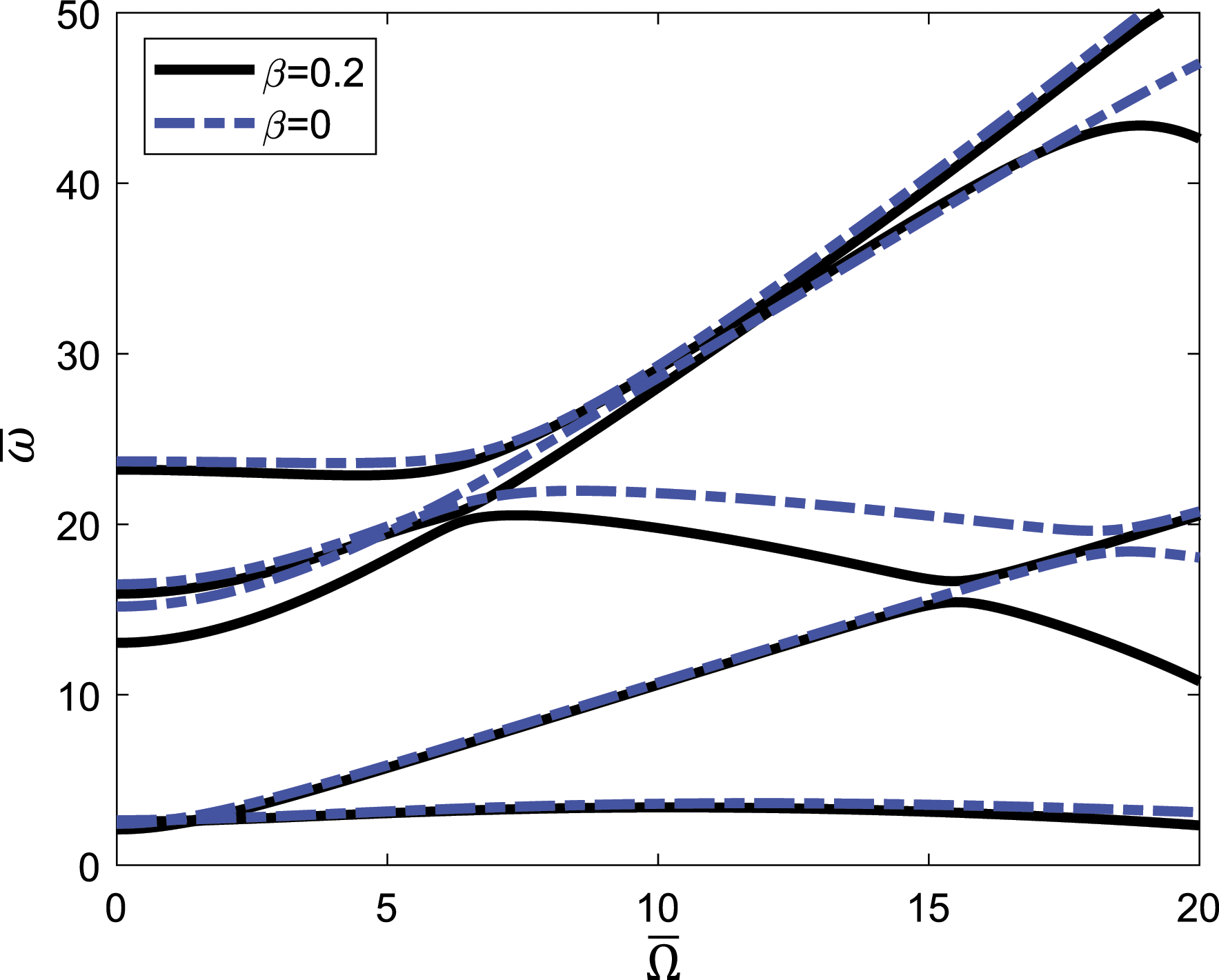
4.4. The free vibration of unevenly distributed porous rotating FGM beam (Model II)
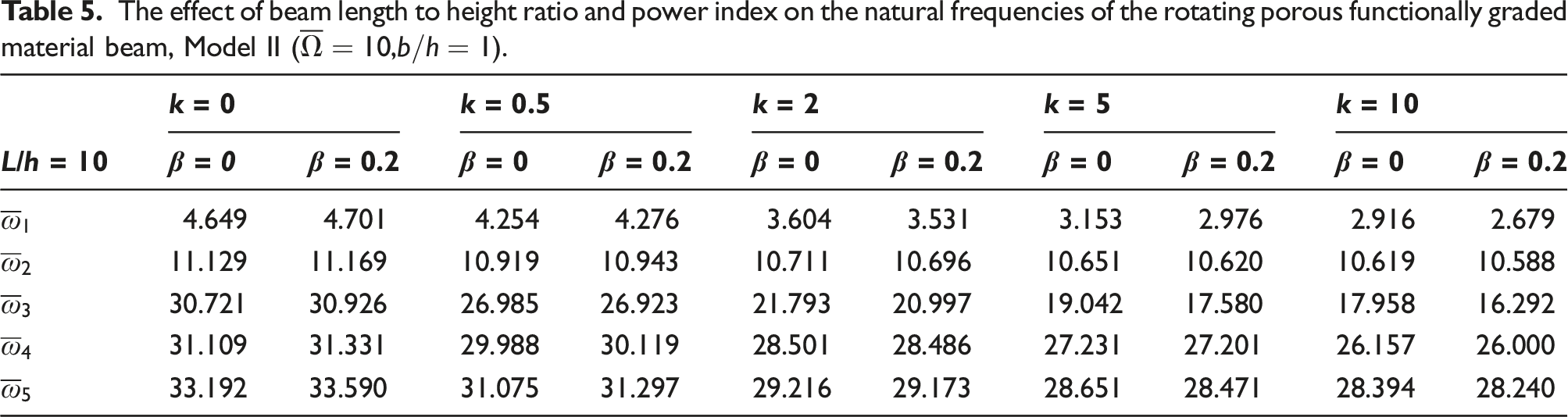
The effect of beam length to height ratio and power index on the natural frequencies of the rotating porous functionally graded material beam, Model II (
Furthermore, Figure 6 shows the effect of rotating speed and type of porosity distribution on the frequencies of the FGM beam with k = 2. The type of porosity distribution not only affects the values of frequencies, but also it shifts the location at which the mode veering happens. Furthermore, for this case (k = 2), the model with uneven porosity distribution results in higher frequencies than the even porosity model. To elaborate this more, the variation of the first three frequencies of the beam for different porosity volume fractions is studied next. The effect of rotating speed and type of porosity distribution on the frequencies of the beam with L/h = 10, h/b = 1, k = 2 and β = 0.2.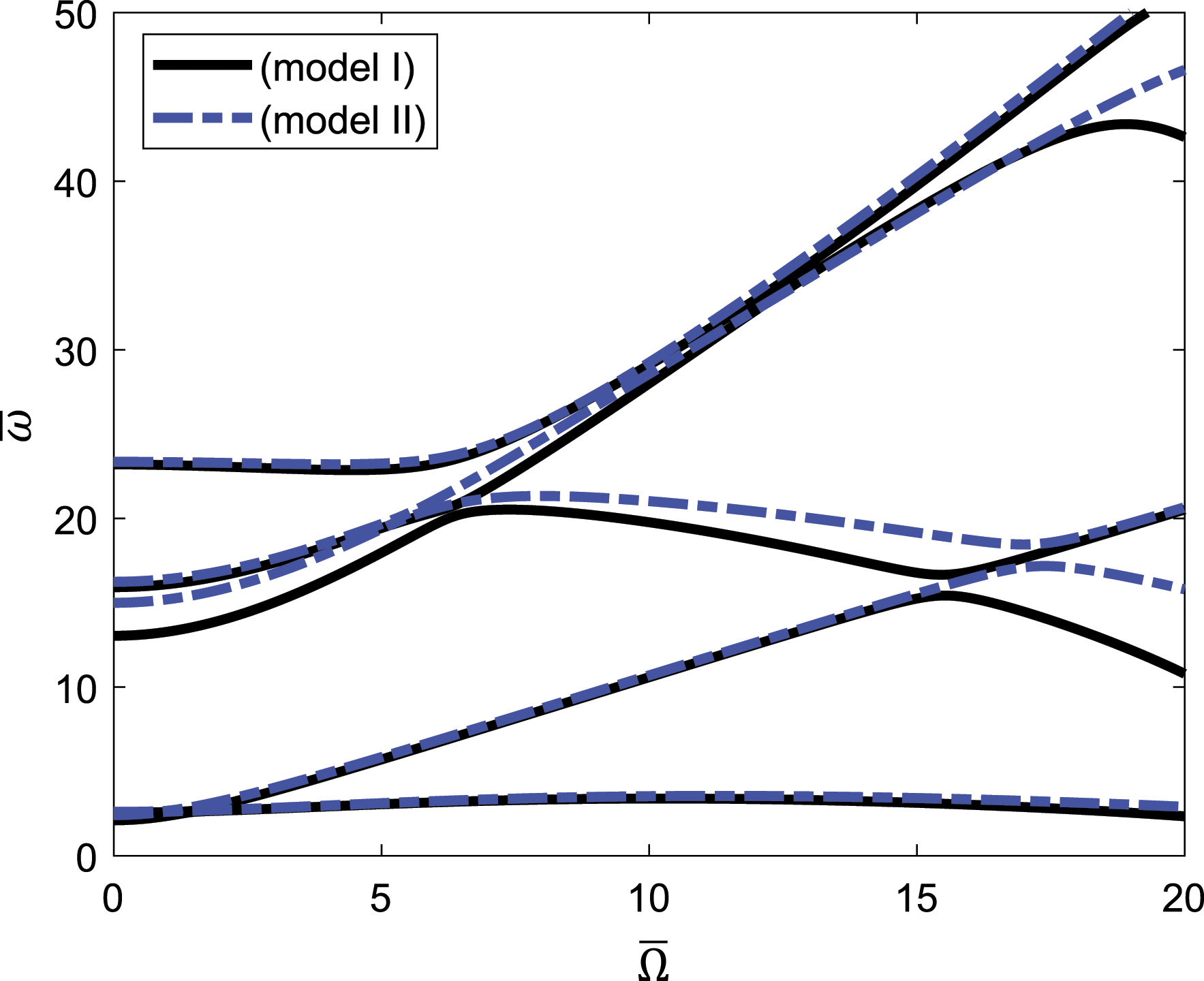
Figure 7 compares the variation of the first three frequencies of the rotating FGM beam for two types of porosity distributions and two values of power law indices. In this case, the beam is rotating with a constant speed of The effect of porosity model and power law index on the natural frequencies of the rotating beam for L/h = 10, h/b = 1 and 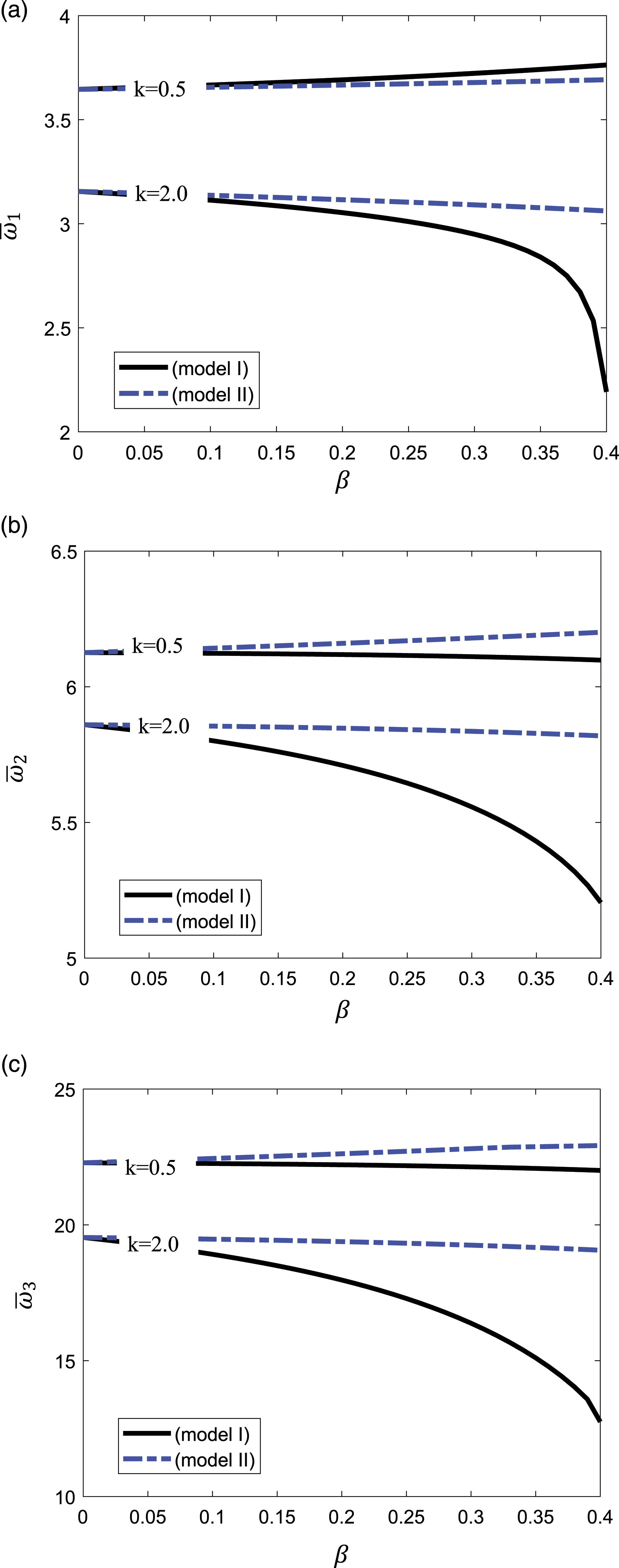
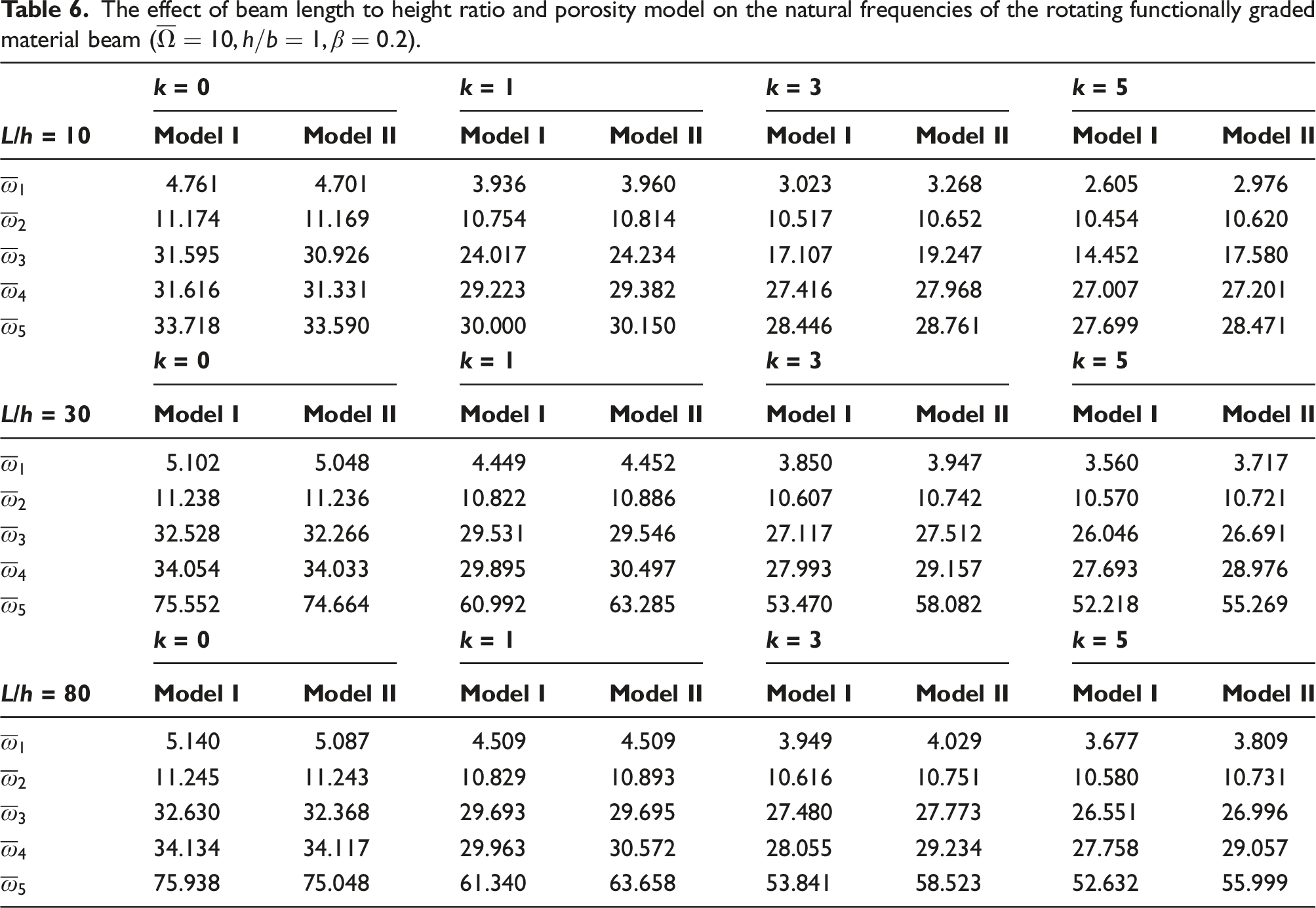
The effect of beam length to height ratio and porosity model on the natural frequencies of the rotating functionally graded material beam (
Conclusions
The free vibration of a porous rotating functionally graded blade is studied. In this study, the application of geometrically exact fully intrinsic beam equations is extended to study the free vibration of rotating FGM beams. To this aim, the cross-sectional stiffness and inertial matrices of the FGM beam are presented, and the Saint-Venant warping has been incorporated to determine the torsional rigidity of the rectangular cross section. Two types of porosity models representing the even and uneven porosity distributions are considered to take into account the possible porosities, that might appear during the manufacturing processes. The proposed exact formulation is used to study the effect of material grading on the dynamics of the rotating beam. Furthermore, the effect of porosity distribution model on the free vibration of the blade is investigated. It has been observed that as given in the following: The proposed exact beam formulation can accurately predict the dynamics of rotating FGM beams. The material gradation affects both the frequency values and the location at which the modes veer away from each other. The blade dynamics is sensitive to the material porosities due to manufacturing flaws. For power law indices lower than For the range of power law indices of higher than Various modes behave differently depending on the type of porosity distribution and power law index. Finally, ignoring the cross-sectional warping in the formulation results in overpredicting the torsional frequency.
Footnotes
Declaration of Conflicting Interests
The author(s) declared no potential conflicts of interest with respect to the research, authorship, and/or publication of this article.
Funding
The author(s) received no financial support for the research, authorship, and/or publication of this article.
