



Abstract
This study aimed at mapping the environmental frameworks available for gifted children and their families in both the periphery and central regions in Israel, based on Bronfenbrenner’s ecological systems theory. Twenty-six in-depth interviews were conducted with parents and educators from the two regions. The findings indicate that both groups of participants recognize the advantages of the pull-out programs and invest in family activities. However, in the periphery, parents spend more time with their children at home, have little or no contact with the teachers in the pull-out program, do not receive any guidance and support regarding their gifted child’s education, and perceive the governance and local authorities as less conducive to the education of their gifted children in comparison to parents from the center. The findings indicate the significant role of policymakers in the planning and development of frameworks at the individual and group levels for gifted children.
Theoretically, the study contributes to the understanding of Bronfenbrenner’s system theory, and to the body of knowledge dealing with gifted education and with programs and learning environments for gifted children.”
All parents have a central role in the nurturing and education of their children; parents of gifted children are no different in this respect. The literature (e.g., Jolly & Matthews, 2017; Olszewski-Kubilius et al., 2014) indicates that parents of gifted students have solid perceptions regarding how their children should be raised and educated. Nevertheless, there is a lack of research investigating the involvement of parents from different economic backgrounds, particularly from peripheral (i.e., rural) regions in Israel.
The term “rural” is used in educational research to describe areas outside the limits of a city or town that have unique social, cultural, economic, and educational characteristics. In addition, the term “rural” highlights geographical features that represent places characterized by remoteness, located at distance or in isolated areas (Brown & Scahfft, 2019). In Israel, periphery is the term commonly used to describe areas that are distant from the center of the country as well as from large cities (Grinshtain, 2022). These “peripheral” areas have very similar characteristics to the “rural” areas described in the international literature. Both the peripheral and the central areas in Israel include urban and rural settlements. Yet, the urban settlements in the periphery are characterized by smaller populations than those in the center of the country. In addition, most of the population in the periphery urban settlements are characterized as ethnic minorities—disadvantaged groups that have less power in Israeli society (Tzfadia & Yacobi, 2011). We use both terminology—periphery and rural—to describe the national and international literature regarding these concepts, emphasizing the economic, geographic, and demographic characteristics of rural or periphery that are unique to these specific areas (Green & Reid, 2021; Kühn, 2015).
Ecological Systems Model—Four Environmental Levels (based on Bronfenbrenner, 1977, 1979).
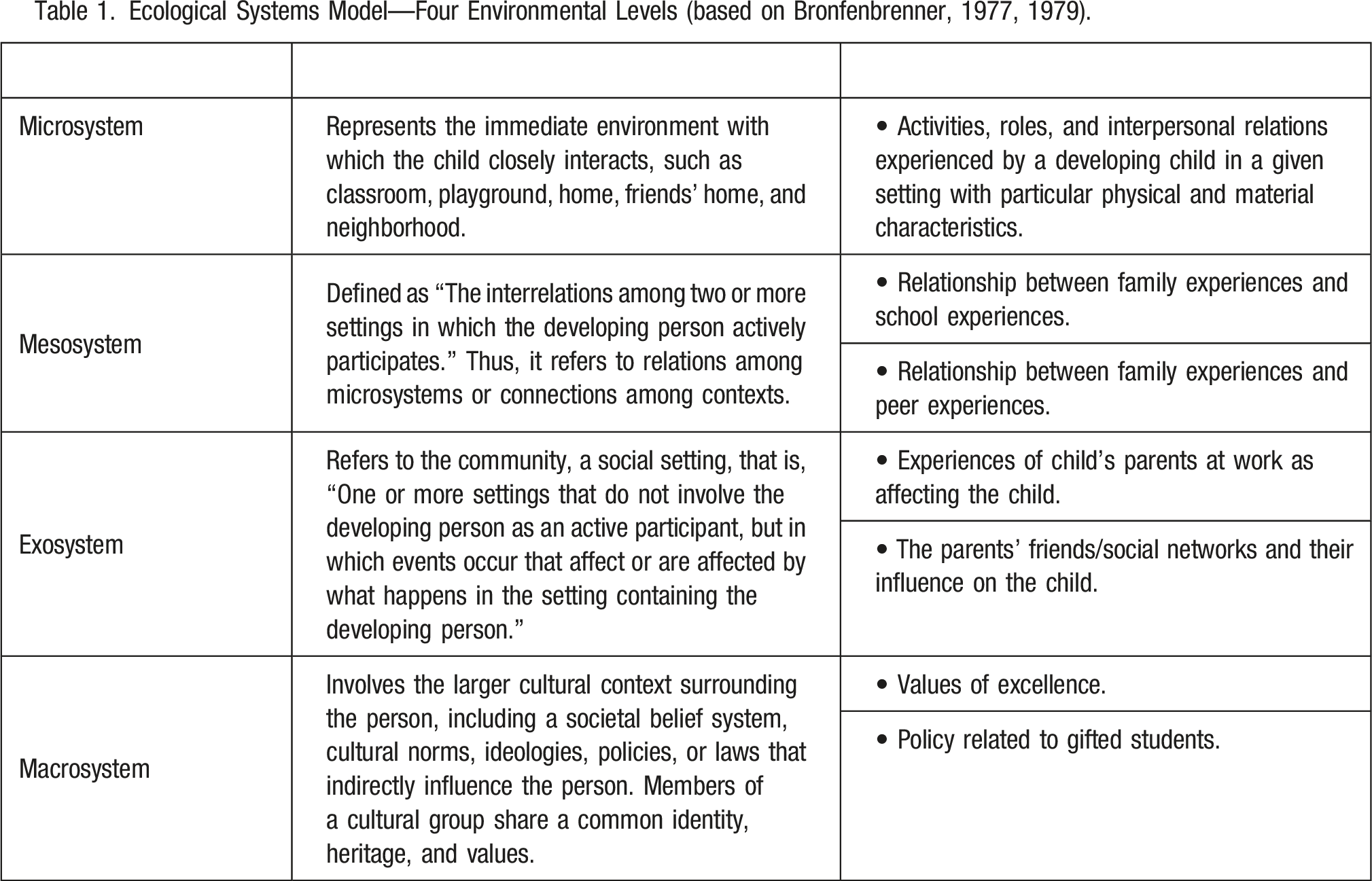
Studies that focus on the significance of various environmental systems for gifted students are scarce. Drawing on the ecologic approach, which emphasizes the wider environment’s importance as a key element in these children’s development and care, alongside the significance of the home environment, it is necessary to examine the frameworks available to gifted students and relate to the environmental setting where they are raised (Bessman et al., 2013; Chowkase, 2021; Crawford et al., 2020). Hence, this study is aimed at examining gifted children’s parents’ and teachers’ views regarding the educational frameworks available for gifted students in two regions in Israel—central and peripheral, with differing geographic and socioeconomic characteristics. Specifically, how do teachers and parents of gifted students perceive the environmental frameworks available to these children in the central and peripheral regions in Israel?
Theoretical Framework
Educational Frameworks for Gifted Students
The common definition for giftedness emphasizes intellectual creativity, the ability to perform at an exceptionally high level and/or express exceptional ideas in areas of varied content, which contribute to the physical, emotional, and social aspects of functioning in the society we live in (Dai, 2019; NAGC, 2021; Renzulli, 2012). According to the above characteristics, it is clear that gifted students are considered a distinct group requiring special treatment for three main reasons: first, gifted individuals tend to be considered as human capital meriting unique care; second, they deserve equal opportunities that enable them, like all other students, to activate their potential in an optimal manner; and third, gifted students are challenged students who tend to encounter difficulties in the social, emotional, and learning domains (Klimecká, 2022; Shechtman & Busharian, 2015). Nevertheless, instruction in the regular classroom is not usually tailored to meet gifted students’ unique needs. There is no true differentiation, which can lead to demotivation (Pomortseva, 2014). As such, these students are offered special educational solutions. There are a least three grouping options for gifted students (Rimm et al., 2018). The first is full-time homogeneous grouping, such as special schools for gifted students, private schools, magnet schools, school-within-a-school plans, and special classes in elementary school. The advantages of ability grouping for gifted students are well documented (e.g., Kulik & Kulik, 1991; Rogers, 2007). Vogl and Preckel (2014) investigated the connection between ability grouping of gifted students and their social self-concepts and school-related attitudes and beliefs. They found that contact with intellectually comparable peers has a beneficial effect on the socio-affective development of gifted children. The second is full-time heterogeneous grouping, such as cluster groups of gifted students placed with regular students. Theses frameworks expose the gifted students to various enrichment activities, either individually or in small groups. The third is part-time temporary grouping, such as pull-out programs in which gifted children leave their schools once a week to attend a special gifted and talented center located in their geographic area, offering a day of special activities. These pull-out programs expose the students to various areas of knowledge and enable comprehensive independent learning of subjects chosen by the students, promoting their cognitive, emotional, and social skills (Fiddyment, 2014; Miedijensky & Tal, 2009, 2016; Renzulli, 1987). Kim’s (2016) meta-analysis shows that enrollment in enrichment programs had a positive impact on gifted students’ academic achievement and socioemotional development. Other part-time temporary groupings are push-in programs, part-time special classes, temporary grouping for reading and Math, and special interest groups and clubs (Olszewski-Kubilius & Lee, 2004; Rimm et al., 2018).
Since most part-time temporary grouping solutions are located in the student’s locality, particularly at elementary-level education, which is considered context-dependent, they are designed and characterized by the specific contexts. According to NAGC (2021), learning environments for gifted students should foster personal and social responsibility, multicultural competence, and interpersonal and technical communication skills for leadership in the 21st century to ensure specific student outcomes. As such, educators would be well advised to understand the needs of gifted and talented students for both solitude and social interaction (Miedijensky, 2018). These processes are located in different educational systems, as mentioned above. However, parents of gifted students have a crucial role in the success of these children in the different systems.
Parents of Gifted Students
Talent research indicates that parents play a vital role in nurturing their gifted children and are fully engaged in their educational processes (Kiewra, 2019; Miedijensky, 2020; Mun et al., 2021). Most often, parents notice their gifted child’s talent at an early age and serve as their child’s first mentors. Later, they expose him/her to enrichment classes and seek out experts who can enhance talent growth (Luo & Kiewra, 2021). Most parents of gifted students have high expectations relating to their children’s capabilities yet are not always able to find the suitable educational system for them (Shechtman & Busharian, 2015). One reason for this could be a lack of connections and relationships among the families, communities, their school, and different enrichment programs. In addition, parents may lack advanced formal education or do not have the skills to guide their gifted child towards talent development. This reality is more common among families of gifted students who live in rural areas (Vialle, 2017). In addition, educators may make incorrect assumptions regarding the gifted children themselves and/or their families, which could lead to a deficit-oriented approach when dealing with these children and their families (Ishimaru, 2019; Olszewski-Kubilius et al., 2014; Wang & Neihart, 2015). Therefore, parents can provide significant information regarding their gifted children, their skills, area of interests, their sensitivity, and the difficulties they face, which can help teachers plan, develop, and implement more tailored activities and curricula for gifted students, addressing their cognitive and socio-cultural abilities, including emotional aspects (Mun et al., 2021). Relationships between parents and various educational settings have the potential to make significant improvements in gifted education for all gifted students, particularly for underrepresented and/or rural-based gifted children (Howley et al., 2009; Lockhart & Mun, 2020).
Gifted Students in Rural Settings
Rural regions are usually classified as such based on population per area and distance from the nearest urban center (NCES, 2022). It is important to remember that the way educators define these might have implications for various domains, such as policy making, resource distribution, and/or education (Azano et al., 2019). Although students in rural areas deserve the best that education has to offer regarding resources, curricula, and educators (Rasheed, 2020), the rural school environment is challenging, since it tends to have a high percentage of inexperienced or poorly prepared teachers, in addition to higher teaching loads, inadequate resources, and poor facilities (Croft, 2015). Yet, parents in peripheral regions who have fewer cultural, economic, and social resources still tend to invest them in meeting their children’s educational needs (Addi-Raccah & Grinshtain, 2016). Gifted children in rural settings and their families face two main challenges—their environmental context and their children’s high abilities (Azano et al., 2014). In their comprehensive review, Howley and her colleagues (2009) present four characteristics of rural schools that challenge gifted students: a declining population, persistent poverty, changing demographics, and ongoing accountability requirements. Hence, gifted students in rural areas seem to be disadvantaged regarding the response to their cognitive, social-emotional, and academic needs (Howley et al., 2009). Based on the above, educators and stakeholders need to consider the needs of gifted students in diverse settings, such as rural and other environments (VanTassel-Baska & Hubbard, 2016).
Method
Context
Gifted children in Israel participate in an enrichment pull-out program (Callahan et al., 2017; Kim, 2016; Miedijensky & Tal, 2016; Olszewski-Kubilius & Lee, 2004; Renzulli, 1987), in which they leave their schools once a week to attend a special gifted and talented center located in their geographic area. The rural region is represented in this study by the Northern district (i.e., Golan Heights, Western Galilee, Upper Galilee, and Kiryat Shmona); while the central region is represented by the Greater Tel-Aviv and the Central District. The focus is on the unique features of the periphery and the center as representing two diverse areas.
Participants
Participants’ Characteristics.
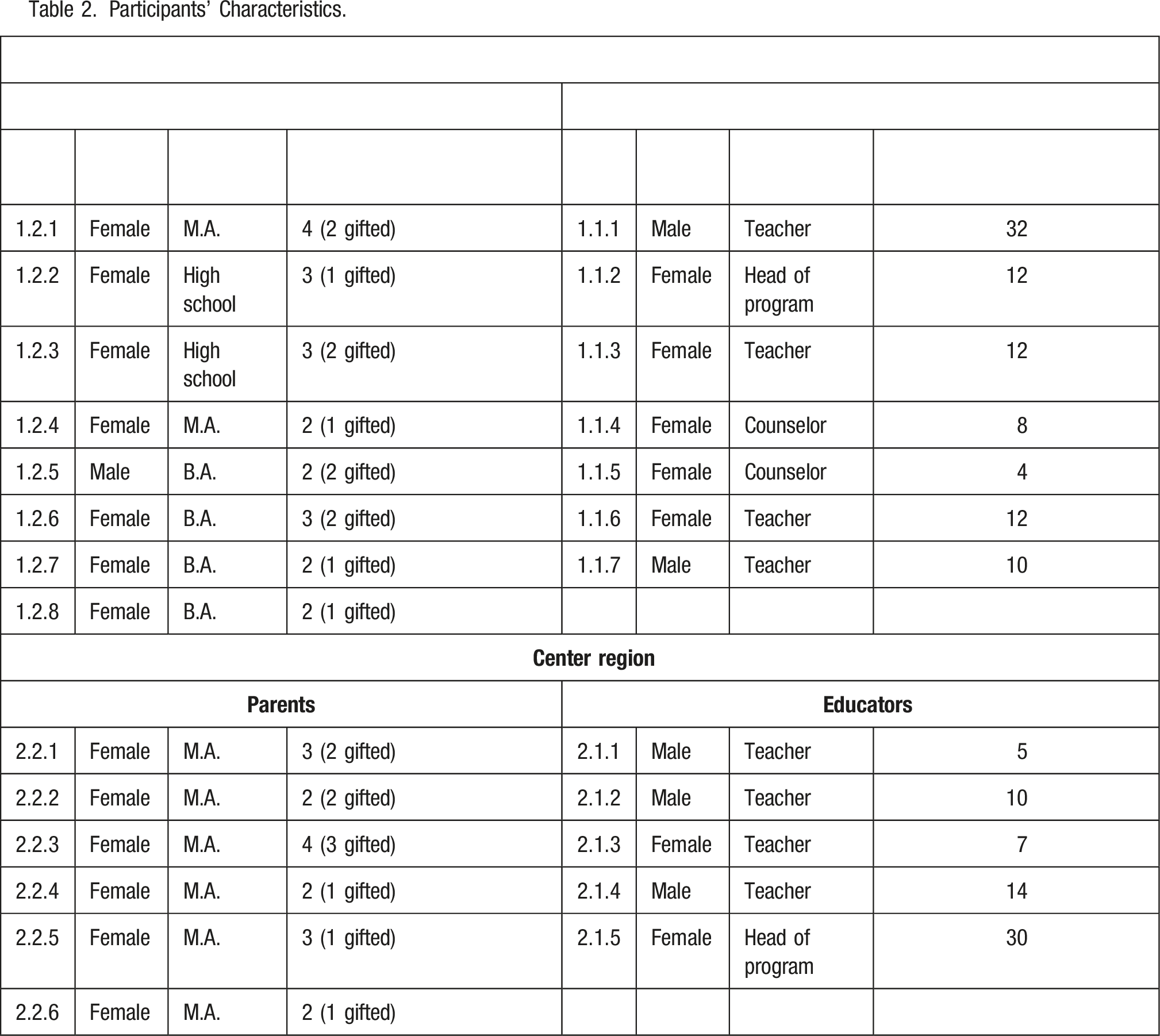
The directors of the gifted pull-out programs were contacted, following approval by the Ministry of Education Chief Scientist. These directors then sent a message to teachers and parents regarding the study, and whoever agreed to be interviewed contacted the researchers and was provided with information regarding the purpose of the study and interview details. The people who agreed to participate signed an informed consent form, stating that all details would be kept anonymous and at any stage during the interview participants could terminate it if they so wished (Marshall & Rossman, 2016).
Data Collection
The interviews aimed at representing a diversity of parents’ and educators’ experiences with gifted students, thus gaining a broader understanding of the existing frameworks. The interview included background questions, questions on traits of the family environment and social groups/systems that gifted students belong to, and questions regarding the regular school, the pull-out program, and the enrichment activities. (For the full interview framework, see Appendix A.) The interviews lasted from 50 to 90 min and were conducted by three different interviewers in order to “balance out the subjective influences of individuals” (Flick et al., 2004, p. 177). They were conducted from July 2020 to January 2021, recorded via the Zoom platform due to the COVID-19 pandemic, and transcribed fully.
Data Analysis
The analysis was comprised of two phases. The first, deductive analysis was based on the four levels of the ecological systems theory (etic) (Bronfenbrenner, 1977, 1979), as described above, and the second, inductive analysis was based on thematic analysis (Braun & Clarke, 2006), which included categories emerging from the interviews (emic). The inductive categorization process was based on interviewees’ statements, according to segments reflecting the four systems. Thus, for the Microsystem the segments were: specific setting, formal education, pull-out program, neighborhood, family, spending time, activities, participation, and friends. For the Mesosystem the segments were: meeting, guidance, coordinate, contact, and communication. For the Exsosystem the segments were: interesting, inquiry, and sharing. For the Macrosyystem the segments were: funds, budget, policy, and system-wide. The embedded deductive (from the theory) and inductive (from the segments in the field) analytic procedures provide a comprehensive approach to data analysis and organization (Azungah, 2018; Bernard et al., 2017; Creswell & Poth, 2018).
During both phases, the researchers generated a rich, thick description (Lincoln & Guba, 1985), based on participants’ words. In order to enhance credibility (Archibald, 2015; Creswell & Poth, 2018), the two researchers, who specialize in gifted education and qualitative research, classified the data in the two phases. First, as a pilot step, they worked jointly on the first four interviews, two with teachers and two with parents from both periphery and center. After the initial analysis and agreement on initial themes, they worked individually on the transcribed interviews by the order of their recording. After the individual analysis process, they shared their system of segments and categories, with incidents of disagreement discussed until full agreement was achieved. The analysis of emerging themes was crosschecked by the researchers. Thus, both peer debriefing and reflexivity were maintained (Berkovich & Grinshtain, 2023). In addition, the researchers presented their experiences with the phenomena being investigated and discussed these experiences based on their understanding of the phenomena (Creswell & Poth, 2018).
Findings
Frequencies of Participants’ References Regarding Environmental Levels: Rural and Central Regions.

According to Table 3, it seems that references to the four levels of ecological systems theory were expressed by parents and teachers from both the periphery and the center. At the same time, in the periphery there were more references to all levels, except for the exosystem level, where the references of parents from the center stood out. Details for each level and categories that emerged from the data analysis are presented below, accompanied by quotes from both parents and teachers.
The Microsystem
When speaking about the microsystem, most parents and teachers referred to the pull-out programs and the regular schools, while only a few referred to special schools for gifted children. In addition, references were made to the home and the neighborhood or city where they live. The categories in this level referred to advantages of the pull-out programs, the regular schools, and the school for gifted students, to family time, to the gifted children’s friends, and to the lack of frameworks for gifted students in the periphery.
Advantages of the Pull-out Programs for Gifted Students
Teachers and parents from both the periphery and the center noted that the weekly activities in the pull-out programs exposed the gifted students to a variety of areas of interest. The diversity of gifted children was accepted, and there was openness and freedom alongside order and limits, as the following quotes indicate: “Formal education is not good for gifted children. They suffer there, but the center for gifted children saves their lives” (Teacher center 2.1.2; individual interview, December 17, 2020). Gifted children have many possibilities to express themselves in the pull-out program. These are groups that have a true desire to learn, and there are no obligations except to be a decent person and behave properly. There is no homework, there are limits and order, but there is a lot of freedom. Gifted children can be who they are, including their differences. Children sense this from the first time they get there. They have someone to talk to. (Parent periphery1.2.1; individual interview, November 14, 2020) They have an opportunity to be with other children like them, who are curious and want to learn. They are not only taught science and mathematics but are also exposed to works of art and many other subjects. They are curious children who want to learn, and they need a place to express their abilities. The regular school limits them. (Parent center 2.2.6; individual interview, January 4, 2021) A gifted child enters 4th grade and is referred to the pull-out program. He is exposed to areas of knowledge that he was not familiar with previously. He suddenly finds that art is an entire world. It’s like an amusement park. The variety of subjects enables children to explore the world. (Teacher center 2.2.1; individual interview, July 16, 2020)
The Regular School and the School for Gifted Students
Most parents from the periphery also explained that their children’s regular school lacked sufficient budgeting and that the children have problems. However, parents from the center noted that their children’s schools have above average budgets because the parents pay school fees. Unlike the parents, some of the teachers claimed that schools designated only for gifted children are not optimal frameworks for these students, as they isolate gifted children from the rest of society. The neighborhood where we live is of a low socio-economic level. The community is attempting to implement a change process in the regular school. One of the reasons we are here is to improve education in the periphery, but there are a lot of problems in my son’s class. (Parent periphery 1.2.3; individual interview, November 22, 2020) Our regular school is not representative. Its budgets are higher because of the fees parents pay, and there are also agendas. For example, there is a supplementary program for gifted children in the school. The program offers enrichment courses in Mathematics and Language, as well as Social Studies courses that include research and field trips. (Parent center 2.2.5; individual interview, December 10, 2020) There are teachers in my daughter’s school who know how to meet the needs of the gifted students in the class. Last year she had a teacher who did not know how to teach gifted children, and they didn’t want to go to school because they were bored and frustrated. I think that if the government doesn’t take responsibility for this, a lot of children here will be lost. I wouldn’t want to think what would happen to her if she didn’t have everything she has here. It’s the same thing as not providing a ramp for a child who uses a wheelchair. (Parent center 2.2.6; individual interview, January 4, 2021) It’s not good if the gifted attend a school for only gifted children. You can’t isolate children from the rest of society. After they finish school, they remain isolated. (Teacher center 2.1.2; individual interview, December 17, 2020)
Family Time
Another aspect that parents spoke about was spending time together as a family. All the parents noted that they make an effort to spend time with their gifted children. Parents from the periphery emphasized the importance of eating a meal together at least once a day, playing games and taking trips together on weekends. “It’s important that we spend time together as a family as part of our routine. We eat a meal together every day and play together, and L. participates. We take trips together on the weekend” (Parent periphery1.2.1; individual interview, November 14, 2020). “We play board games and read a lot at home. We have lots of books and games” (Parent periphery1.2.2; individual interview, November 11, 2020).
Parents from the center also explained that they share activities with their gifted children, but many of these activities revolve around organized enrichment activities and attending plays and performances: “I did lots of enrichment activities with them. I took them to everything that was available, including intellectual activities such as plays, movies and performances, as well as physical activities and playgrounds up to a very late age” (Parent center 2.2.6; individual interview, January 4, 2021). “My daughter participated in a dog training class, a Dungeons and Dragons class, and an electronics class. Each time we chose something different. She has a group of friends from her class and her Scouts group” (Parent center 2.2.4; individual interview, December 12, 2020). There are a lot of extracurricular activities at school. There is a visit to the Safari Park every two weeks, and activities at the museum. There are about three activities each week, including sports and other activities. The rest of the time we are together. (Parent center 2.2.5; individual interview, December 10, 2020)
Parents’ testimonies revealed that there were more family activities available in the center of the country, while parents in the periphery spent more time at home with their nuclear family.
Gifted Children’s Friends
When discussing the social aspect, parents from both the periphery and the center noted that their gifted children had friends from their regular school, from the neighborhood, and from the pull-out program. However, the friendships with other gifted children were often limited to their pull-out program, and they did not usually visit each other’s homes. My son has good friends from his class. Some of them are children from the kibbutz and some are from other kibbutzim. They communicate through WhatsApp groups, and they meet for birthday parties. They have common interests and a large number of them attend the same pull-out program. (Parent periphery1.2.1; individual interview, November 14, 2020) My son has friends from the pull-out program, but those friendships are limited to meetings once a week, and they don’t visit each other. His friends from school visit more often. He has a hiking class that hasn’t met recently because of COVID-19, but it’s a good group for him to belong to. (Parent periphery 1.2.4; individual interview, November 8, 2020) My daughter can meet with other girls from school who have difficulty and make them feel as if they are like her. She’s like a chameleon – she knows how to adapt herself to her surroundings, and she’s sociable. She likes to be exposed. She is curious, she wants to meet new people. (Parent center 2.2.6; individual interview, January 4, 2021)
Lack of Frameworks and Resources for Gifted Students
Parents from the periphery also spoke about the lack of resources and frameworks for gifted children in their area. They emphasized that if there were more enrichment programs and classes, their children would undoubtedly participate. We live in the periphery, and these are the only frameworks that are available for my son. If we lived in the center of the country, he would be exposed to more frameworks. He would attend more classes and enrichment programs. (Parent periphery1.2.1; individual interview, November 14, 2020)
“I see how many social opportunities the youth movement provides for my nieces and nephews, but there is no youth movement here where we live” (Parent periphery 1.2.7; individual interview, November 16, 2020).
The Mesosystem
The mesosystem refers to the interrelations between two or more frameworks in which gifted children study or participate. These include interrelations between parents and the regular school, between parents of gifted children and the pull-out program or other special classes the child attends, and between the pull-out program and the child’s regular school.
Many parents from the periphery reported that they had not received any formal guidance or consultation about their gifted child’s education, and some have no contact with the teachers in the pull-out program. No one from the pull-out program bothered to tell us that we have a child who requires special education and that there are suitable frameworks for him. Not only that, but they would organize and pay for transport, and we wouldn’t have to pay for it privately. We found out about it accidently. (Parent periphery 1.2.3; individual interview, November 22, 2020)
“I went to the pull-out program for a meeting about a year ago. There was a formal meeting with the director, the counselor, and the teacher. I don’t have any contact with the teachers there or with the director” (Parent periphery 1.2.8 individual interview, November 12, 2020).
On the other hand, some parents from the periphery reported that they were in constant contact with their child’s regular school. “I was in contact all the time because things were not going well for my son at school. I was in contact with the school counselor and his teacher” (Parent periphery 1.2.6; individual interview, November 1, 2020). I personally think that there has to be guidance for the family in the educational framework. We need to coordinate our expectations. That way, there will be no problems for the child. For that reason, we are always in contact with the regular school. (Parent periphery 1.2.7; individual interview, November 16, 2020)
Some of the teachers of gifted children in the periphery spoke about similar things regarding contact with parents of gifted children. Some spoke about the fact that there was no permanent framework for meeting with parents, or that the coordinator for gifted students initiated meetings with parents of a specific child. Most of the instances of contact were due to discipline or functioning problems with their child at the enrichment program. Contact often takes place as a result of problems. We often have children with complicated issues at the pull-out program, and we often have to speak with their parents because the child doesn’t function, causes problems, or doesn’t come. I know that parents can approach us, and they will be listened to, but there is no consistent contact. There is no framework in which parents meet with us on a permanent basis or in which the center approaches the parents to ask how the child is doing. (Teacher periphery 1.1.3; individual interview, July 15, 2020)
Some teachers from the periphery reported instances in which parents came to the enrichment center, entered their classroom, and criticized them: Many parents would prefer that their child study chemistry, science, courses in medicine or astronomy, because these topics have an image that is more appropriate for gifted children. A year ago, a parent interrupted my lesson by coming in and demanding to know why this lesson was needed here. (Teacher periphery 1.1.6; individual interview, December 31, 2020)
Most parents from the center noted that they are only occasionally in contact with their children’s teachers at both the regular school and at the pull-out program. Others preferred not to intervene if it was not necessary. Our daughter is a child for whom everything goes smoothly, so there is no need to talk with her teachers. Nevertheless, friendships are formed on parents’ visiting days. I think I have good communication with the teachers because I take an interest in education. This is not because of my daughter, but because I am interested in creating a social initiative or volunteering. (Parent center 2.2.6; individual interview, January 4, 2021) For me the most significant contact is with the teachers, whom I greatly admire and who my son A. has a close bond with. There are not a lot of reasons for contact between one parents’ day and the next, because he got along well and things were going smoothly. (Parent center 2.2.5; individual interview, December 10, 2020)
On the other hand, teachers from the center reported that they contacted parents about their child’s unique abilities, or if they thought their child was experiencing frustration or other difficulties. Some of them also noted that sometimes they made a connection with a specific parent, and even developed and taught a course together. “If I see an outstanding child with an exceptional ability, I notify his or her parents. It makes no difference if it’s juggling or chess” (Teacher center 2.1.2; individual interview, December 17, 2020). It varies. Usually, contact is made with the parents. For example, I taught a course together with the parent of one of my students. He approached me and we developed and taught a course together. It was great. Once or twice during the semester there is a problem, or a child is frustrated with the lesson. Then I talk to the parents about their needs and the needs of their child. That sometimes involves meeting with the child individually and calming the parent. Gifted children’s parents feel pressured as much as gifted children do. Their child’s success is important to them. (Teacher center 2.1.3; individual interview, January 3, 2021)
Teachers from both the center and the periphery agree that contact exists between the pull-out program and the regular school, but it is often complicated. The two institutions must cooperate and coordinate things so that gifted children will not miss out on social activities or examinations, which is often difficult. The connection between the regular school and the pull-out program is extremely complicated. I personally attend principals’ conferences and I’m in contact with all the principals. It’s hard work and there are difficulties. We get the cream of the crop, but we make demands. Since the gifted children miss a day of school each week, we have to put pressure on the principals to not schedule lessons in Science and Math that are difficult to make up. Thus, we have impact upon how they arrange their schedule. We ask the teachers to take the gifted children into consideration. They are not compensated for it, and it’s a sensitive issue. (Teacher center 2.1.5; individual interview, December 16, 2020)
The Exosystem
This level included mostly parents’ thoughts. Parents in both the center and the periphery included their gifted children in discussions with friends, work colleagues, and relatives. They also shared personal experiences and events at work with their children, and their children were interested and asked questions. “Our children take an interest when we talk about our work, ask questions, and respond. For example, a month ago I had an inspection at work, and they were curious and wanted to know how it went” (Parent periphery1.2.1; individual interview, November 14, 2020). “She’s interested. I do give her examples from my work, like if I have difficulties. I do share to the limit that I think it’s right” (Parent center 2.2.4; individual interview, December 12, 2020). “My son knows about my work because he inquired about it. Sometimes he comes to work with me, and he knows exactly what we do there. He has met my colleagues and employees at social events” (Parent periphery 1.2.8 individual interview, November 12, 2020). “I share what happens to me during the workday with my children, and they share things with me. We can have discussions, develop, and learn a lot” (Parent center 2.2.6; individual interview, January 4, 2021).
The Macrosystem
Parents from the periphery stated that the educational system and the Ministry of Education were not guided towards developing excellence or talents among the students. Most of the activities outside the regular school framework were paid for by the parents. “The amount being invested in education for gifted children here is far below what it should be. Our school climate, educational system and overall orientation are not directed towards excellence or towards developing students’ abilities outside the framework” (Parent periphery 1.2.5 individual interview, November 16, 2020). Anything that takes place in the village outside of school is paid for by the parents. Those who have the possibility of supporting their children financially can offer them an educational or social framework, sports activities, or classes in the afternoons. If they can’t afford it, there is nothing, because the local authorities don’t provide any subsidy. (Parent periphery 1.2.4; individual interview, November 8, 2020)
On the other hand, parents from the center noted that the population in their area was economically well-off and that their children participated in classes and enrichment activities. They did not mention the need to pay for transportation or activities. The parents noted that the pull-out programs provided a suitable response for their children, but sometimes that was not sufficient, and the Ministry of Education needed to be responsible. Some parents also mentioned that the center is ethnically homogeneous, and that their children were not acquainted with other sectors of Israeli society, such as the Arab Sector. One day a week at the pull-out program is wonderful. I have no complaints, but I don’t think it is enough. The Ministry of Education is responsible, not the municipality. The population who lives here is socio-economically well-off, but as someone who grew up in the north of the country, I regret that my daughters don’t know any Arabs because we have no contact with them. (Parent center 2.2.3; individual interview, November 23, 2020)
Teachers in the periphery felt that education for gifted children needs to be dealt with systematically by the national and local governments, without being dependent on private organizations. This would promote the importance of the need for education of gifted children. In addition, some teachers also criticized the regular educational system and made an ideological decision to refuse to teach there. The Ministry of Education is supposed to be allotted a higher budget, but despite that I think that the Department for Gifted Children is doing a good job. I became familiar with gifted children through my teaching and through my son, and it was something new for me. It makes me wonder why children who are not gifted don’t have the same enrichment programs. My third son, who does not attend the pull-out program, complains about the fact that his brothers enjoy classes there and he only gets to attend a regular school. On the other hand, I think it’s great that this is available for gifted children. It is provided by a private organization here. I don’t know who provides the budget, but it clearly needs to be system-wide and provided by the Ministry of Education and the municipality. It has to be clear to everyone that it’s important. (Teacher periphery 1.1.3; individual interview, July 15, 2020) I’m sorry to say that the formal educational system is dreadful, and that’s why I don’t teach there at all. I think it’s a constitutional and political issue. Perhaps it is even worse in the periphery than it is in the center, and it’s worst of all in the religious schools in the periphery. There is still no approach to gifted children. (Teacher periphery 1.1.1; individual interview, July 20, 2020)
Teachers who taught in the enrichment centers in the center were aware that their situation was better than that of their colleagues in the periphery. They noted that they usually received support from the local authorities and from parents. They felt that the local authorities understood the need for and the importance of promoting gifted children. Some also referred to the cultural-political aspect, and how it was expressed at the pull-out program. My situation in the center of the country is definitely better than that of my colleagues in enrichment centers in the periphery. The municipality invests money in the enrichment center. They know that it is important to promote gifted children for the future. Other enrichment centers are allotted one or two classrooms within a school, but I have my own building. The center is going to be refurbished and I am going to receive new, upgraded computers. (Teacher center 2.1.5; individual interview, December 16, 2020) The population here at the center of the country is mainly secular and on the left side of the political map. It is a population that asks questions and cares about culture. The children have already visited museums, been to plays and performances and have listened to classical music. They are in a different place. On the other hand, I taught courses in chess in the Arab Sector in the periphery, and it’s a different culture there altogether. Children in the center of the country have seen a chessboard before, even if they have never played the game, but if you show a chessboard to children in the periphery they ask: “Where are the dice?” (Teacher center 2.1.1; individual interview, November 21, 2020)
Discussion
The current study aimed at examining gifted children’s parents’ and teachers’ views regarding the educational frameworks available for gifted students in two regions in Israel—central and peripheral, with differing geographic and socioeconomic characteristics. At the microsystem level, teachers and parents from both the periphery and the center described advantages of the pull-out programs as an environment that nourishes the gifted children and their unique talents. This finding strengthened the notion that enrollment in enrichment programs has a positive influence on gifted students’ talent and academic development (Kim, 2016; Redding & Grissom, 2021). Regarding the regular school, it seems that in the periphery there is a lack of budget, while in the center schools have above average budgets due to parental payments. This reality leads to gaps between districts, with the periphery usually lagging behind what is offered for the gifted in the non-peripheral regions (Mattingly & Schaefer, 2021; Puryear & Kettler, 2017). The findings indicate that parents in both the periphery and central regions invest in family activities with their gifted children. They create meaningful experiences for them and engage them in challenging activities (Freeman, 2000; Manasawala & Desai, 2019). However, it seems that in the periphery parents spend more time with their children at home. This can be explained by the fact that in peripheral areas there is a strong emphasis on family, community, and a sense of place (Richards & Stambaugh, 2015). In relation to the social aspect, no differences were found between parents from the periphery and the center. They all noted that their children have friends from the regular school, the neighborhood, and the pull-out program.
At the mesosystem, most of the parents from the periphery noted that they have no contact with the teachers in the pull-out program and did not receive any guidance or support regarding their gifted child’s education. This situation can make it difficult for parents to navigate between what is required in gifted enrichment programs to what is done in their home and in the regular school, leading to loss of confidence in the system’s ability to sufficiently support their children’s needs (Jolly & Matthews, 2014; Mun et al., 2021). On the other hand, schools and/or district authorities that do collaborate with families could leverage knowledge to build capacity in their teachers and help them better serve the gifted students (Mun et al., 2021). Most of the teachers from the periphery noted that they only contact parents regarding discipline issues with their child at the pull-out program. Parents from the center stated that they were seldom in contact with their children’s teachers at either the regular school or at the pull-out program. They preferred not to bother them, if there was no need. It seemed that parents from the periphery needed guidance and contact with educators who were experts in the field of gifted education but did not consistently receive it. A possible reason could be a lack of resources and counselors specializing in gifted education in the periphery (Azano et al., 2017; Rasheed, 2020). Nevertheless, the literature (e.g., Manasawala & Desai, 2019; Renati et al., 2016) emphasizes the vital connections among various settings where gifted students learn (i.e., schools and programs for the gifted) (Chowkase, 2021), and that parents need to collaborate with them and with mentors in gifted education to be able to cope with stressors and the responsibility of raising a gifted child. With regards to the connection between the pull-out programs and the regular school, teachers from both the center and the periphery noted that it exists due to the coordination necessary so the gifted students can participate in exams and school events. The exosystem level included mostly parents’ thoughts, and there were similarities in their responses. For instance, parents in both the center and the periphery shared their experiences at work with their children. In relation to the macrosystem, parents in the periphery perceived the government and the local authorities as less conducive to the education of their gifted children in comparison to parents from the center. This finding is in accord with studies (e.g., Howley et al., 2009; Rasheed, 2020; Richards & Stambaugh, 2015) that emphasize the distinctions between peripheral and central areas regarding gifted education. It is important to note that if the macrosystem level is not addressed by the government and local authorities in relation to gifted education in the periphery, it may prevent the cognitive, social, and emotional development of gifted children at present, and as contributing citizens to society in the future (Chowkase, 2021; Stambaugh & Wood, 2015).
Overall, characterizing the various frameworks to which the gifted students belong is a unique issue that has not been studied in Israel. In addition, the population of gifted students represents a small percentage of the general population in Israel, and therefore is rarely studied. From the practical standpoint, the research findings may assist policymakers and officials in the planning and developing frameworks for gifted children and suggest alternatives at the individual and group levels for this unique population in developing and allocating resources, providing appropriate support to gifted children and their families in general, and in the rural regions particularly. Theoretically, the study contributes to the understanding of Bronfenbrenner’s system theory, and to the body of knowledge dealing with gifted education and with programs and learning environments for gifted children.
Regarding the study’s limitations, it should be noted that most of the interviewees were mothers, with the exception of one father. Furthermore, the views of educational agents, such as policy makers and stakeholders, should be considered in order to enhance the meaning of the phenomena from a broader perspective. In addition, it is possible that types of settlements in the periphery itself (e.g., local authority, regional council, and city) may affect exposure to frameworks for gifted students, thus it is recommended they be compared with the central region in a follow-up study. In addition, further populations can be examined, such as Jewish and Arab populations. This study suggests further research focusing on the extended family members of gifted students, such as grandparents or uncles/aunts, and their perceptions regarding how these children should be raised and educated, as well as their views regarding the educational frameworks available for gifted students in the central and peripheral regions in Israel.
Footnotes
Declaration of Conflicting Interests
The author(s) declared no potential conflicts of interest with respect to the research, authorship, and/or publication of this article.
Funding
The author(s) disclosed receipt of the following financial support for the research, authorship, and/or publication of this article: This work was supported by the Tel-Hai Academic College (75200) and by Oranim Academic College (5320310).
