




Abstract
The objective of this study was to clarify the relationship of regulated on activation normal T cell expressed and secreted (RANTES) levels with metabolic syndrome (MS) and activated platelets-associated markers. We conducted a cross-sectional study of 210 healthy Japanese male volunteers (mean age 41 years old) who did not take any medications and were free of cardiovascular or cerebrovascular disease. The RANTES is correlated with age, diastolic blood pressure, and fast glucose by multivariate analysis using the cardiovascular risk factors (R 2 = .396, P < .001). The plasma RANTES level is significantly associated with MS after adjusting for age (P = .040). Once plasma interleukin 6, an activator of platelets, and plasma platelet-derived microparticles, a marker for activated platelets, are put into the equation, plasma RANTES level is significantly correlated with the activated platelet-associated markers (R 2 = .396, P < .001). These suggest the possible role of elevated RANTES in the forerunner of atherosclerosis in healthy younger men.
Keywords
Introduction
The initiation and progression of atherosclerosis are controlled by various mediators of inflammation, 1 which are reportedly associated with cerebrovascular and cardiovasucular disease. 2,3 The chemokines play a significant role in the inflammatory cascade. 1 Platelets are an important source of chemokines and they play a role in the inflammatory process. 4 The CC chemokine ligand-5, or regulated on activation normal T cell expressed and secreted (RANTES), is a CC chemokine expressed by cell types such as fibroblasts, T cells, endothelial cells, smooth muscle cells, glial cells, and mesangial cells 4 ; it is also stored in the α granules of platelets. 5 After release from the activated platelets, RANTES is deposited on the endothelium via interactions with specific chemokine receptors (CCR1, CCR3, CCR4, and CCR5) 6 in an oligomerization-dependent manner with cell surface glycosaminoglycans. 7 It mediates transmigration of monocytes and T cells into damaged or inflamed tissue, except the intima by releasing proinflammatory mediators. 8 In a hypercholesterolemic mouse model the inactivation of RANTES receptors prevented the progression of the disease, 9 suggesting that RANTES plays a causal role in atherosclerosis.
Obesity is associated with chronic systemic inflammation, which may also directly contribute to the development of cardiovascular disease and diabetes mellitus. 10 Visceral adiposity, hypertension, insulin resistance, high triglyceride (TG) level, and low high-density lipoprotein (HDL) cholesterol level characterize atherosclerotic metabolic abnormalities, the so-called metabolic syndrome (MS), 11 –13 which is strongly associated with atherothrombotic events seen in cardiovascular 12 and cerebrovascular disease. 13 Plasma interleukin 6 (IL-6) has been reported to be associated with obesity 14 and features of MS. Plasma IL-6 is reported to be correlated and associated with the plasma platelet-derived microparticles (PDMPs), markers of activated platelets in healthy individuals. 15
Accumulating evidence suggests that activating platelets play crucial role in the formation of atherosclerosis. Here, we report the relationship of plasma RANTES with MS and with IL-6, an activator of platelets, 14,15 and PDMP, a marker for activated platelets, 15 to show the significance of plasma RANTES with activating platelets in healthy men.
Methods
Participants
The institutional review board of Kishiwada City Hospital approved our study protocol; prior written informed consent was obtained from all the participants. We recruited 210 male Japanese volunteers without signs, symptoms, or a history of cardiovascular or cerebrovascular disease; none took antihypertensive, antihyperlipidemia, antidiabetic, or steroid or nonsteroid anti-inflammatory drugs on a daily basis. We excluded the individuals who took these medications daily because they can affect the RANTES level. 16
Measurement of Traditional Cardiovascular Risk Factors: Lipoproteins, High Sensitivity C-Reactive Protein, and Other Biochemical Parameters
Anthropometric data (height and weight) and the blood pressure (BP) were recorded. The body mass index (BMI) was calculated as the weight in kilograms divided by the square of the height in meters.
We defined MS according to guidelines promulgated by Adult Treatment Panel III (ATPIII), which proposed 5 criteria for MS. However, as the body mass of Japanese tends to be less than that of Caucasians, we found it inappropriate to use the ATPIII criteria for abdominal obesity. Instead, as proposed by the Japanese Society for Obesity, we adopted a waist circumference of >85 cm for men. 17 The MS was defined as the fulfillment of 3 of the following 5 criteria: (1) waist circumference >85 cm, (2) BP >130/85 mm Hg, (3) fasting glycemia ≥110 mg/dL, (4) HDL <40 mg/dL, and (5) triglyceride ≥150 mg/dL.
Fasting blood samples were drawn from a peripheral vein with a vacuum system using a 21-gauge needle. We used kits (Kyowa Medex, Tokyo, Japan) to directly determine the total cholesterol (TCho), HDL, and low-density lipoprotein (LDL), and restricted maximum likelihood (Rem-L) levels. We used uncoated vacutainers for high sensitivity C-reactive protein (hsCRP) assay. Immunoradiometric assay for hsCRP was performed as previously described. 18
Measurement of RANTES, PDMP, and IL-6
To measure RANTES we used an enzyme-linked immunosorbent assay (ELISA) kit (R&D System, Wiesbaden, Germany) and measured in duplicate as manufacture’s recommendation. For IL-6, we used a conventional ELISA kit. The values of IL-6 were measured in duplicate as the manufacture’s recommendation and the mean values were recorded. For PDMP, blood samples were collected in vacutainers containing EDTA-ACD (NIPRO Co Ltd, Japan) with a 21-gauge needle to minimize platelet activation. The samples were gently mixed by turning the tube upside down once or twice, stored at room temperature for 2 to 3 hours, and centrifuged at 8000g for 5 minutes at room temperature. Immediately after centrifugation, we collected 200 μL of the upper layer supernatant from 2 mL samples to avoid the contamination of the platelets. 19,20 The values of PDMP were measured in duplicate and the mean values were recorded. PDMPs of 1 U/mL in this ELISA kit was defined as the amount of PDMPs obtained from 24 000 solubilized platelets/mL. 19
Statistical Analysis
Variables are expressed as the mean (standard deviation) when they were normally distributed and as the median and minimum-maximum when they were not. The correlation of plasma RANTES levels and other response variables was assessed by univariate analysis. Multivariate analysis was used to identify the independent predictors of elevated RANTES levels. All variables significant (P < .1) by univariate analysis were entered in the equation. Variables with a high Pearson product-moment correlation coefficient (r) value (>.8) were excluded from the equation as potential confounding factors. We performed logistic regression analysis to determine whether the RANTES level is associated with MS. We logarithmically transformed and calculated all variables not normally distributed for greater symmetry of the distribution. Differences of P < .05 were considered significant. Analyses were performed with the SPSS 14.0.J program (SPSS Inc., Chicago, Illinois).
Results
Characteristics of the Study Population
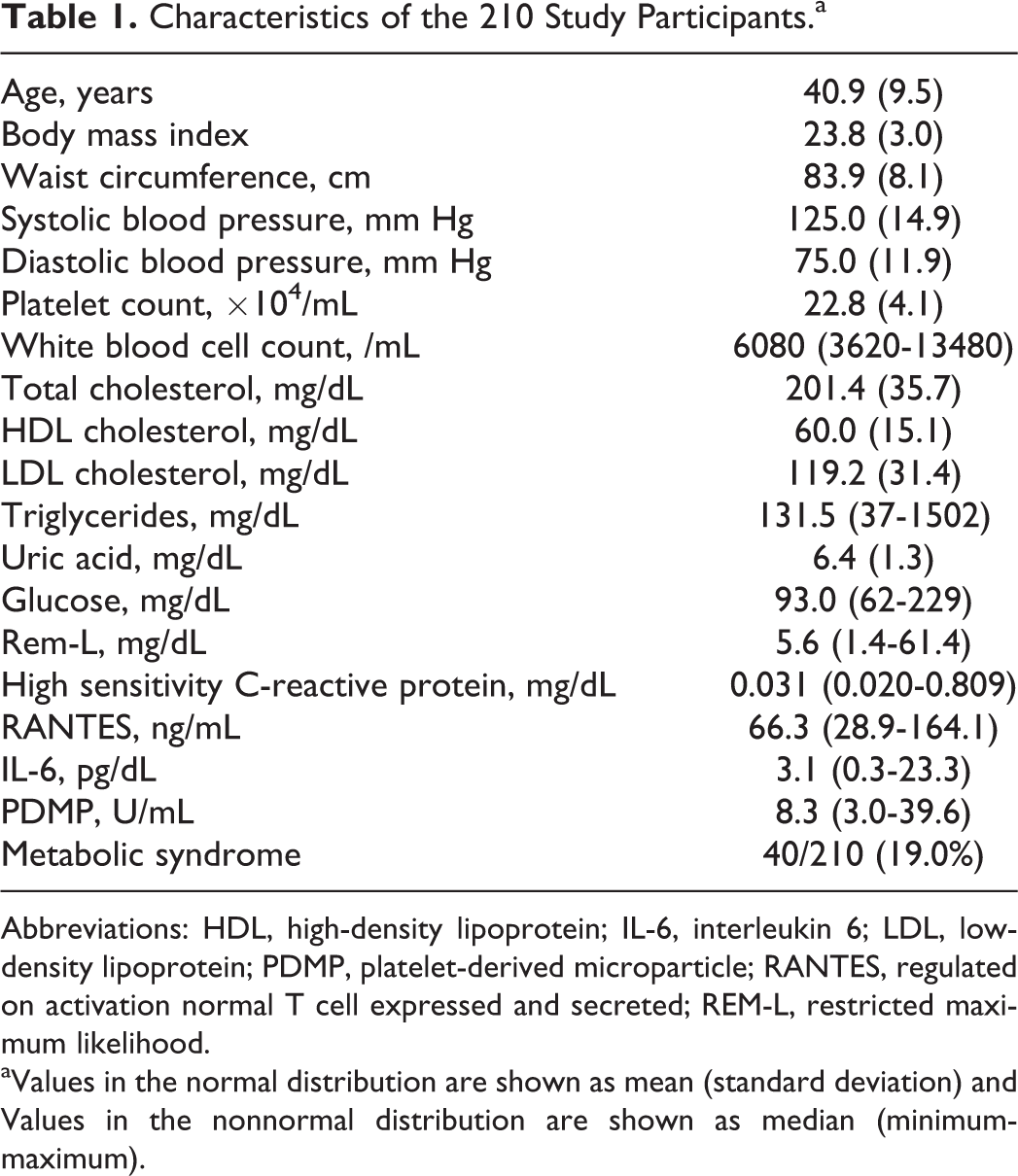
As shown in Table 1, 210 Japanese men were included in our cross-sectional study. Their mean age was 41 years; 40 (19.0%) were MS positive. The mean and the median values for BMI, waist circumference, systolic and diastolic BP, TCho, HDL, LDL, TG, and fast glucose were within the normal limits. The levels of Rem-L, hsCRP, RANTES, PDMP, and IL-6 are shown in Table 1.
Characteristics of the 210 Study Participants.a
Abbreviations: HDL, high-density lipoprotein; IL-6, interleukin 6; LDL, low-density lipoprotein; PDMP, platelet-derived microparticle; RANTES, regulated on activation normal T cell expressed and secreted; REM-L, restricted maximum likelihood.
aValues in the normal distribution are shown as mean (standard deviation) and Values in the nonnormal distribution are shown as median (minimum-maximum).
Level and Distribution of Plasma RANTES in Healthy Men
The RANTES value, a response variable, was not normally distributed. The empirical cumulative distribution of the logarithmically transformed values in our sample of 210 men was smooth and symmetrical, indicating that the RANTES values in this population approximated a log-normal distribution. The median level was 66.3 ng/mL (Table 1).
Correlation Between RANTES and Lipoproteins, an Inflammation Marker, and Traditional Cardiovascular Risk Factors
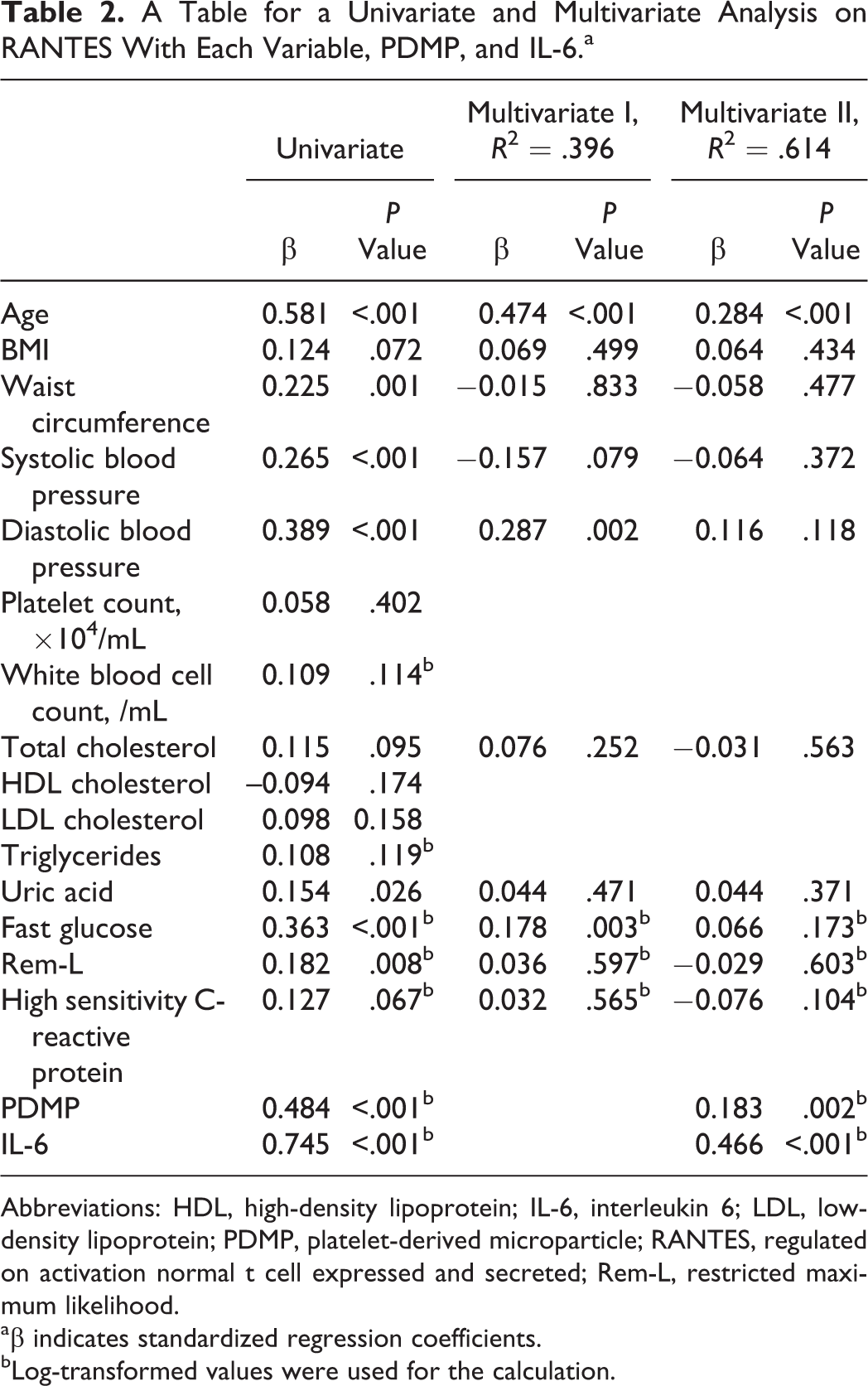
Univariate analysis showed that age, waist circumference, systolic- and diastolic- BP, uric acid, fast glucose, and Rem-L were significantly correlated (Table 2). We logarithmically transformed and calculated all variables not in normal distribution. In the multivariate model, we calculated the age, BMI, waist circumference, systolic and diastolic BP, TCho, uric acid, fast glucose, Rem-L, and hsCRP. As shown in Table 2 (multivariate model I), age, diastolic BP, and fast glucose were significant factors (R2 = .396, P < .001). Age was one of the most significant factors to predict plasma RANTES levels (β = 0.474).
A Table for a Univariate and Multivariate Analysis on RANTES With Each Variable, PDMP, and IL-6.a
Abbreviations: HDL, high-density lipoprotein; IL-6, interleukin 6; LDL, low-density lipoprotein; PDMP, platelet-derived microparticle; RANTES, regulated on activation normal t cell expressed and secreted; Rem-L, restricted maximum likelihood.
aβ indicates standardized regression coefficients.
bLog-transformed values were used for the calculation.
Association Between the MS and the RANTES Level
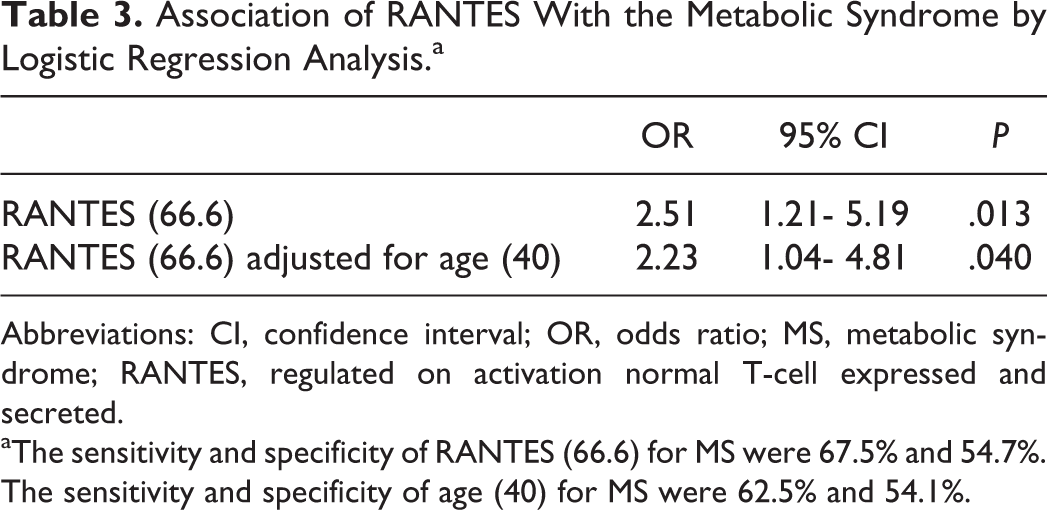
Because hypertension and glucose intolerance were correlated with RANTES levels in the multivariate model, we performed logistic analysis for MS. The RANTES and age were categorized as RANTES (66.6) and age (40) based on the receiver–operating characteristic curve for MS. The sensitivity and specificity of RANTES (66.6) and age (40) for MS were 67.5% and 54.7% and 62.5% and 54.1%, respectively. The RANTES (66.6) was associated with MS; the unadjusted odds ratio (OR) was 2.51 (1.21-5.19, P = .013); the adjusted OR for age (40) was 3.4 (1.04-4.81, P = .040) by logistic regression analysis (Table 3).
Association of RANTES With the Metabolic Syndrome by Logistic Regression Analysis.a
Abbreviations: CI, confidence interval; OR, odds ratio; MS, metabolic syndrome; RANTES, regulated on activation normal T-cell expressed and secreted.
aThe sensitivity and specificity of RANTES (66.6) for MS were 67.5% and 54.7%. The sensitivity and specificity of age (40) for MS were 62.5% and 54.1%.
Distribution and Correlation of Plasma RANTES With Platelet Number, Plasma PDMP, and Plasma IL-6
Figure 1 shows the distribution and correlation of plasma RANTES with platelet number, plasma PDMP, and plasma IL-6. No correlation of plasma RANTES with platelet count is shown (R2 = .003, P = .402). Significant correlation of plasma RANTES with plasma PDMP (R2 = .234, P < .001) and plasma IL-6 (R2 = .555, P < 0.001) is shown.
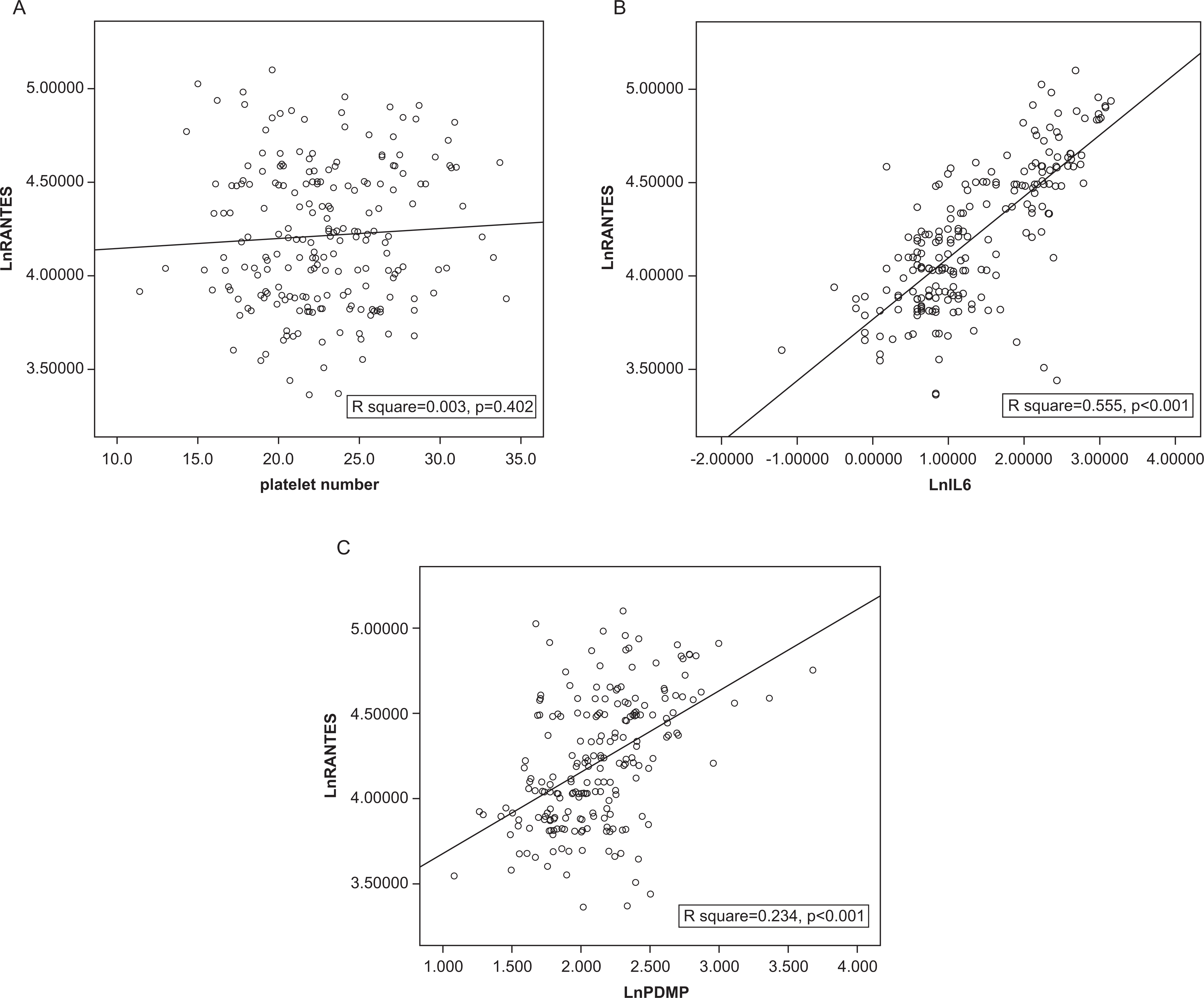
Distribution and correlation of plasma regulated on activation normal T cell expressed and secreted (RANTES) with platelet number, plasma interleukin 6 (IL-6), and plasma platelet-derived microparticles (PDMPs). Plasma RANTES, IL-6, and PDMP were logarithmically transformed and calculated. A, No correlation of plasma RANTES with platelet count is shown (R2 = .003, P = .402). B, Significant correlation of plasma RANTES with plasma IL-6 is shown (R2 = .555, P < .001). C, Significant correlation of plasma RANTES with plasma PDMP is shown (R2 = .234, P < .001).
Correlation Between RANTES and Lipoproteins, an Inflammation Marker, Traditional Cardiovascular Risk Factors, IL-6, and PDMP
Univariate analysis showed that age, waist circumference, systolic and diastolic BP, uric acid, fast glucose, Rem-L, PDMP, and IL-6 were significantly correlated (Table 2). In the multivariate model, we calculated the age, BMI, waist circumference, systolic and diastolic BP, TCho, uric acid, fast glucose, Rem-L, hsCRP, PDMP, and IL-6. As shown in Table 2 (multivariate model II), age, PDMP, and IL-6 were significant factors (R2 = .614, P < .001). The IL-6 was one of the most significant factors to predict plasma RANTES levels (β = 0.466).
Discussion
Our cross-sectional study of 210 healthy men provides clear evidence for a positive association of plasma RANTES level with MS and a positive correlation of plasma RANTES level with IL-6 and PDMP. An elevated RANTES level was correlated with age, diastolic BP, and fast glucose among the traditional cardiovascular risk factors. When IL-6, an activator of platelets 14,15 and PDMP, a marker for activated platelets 15,18,20 were put into the equation, an elevated RANTES level was correlated with IL-6, PDMP, and age. Plasma RANTES is associated with activated platelet-associated markers, suggesting the possible role of activated platelets in the production of RANTES in the healthy men. Plasma RANTES were not correlated with platelet number. However, the platelet number necessarily does not mean the activated platelet number. These data suggest that RANTES acts not only as a marker of MS but also plays a crucial role in the forerunner of atherosclerosis, 20 –22 that is, as a potent proinflammatory factor.
The RANTES plays important roles in allergic inflammation 23 and leukocyte recruitment to atherosclerotic lesions 24 and high RANTES levels were associated with severe inflammation. 25 In our study, RANTES was not correlated with hsCRP and this discrepancy may be attributable to the characteristics of the study population, the mean age of our male volunteers was younger, 41 years old. The RANTES is released upon platelet activation and immobilized on the surface of inflamed endothelium; it promotes monocyte recruitment and the arrest of atherosclerotic arteries and accelerates the formation of atherosclerotic lesions and thrombi. 21,24,26 Veillard et al 9 showed that the CC chemokine antagonist Met-RANTES reduces the progression of atherosclerosis in a hypercholesterolemic mouse model. Data from animal models provide evidence for the crucial role of RANTES in the pathogenesis of atherosclerosis. In the clinical setting, Holven et al 27 reported enhanced RANTES expression in peripheral blood mononuclear cells from children with familial hypercholesterolemia, suggesting the involvement of chemokines in the early stages of atherosclerosis. The RANTES has also been reported to be associated with coronary artery disease. 28
This study reveals higher correlation of RANTES with IL-6 (R2 = .555, Figure 1). We speculated that IL-6 modified platelet status. Platelets exposed by IL-6 may also be likely to be activated by additional factors, for example BP 15 and activated platelets released RANTES. At nanomolar concentrations, RANTES behaves as a typical chemokine causing chemotaxis of mononuclear cells by inducing cell polarization and transendothelial cell migration. 4 Moreover, RANTES is recently reported to stimulate IL-6 secretion in Waldenstrom macroglobulinemia stromal cells. 29 There may be crosstalk of RANTES and IL-6 in the chronic inflammatory environment.
Study Limitations
Because of the cross-sectional nature of our study we were unable to establish causal relationships. Because our study population was small in number, there could be a selection bias. We are in the process of performing longitudinal studies in elderly Japanese individuals to avoid type II error and to validate the RANTES levels for practical medicine.
Conclusion
Elevated RANTES levels are associated with MS and are correlated with IL-6 and PDMP in healthy men, suggesting the possible role of elevated RANTES in the forerunner of atherosclerosis in healthy younger men.
Footnotes
Declaration of Conflicting Interests
The author(s) declared no potential conflicts of interest with respect to the research, authorship, and/or publication of this article.
Funding
The author(s) received no financial support for the research, authorship, and/or publication of this article.