



Abstract
This paper analyzes articles from the popular Babylon Bee satire website to show how right-wing humor spreads climate change denialism. The findings reveal that denialist satire closely follows the news cycle, clustering around moments of heightened media attention. Satirical attacks focus primarily on the messengers of climate action—politicians, activists, and scientists—rather than on scientific evidence itself. These figures are most often discredited through ad hominem attacks, though other logical fallacy techniques are also frequent. A qualitative application of humor theory demonstrates how such satire resonates with conservative worldviews, reinforcing distrust of climate science and policy.
Introduction
The title of this paper references an article published by The Babylon Bee, a popular conservative satire website (The Babylon Bee, 2021a). The article takes the phrase “the science is settled”—a common shorthand indicating broad scientific consensus on core aspects of climate change—and pushes it to an absurd extreme: if the science really is settled, scientists have nothing left to discover, forcing them all into retirement. Beneath this playful exaggeration lies a powerful rhetorical strategy. By misrepresenting “settled science” as a state of total scientific closure rather than what it actually signifies—namely, a robust consensus on certain key issues, alongside ongoing research—the satire undermines the credibility and necessity of climate science itself. Thus, through satirical humor, The Babylon Bee spreads climate change denialism, not by directly challenging scientific evidence, but by turning the very idea of scientific agreement into a punchline.
While recent scholarship has advanced our understanding of humor’s potential to foster constructive engagement with climate change (see Kaltenbacher & Drews, 2020), the inverse dynamic—how humor spreads climate change denialism—remains underexplored. This gap matters because the effectiveness of climate communication rests not only on the robustness of evidence but also on the discursive context in which that evidence circulates. A growing body of research in science and environmental communication has shown that denialist discourse erodes the public authority of scientific knowledge, not only by outright rejection (e.g., Bloomfield & Tillery, 2019; Feldman et al., 2012; Kinol et al., 2025), but increasingly through more refined strategies, shifting from open denial of evidence to subtler rhetoric (e.g., Schmid-Petri et al., 2017). This paper contributes to these scholarly efforts by systematically analyzing Babylon Bee articles that target climate science and policy, thereby generating new evidence of how denialism now operates through satire and documenting the increasing subtlety with which climate change denial is communicated.
The paper begins by reviewing relevant scholarship on humor and satire, followed by a discussion of the rhetorical and ideological foundations of climate change denialism. The research design is then outlined in detail. The paper proceeds to present and interpret the findings, concluding with a discussion of how Babylon Bee climate satire is constructed to resonate with anxieties among conservative audiences about government overreach and institutional change, as well as with narratives that portray liberal elites as using climate change as a Trojan horse for far-reaching political and social reforms.
Climate Change Humor: From Liberal to Right-Wing Satire
The role of humor in the communication of climate change has attracted growing scholarly attention, with research generally falling into three main strands. First, audience effect studies, often based on experimental designs (e.g., Anderson & Becker, 2018; Brewer & McKnight, 2015; Clarke et al., 2022; Skurka et al., 2019), examine whether exposure to humorous messages supporting climate science can foster pro-environmental attitudes and behaviors. They generally report significant positive associations, often moderated by individual-level factors. Second, content analyses explore how, and to what extent, comedic formats address climate change, mapping the themes and framings that shape its representation in humorous media. While many such studies identify a predominance of climate-affirming framings (e.g., Brewer, 2013; Feldman, 2013; Gehrke, 2024), others caution that prime-time comedy can also ridicule environmental concern (e.g., Carter, 2023). Third, qualitative interrogations of individual texts complement this mixed picture, showing how climate humor can both prompt critical debate among audiences about alternative futures and political solutions (e.g., Hellmann, 2025; Sels et al., 2025), and risk reinforcing counterproductive attitudes or masking the structural causes that underpin the climate crisis (e.g., Doyle, 2022; Little, 2022).
A major focus of existing research has been satire, particularly in left-leaning outlets such as The Daily Show (Brewer, 2013; Brewer & McKnight, 2015; Gehrke, 2024), Last Week Tonight with John Oliver (Brewer & McKnight, 2017; Clarke et al., 2022), Jimmy Kimmel Live! (Skurka et al., 2019), and The Onion (Anderson & Becker, 2018). Satire is typically defined as a form of humor marked by exaggeration and absurdity, aimed at exposing the gap between social or political ideals and lived realities (Park-Ozee, 2019, pp. 588–589). What distinguishes satire from other types of humor is its inherently critical and aggressive yet playful approach: satire deliberately attacks or ridicules a particular target—such as individuals, institutions, societal norms, or political agendas—but does so in a way that is humorous rather than directly confrontational. This playful aggression allows satire to transform ridicule into socially acceptable critique (Hellmann, 2023, pp. 569–571; Gray et al., 2009, pp. 12–13).
Three key mechanisms have been proposed through which satire may effectively convince audiences of the reality and urgency of climate change. First, satire has a broad and cross-cutting appeal, enabling climate science communicators to reach wide audiences beyond those typically interested in science or environmental issues (e.g., Anderson & Becker, 2018). Second, and related to the previous point, satire effectively simplifies complex scientific concepts by presenting them in accessible and engaging ways, making climate science more understandable and memorable (e.g., Feldman, 2017, p. 324). Third, satire reduces resistance and counter-arguing, a psychological barrier that typically prevents individuals from accepting persuasive messages that conflict with their existing beliefs (e.g., Boukes & Hameleers, 2023). According to the elaboration likelihood model (ELM), persuasion can occur through two routes: a central route, involving careful evaluation and counter-arguing, or a peripheral route, involving more superficial cues, such as entertainment or emotional reaction. Satire primarily engages the peripheral route, as its humorous framing reduces motivation and ability to elaborate on messages, making individuals less likely to generate counter-arguments and more likely to rely on heuristic shortcuts (Baumgartner, 2021, p. 22).
While recent scholarship has significantly advanced our understanding of humor’s potential to support climate engagement, there remains a notable gap in the literature concerning how climate denialists and pseudo-scientific skeptics deploy humor. The very mechanisms identified in studies of pro-science satire may also operate in denialist messaging: satirical content can attract broad audiences, simplify or distort complex climate science in ways that render denialist arguments more plausible, and lower cognitive defenses through humor, thereby reducing critical engagement with misinformation. The Babylon Bee article referenced in the introduction offers a telling example, reminding us that climate communication “takes place in an open system, where competing messages exist” (Pearce et al., 2015, p. 618) and that humor, too, can be strategically mobilized to advance denialist frames.
The lack of research into climate denialist humor is unsurprising, given long-held assumptions about the emotional dynamics of right-wing and conservative media systems. Traditionally, conservative media have been associated with negative emotional appeals—especially anger, outrage, and fear—rather than humor and irony (e.g., Young, 2019). Only more recently have scholars begun to recognize and investigate the significant role humor can play in right-wing and conservative communication, revealing how humor challenges progressive viewpoints and reinforces in-group identification (e.g., Pérez, 2022; Sienkiewicz & Marx, 2024). One notable example is The Babylon Bee, founded in 2016 as a Christian satire website and, after its purchase by Seth Dillon in 2018, reoriented toward electoral and culture-war politics. As Bach (2024, p. 348) observes, The Babylon Bee portrays conservatives and traditionally dominant groups (white people, Christians, men) as embattled by powerful liberal institutions (such as news media, Big Tech or the “deep state”), allowing it to frame its satire as “punching up” rather than down. With a substantial social media presence—2.2 million followers on Instagram and 4.9 million on X—its posts have at times been amplified by prominent conservatives such as Donald Trump, Elon Musk, and Ted Cruz.
Reflecting the growing popularity of The Babylon Bee, scholars have systematically compared the site to its liberal counterpart, The Onion, finding that their articles are strikingly similar in both form and structure. Most notably, both outlets reproduce the stylistic and rhetorical conventions of news reporting, presenting satirical content in the guise of straight journalism (Brugman et al., 2022; Skalicky & Chen, 2023). These findings open an important line of inquiry into The Babylon Bee’s treatment of climate change—namely, whether its satirical coverage aligns with the rhythms of mainstream reporting. Accordingly, this study asks,
Research Question 1 (RQ1): Does climate change denialism in The Babylon Bee follow the news cycle?
Given what is known about The Babylon Bee’s editorial process, it is reasonable to expect that its climate change humor closely follows the daily news agenda. Editors have explained in interviews that their working day begins with scanning headlines and “getting a sense of what the news cycle is that day, what people are going to be talking about” (Pat Gray Unleashed, 2023). From there, ideas are circulated to a pool of contributors, who pitch potential headlines to be developed into full articles. This process reflects a keen awareness of how topicality generates engagement. As one editor put it, “the current events stuff is really what drives a lot of traffic . . . you really have to think about what Facebook algorithms or Twitter trends are going to drive” (Goodall, 2020).
While research highlights structural similarities between liberal and conservative satire, the two may diverge significantly in terms of their chosen targets of attack (cf. Brugman et al., 2022, p. 1640). Existing content analyses of climate humor (e.g., Brewer, 2013; Feldman, 2013) suggest that liberal satire tends to focus on political actors—ridiculing conservative politicians for pseudo-scientific skepticism and denial, while also lampooning left-leaning politicians for insufficient action. The news media has also been a recurring target, particularly its tendency to frame climate change through “balanced” coverage that grants activists and denialists the same space to voice their views (e.g., Brewer & McKnight, 2017). By contrast, the targets of right-wing climate satire remain less well understood, with little empirical research to date. This gap raises a second guiding question,
Research Question 2 (RQ2): Who are the main targets of attack in Babylon Bee climate denialist articles?
Scholarship on climate change denialism provides a useful lens for this inquiry. Hoffman (2015, pp. 21–26), for example, observes that denialist discourse often works by undermining trust in four areas: the messengers who communicate climate science, the processes by which scientific claims are produced, the message of climate change itself, and the policy solutions that follow from it.
Climate Science Denialism: Rhetorical Tactics and Ideological Origins
Climate change denial has been defined as the “motivated rejection of evidence in favor of political or personal views” (Lewandowsky, 2021, p. 3). Scholars typically distinguish between three core variants: trend denialism, which contests that significant global warming is occurring; attribution denialism, which disputes the anthropogenic nature of climate change; and impact denialism, which downplays or rejects the negative consequences of climate change for humans or the environment (Edvardsson Börnberg, 2017, p. 235). Building on this taxonomy, Coan et al. (2021) identify two further types: claims that proposed solutions to climate change are ineffective or harmful, and that climate science and scientists themselves are unreliable.
To understand how such denialist claims gain traction, it is helpful to consider the rhetorical tactics used to promote them. Diethelm and McKee (2009) outline five characteristic denialist tactics: (a) fake experts, (b) logical fallacies, (c) impossible expectations, (d) cherry-picking, and (e) conspiracy theories. Cook (2020) expands on this typology by offering a more detailed classification of rhetorical strategies within each category, referred to as the FLICC framework. This includes a range of specific techniques that illustrate how denialist arguments function at a granular level. For example, fake experts may involve a magnified minority or the creation of a fake debate. Logical fallacies encompass tactics such as ad hominem attacks, straw man arguments, and false analogies. Impossible expectations manifest in shifting evidentiary standards or demanding unattainable levels of precision from models. Cherry-picking includes slothful induction and the use of anecdotes, like citing cold weather to refute global warming. Conspiracy theories rely on self-sealing logic and strategies such as quote mining, as exemplified by persistent narratives such as “Climategate.”
Scholars have documented the existence of a veritable “climate change denial machine,” an interconnected network of actors working to undermine public understanding of climate science (Dunlap & McCright, 2011). These entities channel resources and messaging into an “echo chamber” of politicians, mainstream and social media, and astroturf campaigns, all of which amplify and legitimize climate denialist claims. Research has examined how individual components of this machine—such as political leaders and parties (Fiorino, 2022), corporations and business associations (Kinol et al., 2025), news media (Feldman et al., 2012), and online influencers (Bloomfield & Tillery, 2019)—help sustain pseudo-scientific climate skepticism. Yet, one domain remains underexplored: satirical media. Despite their growing cultural reach, outlets such as The Babylon Bee have not been considered within studies of climate denialism. This gap motivates two further research questions:
Research Question 3 (RQ3): What are the most common climate change denialist techniques employed by The Babylon Bee?
Research Question 4 (RQ4): Which climate change denialist techniques are deployed to undermine specific targets?
As outlined above, the persuasive impact of satire hinges on its ability to elicit laughter. Humor is the mechanism through which satire renders complex scientific issues more accessible, engages wider publics, and activates the peripheral route of information processing. Yet, as broader satire research has demonstrated, whether audiences laugh is strongly conditioned by the alignment of their political ideologies and worldviews with those of the satirist (e.g., Baumgartner, 2021, pp. 22–23). This dynamic is also well established in the context of climate communication: experimental studies of liberal climate satire show that left-leaning audiences are more likely to appreciate the humor, understand its encoded critique, and ultimately endorse its climate science–affirming messages (Brewer & McKnight, 2015; Clarke et al., 2022; Skurka et al., 2019). By the same logic, The Babylon Bee’s satire may rely on ideological alignment to elicit laughter, which in turn facilitates the uptake of implicit climate science denialist claims. This raises the following question:
Research Question 5 (RQ5): How does The Babylon Bee craft humor from climate denialist claims so that it resonates with like-minded audiences?
Research has identified several ideological orientations that help explain why conservatives, more than other groups, resist climate science. These orientations also provide insight into the worldview that Babylon Bee humor may seek to activate. First, free-market ideology positions government regulation as a threat, making climate action—which demands precisely such interventions—politically unpalatable (e.g., Heath & Gifford, 2006). Second, conservatives tend to score higher on social dominance orientation (SDO), which normalizes group-based hierarchies and human dominance over nature, reducing empathy for vulnerable populations or ecosystems most at risk from climate change (e.g., Stanley & Wilson, 2019). Relatedly, system justification theory (SJT) emphasizes a preference for seeing existing economic and political arrangements as fair and just. Because climate activism highlights systemic failures, high-SJT individuals are more likely to downplay or dismiss climate change to preserve their belief in the status quo (e.g., Feygina et al., 2010). Finally, moral foundations theory (MFT) shows how conservatives’ moral priorities of loyalty, authority, and purity—rather than liberals’ emphasis on care and fairness—foster suspicion toward climate scientists (aligned with the liberal out-group), international treaties (perceived as threats to sovereignty), and environmental activists (framed as radical disruptors; e.g., Dickinson et al., 2016). Together, these perspectives illustrate a constellation of beliefs and values that Babylon Bee satire can resonate with, normalizing climate denialism through comedic framing.
Research Design
To address the research questions, this study analyzes Babylon Bee articles published from 2016 to 2024. Items were located through the Babylon Bee website’s search function using climate- and environment-related keywords, and retained when the headline targeted climate communicators, the production of scientific claims, the message of climate change, or policy solutions (full search terms and screening criteria in the Online Appendix). The final sample comprises 196 articles that engage in climate change denialism.
In line with content-analysis conventions, entire articles serve as sampling units, whereas the coding units are the satirical targets within those articles (see Krippendorff, 2019, pp. 104–105). A “target” is defined as any individual (e.g., politician), group (e.g., activists), institution (e.g., media), or abstract entity (e.g., climate science) at which the humor is directed. Coding units are smaller than the sampled text and need not be contiguous; a single article may advance several targets across headline and body. A detailed coding framework, provided in the Online Appendix, specified how units were to be identified and coded. Notably, the framework does not distinguish between left- and right-wing politicians, as the headline review during sampling revealed no instances of the latter being targeted—a pattern confirmed during coding. To reflect distinctions between trend, attribution, and impact denialism, climate science was divided into three categories: attacks on evidence of climate change occurring (e.g., rising global temperatures), being caused by human activity (e.g., meat consumption), and having negative consequences (e.g., extreme weather events).
For each identified target, coders recorded the denialism technique used. When multiple individuals from the same target category were attacked using different techniques, each was coded as a separate instance of that target category with its corresponding technique. When multiple individuals from the same target category were attacked using the same technique, the target category was coded only once.
The coding framework adapts established taxonomies of climate-denialist rhetoric (Cook, 2020; Samoilenko & Cook, 2024) to the satirical genre. Four categories from those taxonomies were excluded a priori. Ambiguity and red herring were removed because satire, by definition, relies on irony and exaggeration (Park-Ozee, 2019). All satirical pieces are inherently ambiguous and distract from the issue; coding them would yield variables with no analytic value. Fake experts and quote mining were also excluded, as they are not applicable to headline-driven satire, which does not seek to claim evidentiary authority. To capture person-directed attacks more precisely, the ad hominem category was disaggregated using Walton’s (1998) subtypes. The resulting framework is summarized in Table 1.
Climate Denialism Rhetoric: Types and Subtypes.
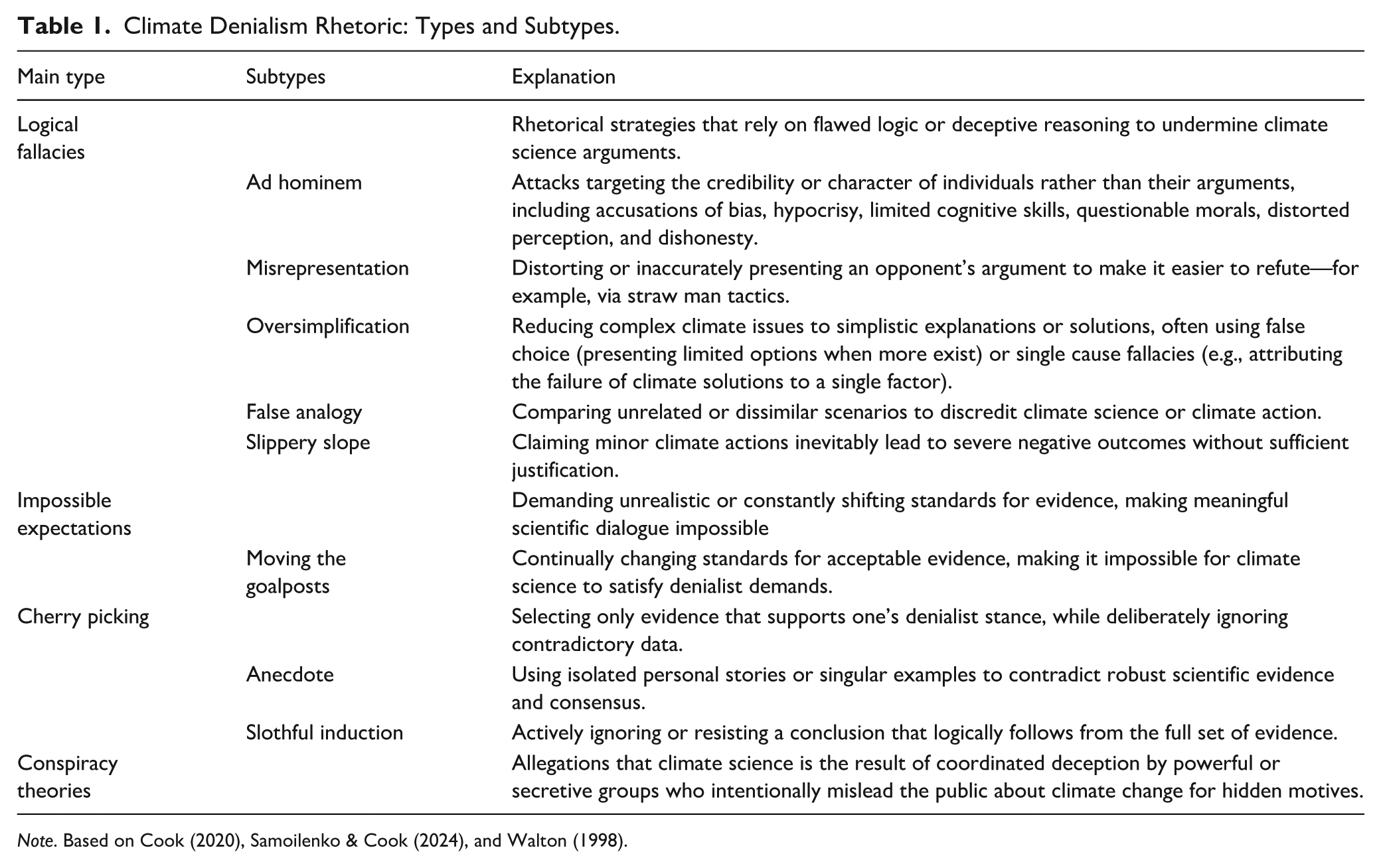
Note. Based on Cook (2020), Samoilenko & Cook (2024), and Walton (1998).
To ensure coding consistency, articles were independently coded by two coders (the author and a graduate student) in two steps. First, the coding framework was applied to a pilot subset of 20 articles. After resolving disagreements and refining the codebook, the coders proceeded to code the remaining sample. Overall, the codebook was applied reliably, as indicated by Krippendorff’s alpha scores exceeding the commonly accepted threshold of α = .80. To further assess agreement at the more fine-grained level of target × technique combinations, Jaccard similarity coefficients were also calculated (scikit-learn, n.d.). These showed an average of 0.90 (macro) and 0.85 (micro), confirming high consistency between coders in assigning the same denialist techniques to the same satirical targets. Detailed scores for each target and denialism technique category, along with a description of the calculation procedures, are reported in the Online Appendix.
To explore how The Babylon Bee crafts humor from climate denialist claims so that it resonates with like-minded audiences (RQ5), the analysis applied the General Theory of Verbal Humor (Attardo, 2017) to combinations of satirical targets and denialist techniques that showed strong statistical associations (see RQ4). GTVH builds on incongruity theory, which holds that humor arises when expectations are violated in surprising but playful ways. Incongruity is widely regarded as the most convincing of the classical humor theories, since it captures the cognitive processes involved in perceiving and resolving unexpected juxtapositions, and explains why humor depends on a non-serious “play frame” that invites audiences to treat contradictions as amusing rather than threatening. By contrast, relief and superiority theories, while historically influential, are now considered too narrow: relief theory focuses mainly on the release of tension, and superiority theory emphasizes ridicule and negative emotions such as scorn, neither of which accounts for the wide range of humorous experiences (Martin & Ford, 2018, ch. 2).
Building on this theoretical foundation, the analysis focused on two core dimensions of GTVH. Script oppositions capture the clash between incongruous scripts that underpin humorous texts, with one script explicitly stated in the text and the other retrievable from shared knowledge or easily inferred from context (Attardo, 2017, p. 134). Three basic types are relevant here: actual/non-actual, possible/impossible, and normal/abnormal. In a further step, the analysis identified the logical mechanisms that help readers resolve the incongruity between the two scripts, recognizing that there may be both a primary and a secondary path to resolution. For this step, the analysis drew on established classifications of logical mechanisms developed within GTVH (Attardo et al., 2002). This interpretive process follows previous studies (e.g., Fiadotava et al., 2023) that have applied GTVH to analyze the role of humor in spreading science denialism. See the Online Appendix for more details and an illustrative example. Note that while GTVH also includes target as a conceptual dimension, this is already accounted for in the study through the coding of satirical targets.
Findings
Before examining the targets and techniques of climate denialist satire in detail, it is important to establish the longitudinal distribution of output: when does The Babylon Bee choose to satirize climate change? The answer speaks directly to RQ1, which asks whether denialist satire follows the rhythms of the news cycle or circulates more independently.
The longitudinal data suggest the former. Between 2016 and 2024, The Babylon Bee did not produce a steady stream of climate denialism, but instead published such articles in distinct peaks (Figure 1). Very few denialist articles appeared prior to 2018, reflecting the site’s initial focus on Christian satire before its reorientation toward political issues and increased daily output following the change of ownership. However, even after 2018, coverage of climate change denialism did not become routine, with long stretches of little or no content punctuated by sudden bursts of activity. These peaks corresponded with moments when climate change was especially prominent in news coverage and political debate, both in the United States and globally.
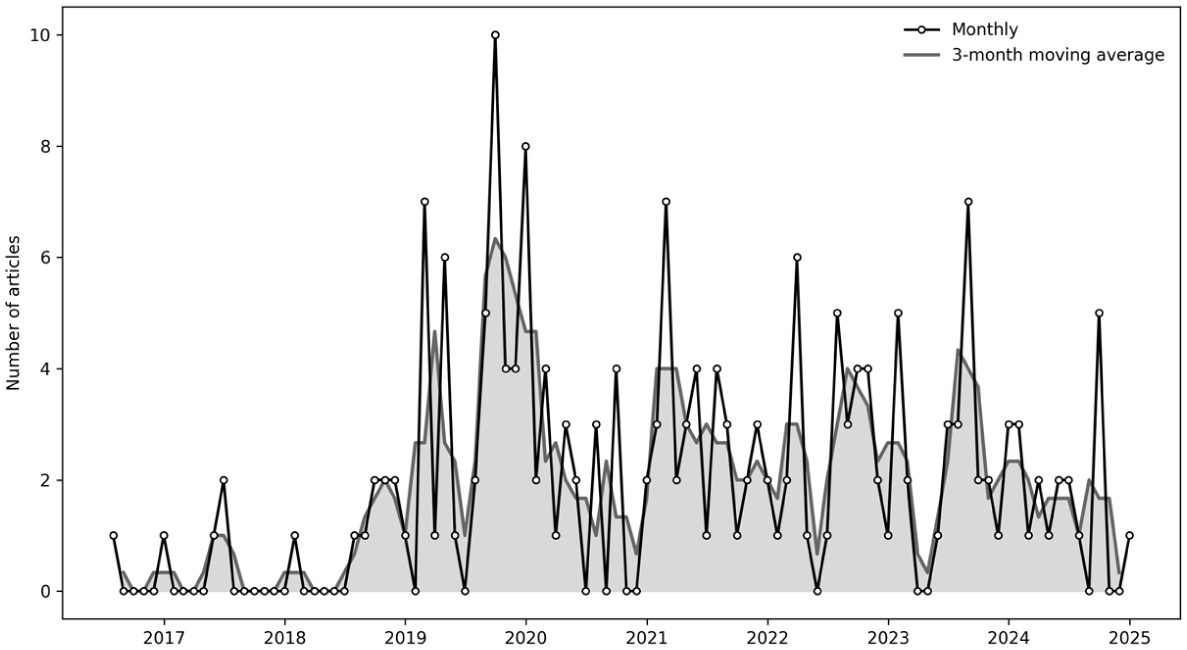
Tracking Climate Denialism Articles Over Time.
The early 2019 surge coincided with the introduction of the Green New Deal resolution in the U.S. Congress by Alexandria Ocasio-Cortez and other Democrats, which offered abundant fodder for satire. A larger cluster in late 2019 and early 2020 aligned with the global Climate Strike wave, Greta Thunberg’s “How dare you” speech at the UN, and the CNN Democratic Climate Town Hall. Another spike in early 2021 followed Joe Biden’s day-one climate actions, the Texas power grid crisis, and U.S. re-entry into the Paris Agreement. In mid-to-late 2022, output rose again around the signing of the Inflation Reduction Act (the largest piece of U.S. climate legislation to date), California’s adoption of its 2035 zero-emission new-car mandate, and a wave of high-salience activism in Europe, including soup thrown on van Gogh’s Sunflowers, mashed potatoes on Monet, and Letzte Generation blockades of roads and airports in Germany. Finally, the mid-to-late 2023 peak paralleled the global “End Fossil Fuels” weekend of protests across more than 60 countries, Greta Thunberg’s arrest at demonstrations in London, and devastating wildfires in Maui and along the U.S. West Coast—events that fueled both scientific explanations linking climate change to extreme weather as well as political debates over preparedness and response.
A total of 290 satirical targets were identified across the 196 Babylon Bee articles (RQ2). Of these, the majority (74.5%) are individuals or groups, while the remainder encompasses climate science and proposed climate solutions (Figure 2). Politicians are the most frequently featured targets, accounting for 31% of all instances. With very few exceptions (such as French president Emmanuel Macron), all satirized politicians are U.S. Democrats, including figures such as Joe Biden, Bernie Sanders, Alexandria Ocasio-Cortez, and Gavin Newsom. The next most frequent targets are climate activists (14.5%)—a category that comprises mainly environmentalists as an abstract collective but also Greta Thunberg as an individual—and climate solutions (14.5%), ranging from policy interventions (e.g., the Green New Deal) to technological innovations (e.g., solar geoengineering). Scientists are also a common focus, appearing in nearly 8% of coded targets. Other groups—including the media, liberals, celebrities, companies, and elites—each appear in fewer than 6% of cases. Targets relating to climate science are more dispersed, with references to the effects of climate change (5.5%), its causes (2.4%), and its very reality (2.4%) registered less frequently than critiques of climate solutions.
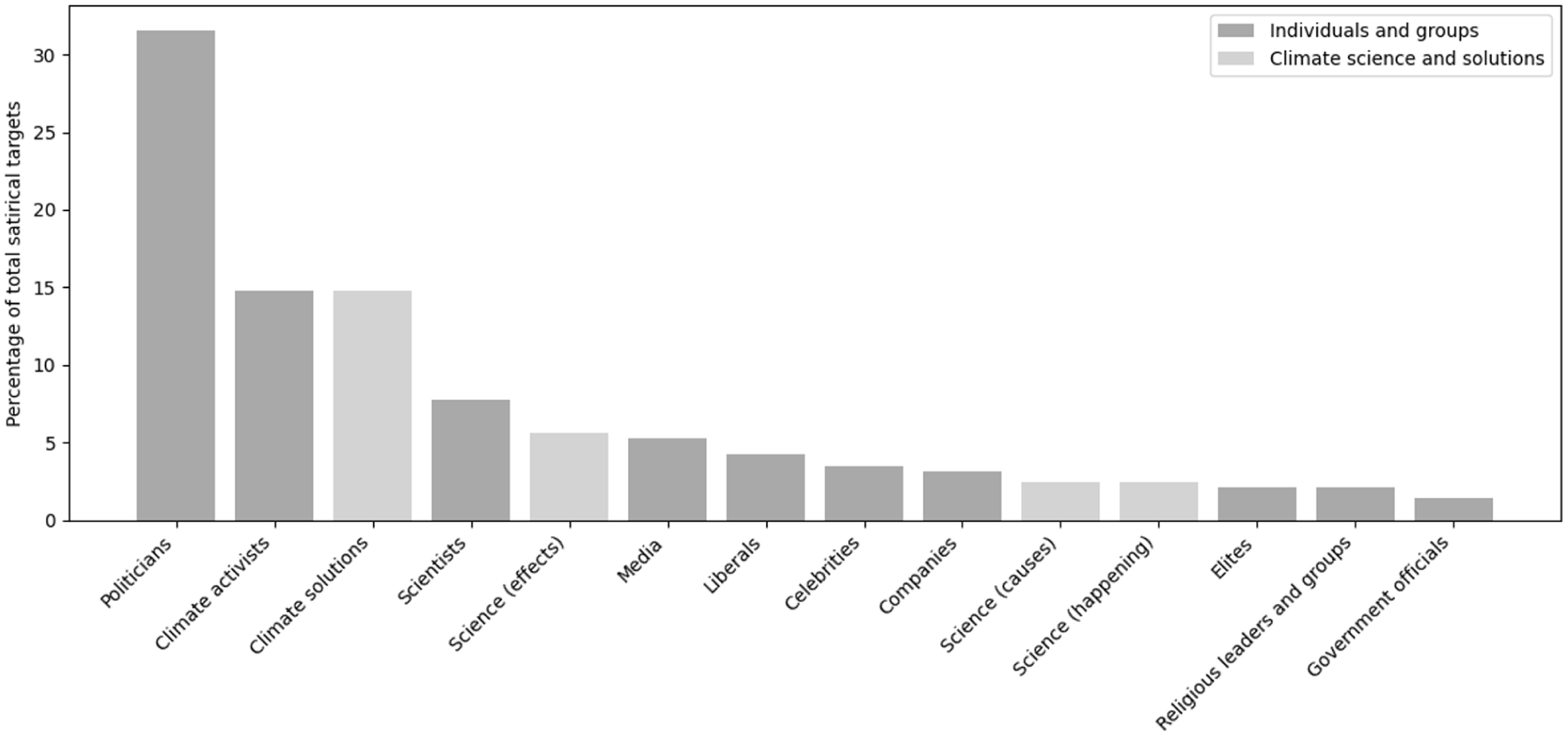
Satirical Targets.
Turning to RQ3, the analysis reveals that ad hominem attacks are by far the most frequent type of denialism technique employed in the Babylon Bee articles (Figure 3). Together, the six ad hominem subtypes account for 54.1% of all coded techniques. Given that most satirical attacks were directed at individuals or social groups, it is not surprising that character-based ridicule plays such a central role in The Babylon Bee’s climate coverage. The most common ad hominem subtype is perception (13.8%), which mocks targets for being out of touch with reality or the societal mainstream. This is followed by bias (12.8%), where targets are portrayed as being motivated by political ideology or personal gain, or as overly emotional or alarmist in their communication of climate issues. The third most common subtype is moral (11.7%), which accuses targets of either moral inconsistencies or an inflated sense of moral superiority. Circumstantial attacks (9.7%) focus on perceived hypocrisy, while cognitive (3.4%) and veracity (3.1%) suggest the target is unintelligent or dishonest, respectively.
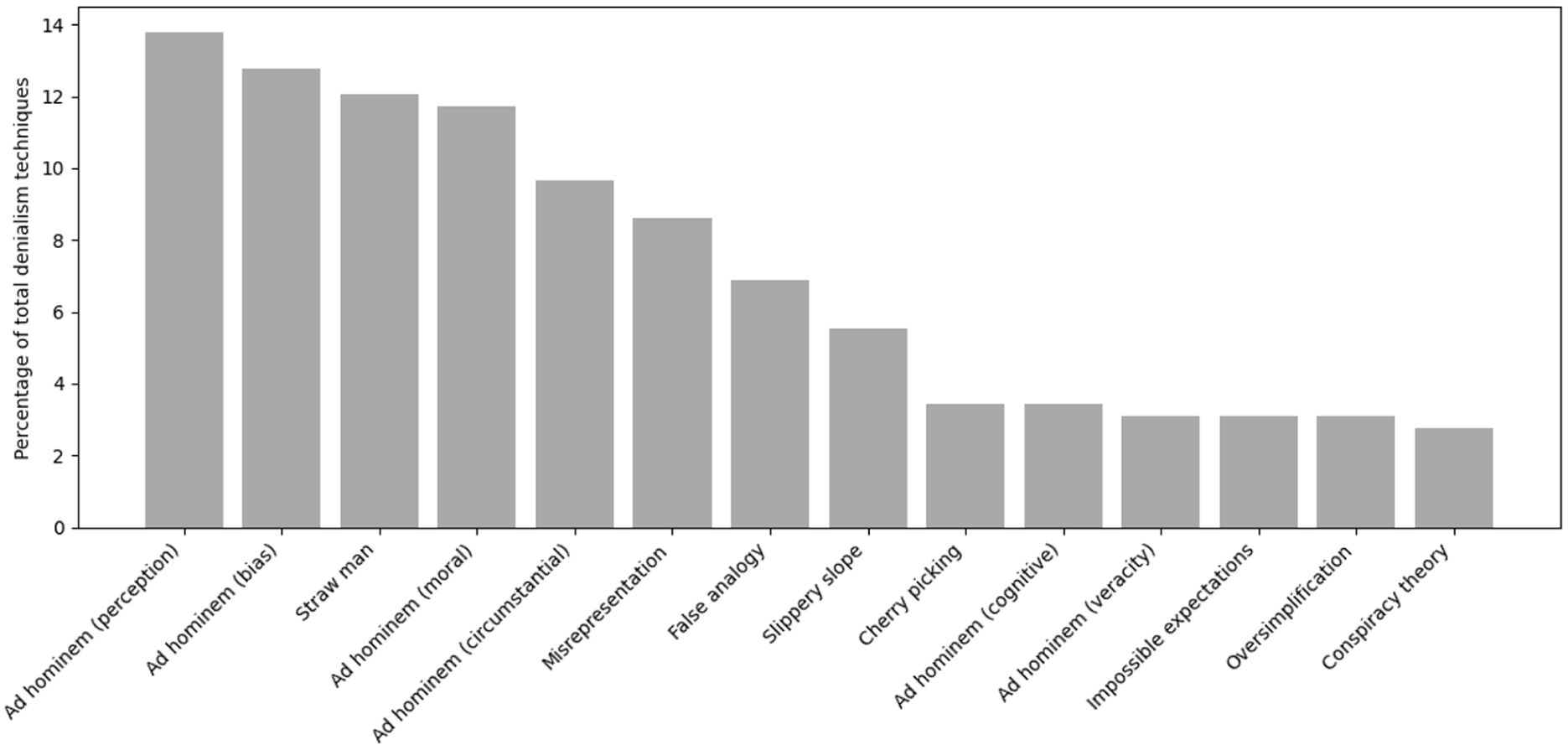
Climate Denialism Techniques.
Among the remaining techniques, straw man arguments (12.1%) and misrepresentation (8.6%) feature prominently. The former involves exaggerating or inventing a specific position to ridicule it, whereas the latter is a broader category that encompasses more general distortions of reasoning or logic—for example, mischaracterizing the scientific method. Other techniques include false analogy (6.9%), which draws flawed comparisons; slippery slope (5.5%), which suggests that climate action will inevitably lead to absurd or extreme consequences; and cherry picking (3.4%), which selectively highlights evidence that supports the denialist point. Comparatively few articles featured impossible expectations (3.1%), oversimplification (3.1%), or conspiracy theories (2.8%).
To examine the associations between satire targets and specific climate denialism techniques (RQ4), two separate Multiple Correspondence Analyses (MCA) were conducted using the prince Python library (see Online Appendix for more details), complemented by chi-square tests. The first MCA (Figure 4) focuses on the three most frequently targeted social actors: politicians, climate activists, and scientists. This narrowed scope improves visual clarity and ensures more robust statistical interpretation by focusing on frequently occurring categories and avoiding the instability introduced by sparse data. Among the most prominent patterns is the strong clustering of climate activists with several ad hominem subtypes—most notably moral attacks (χ² = 36.05, p < .001), perception-based ridicule (χ² = 10.53, p < .01), and cognitive attacks (χ² = 7.79, p < .01). These results suggest that activists are mocked for perceived moral superiority, being out of touch with reality, and lacking rational thought. Politicians, by contrast, are closely associated with straw man arguments (χ² = 11.33, p < .001), misrepresentation (χ² = 8.01, p < .01), and ad hominem (veracity) attacks (χ² = 7.36, p < .01), reflecting a strategy of distorting their positions and questioning their honesty. Politicians are also linked to perception-based ridicule (χ² = 6.80, p < .01) and circumstantial ad hominem or hypocrisy (χ² = 4.27, p < .05). Finally, scientists are significantly associated with false analogy (χ² = 6.82, p < .01) and impossible expectations (χ² = 5.40, p < .05), indicating that satire often employs flawed comparisons or imposes unrealistic standards of proof.
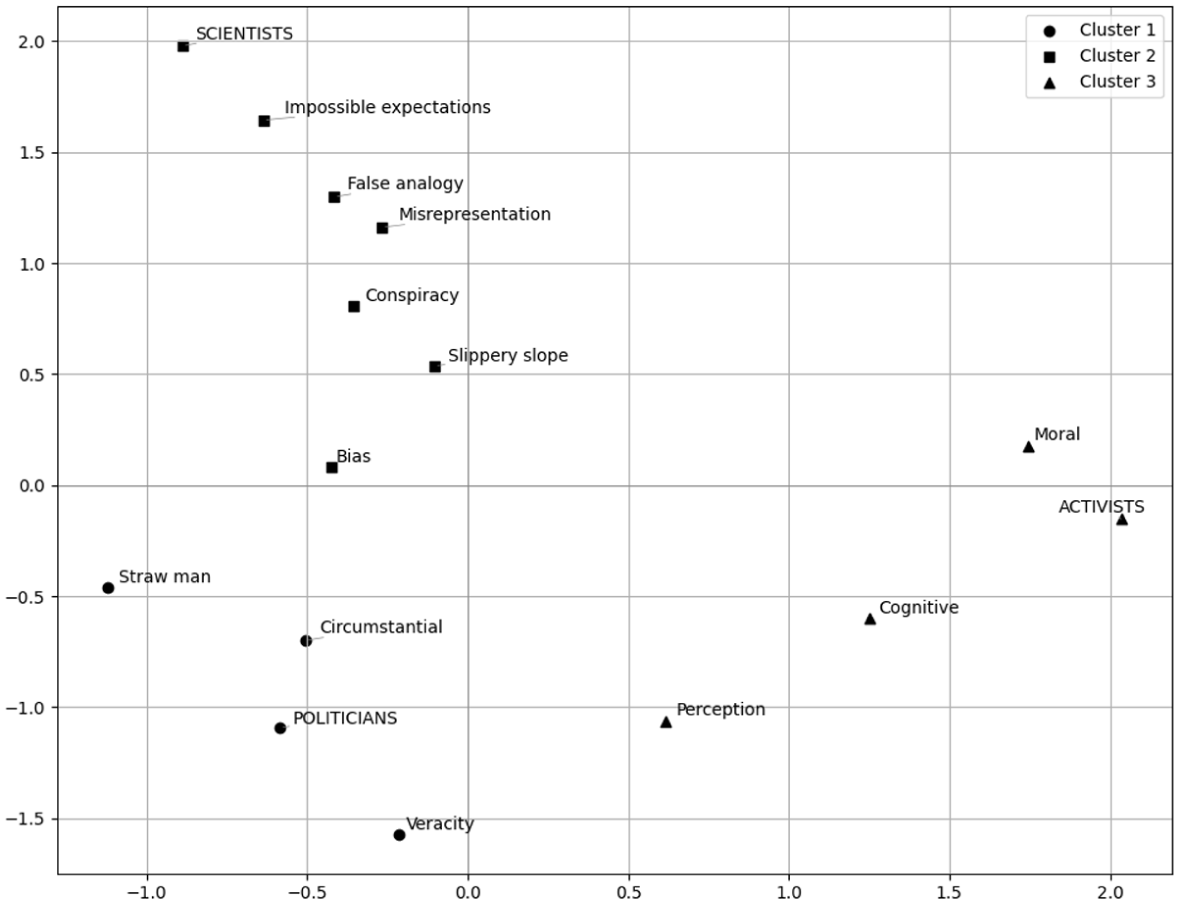
MCA With K-means Clustering: Individuals and Groups.
Meanwhile, ad hominem (bias)—the second most frequent denialism technique in the dataset—appears near the center of the MCA plot, suggesting that it functions as a flexible, cross-cutting strategy. Unlike techniques that are statistically overrepresented in specific contexts, bias is not strongly associated with any single satirical target. This lack of clustering indicates that bias-based attacks are used broadly to undermine politicians, climate activists, and scientists alike. In other words, ad hominem (bias) appears to function as a general-purpose rhetorical device for discrediting climate messengers and casting doubt on their motivations.
To begin addressing RQ5, the following interpretive illustrations examine how these quantitative patterns materialize in specific texts. The article “In climate change measure, White House looks into blocking sunlight using your mom” (The Babylon Bee, 2023a) exemplifies the common politician/straw man combination in climate denialist satire. The background to the article is this: in mid-2023, the Biden administration publicly expressed cautious interest in researching solar geoengineering as a potential climate intervention. However, rather than engaging with the substance of this proposal, the Babylon Bee article exaggerates it into an absurd claim—that the White House plans to use “your mom” to block sunlight—thereby ridiculing a complex scientific idea through distortion. When applying the GTVH framework, it becomes evident that the humor relies on a possible/impossible script opposition, turning a real (albeit speculative) policy discussion into a patently unfeasible scenario. This incongruity is resolved through the logical mechanisms of exaggeration and juxtaposition: the scale of climate action is inflated to absurdity and a juvenile punchline is inserted into the realm of serious policymaking. The result is a satirical dismissal that seeks to undermine Biden’s credibility on climate policy.
The article “New Greta Thunberg thermostat scowls at you when you turn the heat up” (The Babylon Bee, 2022a) is a clear instance of the strongly correlated climate activists/ad hominem (moral) combination. It targets climate activist Greta Thunberg by mocking her as self-righteous and overbearing. Instead of seriously confronting her climate arguments, the article discredits Thunberg by attacking her perceived moral authority. Through the absurd premise of a “Greta thermostat” that scowls when users dial up the heat, the satire frames Thunberg as an intrusive moral enforcer, eager to shame others for their everyday choices. Read through the GTVH framework, the humor is structured around a normal/abnormal script opposition: something that is normally considered a mundane act (adjusting a thermostat) becomes a morally loaded decision subject to activist scrutiny. This incongruity can be worked out via the logical mechanisms of exaggeration and juxtaposition, which amplify Thunberg’s authority to the point of absurdity and insert her climate messaging into an ordinary domestic setting, thus undermining its seriousness by rendering it as out-of-place overreach.
The Babylon Bee article “Scientists who didn’t predict a single thing accurately for the last 12 months confident they know what the weather is going to be like in 100 years” (The Babylon Bee, 2020) offers an example of how scientists are often targeted with false analogy and impossible expectations rhetoric. Rather than challenging climate models directly, the article discredits climate scientists by drawing a flawed comparison to early COVID-19 forecasting errors. This false analogy equates two fundamentally different domains—a fast-moving, novel pandemic and long-term climate modeling—suggesting that failure in one invalidates credibility in the other. At the same time, the article imposes an impossible expectation: that scientists must deliver perfect predictive accuracy across all domains to be considered trustworthy. The humor relies on a normal/abnormal script opposition: instead of adhering to scientific norms of knowledge advancement and cautious confidence, the scientists are depicted as abnormal—offering trivial observations (“Fire hot!”) and absurdly imprecise forecasts (“the earth’s average temperature will be either 1 million degrees Celsius or below freezing, give or take 1 million degrees”). Logical mechanisms that help resolve this incongruity include false analogy, which recycles distrust from failed COVID-19 forecasting and transfers it onto climate science, and exaggeration, which inflates ordinary scientific uncertainty into the caricature that scientists were wrong about every COVID prediction.
“Experts advise responding to heat wave by staying indoors and paying more taxes to the government” (The Babylon Bee, 2023b) illustrates how The Babylon Bee uses ad hominem (bias) to attack both scientists and politicians. Scientists are referred to vaguely as “experts,” whose advice (“stay indoors and pay more taxes”) is framed as politically motivated rather than scientifically grounded. Politicians are portrayed as exploiting extreme weather events to expand government control and extract revenue, as seen in the suggestion that “tax increases are the only way to stop climate change.” The satire relies on a normal/abnormal script opposition: instead of offering reasonable coping strategies during a heat wave, the “experts” are depicted as prescribing far-removed policy solutions. The humor unfolds through juxtaposition, by pairing a reasonable health suggestion (“stay indoors”) with a nonsensical tax mandate, and through inferring consequences, by suggesting that paying taxes could directly lower global temperatures.
The second MCA (Figure 5), supported by chi-square tests, reveals distinct patterns in how Babylon Bee satire targets climate science and climate solutions (RQ4). Satirical attacks on climate science (causes and evidence) are closely linked to cherry-picking (χ² = 39.71, p < .001), which discredits scientific consensus by highlighting isolated data points or anomalous events. Attacks on climate science (effects) are significantly associated with straw man arguments (χ² = 4.11, p < .05), which exaggerate or fabricate predictions to make climate impacts appear absurd or alarmist. Climate solutions, meanwhile, are strongly targeted through slippery slope (χ² = 79.27, p < .001), oversimplification (χ² = 47.95, p < .001), and straw man (χ² = 4.11, p < .05). These techniques frame proposed policies as senseless or extreme, often depicting modest interventions as instances of government overreach.
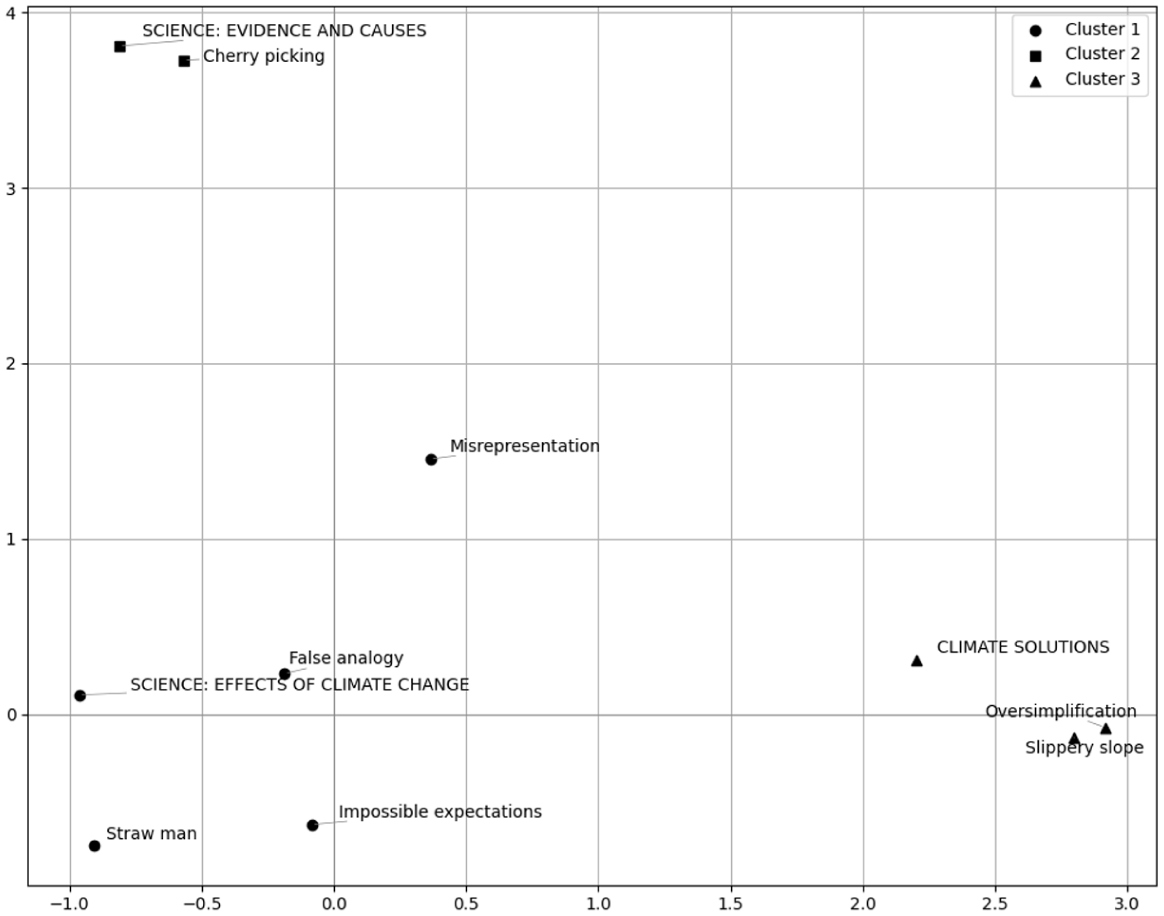
MCA With K-means Clustering: Climate Science and Solutions.
Alongside these target-specific patterns, misrepresentation occupies a central position in the MCA plot. Rather than clustering with a single target, misrepresentation is statistically overrepresented across all three satirical targets: scientific evidence for and causes of climate change (χ² = 11.67, p < .001), scientific evidence for the effects of climate change (χ² = 8.18, p < .01), and climate solutions (χ² = 12.22, p < .001). This suggests that misrepresentation—similar to ad hominem (bias)—serves as a versatile, cross-cutting denialism technique. In particular, misrepresentation offers a rhetorical shortcut that enables satire to distort climate science and action into a message that can be readily dismissed or ridiculed.
Returning to the qualitative dimension of the analysis (RQ5), the article “Green New Deal promises energy-efficient gulags in every neighborhood” (The Babylon Bee, 2019) helps illustrate how the climate solutions/slippery slope correlation operates in satirical form. The article portrays an environmental policy as a dystopian political regime, discrediting climate solutions by implying that they will inevitably spiral into tyranny. The humor is structured around an actual/non-actual script opposition: a fictional dystopian scenario in which the Green New Deal establishes “energy-efficient gulags” is treated as if it were an actual policy proposal. The incongruity can be resolved through two key logical mechanisms: juxtaposition, which places the language of sustainability alongside imagery of repressive violence, and exaggeration, which inflates policy intentions into Orwellian extremes.
The article “‘Let them drive Teslas!’ says Pete Buttigieg clad in elaborate 18th-century royal gown” (The Babylon Bee, 2022b) illustrates how oversimplification—particularly the false choice subtype—is frequently used to discredit climate solutions. It presents a caricature of Buttigieg offering electric vehicles (EVs) as a simplistic, one-size-fits-all answer to fuel shortages and climate change: people must either adopt costly EVs or be left stranded. This binary framing erases the complexity of decarbonization and falsely positions EVs as the only viable option, ignoring broader structural or transitional policies. By explicitly echoing Marie Antoinette’s infamous “let them eat cake,” the satire implies that climate policy is oblivious to material inequality. The article also exemplifies the common politician/ad hominem (perception) pairing: instead of grappling with the substance of the Biden administration’s climate agenda, Buttigieg is mocked for his perceived elitism and detachment from everyday Americans. The humor derives its effect from a normal/abnormal script opposition, depicting Buttigieg in violation of basic norms of democratic discourse and accountability. Logical mechanisms include exaggeration, which transforms the secretary of transportation into a grotesque aristocratic caricature, and analogy, which equates the Biden administration’s climate policy with pre-revolutionary France (Figure 6).
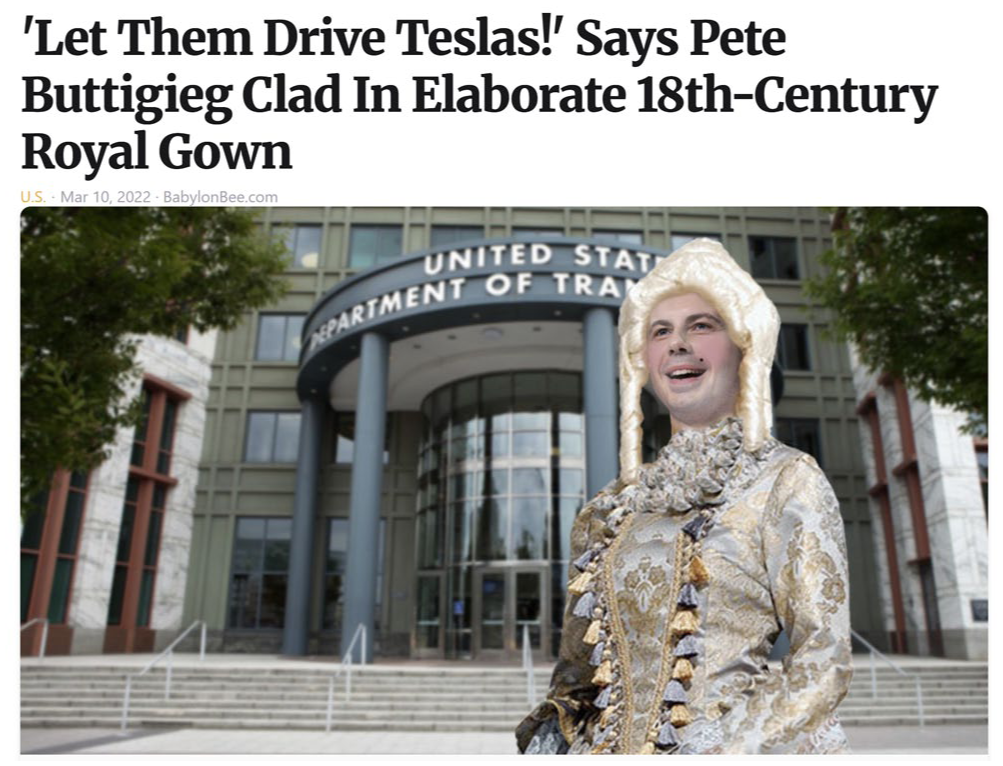
Babylon Bee Screenshot. © The Babylon Bee; reproduced under the fair use provisions of U.S. copyright law (17 U.S.C. §107) for the purpose of academic commentary and research.
While climate science is not the most frequent target of Babylon Bee satire, numerous articles do seek to discredit scientific evidence. The article “Southern California covered in 6 feet of global warming” (The Babylon Bee, 2023c) shows how the cherry-picking technique—particularly in the form of anecdotal evidence—can be used to undermine the scientific consensus that climate change is happening. By highlighting an isolated snowfall and sarcastically attributing it to “global warming,” the article mocks the logic and credibility of climate science itself. The humor operates through a normal/abnormal script opposition: a headline that appears to describe an extreme weather event (6 feet of snow) is reframed as the abnormal claim that the snow itself constitutes “global warming.” The primary logical mechanism is garden path, leading readers to expect a conventional weather report before abruptly flipping to a satirical climate reference. This is reinforced by exaggeration, which ridicules science by inflating the effects of climate change into absurd extremes (“Run for your lives, my fellow humans!”). Meanwhile, “From tornadoes to myocarditis, here are the 9 worst effects of climate change” (The Babylon Bee, 2021b) illustrates the use of misrepresentation, inflating scientific predictions to the point of ridicule. Here, a possible/impossible script opposition—attributing implausible outcomes to climate change—is resolved through coincidence, which treats unrelated events as if their simultaneity with climate change proves causation, and exaggeration, which blames climate change for everything from inflation to the Fyre Festival.
Discussion
This study set out to examine how The Babylon Bee contributes to the circulation of climate change denialism through its satirical coverage. The temporal distribution of articles demonstrates that Babylon Bee coverage of climate and environmental issues is closely tied to the rhythms of the news cycle. Rather than producing a steady flow of content, the satire clustered around moments when climate change dominated headlines, suggesting that its editorial decisions respond opportunistically to topical salience. This finding adds further evidence to scholarship showing that The Babylon Bee imitates mainstream journalism (Brugman et al., 2022; Skalicky & Chen, 2023): not only does it reproduce the stylistic and rhetorical conventions of news reporting, but its coverage also mirrors the temporal dynamics of news itself.
Coding articles for satirical targets and denialist techniques reveals clear patterns in Babylon Bee climate change denialism. In terms of the messengers who communicate climate information, satire primarily targets politicians and climate activists, while the scientific process is discredited more indirectly, through ridicule of scientists rather than abstract reasoning and methods. Distrust of climate solutions is propagated by satirizing both the solutions themselves and the politicians who promote them. Importantly, the analysis also shows that different targets tend to be associated with specific denialist techniques. This suggests that the rhetorical form of the satire is not random: the choice of target appears to shape the type of denialism strategy deployed. Both the mechanics of satire—exposed through a qualitative application of GTVH—and the core tenets of conservative ideology help explain these patterns.
On the dimension of messengers, The Babylon Bee overwhelmingly targets politicians and climate activists because these figures are already symbolically charged within conservative discourse. Public personalities like Joe Biden and Greta Thunberg carry strong ideological associations, thus making them efficient vehicles for satirical attack. They also embody the visible face of climate action, which makes them a clearer and more emotionally resonant target than distributed actors such as news media or corporations. Conservative ideology adds further explanatory insight. From a free-market standpoint, and clearly illustrated by the “Experts advise . . .” article (The Babylon Bee, 2023b), politicians and activists are associated with government intervention and regulation—and thus pose a threat to core principles of individual liberty and minimal state control. Similarly, MFT helps explain the emotional appeal of this type of satire for conservative audiences, who are especially attuned to values like loyalty, authority, and purity. Politicians and activists who appear to undermine these values—by challenging established hierarchies or signaling moral superiority—become especially potent targets for ridicule, as seen in the “Thunberg thermostat scowls . . .” article (The Babylon Bee, 2022).
As the cluster analysis demonstrates, liberal figures are often targeted through ad hominem attacks, which mock personal traits, motives, or perceived hypocrisy. Such attacks may strike a chord with conservative audiences not only because they sidestep substantive debate, but also because they reinforce existing stereotypes of the political out-group. By portraying personalities such as Biden, Sanders, AOC, or Thunberg as biased, alarmist, or morally self-righteous, Babylon Bee satire implicitly casts conservatives as their opposites: rational, grounded, and morally restrained. In this way, ad hominem satire does more than discredit individual messengers—it helps construct and affirm group identities, positioning the conservative in-group as sensible and balanced in contrast to an exaggerated, emotionally driven out-group. This dynamic aligns with existing arguments about satire, which suggest that ridicule of ideological opponents can serve not only to delegitimize them, but also to strengthen internal cohesion within the satirist’s own audience (e.g., Becker, 2020, pp. 280–281; Feldman, 2017, p. 328).
On the dimension of the scientific process, The Babylon Bee overwhelmingly targets scientists rather than abstract approaches to evidence. This rhetorical move allows the satire to frame scientists as part of the broader liberal “climate establishment”—a politicized elite aligned with activists, politicians, and progressive agendas. The “Experts advise . . .” article (The Babylon Bee, 2023b) is a clear example: by mocking scientists’ alleged biases, the satire repositions them not as neutral experts, but as ideologically compromised actors operating in coordination with others who seek to transform the current social and economic order. SJT and SDO help sharpen this analysis: for audiences motivated to defend existing hierarchies and resist systemic change, framing scientists as disruptive actors—rather than apolitical conveyors of evidence—speaks to deeper ideological anxieties about regulation, redistribution, and progressive challenges to the social and economic status quo.
Satire’s reliance on exaggeration and absurdity makes it a particularly effective vehicle for launching false analogy and impossible expectations attacks against scientists. These techniques are pushed to extremes: scientific projections are likened to laughably flawed comparisons, or scientists are mocked for failing to deliver perfect certainty in the face of complex, probabilistic phenomena. As discussed earlier, the article “Scientists who didn’t predict a single thing . . .” (The Babylon Bee, 2020) exemplifies both techniques. Not only does the piece flatten the distinction between pandemic and climate forecasting to deliver a false analogy, it also imposes impossible expectations by ridiculing statistical confidence intervals as evidence of incompetence.
On the dimension of climate solutions, The Babylon Bee uses satire to undermine both the proposals put forward and the political figures associated with them. These attacks follow two distinct rhetorical strategies. First, some articles employ the slippery slope technique to exaggerate climate solutions into dystopian threats—for example, by portraying policies as precursors to totalitarian control, as in “Green New Deal promises energy-efficient gulags” (The Babylon Bee, 2019). Second, other articles disarm climate solutions by ridiculing them into absurdity, using misrepresentation, straw man, or oversimplification techniques to depict policies as laughably naive or incoherent. In this framing, exemplified by the “Let them drive Teslas” article (The Babylon Bee, 2022b), the threat is not amplified but nullified: climate solutions are no longer radical, they are ridiculous. Both strategies cast climate action not as responsible governance, but as either a threat to the existing social and economic order or a symptom of “climate establishment” absurdity. As with The Babylon Bee’s use of ad hominem attacks, this rhetorical strategy aligns with strong system justification motives among conservatives and with free-market ideology, which sees interventionist climate policy as an encroachment on individual freedom.
Overall, the findings of this paper show how satire reinforces core tenets of conservative ideology—particularly suspicion of government regulation and overreach, and defense of the social and economic status quo. In doing so, it contributes to our understanding of how denialist messaging can become intertwined with broader cultural and political identities (e.g., Hoffman, 2015). Rather than merely opposing climate science on empirical grounds, Babylon Bee satire affirms group belonging for readers by portraying the out-group (e.g., Democrats, climate activists, and scientists) as alarmist, irrational, or elitist. Importantly, the analysis also highlights that such satire—because it operates largely through implication, character attack, and exaggerated association—often eludes conventional forms of rebuttal or fact-checking. In doing so, this study demonstrates how climate change denialism is no longer expressed primarily through overt rejection of evidence, but increasingly through subtler discursive strategies.
However, there is a need to acknowledge the limitations of the paper. First, the sample includes only satirical articles that directly reference climate change. Yet climate-related messaging may also be embedded in humor that primarily addresses other topics. For example, the Babylon Bee article “13 most surprising things in the new spending bill” (The Babylon Bee, 2024) includes the fabricated budget item “$370 million to study the effects of climate change on gender fluid salamanders,” thus deploying the misrepresentation denialism technique without climate change being the main focus. Limiting the sample to articles with explicit climate framing may therefore underestimate the scope and frequency of denialist messaging. Relatedly, problematic—though not necessarily outright denialist—rhetoric may also be found in mainstream comedy and satire, for instance when humor ridicules ordinary people who express environmental concern (Carter, 2023; Little, 2022). Second, the paper focuses exclusively on The Babylon Bee, which—while prominent—is only one part of a broader conservative humor ecosystem (see Sienkiewicz & Marx, 2024). Other sources of denialist humor (e.g., memes, stand-up) may mock different targets or rely on different rhetorical techniques, which limits the generalizability of the findings. Third, the paper analyzes how Babylon Bee articles are constructed but does not examine how they are interpreted or received by readers. As such, it cannot make claims about the effects of satirical climate denialism—whether it persuades, reinforces prior beliefs, or is dismissed as harmless humor. In other words, the paper does not provide any insight into how conservative satire actually shapes public attitudes toward climate change.
Future research can address these limitations by analyzing satire that references climate change indirectly, expanding the sample beyond The Babylon Bee, and investigating how audiences interpret and respond to denialist humor through empirical methods such as experiments and focus groups.
Supplemental Material
sj-pdf-1-scx-10.1177_10755470251391686 – Supplemental material for “All Scientists Forced to Retire After Realizing the Science Is Now Settled”: The Role of Right-Wing Humor in Spreading Climate Change Denial
Supplemental material, sj-pdf-1-scx-10.1177_10755470251391686 for “All Scientists Forced to Retire After Realizing the Science Is Now Settled”: The Role of Right-Wing Humor in Spreading Climate Change Denial by Olli Hellmann in Science Communication
Footnotes

Ethical Approval and Informed Consent Statements
N/A.
Funding
The author received no financial support for the research, authorship, and/or publication of this article.
Declaration of Conflicting Interests
The author declared no potential conflicts of interest with respect to the research, authorship, and/or publication of this article.
Data Availability Statement
The list of the 196 articles analyzed, along with their corresponding target and denialism technique codings, is available from the author upon request.
Author Biography
References
Supplementary Material
Please find the following supplemental material available below.
For Open Access articles published under a Creative Commons License, all supplemental material carries the same license as the article it is associated with.
For non-Open Access articles published, all supplemental material carries a non-exclusive license, and permission requests for re-use of supplemental material or any part of supplemental material shall be sent directly to the copyright owner as specified in the copyright notice associated with the article.
