




Abstract
Making science communication more inclusive is as much about how the discipline itself works as it is about how we engage with our audiences. This paper presents a framework comprised of the factors we identify as critical for inclusive science communication derived from our perspectives as practitioners and researchers in the southern hemisphere and/or from the Global South. The intent is to add to existing frameworks and studies, predominantly from the northern hemisphere/Global North to stimulate further discussion among, and guidance for, science communication researchers and practitioners in thinking of and about inclusive science communication.
Keywords
Introduction
In a commentary prefacing a special issue in the Journal of Science Communication, Massarani and Merzagora (2014) write about placing “social inclusion and political engagement at the heart of the values of science and science communication” (p. 2). In the subsequent 10 years, an increasing focus on “inclusive science communication” has been seen in the literature and rhetoric within the discipline (Bevan et al., 2020; Judd & McKinnon, 2021). While presenting a wide range of perspectives on what counts as inclusion, they often focus on a single aspect of identity, typically binary gender (Judd & McKinnon, 2021). Others have focused on broader notions of identity (Rodrigues et al., 2023) and inclusion as a form of social justice (Polk & Diver, 2020). Calabrese Barton and Tan (2020) noted the tendency for “equity as inclusion” approaches to promote the rights of marginalized audiences and provide new opportunities. However, they note “. . .it does little to account for whose values undergird these rights,” meaning these groups may still need to conform to dominant cultural values (Calabrese Barton & Tan, 2020, p. 435), leaving systemic barriers intact. Therefore, facilitating equity and inclusion requires a deep understanding of associated practical, cultural, and systemic issues. Inclusive science communication theory and practice is no exception.
This paper describes a framework for considering inclusive science communication holistically to meaningfully address several barriers and misconceptions, from the perspective of researchers and practitioners in the southern hemisphere. The purpose of this paper is not to advocate that all science communication should be pursuing inclusion. Certainly, it is an ideal; according to the United Nations Declaration on Human Rights, the right to science is a human right. However, in some countries, attempting to share information or remove structural and political barriers may have serious consequences. Roedema and colleagues (2022) argue science communicators should be reflexive, aware of our emotions, values, worldviews and assumptions and how these connect to what we do and with whom. This is reflected in Canfield and Menezes’ (2020) conception of inclusive science communication practice as equity-based, intentional, reflexive and reciprocal. Equally, as Farida Shaheed, the former UN Special Rapporteur on Cultural Rights has clarified (Shaheed & Mazibrada, 2021), the Right to Science is not just about having access to knowledge and benefits created by others, i.e., scientists. Rather, it is about a fundamental right to creativity and hence, the right to contribute to the production and sharing of knowledge. Inclusion in this sense, could well mean in some cases, reversing the traditional focus on bringing the excluded Other into a dominant core science, to recognizing their creative epistemic capacities. This also may mean acknowledging the power imbalances which underpin many of the structures and policies inherent in science and its communication, which limit the ability of some to fully participate—even if they are ‘included’—as the next section describes.
The intent of this paper is to provide a structure for science communicators—in research, practice, or both—to guide thinking of and about intentional, reflexive, and reciprocal inclusive science communication. It builds on previous works by providing perspectives outside of North America, the UK and Europe, and demonstrates an inclusive science communication research approach. It is an invitation for all science communicators to reflect on whether the framework presented here is appropriate for their context, and to join a conversation about what inclusive science communication means globally. We argue the challenge of making science communication more inclusive is as much about how the field itself works, collaborates and interacts, as it is about producing content that is accessible to specific audiences. What does the field of science communication need to do in-house first, so we can do better when we—and hopefully more diverse actors—leave the house to engage publics?
Literature Review
Science is dominated by Western knowledge systems (Iaccarino, 2003) and operates predominantly in English (Montgomery, 2013), and this is echoed in science communication, with most of the discipline’s published research tending to come from the Global North (Gerber et al., 2020; Judd & McKinnon, 2021). Although the use of English has provided some advantage in the form of a shared language, facilitating communication across cultures and subsequent knowledge production (Lynch et al., 2021), it has also created barriers and inequities for nonnative English speakers (Pérez Ortega, 2020; Politzer-Ahles et al., 2020). English-language international journals are deemed more prestigious, meaning research published in languages other than English are perceived as of lesser quality, entrenching disparities in scientific knowledge production in countries with low English proficiency (Ramírez-Castañeda, 2020). This perception is reinforced within science communication research (Guenther & Joubert, 2017).
Knowledge derived from academic research is deemed more “valuable” (e.g., Nelson, 2015), while knowledge derived from lived experience (Newman et al., 2024; Wynne, 1992) or Indigenous knowledge systems (Seleti, 2012) is downplayed. Ignoring or devaluing these sources is detrimental to the diversity of thought and creativity, which can stimulate and support good science (Ramírez-Castañeda, 2020), along with its impactful communication and application. Considering knowledge a human right and broadening the recognition of, and engagement with, other traditional forms of knowledge could work to restore trust in scientific institutions (de Oliveira et al., 2021). Building and maintaining public trust is an ongoing and increasingly challenging task for science communicators around the world, and one that will fail if science communication continues to adhere to “the narrow premise of a one-dimensional Eurocentric framework” (Rasekoala, 2023, p. 244).
Inclusive Science Communication
Science communication tends to be “Western, white, ableist and patriarchal” (Canfield & Menezes, 2020, p. 13), indicating that as a discipline there is some way to go to be considered “inclusive.” Questions are also emerging over how we bound and define the field of science communication, particularly in the context of its traditional home in the communication of scientific information and the creation of scientific literacy (Bevan et al., 2020). Canfield and Menezes (2020) define science communication as “any information exchange designed to engage specific audiences in conversations or activities related to STEMM topics” (p. 8). Others seek to look beyond STEMM, broadening what counts as science and science communication, to account for various forms and sources of knowledge and to promote epistemic justice (see Bevan et al., 2020; McEntee et al., 2024; Medvecky, 2018; Raman, 2023). Finlay and colleagues (2021, p. 7) offer a definition of science communication which implies a move toward more inclusive practice, describing a “journey of iterative, endless cycles of reflection and practice to co-develop inclusive, relevant, equitable and useful science communication, together.” How this is enacted in reality still appears to be a work in progress with Rasekoala (2023) calling for the development of “a broader framework for science communication that will transcend the Global North-South divide to explain the challenges in different contexts. . .” (p. 239).
Previous studies have sought to develop such frameworks, or at least further our understanding of what science communication—and those who work within it—should “do.” In their State of Science Communication landscape study, Canfield and Menezes (2020) noted that although much work on components of inclusive science communication already existed, it was siloed. To accelerate the transition to science communication that is “inclusive and equitable by default” (Canfield & Menezes, 2020, p. 3), they made several recommendations, including to: embed the key traits of inclusive science communication in all practice, validate context-dependent approaches, collaborate, embrace transdisciplinary and intersectoral expertise, and incorporate and evaluate inclusive science communication curricula and training. Two years after the publication of the landscape study, a symposium on advancing inclusive science communication in the United States showed many barriers still remain (Menezes et al., 2022). Core among these is the need for evaluation and far greater collaboration across settings, in research and professional communities of practice (Menezes et al., 2022). Rasekoala (2023) echoes this, asserting that mutual learning between Global North and Global South would help transform science communication. This paper seeks to answer some of these calls by broadening the framework for science communication (Finlay et al., 2021) by presenting perspectives from academics and practitioners from the southern hemisphere and Global South in the hope of helping to bridge the Global North-South divide (Rasekoala, 2023) and support more nuanced conversations among science communicators globally.
Arguably, an important community of practice in science communication are those new to the discipline, or who participate casually. What they learn will shape their perceptions and actions and either reinforce exclusion or reimagine what could be. This is shown through the development of core competencies for teaching science communication, which include references to understanding and awareness of the influence of different contexts on opportunities and resources, issues of equity and inclusion and how to work with, rather than for or on, marginalized communities (Baram-Tsabari & Lewenstein, 2017; Lewenstein & Baram-Tsabari, 2022). Responses to these competencies from science communicators suggest that they are useful but suggest placing inclusion and accessibility more explicitly in the framework as its own threshold concept category (Wilkinson & Webber, 2024) along with another category for cultural communication and different knowledge systems (Stocklmayer et al., 2024).
In training science communicators, we also need to acknowledge the inequalities that exist within science communication. Valdez-Ward and colleagues (2023) note that participants from marginalized backgrounds are largely unseen and undervalued in science communication. To address this, they organized a training space that emphasizes recognizing and embracing intersectionality, intentional organization and inclusion from the leadership down, and exhorts science communication trainers and organizers to examine themselves and their organizations to reflect on how they may be reinforcing or reproducing inequities (Valdez-Ward et al., 2023). A similar self-reflective theme is observed in the core competencies proposed by Seethaler and colleagues (2019). One of the competency themes concerned ethics and identities, and how this can manifest in how people do, perceive and respond to science, including scientists themselves. Their competencies also called for science communicators to diversify expertise and authority and recognize social inequalities and power differentials (Seethaler et al., 2019). Taragin-Zeller and colleagues (2020) note that although much has been done to focus on race, gender and disability, science communication also needs to focus on more contextualized (local) understandings of minority groups, such as religious minorities. This echoes previous calls for intersectional approaches to inclusion (Avraamidou, 2020), recognizing how identities can overlap and compound advantage or disadvantage (Crenshaw, 1989). This intersectional lens needs to be applied to our audiences and to our own discipline.
There is growing recognition that inclusive, reflective practice and meaningful co-creation is necessary if science communication is to evolve with the changing relationship between science and society (Achiam et al., 2022). The YESTEM Equity Compass (YESTEM Project Team, 2020) is an example of a tool to assist in the planning and development of equitable practice in STEM activities, using eight dimensions of equity to help science communicators identify where practice could be more equitable. The Equity Compass was originally developed for informal settings, but has evolved to include versions for teachers and formal education, STEM ambassadors and funders (YESTEM Project Team, 2020). It has not been universally adopted, as evidenced by other resources being developed for informal STEM activities. For example, Cagnoli (2024) presents a framework for considering inclusion in the design and monitoring of participatory science communication projects, recognizing that a lack of inclusion is often a barrier. This supports Canfield and Menezes’ (2020) observation that siloes exist, and they persist. However, we also need to consider what happens when various groups do not wish to be included, or if their inclusion introduces contradictory or contested points of view (Lewenstein, 2024). Taragin-Zeller and Peterson (2024) note that science can be diversified in unexpected ways and encourage science communicators to consider not only the past but possible future imaginations of science and how these might be linked to (possibly competing) epistemologies and cultural, religious and political structures and inequalities. This adds a temporal element, recognizing the impact of history but also acknowledging the potential influence of futures, both real and imagined.
In each of these frameworks, all authors point out that they are not intended as a set of rules or a checklist to follow. Rather, they are offered as a series of prompts for reflection and consideration to inform development, delivery and evaluation. Each framework also tends to focus on a particular group or setting (i.e., participatory projects, training, marginalized groups, youth). Crucially, each of these papers is also derived from perspectives from the northern hemisphere. The voices from the southern hemisphere, and the Global South, are not explicit in these works. This paper aims to add to this body of work, by attempting to answer Rasekoala’s (2023) call for a broader framework. Here we aim to articulate some of the factors we consider critical to inclusion in science communication, as a practice and discipline, which may transcend groups and settings. We also aim to demonstrate an inclusive approach to research, with all authors representing a range of identity and demographic characteristics and collaborating to produce a truly collective framework. We must not only focus on making science communication more inclusive for audiences, but we must also advance the discipline to be more inclusive in how it works, collaborates and interacts, locally and globally. When we use the term science communicator in this paper, we do not differentiate between academics and practitioners; all activities contribute to the development and boundaries of science communication as a discipline. We echo Canfield and Menezes’ (2020) call to move beyond this false binary. As a disciplinary field, the responsibility for reflexive, intentional, reciprocal science communication belongs to all of us.
Method
Authors and Their Positionality
This paper originated from a group of 17 university-based science communication researchers and practitioners with an interest in equity, diversity and inclusion. The group was comprised of one senior academic (20+ years of experience); three mid-career academics (10 – 15 years of experience); two postdocs (less than 10 years of experience); seven PhD students; one masters student; two recently graduated Honors students; and a communications officer. Ten of the authors (including most of the academics) have experience working in science communication outside of academia, bringing expertise from science centers and museums, nongovernment and government organizations, and from scientific and social scientific research. We have been educators, policy officers, knowledge brokers, consultants, development workers, sole-traders, and researchers. Collectively, we have backgrounds in journalism, biological and environmental sciences, psychology, geography, geology, physics and astrophysics, informal science education, science and technology studies, ethics, entertainment, and policy. Eight of us are from different cultural backgrounds to the academic context from which we write. We have different gender and sexuality identities, religions, neurodiversities, socioeconomic statuses and ethnic identities. All of us identify as science communication researchers and/or practitioners. As a collective, we provide a broad representation of “science communicators.”
The characteristics described above reflect what Jacobson and Mustafa (2019) refer to as the first tier of a social identity map. They influence our path through—and perceptions of—science communication and, consequently, our research interests. The multiplicity of perspectives held by the group enable us to reflect, as Halpern (2019) suggests, on where our knowledge comes from, the uniqueness of our expertise and how we might resituate our knowledge to other contexts. However, we all share a common position of privilege in that we are based in a university setting as scientists and scholars. Thus, while some of us may share identity characteristics with those who may be typically marginalized in, or excluded from, science communication, we acknowledge that there are likely gaps in our perspective.
Framework Development
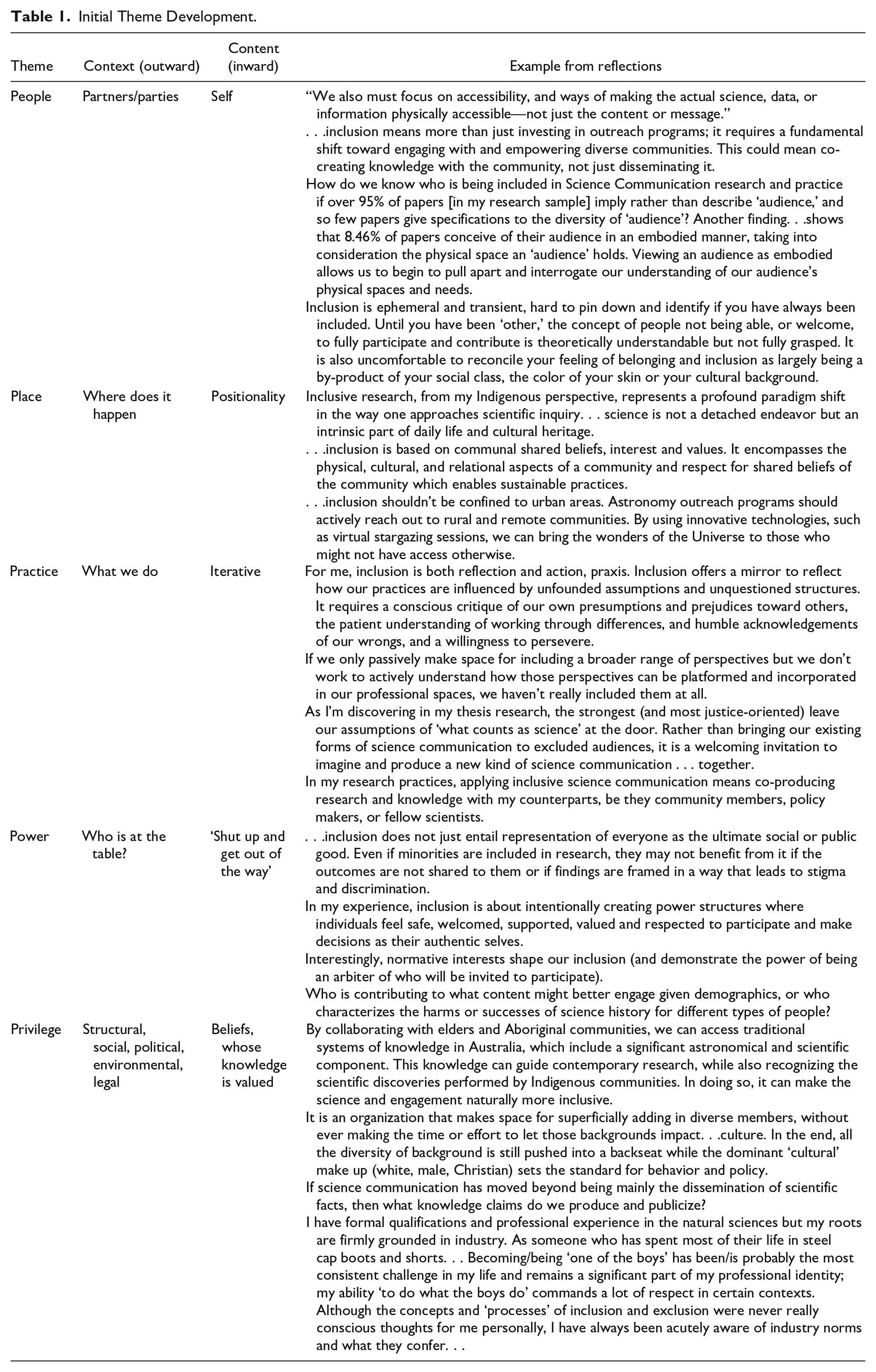
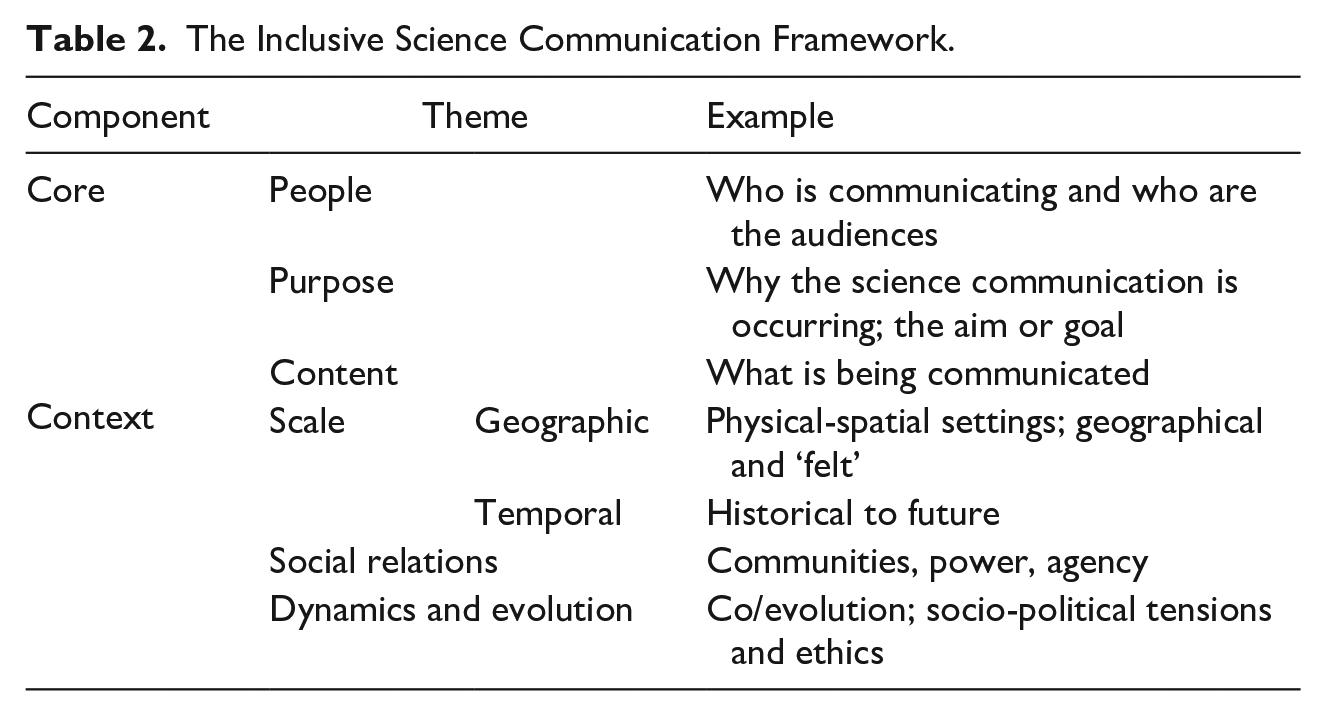
Each author first wrote a short (500-word) reflection on: “What does inclusion mean in my science communication context?.” Context was defined as the disciplinary areas in which we work—now and in the recent past—encompassing academic, nonacademic, research and practice. The method draws upon Thomas and colleagues (2021), who argue that allowing the stories and experiences of participants—in this instance, the authors reflecting on what inclusive science communication means in their context—enables the development of themes that will inform a theoretical framework, and allows for an intersectional approach to theme development. Individuals, even those who share certain demographic characteristics, may not experience the world in the same way (Thomas et al., 2021). Using this premise for data collection and theme development, an inductive approach was considered most appropriate (Elo & Kyngäs, 2008), allowing for patterns to be identified from the participant-generated data (Creswell & Creswell, 2018). Each individually written response was collated into one document and then shared. Close reading of the text (Miles & Huberman, 1994) was used to develop an initial set of themes through an inductive process of categorisation of all texts (Table 1). These themes had an outward- and inward-looking focus, reflecting our interest in not only examining how we include excluded or marginalized audiences in science communication, but also how science communication itself should function. All authors then broke into smaller working groups to collectively develop a theme, drawing from their own perspectives and the literature. These developed themes were then shared with the whole group and iterative discussions refined the themes into the final structure (Table 2). Nothing was included without collective agreement from all authors.
Initial Theme Development.
The Inclusive Science Communication Framework.
“Trustworthiness” of Data
We draw from Lincoln and Guba’s (1985) methods to ensure trustworthiness and credibility of our qualitative data. This study incorporates three techniques: prolonged engagement, peer debriefing and triangulation. The development of the framework was iterative, taking place over 6 months. Initial themes were developed and discussed. Peer debriefing was used to test and defend the themes derived from the personal reflections. All authors participated in these discussions and disagreements were resolved through extended conversations occurring over a period of months, aligning with what Lincoln and Guba (1985) describe as prolonged, collaborative and deliberative engagement. All authors questioned assertions, clarified their understanding of others’ perspectives and collectively contributed to the refinement of each theme. Discussions of intent and meaning of themes often drew upon personal experience but also examples from other research, science communication programs and traditional cultural practices. These examples are presented within the related themes in the framework, drawing upon peer reviewed research as appropriate. In this way, the theme development drew upon multiple analysts and theoretical perspectives, providing both credible data and confirmability. Confirmability was further strengthened using researcher reflexivity in noting how personal interests and identities have informed or influenced personal descriptions of what inclusive science communication means. The framework presented here is offered for “external audit” (Lincoln & Guba, 1985) by other science communicators, serving as a starting point for conversation and a prompt for response and reflection.
A Framework for Inclusive Science Communication
Our framework has two main components: “Core,” and “Context” (Table 2). The themes of the core component occurred frequently, in our development discussions and in the papers presented in the literature review, reflecting the integral nature of these concepts to science communication. In broadening inclusion, these core components are important and more readily targeted interventions. However, a focus primarily on greater access and demographic diversity insufficiently addresses persistent systemic issues (Calabrese Barton & Tan, 2020); the context within which communication occurs is equally important. The context component outlines and details four additional themes which, although presented separately to the core, are fundamental to it. Communication does not occur in a vacuum; what, to whom, and why a message is communicated can be shaped by broader contextual factors spanning place, time, power relations, and dynamic socio-political dimensions.
In presenting the framework, we will articulate insights from our discussions and provide examples from the literature which reflect the broad relevance and applicability of our framework to wide ranging contexts. There are undoubtedly many other examples that could be used; however, our aim is to provide examples from outside the dominant Western paradigm.
Core Component
The core component is comprised of three key themes: people, purpose and content. Aspects of each of these themes appear frequently throughout the science communication competencies proposed by Lewenstein and Baram-Tsabari (2022), underscoring their fundamental importance. Most inclusive science communication activities focus on these, with considerations of people and content dominating the literature (Judd & McKinnon, 2021).
People
Considerations of people refer to both the audience and the communicator/s. A more inclusive science communication discipline should be a safe and welcoming place for diverse actors, allowing them to exercise and share their creativity in line with contemporary meanings of the UN Right to Science (Shaheed & Mazibrada, 2021). While underrepresented cohorts are communicating science and are filling gaps in traditional science communication activities (Torres-Gerald, 2019), their efforts are less visible in the field (Valdez-Ward et al., 2023). Both factors highlight a gap in science communication theory and practice, presenting a need for those who hold power and privilege in the field to listen, learn and change.
Western approaches to science communication more commonly frame science as an endeavor to fulfill individual curiosity such as through asking “why” questions in science classes (Lockhart et al., 2022) as an indicator of a developing science identity. This contrasts with the observations of one of the authors in their doctoral research (unpublished at the time this article was produced) examining case studies of science communication in Samoa. The author’s content analysis demonstrates a different value system at play, with science (and STEM) framed as an opportunity to give back to the community by those who can. A Western, individualistic approach creates a barrier to engaging with science for people from some non-Western cultures, hindering their inclusion in dominant spaces (Aikenhead & Jegede, 1999) and impoverishing Western imagination of who is thought of as communicating science. Breaking away from this narrow, individualistic framing of science to apply an intersectional lens requires an openness to how the pieces we bring to our field come together to create a greater whole. This approach incorporates epistemic inclusion, offering a more holistic and relevant mechanism to re-examine science, ourselves, and the people around us.
Epistemic inclusion expands our understanding of what is “science” beyond the boundaries of conventional, Western paradigms. The focus is not on understanding a community through their biographical data but how we as outsiders might better understand a community’s knowledge (Canfield et al., 2020). Calls for epistemic inclusion come from a decolonial framework (Finlay et al., 2021), which also allows for a greater flow of information and respect between groups, fostering creativity in the production and sharing of knowledge (Shaheed & Mazibrada, 2021). This allows for the more authentic recording of experiences and science, creating more avenues for trust and progress. Focusing on people also requires us to acknowledge that diverse social groups have diverse requirements and capacities to contribute; there is no one size fits all. Considering people requires consideration of their preferred languages (Márquez & Porras, 2020), as well as delivery method, at a deeper level than demographics, as the Content section will further expand. Failing to focus on the needs of people may limit their ability, and/or desire, to participate.
Purpose
“Purpose” in and of science communication theory and practice is manifold, yet it is often implicit and unarticulated. Purpose serves as a cornerstone to inclusive science communication and elicits direction, significance and relevance. Earlier models, that align with the dissemination paradigm, have long been framed as encompassing the goals of generating public epistemic and moral trust, generating social acceptance, and enhancing democratic legitimacy of science (Kappel & Holmen, 2019). Inclusive science communication seeks to broaden representation in science, integrate diverse knowledge systems and values, explore alternative perspectives on science-society relationships, and cultivate belonging and engagement of various perspectives. Ideally, it aims to enhance agency, share power, and embrace varied communication approaches, fundamentally questioning traditional notions of “science.” It is not just about reaching diverse audiences but also about evolving the discipline itself. The purpose of inclusive science communication therefore spans philosophical considerations, value-driven motivations, and material outcomes.
For example, Sesan and Ibiyemi (2023) highlight that science communication in postcolonial African societies is heavily shaped by historical legacies, leaving little room for precolonial epistemologies and communication systems. Transforming the purpose of science communication to grapple with diverse philosophical understandings and historical frameworks can, however, stimulate new imaginative avenues for inclusion. Furthermore, inclusive science communication can be harnessed to systematically reshape the values of practice and inclusion in science communication. Sobane and colleagues (2023) focus on the need for research designs and content that are responsive to gender inclusivity, using the case of the Science Granting Councils in Sub-Saharan Africa. They highlight the pressing need for sustainable gender equity values in science communication practice and research, emphasizing the societal impact of inclusive science communication.
Science communication can also be engendered to achieve a tangible, physical or material result such as raising funds for science communication projects, development of a science center, or establishment of a science museum. However, it is also important to consider potential conflicts of interest, such as financiers who are interested in the material purpose of a project, whereas the community involved may be interested in the value-based proposition of the project. Ofori-Parku (2016) provides a case study from Ghana, where a local NGO was concerned about offshore oil production and pointed to associated whale deaths to garner support from a coastal community. However, the community, rooted in folk culture, regard whale deaths as a sign of bountiful fish harvests which improve their material and economic lives. In addition, they anticipated employment opportunities in oil production. In this case, values-driven purpose and material-driven purpose were in conflict.
We invoke “purpose” to clarify the “why” inherent in communication and to improve the synergy between the objectives of the science communicators and the needs of the audience. Examining “purpose” prompts us to critically reflect on the values, assumptions, and power dynamics inherent in communication endeavors. It is also crucial to acknowledge that science communication occurs within a broader system mediated by other human and nonhuman actors and is subject to other aims that may be causally related.
Content
Messages, words, ideas, graphs, framings, and images can and have been used to omit, marginalize and Other people, as well as include, show courtesy, and celebrate diversity. Fundamentally, inclusive science communication content is about making choices out of a genuine care and concern for others. It acknowledges the diverse needs of the audience and the communicative modalities that work best for them, and that contextually tailored forms of communication may already exist in the “margins” yet remain invisible in dominant circles.
For content to be inclusive, it must be accessible to the audience. Many efforts in inclusive science communication adapt content to be more accessible to people with different identities. For example, autistic people with intellectual difficulties often find graphic organizers, where concepts and connections are represented visually with little text, particularly helpful (Barnett et al., 2018). More broadly, science communicators can use tools to aid with visual impairments, mobility issues, neurodiversity and neurologic/psychiatric conditions, or hearing difficulties (Canfield et al., 2020; Ferreira et al., 2023; Rocha et al., 2020; Splendiani, 2015) to make content—and participation—more accessible. Accessibility interventions also regularly involve geographic factors—science outreach programs such as the “science circus” have been used in both high and low-income settings, from Australia (McKinnon & Bryant, 2017) to sub-Saharan Africa (Walker et al., 2020). Geographic accessibility can also operate on a local level, such as a science center running programs in multiple areas of a city, often to reach more diverse or socioeconomically disadvantaged audiences (Streicher et al., 2014). But while these efforts can enhance accessibility, the content itself may not be inclusive (Dawson, 2019).
Equally, prescriptions on adapting content can too easily fall into the trap of assuming the science communicator to be an all-powerful or neutral agent who can single-handedly transform the field. The only way into this conundrum is to see inclusion as a collective endeavor where the people creating and doing science communication become more diverse and where their efforts are recognized. This could allow novel content to be developed and for existing content to be adapted in genuine, tailored, and nontokenistic ways. For example, science communicators from the Pacific can highlight the relevance of mangroves in climate resilience in ways that resonate with the lived experience of Pacific Islanders. This goes beyond ecosystem perspectives available to someone from outside the cultural group (Walker, 2024). In turn, examples of such content framed by specific cultures can benefit others (Shaheed & Mazibrada, 2021). For example, bringing Indigenous perspectives to global sustainability challenges (Yunkaporta, 2019) does more than including the Other in a Euro-dominated space; it also opens up new ways of thinking and framing of content. Inclusive content also involves reflexivity and reciprocity, wherein communicative practices are not just interrogated, but are co-created with the audience (Canfield et al., 2020), allowing science communicators to explore our own positioning around a topic and how it impacts our research (Salmon et al., 2017)
Thus far this paper has explored the core of science communication—who is communicating what, to whom, and why. Yet communication does not occur in a void. The context for the communication can be a highly influential factor, as the next section outlines.
Context Component
All science communication, whether speaking to mass audiences or to localized ones, necessarily takes place in a context. Deepening our understanding of the context from which we speak or engage is therefore a critical step toward inclusive science communication. Examining context might mean considering the influence of cultural nuances, historical factors, and social identities on practices shaping the production, valuation, and transmission of knowledge (Kappel & Holmen, 2019). Science communication could evolve in line with trends in leading science journals and academies—such as the International Science Council which is the global voice for science—where authors are acknowledging the limitations of a homogenized, Western-centric perspective and are calling for a reckoning with the diverse tapestry of human experiences and knowledge-systems (Bartlett et al., 2012). In this section, the contexts of knowledge practices are explored within the themes of scale (geographic and temporal), social relations, and dynamics and evolution.
Scale: Geographic
Physical-spatial settings influence inclusiveness (or lack thereof) in science communication at varying scales. At the largest scale, the geopolitics of a region influence the values, norms and culture in which science communication work occurs, including historical relationships with colonization and efforts to decolonize (Sesan & Ibiyemi, 2023). These contextual factors all influence the types of knowledge, modes of engagement, dissemination strategies, participation levels, and perspectives. Appreciating and incorporating these considerations is an important part of inclusive science communication practices. For example, there is an intrinsic advantage to members of an underrepresented group developing their own way of communicating, as factors that are difficult to identify from the perspective of an outsider can be accounted for, such as alternative value-hierarchies or ways of knowing and doing (Drawson et al., 2017; Hayward et al., 2021).
Wider geo-physical contexts could, however, play a crucial role in shaping a group’s motivation to engage with issues. For example, coastal communities may be more inclined to engage with science communication on rising tides than inland communities (Ansari et al., 2023); or densely populated cities may show greater engagement with issues like smog than rural farming towns. Understanding the potential influence of the immediate physical-spatial context is also important. Where the communication occurs may influence the power dynamics of a space. This can contribute significantly to the access, inclusion and agency felt by varying groups and ultimately the success of the communication and engagement activity. For example, in the early 2000s one of the authors was sent to Timor Leste to set up a temporary hands-on science exhibition in a centrally located venue organized by the funding agency. Upon arrival, it was discovered that the venue had been a site associated with the Timorese struggle for independence, which elicited negativity and fear, and consequently, locals were reluctant to enter the building. Moving the exhibits to an open-air courtyard and out onto the streets removed this obstacle. Communication content and purpose may be well designed; however, the context could undermine inclusion efforts if they are not appropriately considered.
Scale: Temporal
What science communication is, and whom it should involve and serve, has and will continue to change over time, and potentially so too will the meaning of what was or is communicated. Indigenous and traditional knowledge often exemplifies this point when viewed through a Western lens and academic narrative. Indigenous Australian Yorta Yorta people and their ancestors have communicated a geological uplifting that occurred c.30,000 years ago, changing the course of a river and causing a flood. However, this story has found itself in different historical contexts, consequently changing its content (Orthia, 2020). Wurdi Youang, a stone arrangement dated to be around 11,000 years old, could be the first observatory in the world (Norris et al., 2013). Believed to be a tool to record the motion of the Earth for agriculture, parts of the formation have been lost. Interpretations by various academic fields in Western culture have changed the narrative of the formation, in conflict with the traditional knowledge held by elders, which is passed down by oral tradition (Norris et al., 2013).
Time is an inherently dynamic context, but an awareness of current trends is important for being aware of how inclusion and inclusive practice changes. Thomas and colleagues (2021) reflect on the influence of time on what they term an “individual’s talent framework for intersectionality” (p. 2). They assert a person’s intrinsic diversity is shaped by their knowledge, skills, networks, identity characteristics and in turn, these are shaped by the era; the historical, cultural, political and world events at that time. These events create shifts in societal norms and expectations, which in turn influences how certain characteristics are perceived and valued. This consequentially means that social values are likely to change over time, as has been noted regarding age-appropriate sex education (Bhana et al., 2019). Thus, what might have been “good” science communication at one point in time, may not be appropriate in another, necessitating an adaptive approach in understanding and practice. These shifts may also be reflected in how society interacts with itself and with science.
Social Relations
Our collective understanding of science is intricately woven into the fabric of diverse social identities, each influencing and shaping the ways individuals perceive, engage with, and contribute to scientific discourse. The COVID-19 pandemic highlighted how important social relations were in influencing how some minoritised groups received, perceived and acted upon health information (Taragin-Zeller et al., 2020). Acknowledging and incorporating these social contexts is a fundamental commitment to dismantling barriers, fostering equity and ensuring that science communication resonates authentically with the experiences of a broad and heterogeneous audience.
To assist with addressing these social contexts, science communication can draw from the procedural justice literature. Procedural justice, which involves the ability of affected individuals or communities to participate in decision-making regarding socio-environmental risks or benefits, is an important aspect of environmental justice (Gellers & Jeffords, 2018). It requires that affected communities have a thorough understanding of the risks and benefits associated with a particular decision. However, the knowledge required for genuine and informed consent is often unavailable or is presented in a way that downplays potential harms and hazards (Ottinger, 2013). Inclusive science communication necessitates a critical approach that acknowledges and addresses the unequal distribution of power and agencies among social actors in shaping how knowledge is generated, valued, and shared (Canfield & Menezes, 2020). For example, Legg et al. (2021) have identified typologies of “science for profit” through the analysis of secondary data. Their findings reveal that industries such as tobacco, chemical, and pharmaceutical companies strive to enhance the credibility, communication, and use of science that aligns with their interests, while diminishing or downplaying science that does not favor them.
The value attributed to various scientific information and sources is also seen to manifest as epistemic injustice (Herrera-Lima & Gutiérrez-Ramírez, 2023). Institutionalized knowledge, often imported from Western systems, is seen as more valid, creating exclusionary conditions that delegitimise and exclude Indigenous and local knowledge, which offer different perspectives and other ways of thinking (Fricker, 2007). To overcome this, Herrera-Lima and Gutierrez-Ramirez (2023) suggest shifting the focus of science communication to address complex social problems and promote genuine co-design and co-development among social stakeholders, integrating their sociocultural contexts, perspectives, visions, and values.
A key barrier to effectively harnessing social relations for a shared purpose is a power imbalance between actors designing and implementing science communication. Power, expertise and other imbalances can often be inherent in areas like training, capacity building, teaching, co-design, and other collaborative spaces in which science communication initiatives are conceived, designed, planned and skills are developed (Walker, 2022). An asset-based approach acknowledges and leverages the strengths of collaborators and shares or transfers power, i.e., empowers others (Kretzmann & McKnight, 1993). In this way, capacity building, teaching, training and other similar formats can be about the redistribution of power and, in turn, the incorporation of more diverse and inclusive elements, such as traditional knowledge and local expertise which can be critical to long term success. For example, projects in the Global South that are led by Global South partners are more likely to lead to more sustainable capacity building and better engagement outcomes (Reed et al., 2018; Weiler & Ham, 2002).
Finally, those teaching or providing capacity building can be open to the converse: learning from their students and collaborators and having their own capacity built. Several studies show the benefits and necessities of “cultural capacity building,” where a deep understanding of cultural contexts and openness to alternative knowledge systems by actors results in better outcomes, more asset-based approaches by beneficiaries, and less deficit mode engagement by those building capacity (Bockstael, 2017; Tedmanson, 2012). Cultivating cultural humility can also be a potent way to address power imbalances, where actors, who on the surface appear to hold the power and expertise necessary for a project, realize they are ill-equipped and become more aware of the deep expertise and knowledge of other actors who may be less visible (Bockstael, 2017; Hoover, 2016; Tedmanson, 2012).
Dynamics and Evolution
Science and technology have evolved rapidly, and so too has society’s relationship with science. Despite having access to more information than ever before, we also have a higher level of circulating misinformation, with social dynamics, individual attitudes and worldviews interacting with the content and contributing to the likelihood of the transmission of (mis)information and behaviors (Bendixen, 2020). This is not a new phenomenon; publics have contested scientific information and advice for decades, on issues such as vaccination, genetically modified organisms and climate change. Debate within science communication about whether and how to engage those who do not accept science has existed and evolved for over 40 years (Lewenstein, 2024). What is known, understood and accepted is always in a state of flux, reflecting the current state of knowledge and societal norms. Our science communication must similarly evolve. Arguably this component underpins all of the previously presented themes, however as Taragin-Zeller and Peterson (2024) note, considering the past and possible futures should be active considerations in inclusion efforts. It is thus included as a separate theme to encourage active reflection.
Social, environmental and political contexts can evolve rapidly, working to include or exclude groups, creating new and sometimes urgent communication needs. Appreciating this constant evolution requires us to use self-awareness and knowledge of our own positionality to enable bidirectional (Chilvers, 2012) and critical reflexivity (Salmon et al., 2017) in our research and practice. Inclusive science communication requires us to carefully consider those who fill the roles of audience and knowledge sharer, which will and should evolve and revolve throughout the course of the science communication relationship. Crucially, when this relationship is not maintained with care and consideration for all the diverse realities of those involved, the resulting damage can have far reaching impacts (Ashley, 2021). As Lewenstein (2024) notes, addressing diversity is complicated as it can yield new limits and constraints, challenge our science communication goals and definitions of science, and consequently, can be uncomfortable. There are some issues which there may be no clear way to proceed, dealing with moral issues of what is right and wrong and acknowledging that a collective position of what is “right” may, in some cases, be difficult if not impossible to achieve (Lewenstein, 2024). Certainly, in the development of this framework, the group did not always agree. However, this should not mean we cease to try. Rather than aiming for consensus, perhaps science communication would be better placed to recognize how contexts have changed over time and the origins of different and conflicting points of view. We echo Lewenstein’s (2024) call to strive to hold multiple perspectives simultaneously.
Defining context is complex and the above section provides a far from exhaustive collection of some ways in which we can begin unpacking various elements of contextual thinking. Context is everything that answers the question of “what surrounds this engagement?” on social, physical, cultural, historical and epistemological levels. This approach to engaging with the world takes work and practice; for most of us, it will not come naturally. It also speaks to one of the ethics of science communication proposed by Medvecky and Leach (2019); that of Kairos. First theorized by classic Greek philosophers, Kairos presents the notion that there is a “right way and a right time to say the right thing.” Inclusive science communication requires us to be conscious of the Kairos of the work, alongside other contexts discussed.
Conclusion
This paper seeks to contribute to the ongoing discussion of inclusion in science communication and to provide a framework for thinking through the complexities, building upon the considerations typically encouraged in science communication training, research and practice. It aims to present a broad framework that might be applicable to a wider range of contexts and groups, aiming to bridge the Global North-South divide (Rasekoala, 2023). It also aims to illustrate what an inclusive approach to science communication research might look like.
The presented theoretical framework considers inclusion in science communication within two components. The core component is familiar to most, if not all. Considerations of the people involved in the communication should be deeply reflective, aware of positionality, and founded on genuine and respectful engagement—particularly when engaging with a diversity of actors. We also describe some of the different purposes of science communication which can be philosophy-, value- and/or material-based. The content of what is being communicated, we argue, would benefit from consideration through an intersectional lens, including reflecting on the implications and choices of what is provided. The second component, context, provides tools for the science communicator to consider these core features of audience, purpose, and content more deeply, examining aspects which may enrich or fundamentally challenge their perspective. This may feel uncomfortable, but our practice, research and relationships with the communities we serve will be strengthened. We stress here the importance of intersectional considerations, of the push and pull of these themes, and of the nature of inclusive science communication being one of ongoing intention, reflection and iteration.
Overall, promoting inclusivity in science communication does not require tailoring science communication initiatives just to encourage greater public acceptance of, and accompanying social license for, techno-scientific projects and products. It necessitates interrogating how science and science communication are conducted, along with the local, national, and global power asymmetries that shape who gets to do science and who gets to communicate it. Understanding how science, science communication initiatives, and science communicators are embedded in time, place, and social interactions characterized by specific power relations is crucial for making science communication theory and praxis truly inclusive.
This framework is offered as a starting point for discussion and is not without limitations. While several authors are originally from Global South countries, all the authors currently reside in Australia. We recognize the need, and call, for additional on-the-ground imaginaries of and propositions on inclusive science communication, especially from people and places traditionally underrepresented in the global discourse. Where possible, we have included research which involves voices and perspectives from outside of academic settings but acknowledge this is imperfect. Future research should explore the relevance and applicability of this framework with those outside academic contexts. There are many other theories which could have been incorporated in the presentation of this framework, and future work in this area is encouraged. Engagement of science communication with insights on decolonization, justice, diversity, equity, and inclusion in other disciplines, such as global health (Khan et al., 2021), ecology (Urzedo & Robinson, 2023), bioethics (Bond et al., 2021), and social studies of science (Epstein, 2007) could further enrich conversations. While conceptualizing inclusive science communication is important, making science communication inclusive ultimately means testing and iterating different notions, examining their value in and adapting them to different contexts, and being constantly reflexive of our roles and responsibilities in decolonizing and diversifying the discipline. We hope this framework offers a tool to enable science communicators to do so.
Footnotes
Declaration of Conflicting Interests
The author(s) declared no potential conflicts of interest with respect to the research, authorship, and/or publication of this article.
Funding
The author(s) received no financial support for the research, authorship, and/or publication of this article.
