




Abstract
Trust in science is both a goal and prerequisite for science communication. While participatory methods are claimed to build this trust, supporting evidence remains limited. In an online experiment (N = 725), we investigated how different levels of participation in designing an article impact message credibility, trustworthiness, and trust intention toward a scientist. Active participation enhanced perceptions of the scientist’s benevolence and integrity but not their expertise or message credibility. Prior participation intentions moderated most effects. Conversely, awareness of others’ participation increased trust intention. These findings highlight the complexity of trust in science and the need for tailored participatory approaches.
Trust in science plays a key role in effective science communication and the functioning of an informed society (Weingart & Guenther, 2016). It shapes how individuals use science-based information in their personal decisions or political actions on socio-scientific issues (Osborne & Allchin, 2024). Moreover, individual decision-making processes rest not only on information credibility but also on trust in the information source (Plohl & Musil, 2021).
As global challenges grow, science communication is evolving from one-way communication to more dialogic and participatory models (Davies, 2021). These models encourage dialogue between science and society, with the goal of co-creating knowledge, and making science more democratic (Metcalfe et al., 2022). While it is believed that participatory approaches can build trust between science and society, thereby democratizing science, there is limited evidence on how exactly participation impacts trust (Bedessem et al., 2021).
How does trust evolve when publics move from passive recipients to active contributors to the scientific discourse? And does direct involvement in or mere awareness of others’ participation in designing science communication products affect trust differently? Our study addresses this by simulating a participatory scenario where individuals collaborate with a fictional scientist to co-design a scientific online article, allowing us to examine how different levels of participation influence trust.
Trusting Science: The Critical Role of Trustworthiness and Credibility
According to Mayer et al.’s (1995) model, trust is a psychological state in which a party is willing to be vulnerable to another: Despite not being in control over the outcome, the trustor voluntarily depends on a trustee based on positive anticipations. In science communication, trust in scientists involves laypersons (trustors) being willing to be vulnerable to scientists as representatives of the scientific system (trustees) (Besley & Tiffany, 2023; Wintterlin et al., 2022), who guarantee for the veracity of scientific knowledge.
Empirical research shows that such trust is not blind; it rests on spontaneous ascriptions of trustworthiness, based on certain indicators (Hendriks et al., 2016). Laypersons, with their bounded understanding of science, must make science-related decisions without the ability to evaluate all possible options firsthand (Bromme & Goldman, 2014). This vulnerability can be mediated by deciding whom to trust for scientific knowledge, which in turn builds on anticipations and evaluations of both the trustworthiness of scientists (Hendriks et al., 2015), and the perceived credibility of scientific information (Fiske & Dupree, 2014).
Trustworthiness concerns the evaluation of the information source, for example, a scientific expert, and is assessed based on expertise, benevolence, and integrity perceptions (Bromme & Hendriks, 2024). Expertise refers to the knowledge and proficiency in an area of interest. Benevolence reflects a scientist concern for social well-being, while integrity involves the adherence to scientific ethical standards (Hendriks et al., 2016). Recent scholarship has also proposed openness as a fourth dimension for capturing scientists’ trustworthiness (Besley et al., 2021; Besley & Tiffany, 2023). This concept reflects a scientist’s receptiveness and willingness to listen to public input (Besley et al., 2021). In contrast, “credibility” is used to describe the believability of a message or claim, and it implies an individual’s propensity to accept a scientific claim as true (Fogg & Tseng, 1999). Perceived expert trustworthiness affects perceptions of message credibility, and both trustworthiness and credibility in turn affect trust (Hendriks et al., 2016). Furthermore, the trust judgments of individual scientists may contribute to trust in science overall, as representatives of systems represent access points for experiences and expectations toward the system (Wintterlin et al., 2022). Consequently, our study focuses on these key facets of trust: the trustworthiness of scientists, message credibility, and the intention to trust scientists in decision-making regarding the issue at hand.
From Dissemination to Participation—Transforming Trust Dynamics?
In traditional models of science communication, experts produce and share knowledge, while publics passively receive this information and judge its relevance (Bromme & Goldman, 2014; Metcalfe et al., 2022). Participatory science communication paradigms challenge this one-way approach by fostering interaction between scientists and/or science communicators and various publics, where different forms of knowledge and experiences are acknowledged, shared, valued and negotiated (Metcalfe et al., 2022). Examples include citizen dialogues, consensus conferences, deliberative forums, co-design projects and participatory exhibitions in science centers and museums. These interactions aim to demystify science, highlight its relevance, and make it more accessible, which is essential for building trust (Osborne & Allchin, 2024).
Conceptually, participation exists on a continuum with various levels of engagement and decision-making authority (Rock et al., 2018). Early frameworks, such as Arnstein’s (1969) Ladder of Citizen Participation, conceptualize participation as a progressive transfer of power. In a recent development, Gascoigne et al. (2022) have refined this framework for participation in science communication; classifying participation levels from one-way dissemination over dialogic to fully co-created formats.
Participatory approaches are increasingly promoted as best practice for engaging publics and ultimately strengthening trust in science (Kappel & Holmen, 2019). However, existing research only hints at how effects may unfold, as investigations of the direct effects are missing. Initial findings indicate that the integration of target audiences in design processes can enhance the quality and perceived relevance of the final product, while concurrently fostering participants’ self-efficacy (Steen et al., 2011; Wang, 2025). In addition, evidence suggests that scientists who engage in participatory formats are perceived as more open to public opinion, which in turn influences the trust placed in them (Besley et al., 2021).
Beyond improving communication outcomes, participatory models emphasize mutual engagement and social learning, which may help strengthen relationships between scientists and publics (Metcalfe et al., 2022). Unlike citizen science, which typically involves public participation in research activities and follows a sequential process, participatory science communication focuses on co-creating how scientific knowledge is shared (Metcalfe et al., 2022), and emphasizes connections between stakeholders (Kalmár & Stenfert, 2020). For instance, collaborative design allows different stakeholders to work together in iterative cycles to tailor communication to audience needs (Enzingmüller & Marzavan, 2024). Ideally, such processes promote reciprocal knowledge exchange, foster social learning and, even overcome traditional power hierarchies (Kalmár & Stenfert, 2020; Sanders & Stappers, 2008)—although in reality, this is often difficult to implement (Leitch, 2022).
Overall, it is important to consider that the anticipated benefits for trust are based on normative assumptions as opposed to empirical evidence. Whether, and under which conditions, participation fosters trust in science remains yet to be understood through systematic investigation—which this study seeks to provide.
The Present Study: Assessing the Effects of Participation on Trust Dynamics
Given the complexity, resource-intensive nature, and growing institutional push for participatory formats on the one hand (Meister Broekema et al., 2023) and the absence of well-tested theories of participation on the other hand (Segalowitz et al., 2018), experimental research is essential to understanding their true effects before promoting them as a universal strategy. As this requires a clear and testable operationalization, we distinguish three levels of participation in this study. In a fictional scenario, participants were invited by a researcher to make design decisions about an article on antibiotic resistance. In the “active condition,” participants made co-design choices (e.g., selecting headlines or colors), leading to an adapted version of the article they were originally presented with. We thus regard the active condition as similar to the level of consulting in Gascoigne et al.’s (2022) framework; however, due to the experimental design, participation was constrained to pre-defined choices. As a result, this condition did not reach full co-creation, which would necessitate equal decision-making power (Rock et al., 2018). In the “passive condition,” participants were only presented with the article and co-design choices of fictitious others but could not contribute with own decisions. In other words, participants in the passive condition were witness to a consulting process of others in participatory science communication. In the “non-participation condition,” participants simply read the article and completed a distractor task, without being aware of any option to participate in creating the design or content of the article.
Accordingly, we investigate the effect of these three levels of participation in science communication on participants’ perceptions of the trustworthiness of the researcher; the credibility of the resulting science communication product; and their intention to trust scientists for health decisions more generally. In the following, we summarize findings for each of these outcomes and formulate hypotheses on this basis.
Participation and Trustworthiness
We ask how the different levels of participation influence trustworthiness ratings on the dimensions of expertise, benevolence and integrity. As previously summarized, people consider scientists trustworthy if they perceive them to possess expertise, benevolence, and integrity (Bromme & Hendriks, 2024; Hendriks et al., 2015; Mayer et al., 1995). Scientists who value public contributions, consider public perspectives, and are open to discussion are seen as more benevolent (Besley et al., 2021; Hendriks et al., 2016; Metcalfe et al., 2022). Therefore, active participation may strengthen these perceptions. It may also enhance perceptions of integrity by fostering a sense of fairness, ownership, and a commitment to ethical standards and transparency (Bedessem et al., 2021; Greving et al., 2020; Masterson et al., 2019). Informing about public participation could still signal transparency and adherence to the scientific principles of objectivity and honesty (Cummings, 2014; Hendriks et al., 2016).
Given these considerations, we derive our first hypotheses:
Hypothesis 1: The level of participation will affect trustworthiness ratings.
Hypothesis 1.1a: Active participation will lead to higher perceived benevolence and integrity compared with both passive participation and control condition.
Hypothesis 1.1b: Passive participation will lead to higher ratings of benevolence and integrity compared with the control condition.
The case for expertise seems more complex. While active participation may improve how knowledgeable scientists seem by giving insights into scientific processes (Bedessem et al., 2021), it can blur the lines between experts and non-experts, potentially leading to perceptions of less securely anchored knowledge (Nicolaisen, 2024) or deviating from the norms of expected professional standards (Altenmüller et al., 2023). Therefore, we pose a research question:
Research Question 1: How does the level of participation in science communication influence the perception of the scientist’s expertise?
Given prior debates on conceptual overlaps with both benevolence and integrity (Besley et al., 2021), we incorporated openness as an exploratory measure to examine its potential role in participatory settings, rather than considering it as a core variable in our analyses.
Participation and Credibility
Message credibility is judged by factors such as information context (Hilligoss & Rieh, 2008), perceived scientificness of the text, and author reputation (Jonas et al., 2024). However, little is known about how public participation in scientific content creation affects message credibility. Active participation may enhance credibility by giving laypersons insights into scientific processes (Bedessem et al., 2021; Carrier, 2017) and serving as a quality assurance (Grosser et al., 2019). However, credibility could suffer if non-expert involvement signals unreliable knowledge generation and challenges stereotypical views of expert communication (Altenmüller et al., 2023).
As we cannot ascertain the direction of the level of participation on message credibility, we pose a research question:
Research Question 2: How do the level of participation in science communication influence the credibility of the presented information?
Furthermore, source trustworthiness is a key determinant of message acceptance (Bromme & Goldman, 2014; Fogg & Tseng, 1999). Studies demonstrate that scientists’ trustworthiness affects the credibility of their research, as individuals critically evaluate relevant trustworthiness indicators when presented with information (Jamieson et al., 2019). Among these indicators, perceived expertise has been shown to directly align with regarding an expert as possessing the relevant skills and knowledge (Hendriks et al., 2015), which makes it particularly crucial for establishing credibility.
Thus, we pose the following hypotheses regarding the effects of expert trustworthiness on credibility:
Hypothesis 2.1: Higher perceived scientists’ trustworthiness will lead to higher message credibility.
Hypothesis 2.1a: Among the dimensions of trustworthiness, expertise will have the most significant effect on perceived credibility, more than integrity and benevolence.
Participation and the Intention to Trust Scientists
We measure the intention to trust a scientist by an individual’s willingness to be vulnerable to them (Besley & Tiffany, 2023).
Based on evidence from citizen science, active participation in designing a science communication product could encourage participants’ intention to trust in scientists by promoting transparency, mutual respect, and inclusivity (Bedessem et al., 2021). As mentioned before, information about participation may still highlight scientists’ willingness to demystify science and align with public needs (Kappel & Holmen, 2019).
This leads us to our third research question and the associated hypotheses:
Research Question 3: How does the level of participation in science communication influence willingness to be vulnerable to a scientist?
Hypothesis 3.1: Participation level will positively predict willingness to be vulnerable to the scientist.
Hypothesis 3.1a: Active participation will lead to the highest willingness to be vulnerable, significantly more than both passive participation and control condition.
Exploring the Role of Participation Intentions
Trust is not shaped by participation alone; its impact is complex and context-dependent, as people enter participatory processes with diverse attitudes and expectations toward science communication (Schäfer et al., 2018). Social psychological research has long established that intentions not only predict behavior but also shape how experiences unfold (Fishbein & Ajzen, 1975, 2011; Sheeran, 2002).
Existing evidence highlights the importance of intentions and motivations in participatory settings (Kenny & Castilla-Rho, 2022; Segalowitz & Chamorro-Koc, 2018). Research in consumer-behavior indicates that aspects of personality moderate co-creation experiences (Füller & Bilgram, 2017). Notably, participants highly eager to engage actively, were more likely to perceive co-creation positively, leading to heightened trust perceptions. Thus, we explore whether intentions to participate moderate the relationship between participation and trust.
Following Holbert and Park (2020), we propose that intention to participate acts as a contributory moderator, meaning that while the effect of participation on trust remains positive at all levels of intention, its strength varies depending on an individual’s predisposition to engage. When scientists encourage participation, this alignment with individuals’ intentions is likely to reinforce perceptions of trustworthiness and trust intentions. Similarly, these individuals are more likely to engage deeply with participatory elements, leading to stronger effects on credibility (Metzger & Flanagin, 2015). Conversely, low-intention individuals may engage more superficially, relying on heuristic cues rather than systematic processing (Hilligoss & Rieh, 2008; Petty & Cacioppo, 1986). While participation may still influence trust dynamics for them, its effect is likely weaker compared with those with higher intentions.
Therefore, we propose the following additional research question and hypothesis:
Research Question 4: Does intention to participate play a moderating role in the relationship between participation and trust dynamics?
Hypothesis 4: The effect of active participation on willingness to be vulnerable to the scientist will be most pronounced among those with the highest intention to participate.
Method
Study Design
This experimental study was conducted using the SoSci Survey platform to provide a controlled, web-based environment with data being collected in January 2024. A between-subjects design examined the effects of different levels of participation in online science communication (active, passive, and control) on trustworthiness, credibility, and trust intention. Ethical approval was granted by the IPN’s Ethics Committee beforehand to comply with ethical standards, including informed consent, confidentiality, and participants’ right to withdraw. The study was preregistered at the Open Science Framework (OSF) https://osf.io/ze4fs. 1
Participants
An a priori power analysis using G*Power 3.1.9.8 was conducted to determine the required sample size for detecting small effects (f² = 0.02). Due to the lack of directly comparable studies, we conservatively assumed this effect size based on standard guidelines for social science research (Cohen, 1988). The analysis was based on the credibility model, which had the highest number of predictors, using linear multiple regression (fixed model, R² increase). With α = 0.05 and power = 0.80, the analysis determined that a sample size of 688 participants would suffice.
The sample comprised English-speaking adults from 26 European Union countries and the United Kingdom, recruited through the Prolific platform. Eligibility criteria included being over the age of 18, fluent in English, without visual impairments and access to a computer or a tablet. Participants received 9£ per hour for compensation. The final sample consisted of 725 participants due to limited control over stopping the sampling procedure, achieving a balanced gender distribution, (48.41% female, 50.62% male, 0.97% diverse), aged from 18 to 76 years (M = 33.53, SD = 11.53). Most participants had a Bachelor’s (39.17%) or Master’s degree (28.41%). More sample characteristics can be found in the Supplementary Materials.
Procedure
Participants provided demographic information and responded to questions assessing predictor variables and covariates. They were then randomly assigned to one of three conditions: active participation (n = 251), passive participation (n = 236), and control group (n = 238). Each group watched a video featuring the fictitious researcher Dr. Sarah Jones. This approach was adopted to minimize confounding effects related to individual scientist characteristics, which are known to influence perceptions of scientists (Sonmez et al., 2023), and to ensure consistency across conditions. All videos were created using MySimpleShow, a platform that generates comic-based visual representations. This choice was also pragmatic, as it allowed us to standardize stimuli to one visual style, while ensuring clarity in storytelling and avoiding potential biases that could arise from more realistic depictions.
In the active condition, the video depicted a collaborative project between Dr. Jones, designers, and people from different publics to make a scientific article on antibiotic resistance more accessible and engaging for broader audiences. Congruent with both following conditions, they started off with reading the raw text about research on antibiotic resistance. Then, active participants made design decisions, such as choosing a suitable title, framing in the introduction, and visual aesthetics, which were integrated into the article’s design. Fictional data on public choices were depicted to enrich the participatory experience. At the end, participants were presented their own version of the article and could provide qualitative feedback regarding their experiences.
Participants in the passive group received a narrative similar to the active group, but framed in the past tense, indicating the design process had already been completed under public participation. After the presentation of the raw text, these participants reviewed the decisions made by a hypothetical public group, with Dr. Jones demonstrating each choice’s popularity through fictional graphics, simulating a participatory design process that mirrored the steps of the active group. Finally, they were also asked for feedback.
The control group only received information about Dr. Jones’ research, viewed the raw text, followed by its final digital format, but without any mentioning of public participation. They then completed content-related questions as a distractor task.
After completion, participants across all conditions assessed the article’s credibility, Dr. Jones’ trustworthiness, and their intention to trust her regarding personal medical decisions involving antibiotics. The study concluded with a debriefing and participants were redirected to Prolific.
Data Preparation and Data Cleaning
The initial dataset comprised 823 participants. After preliminary cleaning, the sample was reduced to 622 participants due to data quality criteria (see below), falling short of the target sample size of 688 participants. Consequently, a second round of data collection was initiated to reach the required sample size, which led to an overall sample size of N = 922 before data cleaning, resulting in a final sample size of N = 725 post-cleaning. The number of participants failing data quality checks was consistent with findings from crowdsourced platforms (Brühlmann et al., 2020). Initial exclusions removed entries based on failures in the initial language and attention checks and incomplete survey responses.
To ensure data integrity, a thorough careless responding analysis was employed, following recommendations by Brühlmann et al. (2020), Yentes (2020) and Ward and Meade (2023). Participants flagged by at least two careless responding indicators were excluded, except for those with meaningless answers in a bogus question or those identified as extreme problematic speeders (Leiner, 2019), who were directly excluded.
The other careless responding indicators referred to (a) an identical string of answers above a threshold of 0.4 standard deviations above the mean long-string score (Yentes, 2020) and (b) falling below a minimum response time per page (Andreadis, 2021). We initially considered Mahalanobis distance as an additional careless responding indicator but abandoned it due to significant deviations from normality.
Measures
In this study, several validated scales, primarily utilizing 7-point Likert-type scales, assessed key constructs alongside a newly introduced scale to measure participation intentions in online science communication. All materials can be found be found in our OSF repository (https://osf.io/ze4fs).
Control Variables
Positive attitudes toward science were measured with five items adapted from the Swiss Science Barometer (WissensCHaftsbarometer Schweiz, 2019) and were aggregated into an index, adapted from Wintterlin et al. (2022).
Scientific Literacy was assessed with five items from the Swiss Science Barometer (WissensCHaftsbarometer Schweiz, 2019) with a scoring system that attributed points based on the accuracy and confidence of responses, ranging from −2 (confidently incorrect) to +2 (confidently correct). A composite score summed up these points.
For measuring participants’ information behavior for science, information sources were classified as either online or traditional media, based on the approach from Metag (2020). Composite scores for online and traditional media sources determined the dominant information behavior.
A single item measured participants’ previous encounters with the topic of antibiotic resistance, scoring “1” for prior experience and “0” otherwise.
Predictor and Outcome Variables
Intentions to participate in science communication were measured with the Intention to Participate Scale (IPS), a novel instrument developed for the purpose of this research. This scale assessed participants’ intentions to participate in digital science communication activities. It consists of 12 items rated on a 7-point Likert-type scale that followed a theoretically proposed structure on three dimensions: Consuming, Participating, and Generating (Taddicken & Krämer, 2021). The scale underwent a comprehensive validation process, including discriminant and criterion-related validity checks, alongside Exploratory Factor Analysis (EFA) and Confirmatory Factor Analysis (CFA) with maximum likelihood estimation with robust standard errors.
Message Credibility was measured with the credibility subscale from the Web-CLIC Inventory by Thielsch and Hirschfeld (2019) that incorporated three items on a 7-point Likert-type scale.
Epistemic Trustworthiness was evaluated with the Muenster Epistemic Trustworthiness Inventory (METI; (Hendriks et al., 2015). The scale consists of 14 pairs of dichotomous adjectives on 7-point scales, compromising the dimensions of expertise, benevolence and integrity. As a potential fourth dimension of trustworthiness, openness was assessed with seven items following Besley et al. (2021).
Intention to Trust was assessed with three items rated on a 5-point Likert-type scale, adapted from Besley and Tiffany (2023) and Colquitt and Rodell (2011). It assessed participants’ intention to trust in terms of their willingness to give control over personal health decisions involving antibiotics to Dr. Jones. Table 1 presents the alpha, mean, and standard deviation values for each of the outcome variables.
Mean, Standard Deviation and Cronbach’s α of Outcome Variables.

Note. TW= Trustworthiness, EXP= Expertise, BEN= Benevolence, INT= Integrity, TI= Trust Intention,
CRD= Credibility, M = Mean, SD= Standard Deviation.
Statistical Analysis
Essential assumptions for the analyses were tested, including linearity, independence of observations, homoscedasticity, normality of residuals, and multicollinearity. Analysis of variance (ANOVA) and chi-square tests were used to test the success of random assignment across groups.
To validate the efficacy of experimental manipulations, non-parametric Kruskal-Wallis tests, followed by pairwise Wilcoxon-rank-sum tests with Benjamini-Hochberg correction were conducted on all manipulation checks.
Helmert contrast coding was employed on the participation groups to reflect a hierarchical order of participation levels. The active group was distinguished from the combined mean of passive and control groups (first contrast), and the passive from the control group directly (second contrast), facilitating a nuanced examination of participation effects that went beyond simple categorical distinctions.
Hypotheses were tested using five hierarchical multiple regression models, while structural equation modeling (SEM) was employed for the exploratory analyses of a moderated mediation model. All analyses were performed in R Studio (R Core Team, 2023), with statistical significance set at p < .05, adjusting for multiple comparisons where necessary.
Results
Manipulation Check Analysis
Manipulation checks confirmed the effectiveness of the experimental groups. Kruskal-Wallis tests indicated significant group differences in perceived active involvement and design process contribution (χ²(2) = 323.89, p < .001 for both). Pairwise Wilcoxon tests supported these differences (p < .001), with active participants scoring the highest, followed by passive and control group. The third check for awareness of public participation confirmed the passive-control group distinction, with substantial group differences (χ²(2) = 306.11, p < .001) and significant active versus passive and control group and passive versus control group contrasts (p < .001), affirming the manipulations success. Despite 98 control group participants incorrectly acknowledging public involvement, they were retained in the analysis due to no other indicators of careless responding.
Evaluation of the IPS
The scale exhibited good internal consistency (Cronbach’s α = .84) and significant item-total correlations (.39 ≤ r ≤ .72). Discriminant validity was supported by a correlation between positive attitudes and IPS scores (r = .22, p < .001, 95% confidence interval [CI] = [.15, .29]), indicating that while the constructs are related, they measure distinct concepts. Criterion-related validity was shown by significant correlations with future participation intention (r = .32, p < .001, 95% [CI] = [.25, .38]) and a regression model (β = 0.38, SE = 0.04, t(723) = 9.08, p < .001), explaining 10.23% of future participation variance (R² = .10).
The Kaiser-Meyer-Olkin (KMO) measure verified sampling adequacy (KMO = .85, and Bartlett’s test of sphericity (χ²(66) = 2,721.89, p < .001) indicated suitable item correlations for factor analysis. EFA retained three factors, based on eigenvalues >1 and the scree plot, explaining 45.3% of variance. CFA supported this structure: χ²(51) = 270.28, p < .001; comparative fit index (CFI) = 0.92, Tucker–Lewis Index (TLI) = 0.89; root mean square error of approximation (RMSEA) = 0.07 (90% [CI] = [0.07, 0.09]); and standardized root mean square residual (SRMR) = 0.05. All factor loadings were significant (.44 to .83, p <.001). For an overview of these results, please see the Supplementary Material.
Trustworthiness
Trustworthiness dimensions were modeled separately using an Ordinary Least Squares (OLS) approach. All models incrementally included covariates (previous experiences with antibiotic resistance, information behavior, scientific literacy, attitudes toward science), main effects (participation contrasts) and the interaction effect (participation contrasts and participation intentions). For an overview of all model results, please see Tables 2–4. For exploratory purposes, we conducted another regression for openness as a fourth trustworthiness dimension after preregistration. Results can be found in the Supplementary Material.
Hierarchical Multiple Regression for Predicting Expertise.

Note. IP = Intention to Participate; Group 1: Active versus Passive/Control, Group 2: Passive versus Control.
Hierarchical Multiple Regression for Predicting Integrity.

Note. IP = Intention to Participate; Group 1: Active versus Passive/Control, Group 2: Passive versus Control.
Hierarchical Multiple Regression for Predicting Benevolence.

Note. IP = Intention to Participate; Group 1: Active versus Passive/Control, Group 2: Passive versus Control.
Expertise
The model fit from the covariates-only model (AIC = 1,302.81; BIC = 1,330.32) to the final model decreased (AIC = 1,308.32; BIC = 1,358.77) and the explained variance was low (R2 = 0.02). The only significant covariate was attitudes toward science (β = 0.08, p = .032). Both the main effects for participation contrasts and their interactions with participation intentions failed to reach significance.
Integrity
The final model for integrity showed a slight improvement in fit from the covariates-only model (AIC = 1,678.90; BIC = 1,706.42) to the final model (AIC = 1,677.80; BIC = 1,728.25), explaining 4.1% of variance (R² = 0.04). Significant covariates included attitudes toward science (β = 0.10, p = .007) and information behavior (β = −0.23, p = .004). For the main effects, the active contrast reached significance (β = 0.03, p = .011), whereas the passive did not (β = 0.01, p = .721). The significant negative interaction for active participation and participation intentions (β = −0.13, p = .013) suggest that for this group, higher participation intentions were associated with a dampened effect for integrity in the active participation group versus the two other groups. However, participation intentions did not alter perceived integrity in the passive group (β = 0.01, p = .739) versus the control group.
Benevolence
The model for benevolence minimally improved fit from the covariate-only (AIC = 1,664.88, BIC = 1,692.40) to the final model (AIC = 1,659.54; BIC = 1,709.98). Similar to the previous models, it only accounted for minimal variance (R2 = 0.04). Only attitudes (β = 0.09, p = .001) was a significant covariate. The contrast between active and the two other groups was associated with significantly higher perceptions of benevolence (β = 0.09, p = .004), whereas the contrast between passive and control was insignificant. Congruent with integrity, higher participation intentions were associated with less pronounced effects of the active group on benevolence (β = −0.10, p = .012); but not for the passive group.
Credibility
For RQ2, a Generalized Least Squares (GLS) approach with maximum likelihood estimation was chosen to account for observed heteroscedasticity, with a specified error variance that ensured robust and reliable coefficient estimation by allowing the error variance to vary as a function of the fitted values. The covariate-only model included previous experiences, information behavior, scientific literacy, and attitudes toward science, then main effects were added (participation contrasts, expertise, benevolence, integrity), and finally, the model was extended to include the interaction between participation contrasts and participation intentions.
The final model, as depicted in Table 5, explained 31% of the variance in credibility (R2 = 0.31). It significantly improved model fit (AIC = 1,375.92; BIC = 1,449.30) from the covariate only model (AIC = 1,611.36; BIC = 1,648.05).
Hierarchical Multiple Regression for Predicting Credibility.

Note. IP = Intention to Participate; Group 1: Active versus Passive/Control, Group 2: Passive versus Control.
Attitudes (β = 0.14, p <.001 and scientific literacy (β = 0.04, p =.041) showed small but significant effects, while all other covariates were insignificant. Among the trustworthiness dimensions, expertise (β = 0.22, p <.001) and benevolence (β = 0.27, p <.001) significantly predicted credibility. Integrity also contributed significantly, albeit to a lesser extent (β = 0.12, p = .027). Neither direct effects of participation contrasts were significant, nor their interaction with intention to participate.
Building on the hierarchical regression results for trustworthiness dimensions, we developed a secondary credibility model within a structural equation modeling (SEM) framework to examine potential moderated mediation effects. SEM was chosen for its capacity to handle complex relationships and to simultaneously estimate direct, indirect, and moderated effects. Maximum likelihood estimation was employed, and bootstrapping with 1,000 resamples was applied to calculate robust standard errors and 95% CI, addressing non-normality in the data. This model tested whether participation (active vs. passive/control) indirectly influenced credibility through mediators of benevolence and integrity, with the effect of participation on these mediators moderated by participation intentions.
As shown in Table 6, benevolence significantly mediated the effect of being in the active group on credibility (indirect effect = 0.08, p = .003), indicating that increased benevolence perceptions drive credibility. The direct effect of the active group on credibility was non-significant (β = −0.02, p = .589), suggesting full mediation through benevolence. In contrast, integrity did not mediate this relationship (indirect effect = 0.03, p = .120). In addition, the path from active participation versus the other two groups to benevolence was moderated by participation intentions (β = −0.21, p = .003).
Model Fit and Path Coefficients for the Structural Equation Model of Credibility.

Note. IP = Intention to Participate; Group 1: Active versus Passive/Control, Group 2: Passive versus Control. Model fit: χ²(40) = 94.29, p < .001; CFI = 0.97; TLI = 0.95; RMSEA = 0.04, 90% CI [0.03, 0.06]; SRMR = 0.05. Standard errors and confidence intervals were bootstrapped with 1000 resamples. Explained variances (R2) for endogenous variables: Benevolence = 0.03, Integrity = 0.02, Expertise = 0.01, Credibility = 0.30.
The model demonstrated good fit, although the chi-square test for the model was statistically significant: χ²(40) = 94.29, p < .001, CFI = 0.97, TLI = 0.95, RMSEA = .04 (90% [CI] = [.032, .055]), and SRMR = .05. To address potential overfitting, the dataset was split into training (70%) and test (30%) subsets, ensuring predictive accuracy across both (Yarkoni & Westfall, 2017). Despite these promising results, caution is warranted due to the limitations of mediation models in cross-sectional data, which can lead to biased effect sizes (Maxwell et al., 2011).
Trust Intention
For RQ3, we used an OLS regression approach, first entering covariates—previous experiences, information behavior, attitudes, scientific literacy, credibility, and trustworthiness dimensions—followed by participation contrasts and their interaction with participation intentions. Table 7 provides an overview.
Hierarchical Multiple Regression for Predicting Trust Intention.

Note. IP = Intention to Participate; Group 1: Active versus Passive/Control, Group 2: Passive versus Control.
The covariate-only model produced an AIC of 1,284.47 (BIC = 1,330.33), while the final model improved to an AIC of 1,277.32 (BIC = 1,346.12), explaining 30% of the variance in trust intention (R² = 0.30). Attitudes toward science (β = 0.07, p = .002), expertise (β = 0.08, p = .011), integrity (β = 0.08, p = .025), and credibility (β = 0.21, p < .001) were significant positive predictors of trust intention. Conversely, information behavior was negatively associated with trust intention (β = −0.13, p = .001), while scientific literacy, previous experiences, and benevolence were non-significant. Participants in the passive condition reported higher trust intention than those in the control group (β = 0.12, p = .011). As it can be derived from Figure 1, participation intentions moderated this effect, although to a small extent (β = −0.07, p = .011). No significant effects were found for the contrast between the active and the two other groups or its interaction with participation intentions.
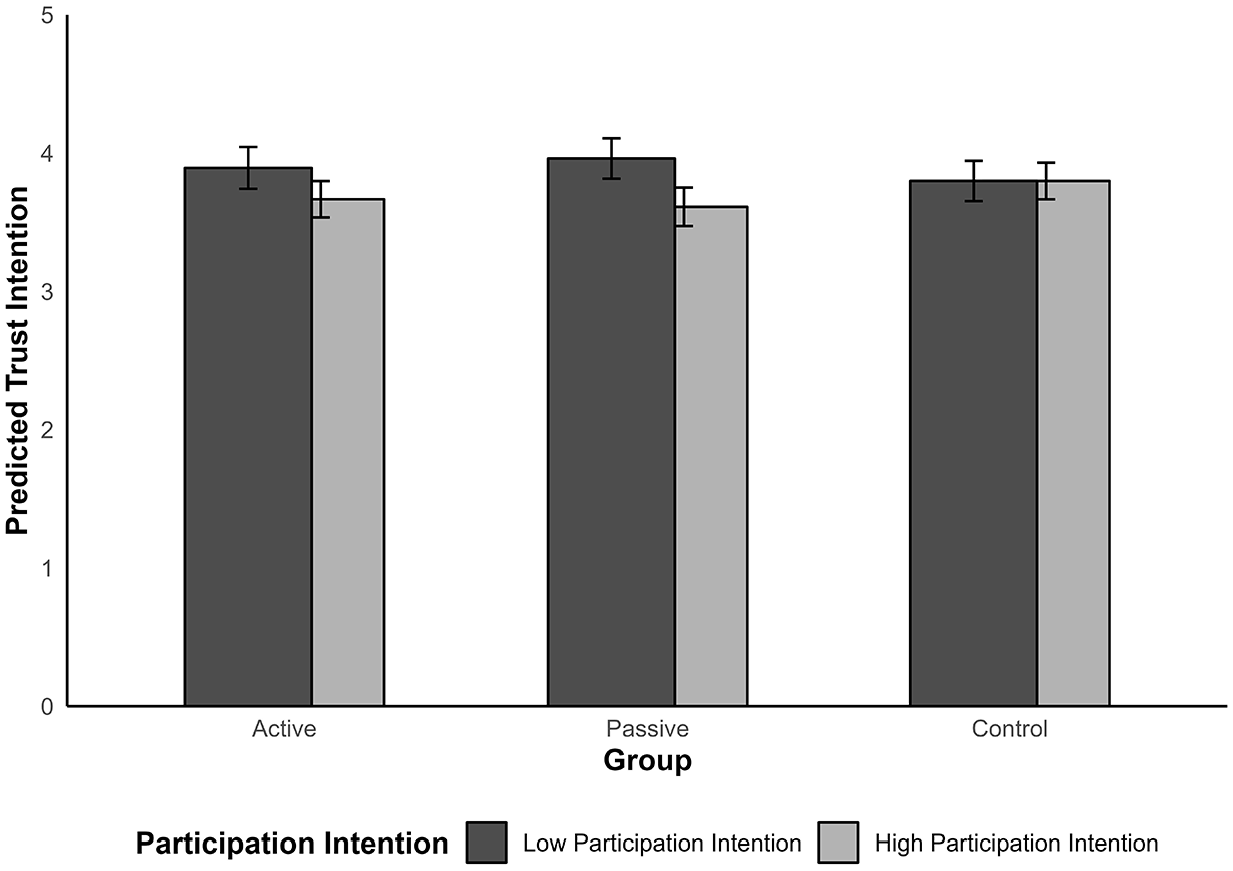
Interaction Effect of Intention to Participate and Group on Trust Intention.
Discussion
Our study explored how different levels of participation influence perceptions of trustworthiness, message credibility, and intention to trust a scientist. We found that only active participation significantly predicted trustworthiness, specifically in terms of integrity and benevolence. Perceptions of expertise remained stable across all levels of participation. Although participation did not directly impact message credibility, our exploratory mediation showed that benevolence mediated the participation-credibility relationship. Unexpectedly, only passive participation significantly enhanced trust intention. Intention to participate was an important moderator in our study.
Impact of Participation Levels on Expertise, Benevolence and Integrity
In a simulated collaborative design process, actively involved participants had the opportunity to make choices that directly influenced a science communication product—a scientific online article. Despite being a simulation, the process may have given participants a sense of ownership over the final product (Greving et al., 2020), which aligns with fairness and respect as key elements of ethical behavior, and well-documented influences of trustworthiness (Bromme & Hendriks, 2024; Jamieson et al., 2019). The transparency regarding their impact may have enhanced their perception of the integrity of the fictional scientist. The validation of input could also demonstrate scientists’ benevolence by addressing participants’ personal needs (Hendriks et al., 2016). These results support the idea that actively involving publics allows scientists to demonstrate genuine concern for public needs and inclusivity (Kappel & Holmen, 2019; Metcalfe et al., 2022). Simply being informed about participation does not appear to have a similar impact on trustworthiness, possibly due to its limited interaction depth and sense of involvement (Leitch, 2022).
Notably, perceptions of expertise remained stable across participation levels, suggesting that expertise is perceived as an inherent and stable quality, less influenced by short-term interactions. This aligns with the notion that expertise is primarily judged based on the scientist’s knowledge, competence, and established credentials (Hendriks et al., 2015; Thon & Jucks, 2017). However, our participatory process did not impact these expertise indicators. It is also possible that the increase in benevolence and integrity led to a reported trade-off effect regarding trustworthiness, potentially neutralizing effects on expertise (Altenmüller et al., 2023).
Impact of Participation Levels on Credibility
Interestingly, our findings suggest that participation alone did not affect the credibility of the final science communication product. Instead, benevolence emerged as the critical factor, demonstrating that it is the perceived qualities of the source, rather than the process itself, that shape credibility judgments. This aligns with previous research that emphasizes the importance of source trustworthiness in assessing credibility (Gierth & Bromme, 2020; Jonas et al., 2024; Metzger & Flanagin, 2015).
While expertise was expected to be the strongest predictor of credibility, benevolence was found to be equally important. Thus, in participatory science communication, credibility—and by extension, trust in the source—seems to depend not only on factual accuracy, but also on whether scientists’ motives reflect the public good (Landrum et al., 2015).
This complexity is further highlighted by our exploratory moderated mediation analysis, which revealed that active participation did not directly affect credibility but was fully mediated through benevolence. As mentioned before, active participation may give people a chance to experience scientists’ benevolence, which then influences their perception of credibility. The absence of a direct effect supports this view; however, since our study is cross-sectional, caution is needed in interpreting mediation, and longitudinal studies are necessary for further validation.
Another possible explanation is that deeper involvement might be necessary for direct effects to unfold. Our study design limited participant interaction to selecting design elements, such as headlines and introductions, rather than co-creating scientific content over a longer period. This limited engagement could have affected credibility assessments. Although our manipulation checks confirmed differences in perceived participation between groups, these checks did not account for differences in outcomes.
Impact of Participation Levels on Trust Intention
Contrary to our hypothesis, passive participation—not active participation—led to an increase in trust intention—particularly, the willingness to rely on the fictional scientist for making health decisions. This suggests that merely knowing publics are involved in the science communication process can influence individual’s willingness to trust scientists.
This effect can be understood through the lens of social influence theories (Cialdini & Goldstein, 2004), particularly the distinction between individual and collective engagement in fostering trust. We conceptualized trust intention as the willingness to be vulnerable to the scientist in this specialized health context, adapted from Besley and Tiffany (2023). For personal and critical decisions, such as those related to medicine in our setting, the broader societal endorsement (as reflected by passive participation) might carry more weight for trust intention. Knowing that others are involved in the science communication process can act as social proof, making people more likely to trust the scientist, as collective involvement suggests a form of verification (MacCoun, 2012). Research indicates that equal opportunities for different groups to engage in decision-making build trust in decision-makers and increase acceptance (Terwel et al., 2010). While active participation enhanced perceptions of benevolence and integrity through direct engagement, trust intention might be more strongly influenced by the knowledge that a larger collective is involved, implying a well-supported, inclusive, and responsive process (Fiske & Dupree, 2014; Jamieson et al., 2019; MacCoun, 2012).
However, our experimental design differs in key ways from real-world participatory science communication, which could have influenced these results. Building trust often depends on personal, authentic interactions and connection (Mayer et al., 1995; Thornton & Leahy, 2012), and practical participatory science communication is often an iterative process, where engagement unfolds over time and allows for relationship-building (Gascoigne et al., 2022). As a recent field study on co-design emphasizes (Wang, 2025), participants’ feelings do not follow a linear trajectory; rather, trust among group members develops gradually over time, evolving throughout the process.
In contrast, our study captured only a brief moment of participation, and used a comic figure instead of a real scientist, which limited our ability to replicate the nature of real-world engagement. Therefore, it is possible that active participants were not provided with the necessary context to establish an interpersonal connection. Meanwhile, passive participants may have more easily imagined a real scientist had interacted with others, as the video illustrated the process.
Moderation of Trust Dynamics by Participation Intentions
Our findings for RQ4 show that the impact of participation on trust varies depending on an individual’s intention to participate. For high-intention individuals, active participation had a weaker positive effect on benevolence and integrity, while passive participation had a weaker positive effect on trust intention compared with individuals with lower participation intentions.
One explanation is that high-intention individuals enter participatory science communication with higher expectations. If these expectations are unmet, they may view the promised participation as insufficient, diminishing its impact. Unmet expectations may trigger epistemic vigilance (Sperber et al., 2010), leading these individuals to scrutinize participatory experiences more critically. By contrast, those with lower intentions may be less vigilant, and therefore more receptive to even minimal participation.
A similar logic may explain why passive participation had a stronger effect on trust intention among those with lower participation intentions. High-intention individuals may require more active roles, as for example, in co-creation formats, to experience increased trust. In contrast, low-intention individuals may still perceive passive participation positively, as it signals collective endorsement rather than requiring personal engagement.
Although our participatory design process was simulated, it points to a broader real-world concern: the need to avoid “partici-washing”—the superficial use of participation without genuine engagement (Metcalfe et al., 2022). When individuals anticipate meaningful involvement but experience the process as merely symbolic, participation can backfire, leading to frustration and undermine trust-building potential (Šakić Trogrlić et al., 2018). Such negative experiences do not just affect immediate perceptions—they also pose the risk of eroding trust more broadly, as individuals may generalize this frustration to science as a whole (Wintterlin et al., 2022).
In addition, this dynamic may be particularly consequential for those who are already interested in participating in science communication. High-intention individuals, who are also likely core audiences for (participatory) science communication (Schäfer et al., 2018) may require more in-depth engagement to be satisfied. As Segalowitz et al. (2018) state, it is the genuine part of participation that is believed to drive positive effects—yet, defining what counts as “genuine” and for whom remains debated. Future research should investigate how mismatches between expected and actual levels of participation influence trust outcomes, particularly across different audience segments.
An alternative explanation is that high-intention individuals may already have strong trust, leaving little room for further increases through participation. In this case, the observed moderation would indicate a trust saturation effect, where participatory efforts reinforce existing trust rather than transforming it. Prior research shows that science-positive audiences, who are highly engaged with science, tend to report higher trust levels (Schäfer et al., 2018). In contrast, low-intention individuals have more room for trust to grow, making participation more impactful.
To summarize, our findings suggest that participation intentions could shape trust dynamics via at least two distinct pathways: (a) an expectation-driven scrutiny, where high-intention individuals scrutinize participation more critically, and (b) trust saturation, where high baseline trust constrains the degree of possible change. While we observed ceiling effects in our dependent variables, we did not measure baseline trust levels, limiting our ability to test these two interpretations.
If individuals with lower trust benefit the most from participation experiences, this presents an opportunity for targeted interventions. However, it comes with a key practical challenge: How can we effectively engage those least inclined to participate, despite their potential to gain the most in terms of trust-building? While practice projects already intended to reach lower-trust populations could be evaluated to provide some answers to this question, future research should address the question whether participatory science communication formats primarily affirm trust dynamics among the already engaged, or whether they could serve as a mechanism for broader public trust-building.
In conclusion, the small but significant moderation effects across models emphasize that the effectiveness of participatory science communication does not only depend on process itself but is partly shaped by individual differences. While it may seem obvious, it is a takeaway worth spelling out: The full benefits of participation can only emerge when formats align with individual preferences (Kenny & Castilla-Rho, 2022).
Limitations and Future Research
While our study provides first insights on trust dynamics arising in participatory science communication, several limitations follow suit. First, we observed pronounced ceiling effects in the trustworthiness dimensions, which restricted variance. This limitation might have masked subtle variations and reflects common challenges with sampling from crowdsourced platforms (Brühlmann et al., 2020). Despite careful data cleaning, we cannot entirely rule out some careless responding, as cut-off values are determined relative to the overall sample.
We used Helmert contrasts for balanced and orthogonal comparisons in our complex study design. Thus, we assumed a hierarchical nature of participation levels, which may have inadvertently obscured certain effects by imposing a structure that may not fully capture the dynamic nature of participation in collaborative settings.
Another significant limitation is the artificial nature of our experimental environment. While this controlled setting allowed us to isolate causal effects, it also introduced constraints on ecological validity. In reality, participatory science communication is an evolving, socially embedded process that is iterative rather than linear, adapting dynamically to context, resources, and institutional structures (Metcalfe et al., 2022; Segalowitz et al., 2018). Although our experimental conditions were carefully designed to signify different levels of participation, real-world implementations require deeper and more sustained interactions than what was feasible in our study. For example, our active participation condition simulated aspects of co-design, but participation was limited to stepwise involvement in design and text-based decisions. Hence, while our study offers valuable insights, findings should be interpreted within the constraints of this experimental setting.
In future research, we plan to include mixed-methods studies in naturalistic settings, involving face-to-face interactions and longer collaboration periods. Longitudinal designs, in particular, could offer deeper insights into how trust dynamics evolve over time under different participatory conditions. By doing so, we can further bridge the gap between experimental research and participatory science communication in practice.
Finally, the small effects suggest that while participation can influence trust dynamics, the impact may be limited and context-dependent, likely shaped by a range of factors, including the nature of the task, the composition of the participant group, and the broader social and cultural context. Future research should delve further into these factors.
Conclusion
From participation to trust in science may sound like a promising, straightforward path. Our study offers some indicators for optimism but also hints at a more intricate reality. While we found small, positive effects on trust—even within the limited scope of a simulated digital environment—it is evident that individual differences and moderating factors introduce twists and turns along this path. A one-size-fits-all approach to participatory science communication risks overlooking the diverse ways individuals engage with and respond to participation. This highlights the need for future research to investigate who truly benefits from participation and under which conditions, particularly beyond the limitations of digital settings.
While participatory science communication certainly holds promise for enhancing trust, its success depends on careful implementation and thorough evaluation. A practical implication of our findings is that enhancing trustworthiness through participation is possible—but it requires meaningful involvement. Clear opportunities for participation are crucial for strengthening perceptions of benevolence and integrity. However, science communicators interested at improving trust through participation should go beyond merely facilitating participation; they should also ensure that these efforts are visible and well-communicated to non-participating audiences. Since credibility perceptions were largely shaped by perceived benevolence, real-world participatory science communication should emphasize transparency about scientists’ intentions and responsiveness to public concerns. By balancing substantive participation with clear communication about the process and scientists’ roles, participatory science communication can become a meaningful tool for building trust in science.
Ultimately, the path to building trust in science through participation may not be simple one, but it is evident that trust can thrive when participatory paths are thoughtfully designed and effectively integrated. By recognizing the complexities of this relationship, we can create genuine opportunities for engagement that strengthen the relationship between science and society.
Supplemental Material
sj-docx-1-scx-10.1177_10755470251333399 – Supplemental material for From Participation to Trust? Understanding Trust Dynamics in Participatory Science Communication
Supplemental material, sj-docx-1-scx-10.1177_10755470251333399 for From Participation to Trust? Understanding Trust Dynamics in Participatory Science Communication by Jane Martha Momme, Friederike Hendriks and Carolin Enzingmüller in Science Communication
Footnotes
Acknowledgements
The authors wish to thank the Kiel Science Communication Network (KielSCN.de) for providing the environment that catalyzed this work. Situated in Kiel, Germany, the KielSCN fosters transdisciplinary science communication research and is generously funded by the VolkswagenStiftung.
Declaration of Conflicting Interests
The author(s) declared no potential conflicts of interest with respect to the research, authorship, and/or publication of this article.
Funding
The author(s) disclosed receipt of the following financial support for the research, authorship, and/or publication of this article: This work was supported by funding from the VolkswagenStiftung (Az.: 99994).
Ethical Approval and Informed Consent Statements
This study was approved by the IPN’s Ethics Committee on August, 29 2023. All participants provided written informed consent prior to participating.

Data Availability Statement
Notes
Author Biographies
References
Supplementary Material
Please find the following supplemental material available below.
For Open Access articles published under a Creative Commons License, all supplemental material carries the same license as the article it is associated with.
For non-Open Access articles published, all supplemental material carries a non-exclusive license, and permission requests for re-use of supplemental material or any part of supplemental material shall be sent directly to the copyright owner as specified in the copyright notice associated with the article.
