




Abstract
This study explores whether the emphasis of science news websites on dissemination over dialogue corresponds to the actual preferences of their science-oriented audiences. Based on interviews with science news website administrators (n = 8) and readers (n = 20) and two reader questionnaires (n = 89; n = 55), we found that readers favor dissemination, yet certain readers may also desire interactive discussions. Readers perceive the ability to comment as beneficial for readers and administrators; however, they do not expect administrators to engage in dialogue. Younger audiences showed a somewhat greater preference for online dialogic communication than their older counterparts.
Rationale
The relationship between science communicators and diverse publics is typically described as Dissemination and Engagement (Kappel & Holmen, 2019). These two science communication paradigms promote different science communication objectives that are nevertheless intertwined and coexist within various types of science engagement activities (Metcalfe, 2019). The Dissemination paradigm reflects the one-way transmission of scientific knowledge from experts to the public and focuses on providing scientific content and informing the public. The Engagement paradigm advocates two-way communication between experts and the public through dialogue that encourages knowledge exchanges, particularly about controversial issues (Reincke et al., 2020), also seeking to foster active public participation in science-related policy-making deliberations and science knowledge co-creation.
Contemporary perspectives on science communication challenge the linear dissemination of knowledge and instead endorse active engagement by promoting critical, dialogic, and participatory bidirectional communication (Davies et al., 2021).
Different communication approaches may cater to diverse audiences in varying ways as a function of these audiences’ needs, abilities, perspectives, and constraints (National Academies of Sciences Engineering and Medicine, 2017). Whether stated outright or implied, each paradigm for dissemination and engagement is associated with different science communication audiences.
Dialogic communication, as found in the engagement approach, is more often related to initiatives targeting traditionally marginalized audiences (e.g., Dawson, 2018) or less interested ones (e.g., Nadkarni et al., 2019), with the overarching aim of cultivating inclusive and meaningful interactions with broader audiences (Menezes et al., 2022), whereas the dissemination approach is argued to be tailored to interested and information-rich audiences (Scheufele, 2018).
This study examines whether science communicators’ tendency to prefer one-way communication aligns with the actual preferences of their science-oriented audiences. Do science-oriented audiences opt for one-way dissemination and lack interest in engaging in dialogue? Do they perceive any benefits in dialogic communication beyond top-down transmission of knowledge? What expectations do they have from science communicators? Addressing these considerations with clarity is essential, as they bring forth a pivotal concern: Are science communicators practically overlooking the potential interest in a dialogue of science buffs who are deeply immersed in the subject, or do contemporary perspectives on science communication inadvertently impose a dialogic communication approach onto audiences who may not necessarily be interested in engaging in two-way interactions? Ideally, normative theory and empirical practice should inform, negotiate, and shape one another. This apparent gap between theory and practice prompts questions about whether this envisioned reciprocal relationship is realized.
This disparity also raises a social concern. Suppose science-oriented audiences are genuinely interested in dialogue. In that case, not meeting their interests and preferences may result in a missed opportunity to establish a constructive deliberative public sphere and reinforce democratic civic behavior through science-related discussions. While reaching out to the disengaged and attending to their needs is crucial, we should not disregard the communicative needs, concerns, and motivations of already engaged people.
Here, we took an audience-centric approach to examine how science news website (SNW) readers, who have a keen interest in science, perceive their experiences with site content in terms of dissemination and dialogue.
The SNWs we studied function as digital media agents that cover various science topics. They integrate scientific expertise with journalism in publishing popular science news, also allowing readers to publicly comment and debate. To distribute their content, the SNWs are active on several social networks, primarily Facebook, and two websites syndicate their content at no cost to general media outlets to reach broader and more diverse audiences.
Our focus on SNWs is primarily driven by the characteristics of their readership, which consists of a science-oriented audience—an ideal demographic to address the communicative needs, concerns, and motivations of those interested in science. The considerable research attention that has already been devoted to YouTube science videos in recent years (e.g., Dubovi & Tabak, 2021) and the fact that science podcasts hardly ever allow listeners to comment also contributed to our focus on SNWs, which represent an online, text-based medium for science communication. Written formats are still the primary way for diverse audiences to engage with science—American adults typically learn about science through general news sources, with 54% regularly consuming science-related news from news outlets (National Science Foundation, 2024), and likewise in Israel, with 48% of the population indicating that they read science news in this way (Israel Ministry of Science and Technology, 2015).
Clearly, SNWs operate as platforms for disseminating scientific news, aligning with multiple objectives inherent to the dissemination paradigm. By permitting readers to post comments over an extended period, these platforms provide a broader range of communication channels for their audiences, creating a space for public dialogue that may enhance active engagement and trust-building. However, it remains uncertain whether SNW readers are interested in the opportunity to comment and whether they seek dialogic communication.
This study explores how SNW readers perceive their interaction with site content to understand the underlying motivations that encourage them to do so, while drawing comparisons with the priorities set by the site administrators, that is, the content generators and providers. Specifically, we ask,
Research Question 1 (RQ1): How do SNW readers perceive their interaction with site content regarding dissemination and dialogue, and how do their perceptions align with the communicative priorities set by the SNW administrators?
Since reader comments can act as a gateway to dialogue, we utilize readers’ perceptions of reader comments to operationalize the concept of dialogue. However, we acknowledge that leaving comments does not necessarily lead to an actual dialogue. It is worth noting that posting comments is the sole form of engagement the websites examined in this study offer their readers.
To further probe whether SNW readers prefer dissemination or dialogue, we explored which of their needs are met by their experiences with the site content and commentary space. The engagement of those intrigued by popular science news will likely be motivated by cognitive needs. However, what other needs might motivate them? Specifically, we ask,
Research Question 2 (RQ2): Which dimensions of need motivate SNW readers to read and comment on popular science news articles and respond to comments authored by others?
Theoretical Background
Science communication encompasses both dissemination and engagement objectives. These primarily include (Metcalfe, 2019; Scheufele et al., 2021):
Enhancing the public’s scientific literacy to be able to make informed decisions.
Contradicting science misinformation, disinformation, and fake news.
Informing the public about science and distributing scientific content.
Making scientific content accessible.
Exciting the public about science and increasing appreciation for science.
Gaining the public’s support and government funding for science.
Tailoring messages to specific audiences.
Finding out the public opinion and needs to better communicate science.
Encouraging the public to be involved in public science discourse, express concerns, and raise questions that stem from science and its applications.
Fostering the public to help set the agenda for science by actively deliberating in public debates on the “why” and “why not” of science as part of democratic policy-making.
Enabling responsible innovations: acknowledge the public critique on the science research enterprise priority list and strive to maximize possible societal returns from investments in science for the larger social good.
Encouraging publics to participate in research endeavors with scientists, encompassing the real-life experiences of nonexperts and their socially informed scientific knowledge as part of the collaborative knowledge creation process.
Objectives 1 to 7 aligned more closely with the Dissemination paradigm, whereas Objectives 8 to 12 better reflected the Engagement paradigm. Since the latter can be achieved through dialogue, we refer to the engagement paradigm as dialogic communication.
These 12 science communication objectives were previously utilized by (Zimmerman et al., 2024) to explore SNW administrators’ perceptions of how to communicate science and their rankings of these objectives.
The Practice of Dissemination and Dialogic Science Communication
Allowing diverse audiences to express their concerns and needs through conversations and attentive listening is crucial for individuals who may feel left out (Humm et al., 2020). Therefore, two-way communication is frequently associated with initiatives aimed at underserved audiences (e.g., Dawson, 2018) or less interested ones (e.g., Nadkarni et al., 2019). Numerous studies have explored the effectiveness of dialogic communication, which values knowledge outside science, in engaging the disengaged (e.g., Habibi Doroh & Streiche, 2021), and also in contexts related to specific communities (Lewenstein, 2019) or politically charged issues relevant to policy-making, such as genetically modified organism (GMOs) (Reincke et al., 2020).
The dissemination approach is practically tailored for interested and well-informed audiences (Scheufele, 2018). It tends to portray science as an authoritative form of knowledge, favoring affirmative coverage of fundamental scientific topics. This approach presents scholarly findings and is predominantly aimed at individuals who are already interested in the subject matter while tends to neglect underserved audiences that may face challenges in effectively utilizing scientific content (Secko et al., 2013). Empirical examples, characterizing diverse science communicators, support this argument. Science bloggers, for instance, perceive their audiences as passionate and deeply interested in the subject who find satisfaction in the unidirectional flow of scientific knowledge (e.g., Ranger & Bultitude, 2016). Administrators of SNWs often communicate with their science-oriented audience through information dissemination rather than nurturing dialogue and active participation (Zimmerman et al., 2024).
Nevertheless, the inclination toward favoring dissemination over dialogue can also be traced back to several constraints. Short deadlines and scant resources may make delivering information more appealing than the more demanding tasks of engaging in dialogue and actively listening to various perspectives (Weingart et al., 2021). Perceived deficiencies or insecurities in their two-way communication skills may also contribute to science communicators’ preference for dissemination over dialogue (Rose et al., 2020). More so holds given that user interactivity does not always translate into a deliberative democratic potential but instead may manifest as a superficial and aggressive form of audience participation characterized by polarized and impolite comments that discourage alternative viewpoints (Collins & Nerlich, 2015). Collectively, these factors may act as deterrents to fostering meaningful dialogue, thus prompting communicators to prioritize one-way communication with their audiences, regardless of whether the audience is science-oriented or not.
The Inherent Dialogical Potential of Online Engagement
Digital media, with its networked technologies, has fundamentally reshaped communication and how people interact with scientific knowledge, blurring the boundaries between science journalists, scientists, and general audiences (Dunwoody, 2021). The new media information ecosystem, compared with legacy media, has become more pluralistic, participatory, and social, allowing for an active public sphere of engagement; users who were once considered a passive audience can interact with content and each other in various forms and at different levels of engagement, making their presence felt (Kupper et al., 2021). This interactivity ranges from simple actions such as clicking to generating original user content that allows users to express their opinions and concerns in writing, such as posting comments (Taddicken & Krämer, 2021). Yet, comments are considered the lowest level within the user-generated content spectrum, as it is argued that they do less to deepen the audience’s experience than contributing more substantial content or actively participating in user forums (Koski, 2015). That said, having comment threads beneath articles on digital platforms represents a significant shift, from—controlled, person-to-person communication, such as letters to the editor, to—the widespread and immediate sharing of user content, allowing diverse public voices to be heard, exchanging opinions and deliberate (Kupper et al., 2021). User comments may provide a window into authentic public knowledge, opinions, and sentiments (e.g., Laslo & Baram-Tsabari, 2021), influence other users’ attitudes about science (Jennings & Russell, 2019), and shape how they apply scientific knowledge (Khosla & Pillay, 2020).
Commenting can initiate public discourse and may empower citizens beyond the one-way flow of knowledge, potentially resulting in high levels of public involvement, such as supporting knowledge construction (Dubovi & Tabak, 2020), and providing a foundation for greater public engagement in bioethics (Laslo & Baram-Tsabari, 2019). But what motivates users to post comments?
Uses and Gratifications Theory
The Uses and Gratifications Theory (U&G; Katz et al., 1973) has consistently provided a leading theoretical approach for mass communication media, including newspapers, radio, television, and now the Internet (Lev-On, 2017). The U&G framework posits that communicative behavior is purpose-driven and sees media consumers as active and involved communicators who seek to fulfill their needs and receive gratification when these needs are met. A need is a combination of psychological dispositions, sociological factors, and environmental conditions that motivate media use, whereas gratification is the perceived satisfaction of a need. Katz et al. (1973) listed five dimensions of needs: (a) Cognitive (acquiring information, knowledge, understanding); (b) Affective (emotion, pleasure, feeling); (c) Personal (status, position relative to others); (d) Social (interacting with friends and others); and (e) Tension-release (escape and diversion).
The convergence of the media with digital technology has significantly altered how media consumers engage with content and interact, increasing the variety of media options (Taddicken & Krämer, 2021). This shift has prompted scholars to question whether new media fulfill the same needs as traditional ones and whether a “modernized” U&G theory should be situated within this new media landscape; thus, concepts, such as interactivity, demassification, and a-synchroneity, were thought to be included and expand existing theoretical models (Weiyan, 2015). However, since U&G researchers focus on the audience’s perspective rather than the media’s, the fundamental questions remain unchanged: What motivates people to engage with specific types of mediated communication, and what gratifications do they obtain from it? (Weiyan, 2015). Hence, scholars have continued to utilize the U&G framework to explore the motivations behind online engagement patterns (e.g., Bucknell Bossen & Kottasz, 2020). In fact, the new media affordances have revitalized the significance and strengthened the theoretical foundation of U&G, enabling it to drive valuable research into this rapidly expanding telecommunication medium (Lev-On, 2017). Thus, despite being 50 years, the U&G framework remains highly relevant and applicable in the dynamic landscape of new media, which not only facilitates rapid information dissemination but also enables user communication and interaction.
This study employed the U&G theory to examine readers’ motivations for interacting with popular science news and their associated comments. Here, we use the terms “needs” and “motivations” interchangeably.
Research Field
Four leading SNWs were included in this study. These websites publish popular science news, integrating scientific expertise with journalism. Typically, they create unique content that focuses predominantly on popular science, much like the material found in Scientific American, but seldom engage in commentary-style initiatives like those pursued by The Conversation. The websites we studied met four predetermined inclusion criteria: (a) coverage of diverse scientific subjects, (b) publishing content at a minimum rate of four times weekly, (c) allowing readers to comment publicly, and (d) cultural prominence (Baram-Tsabari et al., 2020). Despite differences in institutionalized financial support versus volunteer work and variations in the size of their science-trained staff, these SNWs are all journalistic outlets dedicated exclusively to covering science issues. Their administrators have advanced degrees in science, and some are active scientists, with responsibilities that include writing and editing science news, moderating reader comments, and overseeing the website and Facebook page management. Even though their contributors usually do not have professional journalism training, they adhere to journalistic practices and work as editorial teams regardless of their background (Ginosar et al., 2022). The SNWs’ business model measures performance through metrics like Google Analytics views rather than the level of active interactions, based on the assumption that publishing a higher volume of news items will lead to increased viewership (Zimmerman et al., 2024).
Method
To explore administrators’ and readers’ perceptions regarding dissemination and dialogic science communication (RQ1), we employed a concurrent parallel mixed methods approach, in which the data were collected independently from both sources. This involved one-to-one interviews with eight administrators and 20 readers. During the interviews, neither the approaches, that is, dissemination and dialogue, nor any associated theories were discussed with the participants, and none spontaneously identified any potential theory-driven distinctions. Then, we examined the alignment between SNW administrators’ communicative priorities and the actual preferences of their readers (n = 20), with a specific emphasis on understanding the readers’ motivations. This was done by comparing the rankings of 12 science communication objectives 1 from both groups and integrating the insights obtained through the interviews.
To explore the motivations that drive SNW readers to engage with science news (RQ2), we used an exploratory sequential mixed methods approach in which the results of one phase informed and guided the data collection of the next (Creswell & Creswell, 2018). The interviews with readers were analyzed to uncover their motivations. This served as the basis for the questionnaire (n = 55) and subsequently administered to a broader readership.
SNW Readers
Demographic data on SNW readers were obtained from a short online questionnaire posted on the Facebook page of each website and one website’s homepage. Respondents (n = 515) were 63% males, 76% had a college degree, and 60% worked or studied in Science (Biology, Physics, Earth Sciences), Technology, Engineering, and Mathematics (STEM) 2 -related fields. Individuals aged 18 to 39 years constituted 59% of the respondents. The remainder were between the ages of 40 and 80. These findings indicate that SNW readers differ considerably from the general public in Israel (Online Appendix A): Males are overrepresented, and they are relatively younger, more highly educated, and science-oriented. Half of the respondents said they keep up with science news by using other online sources as well, such as blogs and forums. These demographics are similar to those of active science news consumers (Pew Research Center, 2017) and science blog readers (Jarreau & Porter, 2017). Thus, the SNW readers surveyed in this study resemble the typical profile of other deeply engaged consumers of scientific information. During their interviews, the readers portrayed themselves as science-minded with a strong interest in science, for example: “I have been interested in science-related topics for as long as I can remember . . . science fascinates me, and I find myself irresistibly drawn to it” (#4); “I take great pleasure in delving into a wide array of scientific topics” (#11); “Scientific information provides me with a deep sense of satisfaction” (#18). Despite their orientation toward and interest in science, these audiences should still be considered nonexperts, given the considerable differences in scientific disciplines and their specialized nature (Summ & Volpers, 2016).
This demographic questionnaire also asked if readers were willing to be contacted for later stages of the study, resulting in 164 individuals agreeing to participate.
Data Collection
Data were gathered from both SNW administrators and readers from January 2021 to September 2022.
Interviews With Administrators
Eight semistructured interviews were conducted with the websites’ leading staff to understand their modes of communicating scientific knowledge to their audiences. The administrators interviewed represent the dominant staff members familiar with the objectives and practices of the SNWs, thus fairly representing them. The interviewees were explicitly asked to describe the website’s objectives and were encouraged to elaborate on their relationships with their readership. Four follow-up 1-hr interviews with the leading administrators were then conducted, asking them to rate the 12 science communication objectives in terms of importance from the website perspective on a scale of 1 to 6. These four rankers hold the primary positions on each website concerning science communication objectives and practices, establishing and mirroring the priorities of the websites. Nevertheless, we verified their prioritization rankings by cross-referencing quantitative data with quotes obtained from interviews with all eight staff members.
Data were collected from SNW readers in three subsequent phases:
1. Preliminary questionnaire. An online questionnaire with two batteries of closed-ended questions was emailed to 164 SNW readers. Eighty-nine readers responded (54%). Readers were asked: (a) How often do you comment on SNWs’ news items or respond to those written by other readers? and (b) How often do you read comments written by others? (on a scale ranging from often, occasionally, rarely to never). Fewer than one-third (29%) noted that they often (7%) or occasionally (22%) wrote comments. The majority (80%) stated that they often (47%) or occasionally (33%) read comments.
2. Interviews with readers. Twenty semistructured 1-hr interviews with website readers were conducted via Zoom to provide insights into readers’ motivations for reading science news, commenting on them, and responding to those written by other readers. A purposive sampling technique (Patton, 2015) was used to prioritize readers who reported on the preliminary questionnaire that they were inclined to write and read comments, with the constraint of interviewing only those who gave their consent. Fourteen interviewees (70%) were male, 16 (80%) had a college degree, eight were 18 to 39 years, and the remainder were more than 40. The interviewees were asked to describe their experience reading and commenting online and explain what motivates them to keep doing so. The interviews primarily revolved around four broad, open-ended questions: (a) What are your expectations from the SNW administrators? (b) What is your opinion on allowing readers to comment? (c) What are your motivations for reading SNWs’ science news? and (d) What are your motivations for writing comments or reading those written by others? Each of these questions was accompanied by specific predetermined subquestions, and prompts were employed to further explore and clarify topics raised by the respondents (Tong et al., 2007). Then, interviewees were given the same list of 12 science communication objectives presented to the administrators and were asked to rank them. The prompt was Suppose the site administrators were to say: we are planning to try out a new format for the website and would like to know what to include that would keep you interested and give you even more reasons to continue reading and commenting. Please highlight the first two most important statements then the third and fourth most important and so on six times. The interviewees were encouraged to justify their rankings with examples and explanations.
3. Reader motivation questionnaire. The analysis of the reader interviews yielded 14 motivations for reading and commenting. These were subsequently grouped to form a 6-point Likert-type scale questionnaire (Online Appendix B). It aimed to determine the relative importance of each motivation in a reader’s self-report. The questionnaire was emailed to the 164 SNW readers who expressed a willingness to participate in the subsequent stages of the study. This yielded 55 responses (34% response rate). The respondents were predominantly male (66%) with an academic degree (82%), 23 were 18 to 39 years, and the other 32 were more than 40.
Subset Samples
When comparing the subset samples of SNW readers, that is, interviewees (n = 20) and questionnaire respondents (n = 89, n = 55), to the demographic questionnaire sample (n = 515), no substantial differences were found (Online Appendix A).
Analytical Procedure
To examine the alignment between reader perceptions of their interactions with site content in terms of dissemination and dialogue and the communicative priorities of the SNW administrators (RQ1), we compared the rankings of the 12 science communication objectives by the website administrators and readers. We assessed the consistency between both groups’ rankings, also drawing insights from their interviews. As a preliminary step, we evaluated the extent to which participants in each group assigned the same ratings to the science communication objectives by calculating the intraclass correlation coefficient (ICC) using an absolute agreement, two-way random effects model. Note that the ICC level reflects the rank order rather than the absolute score of the ranking. The ICC value for the SNW administrators was 0.891, with the 95% confidence interval ranging from 0.74 to 0.97, indicating good reliability. The ICC value for the SNW readers was 0.967, with the 95% confidence interval ranging from 0.93 to 0.98, indicating excellent reliability.
To better understand how readers perceive their interaction with the site content regarding dissemination and dialogue (RQ1) and what motivates them to read and comment on popular science news articles and respond to comments authored by others (RQ2), we conducted a coding reliability thematic analysis (Braun & Clarke, 2022) on interviews with 20 readers. This positivist-qualitative thematic analysis enables the development of emergent themes during coding, following initial data familiarization early in the analytic process (Braun & Clarke, 2023). In this approach, the inductive identification and conceptualization of themes as topic summaries—sometimes directly derived from data collection questions—is relatively straightforward (Braun & Clarke, 2022).
A total of 172 reader statements were extracted. The first author classified these statements into emergent themes, identified during the early stages of the analysis (Tables 1 and 2). To enhance the systematicity and transparency of the coding process and ensure rigor coding reliability (O’Connor & Joffe, 2020), 40% of these statements (n = 68) were independently classified by another trained coder, a Ph.D. student in science communication. Cohen’s kappa coefficient was computed for each category, with values ranging from 0.73 to 1. Any coding discrepancies were discussed until a consensus was reached before being incorporated into the analysis.
Reader Motivations to Write and Read Comments (n = 20).

Note. The numbers in brackets (#1 to #20) correspond to individual readers.
Readers’ Motivations for Engaging With Content on SNWs: Illustrative Quotes and Descriptive Statistics.
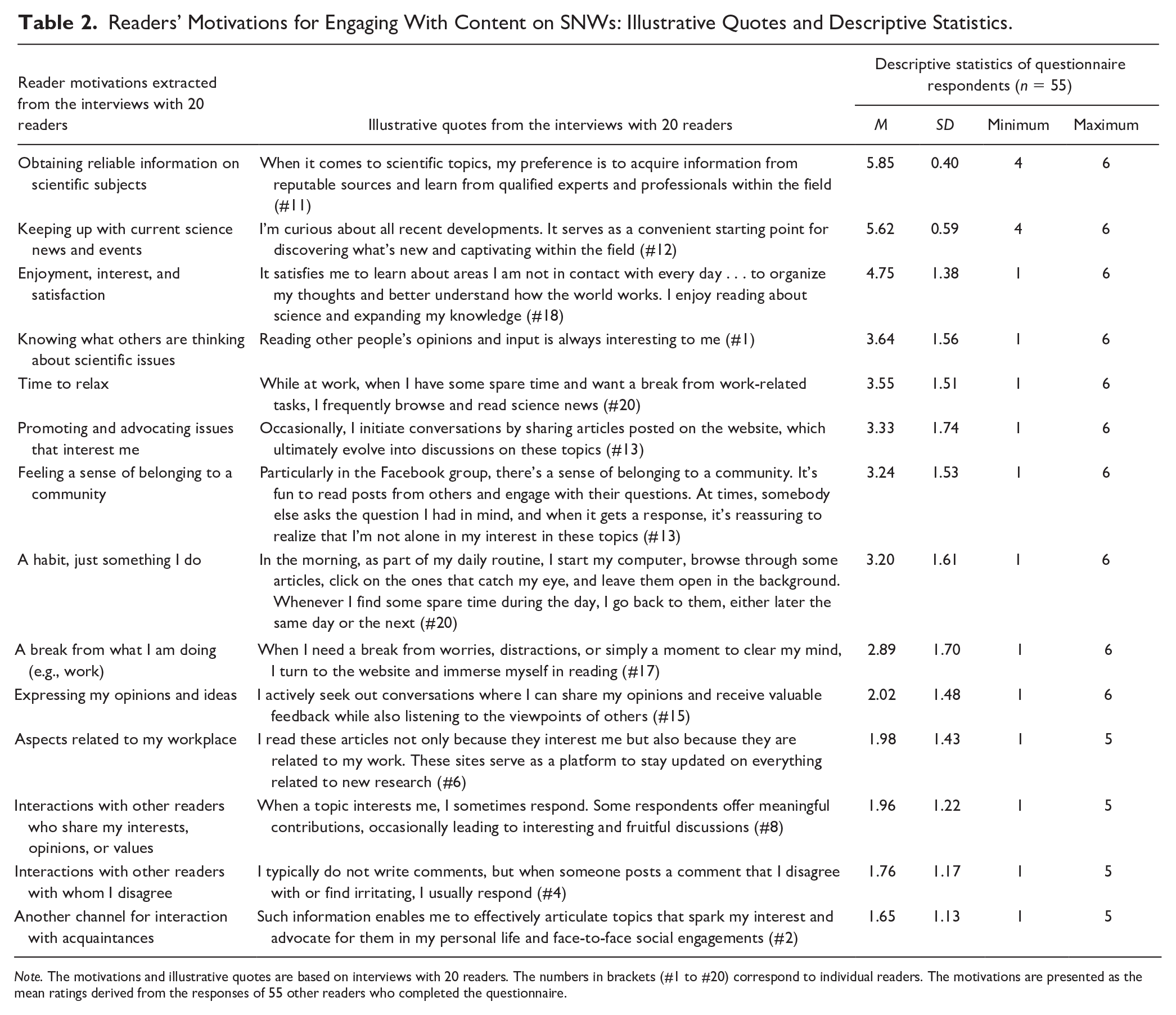
Note. The motivations and illustrative quotes are based on interviews with 20 readers. The numbers in brackets (#1 to #20) correspond to individual readers. The motivations are presented as the mean ratings derived from the responses of 55 other readers who completed the questionnaire.
Given that reader comments can be a pathway to dialogue, we analyzed readers’ perspectives on allowing reader comments to operationalize the concept of dialogue. That said, while comments can facilitate dialogue, ensuring an actual dialogue is not guaranteed.
This study was approved by the university Institutional Review Board (approval No. 2021-010). The participants filled out a consent form, and all were volunteers.
Findings
The analysis of the extensive data set collected from SNW readers and administrators yielded insightful results regarding readers’ perceptions of dissemination and dialogue, and their motivations to engage.
Readers’ Preferences and Administrators’ Priorities (RQ1)
The rankings of the 12 science communication objectives by readers (n = 20) and administrators (n = 4) indicated a trend favoring dissemination (Figure 1). Items corresponding to the dissemination-related objectives, such as “informing the public about science and distributing scientific content” and “making scientific content accessible” were ranked the highest, suggesting that they were the most motivating for reader engagement and deemed the most important for the SNWs, whereas objectives related to dialogue came in second place. The administrators’ limited involvement in the discussions was apparent from their statements, which assumed that readers would participate without the need for active encouragement: Encouraging reader comments is not a deliberate endeavor and is deemed unnecessary as readers naturally engage without prompting. The topics in the articles frequently spark discussions. I may respond on occasion, but not consistently. Occasionally, readers engage in conversations, with both sides of the argument exchanging thoughts.
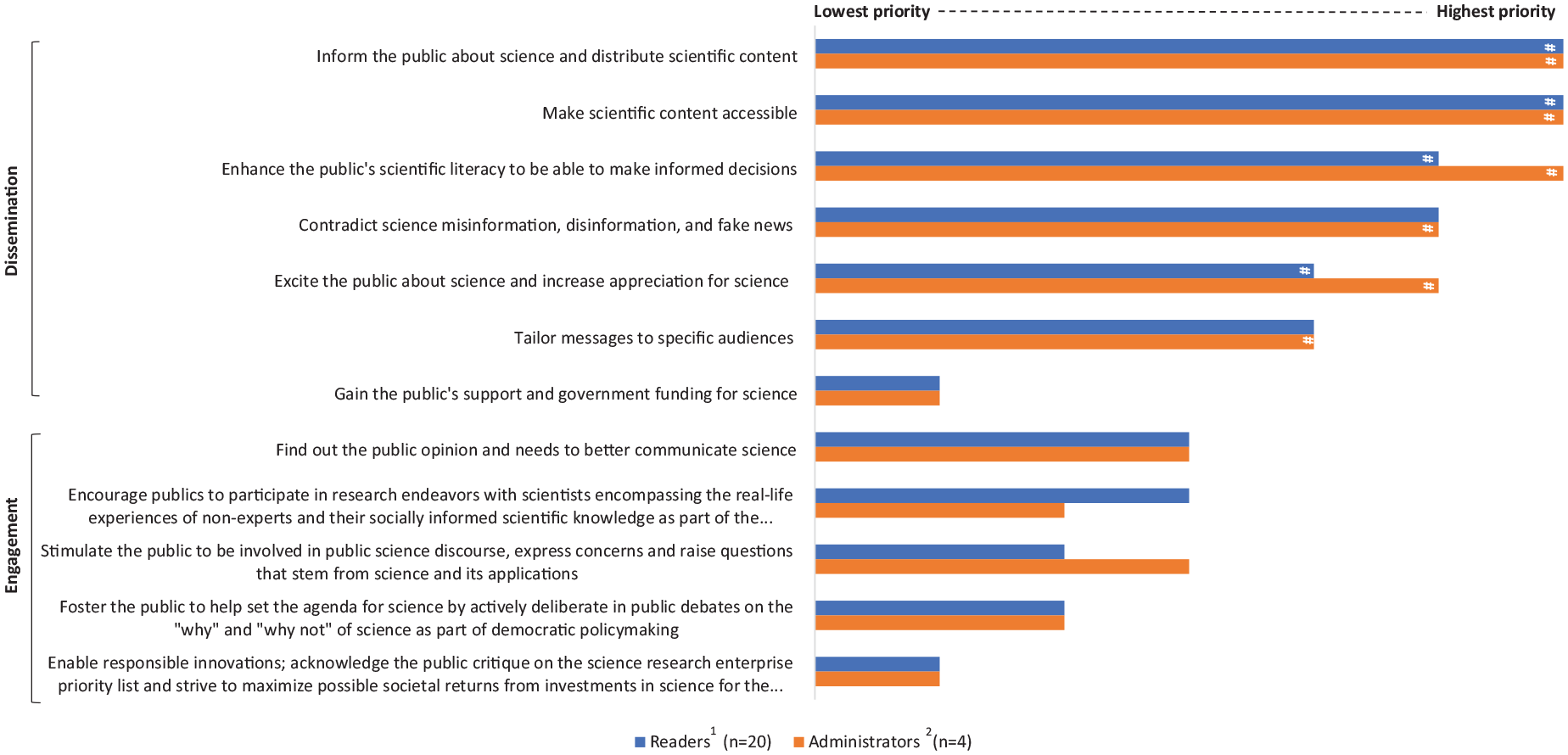
The Prioritization of 12 Science Communication Objectives as Perceived by SNW Readers1 and Administrators2.
The readers’ and administrators’ rankings of the objectives were highly similar. The ICC value was 0.972, demonstrating a robust level of alignment, and the 95% confidence interval ranged from 0.90 to 0.99, indicating excellent reliability.
In the interviews, all the readers spontaneously underscored the importance of disseminating scientific content when queried about their expectations from SNWs. This further strengthened the trend that was already apparent in their rankings. None of their spontaneous expectations were related to dialogue or participation. Readers overtly expressed interest in the SNWs’ articles, and some viewed them as a catalyst for further information-seeking and learning: “The science news they publish is just a starting point for me to read more about the topic” (#17).
However, when the readers were explicitly asked about their stance on allowing reader comments, a resounding majority of 19 out of 20 expressed their support. The readers emphasized that both websites and readers benefit from allowing comments. For the SNWs, the main benefits were future improvement, such as learning from critiques and gaining insights into topics that captivate readers (n = 13), and heightened reader engagement (n = 8). For readers, the main benefits were the opportunity to ask questions to get clarifications and explanations (n = 11), satisfying the readers’ curiosity about the opinions, feelings, and thoughts of fellow readers (n = 8), and the opportunity to share professional expertise and personal experiences (n = 7).
The readers suggested proactive steps that administrators should take to encourage comments by (a) responding more frequently to reader comments to reestablish the interaction, (b) monitoring incivilities to avoid a toxic environment that would deter readers, (c) addressing topics relevant to everyday life including socio-scientific issues or current affairs such as climate change, and (d) incorporating questions into the content or explicitly inviting readers to comment. These remarks, regarding fostering comments, were spontaneously raised by readers, implying that while readers expressed a preference for dissemination, they also considered ways to encourage interactions.
That said, less than a third of the readers regularly wrote comments (29%, n = 26), and a substantial majority preferred reading comments written by others (80%, n = 71), as shown from the 89 responses to the preliminary questionnaire. What factors may contribute to this pattern? The motives underlying readers’ engagement, whether encouraging or discouraging, were revealed through their interviews (Table 1).
Half of the interviewees said that the administrators’ inconsistent responses to reader comments dissuaded them from further commenting. Fewer than one-third cited a vague sense of self-efficacy coupled with a lack of specific scientific knowledge, while others mentioned incivility of readers’ comments as factors deterring them from commenting. Readers’ inclination to read comments written by others was predominantly fueled by their curiosity to discover what other readers thought (n = 8) and their interest in benefiting from the expertise contributed by fellow readers (n = 6).
While readers acknowledged the advantages of allowing comments for both websites and readership, they did not explicitly articulate this in their expectations. Upon closer examination, in addition to their overall interest in SNWs’ articles, certain readers also voiced a desire to engage in dialogue with administrators, but for various reasons, they hesitated to anticipate any expectations. Some readers mentioned the high professionalism and busy schedules of SNWs’ administrators, and felt it would be more appropriate for readers to refrain from burdening them further: I would enjoy a conversation with scientists, but for goodness’ sake, I am a layperson, so why would they want to talk to me just because I feel like it? It does not seem right . . . the science news they publish is enough for me. (#14)
Some readers acknowledged that SNWs are run by volunteers and provide free access to their content: “I do not have any demands [related to dialogue]; instead, I feel grateful . . . these experts are doing this voluntarily” (#11). Readers also noted that moderating readers’ comments requires resources, and considering that SNWs depend on donations, this would likely encounter financial challenges: “I would not want to burden them [by engaging in dialogue]. They do not have the resources other media organizations have . . . they do not collect advertising income, and they don’t charge for their articles . . . without income, it is difficult to maintain the site over time, and this type of cutthroat economy is likely to make it difficult for them to survive” (#6).
A clear stance favoring dissemination or dialogic practices emerged from the readers’ survey responses to the question: “If the SNWs’ administrators received additional funding, where should they invest it (without detracting from what is done today)? (a) writing and publishing many more items, or (b) responding to reader comments with greater frequency and engaging in dialogue?” Out of the pool of 55 responses, most (n = 40, 73%) opted for publishing many more items. No significant differences were found as a function of gender, education level, or STEM orientation. However, significant age differences emerged, χ 2 (1) = 8.409, p < .01. Among those supporting dissemination, 70% (n = 28 out of 40) were aged 40 and above, whereas among advocates of dialogue, 73% (n = 11 out of 15) fell within the 18 to 39 age group.
Reader Motivations (RQ2)
A total of 14 separate reader motivations were identified through interviews with 20 readers. These were structured into a 6-point Likert-type scale questionnaire (Online Appendix B) administered to a larger group of readers (n = 55). Table 2 lists these motivations in descending order, based on the mean value of each item rating, accompanied by reader quotes. The top two motivations for readers presented the highest mean and the lowest standard deviation (SD), indicating agreement among readers about learning new things: “Obtaining reliable information on scientific subjects” and “Keeping up with current science news and events.” These two motivations were rated 4 or higher out of 6. In contrast, motivations related to interacting with others were rated lowest, where the highest rating was 5.
An exploratory factor analysis based on the principal component solution with varimax rotation was computed with three, four, and five factors to analyze the readers’ assessment of these 14 motivations. Since one (“aspects related to my workplace”) exhibited a factor loading below the minimum value of 0.40 for inclusion for any of the factors, it was excluded (Salkind, 2014). The remaining 13 items had a Cronbach’s alpha of 0.79, signifying good internal consistency. The four-factor solution was chosen to represent the underlying dimensions for this study (Online Appendix C). We conceptualized these dimensions as Cognitive, Affective & Tension release, Personal, and Social motivations based on the categories proposed by Katz et al. (1973) with slight modifications. This involved integrating the affective motivations with the tension-release motivations and expanding the scope to encompass habitual 3 motivations. Table 3 presents the four dimensions of reader motivations: Cognitive motivations (Factor 1): acquiring information, knowledge, and understanding (M = 5.74, SD = .52, α = .727), Affective and Tension release motivations (Factor 2): emotions, feelings, escape, diversion, and habits (M = 3.60, SD = 1.70, α = .736), Personal motivations (Factor 3): status, position relative to others (M = 3.44, SD = 1.55, α = .682), and Social motivations (Factor 4): interacting with acquaintances and others (M = 2.15, SD = 1.49, α =.821).
Exploratory Factor Analysis of Reader Motivations for Engaging With Content on SNWs (n = 55).

Note. The four factors correspond to Katz et al.’s (1973) Uses and Gratification Theory.
Table 3 shows that cognitive motivations had the highest mean ratings and the smallest standard deviation. Affective and tension-release motivations were second; however, these responses had the highest standard deviation, indicating significant variations across readers. Personal motivations were rated third, and social motivations were last. It is noteworthy that the social dimension was perceived as extending beyond online interactions to include offline socializing, where scientific knowledge becomes a topic of conversation, as indicated by readers’ statements in their interviews: “Such information enables me to effectively articulate topics that kindle my interest and advocate for them in my personal life and face-to-face social engagements” (#2).
Discussion
How do the deeply involved in science wish to engage with editorial scientific content? Taking an audience-centric approach, we provide insights into how science-oriented audiences (SNW readers) perceive communication through dissemination and dialogic approaches by making comparisons with the priorities defined by the content providers (SNW administrators) and analyzing the motivations underlying their engagement, utilizing the Uses and Gratification Theory (Katz et al., 1973) as a framework.
The findings indicate a strong alignment between the readers’ preferences and the administrators’ priorities with both placing a significant emphasis on dissemination (Figure 1). Readers primarily want the websites to provide scientific information, while the engagement factor seems less important. This observation is consistent with the readers’ expectations from SNW administrators, primarily regarding disseminating scientific knowledge without mentioning dialogue. It also aligns with the dominance of the cognitive dimension in the readers’ motivations, which pertains to the consumption of scientific content (Table 3). The dissemination of scientific content online also meets readers’ social needs by sparking offline discussions and real-world interactions, demonstrating that online commenting is just one form of dialogue and that readers value other forms of conversation as well. The preference for dissemination is consistent with results reported by Wicke and Taddicken (2020), who indicated that interested individuals attending science expert debates are primarily focused on acquiring knowledge and show less interest in engaging in dialogue with the experts.
Cognitive and personal motivations were previously shown to be linked to higher rates of user-contributed content, such as commenting (Leiner et al., 2018). However, in the context of SNWs, this potential is not fully capitalized on. Although readers are mostly motivated by cognitive needs and seem to appreciate being able to comment, they do not often take advantage of this opportunity. Their interest in dialogue is manifested by their frequent reading of comments authored by others, which derives predominantly from curiosity about their peers’ opinions and a desire to glean scientific knowledge from fellow readers (Table 1). This suggests that readers use comments to fulfill dissemination-related objectives rather than engaging in dialogue and implies that they take a nonhierarchical stance that involves rejecting the notion that the administrators have exclusive knowledge, expressing interest in other readers’ viewpoints, and valuing the scientific knowledge contributed by other readers. Thus, comment sections enable readers to engage in ways that resonate with their inclinations, whether by actively posting comments or simply reading those contributed by others.
The tendency to read comments authored by others without actively writing comments appears widespread among various audiences and is commonly referred to as “lurking” (Reimer et al., 2021). While lurking is predominantly a form of passive engagement, it can satisfy essential needs, such as gaining insights into prevailing social norms related to the content and having a sense of belonging to a community (Sun et al., 2014). Our findings, however, indicate that the primary reason SNW readers refrain from commenting is the inconsistent responses of administrators to their comments (Table 1). Previous research has shown that forum users anticipate some form of dialogic interaction with administrators as a gesture of appreciation for their participation in posting comments in terms of the dynamics of the relationship (Smith & Gallicano, 2015). Yet, as was evident from their statements, SNW administrators assume engagement from readers without actively incentivizing reader comments. This makes us question whether lurking behavior is the reason readers do not post comments, or if it results from administrators’ lack of involvement in discussion threads, which potentially dissuades readers from engaging actively and commenting.
At face value, the prioritization of dissemination suggests a clear epistemic positioning: SNWs view themselves primarily as content generators publishing science news rather than facilitators of interactive discussions with their readership (Zimmerman et al., 2024), and readers engage by consuming the disseminated content. However, the findings indicate that while expressing a preference for dissemination, readers viewed the opportunity to comment as advantageous for both websites and readers: Websites stand to be enhanced and learn from the feedback in reader comments, thus potentially increasing reader engagement, while readers can ask for further clarification and elaboration or share their professional expertise and personal experiences in their comments.
It is somewhat puzzling that readers recognize the importance and benefits of enabling comments for both websites and readership but do not explicitly include this among their expectations from administrators. This may be related to certain readers’ inclination to refrain from burdening administrators. Our findings revealed that readers acknowledge the considerable efforts required to moderate interactive channels with readers and that SNWs offer their articles as a public good by allowing free access to everyone. The readers are also aware that administrators prioritize dissemination over dialogue, a practice evident in SNWs’ actions, which likely arises from the incentives embedded in the business model of SNWs, where performance is evaluated based on metrics such as Google Analytics views rather than the volume of active interactions (Zimmerman et al., 2024). Given that communication strategies utilized by science communicators impact audience motivation to participate (Lotfian et al., 2020), it raises the question: Do administrators’ implicit messages shape readers’ expectations, leading them to primarily seek dissemination rather than interactive engagement? Could readers comply with administrators’ emphasis on dissemination over dialogue, adjusting their engagement to primarily consume science news and limit their interactions? While this study does not offer definitive conclusions on this matter, it sets the stage for future research to delve into whether readers tend to downplay their interest in dialogue out of acknowledgment of the administrators’ resources and disposition. If this is the case, it signifies a missed opportunity to establish democratic capacity through science-related discussions, despite growing calls for increased public engagement with science to play a more prominent role at the intersection of science and society (Reincke et al., 2020).
Our findings indicate a stronger trend in favor of online dialogue in the segment of younger audiences compared with their older counterparts, shedding light on the ongoing debate surrounding generational diversity in online behavior and preferences (Kirk et al., 2015). These findings align with the previously noted tendency of younger audiences to perceive online engagement as a two-way process involving mutual exchanges through dialogic communication, which contrasts with the perspective of older audiences that see it primarily as a means of one-way information dissemination (Manor, 2019). These findings also correspond to the varying levels of responsiveness to interactive stimuli observed among older and younger age groups (Kirk et al., 2015), and the differing patterns of social media usage in which older people reported that face-to-face interactions, where they utilize scientific content as a topic for offline socializing, are a fundamental mode of their social engagement (Jarrahi & Eshraghi, 2019). However, considering the ambiguous nature of generational boundaries and the challenge of making fine-grained distinctions between individuals based solely on their age, coupled with the relatively small sample size of 55 participants, we acknowledge the limited generalizability of this finding.
Limitations
While the data were collected from diverse sources and using different measures, it should be acknowledged that the data set originated solely from four SNWs in a particular country. Yet, these are the sole SNWs in Israel that met the inclusion criteria for this study. Another limitation concerns the readers’ samples, which may not represent the entire audience of the SNWs but rather the most engaged audience on their Facebook pages. In addition, the bulk of the findings were based on relatively small sample sizes consisting of 20 interviews with readers and responses from 55 individuals to a questionnaire. Another limitation pertains to the operationalization of the concept of “dialogue.” That is, reader comments may not always result in dialogue. Moreover, posting comments provides only one view of engagement while there are other possible ways to engage audiences of online science news, such as citizen journalism. However, the websites we studied enabled comments but no other engagement channels. Finally, the inherent nature of SNWs as content providers, which leans toward dissemination and educational functions in science communication, has yielded specific outcomes. Exploring alternative science engagement activities with interested audiences, such as citizen science projects, might unveil different priorities and perspectives.
Conclusions
This study expands our understanding of science-oriented audiences’ perceptions of dissemination and dialogic communication and the motivations underlying their engagement. While the findings clearly indicate that individuals who are passionate about science typically prioritize the dissemination of scientific knowledge, they cautiously suggest that certain science-oriented audiences may also appreciate dialogue; yet this appreciation may be overshadowed by the emphasis placed by science communicators on dissemination priorities and may even be perpetuated by it. This desire for dialogue resonated somewhat more strongly in younger audiences. However, further research is needed to draw more definitive conclusions about the motivations driving the engagement of science-oriented audiences to guide science communicators in fostering more constructive engagement among those already deeply involved in science.
Supplemental Material
sj-docx-1-scx-10.1177_10755470241293352 – Supplemental material for Dissemination Versus Dialogic Science Communication: How Do the Deeply Involved Wish to Engage?
Supplemental material, sj-docx-1-scx-10.1177_10755470241293352 for Dissemination Versus Dialogic Science Communication: How Do the Deeply Involved Wish to Engage? by Ifat Zimmerman, Ayelet Baram-Tsabari and Tali Tal in Science Communication
Footnotes
Declaration of Conflicting Interests
The author(s) declared no potential conflicts of interest with respect to the research, authorship, and/or publication of this article.
Funding
The author(s) disclosed receipt of the following financial support for the research, authorship, and/or publication of this article: This work was supported by the Israel Ministry of Science Technology and Space, grant #3-15725. The open access publication for this article was funded, in part, by MALMAD - the Israeli Inter-University Center for Digital Information Services.

Notes
Author Biographies
References
Supplementary Material
Please find the following supplemental material available below.
For Open Access articles published under a Creative Commons License, all supplemental material carries the same license as the article it is associated with.
For non-Open Access articles published, all supplemental material carries a non-exclusive license, and permission requests for re-use of supplemental material or any part of supplemental material shall be sent directly to the copyright owner as specified in the copyright notice associated with the article.
