



Abstract
To explore narrative engagement’s impacts on science communication, we examine a representative sample of U.S. adults randomly assigned to watch one of the four short documentary science films. Our results indicate that narrative engagement—feeling connected to the story world and identifying with characters—predicts a wide range of outcomes relevant to engagement and learning: greater knowledge gain and perceived knowledge and interest, perceiving science in a new way, perceiving science as valuable, and identifying with science. These outcomes typically appeared regardless of viewer demographics. We describe implications and opportunities for research into the impacts of stories and science films for engaging diverse audiences.
Keywords
Introduction
Storytelling is a universal human activity that seems to have profound impacts on our understanding of ourselves, others, and the world around us (Boyd, 2009; Green, 2017). A growing body of research highlights the potential for stories to facilitate engagement and knowledge gain (Negrete & Lartigue, 2004; Szurmak & Thuna, 2013; Tal-Or & Cohen, 2015). These possible benefits have meant increased attention to stories within science communication and education contexts (e.g., Dahlstrom, 2021; Davies et al., 2019; Flemming et al., 2018; Negrete & Lartigue, 2004).
Common conceptions of science and, relatedly, of science communication approaches, at least in the Western world, often envision a dichotomy between rationality and emotion. Science communication and education, as a result, are often positioned as concerned with the former and entertainment, including through storytelling, with the latter (Bassols et al., 2022; Gouyon, 2016; Kustusch, 2007; Mellor, 2018; Taddicken & Reif, 2020). Perhaps because of these presumed dichotomies, stories as a method for science communication—in part because they are emotional experiences—have traditionally been treated with some skepticism as to their appropriateness (Dahlstrom, 2014; Neeley et al., 2020). This is despite the fact that stories are an important component of science and understanding of and connection to science, including in how scientists approach and make sense of their work (Davies et al., 2019; Latour, 1991; McComas, 2002). Evidence suggests that more realistically conveying stories and emotions in portrayals of science may also be one avenue for alleviating alienation of people traditionally excluded from science and science communication (Humm et al., 2020; Suzuki et al., 2018).
Better understanding the impacts of narrative for science communication, then, is a potentially powerful way of advancing both research and practice. Film may be one promising medium for doing so. In the United States, documentary science films tend to be one of the most popular and trusted sources of science information for people outside of formal education (Funk et al., 2017), and film is ubiquitous in formal education (Brame, 2016; EDC’s Center for Children and Technology, 2004).
Yet many large gaps exist in research and practice concerning storytelling and narrative impact in general, not to mention in science-related contexts. Here, narrative refers to the presentation of a story, which is a linear strand of causes and events populated by characters who shape and are shaped by those causes (Szurmak & Thuna, 2013). Narrative can include, for example, the point-of-view, ordering of events and information, or attention characters receive. Little of the growing body of research on narrative impacts focuses on stories for science-related communication nor on narrative engagement in audio-visual mediums (Dahlstrom, 2017). Existing research on narrative impacts in potentially related contexts, such as health communication, tends to focus on stories’ persuasive effects (e.g., Dahlstrom, 2017; Escalas, 2004; Green & Clark, 2013; Murphy et al., 2013), rather than a wider range of outcomes that may be more relevant for many science-related issues, such as interest in learning more and broader perceptions of science and one’s relationships to it. Furthermore, scholarship on nonfiction science videos for broader publics typically finds that stories or narratives are rarely used (Bourk et al., 2018; Davis & León, 2018) Instead, factual science information in film and TV documentaries or in online videos overwhelmingly relies on an expository “illustrated lecture” style to convey information (Bourk et al., 2018; Campbell, 2016; Davis & León, 2018; Kustusch, 2007; Sternberg, 2010). This expository approach can reinforce mythic images of science that not only do not reflect the nature of science but also run the risk of alienating audiences who do not already feel connected to science or to that particular mythic view (Davies et al., 2019; Gouyon, 2016; Mellor, 2018).
There is great potential within science filmmaking research and practice for innovation, particularly in ways that might better understand the possibilities of science film and storytelling for engaging diverse audiences. In addition to the medium’s popularity, evidence from research on visual communication suggests that film’s audio-visual format could greatly facilitate learning, particularly across a wider range of people (Barry, 2020; Pettersson, 1988).
Given this context, we are interested in narrative as an avenue for science communication through film, to learn what the impacts of stories are for engagement, learning, and portraying more complete pictures of science. Here, we describe results from an exploratory study conducted within a research-practice partnership. Using a set of four publicly available professionally produced nonfiction science films that incorporate narrative, we examined experiences of a representative sample of U.S. adults randomly assigned to watch one of the films.
We did so through a focus on narrative engagement—as captured by audiences’ levels of narrative transportation, or feeling as though they have entered the story world (Green & Brock, 2000) and identification with the characters (Cohen, 2001)—to better understand how the audiences’ experiences with the narrative translate into a wide range of potential outcomes relevant to science learning and engagement. These include factual knowledge recall, feelings of being more informed by the film, greater interest in the film topic, and self-reports of changed views of science. We also examine audiences’ reported identification with science and perceived value of science as an endeavor. Because viewer identities can shape narrative experiences, we also examine how viewers’ demographics relate to their experiences with the films and subsequent impacts.
This is one of the few studies on narrative impacts that also uses a nationally representative sample of U.S. adults rather than student samples and tests real-world, professionally produced, nonfiction science films incorporating narrative rather than researcher-produced texts (Dahlstrom, 2017; Negrete & Lartigue, 2004; Slater & Rouner, 2002). As a team of filmmakers and science communication researchers, we are interested in whether short documentary science films can engage broad, diverse audiences in ways that enable not only learning but also greater perceived connection to the film topic and science more broadly.
Despite differences in the films’ content, our results revealed consistent patterns. We found that across all films, viewers had high levels of narrative engagement, as well as high factual recall and reports of feeling more informed and interested in the film topics. Narrative engagement positively related to these factual and perceived knowledge gains, as well as to reports of changed views of science. Viewers also tended to perceive science as valuable and reported high identification with science—both of which related to greater narrative engagement as well.
Importantly, viewer demographics mostly did not relate to these outcomes. There were some interesting exceptions, such as greater viewer religiosity relating to greater narrative engagement across most of the films. We describe potential implications and opportunities for further understanding stories’ impacts in science communication to portray the complex, engaging, and human faces of science.
Literature Review: Narrative Impacts on Engagement, Knowledge, and Beliefs
As described above, storytelling has received increased attention in psychology and communication research over the past couple decades (Dahlstrom, 2017; Green & Brock, 2000; Ratcliff & Sun, 2020), including interest in storytelling for communicating science (Dahlstrom, 2021; Davies et al., 2019; Neeley et al., 2020). Education research has included a focus on stories since at least the 1990s, but similarly is going through a period of increased attention on their potential for enabling engagement and lasting knowledge gain (Avraamidou & Osborne, 2009; Negrete & Lartigue, 2004; Szurmak & Thuna, 2013).
Narrative impacts refer to the effects of narrative choices on how recipients receive and are affected by the story and its contents. Research consistently finds that narratives can have instant and long-lasting impacts. The persuasion-focused research that forms a large portion of studies on narrative impacts overwhelmingly finds that stories lead to changes in recipients’ attitudes and intended or actual behaviors in ways that align with the story messages (Braddock & Dillard, 2016; Ratcliff & Sun, 2020; Tukachinsky & Tokunaga, 2013; van Laer et al., 2012). From a learning perspective, stories or narrative formats—as compared to expository or argumentative formats—enable recipients to take in new information more quickly and easily and retain it longer (Dahlstrom, 2014; Glaser et al., 2009; Negrete & Lartigue, 2004; Strube, 1994).
Several features of stories seem to enable these gains in learning and potential for perspective change. One particularly important one, as mentioned in the introduction, is the greater presence of emotional information in stories, which tends to facilitate faster learning. Among the growing research on storytelling in science communication is a focus on the role of emotions, and the “emotionalization” of science-related media (or message-design decisions made to evoke emotions), on people’s experiences with science and science information (Flemming et al., 2018; Taddicken & Reif, 2020). Research on cognition and learning (e.g., Barry, 2020; Boyd, 2009; Sojka & Giese, 2006), on (science) media use and preferences (e.g., Funk et al., 2017; Taddicken et al., 2024), and on impacts of different ways of portraying science, including through storytelling (e.g., Bilandzic et al., 2020; Dahlstrom, 2014; Flemming et al., 2018; Negrete & Lartigue, 2004), to name just some of the relevant strands of research, is providing increasing evidence of the crucial roles of emotions in people’s engagement with media and its impacts on perceptions and on learning (Bilandzic et al., 2020; Humm et al., 2020; Reif et al., 2020).
Another important feature is including ambiguity or “empty space,” rather than predetermined, clear-cut answers, which encourages audiences to reflect on the story and run simulations imagining how and why events progressed as they did (Dahlstrom, 2014; Glaser et al., 2009; Green et al., 2002; Szurmak & Thuna, 2013; Tytler & Prain, 2010). This ambiguity can also mean that audiences’ are less likely to perceive a story as overtly “preachy” or trying to force a message upon them. Research on persuasion through narrative theorizes that narrative impacts occur in part through reducing counterarguing or other forms of resistance to the premises, “realities,” or takeaways of a story (R. J. Krause & Rucker, 2020; Moyer-Gusé, 2008; Ratcliff & Sun, 2020). In addition to the empty space available that encourages audiences to develop their own opinions on what they see, the fact that stories always involve specifics, rather than just more general or abstract concepts or claims, is particularly important for viewers’ experiences, learning, and opinion-formation. These specifics can mean that audiences are more likely to be “transported” into the narrative and/or to find details about the characters that they can identify with or that make them feel particularly “real” and/or understandable. These two mechanisms—transportation and identification—are the focus of this study.
Narrative Engagement: Transportation and Character Identification
Narrative’s potential for perspective change, broader learning, and the stickiness of those effects—whether through emotional impacts, reduced resistance to story-related perspectives, or space for sense-making—seem to depend in large part on how mentally absorbed people become within the story world and the characters. This engagement is often studied as the two related but distinct concepts of narrative transportation and character identification (Busselle & Bilandzic, 2009; Tal-Or & Cohen, 2015). Transportation refers to story recipients feeling as though they have entered the story world: they experience strong emotions and motivations related to the story content, temporarily lose focus on the real world outside of the story, and leave changed from the experience, as one might from traveling to a new place (Green & Brock, 2000).
In contrast, character identification refers to entering the experiences of a character in the story (Cohen, 2001). As Cohen (2001) describes in the paper explicating the concept, identification “involves imagining being someone else and imagining behaving like someone else” to the extent that “we forget ourselves and become the other” (p. 247). Both transportation and identification are partly emotional experiences and can signal less resistance to a story’s messages and greater opportunities for learning by enabling viewers to “lose themselves”—including losing relevant preconceptions or assumptions of how the world works or of others’ realities.
While transportation and identification are conceptually distinct, measurements often conflate the two (e.g., Green and Brock’s [2000] Transportation Scale and Cohen’s [2001] character identification items) (Tal-Or & Cohen, 2015). The few studies explicitly examining the two concepts side-by-side also typically find they are very highly correlated with each other (Tal-Or & Cohen, 2015). Many studies examine transportation- and identification-related items under a broader umbrella capturing “narrative engagement” (Busselle & Bilandzic, 2009; Escalas et al., 2004). In this study, we first examined transportation and identification separately and then combined them into a larger measure of narrative engagement, as described in Methods.
Storytelling Through Science Film: The Power of Visuals for Engagement and Learning
We are interested in narrative engagement as it relates to viewers’ experiences with short, nonfiction science films and how that engagement seems to relate to subsequent perceptions of the film topic and of science more broadly. As we mention above, little of the science communication research has focused on narrative engagement as a tool for learning, particularly through film, rather than through text. In addition to the popularity of film, film’s audio-visual nature offers several features that can facilitate engagement, learning, and perception change across a diverse group of viewers. These features overlap with some of the features mentioned above about why story or narratives are believed to be particularly powerful: triggering emotional processing, leaving open space or ambiguity for audiences to see themselves and draw their own conclusions, and convincingly portraying “reality.”
Humans rely heavily on visuals for gathering information and forming conclusions about the world and how it works (Barry, 2020). Research in neurology has found that more than half of the human brain is dedicated to visual processing. Much of that processing is done unconsciously and through emotion (Barry, 2020), while words, on the other hand, are more experientially remote and less emotional. The brain processes visuals from media as they would visuals from real life, quickly learning from them and using those emotional precognitions to inform the story that the cognitive, reasoning part of the brain develops to understand what they see (Barry, 2020). As a result, people are skilled at quickly drawing conclusions or a “gist” of a situation from even a small amount of information (Alcolea-Banegas, 2009; Barry, 2020; Pettersson, 1988). This can also mean that film is more accessible in general, and research suggests that films have the potential to be particularly more engaging for or desirable to individuals with higher affective processing and/or lower need for cognition (Green et al., 2008; Sojka & Giese, 2006) or with lower ability to imagine visual imagery (Isberner et al., 2019).
Related to this, visuals contain more implicit content and are often more open to interpretation than words tend to be (Barry, 2020; Pettersson, 1988). As we mentioned with the literature on stories, part of stories’ power comes from creating a space where people have to take part in generating their own inferences and interpretation of the significance of what they see. This allows people to find their own relationships to the content they see and to make connections that are stronger and longer lasting.
Finally, and perhaps particularly relevant for science communication, the many different layers available in a film (e.g., audio and visual) can enable learning. Beyond the emotional information conveyed, film can convey content information through the audio and spoken word that the visuals complement and enhance. As many people are stronger visual learners than auditory learners, the addition of visuals is valuable alone (Pettersson, 1988). But beyond being additive, the visuals can also transform the spoken information. This can be through translating it into a more concrete form, for example, or providing a more holistic, abstract, and/or emotional dimension (Pettersson, 1988; Sojka & Giese, 2006). This helps organize the information in a way that allows viewers to alternate between different cognitive processing systems and more systematically store and retrieve the relevant information.
Research Questions: Does Storytelling Through Film Facilitate Science Learning and Connection?
Given the potential for film to be an accessible and powerful medium for conveying science stories, in this study, we explore how viewers’ reported engagement with a narrative in a short science film relates to knowledge gains and perceptions of the film topic and of science more broadly. We examine first how viewers from a representative sample of U.S. adults report their levels of transportation into and identification with one of the four short documentary science films and to what extent that engagement varies by viewer demographic. We then examine how that narrative engagement relates to several possible positive outcomes of narrative impact in general and of relevance to science communication and education research in particular: knowledge gain (both in terms of factual knowledge recalled from the film and in terms of viewers’ perceived knowledge of the film topic), interest in the film topic, reported changed perceptions of science, belief in the value of science in general, and identification with science.
Knowledge and Interest Gain
Knowledge gain is often a goal of science communicators and educators (Dahlstrom, 2021). One relationship we examine is that of narrative engagement and gains in (a) factual knowledge and (b) perceived knowledge. We focus on the two measures of knowledge because they can capture different dimensions of relevant knowledge. Factual knowledge is usually captured with an index of true/false or multiple choice questions related to a topic. Perceived knowledge, on the other hand, is a self-reported measure typically asking how informed someone feels overall about a topic. It can be valuable to capture both because the former runs the risk of being too narrowly focused, missing relevant knowledge people hold, while the latter is less precise and can likely reflect a respondent’s confidence levels (Rose et al., 2019).
We also focus on both conceptions of knowledge because research on narrative impacts—while consistently finding attitudes and beliefs can change to align with story content—finds a more inconsistent picture when it comes to the two different conceptualizations of knowledge. As a review by Tal-Or and Cohen (2015) found, studies focused on perceived knowledge gain typically find that narrative engagement significantly predicts knowledge gains. Studies examining factual knowledge gains or recall, however, had more mixed results (Tal-Or & Cohen, 2015). We therefore examine the following research question:
Research Question 1 (RQ1): How does narrative engagement (as measured by narrative transportation and character identification) impacts knowledge gain (factual recall and perceived gain) from the films?
Beyond the knowledge viewers may gain from a science film, another positive outcome could be greater interest in the film topic, perhaps making them more likely to continue learning about the topic after the film. Given that narrative transportation and character identification both entail feeling personally connected to the world and people of a story, we would expect that interest in the film topic would be an outcome of feeling engaged with the film. We therefore predict:
Hypothesis 1 (H1): Greater narrative engagement will relate to greater topic interest, including interest in learning more postfilm.
Perceptions of Science, Science’s Value, and Personal Identification With Science
We are also interested in the relationship between narrative engagement with the films and viewers’ broader perceptions of science in general. As described in the literature review on narrative impacts, narrative engagement seems to operate in part through the personal connections people develop to the story and the relevant aspects of the story world and characters. This can include changing viewers’ perceptions of those aspects, as well as making them feel those features are relevant to and connected to themselves. In this first examination of narrative engagement and its relationships to viewers’ perceptions, therefore, we were interested in how narrative engagement with the films related to three outcome variables relevant to viewers’ relationships to science: viewers’ perceptions that their views of science had changed, beliefs that science adds value, and identification with science.
First, given that narrative impact research consistently finds that stories change people’s perceptions of a given topic, we predict that:
Hypothesis 2 (H2): Viewers who report greater narrative engagement will also report feeling changes in views of science postfilm.
We also were interested in viewers’ reports of their relationships to science, through the lens of (a) seeing science as a valuable endeavor and (b) identifying with science. Seeing science as valuable, such as that it provides value to society or to oneself, is one way that people can feel they have a (positive) relationship to science (Estrada et al., 2011). Identifying with science is a related concept capturing whether one has a personal interest in science and feels that people like themselves are in and/or can do and use science (Lockhart et al., 2022). Even as people hold diverse and complex views related to specific uses or fields of science, opposed to or skeptical of or uninterested in some and vice versa for others, feeling they have a relationship to science can be an important aspect of feeling that they can and are motivated to engage with science and science-relevant issues. These concepts have received focus in (formal) science education settings, and we are interested here in applying them to a broader sample outside of formal education with the following research question:
Research Question 2 (RQ2): How does narrative engagement relate to seeing value in and identifying with science more broadly?
Impacts of Viewer Characteristics
In understanding narrative engagement, characteristics of story recipients can be an impactful—and often unexamined—factor shaping experiences with a film and subsequent outcomes. The impact of viewer characteristics when it is examined is often through the lens of whether story recipients have traits and/or pre-existing opinions that align or not with the characters and story messaging. In their review of factors affecting transportation and identification, Tal-Or and Cohen (2015) found limited evidence that character identification was affected by whether audiences had similar traits to a character and reported that no study had examined whether this was the case for narrative transportation as well. Overall, scholars in narrative impact argue that there is great need to examine the possibility of heterogeneous effects of narratives depending on the recipients’ characteristics (Tukachinsky & Tokunaga, 2013; Xu et al., 2021). In this study, therefore, we examine how viewer demographics relate to narrative engagement, knowledge gain, interest, changed perceptions, and views of science across the four films.
We are interested in particular if narrative engagement and these subsequent gains or perspective changes occur for those viewers with demographics that might be less likely to be expected to feel engaged with science. Demographic backgrounds that are underrepresented in or underserved by science and science communication and education include women, people from racial and ethnic minority groups, and people from lower income and education levels (e.g., National Academies of Sciences, 2017; National Research Council, 2012). Research on science communication and public perceptions of science, at least in U.S. contexts, often focuses as well on differences depending on religiosity and political ideology (e.g., Evans, 2011; N. M. Krause et al., 2019). Relationships between religiosity, political ideology, and perceptions of a given science issue depend on the specific issue (e.g., Brewer, 2012; Ho et al., 2008; Scheufele et al., 2017). There is evidence, however, that less religious and more political liberal Americans currently express higher levels of overall trust in scientists in general (N. M. Krause et al., 2019) and tend to be more “deferent” to science, a rough measure of belief that scientists should be involved in decision-making concerning science in society (including potentially at the cost of greater democratic engagement from others) (Howell et al., 2020). How political ideology and religiosity translate into differences in engagement with, interest in, and identification with science, though, is less examined.
Research Question 3 (RQ3): How do viewers’ demographics, including ethnicity, gender, (science) education, religiosity, and political ideology, relate to narrative engagement, factual knowledge recall, perceived knowledge gain, topical interest, perceived changed views of science, seeing science as valuable, and identifying with science?
Method
We ran a survey-embedded experiment with a representative sample of U.S. adults, fielded through Forthright, an online survey panel managed by Bovitz, in October 2022. Forthright recruits participants through address-based sampling and digital advertising to deliver samples matching national age, gender, race/ethnicity, and geographic region distribution. Members of the Forthright panel are randomly selected to receive the invite to the survey until the quota for each demographic group is met. Of a sample of 800, we removed 19 cases from duplicate IP addresses, for a final N of 781. Demographic descriptives of respondents are in Table S1 in the Supplemental Materials.
Respondents were randomly assigned to watch one of the four short films (described in Table 1). To help ensure that respondents watched the full film, each film was streamed in a video player we designed that did not allow respondents to skip ahead in the film. The median time respondents spent completing the survey was approximately 25 minutes, matching our estimate of the time required to watch the film and complete the questions that followed it.
Study Design: Respondents Were Randomly Assigned One of the Films Described Below.
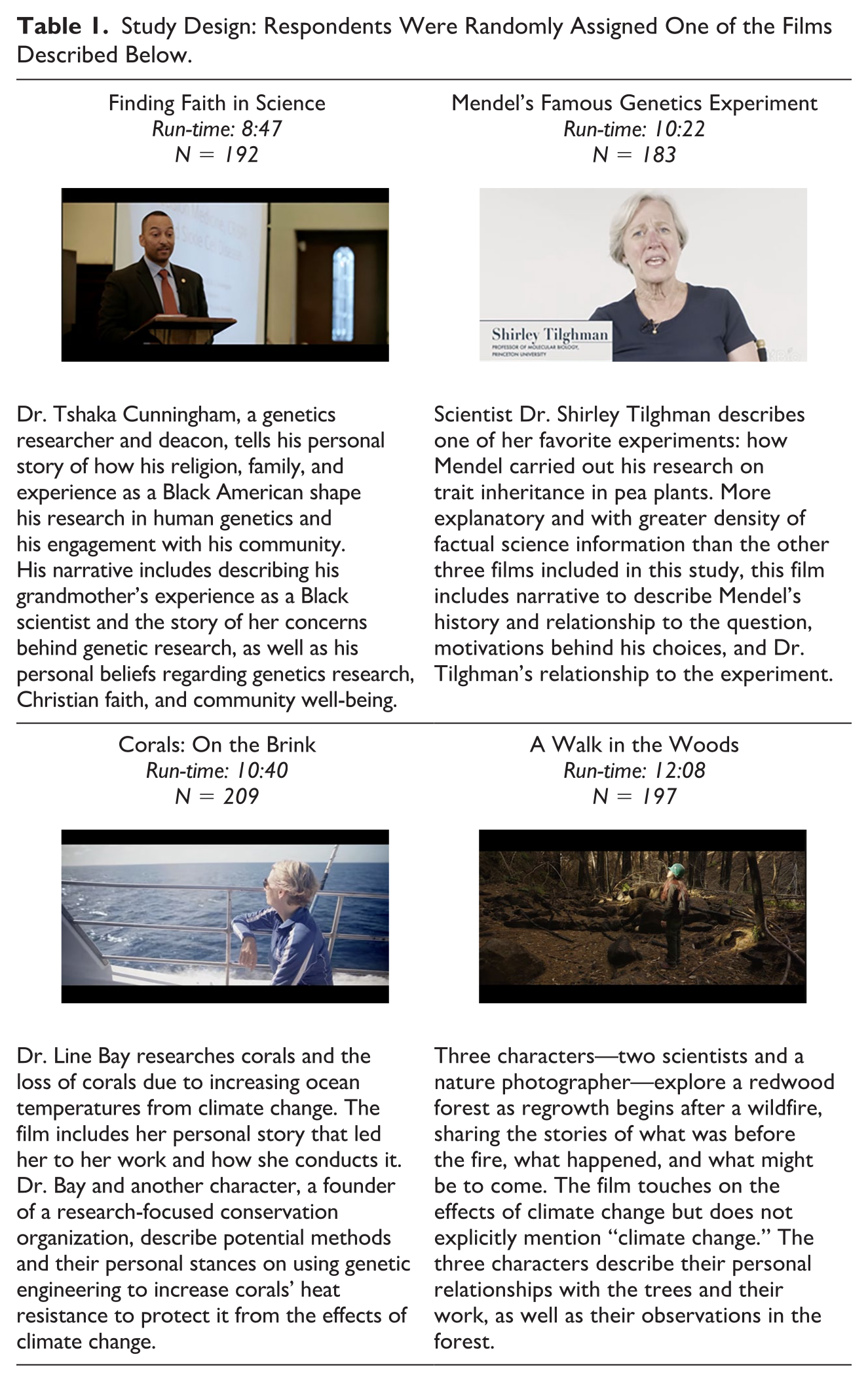
The four films were selected from a pool of existing, publicly available, professionally produced short films. We controlled for length, production style, and general topic, to a degree. Each was a documentary-style film that included storytelling to different extents (e.g., characters telling the story of a place, of themselves, and/or of someone else’s history). All the films were from the Science Communication Lab, a nonprofit organization that creates open-access films and educational content related to biology and scientific research (Goodwin, 2014; Rajan & Veguilla, 2018), in part to control for differences in film style from different producers. Each film focused on a topic connected to genetics research and was approximately 10 minutes long. Each featured real people speaking directly to the camera, including at least one scientist in each film. We focused on genetics because it is a broad topic that can be explored in many different contexts, and the Science Communication Lab had several of such films with similar length and production approach (e.g., no narration, characters speaking directly to the camera, emphasis on science process/observations, and use of music).
The films also had many differences among them that likely shape viewers’ experiences with the films. We selected them to have variety in the number of speaking “characters” or people featured (the films had 1, 2, or 3 speaking characters) and to have a range of densities of scientific information in terms of how much the film focused on conveying scientific facts about the topic of focus.
As mentioned, each focused on genetics but different subtopics and frames within that field. Two, for example, focused on environmental topics, with a climate change-related aspect in particular—one on possibilities of gene editing corals to make them more heat-resistant (Corals: On the Brink; N = 209) and one on a redwood forest after a forest fire (A Walk in the Woods: After the Flames; N = 197). Corals explicitly mentioned climate change; Woods did not. These two also were the films with multiple characters: two White women in Corals (one a scientist and one the head of a nonprofit research organization) and two White men (a scientist and a photographer) and a Latina woman (a scientist) in Woods.
Of the other two films, both with single characters, Finding Faith (N = 192) focused on relationships between religion and science, with a Black male protagonist who is a researcher in genetics and a deacon in his Christian church describing his personal story involving family, science, religion, and genetic data. The last film, Mendel’s Famous Genetics Experiment (N = 183), focused on Mendel’s experiments examining trait inheritance, with the story and rationale behind the experiments described by a white female scientist. Mendel was the most similar to an expository format, although it incorporated narrative focused on who Mendel was, the context and motivations shaping his decisions, and the character’s personal relationship to the story. Mendel was also the only film that took place solely within a studio setting with the character seated and talking to the camera. It relied on animations to illustrate the concepts the character’s described, while the other films had mostly real-life footage and did not include animations or other illustrations of processes. The other three films all had some degree of footage showing the character(s) outside a studio, in their respective work environments conducting their research or other work. Mendel was the only film in which a character describes the work of another researcher but not her own work. In these aspects, it is the film that has the least amount of narrative and a greater amount of expository format. Mendel was also more dense in the technical scientific information it described, followed by Corals, Woods, and Faith. Each of these differences in style and content could likely impact viewers’ experiences and are areas we explore in the discussion, when interpreting what results may indicate for advancing future work.
Measures
Independent Variables
Narrative engagement was our main independent variable of interest. We included items capturing narrative engagement through the concepts of (a) narrative transportation (Green & Brock, 2000) and (b) character identification (Cohen, 2001). As described previously, both concepts involve experiencing a story or aspects of a story as though it were happening to oneself, and measures of narrative engagement often include aspects of both (Busselle & Bilandzic, 2009; Cohen, 2001; Dal Cin et al., 2004).
Given the diversity in measurement of narrative engagement (Busselle & Bilandzic, 2009; Tal-Or & Cohen, 2015; Tukachinsky & Tokunaga, 2013), we used two batteries of items to capture transportation and identification separately, and then combined them into one narrative engagement variable based on analyses. As listed in Table 2, we selected items from a wide range of narrative engagement measures and adapted conceptually similar items to try to capture engagement within a film context. For example, although a narrative transportation scale exists (Appel et al., 2015; Green & Brock, 2000), it is designed for use with written stories, where readers’ mental imagery plays a large role in their experiences. Research has found that it performs differently and inconsistently for audio-visual material (Reinhart et al., 2021). Reliability analyses of the items we included indicated that the transportation items we included and adapted were highly correlated (see Table 2) and seemed to relate similarly to the variables of interest.
Items for Narrative Engagement, Capturing Narrative Transportation and Character Identification.
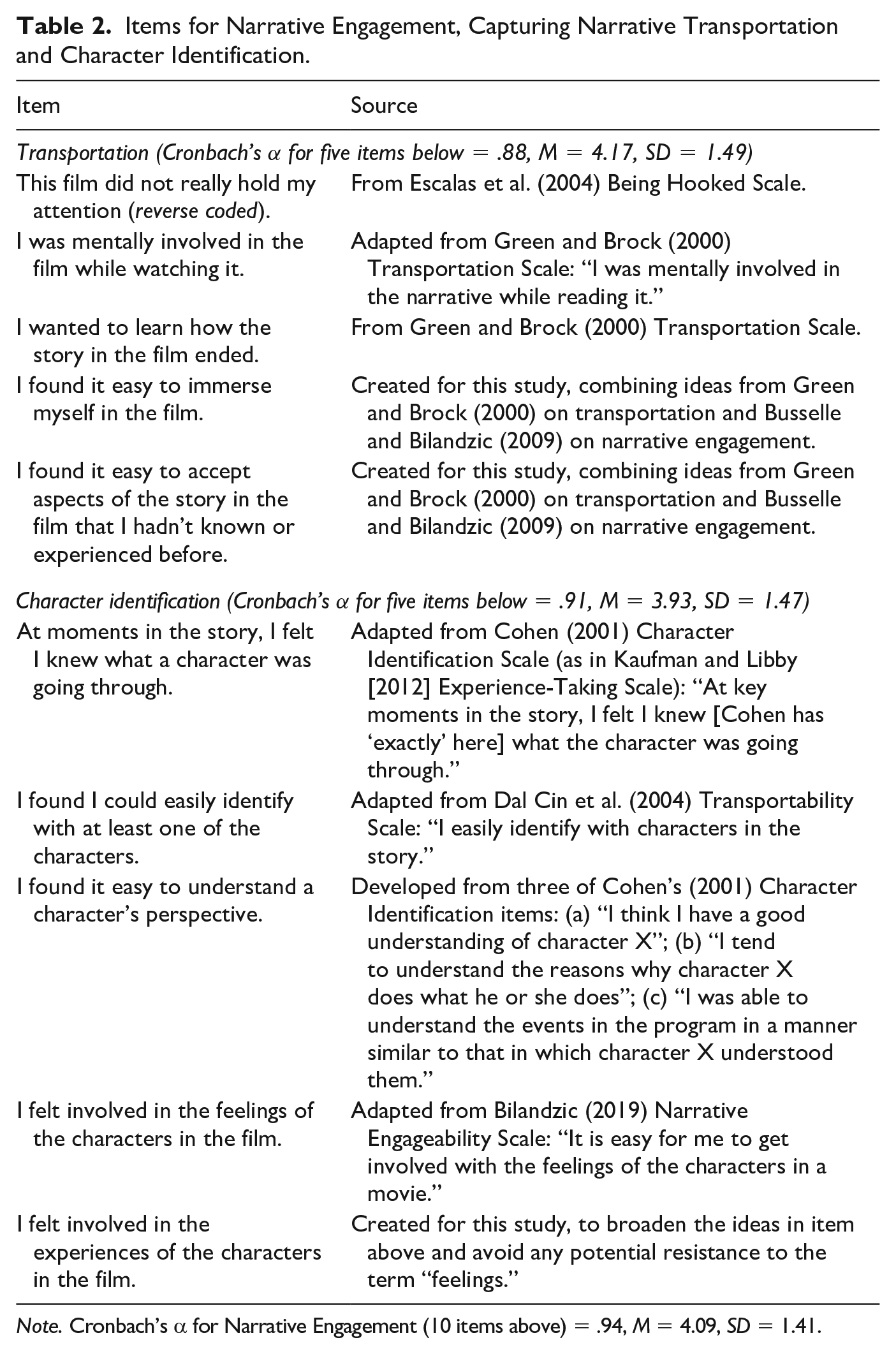
Note. Cronbach’s α for Narrative Engagement (10 items above) = .94, M = 4.09, SD = 1.41.
We examined transportation and identification separately in the first set of analyses to see whether there were differences in how the films affected transportation or identification. We then combined them for the regression analyses that examined how the independent variables (narrative engagement and viewer demographics) related for each of the four films to the outcome variables of interest. We made this decision after consistently finding—as other studies examining the two concepts often do—that only one would remain significant if both were in the model, despite both being highly related to the outcome variables if only one was included, seemingly because of the extremely high correlation between the two (Tal-Or & Cohen, 2015). The items for narrative engagement, measured from 0 = “Not at all” to 6 = “Very much so,” are listed in Table 2.
For viewer demographics, we examined gender, race/ethnicity, age, education, experience with science posthigh school, religiosity, and political ideology. Gender, race/ethnicity, age, and education are described in Supplemental Table S1. The other three demographic variables are as follows:
Posthigh school science experience asked respondents to select their experiences from a set of items: (a) “Took post-high school science courses” (45.1%); (b) “Majored or minored (or currently majoring or minoring) in a science field” (8.8%); (c) “I consider myself a scientist” (4.5%); (d) “I work in a science field” (4.5%); or (e) “None of the above” (47.5%). We focused on those who selected “none of the above” and coded them as “1” and all others as “0.”
Religiosity is a single item asking respondents how much guidance religion provides in their everyday life (0 = “No guidance at all”; 10 = “A great deal of guidance”; M = 5.18, SD = 3.61).
Political ideology is a composite of two items asking respondents on a 7-point scale from 1 = “Very liberal” to 7 = “Very conservative” what best describes their views on (a) economic issues and (b) social issues. The two items were averaged (Pearson’s R = .78, M = 4.03, SD = 1.70).
Dependent Variables
Because this study is more exploratory, we examined a large set of dependent variables: factual recall, perceived knowledge, interest in learning more, perceived change in views of science, perceived value of science, and identification with science.
Factual recall is a sum of five true-false items asking respondents about information that appeared in the film they watched. Each asked respondents if they thought a statement was “Definitely false,” “Probably false,” “Probably true,” or “Definitely true,” with an option to indicate “Don’t know” as well. For this study, the “definitely” and “probably” categories were combined within true and false and “don’t knows” were coded as missing. Correct responses were summed, for a maximum score of 5 (Corals: M = 3.99, SD = 0.76; Woods: M = 4.26, SD = 0.69; Faith: M = 3.84, SD = 0.68; Mendel: M = 4.21, SD = 0.80) (Supplemental Table S2).
Perceived knowledge is the average of two items asking respondents how informed they felt about (a) “the science behind the topic that the film focused on” and (b) “the societal implications of the topic that the film focused on” (0 = “Not at all informed” to 6 = “Very informed; Pearson’s R = .75, M = 3.73, SD = 1.50).
Interest in learning more is the average of three items asking respondents to what extent: (a) “The film raised questions that I want to explore more”; (b) “I am interested in learning more about things that the film mentioned”; and (c) “I think I will talk to others about content that film included” (0 = “Not at all” to 6 = “Very much so”; Cronbach’s α = 0.92, M = 3.53, SD = 1.77).
Perceived changed views of science is an average of four items asking respondents to what extent the film changed their perceptions of: (a) “the topic the film focused on”; (b) “what science can be like”; (c) “how science can work”; and (d) “what scientists can be like” (0 = “Not at all” to 6 = “Very much so”; Cronbach’s α = .93, M = 3.69, SD = 1.75).
Perceived value of science is the average of three items asking respondents how much they agree that: (a) “it is valuable to conduct research that adds to the world’s scientific knowledge”; (b) “discovering something new in science is thrilling”; and (c) “scientific research can help solve many of our current world challenges” (0 = “Not at all” to 6 = “Very much so”; Cronbach’s α = .86; M = 4.91; SD = 1.16). These are adapted from the Scientific Value Orientation Scale (Estrada et al., 2011), meant to capture aspects of what science might offer for knowledge growth, enjoyment, and societal problem-solving.
Identification with science is the average of 13 items from three sources (Estrada et al., 2011; Lockhart et al., 2022; Robnett et al., 2018) (see Supplement Table S3). Respondents were asked how much each statement describes themselves (0 = “Not at all” to 6 = “Very much so”; Cronbach’s α = 0.95, M = 4.1, SD = 1.2).
Analyses
We used IBM SPSS version 28 for all analyses. We ran ordinary least squares (OLS) regression analyses to examine the relationships between viewer demographics, narrative engagement, and the dependent variables (RQ1, RQ2, and RQ3, and H1 and H2). For the regression analyses, we examined each film separately, to see how those relationships varied or not across the different films. Prior to the regression analyses, we also used analysis of variance (ANOVA) to examine if the films seemed to have different levels of overall narrative engagement and of the outcome variables of interest. We start with those results below, and then move to the regression analyses focused on the way that viewer demographics and narrative engagement related to outcomes across the four films.
Results
Prior to running the regression analyses, we examined if respondents seemed to be more likely to stay in the study depending on the film they received. Using demographic information from Forthright for people who had started the survey but dropped out after being assigned to a film, we found that men and younger viewers were significantly more likely to finish the survey overall. These effects did not differ across the films. However, significantly more people dropped out who had been assigned Mendel’s Famous Genetics Experiment (30%), which had the highest drop-out rate, than did those assigned Corals: On the Brink (20%), which had the lowest drop-out rate (one-way ANOVA results for group differences: F[3, 1112] = 2.68, p = .045; significance level for post hoc Tukey’s honestly significant difference [HSD] for Mendel and Corals: p = .030).
Of our final sample of those who watched the films (N = 791), we did not see significant differences in impacts by film with some exceptions. Narrative engagement, whether as transportation or identification with characters, was in the positive ends of the scale across all the films (see Table 3). Viewers indicated on average that they felt more than somewhat transported into the narratives in the films and more than somewhat identified with the characters. Viewers of Mendel, however, did tend to report lower engagement with the film: both significantly lower character identification than did viewers of all three other films (F[3, 777] = 5.89, p < .001) and lower levels of transportation than for viewers of Corals or Woods (F[3, 777] = 3.12, p = .025).
Mean Levels of Narrative Engagement and Other Outcome Variables Among Viewers of Each Film.
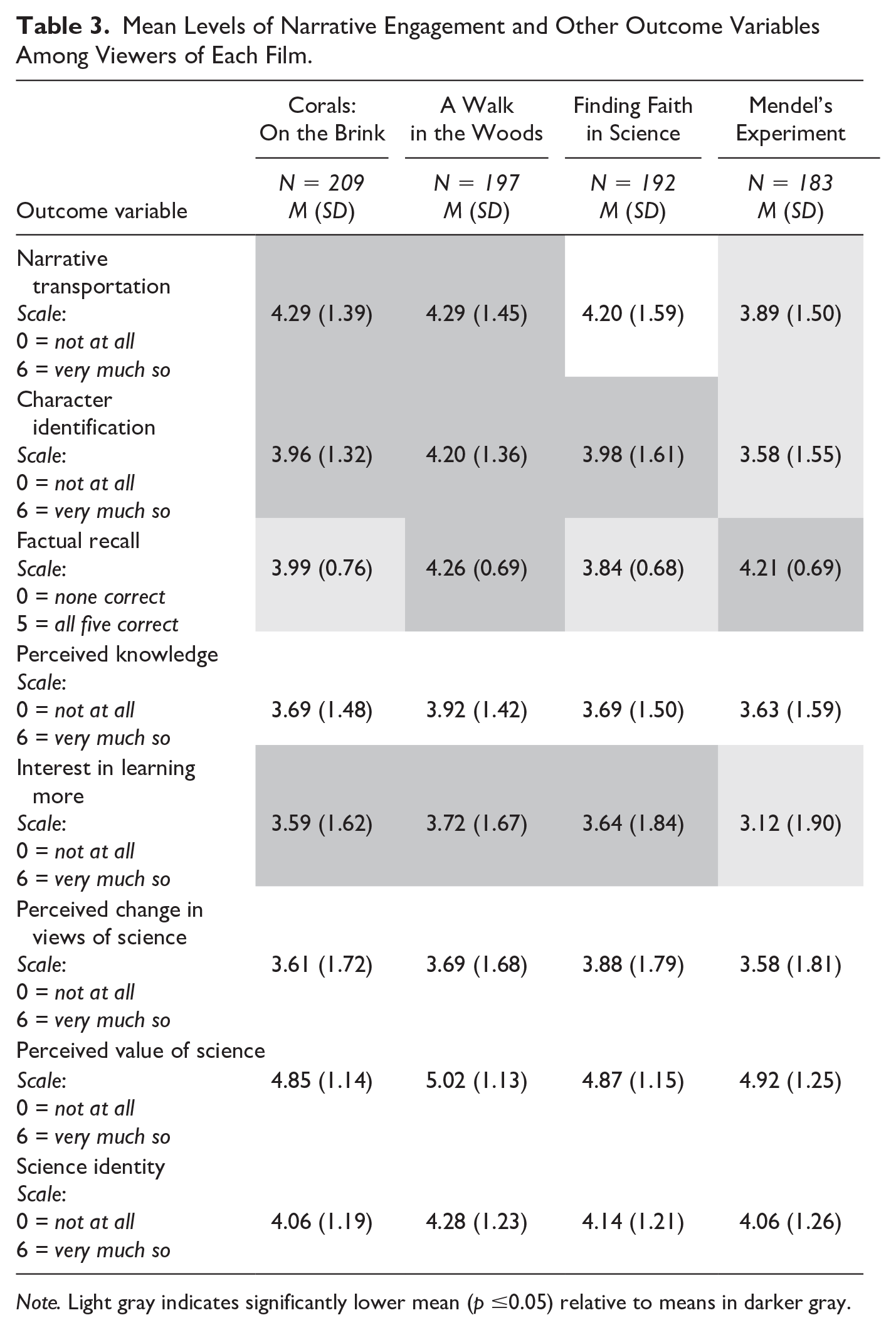
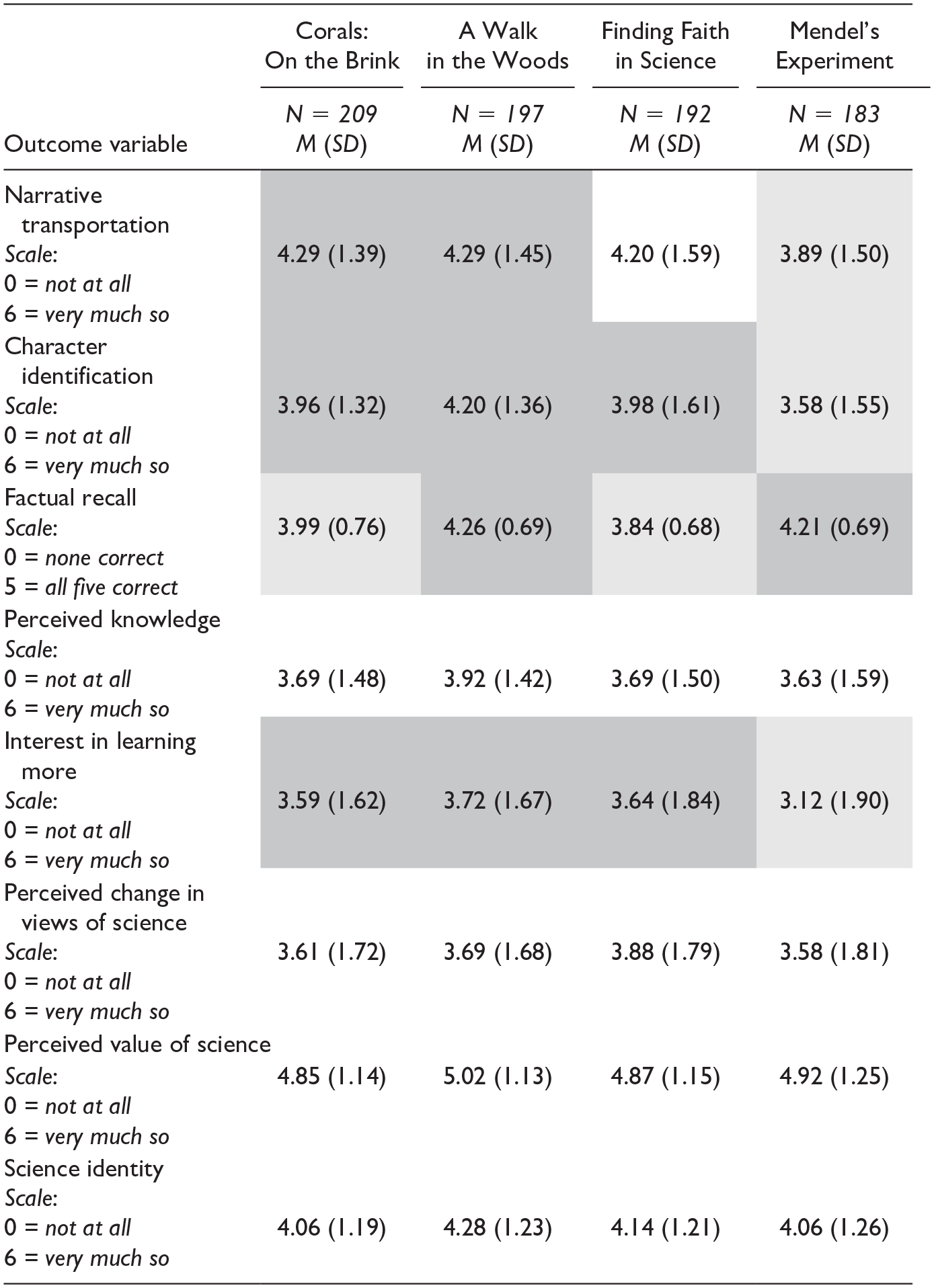
Note. Light gray indicates significantly lower mean (p ≤0.05) relative to means in darker gray.
For the other outcome variables—factual recall, perceived knowledge, interest in learning more, perceived changed views of science, perceived value of science, and identification with science—the only significant differences concerned factual recall and interest. Viewers of Mendel and Woods had significantly higher recall than viewers of Corals or Faith (F[3, 777] = 13.73, p < .001). Mendel related to significantly lower levels of interest in learning more compared to the other three films (F[3, 777] = 4.37, p = .005).
Narrative Engagement and Viewers’ Science Learning and Perceptions
We then ran regression analyses to examine relationships between narrative engagement (the composite of narrative transportation and character identification) and knowledge gain (RQ1), seeing value in or identification with science more broadly (RQ2), greater interest (H1) and perceived change in views of science (H2), and impacts of viewers’ demographics on these outcomes (RQ3). We ran models on each film separately. We focus on the overarching patterns that emerged across these and mainly describe results with significance levels below p = .05 with some reference to results below p = .10. In the interest of space, we focus primarily on significant relationships that appeared somewhat consistently across the films, rather than ones that appeared to be one-off relationships. All significant coefficients are bolded in tables listing the regression results.
Predictors of Engagement, Knowledge Gain, and Interest for the Film and Film Topic
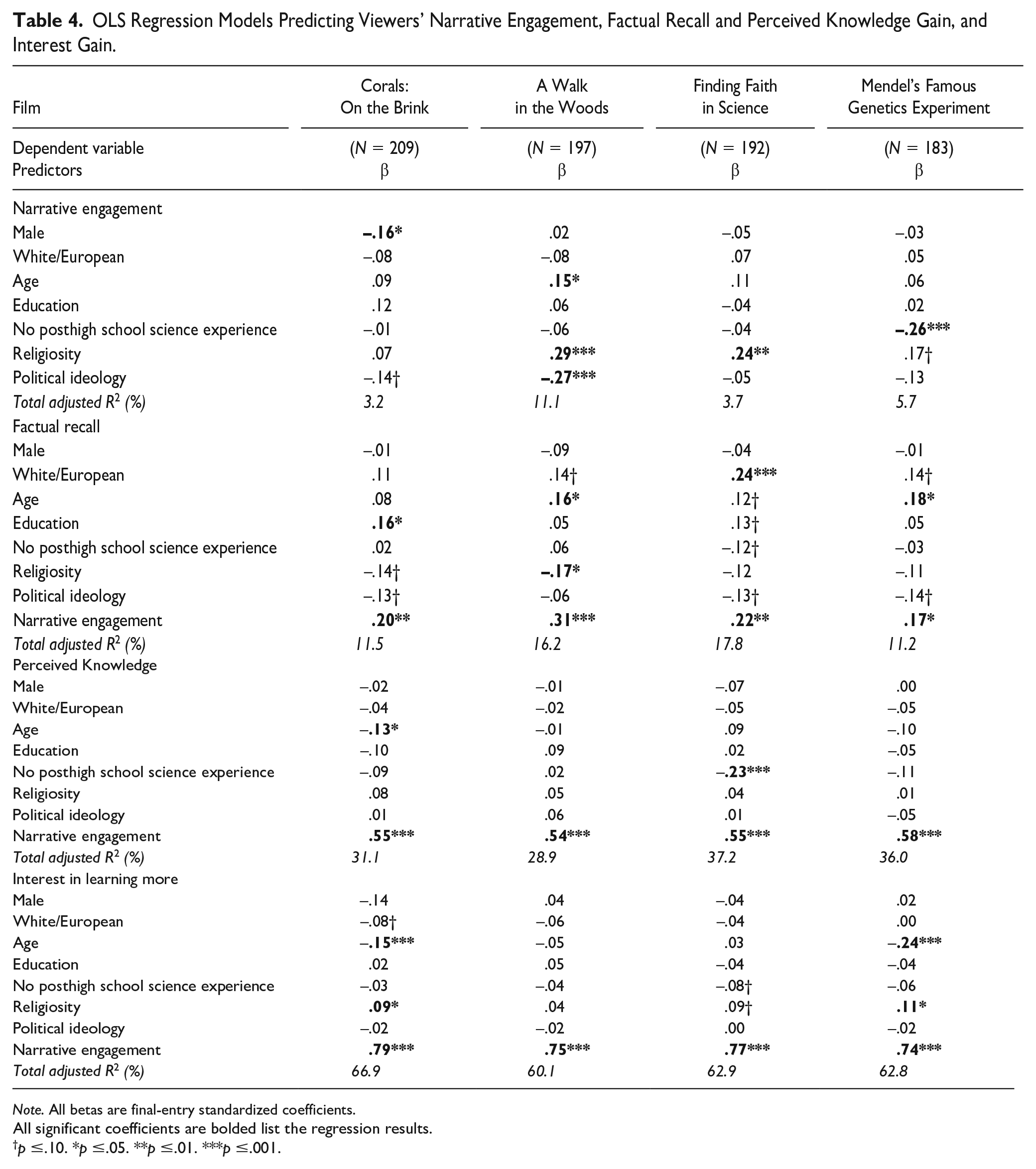
Starting with how viewer characteristics related to narrative engagement (to answer, in part, RQ3), some consistent patterns appeared. Religiosity related to higher engagement among viewers of Woods, Faith, and Mendel (with the first two significant at p < .05 and Mendel at p = .059). Politically liberal respondents were significantly more likely to have higher narrative engagement with Woods and, at p = .068, with Corals. These were both environment-focused films that reference effects of climate change, with Corals referring explicitly to climate change. No other consistent differences in viewer characteristics appeared across the films.
Narrative engagement was then consistently and significantly related to knowledge gain among the two knowledge variables we examined (RQ1). Factual recall was significantly higher across all films for viewers who had higher narrative engagement. Many demographic characteristics related to factual recall at the p < .10 level but not at p < .05, and no consistent patterns appeared in how demographic characteristics related to recall across the films, with any significant results being a “one-off” between a single demographic characteristic and a particular film (Table 4).
OLS Regression Models Predicting Viewers’ Narrative Engagement, Factual Recall and Perceived Knowledge Gain, and Interest Gain.
Note. All betas are final-entry standardized coefficients.
All significant coefficients are bolded list the regression results.
p ≤.10. *p ≤.05. **p ≤.01. ***p ≤.001.
Narrative engagement also significantly related to perceived knowledge gain across all four films. Demographics, however, were even less likely to relate to perceived knowledge postfilm than they were for factual knowledge recall, again with only one-off relationships.
Repeating the pattern that appeared for the two knowledge variables, interest in learning more was significantly related to narrative engagement across all four films (H1). As seen in Table 4, the coefficients for narrative engagement’s relationship to greater interest are quite large. Across all of the films except Woods, more religious viewers were significantly more likely to report greater interest in learning more postfilm. Younger respondents were more likely to report greater interest among viewers of Corals and Mendel.
Predictors of Views of Science More Broadly
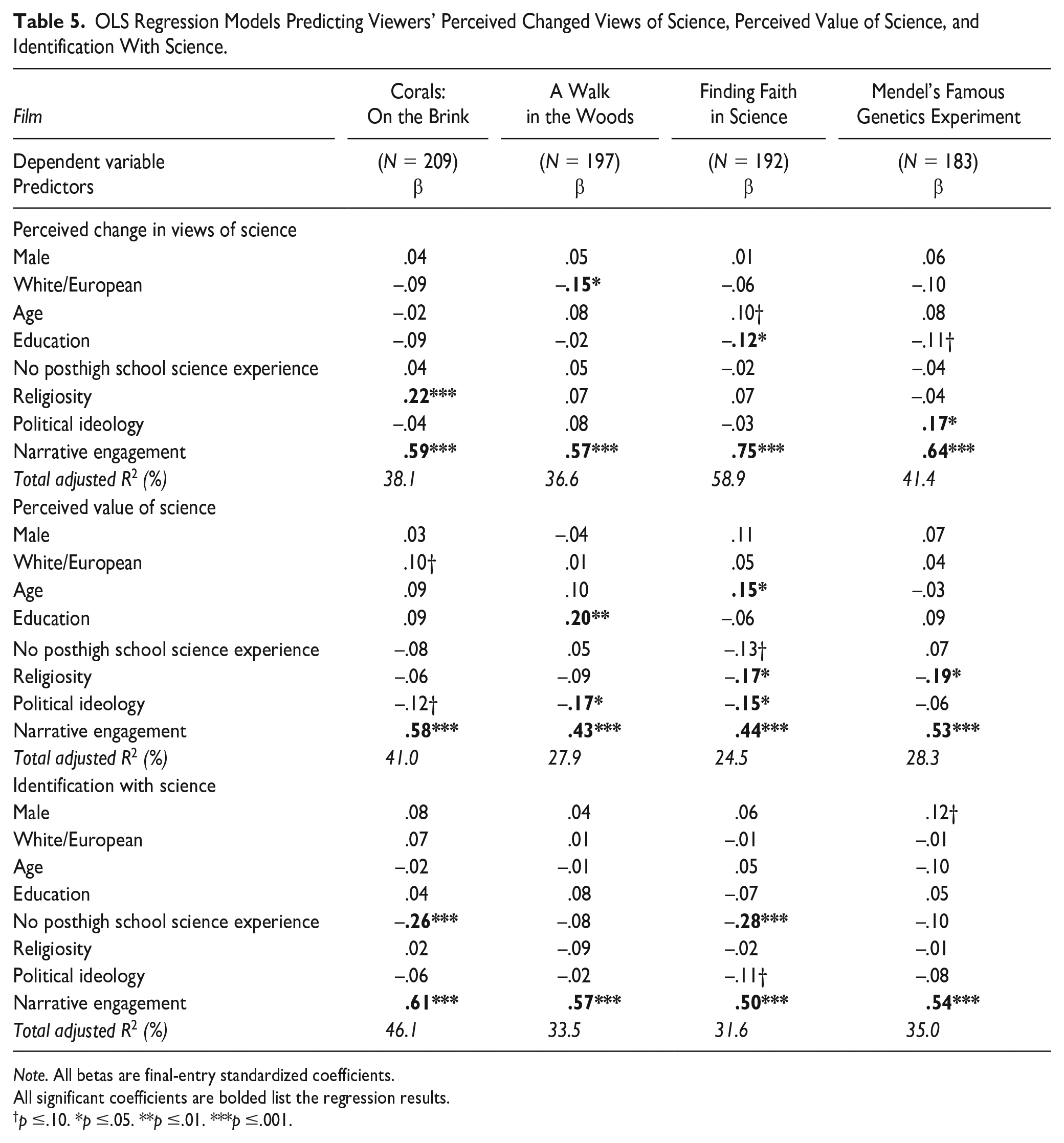
Moving to viewers’ broader perceptions of science, we found strong support for H2: narrative engagement significantly predicted perceived changed views of science across all four films. No consistent patterns emerged in how demographic characteristics related to changed perceptions (Table 5).
OLS Regression Models Predicting Viewers’ Perceived Changed Views of Science, Perceived Value of Science, and Identification With Science.
Note. All betas are final-entry standardized coefficients.
All significant coefficients are bolded list the regression results.
p ≤.10. *p ≤.05. **p ≤.01. ***p ≤.001.
For seeing value in and identification with science more broadly (RQ2), narrative engagement also significantly related to both, and this was true across all four films. For perceived value in science, political ideology tended to negatively relate (at p < .05 for Woods and Faith and p < .10 for Corals), such that liberal viewers were more likely to report higher perceived value. Religiosity was significantly negatively related to perceived value of science among viewers of Faith and Mendel.
For identifying with science, viewers with no posthigh school science experience were less likely to identify when they were viewers of Corals or Faith. Interestingly, no other demographic characteristic had a significant relationship to identification with science across the four films.
Discussion
In this study, we were interested in how audiences engaged with narrative in science films and how that engagement relates to outcomes concerning knowledge and perceptions of the film topic and science more broadly. Using a national U.S. sample, we randomly assigned viewers to one of the four short documentary science films and examined their narrative transportation, identification with characters, and how that narrative engagement varied, if at all, depending on viewers’ demographics. This study offers one of the few examinations of narrative engagement in real-world documentary science films, doing so with a large, nonstudent sample, and including a wide range of dependent variables spanning communication and education goals. The results give us a broader look at how narrative engagement with science stories across a diverse set of viewers could relate to learning and connection to science topics and science in general.
Narrative Engagement Predicts Higher Knowledge, Interest, and Connection to Science
Based on the results, the relationship that stands out across these analyses is the consistent positive relationship between narrative engagement and all the dependent variables this study focused on. Narrative engagement across all four films significantly related to higher factual knowledge through recall of topical facts in the film and to viewers reporting: greater perceived knowledge of the film topic, greater interest in learning more about the topic, perceived changed views of science, greater perceived value of science, and greater identification with science.
Viewers tended to report high narrative engagement levels across all of the films, as well as high levels of the outcome variables listed above. One exception was Mendel, which seemed to perform more poorly among viewers in general and for people with lower levels of science experience in particular. Survey respondents were also more likely to drop out of the study if they were assigned that film. This was regardless of the viewer demographics for which we have data on the dropouts: gender, ethnicity, age, education, political ideology, and religiosity.
It may be that the more expository nature of the Mendel film meant it was less engaging. The topic could also have seemed less relevant to audiences, as it was not situated in the context of a current societal issue or emerging technology, focusing on a foundational genetics study rather current applications of genetics research or on using science to understand modern ecological or health challenges. This film was the only one that had a scientist discussing someone else’s research, rather than their own, which a study of audience perceptions of online science videos found can be associated with lower evaluations of the character compared to assessments of scientists presenting their own research (Ruzi et al., 2021). It also could be that viewers were already familiar with the Mendel study, it being one commonly focused on in science classes. The less novel material, then, could have hindered engagement. Any of these factors could also have meant the film content was less emotion-producing, which, as the research in visual communication and in narrative impact highlights, is integral to engagement with visual and narrative messages. That the character was filmed only in a studio, compared to the other three films which portrayed the characters in the field in different contexts, could also have made the film content feel less “real” and/or more abstract. As we described, specificity and realism are other integral dimensions shaping the power of stories and film. Conducting more systematic content analysis of film content and qualitative studies that enable us to better connect content to audience experiences would both be valuable paths to build on this work, as would pretesting the films to see what audiences perceive, such as the extent to which they perceive different narrative features.
Throughout the results, however, we see that this narrative engagement and use of narratives in conveying science did not seem to come at a clear cost to factual knowledge gain. In fact, we see evidence that narrative engagement may facilitate greater learning, whether in factual recall immediately after the film or in viewers’ reports of increased interest that may translate into continued engagement with the film topic and greater learning gains later on. Science communication and, to some extent, science education research and practice both still often house an assumption that stories or entertainment necessarily come at a cost to education and learning (Bourk et al., 2018; Campbell, 2016; Dahlstrom, 2021). Testing narrative against more expository forms of communicating science would help more systematically explore these relationships between narrative and knowledge gain. But the results here of narrative engagement relating to greater factual recall suggest that narrative and factual knowledge gain can complement each other in science communication contexts. The strong relationships between narrative engagement, perceived knowledge, and interest in learning also point to the potential for knowledge gain that includes longer-term impacts beyond the recall of scientific facts portrayed in the film. They highlight as well the value of using a broad set of outcome variables to better understand narrative impacts in science communication and education contexts.
Beyond topical knowledge and interest gain, across all the films, the response levels indicating perceiving value in science and identifying with science were high and mostly did not vary by viewer demographics. For perceived value of science and identification with science, the survey items did not ask respondents to indicate whether these values or levels of identification had changed due to watching the film.
As this study design is only correlational, it is especially possible with these two variables that they have a bidirectional or reversed causal relationship with narrative engagement. For example, people who were more engaged with the films may have been more likely to identify with science or find value in science prior to watching the films. For changed perceptions of science, we also did not ask respondents to specify in what ways their perceptions changed, which limits our ability to know what these changes were or whether they were positive or negative. The fact that these responses were so high, however, in a U.S. sample suggests that many people may either already see value in and identify with science or can gain such perceptions through engaging interactions with science, such as through science films. Future studies can incorporate experimental designs that enable us to better understand how audiences are changed by watching a film, such as by employing a pre-/post-film viewing design and/or the inclusion of a non-narrative control.
Similarities and Differences Depending on Viewer Demographics
There were some patterns in differences in how viewer characteristics seemed to interact with particular films. Less religious and more liberal viewers were more likely, among viewers of some of the films, to report more perceived value of science. “Value of science,” as defined in this study, captured perceptions of science’s potential to add to knowledge, solve societal challenges, and provide excitement through discoveries. For identification with science, however, the only demographic characteristic that related to lower identification was not having had regular posthigh school experiences with science through education or work. This is related to lower identification among viewers of Corals and Faith.
That relationships between demographics and perceiving value in, and identifying with, science did not appear across all of the films, may suggest that some of the content differentially heightened or reduced such perceptions among viewers with those characteristics. It is interesting, however, that perceiving value in science (or not) does not seem to automatically translate into identifying with science (or not). We do not see evidence of religiosity and political ideology relating to viewers’ feelings of identifying with science, despite both relating to lower perceived value of science for some of the films. It could also be the case that the films led to similar levels of identification with science across diverse viewers—perhaps by supporting a sense of accessibility to the science or changed perceptions of science. As mentioned, research using a pre-/post-design or other ways of capturing how views changed as a result of watching the films would be valuable to examine these possibilities.
Overall, levels of interest in learning more and knowledge gain were high across all the films, as were levels of narrative engagement. These items were specifically capturing experiences and changes in viewpoints from interaction with the films. These results, taken alongside the fact that engagement and outcomes mostly did not differ by viewer demographics, suggest that a diverse set of viewers felt transported into and/or identified with the characters and experienced positive outcomes in terms of knowledge gain, interest, and broader views of science with the films.
Interestingly, the viewer demographic which most consistently related to narrative engagement and the outcomes of interest was religiosity. More religious viewers were consistently more likely to report higher levels of engagement. This relationship was significant in all films except Corals. This finding is interesting in light of the commonly assumed dichotomy or tension between religion and science in the United States and other countries with populations that are predominantly Christian (Rios et al., 2015; Simpson & Rios, 2019), which would suggest that more religious viewers in a U.S. national sample would be less likely to engage in a science film.
One possible direction for future research that would be valuable for understanding impacts of science storytelling through film in general, and possibly for more religious audiences in particular, is exploring the effects of “awe” induced by films. Awe is an emotion that has relevance for both religious experiences and experiences with nature and science (Keltner & Haidt, 2003; Valdesolo et al., 2017). It is gaining interest in social science research and, in recent years, has been highlighted as one potentially promising area for science communication research and science communication through narratives in particular (Dahlstrom, 2021; Valdesolo et al., 2017). Further work here, particularly on how narratives, and narrative and other features in film in particular, can elicit awe and how that enables engagement across different viewers, including potentially religious viewers, may be valuable to understanding narrative impacts in science stories.
Given the importance of emotion in general in stories, it would be useful to focus more on the emotional experiences of viewers and how these affect other aspects of their experience with and perceptions of a science-related story. How emotions conveyed by the (scientist) characters shape viewers’ experiences and subsequent perceptions, whether as captured by character identification, broader perceptions of science, or other measures, is one likely fruitful direction for research in this vein. Ongoing conversations and questions concerning emotional aspects of (para)social relationships highlight how these aspects may influence one’s assessment of the trustworthiness and shared values of scientists and science (Taddicken & Reif, 2020) and may be particularly important for audiences more underrepresented by and/or alienated from science, for whom science communication, like science, is often not designed (Humm et al., 2020). Emotionality is often most apparent when science-related issues become controversial (Simon, 2020). But it is worth exploring the range of contexts, and of positive and negative emotions, through which emotion shapes science, science communication, and broader civic discourse and decision-making. More research on and production of stories in science communication is a valuable way to do so.
Related to the point of science in larger societal and political contexts, we also saw, to a lesser degree, evidence of relationships between viewers’ political ideology and narrative engagement with the films. More liberal viewers reported more engagement for the two environmentally focused films related to climate change, Corals and Woods. Environmental issues are typically perceived as of greater importance by political liberals, and divisions in views of climate change still exist between conservatives and liberals in the United States (Energy Policy Institute, 2017; Tyson et al., 2023). That more liberal viewers felt more engaged in the narratives may be due to greater alignment—and less resistance—to the premises or realities portrayed in each story world for these two films. As mentioned in the literature review, for narrative to be successful in engaging people, most research theorizes or finds evidence supporting that the narratives should not trigger, or must be able to overcome, resistance to the information in the story (Ratcliff & Sun, 2020). In the case of the films examined here, it seems possible that the two environmental films were not able to overcome this likely pre-existing resistance. We also saw, as described previously, that viewers who were more politically conservative were less likely to perceive value in science, although not less likely to identify with science.
Our study design does not allow us to dig more deeply into how viewers’ experiences with the films shaped these views, or not—such as if divisions in perceived value were higher or lower among politically conservative and liberal viewers before watching the film. Using studies designed for a more systematic focus on viewer demographics would be insightful for better understanding the possibility of narrative to engage audiences of different political perspectives for specific, and more controversial, science issues. Beyond narrative impacts, having more baseline research that examines how political ideology relates to broader views of science would be valuable as well to better understand how pre-existing views may impact audiences’ experiences with science and science communication content and stories.
Conclusion
This study provides one of the few examinations of the impacts of narrative in real-world documentary science films, including across a wide range of outcomes spanning communication and education goals. It is unique in using a national U.S. sample, professionally produced films, and incorporating a wide range of outcomes to take a broader look at narrative engagement with science stories across diverse viewers. Consistent across the results is the strong role of narrative engagement for facilitating factual learning, perceptions of having learned more, and creating interest in learning more when it comes to science.
Going forward, pre-/post-studies examining viewers’ perceptions before and after watching documentary, narrative films would be especially beneficial. For example, this study rarely found differences in viewer engagement and outcomes depending on viewer demographics. Is this because the nature of the narrative structure of the film alleviated such differences? Comparing narrative films to non-narrative films, as well as to the text-based formats more commonly used in research and education, will be crucial here as well. That the most expository of the films—Mendel—had the least engagement and that this was especially the case with viewers who had less science experience (an effect we did not see for the other three films) could suggest that features of expository films (and perhaps of expository science communication or education in general) may exacerbate or fail to address divisions in audiences’ experiences with science.
More research on viewer experiences with science and science stories depending on viewers’ religiosity and political ideology would be especially valuable as well. A better understanding of how science films can engage audiences on topics that may be more polarizing, such as climate change, through narrative is one avenue worth exploring, as well as doing so in a way that helps understand the bounds of what that polarization means. For example, we found less engagement among conservatives for the two environmental/climate-focused films but did not see differences in how much conservatives reported identifying with science overall. These results also point to the importance of efforts aimed at understanding value-based diversity in science and science communication and education, alongside crucial identity-based factors such as gender, ethnicity, education, and class.
Finally, more work on what the affordances of film are as a medium for stories in particular, relative to the more commonly examined text-based narratives, would be especially worthwhile. What does film and narrative in film allow us to convey, to different audiences, that is otherwise missing from portrayals of science, how science works, and who is connected to science? Who is film likely to reach and engage? It will be valuable to pair these lines of inquiry with a focus on stories as ways to enable greater understanding of the nature of science, more human pictures of science, and the diversity of viewpoints required to advance scientific research and decision-making on what science we do and how we use it in society. These are all vital areas for innovating in science communication research and in how we talk about and act on science—and in expanding who is able to do so.
Supplemental Material
sj-docx-1-scx-10.1177_10755470241269885 – Supplemental material for Storytelling in Science Film: Narrative Engagement Relates to Greater Knowledge, Interest, and Identification With Science
Supplemental material, sj-docx-1-scx-10.1177_10755470241269885 for Storytelling in Science Film: Narrative Engagement Relates to Greater Knowledge, Interest, and Identification With Science by Emily L. Howell, Shannon L. Behrman, Elliot Kirschner and Sarah S. Goodwin in Science Communication
Footnotes
Declaration of Conflicting Interests
The author(s) declared no potential conflicts of interest with respect to the research, authorship, and/or publication of this article.
Funding
The author(s) disclosed receipt of the following financial support for the research, authorship, and/or publication of this article: This work was supported by the National Science Foundation [Grant number 2122350].

Author Biographies
References
Supplementary Material
Please find the following supplemental material available below.
For Open Access articles published under a Creative Commons License, all supplemental material carries the same license as the article it is associated with.
For non-Open Access articles published, all supplemental material carries a non-exclusive license, and permission requests for re-use of supplemental material or any part of supplemental material shall be sent directly to the copyright owner as specified in the copyright notice associated with the article.
