



Abstract
This work examines worldview predictors of attitudes toward nanotechnology, human gene editing (HGE), and artificial intelligence. By simultaneously assessing the relative predictive value of various worldview variables in two Dutch samples (total N = 614), we obtained evidence for spirituality as a key predictor of skepticism across domains. Religiosity consistently predicted HGE skepticism only. Lower faith in science contributed to these relationships. Aversion to tampering with nature predicted skepticism across domains. These results speak to the importance of religiosity and spirituality for scientific innovation attitudes and emphasize the need for a detailed consideration of worldviews that shape these attitudes.
Innovations at the intersection of science and technology are developing at a fast pace. During the COVID-19 pandemic, advancements in mRNA vaccines have been indispensable in bringing the virus under control. Beyond this recent example, major developments at the intersection of science and technology have profound societal, ethical, and legal implications.
Novel biotechnologies such as CRISPR have made human gene editing (HGE)—that is, altering the DNA of human cells—possible (Doudna, 2020).This brings about the potential to eradicate many debilitating diseases, but also raises ethical considerations in the context of reproductive technologies (e.g., see Somerville, 2022). Furthermore, nanotechnology, broadly defined as the manipulation of matter at the 1 to 100 nm scale to produce materials with novel characteristics, holds promise to significantly contribute to medical advancements, food production, and many other processes (Nasrollahzadeh et al., 2019). However, the safety of nanotechnologies and a regulatory framework for managing their risks and benefits are highly complex and somewhat contentious topics (e.g., Mitter & Hussey, 2019). Finally, artificial intelligence (AI)—machine systems capable of sophisticated (intelligent) information processing (Zhang & Dafoe, 2019)—is permeating people’s professional and private lives through a variety of applications (Olhede & Wolfe, 2018), while simultaneously instigating debates about mass surveillance, privacy, and job losses (Zhang & Dafoe, 2019). A recent example of public debates surrounding AI concerns the societal and ethical implications of generative AI tools (e.g., ChatGPT).
Although the general public is not (yet) broadly opposed to these emerging technologies (Satterfield et al., 2009; Scheufele et al., 2017; Zhang & Dafoe, 2019), skepticism about certain aspects of these technologies is well documented. For example, a substantial part of the public is unsure about nanotechnology risks (Satterfield et al., 2009), and being exposed to polarizing online nanotechnology discourse can create divisions along religious and issue support lines (Anderson et al., 2014). Furthermore, the use of HGE technologies for enhancement purposes is controversial (Gaskell et al., 2017; Scheufele et al., 2017). Finally, large parts of the general public associate AI with being “scary” and “worrying” (Centre for Data Ethics and Innovation, 2022).
The moment such worries and perceived risks become widespread and permeate the public sphere, this can not only slow down development but might even lead to an outright rejection of the scientific innovation in question (e.g., Kieslich, 2022). This is readily apparent in the domain of genetically modified (GM) foods—public opposition has resulted in a long-lasting halt in GM foods implementation in the European Union (Fresco, 2013; Rozin et al., 2012) and across the world with harmful consequences (Wu et al., 2021).
In this light, it is imperative to deepen the understanding of public skepticism surrounding scientific innovations. In the current article, we examine various individual difference antecedents of skeptical attitudes toward nanotechnology, HGE, and AI. We define skepticism as a negative attitude toward a field of science or technology that entails its rejection and is reflected in high-risk/low-benefit perceptions. Crucially, we expand upon the scope of potential worldview predictors (Hornsey & Fielding, 2017; Lewandowsky & Oberauer, 2016; Rutjens et al., 2018) beyond routinely considered political and religious beliefs to include spirituality, aversion to human tampering with nature, general trust in science, and conspiracy beliefs, while also taking into account knowledge factors (Study 2). In doing so, we contribute to a more comprehensive account of worldview factors associated with science attitudes, and thus simultaneously provide insights into which worldview factors are most relevant for science communication campaigns.
Worldviews and Nanotechnology, HGE, and AI Skepticism
The view that unfavorable attitudes to science and technology are primarily due to a lack of information or knowledge (i.e., Sturgis & Allum, 2004) has been dismissed as incomplete (Nisbet & Scheufele, 2009; Simis et al., 2016). Regarding nanotechnology, HGE, and AI attitudes more specifically, some work has found general scientific literacy to be a negative predictor of nanotechnology skepticism (Drummond & Fischhoff, 2017; Ho et al., 2010), while other work found it is not predictive of attitudes toward HGE, AI, nor nanotechnology (Connor & Siegrist, 2010; Lobera et al., 2020; Retzbach et al., 2011). These mixed findings suggest that while knowledge can contribute to more positive science attitudes, its impact is likely modest and context-dependent, because people search for and process information in a way that “fits” with a wide range of psychological motivations and preexisting attitudes they hold (Hornsey, 2020; Kunda, 1990).
The role of worldviews in skepticism toward nanotechnology, HGE, and AI skepticism can be explained by two related theoretical frameworks: The theory of motivated reasoning (Kunda, 1990) and the attitude roots model of science rejection (Hornsey & Fielding, 2017). The concept of motivated reasoning refers to the idea that motivational goals can affect information processing (Kunda, 1990), such as reasoning about scientific information (e.g., van Stekelenburg et al., 2020). A directional goal, such as defending one’s preexisting attitudes, might bias reasoning toward a predetermined conclusion, while an accuracy goal would steer reasoning toward the most accurate conclusion based on the available information.
The attitude roots model of science rejection (Hornsey & Fielding, 2017) draws from the concept of motivated reasoning and applies it to science attitudes. It distinguishes between surface attitudes (e.g., “Vaccines are toxic”) and the underlying attitude roots (e.g., ideologies, values, worldviews). Attitude roots, for example, a particular worldview, can sustain and motivate surface attitudes. In other words, someone might express being skeptical of science because the science does not mesh well with one’s beliefs, values, or worldviews. For example, a religious person might be more likely to reject technological innovations (e.g., HGE) that challenge their deeply held beliefs about the sanctity of human life.
Political and Religious Beliefs
The current work aims to systematically investigate the sources of motivated reasoning, that is, the attitude roots of skepticism toward nanotechnology, HGE, and AI. In line with motivated reasoning accounts more broadly and the attitude roots model of science rejection more specifically, prior research suggests that both political and religious beliefs can play a role in attitudes toward nanotechnology, HGE, and AI. First, political conservatism has been found to be associated with opposition to HGE (Critchley et al., 2019; Halstead et al., 2023; Scheufele et al., 2017; Weisberg et al., 2017). While evidence for the same finding in the context of nanotechnology is mixed (Akin et al., 2021; Cacciatore et al., 2011; Drummond & Fischhoff, 2017; Kim et al., 2014), AI attitudes do not seem to be shaped by conservatism (Bao et al., 2022; O’Shaughnessy et al., 2021; Selwyn & Gallo Cordoba, 2021; Zhang & Dafoe, 2019).
Second, religious beliefs seem to be associated with lower support for and lower perceived benefits of nanotechnology (Akin et al., 2021; Brossard et al., 2009; Cacciatore et al., 2011; Drummond & Fischhoff, 2017; Ho et al., 2010). Other studies, however, do not find religiosity to be related to negative attitudes toward nanotechnology (Anderson et al., 2014; Bao et al., 2022; Vandermoere et al., 2010). As for HGE, a systematic review found religious beliefs to be related to less favorable attitudes toward HGE (Delhove et al., 2020), which is further corroborated by recent evidence (Jedwab et al., 2020). Preliminary evidence suggests that religious belief could also be related to AI attitudes (Budic, 2022).
Worldview Predictors Beyond Politics and Religiosity
While the above-mentioned insights are informative, they likely provide an incomplete picture in terms of the robustness and relative importance of worldview predictors for HGE, AI, and nanotechnology attitudes. This is because, when considered alongside a broader range of worldview predictors, political ideology and religiosity often do not play the most prominent role in domain-specific skepticism (e.g., GM foods, vaccination; Rutjens, Sengupta, et al., 2022). Instead, other worldview and value-based factors seem to be more important, particularly spirituality but also general trust in science, moral concerns, and conspiracy beliefs.
Spirituality
An increasingly large part of Western Europeans reports not having a religious affiliation. For example, only 41% of the Dutch population see themselves as Christian, despite 67% being raised in a Christian tradition (Lipka & Gecewicz, 2017). This is accompanied by a surge of alternative forms of spirituality, often labeled as New Age or post-Christian spirituality (Houtman & Tromp, 2021). This loose set of beliefs entails rejection of external sources of authority, including religious but also scientific elites (Houtman & Tromp, 2021). In addition, its experiential approach to knowledge (i.e., the notion that knowledge is only found in personal experience) puts it at even greater odds with the scientific notions of knowledge and faith in the scientific method (Rutjens & van der Lee, 2020), rendering it a potential source of motivation to be skeptical of some domains of science and technology.
Indeed, when considered alongside religiosity, spirituality emerges as a better predictor of vaccination skepticism, general faith in science, as well as pseudoscientific beliefs (Nowak et al., 2022; Rutjens et al., 2018; Rutjens & van der Lee, 2020; Rutjens, Zarzeczna, & van der Lee, 2022; Zarzeczna et al., 2023). However, spirituality has not received much attention in research on attitudes toward scientific innovations (but see Vandermoere et al., 2010; Većkalov et al., 2022). Given that scientific innovations such as nanotechnology, AI, and HGE all have implications that are at odds with the spiritual worldview that values intuitive, authentic or natural experiences (Houtman & Aupers, 2007), we expect that, in line with findings on vaccination, spirituality predicts skepticism toward these scientific innovations.
Faith in Science
Second, general faith in science (i.e., trust in science as an institution and method that produces reliable knowledge; Farias et al., 2013) plays a role in worldview-motivated science skepticism. More specifically, faith in science has been shown to account for the positive link between spirituality and religiosity, and vaccination skepticism (Rutjens et al., 2018; Rutjens & van der Lee, 2020; Zarzeczna et al., 2023), such that spiritual and religious individuals’ lower faith in science contributes to their higher vaccination skepticism.
Considering the likelihood of a worldview-motivated basis of skepticism toward scientific innovations, as discussed earlier, it is all the more important to include a marker of general trust in science in a comprehensive investigation of its predictors. Moreover, indirect evidence for the potential importance of faith in science in shaping skepticism toward scientific innovations comes from findings linking higher deference to scientific authority with more positive attitudes toward nanotechnology (Akin et al., 2021; Ho et al., 2010; Lee & Scheufele, 2006), AI (Bao et al., 2022; Cui & Wu, 2021), and HGE (Critchley et al., 2019).
Aversion to Tampering With Nature
Third, an a priori preference for the natural order of things might be considered an attitude root that can be a hurdle to accepting novel technologies (Scott & Rozin, 2020). Higher concern for moral purity, which—at least in part—reflects this preference (Gray et al., 2022), has been found to be a positive predictor of vaccine, evolution, and GM food skepticism (Rutjens et al., 2018; Rutjens, Sengupta, et al., 2022). In line with this, moral purity concerns have been linked to the aversion to “playing God” (Waytz & Young, 2019), and its more secular counterpart—aversion to tampering with nature (ATN; Raimi et al., 2020). In turn, both of these manifestations of the preference for the natural order are related to less favorable attitudes toward scientific innovations such as HGE and nanotechnology (Connor & Siegrist, 2010; Raimi et al., 2020) or less support for science funding (Waytz & Young, 2019). Given the prevalence of secular worldviews in the Netherlands (The Netherlands in Numbers, 2021; Wojtkowiak et al., 2010), where the present studies were conducted, we included a measure of ATN to tap into these concerns.
Conspiracy Beliefs
Finally, there is a consistent association between conspiracy beliefs and science skepticism in certain domains (Rutjens & Većkalov, 2022). More specifically, climate change, vaccination, and GM food skepticism are associated with belief in unrelated conspiracies (Hornsey et al., 2018; Lewandowsky et al., 2013; Marques et al., 2021). Albeit recent findings show conspiracy rhetoric can decrease support for novel technologies (i.e., carbon capture; Bolsen et al., 2022), the link between conspiracy beliefs and rejection of novel technologies has yet to be systematically assessed (Jolley et al., 2022).
Overview of Present Studies
In sum, we argue that for a deeper understanding of worldview factors underlying the rejection of scientific innovations, a more comprehensive investigation, beyond only political and religious beliefs and identities, is needed. Therefore, in the present studies, we aim to simultaneously investigate multiple potential worldview predictors of skeptical attitudes toward nanotechnology, HGE, and AI. In Study 1, we tested spirituality, in addition to religiosity and political ideology, as positive predictors of skepticism across these three domains, while controlling for various demographics. Furthermore, we assessed general faith in science as a potential negative predictor of skepticism across the three domains. In Study 2, we aimed to replicate and expand on the findings of Study 1: In addition to the variables investigated in Study 1, we also examined conspiracy beliefs and ATN as potential worldview predictors of skepticism, while also controlling for science knowledge.
Study 1
Method
All data, materials, and code for both studies are available at the Open Science Framework (OSF): https://osf.io/msv5c/.
Both studies were approved by the first author’s university ethics committee. We obtained informed consent from all participants recruited across both studies. Participants were not reimbursed for their participation; they participated on a voluntary basis.
Participants
Participants were recruited through social media posts and snowball sampling. Three hundred eighty-one participants completed the study. After excluding participants who did not pass both attention checks, our final sample consisted of 342 participants (218 female, 2 unspecified; Mage = 39.62, SDage = 15.63). Most participants (75.1%) reported having no religious affiliation. The majority of the participants (58.5%) indicated having some experience with science during their education, while 3.2% reported currently working as scientists. Finally, 39.5% indicated having no experience with science. See Table 1 for a more detailed overview of participant demographics. 1
Overview of Study Aims and Participant Demographics.
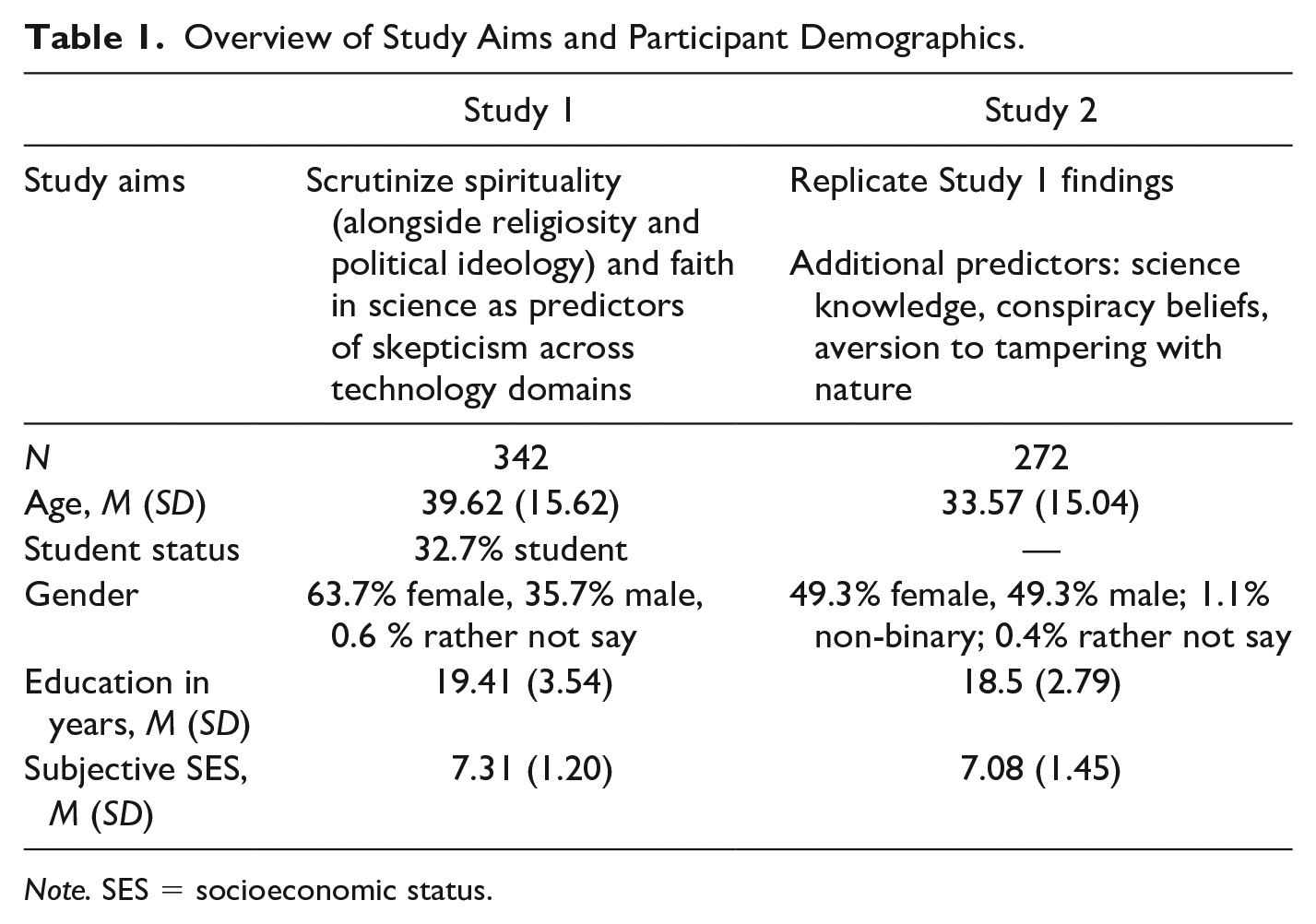
Note. SES = socioeconomic status.
A sensitivity analysis showed that we had 90% power to detect an effect as small as f2 = .03 in a multiple regression with seven predictors.
Measures
The study materials were translated into Dutch by two researchers through a parallel translation procedure. Discrepancies in translations were discussed and edited until a consensus was reached.
Skepticism
For all three scales, participants gave responses on a scale from 1 (strongly disagree) to 7 (strongly agree).
Artificial Intelligence
This scale (α =.81) consisted of seven items, five of which were highly comparable to items from Lewandowsky and colleagues’ (2013) GM food and vaccination skepticism scales (e.g., “I trust that only safe and reliable AI technologies will be made available for widespread use”; reverse-coded), while the remaining two reflected concerns more specific of AI (e.g., “Artificial intelligence is too dangerous because humans could lose control over it”).
Nanotechnology
Similarly, nanotechnology skepticism (α =.81) was measured using seven items, five of which were adapted from the skepticism scales in Lewandowsky et al. (2013) (e.g., “Because there are so many unknowns, it is dangerous to advance nanotechnologies further”), while the remaining two reflected concerns more specific of nanotechnology (e.g., “Nanotechnology is dangerous for human and environmental health”).
Human Gene Editing
We used eight items (α = .85), five of which were highly comparable to items from Lewandowsky and colleagues’ (2013) vaccine and GM food skepticism scales, with the addition of three items tapping into concerns specific for the domain of HGE (e.g., “Gene editing puts too much power in scientists’ hands”).
Religiosity
Religiosity was measured using three items tapping into religious belief (α = .84; Cohen et al., 2008). The items were as follows: “I believe in God”; “I believe strongly in the teachings of my religion or faith”; “My personal religious beliefs are important to me.” Participants responded on a 5-point scale (1 = strongly disagree; 5 = strongly agree).
Spirituality
Spirituality was measured using the Post-Christian Spirituality Scale (Houtman & Tromp, 2021) comprising seven items (e.g., “There is some sort of spirit or life force which permeates all life”; “The cosmos is a living entity”) with a 1 (strongly disagree) to 5 (strongly agree) response scale. In addition, we measured the extent to which participants self-identified as spiritual using two items (r = .85; Rutjens et al., 2018). Participants indicated on a scale from 1 (not at all) to 7 (very much) whether they considered themselves as spiritual and whether other people consider them as spiritual. Since the reliability of a composite score was high (α = .86), as well as the correlation between two scales (r = .66), we rescaled the two self-identification items from a 7- to a 5-point scale and averaged all nine items to form one measure of spirituality.
Faith in Science
A five-item shortened version of the belief in science scale (Farias et al., 2013) obtained from previous studies (Rutjens et al., 2018) was used (α = .75). The items were as follows: “The scientific method is the only reliable path to knowledge”; “The only real kind of knowledge we can have is scientific knowledge”; “We believe too often in science, and not enough in feelings and faith”, “Science tells us everything there is to know about what reality consists of”; “Science is the most efficient means of attaining truth.” Participants responded on a scale from 1 (strongly disagree) to 7 (strongly agree).
Political Ideology
We measured political ideology using two items. We asked participants the extent to which they considered themselves left-/right-wing or liberal/conservative in terms of economic and social issues from 1 (left-wing/progressive) to 10 (right-wing/conservative). These items were positively correlated (r = .58) and therefore an average score was used in the analyses. 2
Demographics
Finally, we asked participants to report their country of residence, nationality, gender, age, years of education, student and employment status, religious denomination, subjective socioeconomic status, and whether they have had any prior experience in conducting science.
Attention Checks
Two attention checks were embedded in the skepticism scales (“This question tests whether you are serious about completing the questionnaire. Click on the ‘strongly agree’ option.”; “This question tests whether you are serious about completing the questionnaire. Click on the ‘somewhat agree’ option”).
Other Measures
In addition, we measured general attitudes toward technology and perceived threat from AI for job security. These measures are beyond the scope of the research questions of this article. Details on these variables are available on OSF.
Results and Discussion
Zero-order correlations between the main variables of interest are shown in Table 2. The correlation between spirituality (M = 3.09; SD = .71) and religiosity (M = 2.12; SD = 1.01) was positive and significant, but medium in size, indicating these two constructs are empirically distinguishable. Both religiosity and spirituality correlated positively with nanotechnology (M = 3.58; SD = .91), AI (M = 3.86; SD = 1.03), as well as HGE (M = 3.79; SD = 1.05) skepticism. Faith in science (M = 4.22; SD = 1.21) was moderately negatively related to skepticism in all three domains. Political conservatism (M = 3.92; SD = 1.72) was unrelated to skepticism in all three domains.
Means, Standard Deviations, and Zero-Order Correlations, Study 1.
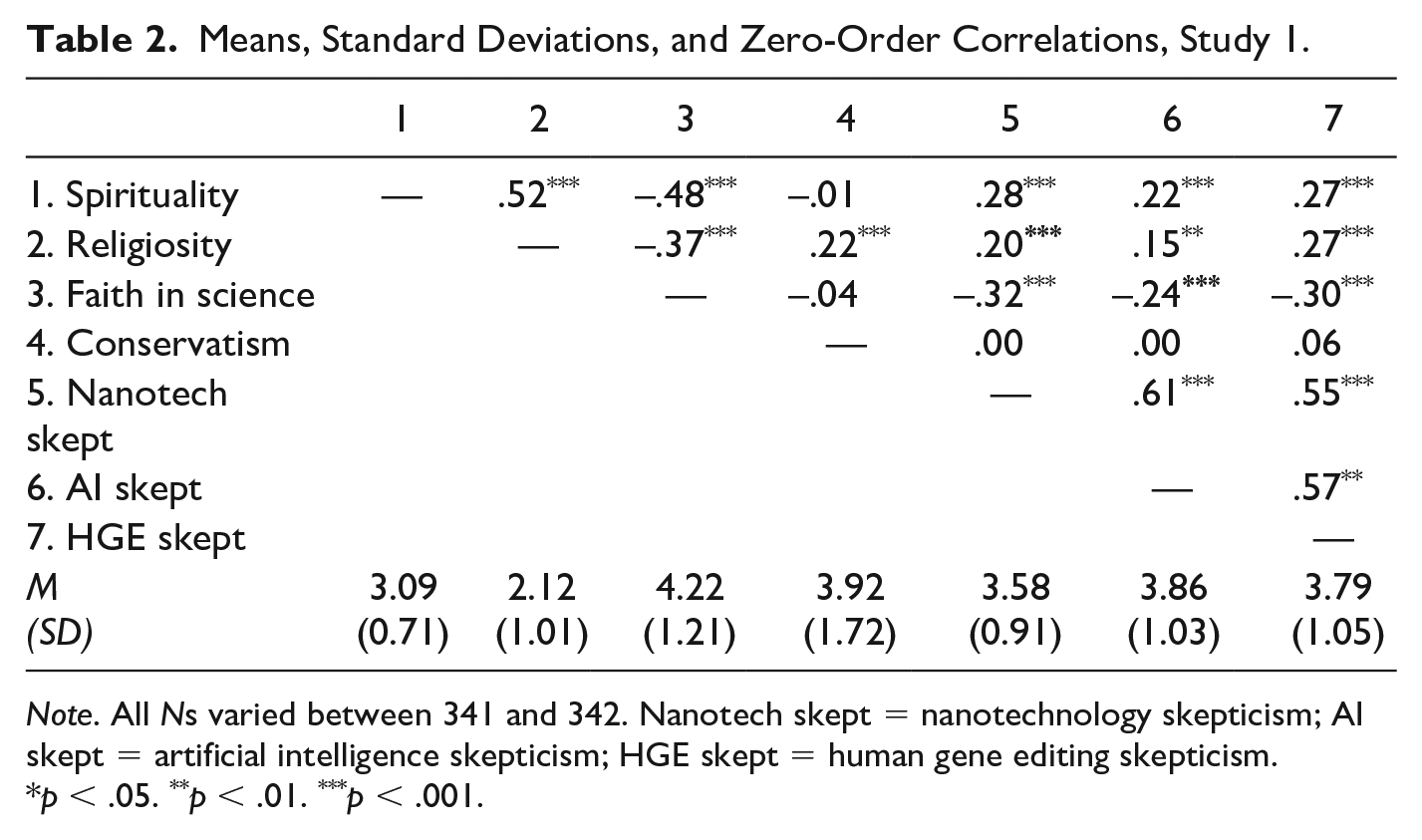
Note. All Ns varied between 341 and 342. Nanotech skept = nanotechnology skepticism; AI skept = artificial intelligence skepticism; HGE skept = human gene editing skepticism.
p < .05. **p < .01. ***p < .001.
Next, we tested the relative importance of political ideology, religiosity, and spirituality in predicting nanotechnology, AI, and HGE skepticism, while controlling for demographics (i.e., age, gender and education) using hierarchical linear regressions. In addition, we tested faith in science as a more general attitudinal predictor in Step 2. As shown in Table 3, spirituality (but not religiosity) was a significant positive predictor of nanotechnology and AI skepticism. When faith in science was included in Step 2, this relationship somewhat diminished (although remaining significant) for nanotechnology and was no longer significant for AI skepticism. As for HGE skepticism, both spirituality and religiosity were significant positive predictors in Step 1; however only religiosity remained significant after including faith in science in Step 2. Faith in science was a consistent negative predictor of skepticism in all three domains.
Multiple Regressions for Nanotechnology, AI, and HGE Skepticism, Study 1.
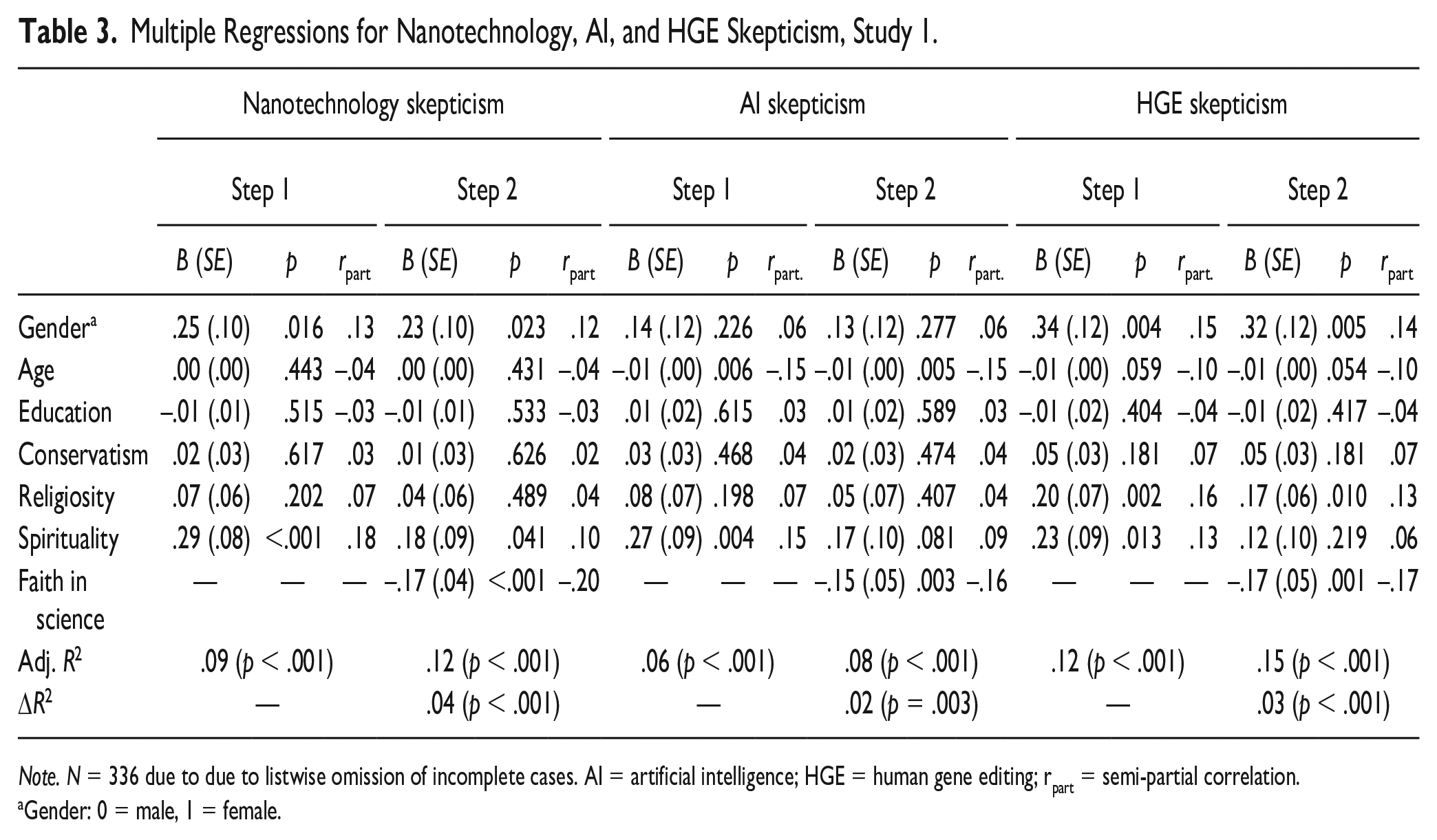
Note. N = 336 due to due to listwise omission of incomplete cases. AI = artificial intelligence; HGE = human gene editing; rpart = semi-partial correlation.
Gender: 0 = male, 1 = female.
Given that the predictive power of spirituality and religiosity was (somewhat) reduced when including faith in science in Step 2 of the regression, and in light of previous findings on faith in science as a mediator of the relationship between religiosity/spirituality and vaccination skepticism (Rutjens et al., 2018; Rutjens & van der Lee, 2020; Zarzeczna et al., 2023), we further tested this reduction through mediation analyses. It is important to note that in doing so, we do not imply a causal chain associated with mediation analyses (X → Z → Y). Instead, we are simply using mediation to statistically probe the change in the predictive power of spirituality and religiosity (i.e., by accounting for faith in science as a potential underlying reason for spiritual and religious individual’s higher skepticism). We used the PROCESS macro (Model 4, version 3.4; Hayes, 2022) for SPSS (version 26). These analyses showed that while controlling for demographics, political ideology, and religiosity, faith in science accounted for the relationship between spirituality and skepticism for HGE, B(SE) = .10 (.03), 95% CI [.04, .17], AI, B(SE) = .09 (.03), 95% CI [.03, .16], as well as nanotechnology, B(SE) = .10 (.03), 95% CI [.05, .17]. As for religiosity, faith in science accounted for the relationship between religiosity and HGE skepticism, B(SE) = .03 (.02), 95% CI [.004, .07], while other predictors from the regression were controlled for.
In sum, Study 1 is the first to systematically demonstrate that the distinction between spirituality and religiosity is important for understanding skepticism toward science innovations across domains, mirroring previous findings on vaccination (Rutjens & van der Lee, 2020; Rutjens, Zarzeczna, & van der Lee, 2022), and HGE skepticism (Većkalov et al., 2022). While religiosity seems to play a role in skepticism toward HGE, only spirituality was predictive of nanotechnology and AI skepticism. Furthermore, faith in science was a consistent negative predictor of skepticism in all three domains, and it accounted for the spirituality-skepticism link. More specifically, lower faith in science in more spiritual individuals contributed to their higher skepticism toward science innovations, which is consistent with previous work on vaccination skepticism (Rutjens & van der Lee, 2020; Zarzeczna et al., 2023). Similarly, faith in science accounted for the religiosity—HGE skepticism relationship.
As a final note, the proportion of variance explained was modest (ranging from 8% to 15% in Step 2), indicating a larger array of factors needs to be considered to achieve a more complete understanding of the underpinnings of nanotechnology, AI, and HGE skepticism.
Study 2
While Study 1 demonstrates the importance of spirituality and faith in science for skepticism toward scientific innovations, it does not account for various potentially important predictors identified in previous work. Therefore, in Study 2, we aimed to replicate Study 1 results as well as gauge the relative importance of aversion to tampering with nature (ATN) and conspiracy beliefs. Moreover, as worldview predictors can be interrelated with science knowledge (Carl & Cofnas, 2016; McPhetres & Zuckerman, 2018; Rutjens et al., 2018), we also controlled for science knowledge.
Method
Participants
As in Study 1, participants were recruited through social media advertisements and snowball sampling. Two hundred eighty-eight participants completed the survey. After excluding those who failed one or more attention checks, the final sample consisted of 272 participants (134 female, 3 non-binary, 1 unspecified; Mage = 33.57; SDage = 15.04). Most participants (61.8%) reported having no religious denomination affiliation, identifying as either atheist or agnostic. The majority of the participants (52%) indicated having some experience with science during their education, while 6% currently or previously worked as scientists. Finally, 41.2% indicated having no experience with science. For a more detailed overview of participant characteristics, see Table 1.
A sensitivity analysis showed that we obtained 90% power to detect an effect size as small as f2 = .04 in a multiple regression with 10 predictors.
Measures
Identical to Study 1, the materials were translated into Dutch by two researchers through a parallel translation procedure. Discrepancies in translations were discussed and edited until a consensus was reached. The following scales were measured identically as in Study 1 and are therefore not described below: nanotechnology (α = .82), HGE (α = .84), and artificial intelligence skepticism (α = .75), faith in science (α = .78) and political ideology (r = .57).
Spirituality
Being mindful of survey completion time, we opted for a shorter measure of spirituality. We measured the extent to which participants self-identified as spiritual using two items (r = .79; Rutjens et al., 2018). Participants indicated on a scale from 1 (not at all) to 7 (very much) whether they considered themselves spiritual and whether other people consider them spiritual.
Aversion to Tampering With Nature
To tap into individual differences in discomfort with human interference in the natural world, the Aversion to Tampering with Nature (ATN) scale was used (Raimi et al., 2020). The scale consists of five items (α = .68) that were answered on a 7-point Likert-type scale (1 = strongly oppose, 7 = strongly support): “People who push for technological fixes to environmental problems are underestimating the risks”; “People who say we shouldn’t tamper with nature are just being naïve” (reverse coded); “Human beings have no right to meddle with the natural environment”; “I would prefer to live in a world where humans leave nature alone”; and “Altering nature will be our downfall as a species.”
Science Knowledge
To measure general science knowledge about uncontested scientific facts, we asked participants to indicate whether 13 statements about scientific facts were true or false. The items were adapted from previous research (Kahan et al., 2012; Rutjens et al., 2018) and included questions such as: “Electrons are smaller than atoms”.
Conspiracy Beliefs
We used a single item to measure general proneness to conspiracy beliefs (Lantian et al., 2016). Participants were presented with a short statement about well-known events and asked to indicate whether the statement was true or false on a scale from 1 (completely false) to 9 (completely true): “I think that the official version of the events given by the authorities very often hides the truth.”
Religiosity 3
Participants reported to what extent they considered themselves religious on a scale from 1 (not religious at all) to 7 (very religious).
Attention Checks
Two attention checks were embedded in the faith in science (“We want to make sure that you pay attention to the wording of the questions. Please select the answer ‘Somewhat disagree.’”) and AI skepticism scales (“We want to make sure that you pay attention to the wording of the questions. Please select the answer ‘Somewhat agree’”).
Demographics
Finally, participants reported their gender, age, years of formal education, subjective social status, and if and how much experience with science they have had.
Other Measures
In addition, we measured pseudoscience beliefs, trust in complementary and alternative medicine, as well as psychological distance to science. These measures are beyond the scope of the research questions of this article. Details on these measures are available on OSF.
Results and Discussion
As shown in Table 4, zero-order correlations between most of the predictors and outcomes were significant and in line with previous literature. More specifically, religiosity (M = 1.77; SD = 1.35), spirituality (M = 2.35; SD = 1.42), conspiracy beliefs (M = 3.88; SD = 2.27), and ATN (M = 3.69; SD = 1.03) were positively correlated, while faith in science (M = 4.37; SD = 1.19) and science knowledge (M = 10.25; SD = 1.51) were negatively correlated with skepticism in all three domains (Ms from 2.25 to 3.63; SDs from .73 to .93). Unlike in Study 1, political conservatism (M = 3.67; SD = 1.47) was also a positive correlate of skepticism.
Descriptive Statistics and Zero-Order Correlations, Study 2.
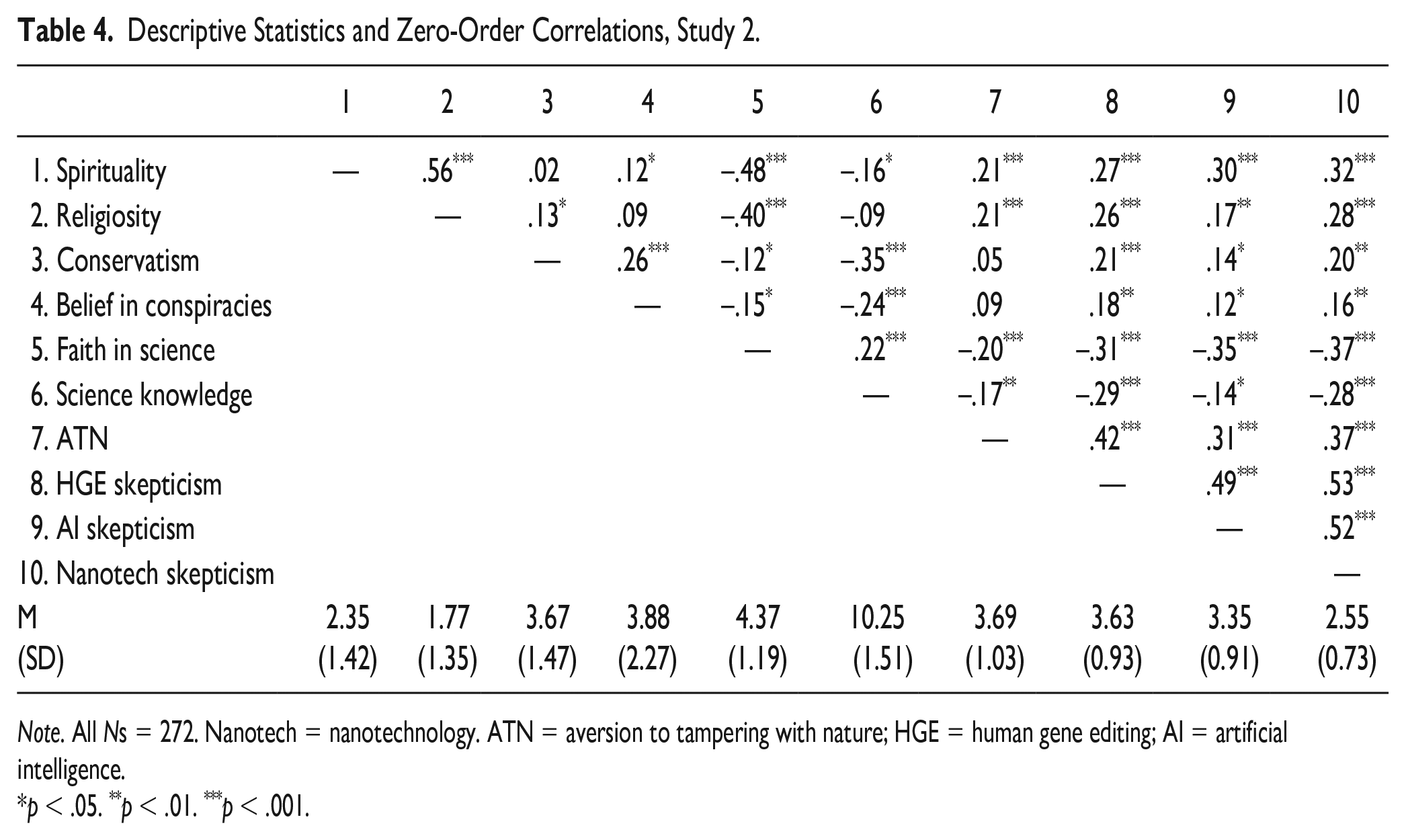
Note. All Ns = 272. Nanotech = nanotechnology. ATN = aversion to tampering with nature; HGE = human gene editing; AI = artificial intelligence.
p < .05. **p < .01. ***p < .001.
Next, following the analytical approach of Study 1, we tested the relative importance of the expanded scope of predictors of skepticism toward scientific innovations. More specifically, Step 1 worldview predictors were identical to Step 1 of the Study 1 hierarchical linear regression (i.e., religiosity, spirituality, political conservatism), with the addition of science knowledge as a control alongside demographics (i.e., gender, age and education). Next, in Step 2, we introduced conspiracy beliefs, ATN, and general faith in science. Complete regressions results are shown in Table 5.
Multiple Regression for Nanotechnology, AI and HGE skepticism Skepticism, Study 2.
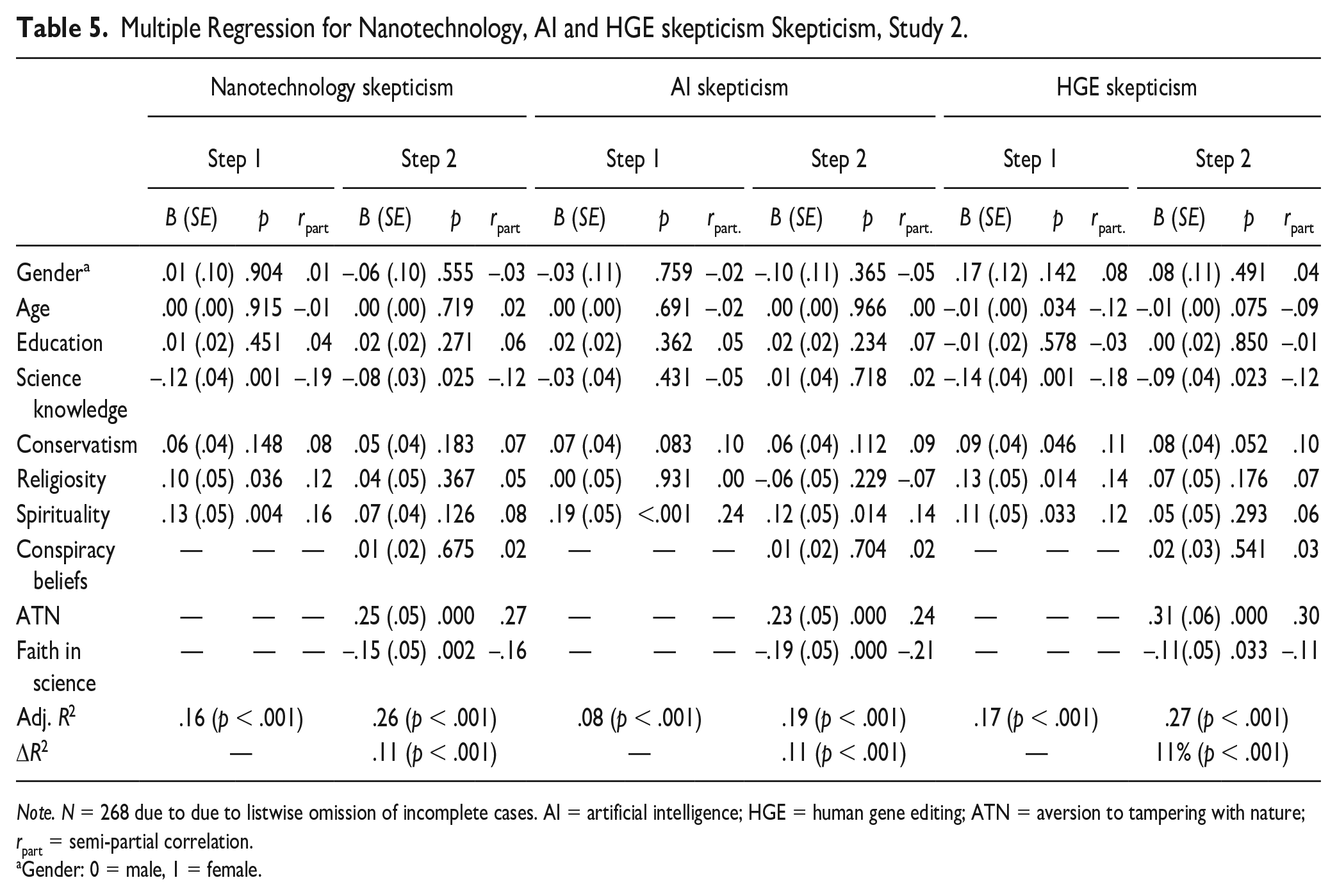
Note. N = 268 due to due to listwise omission of incomplete cases. AI = artificial intelligence; HGE = human gene editing; ATN = aversion to tampering with nature; rpart = semi-partial correlation.
Gender: 0 = male, 1 = female.
In line with Study 1 results, spirituality was a positive predictor of nanotechnology, AI, and HGE skepticism. These relationships were diminished in Step 2, becoming non-significant for nanotechnology and HGE. As for nanotechnology and HGE skepticism, both spirituality and religiosity were significant predictors in Step 1 and became non-significant in Step 2. In contrast with Study 1 results, political conservatism was an additional positive predictor of HGE skepticism (in Step 1 only). Furthermore, it is worth noting that science knowledge was a significant negative predictor of skepticism for nanotechnology and HGE.
As for worldview predictors added in Step 2, ATN was a consistent positive predictor, while faith in science was a consistent negative predictor for skepticism in all three domains, with the latter being in line with Study 1 results. We found no evidence of conspiracy beliefs being predictive of skepticism toward scientific innovations.
As the predictive power of spirituality and religiosity (somewhat) diminished after accounting for Step 2 predictors, we further tested this reduction through mediation analyses. We used the PROCESS macro (Model 4, version 3.4; Hayes, 2022) for SPSS (version 26). As for Study 1, it should be noted that we do not attempt to make causal inferences with these analyses; instead, we are statistically probing the change in the predictive power of spirituality and religiosity when accounting for faith in science (see Study 1 results).
Following Study 1 results, which pointed to faith in science as a potential explanation of the link between spirituality/religiosity and skepticism, we proceeded to replicate these analyses. While controlling for demographics, science knowledge, political ideology, and religiosity, faith in science accounted for the relationship between spirituality and skepticism for HGE, B(SE) = .04 (.02), 95% CI [.01, .09], nanotechnology, B(SE) = .05 (.02), 95% CI [.02, .09], and AI, B(SE) = .07 (.02), 95% CI [.03, .11]. Faith in science accounted for the relationship between religiosity and HGE, B(SE) = .02 (.01), 95% CI [.003, .05], as well as nanotechnology skepticism, B(SE) = .03 (.01), 95% CI [.01, .06].
In sum, Study 2 results largely replicated the main findings from Study 1—spirituality predicted skepticism in all three tested domains, while religiosity was important for HGE skepticism. In addition, and unlike in Study 1, religiosity also contributed some explained variance in nanotechnology skepticism in Step 1. Unlike in Study 1, political conservatism was a marginal positive predictor of HGE skepticism. Furthermore, science knowledge negatively predicted nanotechnology and HGE skepticism. Conspiracy beliefs did not contribute additional explained variance in any of the domains. ATN emerged as the most robust predictor of skepticism across domains, with faith in science as a consistent additional predictor. What is more, we replicated the Study 1 finding that lower faith in science accounts for the relationship between spirituality and religiosity, and skepticism in all three domains.
General Discussion
Compared with other contentious science domains such as vaccination or genetic modification of food, the scope of work on worldview predictors of skepticism toward scientific innovations is limited. Building on the attitude roots model of science rejection (Hornsey & Fielding, 2017), which considers motivated reasoning (Kunda, 1990) factors that contribute to domain-specific science attitudes, we aimed to address this gap in two studies.
We obtained consistent evidence for spirituality as a positive predictor of skepticism across all three studied domains. In line with previous findings (e.g., Delhove et al., 2020; Drummond & Fischhoff, 2017), religiosity was an additional positive predictor of HGE (Studies 1 and 2) and nanotechnology skepticism (Study 2 only). Mediation analyses showed that lower faith in science among more spiritual/religious individuals accounted for these relationships (Studies 1 and 2). As for the other tested predictors, political conservatism explained no variance in skepticism in Study 1, while in Study 2, it was a positive predictor of HGE skepticism only. Similarly, science knowledge was an additional negative predictor of HGE and nanotechnology skepticism (Study 2). We found no evidence for (general) conspiracy beliefs contributing to skepticism in any of the domains. Finally, aversion to tampering with nature emerged as a predictor of skepticism across all tested domains in Study 2.
The current results reiterate the importance of distinguishing between religious and spiritual beliefs in the context of science skepticism, mirroring previous work (Rutjens & van der Lee, 2020; Zarzeczna et al., 2023). This distinction could be particularly relevant in highly secular countries, such as the Netherlands and Western European countries more generally. In these countries, the number of individuals who identify as spiritual is on the rise, while the number of religious identifiers is declining (Houtman & Aupers, 2007). To illustrate, estimates of the prevalence of modest-to-strong spiritual believers hover around one third of the adult population in the Netherlands (Bernts & Berghuijs, 2016). Indeed, the majority of our participants in both studies reported no affiliation with a religious denomination. Beyond Europe, identifying as spiritual but not religious is also on the rise in the United States (a traditionally more religious country; Lipka & Gecewicz, 2017), pointing to the potentially increasing prominence of spiritual beliefs globally. Our results suggest that the identified link between spirituality and skepticism about scientific innovations can be, in large part, contributed to lower faith in science in spiritual individuals. This is also in line with findings on vaccination skepticism (Rutjens & van der Lee, 2020; Zarzeczna et al., 2023). However, what exactly accounts for lower faith in science in spiritual individuals remains an important question for future research (also see Rutjens, Sengupta, et al., 2022).
Reflective of previous work, some of which found either no or weak relationships between conservatism and HGE, nanotechnology, or AI attitudes (e.g., Akin et al., 2021; Kim et al., 2014), the role of political ideology in skepticism toward AI, HGE, and nanotechnology was small, with conservatism being weakly predictive of higher HGE skepticism in only one of the studies. Therefore, political ideology is likely not a crucial contributor to skepticism toward these scientific innovations. This could be a good thing from a science communication standpoint—the fact that these topics are not (yet) highly politicized can enable more meaningful public discussions around these emerging and evolving technologies (see Bao et al., 2022). In addition, the rapid politization of COVID-19 vaccines along ideological lines (Bolsen & Palm, 2022) serves as a reminder that the political context can change rapidly, with potential spillover effects to previously less politicized technologies (i.e., childhood vaccines; Motta, 2023).
Although the current research focused on worldview predictors, it is worth noting that general science knowledge was found to predict nanotechnology and HGE (but not AI) skepticism. This result is consistent with some of the previous work on attitudes toward nanotechnology (Drummond & Fischhoff, 2017). In this regard, nanotechnology and HGE skepticism can be considered similar to skepticism about another biotechnological innovation—vaccines. More specifically, while being determined by worldview factors such as spirituality and/or religiosity, nanotechnology and HGE—like vaccination skepticism—also partially stem from a lack of science knowledge (e.g., Rutjens et al., 2018; Rutjens, Zarzeczna, & van der Lee, 2022). Whether increasing general science knowledge in, for example, educational settings can improve science attitudes that are predominantly rooted in worldviews remains an open question (also see Hornsey, 2020).
Finally, in line with prior work (Raimi et al., 2020), concern about human interference with natural processes (as measured by ATN) was found to be a robust antecedent of skepticism across nanotechnology, HGE, and AI. As such, ATN could reflect universal reluctance about innovations at the intersection of science and technology, which may inform science communication. More specifically, framing these technologies as not opposed to, but in alignment with nature, might counter concerns stemming from an intuitive preference for naturalness (Scott & Rozin, 2020). This could be achieved, for instance, by framing medical technologies (e.g., vaccination or HGE) as “working with” rather than against natural processes (e.g., the immune system) or framing food technologies as combating naturally occurring dangers (e.g., crop diseases).
Taken together, the current results stress the importance of expanding the scope of studied worldview predictors of skepticism toward technological innovations for identifying attitude roots that might play a role in the formation of such attitudes, as well as for tailoring science communication to audiences most likely to be skeptical about these technologies.
Limitations and Considerations
Our studies have several limitations. First, we used a Dutch sample, and although this contributes to diversification of samples in social sciences (i.e., beyond U.S. and English-speaking samples), conclusions regarding culturally embedded constructs may not be generalizable without more diverse samples. Furthermore, we used convenience samples, which may have resulted in a more “science-friendly”, relatively areligious, participant pool. However, although not representative of the Dutch population (in, e.g., education level), convenience samples are generally reliable for correlational and experimental associations between constructs (e.g., Jeong et al., 2019; Mullinix et al., 2015).
In addition, it should be noted that our data are correlational and therefore any causal interpretations are tentative. Future research should further explore faith in science as a potential mechanism in spiritual/religious skepticism by, for example, employing experimental mediation-testing designs (e.g., Pirlott & MacKinnon, 2016). Generally, the correlational nature of our data does not allow for causal conclusions about the relationships between predictor and outcome variables. However, the proposed direction of influence from broader, more core, worldviews and values to more specific, surface attitudes about individual science/technology domains is consistent with theorizing on surface-level attitudes in, for example, the environmental domain (e.g., Stern et al., 1995), as well as science attitudes more broadly (Hornsey & Fielding, 2017).
Finally, two related points regarding the nature of skepticism toward scientific innovations should be noted. First, skepticism toward evolving technologies such as AI, HGE, and nanotechnology, where scientific consensus on the appropriate applications and risks has not been reached, should be regarded as markedly different compared to skepticism toward—for example—the safety of childhood vaccinations or GM foods available on the market; these are domains where scientific consensus is high. Healthy skepticism regarding new technologies can be beneficial in evolving domains, as it might help ensure that scientific innovations are thoroughly scrutinized before being made available to the public. Even so, we argue it is important to understand psychological factors involved in negative attitudes in such science domains to better understand how and which public concerns should be addressed in science communication and public engagement.
Related to the above, the current research does not offer a detailed analysis of risk/benefit perceptions depending on the many different applications of each studied technology, differences between academic and industry contexts, nor does it account for perceived familiarity with the studied science/technology domains. Although attitudes and their antecedents are likely to vary according to these considerations (e.g., Akin et al., 2021; Critchley, 2008; Frewer et al., 1997; Siegrist et al., 2007), our aim was to provide a more general overview of worldview predictors of public perceptions of the studied domains at the intersection of science and technology. Future research aimed at distinguishing different forms of skepticism could benefit from different theoretical and methodological angles.
Conclusion
Public perceptions of scientific innovations can have a substantial impact on their further development and application. The current work contributes to a better understanding of worldview factors that underlie such perceptions by studying a large number of potentially relevant predictors of skepticism in three domains (i.e., nanotechnology, AI, and HGE). Spirituality, faith in science, and aversion to tampering with nature emerged as the most consistent predictors of skeptical attitudes across domains. These findings call for a greater focus on studying a wide range of worldview factors related to attitudes toward scientific innovations, beyond political and religious affiliations.
Footnotes
Acknowledgements
The authors thank Isabel Druijf, Sjoerd Verhagen, Quinty Mars, and Mees Gradener for their assistance in data collection, as well as Carlotta Reinhardt for the assistance in preparation of open materials.
Availability of Data and Materials

Declaration of Conflicting Interests
The author(s) declared no potential conflicts of interest with respect to the research, authorship, and/or publication of this article.
Funding
The author(s) disclosed receipt of the following financial support for the research, authorship, and/or publication of this article: This project has received funding from the European Research Council (ERC) under the European Union’s Horizon 2020 research and innovation program (grant agreement No. 849125).