



Abstract
Microplastics are increasingly populating the environment and human and nonhuman bodies. Their presence has invoked concerns about potential environmental and health effects, resulting in increasing research and media reporting. Here, we explore how the German print media reported on microplastics between 2004 and 2018. We find three distinct phases of reporting in which microplastics are introduced, stabilized, and destabilized as a “risk object.” We show that different attributions of risk go hand in hand with divergent assessments of who is responsible for risk management and argue that media cycles of affirming and contesting risk might undermine public trust in scientific findings.
Introduction
In recent decades, the presence of plastic in the environment has become a prominent social and political concern. Whereas plastic was a material celebrated in a 1955 edition of Life magazine 1 as the perfect aid for American middle-class life due to it enabling a form of “throwaway living,” today, plastic is increasingly portrayed as a cheap and indispensable, yet polluting and harmful, material. A wide variety of media features offer critical accounts of plastic, such as the acclaimed documentary film Plastic Planet, 2 which critically investigates the production, use, and disposal of plastic products, or a range of international articles that detail the effect of plastic debris on the oceans using vivid imagery depicting marine life being strangled or otherwise harmed by plastic litter, or depict the Great Pacific Garbage Patch, an enormous accumulation of plastic and other litter in the north-central Pacific Ocean (e.g., National Geographic, 2018).
A more recent development in the media is the growing attention to microplastic particles. In 2004, Richard Thompson, a British scientist, initially discovered these tiny plastic particles during a beach cleanup. He and his coauthors were the first to use the term microplastics and to introduce it to the scientific community and the media (Thompson et al., 2004). Since then, scientists have defined the concrete meaning of “microplastics,” which is now commonly used to denote microscopic plastic fragments with a dimension of less than 5mm (e.g., Arthur et al., 2009). Microplastics can come in different sizes and shapes, originate from various sources, and consist of numerous synthetic polymers, such as polyethylene, polypropylene, or polystyrene. Based on their origin, microplastic particle types are classified into primary and secondary particles. Primary particles include micropellets, which are industrially produced for use in cosmetics and domestic cleaning products (e.g., Fendall & Sewell, 2009; Gouin et al., 2011) as well as fibers from clothing (e.g., Napper & Thompson, 2016). Secondary particles are produced by the “physical, chemical and biological fragmentation of larger items” (Thompson, 2013, p. 152), such as when marine plastic litter is ground into smaller pieces. Researchers have suggested that microplastic particles can harm animals who ingest them, a phenomenon best described in mussels (Browne et al., 2008). Furthermore, they can harm organisms when they leak toxic substances, for example, BPA (bisphenoal A), a plastic softener (Brewer & Ley, 2014; Vogel, 2009). Yet, despite these indications of risk, the precise scope of the risks posed by microplastics (e.g., if they are harmful to humans and larger animals, or how they might affect ecosystems) is as yet unknown (Koelmans et al., 2019).
In his seminal work on the “risk society,” Ulrich Beck (1992) described how as Western societies increasingly rely on technological innovation, notions of risk within these societies change. With regard to the environment, Beck notes that notions of “natural” environmental risks, such as natural catastrophes, are complemented by risks located in nature but created through human action, such as environmental pollution or radioactivity. These new forms of environmental risk are often characterized by a high degree of uncertainty about the precise character of the risks they pose and a lack of political regulation and means of control. Microplastics are a recent newcomer to this list of human-made environmental risks whose potential effects on environment and health are still largely unknown.
The media represents a space in which the potential risks that microplastics pose to health and the environment are currently being negotiated. In this article, we analyze reports in one arena of the German media about microplastics and the potential risks they pose to the environment and health. We draw on a sample of 410 print media articles published between 2004 and 2018 in seven daily and weekly German newspapers. We analyze these articles as part of an emerging discursive arena in which the meaning of microplastics as a novel “risk object” (Hilgartner, 1992) is both staged and negotiated. While daily and weekly newspapers represent one selected arena of the German media landscape, the respective newspapers chosen for analysis are some of those with the highest circulation and with high-profile online portals. Thus, we concentrate on the discursive practices and shifts that occur in this media arena and ask: How are microplastics depicted in the German print media? How are they constructed as objects and connected to risk? How are possible solutions, as well as responsibilities for addressing this emergent issue, narrated?
Germany is an interesting context in which to study these questions. Germany understands itself as a country with pronounced environmental awareness and indeed has a long history of substantial environmental activism and media attention to environmental topics (Brand, 1993; Hasenöhrl, 2003; Keller, 2004). Specifically relevant for the topic of microplastics is the history of German public debates about the need to improve household waste disposal and recycling, which accompanied a tightening of regulations in the course of the 20th century (Keller, 2004). At the same time, Germany is interestingly one of the countries in Europe that has not yet passed any political regulations regarding microplastics, in contrast to Sweden or the United Kingdom, for example, who banned the use of primary microplastic particles in some product categories, for example, in cosmetics.
In the following, we will first contextualize our work within the current literature in Science and Technology Studies (STS) and neighboring fields that addresses the role of the media as a public space for staging and negotiating health and environmental risks in society, after which we then present our empirical analysis.
Microplastics: An Emergent Risk Object in the Media
When studying risk perceptions in society, the media represent an important social arena in which such perceptions emerge. The media provides extensive information on environmental and health issues (Hilgartner & Nelkin, 1987; Nelkin, 1989; Seale, 2003) and thus can serve as a vantage point for studying how risk is socially constructed within a public discourse (Cottle, 1998; Giddens, 1999). Beck (1992) defined the mass media as a key site for the social construction, negotiation, and critique of risks: “[. . .] the mass media and the scientific and legal professions in charge of defining risks become key social and political positions” (pp. 22-23). Risk accordingly comes to life not only in expert debates and in political negotiations, but also and importantly in the mass media as it is “illuminated under the mass media spotlight” (Beck, 1995, p. 101). This illumination has various effects. One of these is that scientific knowledge, which often acts as a basis for risk statements, is increasingly represented and evaluated in the media. Thus, the mass media represents a stage on which the meaning of scientific knowledge for society is negotiated (Bucchi, 1998; Weingart, 2001).
A concept that aims to capture this increasingly close relationship between scientific knowledge and the media in today’s societies is the so-called mediatization of science (Weingart, 2001). According to studies analyzing the mediatization of science, the relations between science and the media have been changing in at least three ways (Schäfer, 2008): first, a growing number of mass media articles are reporting on scientific knowledge; second, an increasing number of societal stakeholders are being asked to comment on scientific knowledge in the media; and, last, reporting on scientific knowledge is becoming increasingly polarized, as the mass media both embraces and criticizes scientific knowledge.
Against this backdrop, a number of authors have noted that media reporting on risk often follows a logic of newsworthiness. Kitzinger and Reilly (1997) state that the “media coverage of risk is selective” (p. 320) with topic selection often based on the expected amount of public attention a topic might garner (Washer, 2006). Following this logic, risks that are being reported on are often staged in ways that increase their newsworthiness, which can negatively affect the social discourse. For example, social scientists have critically analyzed how media outlets in a range of countries have been staging a rise in average bodyweight as an “obesity epidemic” (Boero, 2007; Penkler et al., 2015), arguing that this narrative stigmatizes and pathologizes people with higher bodyweight. Such translations of media representations into societal narratives and political incentives provide important examples of how media debates influence social discourse. With regard to microplastics, it will be interesting to see what kind of understandings are communicated in the media and what social actions might be proposed.
Other authors have drawn attention to the increasingly decisive role of the media in creating a public image of science and scientific knowledge, noting that media reports tend to foreground certainty and facticity while drawing less attention to the inherent uncertainty and provisionality of scientific findings (Felt & Fochler, 2013). This depiction of emergent scientific knowledge as already established fact can undermine public confidence in scientific findings if prior certainties have to be revoked as new scientific findings emerge.
Media reports also play an important role in staging controversies between scientific assessments of risk and other approaches to risk. Malone et al. (2000), for example, argue that U.S. media reports about the harms of passive smoking tended to stage a conflict between emergent public health advice and core “American” values, such as individual freedom. They assert that this reframing of the debate as a “moral” question, not a scientific one, ultimately aided industry interests. Media portrayal can thus influence the registers of valuation (Heuts & Mol, 2013) that are used to understand and evaluate a problem, which might support the interests of certain actors more than of others. In media and communication studies, this phenomenon is commonly referred to as “framing.” Framing refers to the ways in which media reports can influence public opinion by offering “a particular problem definition, causal interpretation, moral evaluation, and/or treatment recommendation for the item described” (Entman, 1993, p. 53). Studies of media frames have focused on both the practices of framing in media reports—that is, the staging of issues—as well as the effect media reports have on the public understanding of certain issues in specific cultural contexts (e.g., Chong & Druckman, 2007; Nisbet, 2009). Thereby, framing offers a way to study the connections between “the communicator, the text, the receiver and the culture” (Entman, 1993, p. 53). Media framing can be particularly important for emerging and controversial issues about which public knowledge might yet be low (e.g., Druckman & Bolsen, 2011; Völker et al., 2019). In our study, we focus on how German media establishes frames for understanding the emerging issue of microplastics. We do not, however, study reception and uptake by the German public.
Last, it is also important to note that, as Petersen et al. (2010) point out, media reporting about risk issues might influence not only the public but also policymakers. Based on a survey of policymakers in Germany, Petersen and co-authors argue that “mass-mediated expertise [. . .] can be seen as informal policy advice complementing institutionalized advisory arrangements” (Petersen et al., 2010, p. 865). Media reports about emergent risks can put pressure on policymakers to act. However, these reports can also influence the frames they use to understand the problem and to consider possible ways of addressing the issue of risk.
Due to the media’s significant influence on the perception of risk in society and policy making and its role in shaping the public’s understanding of science and scientific knowledge, it appears paramount to better understand how the German print media frames microplastics as an emergent risk issue. To this end, we mobilize a constructivist concept from Science and Technology Studies, namely Hilgartner’s (1992) notion of a “risk object,” as an analytical lens for our study. The notion of the risk object draws attention to the social construction of risks in relation to specific material objects. Risk objects represent “sources of danger, entities to which harmful consequences are conceptually attached” (Hilgartner, 1992, p. 41). The concept of a “risk object” invites us to explore the processes through which “an object [is] deemed to ‘pose’ [a] risk” and how “a linkage alleging some form of causation between the object and the harm” is established (Hilgartner, 1992, p. 40). It also invites us to examine how such a connection might also be disrupted and destabilized again through emerging knowledge or social or technological forms of risk containment and management (cf. also Nader, 1965).
Thus, in contrast to other studies of risk, the risk object conceptualization offers a dynamic perspective on risk. Consequently, we understand risk not as an inherent and stable feature of objects but as a relational category that is attributed and continuously negotiated in social processes. Risk objects emerge, can be stabilized, and can cease to exist if the link between object and risk is disrupted or if the risk object is transformed into a manageable entity through regulation or other systems of control and remediation. Thinking of microplastics as a “risk object in the making” allows us to analyze how risk has been attributed to microplastics in German print media reports and how these attributions might have changed over time.
Our study is unique as it is among the first studies to specifically explore media reporting on microplastics. While more attention has been paid to public and media discourses about macroplastics (Davis, 2015; Gabrys et al., 2013; Hawkins, 2009; Liboiron, 2016; Race, 2012; Roberts, 2010), few studies have thus far engaged with microplastics as a distinct, emergent risk issue (but see Völker et al., 2019 and Henderson & Green, 2020 for exceptions). While we expected and indeed found some overlap with public and media discussion about macroplastics—such as entanglements with larger discussions about consumerism, environmental pollution, and social responsibility (cf. Michael, 2013)—we found that the small size, the virtual invisibility, and the potential health consequences of microplastics create a discursive shift that allows for the formation of a risk object, “microplastics,” that is distinct from the risk object “macroplastics.” In what follows, we will first briefly outline our material and methods before we present our findings, discussion, and conclusions.
Material and Methods
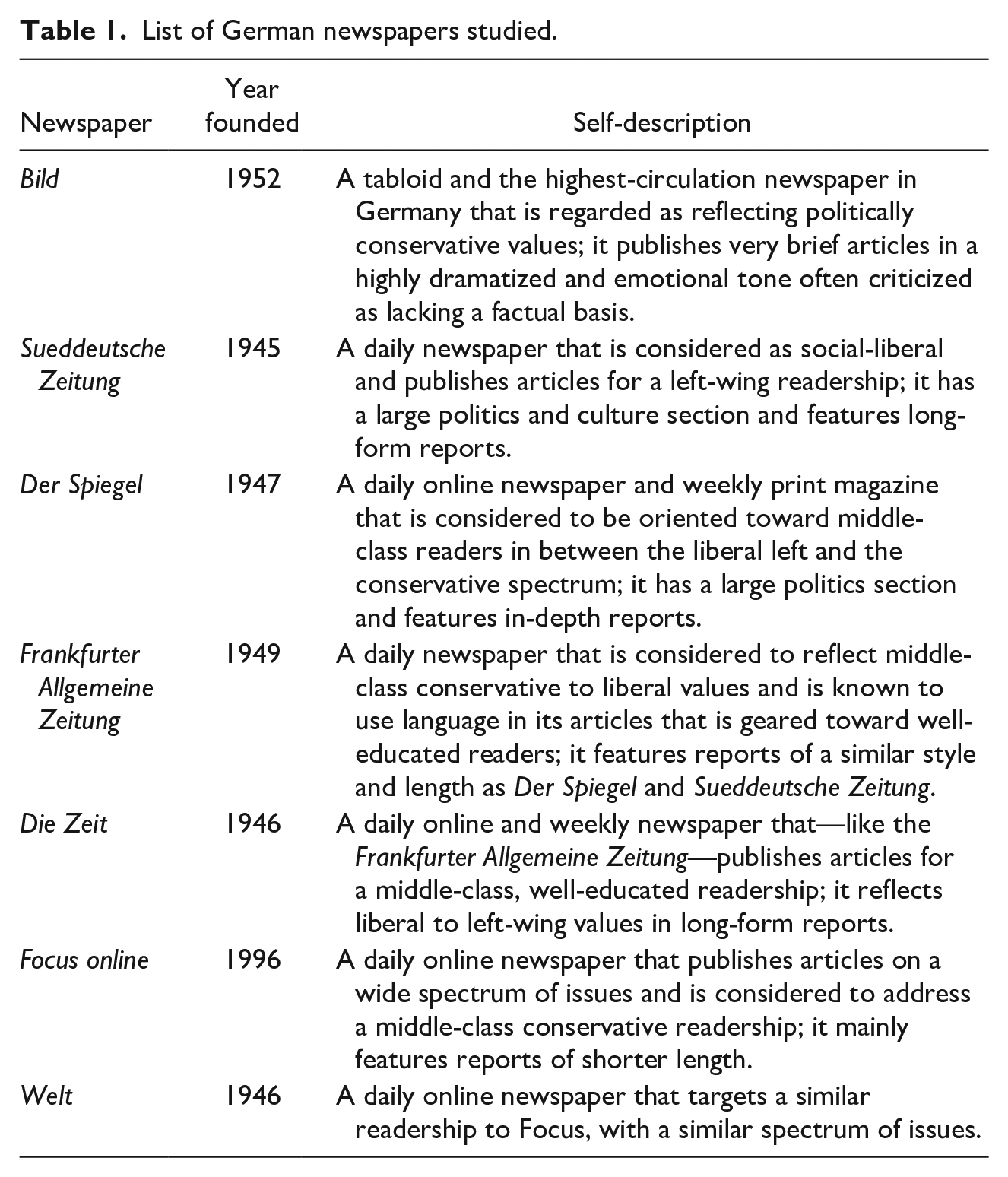
We collected articles from 2004, the year in which microplastics were first featured in a scientific article (Thompson et al., 2004). We focused on seven national newspapers that have a high circulation in Germany and that, at the same time, vary in their self-descriptions and target audiences (see Table 1). Additionally, we sampled media reports from the archive of the German press agency, an archive that collects official press release statements in Germany. While the newspapers address different target audiences and political positions, the central developments and changes in risk reporting of microplastics did not vary within newspapers but occured over time.
List of German newspapers studied.
For our collection of articles, we searched the electronic online databases of the respective newspaper archives and included articles accessible via the university server. Two articles were not accessible, due to their location as part of a special newspaper section. In our sampling, we used the following keywords: microplastics, plastic particle, synthetic particle, microparticle, plastic pellet, plastic fiber, synthetic fiber, granule bead, micro pearls, micro bead, and micro waste. Of all the 410 newspaper articles we collected, 195 had an exclusive focus on microplastics and were taken as the core material for our analysis.
To analyze the data, we used an inductive constructivist grounded-theory approach (Charmaz, 2006; Strauss & Corbin, 1998). Both authors participated in the analytical process, which took place individually and in regular joint meetings during which we critically reflected on the development of codes and analytic themes. Our analysis began with a first phase of multiple rounds of open coding using the ATLAS.ti software, which allowed for initial codes to emerge. For the initial codes, we focused on the social and material dimensions of microplastics, a focus that allowed us to gain important insights into and an overview of the data. For example, we coded media reports based on the mentioned sources of microplastics (e.g., microplastics in cosmetics, microplastics derived from clothing, plastic objects) and the depicted occurrence of microplastics (e.g., microplastics in the sea, in the arctic, in local rivers, in food webs). This allowed us to unpack the geographical trends in German media reports. We also coded articles based on the mentioned possible effects of microplastics on environment and health (e.g., microplastics and pollution, microplastics and disease), the material characteristics of microplastics (e.g., durability, omnipresence, toxicity), or the relationship of microplastics with big plastic objects. Furthermore, we coded the media reports based on the actors involved (e.g., individual actors, group of actors, organizations, etc.), which helped us become aware of these actors over time.
In the second analytical phase, we ordered the codes of the initial phase and conducted extensive memo writing until the analysis reached a point of saturation (Charmaz, 2006; Strauss & Corbin, 1998). In this phase, we grouped initial codes based on important trends in reporting, such as health-relevant topics featuring, for example, the toxicity of the material ingredients of microplastics, the distributed responsibility among the actors involved in the discourse, negotiations between and critique of prominent actors, and potential future solutions—that is, to remove or avoid microplastics—that were named. Based on this step, we identified salient themes that developed over the 14-year time period of media reporting. These included, for example, discussions about prevalent sources of microplastics and the material features of microplastics (both themes that changed over time), increasing reports on the impact of microplastics on human health and on the environment, and the distribution of the responsibility to act, consumer behavior, or political responsibility. These themes prominently related to the emergence of microplastic risk and allowed us to critically evaluate the social norms and values that were employed when the media attributed (or did not attribute) risk to microplastics.
Based on the risk-related themes identified in the second phase, we started to conceptually deepen our analysis in the third analytical phase. To do so, we engaged with microplastics as a “risk object” (Hilgartner, 1992), a concept that helped us focus both on the materiality of the object and on the relationship between object and risk over time. The concept specifically allowed us to highlight the negotiations and risk attributions of an emerging object. We therefore conducted another round of extensive memo writing and revisited the salient themes of the second phase as we focused on microplastics and its representation and development as a risk object.
We conducted our analysis as part of the project “Plastics–Publics–Politics,” a subproject of the research consortium “Tracking of (Sub)Microplastics of Different Identities: Innovative Analysis Tools for Toxicological and Process-Engineering Evaluation.” The research consortium was funded by the research initiative “Plastic in the Environment” of the German Ministry of Education and Research. Although in this article our analysis draws exclusively on media reports, other data we generated in the project, such as qualitative interviews with a range of stakeholders and ethnographic observations at conferences, inform our overall perspective on plastics in the environment in Germany. This brings us to the limitation of this study: While the seven newspapers we study have a high circulation and a high media presence, we did not analyze other discursive arenas, such as TV documentaries, social media, or popular science magazines, which of course also co-shape the overall media discourse about microplastics in Germany. We hope to address these discursive arenas in future studies.
Empirical Findings
Our analysis follows 14 years of reporting about microplastics in the German media. We find three distinct phases of media reporting: in the first phase (2004-2010), media reports introduce microplastics as a new object to the reader, an object that, due to its durability and invisibility, might pose a yet-to-be-determined risk. In Phase 2 (2010-2015), microplastics are portrayed as an established risk object that is toxic. In Phase 3 (2015-2018), controversies emerge over this established risk status as a variety of stakeholders from science, policy, and industry contribute their perspectives to the debate.
First Phase: Microplastics—an Invisible Threat in the Ocean (2004-2010)
Microplastics emerged as a new concern in German media reports in 2004, the same year that the term was coined by Thompson et al. (2004) in a scientific commentary. Although microplastics was introduced as a distinct term, it was still only one among many terms that journalists used to describe small plastic particles. Other terms in circulation at that point were plastic particles, micro waste, garbage particles, or plastic fibers.
During the first phase (2004-2010), the print media mostly reported about the initial scientific studies that had detected microplastics in the ocean. Media articles offered accounts of polluted beaches, marine plastic litter, and the risks potentially associated with marine organisms ingesting small plastic particles. While the ocean was featured as the main location where microplastics were to be found, microplastics were at the same time connected to everyday household products, one of the sources of microplastics in the environment. A 2010 media report (Rögener, 2010), for example, highlighted that the small plastic particles in the ocean resulted from degraded plastic packaging, ropes, or toys. The reports thus intertwined microplastics with macroplastics or, more precisely, with the established environmental problem of marine litter, which served as a key reference point for media reports about microplastics during the first period.
A second key characteristic of media reports in the first phase was a focus on the durability of microplastics. Once present in the oceans, microplastics would not present as a temporary but as a persistent pollutant. Microplastics would accumulate over time, and the number of particles present would increase as more and more marine litter degrades in the ocean. This could pose an increasing threat to marine life (e.g., Rögener, 2010).
However, third, this possible harm was not yet connected to plastic as a material itself. During the first period, media reports focused their discussion about potential harm largely on toxic contaminants microplastic particles could pick up from the environment. Thereby, plastic largely kept its traditional connotation as an inert material. For example, the Frankfurter Allgemeine Zeitung states in 2004 that “while the plastic particles as such are nontoxic, they are often contaminated with toxic substances” (Lindinger, 2004). Similarly, the Sueddeutsche Zeitung reports how plastic particles could absorb toxic substances that reside in the ocean, such as DDT (dichlorodiphenyltrichloroethane), or other outdated chemicals, and could hence become “loaded with toxic substances” (Rögener, 2010) as they travel through the ocean. This contamination could ultimately harm marine life and possibly create risks for humans as it accumulates along the marine food chain, as this quote from Der Spiegel (2004) illustrates.
It is unclear too, what effects these fragments will have on the flora and fauna. Microorganisms that were confronted with polluted water by British researchers ingested the artificial pieces within few days. Since plastic fragments are often contaminated with poisonous substances, scientists now want to research how these poisonous substances might enter the food chain.
Thus, while in Phase 1, plastic particles are narrated as residing in the—for most Germans—far-away place of the ocean, they are also constructed as a potential risk for human health due to their ability to absorb toxic chemicals from the environment and introduce these chemicals into the “human food chain” (Lindinger, 2004) when ingested by marine life, who will “not secrete the plastic particles, but take up their chemical compounds in the organism” (Focus online, 2013b).
As scientists began to address microplastics as a potential new risk for ecosystems and human health, media reports highlighted a fourth feature of microplastics that complicates their detection and lends microplastics an uncanny air: their invisibility. This feature clearly distinguishes microplastics from macroplastics. As Der Spiegel (2004) reports, The throwaway society leaves its mark, albeit barely visible: countless small plastic fibers swim in the oceans, as researchers have now discovered, an available but not necessarily healthy food for the marine inhabitants.
Numerous articles discuss microplastics’ invisibility as a key feature of the threat they might pose and at the same time as a characteristic that makes that risk hard to assess. For example, the Frankfurter Allgemeine Zeitung reported that scientists “suspect that they have only found a small part of the actual microscopic plastic garbage, since they could only detect colored particles bigger than 20 micrometers” (Lindinger, 2004). Hinting at the possibility that there is a significant amount of microplastics that has, as yet, gone undetected creates an image of a problem that might be much larger than expected but which will be hard to asses until the harm becomes visible. This, first, creates an implicit narrative link between microplastics and other invisible risks, such as nuclear radiation, chemical pollution, or pathogens, again setting apart discussions about microplastics from narratives about macroplastic litter. Second, it brings the limitations of contemporary scientific studies to the fore. Media reports, for example, cite scientists who point to the difficulties of detecting particularly small particles with standard laboratory equipment and who argue that “new and improved detection methods would need to be developed to identify the full extent of the pollution” (Der Spiegel, 2004). We will reencounter this concern about methodological limitations in current research on microplastics in Phase 3 of the print media reporting.
Second Phase: From a Far-Away Problem to Local News (2010-2015)
In the second phase (2010-2015), the number of articles about microplastics noticeably increased. For example, the number of articles increased 4.5 times between 2012 and 2013 alone (see Supplemental Figure 1a). This increase is based on more scientific studies covering the potential effects and occurrence of microplastics in diverse areas. For example, a study on microplastics residing in Lake Garda (Imhof et al., 2013) was widely featured and marked the shift from identifying microplastics as a far-away problem to viewing them as a local phenomenon. Microplastics further emerged as the dominant term for describing small plastic particles across media outlets. With this uptake in reporting, new features of microplastics emerged, too.
First, the German media no longer focuses virtually exclusively on the detection of microplastics in the oceans, but now it reports about microplastics in a range of different environments, both far away and nearby. These include streams, rivers and lakes in Germany, Italy, or the United States, with microplastic particles appearing in raindrops and the air as well as in drinking water, food, and beer. Microplastics thereby transform from an object primarily connected to the ocean into an omnipresent substance that anyone might come into contact with (see Supplemental Figure 1b).
The expansion of affected areas is, second, connected to stronger narratives about the risks microplastics might pose to environment and health. While some reports continue to focus on risks associated with the possible contamination of microplastics—for example, on how “bacteria use plastic particles as a taxi to get from A to B” (Klammer & Blage, 2014)—an additional risk narrative emerges in the second phase that focuses on the risk contained in plastic as a material itself. In 2013, Focus online writes, for example, A group of toxins is already contained in the plastic waste: so-called plasticizers. As the floating pieces decompose, the toxic substances escape into the water over the years. “The plasticizers eventually end up in humans via the food chain,” explains the marine biologist. (Focus online, 2013a)
As this quote illustrates, the increasing focus on the toxins released by microplastics themselves goes hand in hand with a growing attention to the process of degradation that microplastic particles experience as they age. “UV radiation, salt and friction” would degrade microplastics and “change the particles” (Willems, 2013), leading them to release toxic substances already inherent in the particles, such as flame retardants or plasticizers. The narrative shifts from the danger of microplastics being contaminated with toxic substances to microplastics themselves containing toxic substances that contaminate the environment as the particles decompose.
Third, while media reports in Phase 1 described the possible environmental and health effects of microplastics in rather vague terms, Phase 2 introduces more detailed accounts of risk. Microplastic toxicity is described as possibly inducing genetic mutations and causing cancer (Sebald, 2014) or, more commonly, as negatively affecting the endocrine system, which could again lead to cancer or chronic inflammation and harm “male fertility” (Focus online, 2013a; citation of a scientist). These negative effects of microplastics themselves are narrated together with reports about the harmful effects of a growing number of substances that are described as attaching to microplastics like a “sponge” (Welt, 2013) or a “magnet” (Focus online, 2013a), for example, DDT, polychlorinated biphenyls, or polycyclic aromatic hydrocarbons. These reports enhance the overall narrative of toxicity as a central attribute of the emergent risk object that is microplastics.
Fourth, while media accounts largely proceed as if science has already established that microplastics pose a risk to the environment and health, we also see a diversification of the voices that are contributing to the print media debate—a foreshadowing of the more controversial multistakeholder debates that will occur in the third phase. In contrast to the first phase, in which scientists were the biggest group of actors referenced and cited in media reports, Phase 2 also includes statements from policymakers and public officials, such as representatives of German water and water-treatment agencies; members of nongovernmental organizations (NGOs), such as environmental organizations; and members of specific industries or lobby groups, such as spokespeople from the beer brewing industry. While some of these stakeholders affirm that microplastics represent a problem in need of addressing, others argue against this. These counter arguments address both claims about the omnipresence of microplastics as well as those about their risk status. For example, a representative of the German brewery community objected to earlier published claims that German beer contained microplastics: Breweries are upset about the accusations made by NDR (note: a North German TV station) and Liebezeit (note: a now retired scientist and entrepreneur). They state, that “the scientifically highly questionable statement lacks any solid ground, since our beer is proven to be pure.” (Dierig, 2014)
The study by the scientist Gerd Liebezeit claimed that microplastics could reside in and potentially contaminate German beer (Liebezeit & Liebezeit, 2014), a product that represents a large industry sector in Germany. This study was widely featured in German media reports. The German brewing community as a result strongly rejects claims about contamination of their beer with microplastics. The statement that their beer is pure needs to be considered in the specific German context, where brewing has historically followed a doctrine known as the “Reinheitsgebot” (beer purity law), which strongly limits which ingredients can be used in the beer brewing process. According to the breweries, claims about microplastics in their beer were even more problematic, since the scientist who had undertaken the study, Liebezeit, owned a private company that offered such testing services commercially. Yet this was not the only industry sector that responded to the growing media debate on microplastics. A statement from the Federal Environment Agency objected in a similar tone to claims about microplastics in German drinking water and stated that it was impossible for microplastics to contaminate German drinking water due to the elaborate filtration system that was in place (Dambeck, 2014; Litters & Möckel, 2014). Articles about beer and drinking water foreshadow more intense debates about the presence and risk status of microplastics in the German media in Phase 3.
Third Phase: Diverging Risk Assessments and Appeals to Individual Consumer Responsibility (2015-2018)
In Phase 3, key features established in Phases 1 and 2 continue to characterize German media reporting. Microplastics are described as a durable and invisible object that researchers are finding in an ever-growing number of local and far-away environments, ranging from German compost heaps to arctic ice. In contrast to Phase 1, in which microplastics were featured as occurring in the ocean as a far-away place, places such as the arctic and the respective occurrence of microplastics challenge conceptions of pristine far-away places in the third phase. Thus, the third phase marks microplastics as an ultimately ubiquituous object (see Supplemental Figure 1b). Phase 3 is also characterized by three novel features: first, an increase in negotiations over the veracity of claims about the presence of microplastics in various environments and food sources as well as their risk status; second, an increase in calls for political action and regulation; and third, a growing focus on consumers and how they could change their behaviors to reduce microplastics pollution.
Discussions about the veracity of claims regarding the presence of microplastics in various environments and food sources in Phase 3 draw on uncertainties in scientific research that some researchers had already pointed to in statements that were referenced in Phase 1—the lack of an appropriate methodology to detect and count microplastic particles. In Phase 3, we see an uptick in citations of statements from researchers who criticize the methodologies of studies that were prominently featured in the print media in Phase 2—for example, studies that detected microplastic particles in honey or beer. Take, for example, this passage from an article published in 2015: Microplastics could enter the samples through closures in the laboratory or through air—thereby distorting the result. Conversely, researchers could fail to detect transparent particles through visual inspection (of samples). Hence, Storck (note: a scientist) advises critical reflection upon the research results that have been published so far. (Donner, 2015)
Media articles increasingly quote scientists criticizing the ongoing lack of methods and laboratory equipment suitable for detecting and counting microplastics with accuracy. This could lead either to underestimating the presence of particles, if, for example, visual inspection methods fail to detect smaller or transparent particles, or to overestimating it if samples are contaminated by plastic particles from research environments. The overall tenor of articles in this vein is that little can be said with certainty at this point, and more studies are required to assess the presence of microplastics.
At the same time, other actors are cited arguing that it is equally unclear whether microplastics, if present, pose any harm to the environment or human health. For example, media reports cited the Federal Office for Materials Research, which stated that it cannot yet be confirmed that microplastics pose any immediate risks to human health and that more detailed analysis is called for instead of preemptive condemnations of the material (Focus online, 2017). This position is in line with statements by the German Federal Office for Risk Assessment, which found the “use of microplastics in cosmetic products less critical” (Bild, 2016), implicitly referencing earlier media statements that had communicated the risk status of microplastics with certainty. Media articles cite numerous scientists who also contend that it remains unclear if microplastics pose any risks to environment and health. Hence, while some articles continue to affirm microplastics as a risk object, others focus on deconstructing their association with risk. This creates an increasingly ambiguous media landscape with regard to the risk status of microplastics.
Yet, at the same time, media articles begin to feature calls for political action on microplastics, such as from the German Federal Environmental Agency, NGOs like Greenpeace or the German section of the Friends of the Earth initiative (BUND), and the German Green Party. The last specifically lobbied for a ban on microplastic particles in cosmetic products, in food, and in clothing, arguing that Germany needs to move beyond voluntary measures by industry and toward clear-cut political regulation. Some media reporters embraced these calls for action, stating that it was “ridiculous” (Dobel, 2015) that Germany lacked any regulation for the use and disposal of primary microplastic particles (Wiederschein, 2015). This is in contrast to statements from members of conservative parties who argued that voluntary measures would be enough and that German industries had already “declared that they will not use microplastics in their products in the future” (Dobel, 2015).
Given the growing number of actors who have become involved in an increasingly pluralistic debate, it is noteworthy that there is a general absence, in media reports, of statements from companies whose products contribute significantly to the increase in microplastic particles in the environment, such as producers of car tires, cosmetics, or fleece products; nor are these companies addressed as possible responsible agents in the articles’ narratives. Instead, media reports often focus on consumers and their behaviors. Journalists, members of NGOs, scientists, or politicians often addressed consumers and their consumption habits as a potential solution for the microplastics problem. In these accounts, the German public is rarely addressed in their role as citizens who, for example, could demand political action. Rather they are primarily addressed as consumers who might wield power through their consumption choices. Concurrently, NGOs begin to develop guides for consumers on how to shop in ways that reduce microplastics. In the quote below, the Sueddeutsche Zeitung (2015) reports on a “shopping guide” put out by the German branch of Friends of the Earth (BUND): Hundreds of products contain microplastics. If you as a consumer want to help avoid microplastics, you need to look carefully at the list of ingredients of a product. The German branch of Friends of the Earth (BUND) lists hundreds of products that contain microplastics in a shopping guide.
Media reports increasingly position consumer choices as central for addressing the problem of microplastics. They offer recommendations on how to reduce the creation of microplastics. For example, these recommendations include buying long-lasting products, such as high-quality car tires, or obtaining information about the content of products (e.g., by consulting the shopping guide published by Friends of the Earth Germany) and changing consumption behaviors accordingly. 3 Some articles move beyond grounding their recommendations in scientific proof, invoking everyday reasoning as a guide post for making decisions, such as an article in the Welt, which states that “common sense tells you that it can’t be good to ingest small plastic pieces with drinks and food every day” (Lossau, 2017). Some scientists implicitly or explicitly support such precautionary approaches, arguing, for example, that “the precautionary principle (must be anchored) more firmly in people’s minds, to get them to use fewer plastic bags and make use of recycling systems” (Pfaff, 2015) or that we, the public, must cease “our careless handling of plastics” (Gütte & Köppe, 2018).
Discussion and Conclusion
In this article, we have shown how German media reports frame microplastics as an emergent risk object. Specifically, we have focused on exploring how this risk object has changed over time. Thereby, we contribute to studying the emergence of a novel object in the media, which has been depicted with new features and characteristics between 2004, when it was first depicted in media reports, and 2018. We find that there are three distinct periods in which a connection between microplastics and risk is established, negotiated, and contested on the public stage of the German mass media.
In the first phase (2004-2010), media articles reported about initial studies that had detected microplastics in the ocean. Microplastics were introduced as durable and invisible materials. Contiguous with traditional representations of plastic, microplastics were described as rather inert. Dangers lurked in its potential to absorb toxic substances and pathogens from the marine environment and introduce them into the marine food chain.
In the second phase (2010-2015), we see an uptick in the overall reporting about microplastics and an expansion of the environments that are said to be affected by microplastics, including most aquatic bodies, air and soil, as well as food sources. Moreover, we find an intensification of narratives that focus on the risks microplastics might pose to environment and health. Here, we see a shift toward narratives about the inherent toxicity of microplastics, a material that may contain toxic substances such as flame retardants and plasticizer, which leaks as it degrades in a range of environments—descriptions of microplastics shift from presenting a contaminated object to a contaminating one. Accounts of the health effects of microplastics become more concrete, framing microplastics as an object that can cause cancer, inflammation, and infertility through endocrine or mutagenetic effects. While microplastics are quite firmly stabilized as a risk object in media reporting at the end of Phase 2, we at the same time find the first indications of contestations of this risk status, which will be central for Phase 3—for example, when the brewers or water agencies reject claims that beer or water is contaminated with microplastics.
Phase 3 (2015-2018) is characterized by an uptick in such controversies in the media arena under study and by the inclusion of a greater variety of stakeholders outside of science. Studies that had previously been conveyed as fact come under fire, as researchers and government agencies criticize the lack of precise methodologies and equipment needed to detect and count microplastic particles or the lack of reliable evidence about whether they can harm humans or the environment. Messages about the risk status of microplastics across the German media arena under study grow increasingly ambiguous. Microplastics are both affirmed and deconstructed as a risk object. At the same time, Phase 3 is characterized by calls to action, which are, on the one hand, addressed to policymakers, who are asked to introduce regulation that will reduce the amount of microplastics in the environment. On the other hand, these calls to action are also addressed to the public, who are framed as consumers who can reduce the amount of microplastics in the environment through their consumption choices. Notably, industry figures are largely absent, both in terms of statements that are cited and as addressees who are called to action.
What can we learn from this analysis of reporting about microplastics in the German media over a stretch of 14 years regarding media debates about scientific knowledge, risk, and the social responsibility for addressing risk?
Our first conclusion addresses the question of how media reporting about microplastics and its potential risk status might affect the relationship between science and society. One of the tenets of the mediatization-of-science hypothesis is that public assessments of scientific knowledge become increasingly polarized because the presentation of scientific knowledge in the media increasingly follows a logic of newsworthiness and hype (Schäfer, 2008; Weingart et al., 2000). This case study shows that such polarization can gradually develop over time and in relation to how risk is attributed to objects over time. Particularly in Phase 2, we find a high number of media reports that affirm the status of microplastics as a risk object that threatens the environment and human health. These statements are partially rescinded in Phase 3, as the media arena under study begins to prominently feature methodological criticism and objections by different public and private stakeholders. These more cautious reports exist alongside articles that continue to advance the alarmist rhetoric of Phase 2. Media messaging at this point becomes ambiguous, affirming risk as both fact and artifact. This development is based on a general underreporting of science as a process, on a lack of any discussion of the uncertainty of new knowledge and on the early affirmation of the facticity of new findings (cf. Felt & Fochler, 2013). Such media practices are particularly problematic in the context of the current “posttruth era” (cf. Lynch, 2017), and they raise serious questions about the media’s role and responsibility within this new era.
Our second conclusion concerns the negotiations about who is responsible for addressing the possible risk object that is microplastics. In our study we find appeals to both policy and individuals, with narratives about the responsibility of industry being virtually absent. However, alongside increasingly polarized debates about the risk status of microplastics and ongoing policy inaction, we find an uptick in appeals to individuals to address the problem through their consumption choices. The public here is primarily addressed as “consumer-citizen(s)” (Michael, 1998), a particular interpretation of personhood that attributes political power to individuals primarily through their consumption choices. In the context of microplastics in the environment, this interpellation, however, creates the false idea that consumer-citizens have control over the main pathways through which microplastics enter the environment. In fact, consumer habits can only influence a small part of these pathways, with significant sources lying beyond their control, such as plastic use along the product transport chain or production choices concerning the recyclability of products (Müller et al., 2020). Yet this move to appeal to citizen-consumers as problem solvers has become more common in relation to environmental problems as regulation lags behind emergent problem definitions (Rossmann & Müller, 2021). As policy fails to implement the precautionary principle, which demands that policy decisions be made according to the possibility of risk and not its proof, consumers are instead asked to take a precautionary stance. This creates a situation where consumer-citizens are inappropriately responsibilized by media narratives and tasked with responsibilities that should squarely fall on the shoulders of policymakers and producers. Such an uber-responsibilization can—particularly against the backdrop of an ambiguous risk narrative—easily contribute to public inaction, mistrust, and fatigue in the face of mounting environmental crises. 4 We thus ask for more dialogue between the social sciences; the life, health, and environmental sciences; and the media about what constitutes responsible reporting on environmental, health, and other risk issues in times of increasing social polarization and posttruth sentiments.
The findings of our article contribute to a better understanding of the mediatization of new scientific findings and risk assessments (Schäfer, 2008; Weingart, 2001). Media reports about microplastics in the German print media clearly exhibit features typically attributed to the mediatization process, such as selective reporting (Kitzinger & Reilly, 1997; Washer, 2006), polarization, as well as responsibilization and moralization (e.g., Iyengar, 1996; Penkler et al., 2015). We have shown this process for the German print media and assessed their potential impact on the public understanding of microplastics. However, future studies are needed that address other relevant media arenas such as television, social media, or the blogosphere (for a first foray into the latter, see Müller and Schönbauer 2020) and that focus on the public uptake of media framings of microplastics. Furthermore, comparative analysis of media reporting about microplastics and about other contemporary environmental and health issues could shed light on specificities and commonalities between this and other risk objects and the genesis and social impact of specific risk-related media frames.
Supplemental Material
sj-jpg-1-scx-10.1177_10755470211030519 – Supplemental material for A Risky Object? How Microplastics Are Represented in the German Media
Supplemental material, sj-jpg-1-scx-10.1177_10755470211030519 for A Risky Object? How Microplastics Are Represented in the German Media by Sarah Schönbauer and Ruth Müller in Science Communication
Supplemental Material
sj-jpg-2-scx-10.1177_10755470211030519 – Supplemental material for A Risky Object? How Microplastics Are Represented in the German Media
Supplemental material, sj-jpg-2-scx-10.1177_10755470211030519 for A Risky Object? How Microplastics Are Represented in the German Media by Sarah Schönbauer and Ruth Müller in Science Communication
Footnotes
Acknowledgements
We would like to thank the three anonymous reviewers and the editor for their constructive comments that helped improve the article, Laura Bomm for her valuable assistance during the collection of the media articles, Mike Holohan for critically proofreading the manuscript, and all consortium members for the engaging discussions.
Declaration of Conflicting Interests
The authors declared no potential conflicts of interest with respect to the research, authorship, and/or publication of this article.
Funding
The authors disclosed receipt of the following financial support for the research, authorship, and/or publication of this article: We gratefully acknowledge funding from the German Ministry of Education and Research that supported the project “Plastics-Publics-Politics” (grant number: 510 3046), which is a part of the research consortium “Tracking of (Sub)Microplastics of Different Identities: Innovative Analysis Tools for Toxicological and Process-engineering Evaluation.”

Supplemental Material
Supplemental material for this article is available online.
Notes
Author Biographies
References
Supplementary Material
Please find the following supplemental material available below.
For Open Access articles published under a Creative Commons License, all supplemental material carries the same license as the article it is associated with.
For non-Open Access articles published, all supplemental material carries a non-exclusive license, and permission requests for re-use of supplemental material or any part of supplemental material shall be sent directly to the copyright owner as specified in the copyright notice associated with the article.


