




Abstract
The study examined the psychological drivers of information-seeking behaviors during the coronavirus disease 2019 (COVID-19) outbreak. Employing a two-wave (from April 16, 2020, to April 27, 2020) survey design (N = 381), the study confirmed that both risk perceptions and uncertainty were important antecedents to information seeking and that their effects were linked to emotional appraisals of the risk situation. Findings revealed nuanced relationships between these two constructs and emotional appraisals. Danger appraisal was positively associated with perceived susceptibility and susceptibility uncertainty but negatively related to severity uncertainty; hope appraisal depended on the interaction between uncertainty and risk perceptions. Implications of the study findings on risk and health communication were discussed.
Infectious disease outbreaks often result in uncertainty among the public, as evidenced in several recent public health crises including SARS, H1N1, Ebola, and Zika (Hubner & Hovick, 2020). Coronavirus disease 2019 (COVID-19) is no exception. Caused by a novel coronavirus named SARS-CoV-2, scientific knowledge of this disease has been limited. With no known vaccines or other cures available, COVID-19 poses a significant threat to public health. It may take years and even decades to fully understand its health consequences. The risk associated with COVID-19 is further compounded by its disruptive power on the social, economic, and other aspects of human life, which has not yet been fully revealed either (Krause et al., 2020; Nicola et al., 2020). As such, the novelty and unknowability of the risk, and the resulting experience of uncertainty, have been prominent for understanding how individuals characterize the risk and their coping behaviors.
The risk literature suggests that newness and unknowability are important characteristics of perceived risk (Slovic, 2000; Starr, 1969). A novel and poorly known risk situation is often associated with a low public acceptance (Fischhoff et al., 1978). Moreover, the experience of uncertainty can stimulate the need for information and motivate information seeking (Fung et al., 2018; Kahlor, 2010; Mishel, 1988). Since the outbreak of COVID-19, information-seeking behaviors have increased dramatically. Figure 1 shows that Google searches of COVID-19 surged after the first U.S. case had been identified on January 21, 2020. Internet searches of “coronavirus” increased by 36% in a single day (Bento et al., 2020).
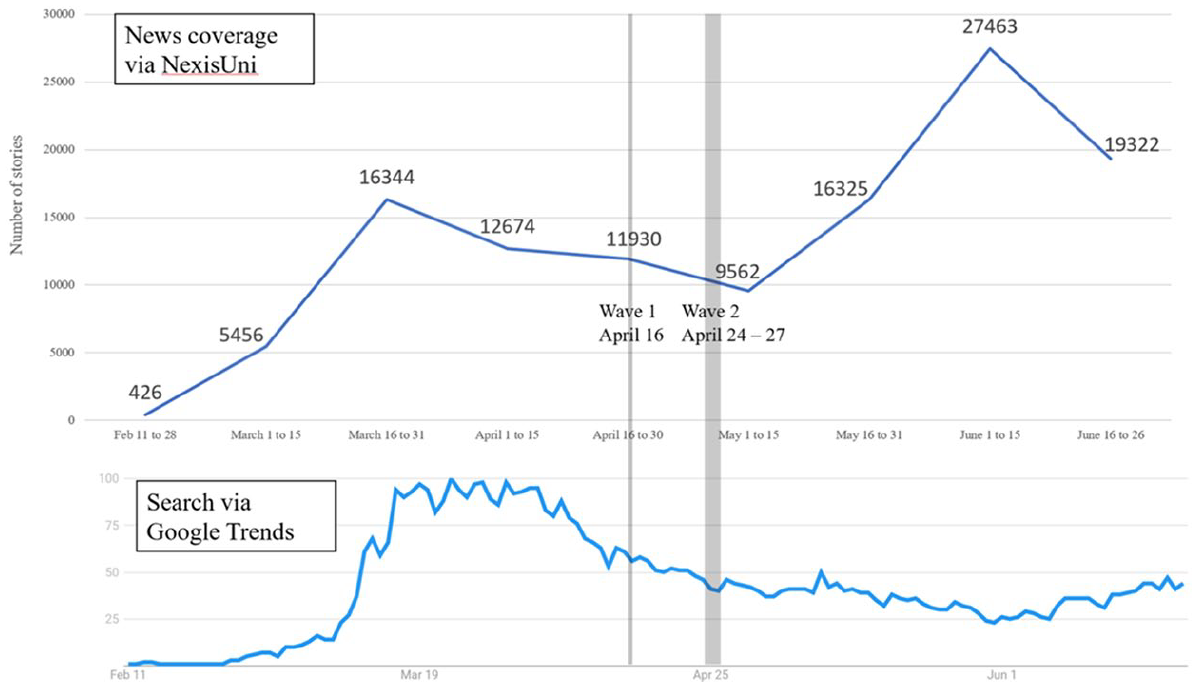
News coverage of and Google searches for COVID-19.
Our goal in the present study is to understand the psychological drivers of the information-seeking behaviors during COVID-19. This is imperative, as information seeking is an integral part of how individuals develop preventive behaviors (Griffin et al., 1999). The question of how individuals manage risk information to guide their decision making has been a primary focus for risk communication research (Yang et al., 2014). Although risk perceptions and uncertainty have been frequently discussed as important antecedents to information-seeking behaviors (Brashers, 2001; Griffin et al., 1999), their combined effects have been underexplored. The present research contributes to literature by theorizing uncertainty as a metacognition (Petty et al., 2007) of risk perceptions and empirically testing its effects through two-wave survey data that examined psychological responses and behaviors during COVID-19.
Conceptualizing Uncertainty as a Metacognition of Risk Perceptions
Risk perceptions and uncertainty are critical in understanding risk information seeking (Afifi & Weiner, 2004; Brashers, 2001; Griffin et al., 1999). Risk perceptions refer to the judgments individuals make to evaluate the characteristics and impact of potential risks (Slovic, 1987), which encompass a variety of dimensions, such as voluntariness of risk, risk immediacy, prior knowledge, availability of scientific information, controllability, newness, chronic catastrophe, common dread, and severity of consequences (Fischhoff et al., 1978). Slovic’s (1987) psychometric paradigm suggests that uncertainty is an important part of a risk experience and that risk perceptions underscore the mental strategies individuals employ to make sense of uncertainties experienced in a risk situation. The emphases on factors including the availability of personal knowledge and scientific information as well as risk newness imply that perceived unknowability or subjective uncertainty is included in the early conceptualization of risk perceptions. Later, research on risk perceptions in risk and health communication has moved away from subjective uncertainty and focused more narrowly on judgments of risk severity and susceptibility. Following the health belief model (Champion & Skinner, 2008) and threat-appeal research (Witte, 1992), perceived severity is defined as the judgment about how serious a risk is; perceived susceptibility is the belief about one’s chances of experiencing a risk. The two judgments together highlight how a potential risk is cognitively appraised (Yang et al., 2014).
Conceptualization of uncertainty has been less consistent in the literature. Decision research tends to define uncertainty as a psychological state related to a probability distribution (Faraji-Rad & Pham, 2017; Kahneman & Tversky, 1972). As a risk is typically a probability event that may or may not occur (Johnson & Slovic, 1995), considering uncertainty as subjective probabilities can be useful in understanding how individuals process probability information. Moreover, in the face of a novel pandemic health threat, risk information itself can be ambiguous and lack precision due to limited scientific knowledge and evidence. Therefore, research has sought to examine how such scientific uncertainty influences perceived probability of risk occurrence at the individual level (Han et al., 2018).
Powell et al. (2007) categorized this conceptualization of uncertainty as external uncertainty, which highlights how much individuals comprehend the uncertainty presented in expert information. By comparison, another line of research focuses on internal uncertainty—a psychological experience of inability to make accurate judgments. In the medical context, uncertainty arises when individuals are unable to interpret the meaning of illness-related events (Mishel, 1988). Experiencing uncertainty may not only be a result of exposure to probability information but also be due to insufficient information or information overload (Hines, 2001).
As a concept centering around information experience, it is no surprise that the impact of uncertainty on information seeking and avoidance has been an important aspect of uncertainty research. In early theorization, internal uncertainty has been conceived as an undesirable state that signals threats (Atkin, 1973). Information seeking is an important strategy for reducing uncertainty (Bradac, 2001). For example, Frewer et al. (2002) revealed a general preference of the public being informed about food risks. In the face of uncertainty, individuals believed it was most important for governments to make all relevant information accessible. The uncertainty management theory (UMT; Brashers, 2001) and uncertainty in illness theory (UIT; Mishel, 1991), however, suggest that uncertainty does not always increase information seeking. This depends on how uncertainty is emotionally appraised and whether information seeking/avoidance is congruent with the emotional state and individuals’ goal in it (Brashers et al., 2000; Lazarus, 1991). Uncertainty can sometimes be appraised as a positive state. For instance, uncertainty may bring hope to those who are waiting for diagnostic results. Consequently, individuals are probably more likely to maintain it than to reduce it (Barbour et al., 2012). Given the profound impact of internal uncertainty on information strategies, a close examination of this concept is valuable for understanding different motivations for and patterns of risk information management (Rains & Tukachinsky, 2015).
Moreover, uncertainty and risk perceptions are almost always intertwined in a risk experience (Brashers, 2001; Slovic, 1987). They both delineate how individuals make sense of a risk situation and predict coping behaviors. However, their combined effects are relatively underexplored. To our best knowledge, only a handful of empirical studies examined the two together thus far (e.g., Fung et al., 2018; Powell et al., 2007). It is perhaps due to the lack of a clear theorization of the relationship and distinction between risk perceptions and uncertainty. Janssen et al. (2018) considered uncertainty in terms of the “don’t know” responses to questions assessing risk perceptions. However, this implied an assumption that individuals do not experience uncertainty if they can indicate a risk judgment. A theorization is needed not only to clarify the conceptual difference between risk perceptions and uncertainty but also to allow for the possibility to study the two in conjunction.
A metacognitive perspective offers useful insights into this effort. Petty et al. (2007) suggested that individuals may hold two types of cognitions. Primary cognition involves initial beliefs that some objects have certain attributes (e.g., “Contracting COVID-19 has serious health consequences”). Individuals also generate second-level thoughts reflecting on their initial beliefs such as how confident they feel about them (e.g., “Am I really sure that contracting COVID-19 has serious health consequences?”). Metacognition refers to these secondary thoughts, which may involve beliefs regarding one’s own knowledge, validity, and desirability of the primary thoughts, and so on. Among them, the sense of epistemic certainty/uncertainty is a crucial element (Petty et al., 2007). Risk uncertainty highlights the metacognitive confidence in a risk experience. It is a self-reflection on how certain individuals feel about their risk judgments. It signals the opposite of conviction, perceived correctness, or firmness (Luttrell et al., 2016). Indeed, operationalization of uncertainty in prior research has implied such a conceptualization. For example, Fung et al. (2018) measured uncertainty by asking respondents to indicate their degree of uncertainty when they judged their risk susceptibility. Although considering uncertainty as a metacognition for risk perceptions is not entirely novel, explicitly stating this in its definition is valuable for theorizing its relationship with risk perceptions and examining how they together influence risk information seeking.
Risk Perceptions, Uncertainty, and Information Seeking
Guided by the heuristic-systematic model (Chaiken, 1980) and the theory of planned behavior (Ajzen, 1991), the model of risk information seeking and processing (RISP; Griffin et al., 1999) identified a range of variables that may determine how individuals deal with risk information, including demographics, political philosophy, subjective norms, channel beliefs, and perceived risk characteristics. Among them, risk judgments are central as they reflect direct cognitive responses to the situation and dictate affective responses and motivations for information seeking. A meta-analysis of RISP research (Yang et al., 2014) tested the predictive power of risk judgments as a function of perceived severity and susceptibility. Their findings demonstrated the substantial effects of risk perceptions on information seeking. Jones et al. (2007) also found that the estimated genetic risk of breast cancer was positively associated with media consumption and interpersonal discussion on related topics. In the context of infectious disease outbreaks, Oh et al. (2020) demonstrated that perceived personal risk of contracting Middle East respiratory syndrome was positively related to risk information consumption on social media and motivated preventive behaviors. Therefore, the following hypothesis was proposed:
Uncertainty also plays an important role in understanding risk information seeking. The accuracy and sufficiency propositions of the dual-processing models (Petty et al., 2007) underscore individuals’ innate tendency to attain a sufficiently confident conclusion and reduce experienced uncertainty by engaging in extensive information processing. However, as reviewed earlier, UMT and UIT suggest uncertainty may either drive or inhibit information seeking depending on how it is emotionally appraised (Brashers, 2001; Mishel, 1991). Information characteristics and various information strategies further complicate the picture. Carcioppolo et al. (2016) suggested that individuals may (a) avoid negative information to maintain uncertainty, (b) avoid insufficient or complex information to reduce uncertainty, or seek out information to either (c) reduce or (d) increase uncertainty. As most empirical research did not differentiate information types or strategies when measuring information seeking, these patterns have been reflected in the mixed findings (Kuang & Wilson, 2017). Risk communication research has thus shifted attention to desired levels of uncertainty (Rains & Tukachinsky, 2015) or the discrepancy between desired and actual uncertainty (Afifi & Weiner, 2004). As a recent meta-analysis has indicated that actual uncertainty is the most robust predictor of information seeking among the three (Kuang & Wilson, 2017), the current research focused on actual uncertainty.
Researchers have acknowledged the multilayered nature of uncertainty (Goodall & Reed, 2013; Hong, 2020). Brashers (2001) proposed that uncertainty may originate as individuals evaluate the severity or susceptibility of a potential risk. As this research proposes to study uncertainty as a metacognition of risk perceptions, it focused on two types of uncertainty individuals may experience as they assess the risk associated with COVID-19: uncertainty about risk severity and susceptibility (termed as severity uncertainty and susceptibility uncertainty, respectively). Given the theoretical accounts and mixed findings, we proposed nondirectional hypotheses regarding the relationships between uncertainty perceptions and information seeking. As reviewed earlier, the stand-alone effects of risk perceptions and uncertainty on information seeking have been well-documented in literature. Although the major interest of this study is in their combined effects, we proposed H1 and H2 to see if their stand-alone effects would replicate in the context of COVID-19.
Relationships Between Risk Perceptions, Uncertainty, and Emotional Appraisals
Research has suggested that both risk perceptions and uncertainty are substantially associated with emotional responses to a risk; furthermore, emotions mediate their respective effects on information seeking (Brashers, 2001; Griffin et al., 1999). As risk occurrence may cause negative consequences to individuals, negative emotions including fear, anxiety, and anger have been frequently examined (Fung et al., 2018; So, 2013; Taha et al., 2014). Scholars also suggested the importance of studying positive emotions, including hope, happiness, and relief (Rains & Tukachinsky, 2015; Yang & Kahlor, 2012).
Mishel (1991) and Brashers (2001) proposed two types of emotional appraisals as individuals assess the risk situation: Negative emotions such as anxiety and fear signal a danger appraisal that motivates information seeking or other coping behaviors, whereas positive emotions reflect a hope or opportunity appraisal that things are or will be under control. A hope appraisal may lead to less information seeking as individuals are satisfied with the current state; it may also trigger information seeking and other coping behaviors as individuals obtain confidence in their ability to manage the risk (Parrott et al., 2012). In UIT (Mishel, 1991), danger and hope appraisals are theorized as parallel processes. UMT advanced this and suggested that the two processes can coexist or shift from one to another over time (Brashers, 2001).
Uncertainty scholars have generally believed that uncertainty is a precursor of emotional appraisals and that uncertainty influences information seeking indirectly through emotional appraisals (Afifi & Weiner, 2004; Rains & Tukachinsky, 2015; Rauscher & Hesse, 2014). Yet recent RISP research proposed a different order. Although researchers acknowledged the uncertain nature of risks, uncertainty was not included in the original RISP (Griffin et al., 1999). Later, researchers incorporated uncertainty into an extended model (Fung et al., 2018; Powell et al., 2007). Informed by the feelings-as-information theory, Fung et al. (2018) argued that uncertainty could be elicited by processing emotional appraisals as risk information, instead of being an antecedent to it. This is probable as individuals may use their emotions as heuristics to guide cognitions and behaviors (Slovic et al., 2005).
The literature thus has revealed two different pictures (see Figure 2). The extended RISP proposed an order in which risk perceptions lead to emotional appraisals, which then trigger uncertainty and influence information seeking (Fung et al., 2018). UMT research has not formally considered risk perceptions, but it suggests that emotional appraisals should mediate the impact of uncertainty on information seeking (Brashers, 2001). Both predictions have received empirical support from cross-sectional data (e.g., Fung et al., 2018; Parrott et al., 2012). The current research tested which one of these orders better explain information-seeking behavior during COVID-19. Moreover, our metacognitive perspective suggests an extension of UMT’s prediction by considering the combined effects of risk perceptions and uncertainty on emotional appraisals. Thus, we asked the following research question:
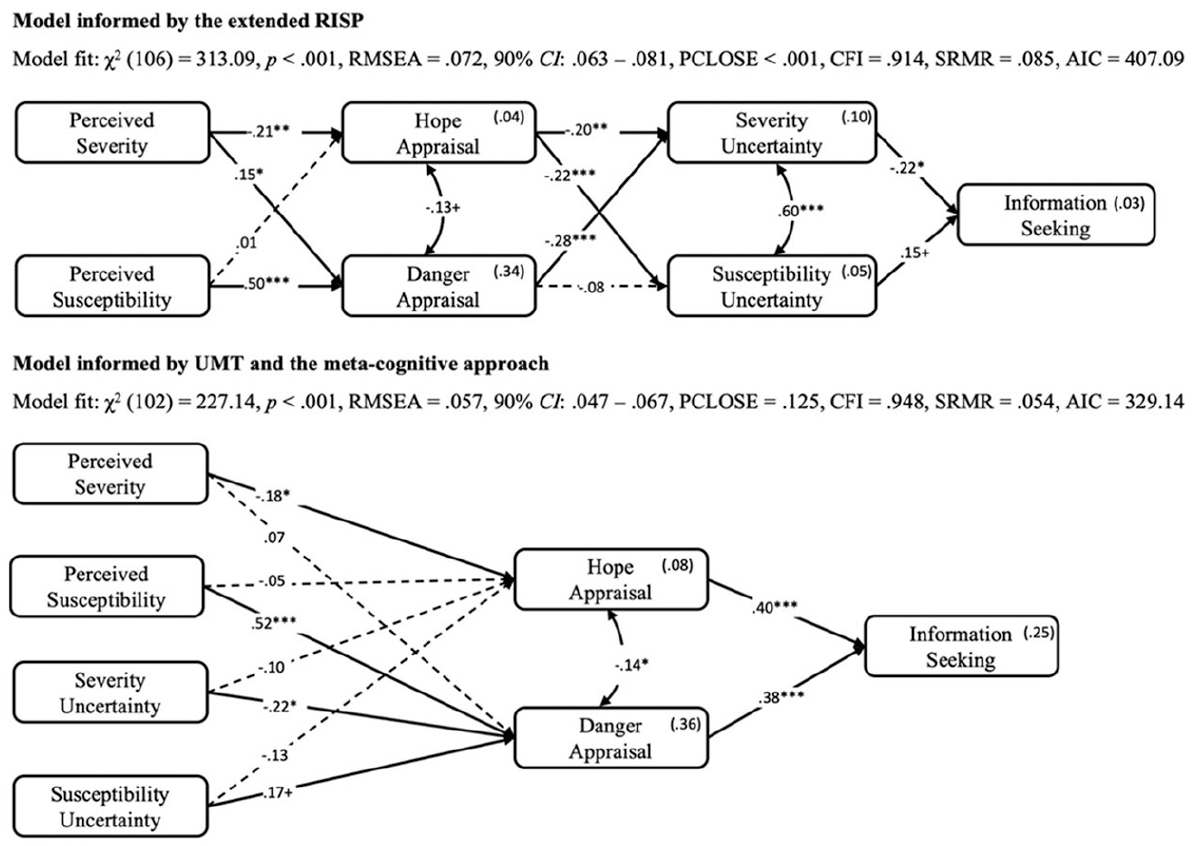
Results for model comparison.
Under the metacognitive conceptualization (Petty et al., 2007), uncertainty is likely generated immediately following or almost simultaneously with risk judgments, and constitutes an integral part of the cognitive assessment of the risk situation. Emotional appraisals are a result of this cognitive assessment and highlight the motivational tendency to deal with it (Brashers, 2001; Lazarus, 1991). This is consistent with the extant risk literature. Epstein (1994) suggests that individuals process information through two different systems: The analytic system that relies on logic reasoning and effortful assessment, and the experiential system that is more attentive to intuitive and automatic responses, such as emotions. The risk-as-feelings theory (Slovic et al., 2004) maintains that the experiential system is more influential in complex and uncertain scenarios. Affective reactions automatically following assessments of the stimuli are often relied upon as a heuristic, and subsequently guide information behaviors (Slovic et al., 2007). It is also the tenet of the original RISP (Griffin et al., 1999) that cognitive assessments of a risk are indirectly related to information seeking through emotional appraisals. Therefore, we proposed the following hypotheses:
It is also intriguing to explore if there is any interaction effect between uncertainty and risk perceptions. On the one hand, the two constructs may be highly intercorrelated. Brashers (2001) has discussed a curvilinear relationship between estimated probability and uncertainty about the estimation. For example, uncertainty about perceived susceptibility is highest when the estimated likelihood of risk occurrence is around 50% and lowest when the estimated likelihood is 0% or 100%. On the other hand, metacognition research suggests that primary cognition (e.g., risk judgments) and secondary thoughts (e.g., uncertainty) can be distinct (Petty et al., 2007). Making a risk judgment is essentially a process of indicating one’s belief or attitude toward the risk situation. This process is not necessarily a rational reflection on knowledge. The functional approach (Katz, 1960) suggests that individuals can also hold beliefs for the utilitarian function, ego defense, or value expression. Risk judgments may sometimes be extreme because they are in accordance with one’s value or can help defend one’s ego, rather than being held with confidence.
Metacognition research has long been interested in examining the interaction between primary and secondary cognition. Studies have shown that metacognitions may moderate the influence of primary beliefs on emotions, information processing, and behaviors (Cooke & Sheeran, 2004; Dwan & Miles, 2018; Luttrell et al., 2016; Tormala & Petty, 2004). Although metacognition of risk perceptions has rarely been studied in the health context, the metacognitive approach has been adopted in psychotherapy to guide individuals to reflect on their maladaptive responses and behaviors (Petty et al., 2007). To our best knowledge, there is no empirical evidence for the interaction effect between risk perceptions and uncertainty. But research does reveal an intertwined relationship between uncertainty, risk perceptions, and emotions (Calvo & Castillo, 2001). As the impact of both uncertainty and risk perceptions is connected to emotional appraisals (Brashers, 2001; Griffin et al., 1999), an interaction effect may exist on emotional appraisals, such that risk perceptions can condition how individuals react to uncertainty emotionally. Uncertainty may be appraised as a less desirable state when perceived severity or susceptibility is high than when perceived severity or susceptibility is low. It is unclear though how negative or positive uncertainty may be appraised under low risk perceptions. Therefore, we expect to find the following patterns: For those who indicate a high level of risk severity or susceptibility, the corresponding uncertainty will be negatively associated with hope appraisal and positively related to danger appraisal; for those who indicate a low level of risk severity or susceptibility, the associations between uncertainty and emotional appraisals may be weaker or in a different direction. Moreover, given the impact of emotional appraisals on information seeking (Griffin et al., 1999; Rains & Tukachinsky, 2015), we predict that emotional appraisals will mediate such interaction effect on information seeking.
Method
Participants and Procedures
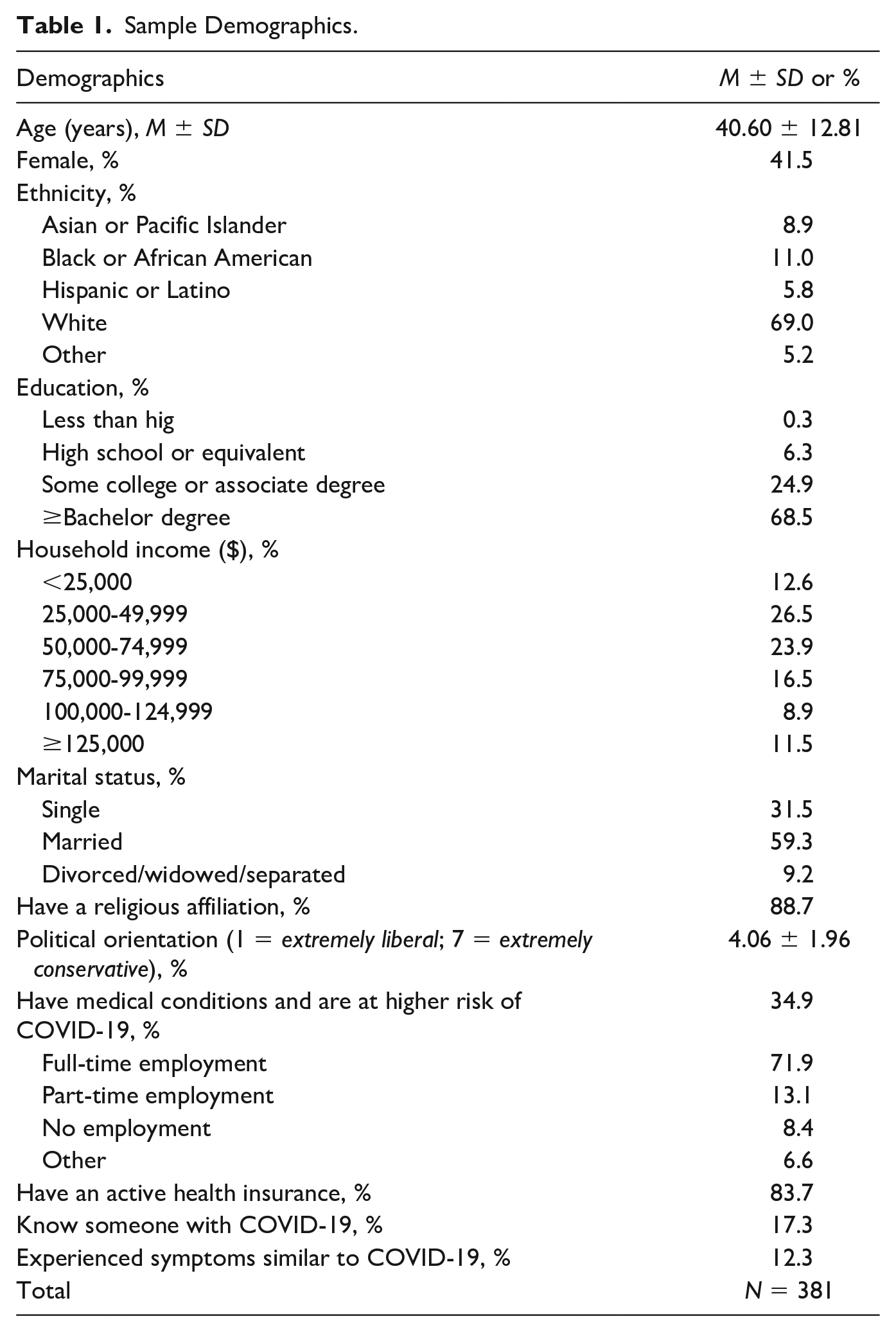
A two-wave survey was conducted via Amazon Mechanical Turk panel. Respondents who resided in the United States were invited, and they received $.80 as compensation for completing each wave of the survey. The study was approved by institutional review board at a Southern university. We collected data from 558 respondents on April 16. A week later, between April 24 and 27, 390 of the original respondents completed the second wave (retention rate: 70%). After removing those who failed the attention check questions (n = 9), the resulting sample (N = 381) consisted of 58% males with ages ranging from 19 to 73 years. Sample demographics are provided in Table 1.
Sample Demographics.
After the respondents indicated their consent, they were asked whether they had been diagnosed with COVID-19. Those who were infected or waiting for testing results were thanked and led to the end of the questionnaire. Qualified respondents then reported some basic demographics (e.g., age, sex, and race) and indicated whether they had family members or friends infected with the virus, followed by questions assessing their risk and uncertainty perceptions as well as emotions regarding COVID-19. Then, respondents reported their information-seeking behaviors. Last, other demographics were recorded. The second-wave questionnaire was almost identical except that the demographic questions were not included.
Statistical Power
For a two-tailed test at p < .05, the final sample (N = 381) provided power of .87, .99, and .99 for effect sizes of f2 = .02, .25, and .40, respectively. Therefore, the study possessed sufficient power to detect small effects.
Measures
All variables were scored on a 5-point Likert-type scale ranging from 1 (strongly disagree) to 5 (strongly Agree) unless specified otherwise. Descriptive statistics (i.e., M, SD, and Cronbach’s α) and zero-order correlations between variables are presented in Table 2. When investigating how risk perceptions/uncertain predict information seeking, prior research (e.g., Fung et al., 2018; Parrott et al., 2012) typically employed cross-sectional data. In our model testing, we used cognition and emotion measures (e.g., risk perceptions, uncertainty, and emotions) from Wave 1 data and a self-reported measure of information seeking from Wave 2 data. This approach allowed us to substantiate the temporal order between variables and better test the combined effects of risk perceptions and uncertainty on information-seeking behaviors.
Zero-Order Correlations Between Variables and Descriptive Statistics.
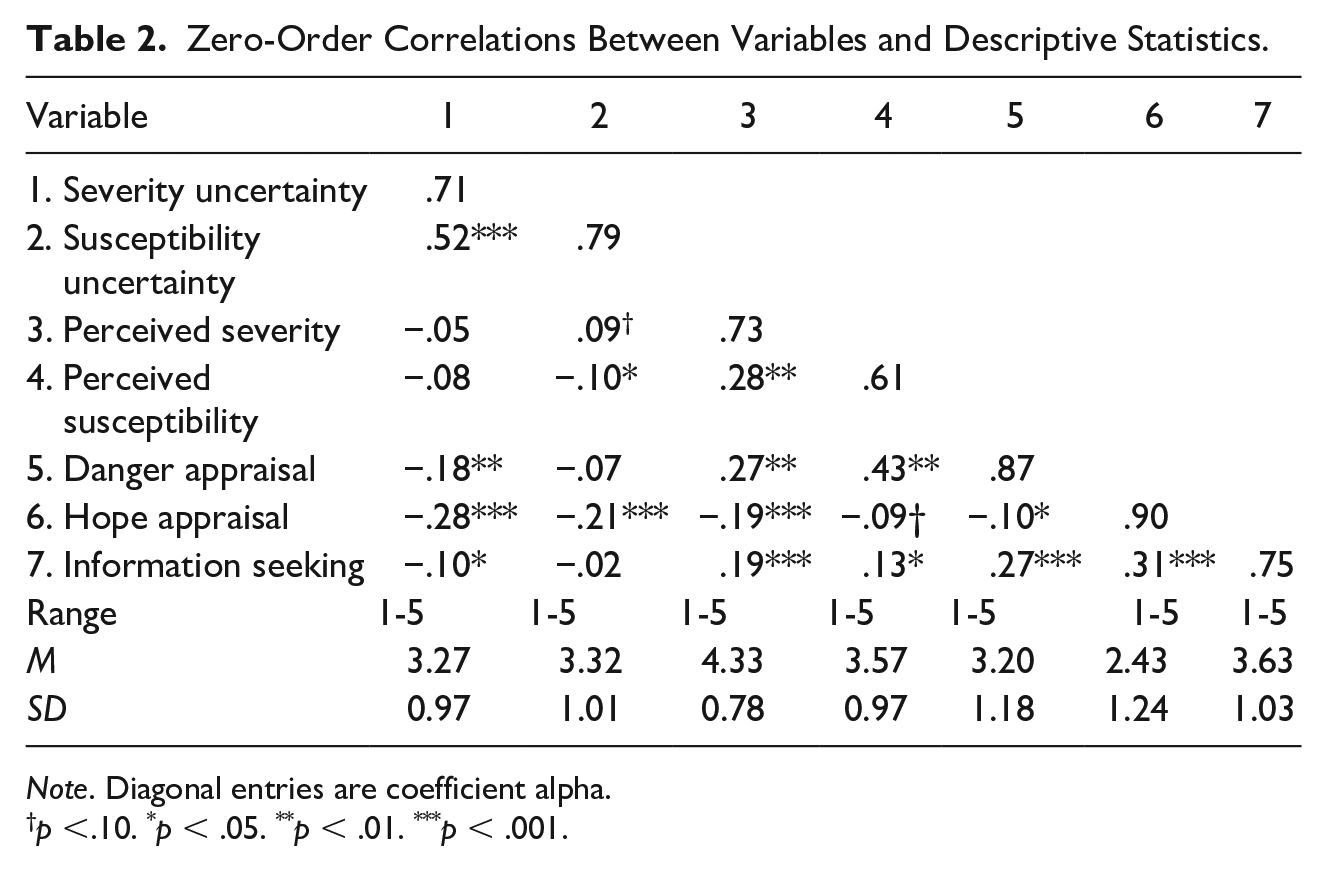
Note. Diagonal entries are coefficient alpha.
p <.10. *p < .05. **p < .01. ***p < .001.
Risk Perceptions
Measures of risk perceptions were informed by Yang and Kahlor (2012). Respondents indicated the extent to which they believe that COVID-19 infection has serious negative consequences and is dangerous. The average of the two items was used as the measure for perceived severity. They also reported their beliefs that they could face a coronavirus infection at some point and they will suffer from the impact of the coronavirus. Again, the average of these two items was calculated to reflect perceived susceptibility.
Uncertainty About Risk Perceptions
Informed by Fung et al. (2018), respondents reported how certain they were to judge the severity of the outbreak, the health consequences of coronavirus infections, their risk of contracting the virus, and their susceptibility to COVID-19 (1 = completely uncertain to 5 = completely certain). The former two items assessed severity uncertainty and the latter pair measured susceptibility uncertainty. The items were reverse coded and averaged such that greater values suggest higher levels of uncertainty.
Emotional Appraisals
This measure was adopted from Rains and Tukachinsky (2015), which was based on prior research (Folkman & Lazarus, 1985; Mishel & Sorenson, 1991). Respondents rated how they felt about COVID-19 with three items assessing danger appraisal: afraid, anxious, and worried, and another three items for hope appraisal: relieved, pleased, and confident, 1 = none of this feeling to 5 = a great deal of this feeling. Item values were summed and averaged to form the scales.
Information Seeking
Three items adapted from prior research (Dillard et al., 2020; Niederdeppe et al., 2007) evaluated the extent to which respondents actively sought out COVID-19 information through the internet, on the radio or television news media, or from other individuals in the prior week. Wave 2 data were used in the study to reflect the extent of information seeking occurred after respondents completed Wave 1 questionnaire.
Control Variables
Respondents provided their demographic information including age, sex, race, income, education, and religious belief. They also reported their employment and marital status as well as whether they had any underlying medical condition that might make them vulnerable to COVID-19. Political orientation was measured on a 7-point scale from 1 = extremely liberal to 7 = extremely conservative. Respondents also indicated whether they had family members or friends contracted COVID-19.
Results
Preliminary Analyses
Attrition Analyses
We compared the final sample (N = 381) with respondents who failed to complete Wave 2 survey (N = 168). No differences were detected between the two groups in terms of age, gender, ethnicity (White = 1, non-White = 0), political orientation, household income, and education. The two groups differed in status of insurance, employment, and marital status. The final sample had more people without insurance (84% vs. 76%), χ2(1, 549) = 4.34, p = .037; fewer members being single (32% vs. 40%), χ2(2, 549) = 6.12, p = .047; and fewer student respondents (0.5% vs. 4%), χ2(4, 549) = 14.28, p < .01.
Demographic Effects
Regression analyses were conducted to test the effects of demographic variables on risk information seeking. Results suggested that age, ethnicity, and education were significant predictors. In particular, elder respondents indicated less information seeking, β = −.13, p < .05. Greater levels of education were associated with greater information seeking, β = .19, p < .001. In addition, minorities indicated (M = 3.92, SD = 0.91) a greater amount of information seeking than White respondents (M = 3.52, SD = 1.06), β = −.11, p < .05. No other effect was significant.
Multicollinearity
No zero-order correlation between predictors was greater than .52. The highest variance inflation factor was 1.44, indicating no concerning multicollinearity issues.
Primary Analyses
Zero-order correlations (Table 2) supported H1a and H1b such that both perceived severity (β = .19, p < .001) and susceptibility (β = .13, p < .05) were positively associated with information seeking. Supporting H2a, there was a significant relationship between perceived uncertainty about risk severity and information seeking, β = −.10, p < .05. Respondents who had indicated greater severity uncertainty later reported less information seeking. Not supporting H2b, susceptibility uncertainty was not a significant predictor of information seeking, β = −.02, p > .05.
Structural equation modeling was conducted using AMOS 25 (Arbuckle, 2017) to compare the two proposed models. We created an input matrix of partial covariances that controlled for demographic variables. Based on the following guidelines recommended by Hu and Bentler (1999)—comparative fit index (CFI) > .95, standardized root mean square residual (SRMR) < .08, root mean square error of approximation (RMSEA) < .06—the measurement model manifested a good fit: χ2(98) = 206.28, p < .001, RMSEA = .054, 90% confidence interval [CI; .044, .064], PCLOSE = .255, CFI = .955, SRMR = .046. Standardized factor loadings were substantial: .62 ~ .87. Results for model comparison were presented in Figure 2. Correlations between exogenous variables were specified. In the model informed by extended RISP, hope and danger appraisals were correlated; so were severity uncertainty and susceptibility uncertainty. In the model informed by UMT and the metacognitive approach, hope and danger appraisals were correlated. Analyses revealed that the latter was a better fit: χ2(102) = 227.14, p < .001, RMSEA = .057, CI [.047, .067], PCLOSE = .125, CFI = .948, SRMR = .054, Akaike information criterion (AIC) = 329.14. Additionally, it explained more variance in information seeking (R2 = .25) than the former (R2 = .03). The fit statistics for the former did not meet the conventional cutoff criteria: χ2(106) = 313.09, p < .001, RMSEA = .072, CI [.063, .081], PCLOSE < .001, CFI = .914, SRMR = .085, AIC = 407.09.
In the model informed by UMT and the metacognitive approach, both hope (β = .40, p < .001) and danger appraisals (β = .38, p < .001) were positively associated with risk information seeking. Perceived severity was negatively associated with hope appraisal, β = −.18, p < .05. Perceived susceptibility (β = .52, p < .001) and susceptibility uncertainty (β = .17, p < .10) were positively related to danger appraisal. Severity uncertainty was negatively associated with danger appraisal, β = −.22, p < .05. Bootstrapping procedures using 5,000 bootstrap samples and 95% bias-corrected CIs were employed to test H3 to H6. Analyses revealed that perceived severity was related to information seeking indirectly through hope appraisal, Β = −.08, SE = .04, p = .05, but not through danger appraisal, Β = .03, SE = .04, p = .40; perceived susceptibility was related to information seeking indirectly through danger appraisal, Β = .22, SE = .06, p < .001, but not through hope appraisal, Β = −.02, SE = .04, p = .58; severity uncertainty was related to information seeking indirectly through danger appraisal, Β = −.06, SE = .03, p < .05, but not through hope appraisal, Β = −.03, SE = .03, p = .27; the indirect effect of susceptibility uncertainty on information seeking was marginally significant through danger appraisal, Β = .05, SE = .03, p < .10, but not significant through hope appraisal, Β = −.04, SE = .03, p = .18. Therefore, H3a, H4b, H5b, and H6b were supported; H3b, H4a, H5a, and H6a were not.
Hayes’s (2018) PROCESS Macro (Model 1) was employed to test the interaction effects between risk perceptions and uncertainty on emotional appraisals, while controlling for demographics. Analyses revealed that the interaction was a marginally significant predictor of hope appraisal, Β = .15, SE = .08, p < .10. Both simple slopes analyses and Johnson-Neyman (J-N) method were used to probe the interaction effect (Figure 3). When severity uncertainty was the focal predictor, there were no significance transition points within the observed range of perceived severity. When perceived severity was the focal predictor: J-N value = 3.61. Among respondents, 23.62% reported levels of severity uncertainty above 3.61, the point at which perceived severity became inconsequential in predicting hope appraisal. Overall, perceived severity negatively predicted hope appraisal only for those with low or medium levels of severity uncertainty.
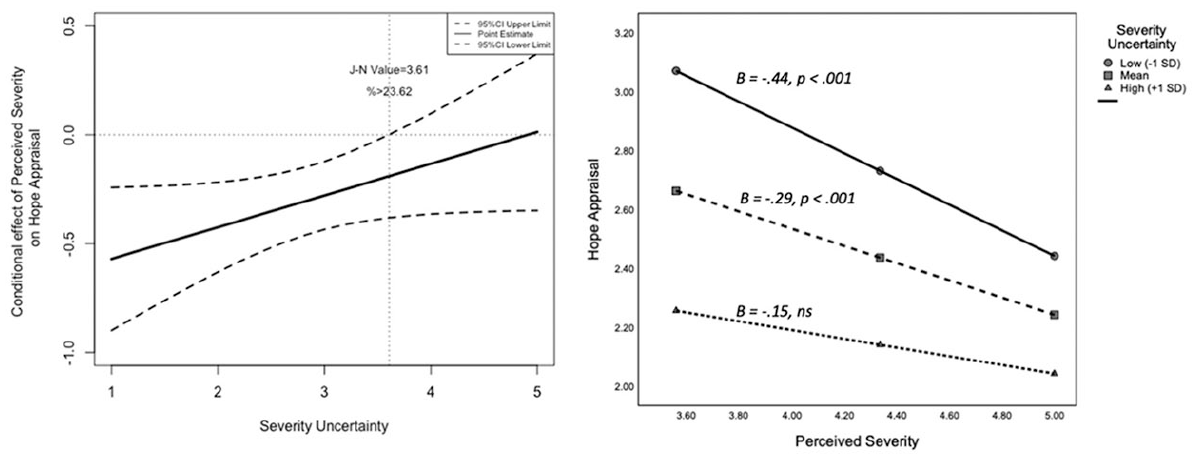
Conditional-effect and simple slopes analyses for severity × severity uncertainty on hope appraisal (perceived severity as the focal predictor, severity uncertainty as the moderator).
There was also a significant interaction effect between perceived susceptibility and susceptibility uncertainty on hope appraisal, Β = −.20, SE = .05, p < .001 (Figure 4). When susceptibility uncertainty was used as the focal predictor, there were two moderator values defining J-N regions: 10.24% respondents reported perceived susceptibility below 2.35, the region in which susceptibility uncertainty was positively related to hope appraisal; 49.08% respondents reported levels of perceived susceptibility above 3.79, the region in which susceptibility uncertainty was negatively related to hope appraisal. For those with levels of perceived susceptibility between 2.35 and 3.79, susceptibility uncertainty was inconsequential. In general, susceptibility uncertainty negatively predicted hope appraisal when perceived susceptibility was high but positively predicted hope appraisal when susceptibility was low.
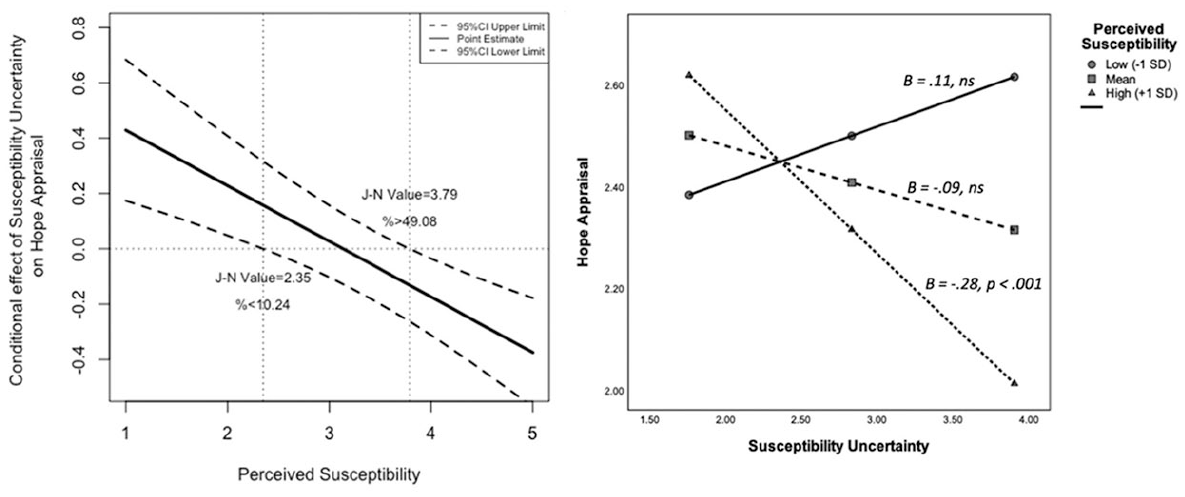
Conditional-effect and simple slopes analyses for susceptibility × susceptibility uncertainty on hope appraisal (susceptibility uncertainty as the focal predictor, perceived susceptibility as the moderator).
The interaction between severity and severity uncertainty on danger appraisal was nonsignificant, Β = −.01, SE = .04, p > .05; the interaction between susceptibility and susceptibility uncertainty was nonsignificant on danger appraisal either, Β = −.07, SE = .07, p > .05.
To answer Research Question 3, moderated mediation analyses were conducted using PROCESS Macro (Model 8) with 5,000 bootstrapped samples and 95% bias-adjusted CIs. As no interaction effect was found on danger appraisal, hope appraisal was entered as the mediator. Analyses revealed that hope appraisal mediated the interaction between susceptibility and susceptibility uncertainty on information seeking, Β = −.06, SE =. 02, 95% CI [−.093, −.024]. Specifically, susceptibility uncertainty predicted information seeking indirectly only when perceived susceptibility was high (+1 SD): Β = −.08, SE =. 03, CI [−.148, −.020]. When susceptibility was low (−1 SD): Β = .30, SE =. 02, CI [−.016, .075] or medium (M), B = −.02, SE = .02, CI [−.071, .016], the indirect effect was nonsignificant. In addition, hope appraisal was not a significant mediator for the interaction between severity and severity uncertainty, Β = .04, SE =. 03, CI [−.009, .094].
Discussion
Due to the inconsistent conceptualization and operationalization of uncertainty in literature (Kuang & Wilson, 2017), the questions of how it is conceptually different from and connected to risk perceptions have been rarely discussed. The present research contributes to literature by reconceptualizing uncertainty as a metacognition of risk perceptions (Petty et al., 2007). This provides conceptual and empirical distinctions between the two constructs. It also informs a theorization of their relationship and how they together predict information seeking.
Our research empirically tested their combinatory effects, and confirmed several basic assumptions of theories pertaining to risk information seeking including RISP (Griffin et al., 1999), UIT (Mishel, 1988), and UMT (Brashers, 2001). Findings revealed that both risk perceptions and uncertainty served as important predictors of information-seeking behaviors during the COVID-19 pandemic. Moreover, their effects were linked to emotional responses to the risk situation. Employing a two-wave survey design, our research provides empirical evidence that substantiates the temporal order between information-seeking behaviors and these psychological antecedents.
A novel insight of our metacognitive perspective is that it suggests an extension of UMT by incorporating risk perceptions into the picture. If uncertainty reflects the secondary thoughts about how confident individuals feel about their risk beliefs, combining uncertainty and risk perceptions would provide a more comprehensive account of how the risk situation is cognitively assessed. This extension can give rise to an improved power for predicting emotional appraisals and information-seeking behaviors. The extended RISP model (Fung et al., 2018) has suggested a different temporal order in which uncertainty is generated based on emotional responses to risk perceptions, instead of being metacognition elicited along with risk judgments. Structural equation modeling was used to compare the two different predictions. Supporting our approach, the better model fit occurred for the extended UMT model. Moreover, it explained much greater variances in information seeking (25% vs. 3%). Because our study examined psychological reactions to the risk associated with COVID-19 and the following information-seeking behaviors reported a week later, the extended UMT model may offer a more generalizable description of the process individuals undergo amid public health crises.
Further supporting our theorization, findings revealed an interaction effect between risk perceptions and uncertainty on hope appraisal, and that such an effect may be carried over to information seeking. This is in accordance with prior research demonstrating the interaction between metacognition and primary beliefs (Cooke & Sheeran, 2004). Our research indicated that susceptibility uncertainty was negatively related to positive affect when compounded with a greater estimation of risk occurrence but positively predicted positive affect when the estimated risk occurrence was low. This moderation was exploratory in nature and warrants further investigations. It corresponds to Brashers’s (2001) suggestion that interpretations of uncertainty in the illness context are conditional. Susceptibility may highlight one of the boundary conditions. This effect is also compatible with the idea of negativity bias such that our aversive system seems to be more active in the presence of negative stimuli than the appetitive system (Cacioppo & Berntson, 1994).
Similarly, there was an interaction effect between severity uncertainty and perceived severity, yet the patterns are different. Perceived severity negatively predicted hope appraisal only among individuals who perceived low or medium levels of severity uncertainty. For those with high severity uncertainty, the association did not exist. We speculate that high uncertainty might be taken as a nonconfirmation of severity; thus the boomerang effect of severity on positive affect disappeared. An associated question is why high levels of susceptibility uncertainty and severity uncertainty could be processed differently. The former would be additive to the negative effect of high perceived susceptibility on positive affect, whereas the latter might be treated as just a nonconfirmation of risk. Prior research offers a possible explanation by suggesting the optimistic biases that exist as individuals estimate their personal risks (Weinstein, 1989). With such biases, there is likely a tendency to process risk-related uncertainty in a positive light. Susceptibility judgments may be an indication of optimistic biases. The biases would be stronger among those with low perceived susceptibility but weaker among those with high perceived susceptibility. Thus, we found that susceptibility uncertainty was appraised more negatively for those with greater susceptibility judgments, and this trend was not found under other conditions. This explanation raises a question of whether optimistic biases can serve as a qualifier for the interpretations of uncertainty. Future investigations may consider empirically testing this idea.
Notably, these interaction effects were not observed on danger appraisal. The extended UMT model suggests that danger appraisal hinged more on the main effects of perceived susceptibility, severity uncertainty, and susceptibility uncertainty. The unexpected pattern is that perceived severity did not predict danger appraisal, although it was negatively associated with hope appraisal. These findings open up questions about the scope of severity and susceptibility judgments in public health crises. In the original conceptualization (Witte, 1992), severity and susceptibility highlight different aspects of perceptions of the same risk. But in an infectious disease outbreak like COVID-19, these two judgments may be made and processed at different levels. Severity may be indicative of a general risk estimation, whereas susceptibility is a judgment of personal-level risk (Sjöberg, 2003). As severity is not necessarily geared toward oneself, it may negatively predict positive affect but the effect may not be relevant or strong enough to induce negative emotions such as anxiety and fear. This also explains why we found a strong and positive association between danger appraisal and perceived susceptibility. Future research may test if the varying associations of severity and susceptibility with emotional appraisals can replicate in the context of a different public health crisis and explore how the effects of these two judgments are distinct in other aspects.
The current research also provides some food for thought for risk and health communication practitioners. Given the adaptive nature of hope (e.g., Parrott et al., 2012) and the negative conditional effect of susceptibility uncertainty on hope, efforts to reduce uncertainty for those who perceive high levels of susceptibility may enhance the effectiveness of preventive health campaigns. Our data suggest that such efforts can also in turn encourage risk information seeking, which would be important for the development of preventive behaviors. Furthermore, the nuanced picture that our data depict reveals the critical role that uncertainty plays in risk communication and health prevention. It is important for practitioners to focus on its antecedents and boundary conditions in order to achieve better outcomes.
Although this research represents a step forward in the understanding of risk perceptions, uncertainty, and information seeking during infectious disease outbreaks, we acknowledge a few limitations. An obvious limitation of our data lies in the nature of the sample. Opt-in MTurk sample is not random. There are discrepancies between our sample and the population in several demographic characteristics (e.g., gender and ethnicity). This would not weaken our tests on the relationships among key variables, but any estimates of the population means of those variables would suffer from this shortcoming. Another notable limitation concerns the complexity of emotional appraisals. Our study understood affective responses primarily as the tendencies to self-protection from virus infection. However, COVID-19 not only poses a great threat to individual health but also possesses an unprecedented destructive power on economy and society in general. It is unclear the extent to which our measures captured those appraisals on non-health related consequences. This is a tradeoff when taking the advantage of researching a real-world health crisis. An experiment with more control on the topic and more focused emotional reactions would further advance this research endeavor. Relatedly, we adapted measures from prior studies for risk perceptions and uncertainty to capture psychological responses to COVID-19 beyond its threats to individual health. For example, to assess perceived susceptibility, we included a broader item, “I will suffer from the impact of coronavirus,” in addition to an item focusing on health, “I could face a coronavirus infection at some point.” As these measures were not developed for a pandemic context and the adapted items did not go through a rigorous process of scale development, some measures did not show strong reliability. We used structural equation modeling to account for measurement errors in model testing. But other analyses might be prone to their influence. In addition, we did not examine the role of other types of uncertainty in risk perceptions and disease prevention. For instance, the threat appeal literature suggests that response efficacy and self-efficacy are critical for cultivating desirable reactions to health threats (Witte, 1992). Future investigations may explore how uncertainty about those assessments affects downstream appraisals and coping behaviors.
In conclusion, our research proposed a metacognitive conceptualization of uncertainty and attempted to provide an ecologically valid examination of how uncertainty, risk perceptions, and emotions function together to predict risk information-seeking behaviors. Our findings demonstrate that these constructs are multifaceted and their relationships are nuanced. We hope that this research will encourage further investigations on the boundary conditions of these constructs and that those efforts can inform more effective risk and health communication practices.
Footnotes
Declaration of Conflicting Interests
The author(s) declared no potential conflicts of interest with respect to the research, authorship, and/or publication of this article.
Funding
The author(s) received no financial support for the research, authorship, and/or publication of this article.
