




Abstract
Preparation before the school year begins is essential for new teachers working with students who have significant behavior support needs. District and school administration can help new teachers increase their likelihood of success with purposeful planning that both connects to classwide systems and supports students’ positive and effective behaviors. Prior to the school year beginning, administration can support new teachers by providing professional development opportunities that focus on using (a) culturally inclusive pedagogies and practices, (b) strategies that promote positive student/teacher relationships, and (c) tools that communicate expectations to students clearly.
Hillside Hills School District administrators have hired three new special educators to work with students at the high school. Recognizing that the educators are new to the profession and may need support implementing their special education intervention and supports, Ms. Padilla, the district’s special education coordinator, proactively commits to providing comprehensive professional development to her new teachers that is focused on classroom and behavior management. Ms. Padilla collaborates with Dr. Blackwood, the superintendent, to design a targeted training program for new educators to take place before the school year starts.
Beginning a teaching career is an exciting time. For educators working with students with and at risk for emotional and behavioral disorders (EBD), thorough preparation before school starts is crucial. As students with EBD experience high rates of academic and social challenges and are more likely to be suspended, drop out of school, and have negative encounters with the juvenile justice system, it is imperative that educators provide effective student support to increase the likelihood of improved student outcomes (Camacho & Krezmien, 2019; Lloyd et al., 2019; Mitchell et al., 2019). Supports to teachers are important as well. Teachers working with students with and at risk for EBD have a high probability of job burnout and stress (Bettini et al., 2020; Brunsting et al., 2022).
Evidence-based practices (EBPs) that support students with EBD are crucial to effective instruction and improving student and teacher outcomes (Riden et al., 2022; Wilkinson et al., 2020). Unfortunately, many teachers do not receive adequate support or training to implement effective behavior management practices (Flower et al., 2017; Samudre et al., 2022). These preparation gaps emphasize the need for building-level structures such as induction, targeted professional development, and mentoring that further support novice teachers as they implement EBPs (Kirkpatrick et al., 2021; Pomerance & Walsh, 2020).
New Teacher Preparation and Preparedness
Effective behavior management is considered a fundamental need for teachers, as it improves teacher self-efficacy, particularly for those supporting students with EBD (Berger et al., 2018; Shank & Santiague, 2022). According to the National Council on Teacher Quality’s 2020 Teacher Prep Review (Pomerance & Walsh, 2020), teacher preparation programs should ensure candidates practice five research-backed classroom management strategies during clinical practice: establishing rules and routines; maximizing learning time (managing time, materials, physical setup, and promoting engagement); reinforcing positive behavior using specific, meaningful praise; redirecting off-task behavior through unobtrusive means; and addressing serious misbehavior with consistent, respectful, and appropriate consequences.
While all teachers need the skills to implement broad classroom management strategies, students with EBD require highly trained and effective teachers to implement specialized instructional and behavioral strategies (Cooper, 2019; Cooper et al., 2018; Riden et al., 2022). Unfortunately, many teachers are not adequately trained to implement these specialized practices (Kirkpatrick et al., 2021; Samudre et al., 2022; Wilkinson et al., 2020). This is concerning as teachers are the primary change agents in the classroom and can have significant influence over students’ academic and social outcomes (Cooper, 2019; Riden et al., 2022). Although educator preparation programs typically include generic classroom management strategies and emphasize understanding learner differences across backgrounds (Gay, 2018), teachers serving students with EBD frequently report low self-efficacy in implementing classroom management in the face of challenging behaviors (Garwood, 2023; Garwood et al., 2018; Moore et al., 2017).
Nationally, programs emphasizing all or nearly all of these strategies during clinical practice have increased by about a quarter since earlier Teacher Prep Review editions, but gaps remain especially around systematic use of praise (Pomerance & Walsh, 2020). As such, teachers must receive high-quality training and support to implement effective interventions in their classrooms to support their students with EBD.
The Role of Professional Organizations in Teacher Development
One often-overlooked avenue for support teachers is participation in professional organizations, such as the Division for Emotional and Behavioral Health of the Council for Exceptional Children (CEC). Organizations such as CEC provide access to resources, networking opportunities, and professional journals like TEACHING Exceptional Children and Beyond Behavior, which offer descriptions of research- or evidence-based strategies for academic and behavioral interventions that can be implemented with students with or at risk for EBD across educational settings. Engaging with these resources increases the likelihood that novice teachers stay informed about current best practices and continuously refine their skills to meet the needs of students with EBD. These organizations may also help provide teachers with some of the high-quality training that they need to support their students.
Collaborative Administrative Support for New Teachers Serving Students with EBD
To reiterate, there are multiple vested interests for school districts in supporting novice teachers as they are at the beginning of their careers. First, the need to prevent teacher burnout has been a long-standing, persistent problem and is exacerbated by the nationwide teacher shortages and the high probability of teachers who support students with EBD leaving the field (Billingsley & Bettini, 2019; Garwood, 2023). This is concerning as high teacher turnover results in significant academic and financial costs to student achievement and district budgets (Billingsley & Bettini, 2019; Carver-Thomas & Darling-Hammond, 2019). Second, evidence indicates that students who are taught by highly qualified teachers tend to have improved short- and long-term academic success (Greathouse et al., 2019; Riden et al., 2022). In contrast, students not taught by high-quality teachers do not experience the same success (Billingsley & Bettini, 2019). These factors highlight the importance of investing in support for novice teachers, enhancing the skills they may not receive during preparation, and helping them in the classroom.
While professional organizations are helpful avenues for supporting teachers, administrators are well-positioned to be a first line of defense for the educators they oversee because administrators know the students and school environment and have daily contact with their teachers (Bettini et al., 2020). Therefore, a collaborative approach in supporting novice teachers should be considered from an administrative perspective. Despite the importance of the administrator’s role in supporting teachers supporting students with EBD, many administrators report receiving little to no training in special education services or classroom management (Rodl et al., 2018). Therefore, it is crucial for administrators to participate in special education and behavior management training to have the necessary skills to support their teachers. In addition, principals can collaborate with other principals in their district, especially if they have different areas of expertise. For example, if one principal is experienced in math and reading instruction and another in special education, the two can work together to provide strategies to improve their skills to support their collective sets of teachers.
From a needs perspective, school district administrators should consider the goals of supporting new teachers both holistically and individually, according to the National Center to Inform Policy and Practice in Special Education Professional Development (Pugach et al., 2009). Broader school district goals for new teachers can include improving effective instructional practice in behavioral and academic support and pedagogy, promoting collaboration with colleagues and parents, and increasing accurate data management of student progress and special education processes.
In addition to the goals, district administrators should work collaboratively with teachers in determining the effective use of resources for professional development in the areas of (a) culturally inclusive pedagogies and practices (CIPP), (b) behavioral interventions, (c) mentorship, and (d) school/classroom climate. This is critical for new teachers as they may not be aware of what is available to them or what areas they need the most support in developing. District administration can be a valuable resource in support of teacher development that is more constructive than destructive. In the remainder of the article, we discuss what skills administrators need to effectively support teachers who work with students with EBD in these four critical areas.
Implementing Culturally Inclusive Pedagogies and Practices
As students of color are more likely to be identified as EBD (Sullivan, 2017), it is especially important that teachers supporting students with EBD are trained to implement CIPP. Taylor and Harkins Monaco (2024) define CIPP as theories and practices focused on sociocultural understanding within the educational space. This includes all individuals and resources and how interactions influence behaviors and outcomes. It is also important that teachers become aware of their own biases (Sullivan, 2017). Administrators can increase the likelihood that all teachers within the school receive training in CIPP. They might even consider that all teachers participate in assessments designed to evaluate an individual’s cultural competence (e.g., Intercultural Development Inventory, https://www.idiinventory.com/). Blazar (2021) reported that students whose teachers use CIPP experienced improvements in their social-emotional, academic, and behavior outcomes. We believe that teachers may feel more supported and their students more successful when an administrator provides opportunities for them to further their growth and knowledge in CIPP.
Providing Resources and Training for Behavioral Interventions
There are other avenues that administrators can support teachers in supporting students with EBD. These areas revolve around providing coaching, mentoring, and a supportive climate. First, they can find appropriate training and high-quality coaching for teachers. Cancio et al. (2013) recommend that administrators listen closely to their teachers’ concerns and find training and mentoring opportunities to address the teachers’ particular needs. Special education teachers have expressed that one of their top needs is access to high-quality, relevant training (Bettini et al., 2020). Therefore, administrators can search for and fund appropriate training and professional development opportunities so teachers can be trained to implement effective practices.
In addition to finding training opportunities, administrators can help teachers build support networks with each other by providing opportunities to collaborate and guidance on how to work together effectively (e.g., modeling effective collaboration skills). For example, administrators can schedule times for grade level and special education teachers to work together to address the needs of their shared students. To reduce the load on teachers, administrators could remove some staff meetings to allow time for teachers to collaborate with each other. Teachers supporting students with EBD frequently feel isolated from their colleagues, leading to stress, burnout, and work dissatisfaction (Bettini et al., 2020). Potentially, if the administrator had a structure for ensuring that all teachers within the school were working together, this may lessen the feeling of isolation and improve teacher retention rates (Soares et al., 2022).
Furthermore, administrators can match novice teachers with mentors who can guide and support them during their first few years of teaching (Cancio et al., 2013). For special educators, that can mean multiple mentors given the multiple grades, content, and settings with which they may engage (Farley et al., 2012; State et al., 2019). For example, one mentor may help the novice teacher navigate the school environment while another mentor may provide applied training in behavior management or working with students with EBD. Regardless of the type or focus, mentors can reduce the feeling of isolation while simultaneously providing high-quality coaching to improve the success of the teacher (Cancio et al., 2013).
Third, beyond material support, administrators can play a crucial role in creating an environment where teachers feel valued and supported. Special education teachers frequently have more paperwork and work demands than general education teachers (Bettini et al., 2020). Administrators can find ways to offer special education teachers time during the school day to write individualized education programs and behavior support plans. For example, an administrator may hire a substitute teacher to cover the special education teacher’s classes for half or whole days to allow time to complete paperwork.
Not only is the paperwork demanding, but also teachers need time and support to hold meetings with parents or guardians/caregivers. Sometimes, it can be a challenge to collaborate with parents. In these cases, administrators can support novice teachers by navigating the demands of parents (Martinez & McAbee, 2020). Providing teachers who support students with EBD with ample time and support to manage paperwork and parent meetings may improve retention rates and reduce burnout and stress (Bettini et al., 2019; Martinez & McAbee, 2020).
Another way that administrators can support teachers is by creating structures that allow them to be observed, receive constructive feedback, set goals, and receive guidance and support to reach those goals (Cancio et al., 2014). Evidence suggests that teachers appreciate when an administrator observes them and provides them with constructive feedback that helps them improve their instructional techniques (Cancio et al., 2014). Administrators can use this feedback to help teachers set goals and track their progress and professional growth. In addition, administrators can identify areas where the teacher may need support and help find the appropriate resources. Administrators can also support teachers by allowing them to observe other teachers within the building. This allows a novice teacher who may be struggling with a specific practice to learn effective strategies from their colleagues. To reduce costs, the administrator could cover for the teacher, allowing them to observe another classroom for a short period.
Finally, administrators can support novice teachers by positively acknowledging them (Cancio et al., 2013). Some examples may be a shout-out during a staff meeting, a note in their mailbox or an email, providing teachers with lunch one day, or allowing them to leave immediately after students on a Friday afternoon. Administrators can recommend teachers for recognition within the school district when a teacher meets the criteria.
For her new cohort of educators, special education supervisor Ms. Padilla creates a survey and compiles a list of responses from the new educators regarding areas of growth that they self-identify. Ms. Padilla charts a path to create professional development in EBPs for promoting positive behavior that fosters a culture of inclusion in the classroom.
Administrative Support Strategies for Teachers in Behavior Support Classrooms
Similar recommendations can be offered administrators of novice teachers who serve students with EBD in self-contained behavior support classrooms. New teachers can benefit from systematic approaches that help support them in their first year of teaching. Administration plays a vital role in providing professional development to increase the likelihood of classroom and student success. Farmer et al. (2014; this special series issue) theoretically framed classroom and behavior management as behavioral, ecological, and social interactional perspectives that must be considered simultaneously to provide the best support to students.
Administrators can help teachers find ways to understand this comprehensive framing early in a teaching career which can make a significant difference in supporting individuals new to teaching careers. Prior to the school year beginning, administration should support new teachers by providing professional development opportunities that focus on using (a) CIPP, (b) strategies that promote positive student/teacher relationships, and (c) tools that communicate expectations to students clearly.
Use Culturally Inclusive Pedagogies and Practices
As the school is culturally diverse, special education teacher Mr. Masters expresses interest in learning more about using CIPP—essential components of creating an equitable learning environment. Mr. Masters admits he has not had much exposure to this framework in his undergraduate education.
In special education, culturally responsive teaching is crucial as students’ backgrounds may influence interactions with families, responses to learning, and a student’s behaviors. Explicit training on culturally responsive special education practices as outlined by Gloria Ladson-Billings (1995) and Geneva Gay (2018) are foundational and addresses academics, and a student’s cultural identity and sociopolitical understanding. Applying these principles in practical ways and collaborating with veteran colleagues can further enhance his understanding of culturally responsive special education. Administrators can provide new teachers with professional development that highlights CIPP that are especially pertinent to the school and school district. Based on the foundational research on culturally relevant (Ladson-Billings, 1995), responsive (Gay, 2018), and sustaining (Paris & Alim, 2017) practices, CIPP focuses on the teaching behaviors that validate students and their learning.
School districts can support new teachers’ use of CIPP through initial and continued professional development that reinforces targeted teaching behaviors. Figure 1 provides a visual for how to teach and include students in the process. Practices that can be considered for new teachers include: (a) focusing on student learning that acknowledges various ways of communication that are culturally relevant and responsive (e.g., knowing social cues and mores that are germane to those from a variety of cultural backgrounds); (b) having high expectations for all students by understanding the assets and strengths of all students based on their individual intersectional identities; and (c) developing curriculum and practices that are rooted in the communities represented in the classroom.
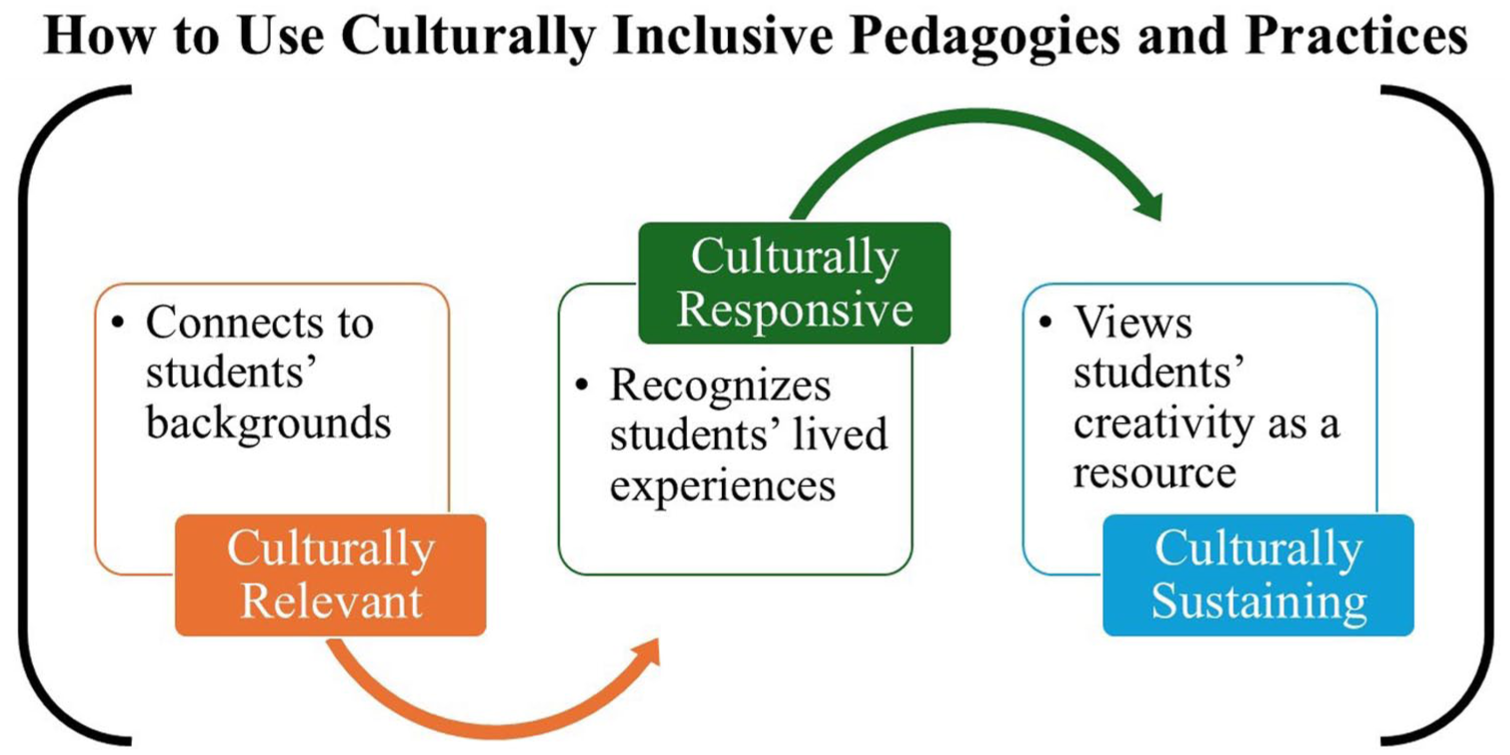
District and School Administration Support for Culturally Inclusive Pedagogies and Practices.
Develop Teacher–Student Relationships
Ms. Baumgartner identifies building relationships with her students as an area on which she would like to focus. She understands that she may face unique challenges working with students with EBD, as her students may struggle with social interactions, emotional regulation, and academic engagement. Ms. Baumgartner believes that with training on proactive classroom management strategies, she can create a more structured yet welcoming space that promotes positive behavior. She also aims to communicate with empathy, increasing the likelihood that she validates students’ feelings and builds trust. With these skills Ms. Baumgartner believes she will foster stronger relationships with her students and empower them to learn.
For students who display persistent challenging behaviors, researchers (e.g., Hunter et al., 2023; Taylor, 2016) have established that developing appropriate and meaningful student/teacher relationships is essential in guiding students in positive ways. Therefore, providing professional development to new teachers that emphasizes the practices that can support creating positive teacher/student relationships is essential for school and district administration (Hunter et al., 2023). They further emphasize that school district administrators should provide training and development to teachers through an onboarding method that includes helping teachers acquire the skills for creating positive teacher/student interactions. Taylor (2016) identified seven instructional traits of classrooms that encourage positive teacher/student relationships. They include:
Shared ownership. Create buy-in with the students as a shared classroom experience (e.g., use language that is used in the classroom; use “we” for as many activities and assignments as possible).
Clarity. Be as explicit and direct as possible with instructions and directions (e.g., use behavior-specific praise; “good job completing your math assignment on time”).
Purpose. Explain the “what” we are doing and the “why” we are doing it (e.g., use explanations that give goals and limit ambiguity; “we are doing reading first because after physical education you all are usually too excited”).
Honesty and fairness. Be consistent and conscientious with all students equally (e.g., use positive and negative consequences to match your stated expectations; “we can have additional computer time, or we can have additional work time, but that depends on each of you completing your assignment”).
Mutual respect. Acknowledge each student (and their opinion) respectfully and state the same expectation in return (e.g., use respectful language, even when frustrated; “we don’t use that language in here”).
Mentor for independent trust. Connect choices to positive and negative consequences (e.g., use language that reflects connection to behavioral choices; “we are not going outside because we didn’t finish the assignment, but if you work hard on it for the next 10 minutes, we can get out there”).
Collaboration and support. Attempt to have a positive praise ratio for each student (e.g., use affirmations and positive statements as often as possible; “we did fantastic today on getting ourselves ready to work”).
School and district administration can support new teachers in emphasizing that professional development includes reinforcing instructional classroom traits that promote the student and teacher dynamic in positive ways. In addition, assessing the development of new teachers’ abilities to create student/teacher relationships should be done via individual self-reflection of the relationship-building tenets combined with administrator observation (direct and indirect), with supportive feedback being critical within the teacher–administrator interaction.
Communicate High Expectations
Ms. Downing shares concerns about clearly communicating expectations to students. She understands that vagueness in directions or tasks can easily confuse her students, leading to frustration and decreased engagement, but she is unsure how to frame her instructions and requests. She agrees to receive training that includes an emphasis on consistency in language and routines and how classroom structure (e.g., visual supports and explicit instruction) can support her in increasing student understanding of communication. By learning to adapt her teaching, Ms. Downing believes that she can increase her ability to effectively and clearly communicate expectations and directions to her students.
The expectations that teachers express to students can have a definite impact on how students perform. Researchers have noted that teachers of students with challenging behaviors have often conveyed low expectations academically, socially, and behaviorally (Lane et al., 2012). In addition to students with challenging behaviors, low expectations from teachers can negatively influence students with varying intersectional identities (e.g., socioeconomic status, Gentrup et al., 2020; racial/ethnic differences, Santiago-Rosario et al., 2021). Administrators can influence and encourage new teachers to have high expectations of all students by modeling those same expectations. Ideally, school administrators can display leadership behaviors that convey high expectations of all students in all areas of their school experiences as well as high expectations of the professionals they lead.
Expectations can be established through the communication networks and language that administrators use. School and district administrators can convey to new teachers the importance of emphasizing work/life balance. That is, novice teachers can experience burnout and be overwhelmed with the amount of paperwork especially in their early years in the profession (Deger et al., 2024). Administrators can share strategic goals (aside from the goals for each student and for classroom climate) and explain the strategic goals of the school and district with detailed markers of what constitutes success. Administrators can also celebrate success. That is, new teachers need positive feedback, reinforcement, and encouragement that recognizes when things are going well, no matter how small the progress is. The language that administrators use when communicating with novice teachers can be supportive or have a demoralizing effect on performance. In addition, by demonstrating high expectations of teachers through their actions, administrators can be models for how new teachers should interact with students and communicate high expectations in the classroom.
Conclusion
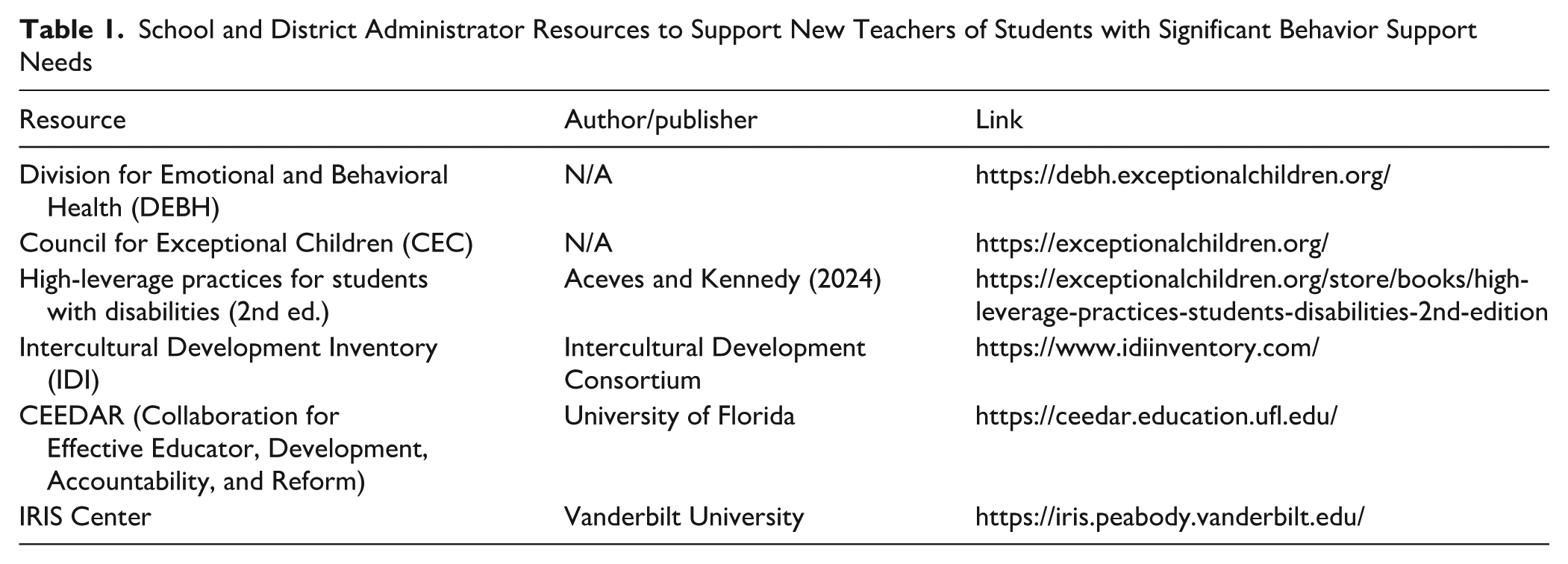
District and school administrators are well-positioned to improve the school environment and help novice teachers with classroom and behavior management and professional success (Bettini et al., 2020; Gilmour et al., 2022). Table 1 includes a list of resources that administrators can share with new teachers. Administrator mentorship of novice teachers who serve students with EBD in behavior support classrooms can be a positive spark of a successful career (Deger et al., 2024). Implementing practical strategies using CIPP, developing positive educator/student relationships through classroom management, and effective communication strategies to increase expected behaviors are three ways that administrators can support new special educators in the behavior support classroom.
School and District Administrator Resources to Support New Teachers of Students with Significant Behavior Support Needs
Footnotes

Funding
The authors received no financial support for the research, authorship, and/or publication of this article.
Declaration of Conflicting Interests
The authors declared no potential conflicts of interest with respect to the research, authorship, and/or publication of this article.