



Abstract
Given the writing struggles of students with and at risk for emotional and behavioral disorders (EBD) served in general and special education classrooms, it is imperative that teachers provide effective writing instruction. One way to learn effective writing skills is through writing instruction through practice-based professional development that scaffolds instructional methods to teach evidence-based writing strategies. Within this article, a framework is described to develop an effective professional development for general and special education teachers who work with struggling writers with and at risk for EBD.
Year after year, students with and without disabilities continue to perform below grade level in writing. Ms. Hood is a principal at Jefferson Elementary School, a Title I suburban school outside a major city in the southeastern United States. Like many principals nationwide, Ms. Hood felt defeated at the end of another school year as she analyzed her school’s writing scores (i.e., state-mandated, district-level). The analysis of student subgroup data revealed students with disabilities scored below their grade-level peers, with many students with emotional and behavioral disorders (EBD) receiving a “does not meet standards” score.
Ms. Hood had supported her teachers throughout every district-level writing initiative over the years. She watched as each “next best thing in writing” started strong, but failed to be sustained by her teachers or the district. Throughout her teaching observations, she noticed that all her teachers were integrating writing across the curriculum yet no one appeared to teach students how to write effectively. Periodically, both general and special education teachers came to her to criticize the writing curricula’s instructional approach or lack of support for students with diverse learning needs.
Most recently, her special education teachers had proposed using writing as a regulation tool for students with EBD since many students’ problem behaviors often hindered their attempts at effective writing instruction. Yet many of the students special education faculty had in mind lacked the basic writing skills needed to attempt using writing to express emotions. To Ms. Hood, her teachers were desperate for help in writing and she was committed to providing support.
Ms. Hood started with a day of professional learning communities (PLCs) to discuss writing data and instruction with her teachers. The general education teachers shared how they integrate writing throughout the instructional day, assess writing through rubrics, and identify student strengths and weaknesses in writing. Still, many teachers could not identify evidence-based instructional writing practices. Most admitted to not getting much effective instruction presentation and practice in their teacher preparation programs. When talking about the subgroup data for students with disabilities, many special education teachers responded with statements like, “I don’t teach writing.”
When the topic of professional development (PD) was introduced, most teachers appeared less than thrilled. The general education teachers stated they did not want another half-day “sit and get” PD with materials that did not align with the district mandates. The special education teachers responded, “I am not the writing teacher, so I don’t think this PD would apply to me.”
Ms. Hood was reminded of the district’s attempt to increase staff engagement during district-wide PD days by conducting grade, content, and population-specific PD. It was alarming how little the PD content aligned across the groups or with evidence-based practices (EBPs). She wanted to clear up the mixed messages her staff received on writing instruction, so she began researching how to build an effective PD plan integrating EBPs (Ray & FitzPatrick, 2022) in writing across all grade levels and content areas in her school. She recruited the help of her teachers and instructional coaches, district administrators, and local university research professors to build a plan to implement in the coming year.
Writing is an integral learning component utilized in every classroom and grade level. Writing is a cognitively demanding task. Therefore, teaching and learning to write can be a challenge. Writers must be proficient in a variety of skills to produce effective writing. These skills include planning and organizing, paying attention to detail, remembering what is written, solving problems, using grammar correctly, and considering an audience (Graham & Harris, 2018). In the past, instruction for students with EBD has prioritized behavior before introducing academic content, resulting in a loss of instructional time (Kauffman, 2003) and splintered skill sets which has negatively impacted students’ abilities to meet the cognitively challenging task of writing (Lane et al., 2008).
Utilizing EBPs to guide writing instruction is the best mechanism educators have to address writing deficits among students with EBD. Yet less than 20% of special and general education teachers feel prepared to teach writing to students with disabilities (Graham et al., 2022). With many students with disabilities receiving writing instruction in the general education classroom (National Center for Education Statistics [NCES], 2022), general and special education teachers must deliver consistent writing instruction across all settings, content areas, and writing tasks.
While writing can be both a tool to demonstrate content knowledge and help regulate emotions (Harris & Graham, 2016), students with EBD can receive “mixed messages” on how to write effectively if co-teachers’ writing instruction is not aligned (e.g., “I use this graphic organizer in writing with my general education teacher, but when I am writing with my special education teacher I can free write to let out my emotions.”). This disassociation of academics and behavior also perpetuates a divide between general and special education teachers’ instructional practices and writing identities (e.g., “I’m not the writing teacher. I’m the special education teacher;” “It is my job to teach writing and the special education teacher’s job to address behavioral concerns.”).
Co-teachers’ roles are evolving (e.g., special education as pedagogy specialist and general education as content master; Woodcock & Hardy, 2017) to a more shared learning experience. However, many PD models are not yet demonstrating how to weave instructional and behavioral strategies within writing instruction. This article synthesizes existing research to provide (a) an overview of an effective PD framework to be used alongside any EBP for writing, and (b) practical implementation supports and considerations to improve writing instruction and outcomes for students with EBD.
Ms. Hood leaned on What Works Clearinghouse (https://ies.ed.gov/ncee/wwc/) to help identify a writing intervention. The team decided to implement self-regulated strategy development (SRSD) because of the documented success across grade and ability levels with a wide range of students (Graham et al., 2012; Graham & Perin, 2007). Self-regulated strategy development is an iterative six-stage framework (i.e., develop background knowledge, discuss it, model it, memorize it, support it, and independent performance; Harris et al., 2008) to explicitly teaching writing strategies. It has documented success improving the writing and academic behaviors for students with EBD (e.g., Ennis, 2015; Ennis et al., 2014; FitzPatrick & McKeown, 2020; Graham & Harris, 2016; Lane et al., 2008; Losinski et al., 2014; Sreckovic et al., 2014).
Ms. Hood and her writing team also appreciated the self-regulation procedures throughout the SRSD framework (i.e., goal setting, self-monitoring, self-instruction, and self-reinforcement). The self-regulation components would address the teachers’ concerns regarding the behavioral challenges some students exhibited when asked to write in the classroom (e.g., shutting down, defiance, anxiety, disruptive; Ennis, 2015; Sanders et al., 2021). The team also agreed that SRSD was flexible enough with the instructional practices to allow opportunities to address problem behaviors through various effective strategies for students with EBD (e.g., choice-making, incorporating student interests, and opportunities to respond; Ennis, 2015).
The next step was determining how to deliver the PD in a way that allowed for both general and special education teachers to receive the same information, provided opportunities for the co-teachers to practice the intervention, and allowed teachers and teams continued support after implementation began.
Practice-Based Professional Development
Districts and administration seeking reform of any kind in schools require changes to teacher practice, and PD is often the vessel carrying the anticipated changes into the classroom and impacting student outcomes. In reality, traditional PD focuses on teachers’ obtaining knowledge but not providing adequate time or opportunities to practice. Traditional PD may also provide little relevance to teachers’ student populations, minimal opportunities for general and special education teachers to collaborate, and no alignment of curriculum or district expectations to promote sustained implementation (Freeman et al., 2016). An alternative to traditional PD is the practice-based professional development (PBPD) approach introduced by Ball and Cohen (1999).
Practice-based professional development focuses on what the teachers need to know and how to implement it with fidelity (Ball & Cohen, 1999). It provides teachers with knowledge of a new skill and an opportunity to practice a newly acquired skill with materials relevant to their classrooms in a supportive environment (Ball & Cohen, 1999). Traditional PD could contribute to the writing failure cycle. Introducing PBPD in conjunction with an EBP in writing, such as SRSD, may help schools and districts break the pattern (see Figure 1; adapted from Scott et al., 2001).
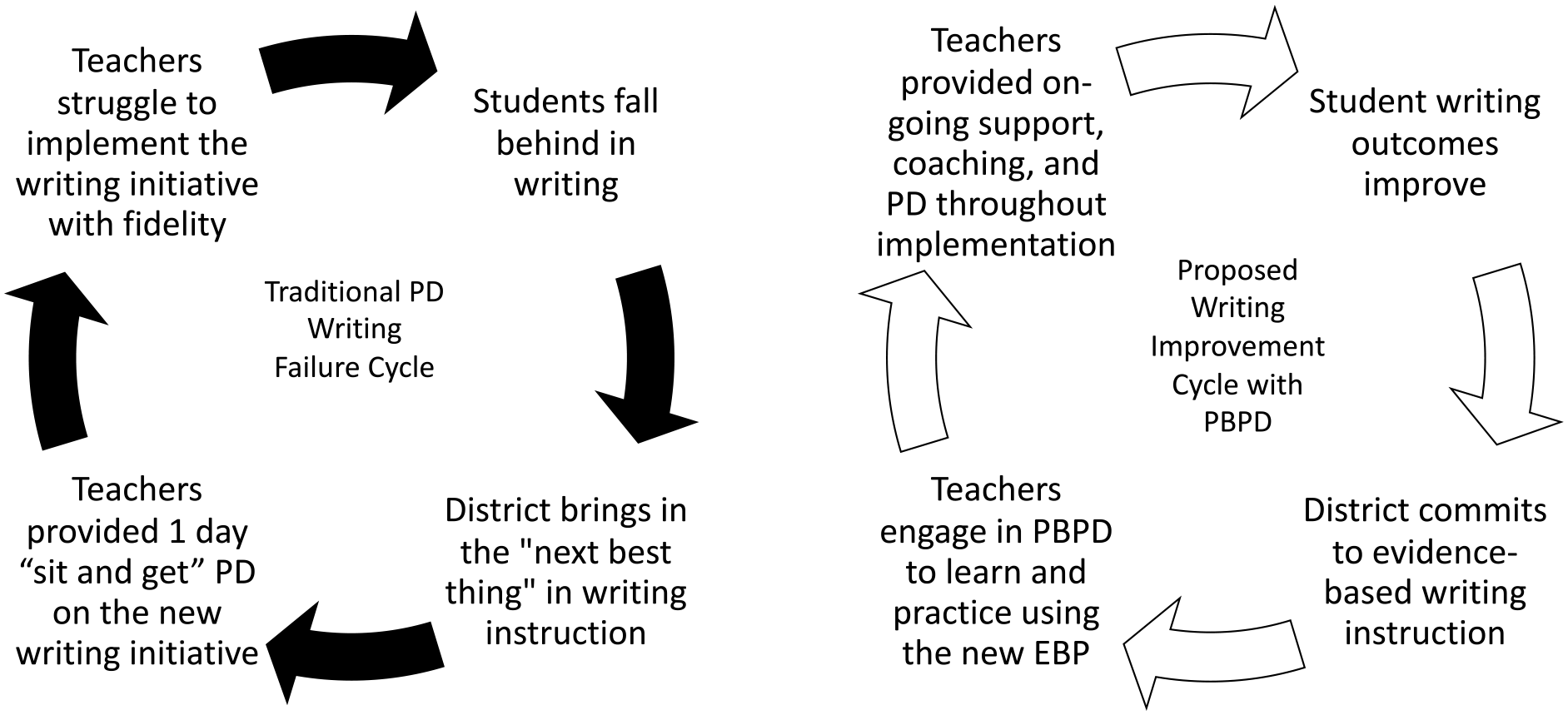
Traditional Writing PD Failure Cycle Versus Proposed Writing Cycle Integrating Evidence-Based Practices.
The PBPD framework provides a structured approach to PD focused on improving teachers’ knowledge, skills, and competencies. Practice-based professional development addresses the complexities of teaching writing by incorporating key components into the PD (see Figure 2) to help teachers make meaningful changes in their writing instruction (e.g., content based on relevant materials, teachers’ needs addressed, instruction modeled, teacher practice of strategies, and experts providing feedback; Harris et al., 2022). By following this framework, schools can increase the likelihood that all teachers are equipped with the skills and knowledge needed to improve writing instruction.
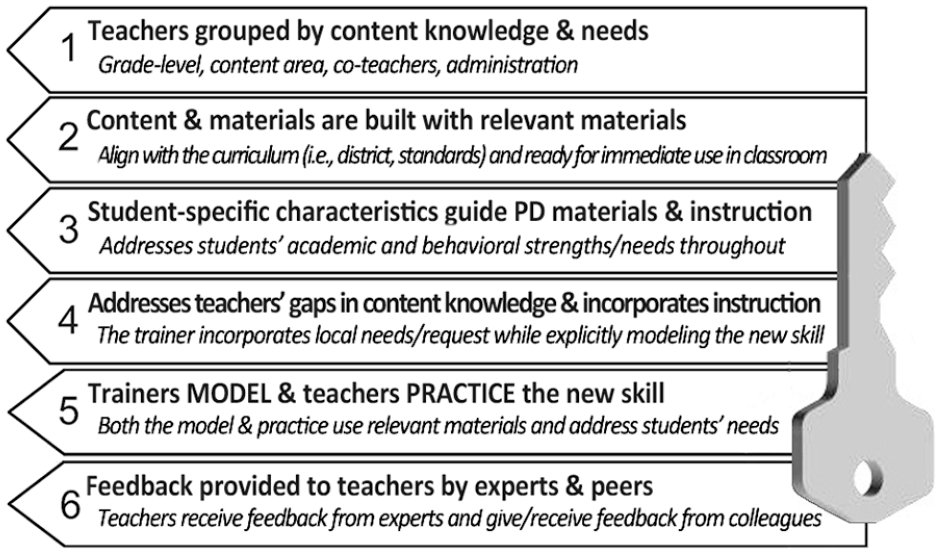
Key Components of Practice-Based Professional Development.
Research on incorporating EBPs in writing through PBPD across settings, grade levels, and student populations is extensive (Harris et al., 2022). Both research and practical guides are available for secondary students (Ray & FitzPatrick, 2022), elementary students (Harris et al., 2015; McKeown et al., 2016, 2018), students with EBD (Harris et al., 2012), and students under challenging or stressful settings (e.g., transient cities, compromised fidelity; McKeown et al., 2018, 2023).
Building PBPD to Support Students With and at Risk for EBD
Practice-based professional development is focused on the needs of the teachers, which allows the trainers to incorporate strategies to help address barriers impacting writing instruction (e.g., problem behaviors and classroom management concerns). The PD framework can incorporate how to address problem behaviors by modeling how to integrate effective strategies into writing instruction (e.g., choice-making, opportunities to respond, high probability task sequencing, and student interest), which makes the experience more meaningful for all teachers (Ennis et al., 2014).
An effective, inclusive writing practice should include both general and special education teachers in all aspects of the writing initiative. Schools and districts must make sure all teachers feel prepared to teach EBPs in writing to ensure students receive consistent writing instruction across grade levels, content areas, and instructional settings. Many factors must be considered before embarking on a new writing initiative (see Figure 3). Focusing the writing PD on an EBP, such as SRSD, is recommended.
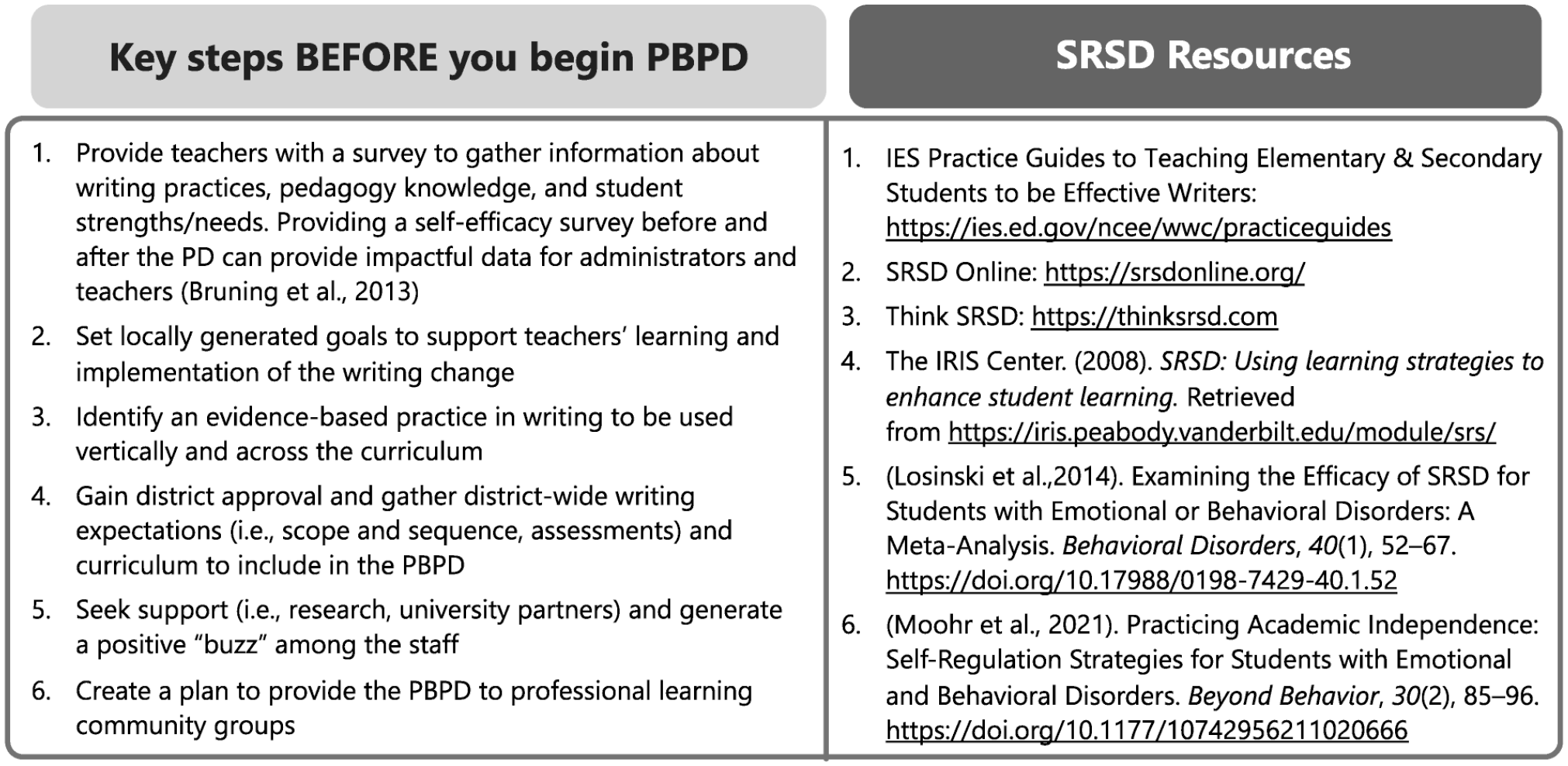
Key Steps to Consider Before Developing a Professional Development (PD) Plan and Writing Initiative and SRSD Resources.
Key Component 1: Teachers Grouped by Content Knowledge and Needs
One downfall of traditional PD is the “one size fits all” approach, where everyone in a school (or district) gathers in one location and receives the same PD. The instructional expectations and needs for writing differ significantly across grade levels, thus making it challenging to meet all the teachers’ specific needs. Professional development in groups helps to build a community of learning and is more effective (Desimone, 2009; Sims et al., 2022). Teacher knowledge impacts implementation (Harris et al., 2022; Iwai et al., 2019). Intentional grouping of teachers is a key component to the success of PBPD because it allows the trainers to cater the materials and instruction to the goals and objectives of the participants. The purpose of PBPD grouping is to create a supportive learning environment where teachers can share ideas, experiences, and best practices to develop a deeper understanding of evidence-based writing practice and how it applies to their students. Grouping participants together allows collaboration and peer learning, especially for special education and general education teachers (Sims et al., 2022).
One implementation tip is to create a Google Form survey for grouping purposes
Developing a survey before grouping teachers for the PBPD will help to maximize the learning teachers receive. In the survey, gathering information on co-teaching schedules is helpful to ensure general and special education teams receive the training together. The results might indicate special education teachers need to attend multiple trainings if they serve a variety of grade levels. Still, knowledge of schedules may allow co-teaching teams to collaborate as they learn new writing strategies, practice co-teaching delivery methods, and brainstorm adaptations to fit the needs of their students. In the survey, questions might be included to capture teachers’: (a) writing knowledge (e.g., What does good writing instruction look like?), (b) self-efficacy (e.g., Do you feel prepared to teach writing? Why or why not?), (c) perceptions of writing PD/curriculum (e.g., Which curriculum are you currently using? What do you like/dislike about your current writing curriculum?), (d) needs and suggestions (e.g., What supports do you need to improve your writing instruction? What are the strengths/areas of weakness of your current students in writing?), and (e) current writing prompts or expectations (e.g., Provide examples of the current writing tasks used in your grade level). Google Forms can be landing points for writing prompts, rubrics, and curriculum materials that teachers use in their classes to help PBPD organizers make the training relevant to each set of teachers.
Key Component 2: Content and Materials Built With Relevant Materials
When building the materials for the PBPD, every aspect of the PD should include materials relevant to the teachers in the audience. With the traditional “sit and get” PD, the presented information is primarily theoretical and not created with specific teachers’ needs in mind. When a PD attempts to reach a large audience (e.g., multiple grade-levels and packaged for mass production), the focus of the skill is stripped down and generalized, and teachers are expected to transfer the new information into the context of their classroom. Yet the time needed to complete this critical change component is rarely provided to teachers. Practice-based professional development removes that barrier by using materials teachers can immediately use in the classroom.
One implementation tip related to PD materials development is to align materials with district expectations
Teachers often encounter mixed messages in PD and expectations set by the district. It is crucial to align the PBPD plan with the district scope and sequence to address competing writing strategies that could interfere with implementation and confuse students. Gather resources from all teachers across content areas and grade levels (e.g., writing prompts, student essays, benchmark examples, constructed response questions). Make them available to trainers and teachers during PBPD and implementation (Ray & FitzPatrick, 2022).
Key Component 3: Student-Specific Characteristics Guide PD Materials and Instruction
In PBPD, both the trainers and teachers keep a student-centered mindset throughout the experience. Trainers are able to make the content relevant to teachers by modeling how to incorporate: (a) the strengths of their students, (b) the writing strategy to address the needs of their students, and (c) student engagement by including relevant topics and student interests. The PBPD framework demonstrates how the writing strategy can help specific student populations engage in the learning process, which increases teachers’ learning outcomes, supports professional growth, increases teacher satisfaction, and removes doubt often associated with traditional PD (e.g., “But how would this look in my classroom?”).
One implementation tip related to writing samples is to have teachers bring their own students’ samples to analyze
Have teachers bring student writing samples to the PD and share the strengths and needs of their specific students with the PLC. Take time at the start of the PLC to share this information to build a supportive writing community focused on student needs.
Key Component 4: Address Teachers’ Gaps In Content Knowledge; Incorporate Requests
Practice-based professional development does not make assumptions about what knowledge and needs teachers bring to PD. Trainers analyze pre-workshop data surveys and assessments provided to teachers (see example questions in Key Component 1). This information is incorporated throughout the PBPD to build teacher-centered content, delivery, and groups to meet the different levels of knowledge (e.g., use prompts provided by the teachers, model how to address student needs in training, highlight the practices teachers currently use that align with the PD and focus the PBPD on the areas that need improvement, build time in the PD to address the needs and concerns stated by the teachers). Building a PD catered to the needs and requests of the teachers increases the instructional time available, demonstrates respect for teachers, and values teacher input. Teachers may be more likely to buy in to the PD message and purpose if they understand how the PD addresses their needs and concerns (Garner & Kaplan, 2019; Harris et al., 2022).
One implementation tip related to PD content is to determine where participating teacher gaps are and discuss that content
Start the PD by demonstrating how the organizers utilized the results from the pre-assessments and surveys to identify the participants’ strengths, needs, and requests. Explain how the unique needs of the teachers shaped the PD by synthesizing the results and sharing common themes among the participants.
Key Component 5: Trainers Model and Teachers Practice the New Skill
Modeling is a powerful tool used in PBPD to facilitate skill acquisition. Many teachers lack the knowledge of teaching writing and do not view themselves as writers (Graham, 2019; Harris & Graham, 2016). Modeling can help teachers build confidence in their ability to engage in the complex task of teaching writing by observing someone else perform the job. In PBPD, the modeling mirrors the instructional practice in the classroom. The trainer models the EBP in writing, such as SRSD, with identical materials to be used in teachers’ classrooms, addressing standards and district-level expectations, and demonstrating how to apply the writing instruction to the identified needs of students (McKeown et al., 2023).
The trainer should model every aspect of the writing initiative, including genre-specific elements, breaking down a writing prompt, planning, writing a rough draft, editing, revising, integrating other content areas, and co-teaching strategies. Teachers, like students, benefit from experiencing a comprehensive, explicit model of effective writing instruction. In many traditional PDs, a portion of a writing lesson is modeled, and teachers are expected to make the transfer of knowledge from the incomplete model to confidently teach writing throughout the year with their students.
Teaching writing involves a complex set of skills (Graham, 2019). Immediately following the trainer’s model, the teachers practice delivering writing lessons to a peer. Teachers must practice the new writing strategy to develop their skills, address confusion before implementation, and build confidence to apply the writing instruction in their classroom. The PBPD framework’s model-practice cycle provides participants the time and opportunity to collaborate with other educators, share ideas, and learn from each other (Ball & Cohen, 1999; McKeown et al., 2016). Collaborative learning is an effective way to improve teaching skills as it helps foster relationships needed to sustain thriving PLC.
One implementation tip in the modeling and presentation phase is to encourage participant co-teaching of lesson parts
Training both general and special education teachers is the first step, but it is crucial for co-teaching teams to practice implementation within their current context. Trainers should be prepared to help facilitate co-teaching methods with the inclusion teachers and encourage collaboration (Michael et al., 2022). If possible, incorporate a variety of co-teaching strategies in the trainer model. The goal is for general and special education teachers to leave PBPD confident and with tools to help them immediately implement the writing instruction within their role in the classroom.
A second implementation tip is to directly address barriers to implementation
During the model and practice cycle of PBPD, build supports and strategies to address barriers teachers might encounter during implementation (e.g., alignment with district expectations, problem behaviors, access to resources, shifts in the daily calendar, or pacing guide to make time for effective writing instruction). Effectively demonstrating how to avoid these potential pitfalls can increase implementation success.
Key Component 6: Feedback Provided to Teachers by Experts and Peers
Once teachers have observed the model writing lesson and begun practicing the task, the next step is providing feedback on their teaching. Not only is this feedback period a critical time to identify areas of improvement, reteach, and adjust their approach as needed, but this also is a time to deliver positive feedback on the complex task of teaching writing. Remember, teaching writing is complex. Creating an ongoing learning community supported by a balance of constructive and positive feedback helps lead to a more outstanding commitment to the PD process. This feedback from experts and peers, during and after when teachers practice the skill, can increase teacher motivation, reflection, accountability, and confidence. Providing feedback during PBPD is essential for promoting continuous learning, supporting individuals in reaching the goals of a unified evidence-based writing practice within the school, and ensuring all teachers acquire the knowledge to successfully implement the strategy with their students.
One implementation tip is for presenters to take good notes on the feedback provided
While the teachers are practicing the writing instruction, take notes on areas of strength and needs for improvement. Make a note of dynamic teachers who can serve as possible champions of the writing strategy within the building (Ray & FitzPatrick, 2022). Also, identify areas of improvement for future booster PD sessions. Identify promising co-teaching teams to serve as models for effectively integrating academic and behavioral strategies into writing instruction.
A second implementation tip is to include school leaders in the PBPD feedback process
Principals and instructional coaches will be evaluating the teachers during the implementation process of the new writing initiative. Therefore, including administrative leaders in the feedback process is crucial to successful implementation. Involving the leadership team in the training process helps with teacher buy-in and can impact implementation success (Domitrovich et al., 2010).
Ms. Hood gathered the survey results, student writing samples, and each grade level’s district writing plans, and the team began to build a PBPD plan to implement school-wide the following year. When deciding on who would lead the training, the team agreed to each lead a portion of the training to show a unified vision among school administrators, coaches, and general and special education teachers. For example, the coach and general education teacher would model co-teaching the lesson of introducing the genre and strategy, while an administrator and the special education teacher would model co-teaching how to plan using the strategy.
Ms. Hood wanted her staff to invest in this schoolwide writing initiative, so she sought funding to support her teachers from every possible source (e.g., district, Parent Teacher Assocation, school budget). Time is the biggest obstacle in schools. Ms. wanted to provide her teachers with sufficient time and support to implement this writing instruction effectively. Over the summer, the administrative team worked on building a year-long PBPD schedule, integrating PD into the district curriculum, and developing PD materials aligned with grade-level prompts and standards.
The survey results revealed general and special education teachers needed strategies to help students with and at risk for EBD with writing tasks. Teachers reported student behaviors as a major factor interfering with effective writing instruction (e.g., off-task behavior, refusing to write, writing assignments being a trigger to escalating behaviors, and classroom management issues occurring during teacher modeling). The team began to gather resources to embed in the PBPD to address these concerns.
The instructional coaches worked with the special education teachers to model how to integrate behavioral interventions into a writing lesson by incorporating choice making (e.g., choice of writing prompt, seat during instruction, and writing utensil), opportunities to respond (e.g., increasing student interaction and participation during teacher models by strategically inserting questions to engage students, providing response cards to demonstrate understanding of the writing lesson, “Does this author defend their opinion with reasons? Did this author provide evidence to support the reason?”), and high probability (high-p) request sequences (e.g., providing positive reinforcement after each requested task the students do with ease [high-p], such as share ideas, recall strategies, and use self-regulation tools taught in the lesson, before asking them to engage in the more difficult task of writing task independently; Ennis, 2015). These purposeful, pre-planned demonstrations addressing how to integrate academic and behavioral concerns into the writing training addressed teachers’ needs and set teachers up for success in meeting school and district expectations.
Further Supports for a Successful PBPD
Timing
A common pitfall of writing initiatives is not investing the time to: (a) adequately train teachers, (b) support teachers during implementation, (c) offer follow-up PD and coaching sessions to deepen intervention understanding, or (d) plan and collaborate with colleagues to build a strong writing community (Graham, 2018). For a writing initiative to demonstrate positive effects on student outcomes, time must be invested in the training and support of the teachers. Scheduling time for PD is a challenge in schools, but the research on PBPD for writing does provide suggestions.
The PBPD needs to occur after the school year has started, allowing teachers to come to the training with current students in mind and a classroom to return to begin implementation immediately. Two full days (or 14 hours) of PBPD for one genre of writing is recommended (McKeown et al., 2018; Ray & FitzPatrick, 2022). Two full days for one genre of writing can be a challenge, so alternative suggestions include (a) two full days consecutively for the first genre of writing followed by 1-day booster sessions for each different genre, (b). one day of PBPD followed by four half days for the first genre plus PLCs on remaining genres, (c). one preservice day in the summer followed by one day of PD throughout the year for each genre of writing (Ray & FitzPatrick, 2022).
Volunteer Versus “Voluntold”
Seeking meaningful vertical and cross-curricular alignment in writing practices is time-consuming and labor-intensive, which is arduous when providing voluntary PD. However, school leaders can recruit teachers to participate in the PBPD by demonstrating their commitment to improving writing practices in the school. School leaders should seek the support of teachers by sharing the proposed plan for PBPD and the promise being made by the administration to support teachers before, during, and after implementation. Considering the required versus volunteer participation in the planning process could impact the engagement of resistant teachers (Harris et al., 2022).
Provide Coaching and Support
Practice-based professional development addresses issues surrounding the “knowing-doing gap” by integrating knowledge acquisition within the PD through practice. Yet some teachers will need more support to implement the strategy in the classroom successfully. Some teachers may leave the PBPD with more confidence in their ability to teach writing but may need more help to overcome some of the obstacles in the classroom (e.g., classroom management, variety of student needs, and student engagement). Coaches can assist teachers by (a) modeling a lesson in their classroom, (b) co-teaching a lesson, (c) conducting observations and providing feedback to teachers, (d) providing coverage for the teachers to observe each other, and (e) devoting time during PLCs to continue the elements of PBPD throughout the school year (Harris et al., 2022; Ray & FitzPatrick, 2022).
Ms. Hood proposed the school-wide writing initiative during inservice training at the start of the school year by providing each teacher with a personal writing journal, a new set of pens, the PBPD schedule, and a personal commitment statement of support signed by the administration team. Ms. Hood met with each grade level and supported teachers throughout the first few weeks of school to answer any remaining questions and share the initial 2-day PBPD schedule. Ms. Hood demonstrated her respect for teacher autonomy by allowing the teachers to volunteer to participate.
Repeatedly, teachers matched Ms. Hood’s enthusiasm for change after being presented with the thoughtful preparations made by the administrative team to support the entire implementation process successfully. Ms. Hood impressed the special education teachers by letting them break their 2-day training sessions across the multiple PBPD sessions so that they could practice the instruction with each co-teacher. The PBPD was planned with SRSD, an EBP in writing, and teachers were enthusiastic.
Throughout the school year, instructional coaches supported co-teaching teams while implementing SRSD. The PLCs were focused and included purposeful planning and collaboration among special education and general education teachers. Teachers came to PLCs with success stories and challenges to work through with colleagues. Students with EBD were actively participating in writing instruction, and the writing was improving.
The teachers contributed the change to finally being taught how to teach writing in a way that addresses the academic and behavioral concerns of their specific students. Ms. Hood recalled the moment she felt a shift in the writing within her school as the day she received a persuasive letter from a student with EBD on why the fifth-grade students deserved a dance. Ms. Hood had this specific student in her office several times over the years for behavior referrals. Yet now, he was there to deliver a well organized essay. Ms. Hood knew this was going to be a journey, but she was hopeful her team was headed in the right direction.
Conclusion
Writing has the potential to be a self-regulation tool for students with or at risk for EBD. Students cannot engage in a task they are not taught how to do, and general and special education teachers often feel unprepared to teach writing. Schools must invest in effective and ongoing support to implement evidence-based writing practices. Logistical issues like time will always be a barrier in schools. Still, the information presented in this article provides school leaders with creative ways to reduce barriers to improve writing instruction (McKeown et al., 2023). The PBPD framework provides teachers with explicit modeling, practice implementing the skill, expert feedback, and relevant materials to leave the PD and begin teaching the following day. By purposefully planning the writing PBPD to demonstrate how to integrate EBPs to address academic and behavioral concerns, teachers can feel better equipped with the tools to help their students with or at risk for EBD in writing.
Practice-based professional development allows special and general education teachers to learn and practice co-teaching to address academics and behavior simultaneously. Writing is a critical component of many academic and professional contexts. Students deserve the opportunity to master this fundamental right. It is time for schools and districts to stop the writing failure cycle by giving PBPD and EBPs a chance (see Figure 1).
Footnotes
Declaration of Conflicting Interests
The author(s) declared no potential conflicts of interest with respect to the research, authorship, and/or publication of this article.
Funding
The author(s) received no financial support for the research, authorship, and/or publication of this article.
