



Abstract
New science demonstrates how students with and at risk for emotional and behavioral disorders experience trauma at higher rates than their peers. When providing writing instruction to these students, it is imperative that the approaches used be viewed through a trauma-informed lens. This article describes steps teachers can take to view writing prompts and their administration of such prompts through a trauma-informed lens.
Students with and at risk for emotional and behavioral disorders (EBD) present many challenges during academic instruction. The challenges include externalizing and internalizing behaviors, academic skill and foundational deficits across content areas, poor interpersonal skills, and expressive and receptive language delays (e.g., Chow, 2018; Ennis et al., 2019; Kauffman & Landrum, 2018). Writing is one academic area where students with and at risk for EBD often perform more poorly than their typically developing peers (Gage et al., 2014). This is a significant concern as writing is a critical skill for both school and postsecondary success.
For students with EBD, the combination of skill deficits across multiple domains and inappropriate classroom behaviors can make it challenging for them to engage in writing instruction to acquire and develop their skills (Garwood, 2018). Also, we know that many students with and at risk of EBD have a greater likelihood of entering our classrooms with a history of traumatic events (e.g., death of a family member, exposure to violence), a factor which can further impact a student’s ability to engage in overall academic and writing instruction (Brennen et al., 2019).
What Student Trauma May Look Like in the Classroom
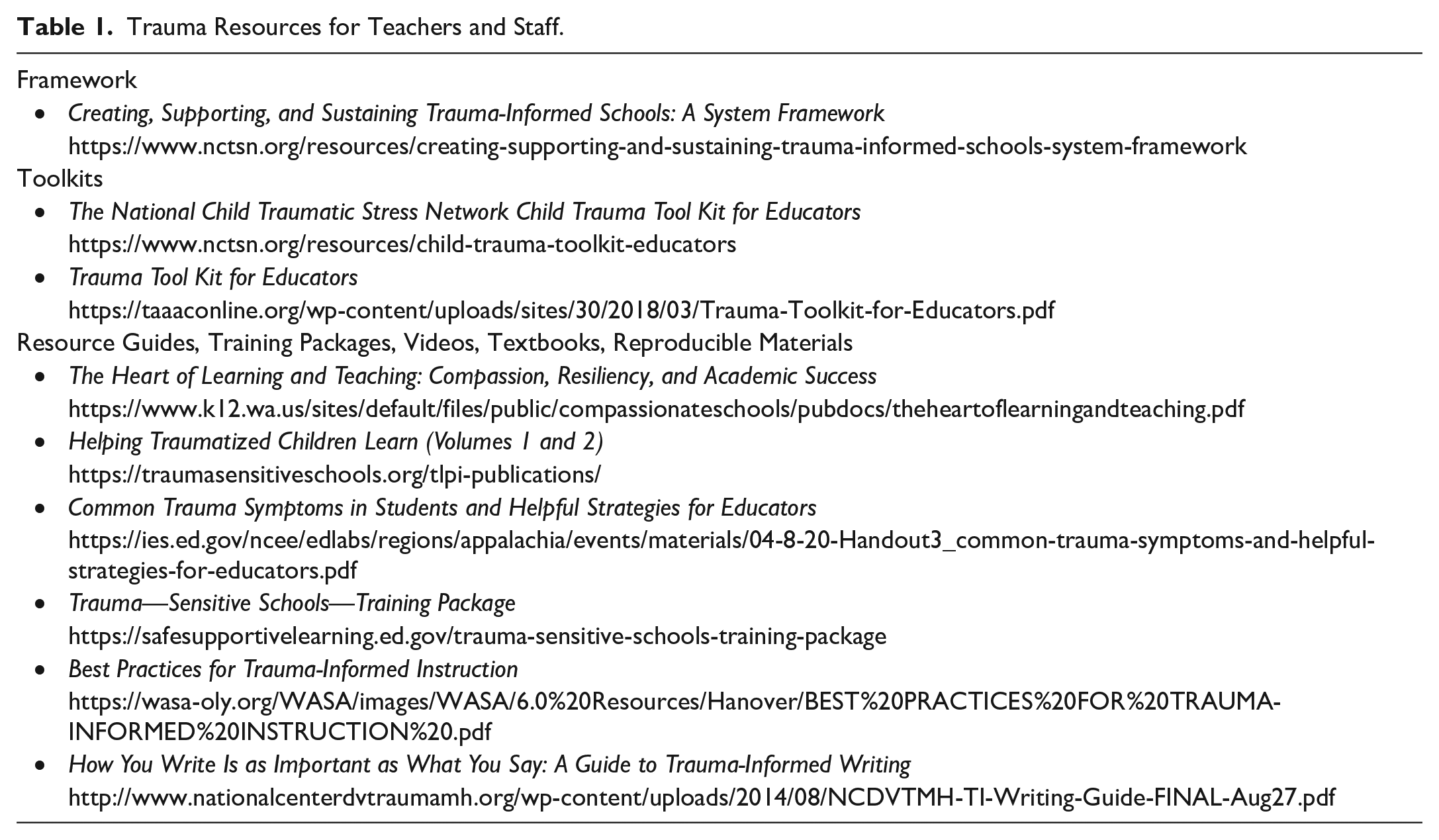
Unfortunately, many of our Grades K–12 students today have experienced one or more adverse childhood experiences—also known as ACEs—or traumatic events that can negatively impact their lifespan development and ability to learn throughout their education. That includes during typical classroom activities (see Table 1 for additional resources about trauma for teachers and staff). While triggering a student with the introduction of a classroom task demand (e.g., asking a youth to respond to a writing prompt) is never the intent of an adult, it can occur (American Psychological Association, 2021). It actually is likely to occur given that over 50% of students can expect to experience a traumatic event before the age of 17 years (Porche et al., 2016), with that percentage even higher (+90%) for those served in more restrictive educational settings (e.g., residential treatment facilities; Barnett et al., 2018). Student responses to triggers within the classroom will be as varied as the students themselves and are often characterized as deficits, difficulties, delays, problems, and inabilities with or reductions in functioning.
Trauma Resources for Teachers and Staff.
Some common trauma responses may include (a) difficulty trusting adults, including the inability to form positive relationships with adults (Hackney, Graham, et al., 2023); (b) deficits with emotional self-regulation and displays of aggression (Farley et al., 2020); (c) poor executive functioning, difficulties with memory, delays with both expressive and receptive language delays (Lieberman et al., 2019); (d) task avoidance and disengagement with the context (Zelechoski et al., 2013); (e) difficulties with concentration and attention span (Hertel & Johnson, 2013); and (f) difficulties with organizational skills (Brunzell et al., 2016). Students who have experienced trauma may exhibit challenges in their overall learning and across skill domains such as their language and communication, cognitive, physical, and social and emotional abilities (Institute of Education Sciences—REL, 2020), no matter if they display the aforementioned common responses or not. One academic area in which trauma responses may occur is during writing instruction and activities which rely on student background and experiences.
Writing Instruction
Writing is a complex skill constituting various phases (e.g., planning, organizing, drafting, revising, and editing), genres (e.g., persuasive, informational, narrative, expository), and forms (e.g., classroom assignments, state-wide assessments, interpersonal communications). Yet, writing is an essential form of expression that one is expected to master and use throughout one’s school and post-school lifespan. Many students with and at risk of EBD struggle with writing throughout school and across their lifespan (e.g., Ennis et al., 2019; Gage et al., 2014; Pitzel et al., 2022).
After explicit writing instruction, students are typically asked to demonstrate proficiency in the use of the writing strategy taught through a written response to a writing prompt. Writing prompts cue students to write with intention while motivating students to write on a topic (Keech, 1982). Examples of writing prompts include the following:
For a class assignment, you get to choose if want (or do not want) to work with other students. Choose which option you would like. Think about who your reader(s) might be. Be your own self-advocate. Write a response to convince the reader to agree with you (Pitzel et al., in press).
Some people think school lunchrooms should be required to provide low-fat and/or vegetarian options to meet the diet choices of all students. Do you agree or disagree? Explain your position. Use reasons and examples as support (McKeown et al., 2019).
I looked around the room. Nothing seemed unusual, but then . . . (Ennis et al., 2017).
When constructing writing prompts for use with students with and at risk for EBD who have ACEs or other trauma histories, it is important to be thoughtful and cognizant of student triggers while maintaining a safe and supportive learning environment.
Trauma-Informed Writing Prompt Construction Process
Just as we seek to implement policies and procedures to make students feel safe in the classroom, we want the materials and activities we use to match. In the classroom setting, writing prompts can function as a means for focusing student performance, improving motivation, and monitoring progress. At the state and national levels, writing prompts are used for standardized testing purposes as well as access to postsecondary education settings and employment. The writing prompt is the starting line for the writing process and a stimulus for facilitating student response (Kroll & Reid, 1994).
It is critical when working with students with and at risk for EBD who have experienced trauma that their starting line is free of roadblocks. Without considering a trauma-informed approach to the writing prompts we provide these students, we can unintentionally add barriers to the already complex writing process and their existing writing challenges. In addition, being responsive to students’ background can support a classroom environment conducive to learning and accessing writing prompts. Being unaware of student background and how the materials (e.g., writing prompts) we use may trigger past trauma can create a classroom environment not conducive to learning and erode established, positive adult-to-student relations.
When creating or determining if a writing prompt is trauma-informed and appropriate for students with and at risk for EBD who have histories of trauma, teachers should consider the following: (a) student prior knowledge, background experiences, and ACEs; (b) potential student triggers; and (c) assessment needs. Prior to providing writing prompts to these students, writing prompts should be constructed carefully, read thoroughly, and reviewed by multiple persons before being presented to students. Such a process may help prevent unknown barriers from being unintentionally presented to a student.
Student Prior Knowledge, Background Experiences, and Adverse Childhood Experiences
After the initial construction of the writing prompt, the teacher should read it through, check for student prior knowledge and experiences related to the topic, and determine if any known ACEs exist. This potential barrier is twofold. First, it is important for the students to have the background knowledge to respond appropriately to the writing prompt. For example, a student in elementary school does not likely have the background knowledge to respond to a writing prompt asking them to describe how a current world event impacts the United States. Second, students need to have background experiences to successfully respond to some writing prompt topics.
For example, not all students may have experience with certain holidays or traditions (e.g., trick or treating at Halloween). Asking a student to write about a holiday they do not celebrate or traditions that are not present may have an adverse impact on the student’s writing response. In tandem with known ACEs, the aforementioned examples may trigger a trauma response. For example, if a student’s family member or family friend perished because of a recent world conflict or has not had opportunities to celebrate specific holidays because of family issues (e.g., family member is incarcerated, is ill, or lost their job), then the writing prompt is inappropriate and likely to trigger further trauma for the student. Thus, prior academic knowledge, background experiences, and known ACES should be considered when developing writing prompts.
Student Triggers
After considering student prior knowledge, experience, and ACEs, it is time to consider potential student triggers. Having a preliminary understanding of student’s experience will support the understanding of potential triggers for students in the classroom and add to the ability to view the writing prompt with a trauma-informed lens. When assessing potential student triggers, language use plays an important role, and adjusting semantics without changing the purpose of the writing prompt may need to occur for students to have a successful writing experience (e.g., appropriately responding to the topic of the writing prompt, richly providing a comprehensive response). It is best practice to be careful of using unnecessarily violent language, descriptions of abuse and violence, and judgmental and/or objectifying language.
For example, a writing prompt that focuses primarily on family life (e.g., Describe your family routine when you get home from school to dinnertime; decide what the family will have for lunch on a weekend by planning the family menu) may be a potential trigger. Family-focused writing prompts may be difficult, upsetting, and/or traumatizing for students who have experienced family traumas, or for students residing in residential treatment facilities, awaiting placements due to the loss, strain, or other dynamics perceived to be upsetting related to their family.
A writing prompt that asks a student to place themselves in a situation that may be upsetting or is emotionally charged has potential to be a trigger for the student. For example, the prompt, “Is it a good idea to keep secrets? Write about examples of when it is okay to keep a secret and when it is not” read without a trauma-informed lens may seem an appropriate method for having a student write an explanatory essay. However, for many students with EBD with ACEs and trauma histories, this writing prompt is likely to be a potential trigger as it requires students to mentally place themselves in an uncomfortable situation (e.g., telling a lie/keeping secrets), which they may have experienced at the hands of adults in prior situations. It is crucial to prevent re-traumatization or the triggering of trauma-related memories when working with students with EBD who have experienced trauma (Cook et al., 2005).
Writing Prompt Assessment Needs
While considering potential triggers and students’ background knowledge and prior experiences, pinpointing the goal of the writing prompt and the assessment needs that drive the writing prompt are critical. This third consideration charges teachers with a priori determining the goal of the writing prompt and with a trauma-informed lens. For example, if the goal of a writing prompt is to assess students’ ability to respond to a persuasive prompt (e.g., number of persuasive essay parts included), then the prompt—regardless of topic—should be constructed for a persuasive response from the student. A prompt that reads “Think about your favorite book. Persuade your parent to read the book” could be potentially triggering due to its family-focused content. Rephrasing the writing prompt language to read “Think about your favorite book. Persuade your teacher to read the book to the class” accomplishes the same goal (e.g., the student responds in a persuasive essay format), allows for the original assessment need to be met, and avoids triggering the student. To summarize, take your writing prompts to the SPA and consider
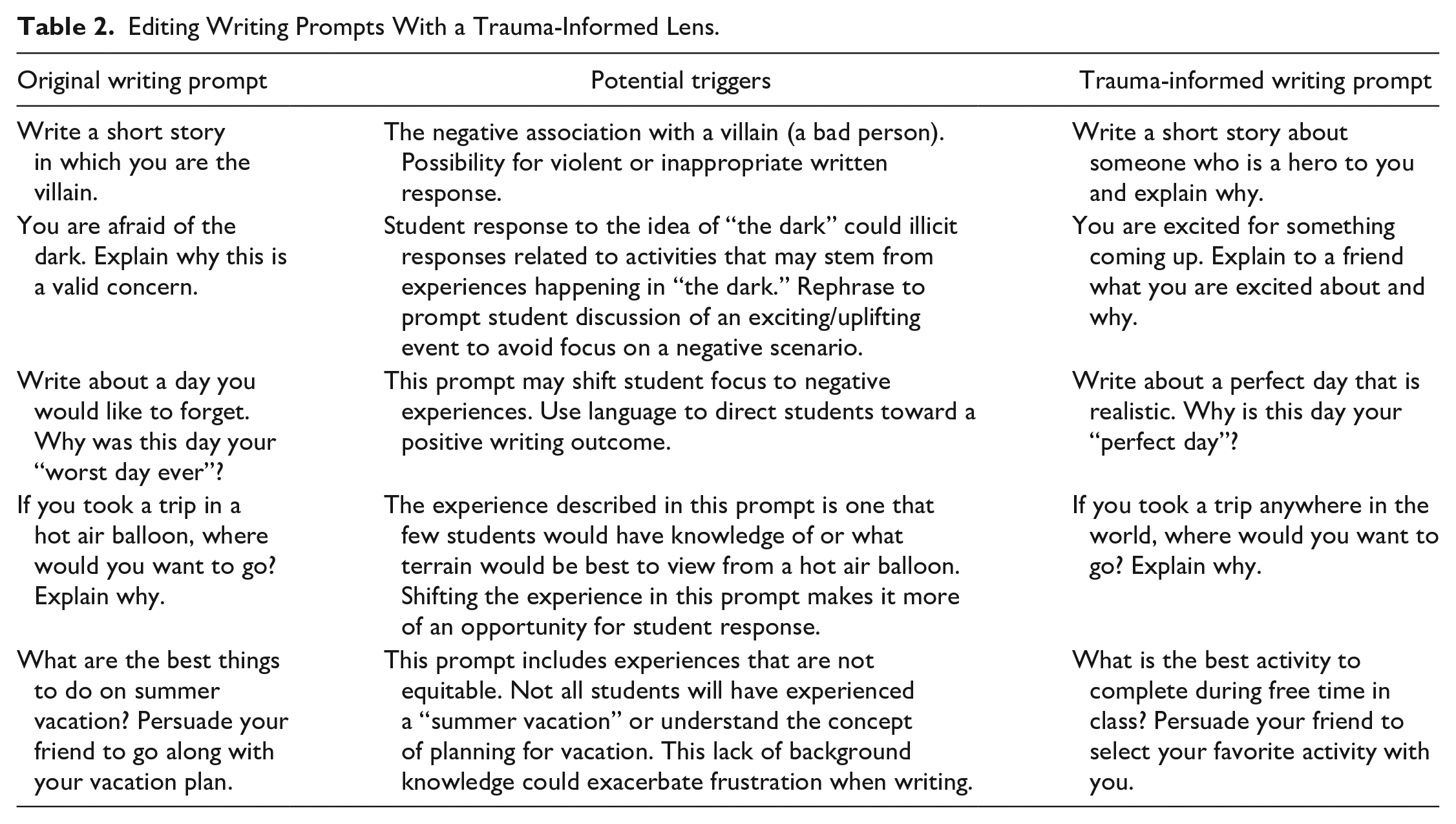
In addition to SPA, it is imperative that multiple adults review the constructed writing prompts prior to presenting them to students. For example, several researchers who engage in writing strategy instructional research with students with EBD and prior ACEs have a layered review process, cadre of persons familiar with the student and their histories involved, and willingness to edit and/or discard writing prompts which may trigger students (e.g., Ennis et al., 2017; Hackney, Graham, et al., 2023; Hackney, Jolivette, & Sanders, 2023). Table 2 provides examples of writing prompts which should be revised before use with students with EBD and ACEs or trauma histories.
Editing Writing Prompts With a Trauma-Informed Lens.
For some students with EBD who have a history of trauma, the writing instruction provided by or writing activities expected of their teachers may trigger a trauma response. Given our years of working with teachers and staff, teaching, and researching students with EBD across educational settings, we have observed these students respond to trauma triggers during writing instruction and activities. We offer hypothetical examples based on our collective experiences specific to writing prompts and offer strategies teachers may use as they continue to provide high-quality and necessary writing instruction to students with EBD.
When Writing Instruction and Writing Prompts Trigger a Student Trauma Response
Unfortunately, it is not possible for teachers and staff to know a student’s full background. A teacher may not often be privy to data on student ACEs or trauma, which may manifest in the classroom during writing tasks. Reviewing educational documents available to teachers and communicating with other educational staff such as the social worker or school psychologist may provide some information, but there will likely be information about students that teachers will not have. In such cases, writing tasks, topics, and instruction provided to the student may unintentionally illicit a trauma response from the student. For example, and on the surface, the aforementioned writing prompts and a host of other writing prompts may appear benign. However, a student with a history of trauma may view the writing prompts as a trigger.
Often, responses to trauma triggers are classified as fight, flight, or freeze responses (Guarino & Chagnon, 2018). A student with EBD displaying a fight response may engage in (a) verbal aggression toward the teacher (e.g., “I am not writing about this stupid topic and you CANNOT make me; I will mess you up if you ask me to write about this again”), (b) property destruction (e.g., “No I WILL NOT!” as they rip the writing prompt paper into small pieces, throw them on the ground, and use their pen to write curse words all over the top of their desk while muttering “stupid writing prompt”), and/or (c) disruption of the class (e.g., walking around the classroom, taking the writing prompt papers off other student’s desks while telling others they are not going to write today, throwing the prompts in the trash, and then stating, “None of us are writing today”).
A student with EBD displaying a flight response may (a) avoid the writing prompt task (e.g., continue to work on a prior task, refuse to acknowledge the writing prompt paper or questions from the teacher), (b) elope from the classroom (e.g., after a writing prompt is read aloud by the teacher to the whole class and the direction for everyone is to write a response, the student walks out of the classroom without permission and ignores directions to return to the classroom; the student looks over the writing prompt and then states they have to use the restroom or see the school nurse immediately), and/or (c) ignore teacher writing instructions (e.g., student prompts to go to their individual desks and get a pen out to begin their written response go unheeded).
Other students with EBD may display a freeze response such as (a) staring into space (e.g., as other students begin writing, a student stares into the corner of the ceiling while holding their pencil), (b) acting confused (e.g., student questioning what is happening and what you want them to do, student neutrally and repeatedly asking for clarification of what to do while holding the writing prompt paper), and/or (c) being disconnected (e.g., student talking off-topic to themselves or those around them).
No matter the student response—fight, flight, or freeze—it is important to respond to the student using trauma-sensitive phrases based on five core values of trauma-informed care outlined by the Substance Abuse and Mental Health Services Administration (2014): (a) safety, “I am here to help you”; (2) trustworthiness, “If you need to take a break, you may”; (3) choice, “How do you want to approach your writing today? Do you want to jot down some ideas and then organize them or begin an outline?”; (4) collaboration, “Together, let’s each brainstorm two ideas on this topic before you begin writing”; and (5) empowerment, “It is okay to have the feelings you are having about this writing prompt” (Hackney, Graham, et al., 2023).
George and Mr. Finley
George is a third- grade student with EBD being served most of his day in a self-contained classroom. George’s teacher, Mr. Finley, has committed to routinely engaging in strategic writing instruction and practice each day in his classroom. As part of this routine writing time, two to three times a week George is asked to respond to writing prompts written and provided by Mr. Finley with input from other teachers on George’s grade level team. This week was hectic, so Mr. Finley’s colleague provided the writing prompts.
When it was time to begin the first written prompt for the week, Mr. Finley began by providing George the prompt to read to himself even though Mr. Finley had not reviewed the prompt. As part of George’s accommodations, Mr. Finley then checked back in with George to reread the prompt aloud to him. Upon returning to George, Mr. Finley noticed that George was not writing. Instead, he was staring intensely at the prompt with a shocked facial expression. Mr. Finley tells George he is going to read the prompt aloud. At first, George shook his head slowly. Then, he shouted, “No! I want to write about something else—I don’t have family and I don’t want to write about that.” George then crossed his arms and put his head on the table. Per their process, Mr. Finley read the prompt aloud, “Think about your family members. Who is your favorite family member? Why are they your favorite?” George, with his head still on his desk said, “No.”
James and Mrs. Johnson
Mrs. Johnson’s class was practicing writing descriptive essays. It was two days before Thanksgiving break. Mrs. Johnson assigned the prompt, “Write about your family’s Thanksgiving traditions. Be as descriptive as possible so your reader can imagine what it would be like to join you for Thanksgiving.” As soon as James picked up the writing prompt paper and read the writing prompt, he crumpled the paper, threw his pencil across the room, cursed several times, and began punching his desk with his fist. Mrs. Johnson looked up but was not sure what made James so angry. However, she knew she needed to help James co-regulate his behavior before discussing why he was angry.
Ways in Which Teachers May Take a More Trauma-Informed Writing Approach
During writing instruction, teachers can create a trauma-informed space in which students with or at risk of EBD may practice and improve upon their writing skills and be prepared for trauma responses from their students with EBD with ACEs. (See Hackney, Graham, et al., 2023 for more details on how to construct trauma-informed spaces within educational settings.) When triggered by a writing prompt, a teacher may address student trauma responses by helping students return to a space where they can re-engage with the academic task through co-regulation.
Co-regulation is a supportive process in which a trusting adult works alongside a student to develop and practice self-regulation skills (Rosanbalm & Murray, 2017). Self-regulation includes skills such as positive self-statements, self-reinforcement, goal setting, self-monitoring, and self-evaluation of one’s growth (Sanders et al., 2021). Co-regulation assists students in their behavioral regulation after a triggering event and builds resiliency for future triggering events due to the emphasis on establishing and maintaining a positive connection with a trusted adult. Healthy connections with an engaged adult is associated with increased positive behavioral and academic outcomes (Garner & Yogman, 2021).
When teachers help their students with co-regulation, the teacher will: (a) validate student feelings by naming their emotion, (b) reassure the student of their consistent presence for the duration of the dysregulation, (c) remain calm while the student displays heightened emotions, and (d) remind and reinforce the use of self-regulation strategies (e.g., breathing, movement and grounding activities, positive self-talk, taking a break; Rosanbalm & Murray, 2017). Co-regulation is a crucial aspect of childhood development and typically occurs in infancy. As a parent is present during new and initially startling events, helping the infant categorize safe activities as the parent models warmth and enjoyment, causing the infant’s brain to understand activation of the trauma response system is not necessary (National Institute for Children’s Health Quality, 2021). For example, the first time a mother plays peek-a-boo with her baby, the baby’s eyes get wide, and her lips begin to quiver, as she wonders if her mother will return. When the mother says, “peek-a-boo” using a sing-song voice, while smiling and clapping with the baby, the baby’s brain learns the baby does not need protection because she is safe in a supportive relationship, playing a pleasant game.
Students with histories of trauma exposure have often not experienced co-regulation with a caring, attuned parent or caregiver, resulting in an alert brain that has not been trained to understand the student is safe during heightened states of emotion when in the presence of an adult helping them return to a calm state. Teachers who co-regulate with students with ACEs model safe, calming responses during periods of student dysregulation, which then develops trust and safety necessary for the student to gradually learn how to manage their own heightened emotional states (Bath, 2008; Hackney, Graham, et al., 2023). Consistent use of co-regulation between a teacher and a student can assist students in internalizing the assurance that there is help and a safe person and place available to them in stressful moments, allowing them to return to a calm state (Perry, 2009; van der Kolk et al., 2005).
When triggered by a writing prompt, teachers may co-regulate with students with EBD by getting down on the student’s physical level (e.g., sitting or kneeling next to them); saying—in a calm and quiet voice free of judgment, sarcasm, or tone—and acknowledging their observed emotions (e.g., “I know you’re frustrated by the writing prompt you were assigned for journal time and it’s okay to be frustrated about this. Sometimes, I get mad and don’t want to write, too”); offering space for the student to process their emotions—feasible for the specific context/situation where the trauma response is occurring while ensuring the safety of others in the context/situation (e.g., “Let’s take a break from this writing activity for 3 minutes. I will set a timer so you will know when the break is complete”); reminding use of available (and previously taught) coping strategies (e.g., deep breathing exercises, use of fidget from the sensory box); reassuring the student that adults are there with them to support, listen to, and co-regulate (e.g., “While you are on your break, I will be right here ready to listen and support you”); providing a reentry approach to re-engaging in the writing task (e.g., “When the timer beeps, I will be here to help you with your writing assignment”); and providing choices related to how to begin and complete the specific writing task (e.g., a choice of a different writing prompt, choice of where to sit or materials to use to complete the writing response).
Let us revisit both the scenarios of George and James which had ended with both their teachers recognizing their students may be exhibiting behavioral trauma responses—George, a flight response, and James, a fight response.
Revisiting George and Mr. Finley
After reading the prompt aloud and observing George’s reaction, Mr. Finley determined the prompt was not appropriate for George as he had a history of out-of-home placements and guardianship had changed several times prior. Mr. Finley decided a different prompt free from triggers (e.g., family, home life) would be provided. Before he requires George to engage in the writing process again, Mr. Finley takes time to plan a thoughtful interaction with George to support their established student/teacher relationship, conveying that this is a safe space for George to process the prompt, and that George would be given a choice. Mr. Finley first says, “George, I am here to help you and it is okay to feel this way about the writing prompt” Mr. Finley then asks George if he would like to select a different writing prompt and take a 2-min break before responding to the selected writing prompt.
During George’s break, Mr. Finley selects two different prompts for George to select from when he is ready to return from the break. He ensures that these prompts are trauma-informed and responsive to George’s needs. After returning from his break, George indicates to Mr. Finley he is ready to write again. Mr. Finley tells George he has two prompts he can choose from and reads both writing prompts: aloud to George. George selects the following prompt, “Think about your favorite meal. What is your favorite meal? Why is that meal what you like to eat most?” After reading the prompt out loud to George, Mr. Finley prompts George to begin writing and says, “If you need help getting started, I am here to help.” While George writes, Mr. Finley provides George with behavior-specific praise and checks in to see if he needs anything. Although Mr. Finley knows he should have reviewed the initial writing prompt written by his peer before giving it to George, he was able to respond in a trauma-informed manner so George could successfully engage in the day’s writing prompt.
Revisiting James and Mrs. Johnson
Mrs. Johnson, who was working across the room at the small group reading table with several students, asked them to read the next two pages to themselves, be ready to answer two comprehension questions when she got back, and then walked over to James’ desk. Mrs. Johnson knelt down next to James to be at his eye level. She quietly said, “You look pretty mad. I bet that doesn’t feel good.” She handed him some thinking putty.
Let’s pause the writing assignment as you play with this thinking putty while you practice your big belly breathing. I am going to be right at this table working with the small group, and I will set a timer to come check on you in 5 min.
Mrs. Johnson finished her small group instruction while James was taking a break and using his calming strategies. She made sure she was sitting where James could see her. He knew she was there with him as a few times James looked in her direction and she smiled. When the timer rang, Mrs. Johnson sat beside James and asked him if he wanted to tell her what made him so frustrated. James told her, “My dad is in jail and I don’t want to have Thanksgiving without him!” Mrs. Johnson said, “That would make me feel confused and mad, too. Let’s pick a writing prompt that is more fun to think about than this one.” Together, James and Mrs. Johnson discussed other topics that would be good for descriptive writing. James decided that he would like to describe his favorite game to play outside instead. Mrs. Johnson asked James to begin writing and praised his use of his coping strategy and willingness to share his thoughts with her.
Final Thoughts
In the last scenario, Mrs. Johnson was able to (a) show compassion and understanding to James; (b) provide him with an opportunity to share his thoughts and feelings; (c) provide James with an opportunity and reminder to use his coping strategy; (d) provide him with time process what triggered him; (e) guide James through discussion and choice making of a forward path; and (f) offer James positive praise for re-regulating his behavior. Such an example showed James how, when future triggers occur, he, too, can navigate through his trauma response.
In addition to having a purposeful plan, such as Student prior knowledge, Potential student triggers, and Assessment needs (SPA), on how to construct writing prompts, teachers should consider other methods to ensure that their students with EBD are fully supported in both space and writing prompt topic so the student may respond appropriately and comprehensively. When teachers take the time to review writing prompts, cognizant of the potential trauma their students with and at risk for EBD carry into the classroom, they can set up a positive academic environment for their students to flourish.
Footnotes
Declaration of Conflicting Interests
The author(s) declared no potential conflicts of interest with respect to the research, authorship, and/or publication of this article.
Funding
The author(s) received no financial support for the research, authorship, and/or publication of this article.
