



Abstract
Sometimes, despite the most perfectly delivered writing lesson implemented with fidelity, students with emotional and behavioral disorders (EBD) do not make the progress expected by teachers or themselves. In these instances, teachers may individualize and differentiate for students with EBD not making adequate progress by purposefully intensifying elements of the writing instruction and supports provided to students. This article describes and explains how to intensify writing instruction to meet student needs.
For students with emotional and behavioral disorders (EBD), writing can be a challenging, non-preferred, and even aversive task. During the writing process, students with EBD may display a variety of inappropriate classroom behaviors, impacting their ability to benefit from writing instruction. Many students with EBD also display significant deficits in writing ability, as writing is a multi-component process with multiple steps (Gage et al., 2014). Writing difficulties can be compounded by deficits in self-regulation skills used to support the writing process (e.g., goal setting, self-monitoring, self-statements; Murray & Rosanbalm, 2017). The combination of inappropriate classroom behaviors and existing academic and self-regulation deficits presents an already significant challenge for teachers when considering how to support writing instruction for students with EBD. Also, when we consider the lack of academic stamina that may be impacted by the frequent missed instruction and class time due to removal from the instructional environment because of inappropriate behaviors and lower levels of motivation and self-efficacy in academics (Garwood & Ampuja, 2019; Pitzel et al., 2022), it is no wonder that students with EBD may struggle to execute all parts of the writing process.
Students With EBD and Writing Instruction
Students with EBD often respond to writing instruction by displaying externalizing (e.g., verbal aggression, physical aggression, off-task behaviors) and/or internalizing (e.g., anxiety, elopement, withdrawing from instruction) behaviors (Kauffman & Landrum, 2018). To maintain a positive educational environment for all students, our teaching response to disruption or other inappropriate externalizing behaviors is often to remove the student from the instructional setting (Garwood et al., 2017). For students with EBD who engage in internalizing behaviors, our response may be to do nothing (e.g., not engaging with the student), especially if the students are not causing a problem in class. However, both responses can continue to reinforce the undesired behaviors of students, by removing an aversive academic demand (Kauffman & Landrum, 2018).
While a common response, these actions of moving the student out of the classroom or allowing the student to withdraw from instruction can prevent students with EBD from acquiring, developing, and mastering writing skills (Garwood et al., 2017). It is critical that as teachers we avoid settling for marginal writing outcomes from students with EBD, and instead, expect and support students with EBD to continue developing and growing their writing skills by keeping them in the classroom, engaged in writing instruction.
Intensification of Writing Practices
In addition to many students with EBD missing classroom instruction during writing, their written products are often less developed than their peers, shorter in length, with fewer included details, and with less complex vocabulary (Cuenca-Carlino et al., 2019). Improving writing quality and outcomes is critical, as writing provides an avenue for students with EBD to succeed in school, communicate their thoughts and opinions, and use their voice to advocate for their needs (Pitzel et al., 2022). Improvement can empower each student to develop and use their individual strengths to find success.
Writing becomes especially important as students enter upper elementary and middle school. In these moments, students begin to use writing more and more as a mode of communication of thoughts and ideas (Graham, 2019). One way to keep students with EBD in the instructional environment and improve their writing outcomes is to incorporate writing intensifications within writing instruction. Intensifications are frequently used with students who need temporary, more intensive supports to improve academic foundations and performance in the classroom (e.g., Fuchs et al., 2014; Sanders et al., 2021). Intensifications do not have to be labor intensive for teachers, but they do provide additional explicit instruction, modeling, and scaffolding as students work to master academic skills (Sanders et al., 2021).
Fuchs and colleagues (2014) describe a taxonomy of intervention intensification to evaluate and build intervention intensities. The taxonomy includes seven dimensions: (a) strength, (b) dosage, (c) alignment, (d) attention to transfer, (e) comprehensiveness, (f) behavioral support, and (g) individualization. While the taxonomy is often used to evaluate the possible benefits of different academic interventions, it can also be used to identify areas where current writing interventions can be strengthened to support more complex student needs.
In this article, we provide examples of how writing instruction can be intensified, focusing on the dimensions of (a) dosage (chances students have to respond to instruction and opportunities for corrective feedback); (b) attention to transfer (how an intervention helps students transfer skills to other contexts, contents, and/or formats); (c) comprehensiveness (the explicit instruction principle already included in the intervention); and (d) behavioral supports (how the intervention already addresses self-regulation, executive functioning, and other behavioral strategies; Fuchs et al., 2014). Within the writing process, potential intensifications can be viewed through the different parts of the writing process: planning, organizing, drafting, and revising and editing.
Intensification and the Writing Process
Planning
The first step in the writing process is planning the writing task. This involves deciding what and how it will be communicated. The goal of planning is to generate ideas through prior knowledge, research, and discussion with others. Planning helps the writer compose more complete thoughts and write a more cohesive story or essay (Graham et al., 2016). Because many students with EBD struggle with language deficits, they also may struggle to generate ideas, express their thoughts in writing, and persist with difficult tasks (Garwood, 2018). Students with EBD often completely skip this step in the writing process to begin composing their text with no plan and with little attention to quality. The teacher can consider some intensifications to help students plan and find voice in their writing.
Choice making
Choice making is a viable strategy to include during planning to increase completion of the writing task and decrease off-task behavior and frustration for students with EBD (Jolivette et al., 2001; Michael et al., 2023). Teachers have different types of choices that can be provided to students such as (a) where (e.g., the location the student works); (b) within task (e.g., the materials used to complete a task); (c) between/among task (e.g., choice between different task options); (d) whom (e.g., who the student works with); and (e) future (e.g., choice among what happens once the task is complete; Jolivette et al., 2002).
There are several aspects of the planning process where students with EBD can be provided a choice, such as who the student may work with or where the student will sit. In addition, teachers can provide choices related to the writing task during the planning process, such as choosing the writing prompt, writing topic, or type of writing (between/among choice). To ensure that the choices provided will be effective, teachers need to plan choice-making opportunities before beginning the writing activity (Jolivette et al., 2017). Planning considerations may include age of students, student learning and behavioral characteristics, number of choices provided (e.g., two or three writing prompts), and alignment with writing goals and lesson objectives. Incorporating choice making as part of the planning stage of writing increases student engagement in writing tasks and student buy-in to the writing task.
Purposeful grouping
Placing students in purposeful groups to work with peers is a second intensification to consider during the planning stage. Purposefully grouping students and giving peers the opportunity to lead instruction within these groups is an effective instructional choice that can improve academic outcomes for students with EBD (Ryan et al., 2004). When students work with each other, they generate more ideas and evaluate each other’s ideas. Students can encourage each other to continue engaging in the writing task, provide more examples of writing samples, and provide direct feedback within the group (e.g., encouragement to add another detail, praise for writing attempts).
In addition, students’ communication skills improve as they discuss ideas, explain their thinking, defend their ideas, and negotiate the dynamics of the group process. The teacher can intentionally group students to align with the goals of the writing task. For example, during planning when students are generating ideas, students can be placed in groups of three or four to work together to generate ideas for a specific writing topic. When students begin organizing and drafting, the teacher can place students in pairs for partner work, which may be more effective for one-to-one feedback (Doubet, 2022).
When purposefully grouping students with EBD for writing tasks, the teacher also should consider several factors, such as the purpose of the group (e.g., planning, peer feedback), student characteristics (e.g., frustrated easily, skill in writing, enjoys working with others), and composition (e.g., mixed ability, similar learning and behavioral characteristics; Doubet, 2022). Purposeful grouping and peer-mediated interventions support students with EBD during academic tasks and may increase their achievement (Ryan et al., 2004). It may also allow students with EBD who excel in certain aspects of the writing process (e.g., generating ideas, writing down the ideas of the group) to take a leadership position even though they still require writing intensifications and supports in other areas.
Cue cards
Cue cards are another intensification the teacher can consider. Often, students with EBD forget what their next step should be while they are planning their writing task. They also may forget the important details about each type of writing task (e.g., narrative, persuasive). Cue cards can be created and used during planning as small reminders when students get stuck and cannot think of the next step (Reid et al., 2013). One advantage of cue cards is that they are small and easy to carry which makes them less conspicuous and stigmatizing to some students. The cards can be customized for each type of writing or mnemonic writing strategy and include the main steps and questions for each step to guide a student’s thought process (Conderman & Hedin, 2015). For example, cue cards can be created to guide students in planning their writing (see Figure 1), completing the graphic organizer being used for the writing task, writing an expository essay, or using specific mnemonic writing strategies.
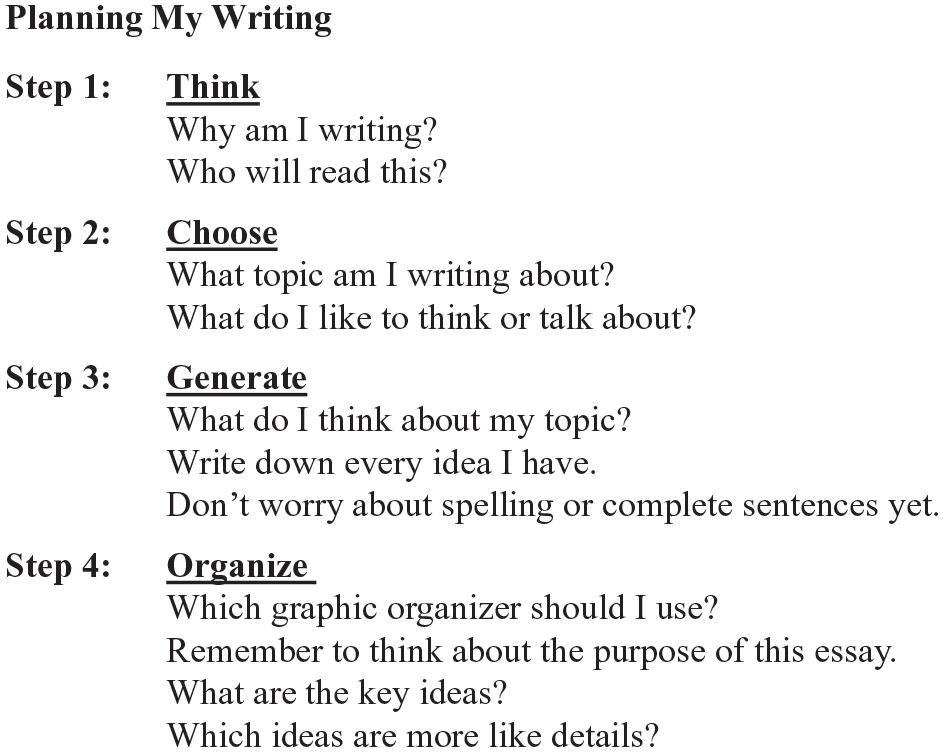
Planning My Writing Cue Card.
Organizing
After students have begun planning their writing task, they need to organize their thoughts and ideas. Planning and organizing often occur simultaneously as the writing process is an iterative rather than a linear process (Graham et al., 2016). The purpose of organizing is to arrange the ideas and information gathered during the planning stage to manage the flow of information and help the reader understand what the writer is trying to communicate. As students with EBD often struggle with self-regulation (Sanders et al., 2021), they may struggle with organizing their ideas, knowing which ideas are most important, and choosing the best organizational structure for their writing task. The teacher can consider some intensifications to support students with EBD.
Graphic organizers
Using graphic organizers is one intensification the teacher can use during the organization step. Graphic organizers are often the first step in organizing writing and can benefit students with EBD with a more structured approach during the pre-drafting stage (Mastropieri & Scruggs, 2014). Graphic organizers support students with EBD by organizing their thoughts, sequencing ideas and details, visualizing the complex process of writing in a graphic or visual format, and communicating their thoughts in writing (Mastropieri & Scruggs, 2014). Another advantage of using graphic organizers is their flexibility. They can be created on paper or digitally on a laptop or iPad (Flanagan, 2023) and easily customized for the writing task.
Teachers can create graphic organizers that are specific to the writing task, students’ age, and students’ learning and behavioral characteristics. When introducing graphic organizers with younger students, teachers may focus on a simple organizer, such as a Venn diagram to organize an expository essay around comparing and contrasting. For both younger and older students who need more structure, teachers can provide a more detailed graphic organizer with headings and fill-in-the-blanks for each section of the organizer, such as with organizing a descriptive essay around three key ideas for students who need more structure or around a mnemonic to organize a persuasive essay (Evmenova et al., 2020). Figure 2 provides an example of a graphic organizer that helps students organize their ideas and plans the use of transition words.
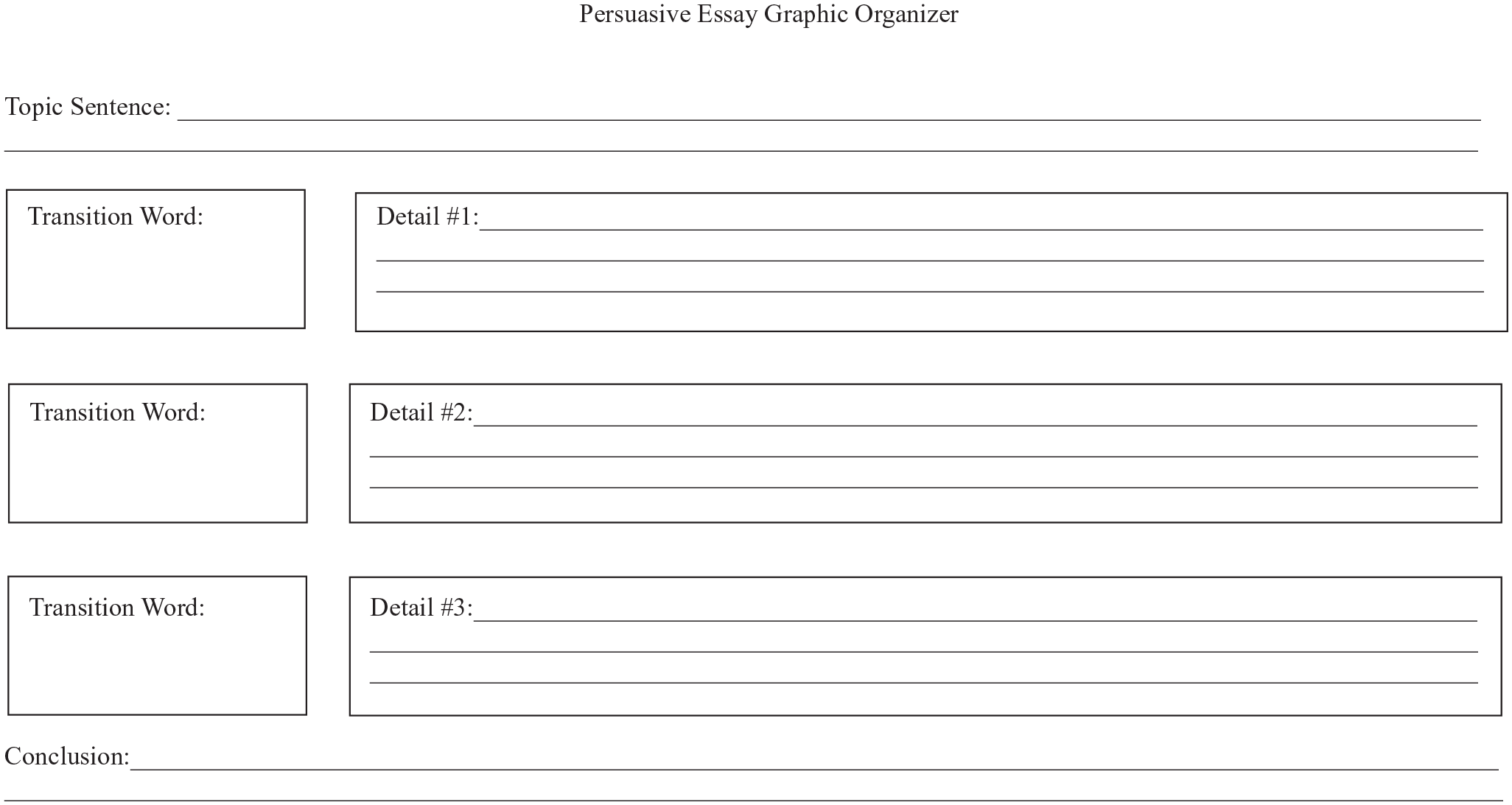
Intensified Persuasive Essay Graphic Organizer.
More exemplars
Another way to intensify writing instruction for students with EBD is to model how cue card, graphic organizer, writing strategy, and effective writing exemplars can be used to improve writing (e.g., Graham & Harris, 2018). Providing concrete models makes instruction clearer to students. Providing a wide range of exemplars helps students understand when to apply strategies and which writing structure to follow (Graham & Harris, 2018). When students see examples of what the teacher is discussing, they can visualize and apply the skill easier (Ruday, 2016).
Students can compare what they are writing to the example provided and use it as a guide to improve their writing. One such exemplar is how to take notes and use phrases on graphic organizers rather than writing out ideas in complete sentences. The teacher also can provide exemplars on the different types of writing: (a) short stories to demonstrate narrative writing, (b) scientific reports to demonstrate expository writing, (c) editorials and product reviews to demonstrate persuasive writing, and (d) travel brochures to demonstrate descriptive writing.
Breaking the task down
A third intensification that can be used in the organizing stage is breaking the task into smaller and more concrete steps. Often students with EBD become overwhelmed when faced with the complexities of an entire writing task and give up (Garwood, 2018). To support these students, the teacher can break the writing task into smaller steps at each stage of the writing process, even more so than the writing intervention or curriculum might recommend. The teacher can explicitly teach the critical steps in manageable chunks by modeling a step-by-step demonstration of each writing task and having the students follow each step immediately after teacher demonstration (Graham et al., 2016).
For example, when students have planned and are ready to organize their ideas, the teacher can demonstrate how to complete a graphic organizer for a descriptive essay in a whole-class or small-group setting. First, the teacher demonstrates how to decide on the topic of the essay and writes down that topic on the graphic organizer. Then the teacher lists each key idea and at least three details under that idea. After the teacher demonstrates each step, the student also completes that step. Breaking down the task is in contrast to a teacher modeling the entire organization process and then asking the student to complete a multi-step process.
Tangibles
Teachers may differentiate for students with EBD who are concrete and visual learners by using tangibles during the organization process. For example, teachers can provide a manipulative to support their writing organization. The student may be asked to write their ideas on individual strips of paper as a way for them to generate and support brainstorming. Then, the student can move their ideas into different positions to best organize their ideas for flow and support. Such an intensification also allows the student to see where additional ideas (e.g., details) are needed to fully support the content they are conveying.
Drafting
Once students have completed the process of organizing their notes and ideas, it is time to start drafting or the actual writing of the paragraph(s). In this step in the writing process, the goal is for students to take their ideas and put them into complete sentences and paragraphs. During this stage of the writing process, students with EBD may struggle with a few different areas. First, some students may initially lack the self-regulation skills to self-monitor their writing progress, leading to difficulties in evaluating if they are on the right track or need to make modifications to how they are approaching a writing activity (Popham et al., 2018). For example, some students may begin their paragraph on topic but quickly deviate into a tangent.
Another common challenge is turning short notes into full sentences, with students often struggling with appropriate transition words and vocabulary (Cuenca-Carlino et al., 2019). Finally, some students with EBD may lack the stamina to complete their paragraph(s), leading to them abandoning their assignment or finishing the assignment without including all their thoughts and ideas (Pitzel et al., in press). For other students, they may become focused on sentence structure and spelling and not the ideas they are trying to convey. To help address these frequent challenges, teachers might consider intensifications related to feedback, writing stems, word banks, and technology.
Frequent corrective feedback
Teachers often provide feedback for students after they complete the drafting process, which frequently focuses on elements such as grammar, spelling, and content (FitzPatrick & McKeown, 2020). However, some students may need more frequent corrective feedback on the content of their writing, especially when they are still mastering writing skills (Zaheer et al., 2019). Many students with EBD may become frustrated when prompted to remove or re-write sentences that veer off topic due to the effort they put into writing those sentences.
Increasing the frequency of corrective feedback can help catch students before they write multiple, off-topic or incorrect sentences. This may look like the student checking in with the teacher at predetermined times, such as after completing the topic sentence or the first supporting detail. This will allow the teacher to provide positive reinforcement when the writing is on target and corrective feedback when a revision is necessary. This also allows the teacher to model how to self-monitor throughout the writing process.
For example, if a student does not completely answer the writing prompt with the topic sentence, the teacher can model how to compare what the student wrote to the prompt and what changes might need to be made. This type of intensification can typically be faded quickly as the student becomes more proficient with the drafting process. However, providing this type of scaffolded support at the beginning can help reduce frustration and move the student toward mastery (Harris et al., 2008).
Writing stems and word banks
Providing students with writing stems and word banks is another intensification that can support the drafting process (e.g., Harris et al., 2008). Students with EBD may have excellent ideas during the planning and organization stages of the writing process but struggle to put these thoughts and ideas into complete sentences. If students struggle with starting sentences, teachers might consider providing students with examples of writing stems they can use to start sentences (Hester et al., 2023; see Figure 3). Sentence stems give students a starting place and can help them turn their notes into sentences and paragraphs. If students struggle with vocabulary, teachers might consider providing students with word banks. Word banks can target specific vocabulary students should be using in their writing. For example, word banks might include transition words or synonyms for commonly used and repeated words. See Figure 4 for examples of possible word banks to use with students.
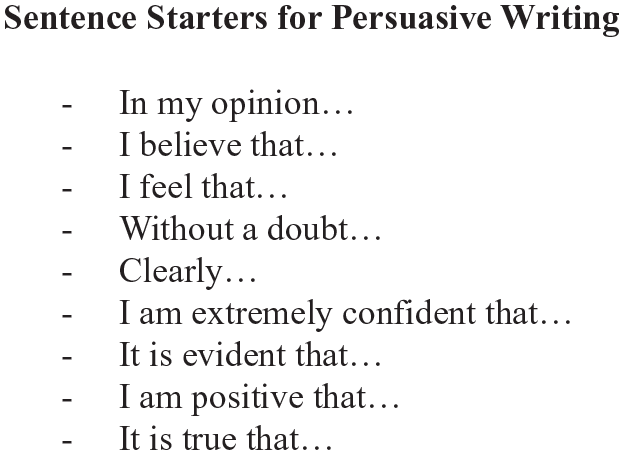
Persuasive Writing Stems.
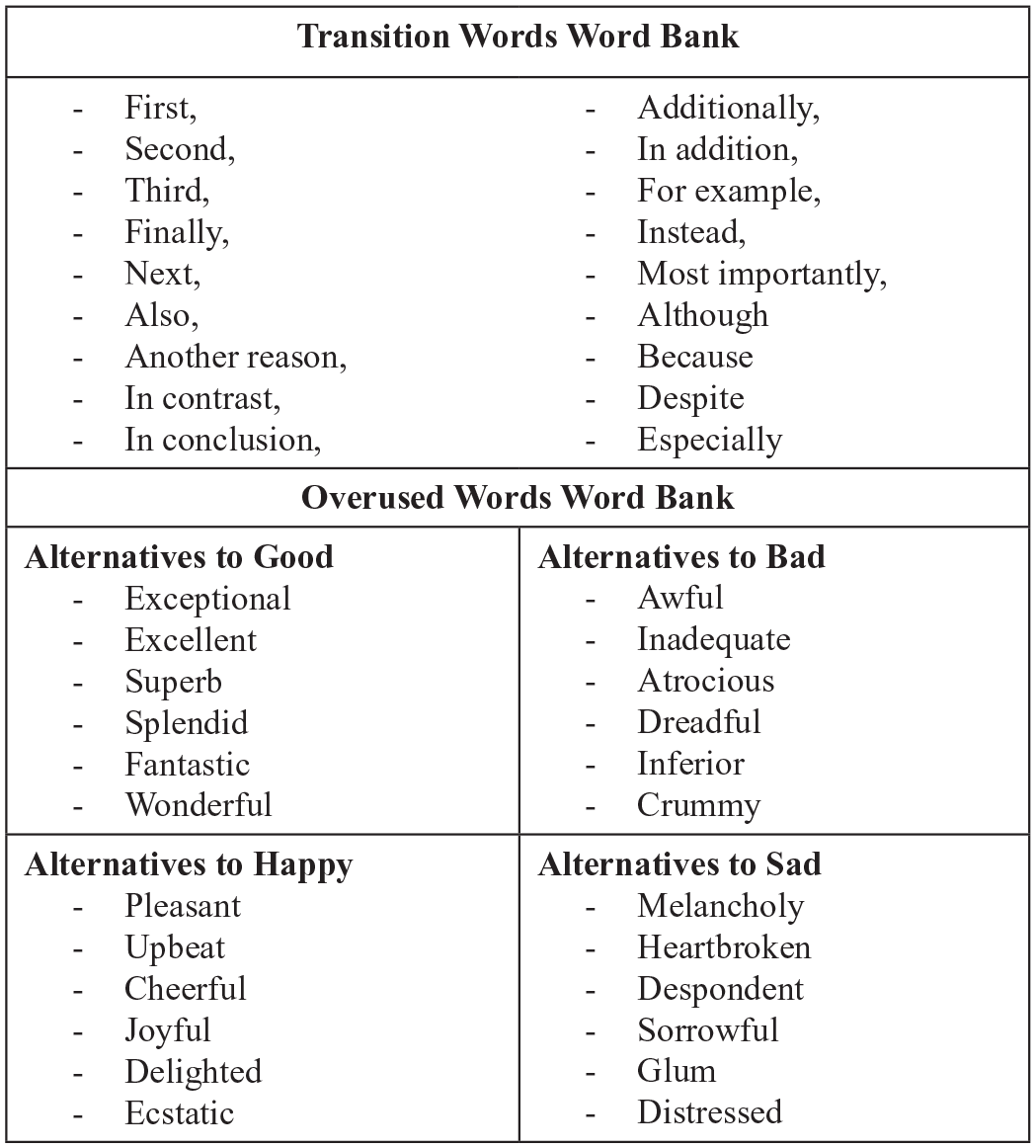
Examples of Word Banks.
Technology
When we think of using technology to support writing, a common tool is the word processor. Allowing students to type rather than write supports students who may struggle with handwriting and stamina (Hester et al., 2023). However, while using a word processor on a computer or tablet may help students who struggle with poor handwriting or stamina, additional assistive technology also may be beneficial (Hester et al., 2023). One type of assistive technology that can be useful is predictive text. Predictive text can support students who struggle with spelling and completing thoughts. Other students, who may have less experience with computers or tablets and consequently be slower at typing, may benefit from tools that translate speech to text. The speech-to-text function removes the barrier of typing, allowing students a way to directly commit their sentences to paper. Both predictive text and speech-to-text tools also are no-cost, low-intensity intensifications easily available to teachers that, if needed, can continue to be easily utilized across settings and into the future.
Revising and Editing
The final part of the writing process is revising and editing. Revising is the process by which students review the content of their work. It is a response to the following questions: Does the draft answer the prompt? Are the explanations clear to the reader? Does the draft have a topic and conclusion sentence? Editing consists of reviewing the text for correct grammar, punctuation, and spelling. Both parts of the writing process are critical for improving and polishing the final written product. Struggling writers with EBD may have difficulties with revising and editing for several reasons, including (a) lack of stamina (e.g., lack of attention and focus to this step after the planning, organizing, writing parts); (b) self-regulation deficits that hinder students from completing all parts of the revising and editing process; and (c) lack of confidence and learned helplessness due to previous negative writing experiences (Garwood & Ampuja, 2019). Self-monitoring and strength-based goal setting are potential intensifications that can be used in the revising and editing stage of the writing process to support students with EBD.
Self-monitoring
Self-monitoring is one self-regulation skill that students with EBD often struggle to use within academic contexts such as writing (Sanders et al., 2021). Self-monitoring, or the ability to assess progress on a task and evaluate if changes need to be made, is important throughout the entire writing process but can be especially helpful during the revising and editing phase. This part of the writing process can be intensified through additional self-monitoring supports (Zaheer et al., 2019). One easy way to support self-monitoring is through visual prompts. This often looks like a simple checklist listing the steps of revising and/or editing (see Figure 5). This visual intensification allows students a structured way to complete a multi-step process independently.
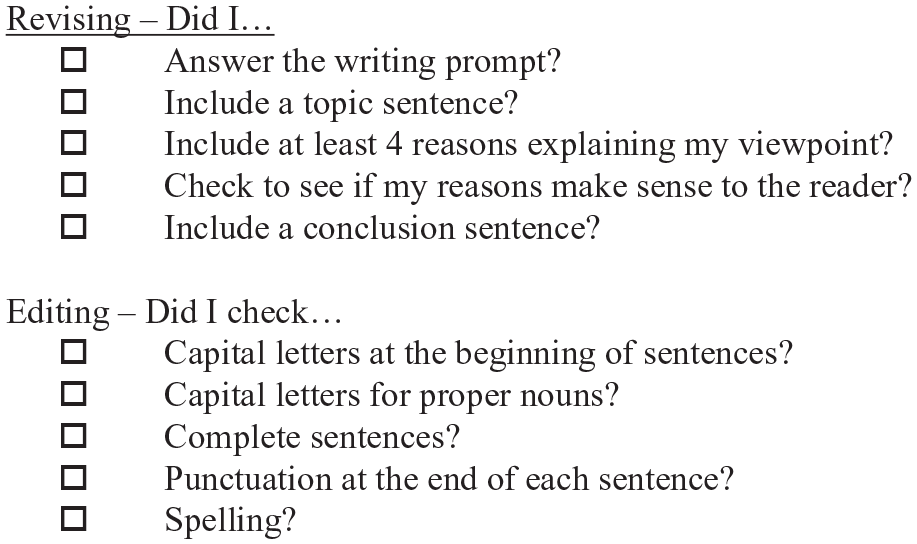
Revising and Editing Checklist.
Strength-based goal setting
Goal setting is a frequently recommended practice for students with EBD as a way to help them identify a tangible, feasible target to work toward (Popham et al., 2018). Many students may have previous experience with goal setting across multiple domains (e.g., academics, behavior, social-emotional; Pitzel et al., in press; Sanders et al., 2023). Within writing, goal setting is often used during the organizing or drafting process to help students increase strategy use (e.g., I will use my graphic organizer to plan my essay) or the number of essay parts (e.g., I will use a topic sentence, three reasons, and a conclusion sentence in every paragraph; Pitzel et al., in press).
While these goals are effective for supporting the writing process, it may be helpful for teachers to also incorporate goal setting into the revision and/or editing process. It may be beneficial to incorporate strength-based language into the goal-setting process (Garwood & Ampuja, 2019). Students with EBD often experience setbacks in their history of schooling and frequently have their needs and shortcomings identified, in the classroom, in individualized education program meetings, and in other areas. This can lead to students having a pervasive negative mindset or developing learned helplessness within their educational experience (Garwood & Ampuja, 2019).
Pairing the writing goal with statements of what the student does well reframes the goal as a way for students to continue to grow and build on strengths rather than highlighting additional deficits. For example, if a student struggles to remember to include capital letters at the beginning of sentences and punctuation at the end, the goal may be phrased like: “I do a great job explaining my point of view and including important details. I want to remember to check for capitalization and punctuation so people reading my paragraph know where my sentences start and end.” Reminding the student of their strengths as a writer also teaches them to set positively phrased goals to help them improve their writing skills. It may increase the likelihood that a student with EBD has more agency over their forward growth.
Progress Monitoring and Fading Intensifications
When any intervention or strategy is introduced into the writing curriculum or writing supports are provided to students, the effects of the intervention on student writing abilities and outcomes need to be regularly monitored. Progress monitoring occurs when a teacher purposefully and continuously collects data on the writing outcomes and skills in which positive improvements are desired (Saddler & Asaro-Saddler, 2013). This is another way to assess a student’s responsiveness to an intervention or support. For students with EBD, progress monitoring is especially important given their persistent writing difficulties and inconsistent academic (e.g., writing) performance (Gage et al., 2014) that may be due to displays of inappropriate behaviors (Pitzel et al., 2022, in press) and/or expressions of writing fatigue during writing task demands (Pitzel et al., in press).
Also, writing is considered a rigorous task with multiple skills subsumed within writing tasks (McKeown et al., 2020). This makes writing much more difficult for students with EBD, who may be missing foundational academic (e.g., prewriting) skills (Kauffman & Landrum, 2018). Progress monitoring for writing for students with EBD should include an a priori plan of when and what writing components to evaluate. For example, a schedule for writing sample collection should be made. Such a schedule may include collecting bi-weekly or weekly writing samples or curriculum-based measures when the writing intervention and/or supports are in place. With collected writing samples, analyses can occur making clear the incremental improvements in the student’s writing skills. A teacher may want to analyze the writing samples based on the student’s (a) essay holistic quality, (b) essay elements, (c) correct word sequence, and (d) length (e.g., Hester et al., 2023; McKeown et al., 2020; Pitzel et al., in press).
If intensifications to the writing supports were made, the teacher also will want to progress monitor such intensifications (see Figure 6). For example, one may monitor: (a) the number and types (e.g., positive or negative) of self-statements made; (b) the writing goals set and achieved; (c) the number of choice-making opportunities given and types of choices selected; and (d) the use of cue cards and which cue cards. For students with EBD, teachers also will want to progress monitor aspects of behaviors displayed when writing interventions and supports are in place.
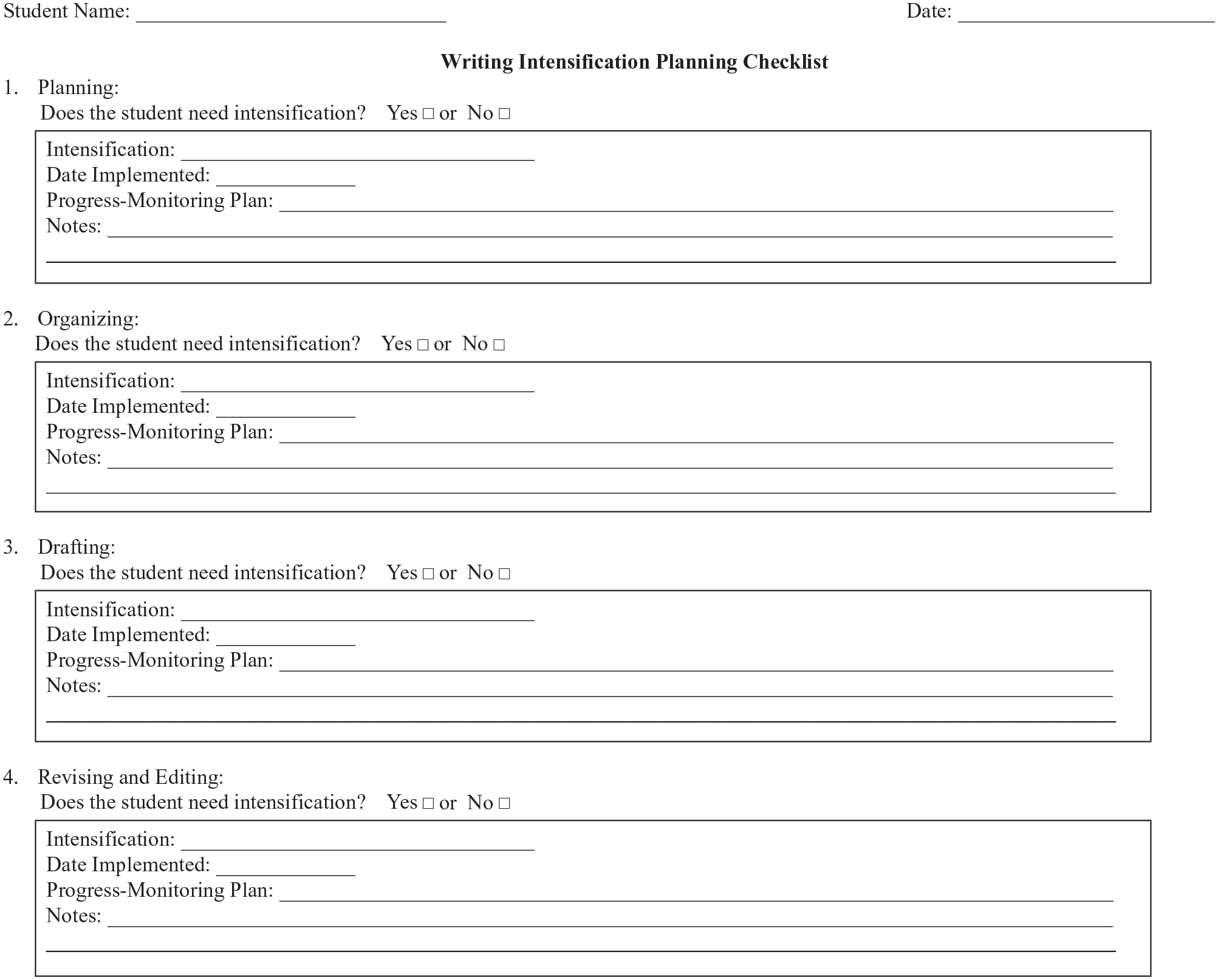
Writing Intensification Planning Checklist.
For example, teachers may monitor: (a) engagement: the percentage of time the student was on task during the writing task; (b) attempts: the number of writing tasks attempted (not accuracy as that is progress monitored through essay elements); and (c) duration: total time the student spent writing. The specific and unique variables to monitor will be dependent on the student, their writing needs, and desired student outcomes. However, the teacher should measure, at minimum, the effects of the intervention and supports on the writing outcomes.
Such progress-monitoring data also will indicate when it is time to begin fading the writing intensification(s). Fading is when the teacher purposefully and gradually removes the writing intervention and/or supports in a systemic manner. The aim is to transfer responsibility for completing the intervention and/or support to the student (Dignath & Veenman, 2021). Fading begins when the writing outcomes and skills of the student are/have improved per the teacher-selected writing outcomes. For example, if the student with EBD received intensification related to use of positive self-statements to keep them focused on their writing potential and growth, the teacher may gradually decrease their use of the verbal prompts for the student to employ their self-statements at the beginning of their writing sessions.
For another student, graphic organizers with goal setting may have been used as intensifications whereby the teacher may then either gradually decrease their verbal prompts for the student use of such supports or slowly withdraw the materials associated with such supports (e.g., presence of the graphic organizer chart, graph paper, colored pencils). While fading the intensifications, the teacher still will need to continue to progress monitor whether the effects of the writing supports maintain. If the effects do maintain (e.g., the number of essay elements remains high), then the fading of the supports should continue until all intensification supports are removed. For example, instead of providing the student with EBD an opportunity to make a choice of where in the classroom to sit to write or what utensils to write with each time a writing task is given, the teacher may provide the choice-making opportunity every other or every third writing session until choice making is faded entirely.
For students who used cue cards, the teacher may encourage the student to write without some or all the cue cards once improvements are observed. The teacher may highlight or draw the student’s attention to their writing improvements and how such a support may not be needed for future writing tasks. If, on the other hand, per the progress-monitoring data, the positive effects on student writing do not maintain, then fading is not ready to occur. In this case, the student has not yet internalized the writing intervention and/or support skills. For students with EBD, it will be important for the teacher to frequently progress monitor for writing improvements and consistency in writing performance given the inconsistent academic performance of these students.
Overall, the teacher should progress monitor student writing ability and continue to implement the intervention and/or supports until consistent improvements are achieved. Then, the teacher can gradually fade the intervention and/or supports while continually progress monitoring the maintenance of the prior writing improvements, all the while celebrating the writing growth and incremental improvements of students with EBD.
Conclusion
Writing does not have to be an academic skill that students with EBD dread. Using intensifications across the writing process, teachers can set up the learning environment in a way for students with EBD to find success. Intensifications added throughout the planning, organizing, drafting, and revising and editing steps can provide support to students with EBD at every stage of the writing process. When students with EBD are supported academically in the classroom, they are less likely to display inappropriate classroom behaviors that cause them to be removed from instruction, leading to increased engagement with academic instruction (Pitzel et al., 2022). This may also lead to more opportunities for students with EBD to practice new skills, increase their self-confidence and self-efficacy, and improve overall academic outcomes. No-cost, low-effort intensifications can help students improve their writing abilities and acquire and develop writing skills that help them communicate thoughts and ideas as they move throughout school and beyond.
Footnotes
Declaration of Conflicting Interests
The author(s) declared no potential conflicts of interest with respect to the research, authorship, and/or publication of this article.
Funding
The author(s) received no financial support for the research, authorship, and/or publication of this article.
