



Abstract
Introduction
Adolescents and young adults (AYA) with cancer have limited opportunities to share their experiences and insights with healthcare providers and supporters. However, they have tangible insights to share with a goal of improving AYA cancer care and support. We worked with 11 AYAs to design an immersive theatre experience that invited audience members–AYAs, healthcare providers (including community organizations), health leaders, researchers, funders, and family members and supporters–to get a felt sense of what it means to navigate cancer as an AYA.
Methods
91 audience members participated in the immersive theatre experience. Each member provided informed consent and completed a qualitative questionnaire. Responses were analyzed thematically.
Results
In their responses audience members reflected on three overarching clusters: struggles with providing care and support, impacts of the immersive theatre experience on audience members, and tangible actions to improve cancer care and support for AYAs.
Conclusion
This novel approach to research and knowledge translation helped to: identify the need for more tools to better support AYAs; provide an embodied, experiential approach to learning; catalyze responsibility; identify tangible changes to improve cancer care and support; and to invite audience members to move from agency to action. Further follow-up remains necessary to further understand the ongoing impacts; however, immersive theatre experience can offer an innovative approach to inspire changes in AYA cancer care and support in practice.
Keywords
Introduction
In Canada, nearly 9,200 adolescents and young adults (AYAs), aged 15 to 39 are diagnosed with cancer each year representing approximately 4% of all newly diagnosed patients. 1 It is well established that AYAs face unique clinical and life stage challenges distinct from children and older adults2-6 and that cancer care and support for AYAs often fails to address their unique needs across their cancer care trajectory.2-6 Yet, over the last two decades, a growing demand for comprehensive and coordinated AYA care and support and specialized training for health care providers working with AYAs has emerged.7,8 In the UK, Australia and other European nations, AYA cancer care and support is standard practice, 8 and in Canada, AYA-specific programs and training are being established.9-13 To support more robust and comprehensive programming, there is a need to continue to build awareness of the distinct needs of AYAs and galvanize support for AYA-specific cancer care and support.
In an effort to build awareness about the distinct experiences and needs of AYAs and galvanize support for an AYA program, we were interested in exploring how we could use arts-based research to engage AYAs in research co-creation.14-16 Specifically, we sought to explore how we could work with a group of AYAs to co-design an immersive theatre experience17-19 that could capture a felt sense of being an AYA with cancer. By definition, an immersive theatre experience is a performance that involves the audience as active participants, where the audience engages physically with the space, performers, stories and objects. 17 In the context of AYA cancer, theatre performances have been used to share research findings in the traditional format of a play20-22 or share personal testimonies23,24; however, the use of immersive theatre with AYAs remains novel.
For the purposes of this project, we sought to co-design an immersive theatre experience with AYAs about their experiences navigating cancer care that could be shared with healthcare providers and key decision makers as well as AYAs and their supporters. Further we sought to ground the immersive theatre experience in an ethic of care25,26 and an orientation towards change.
Our approach was aligned with Patient-Oriented Research (POR) and knowledge translation (KT) literature, which demonstrates that relevant patient and stakeholder engagement can improve research quality, health care practice, informed health decision-making and patient reported outcome measures.25-34 Further, our approach sought to address a gap in research which suggests that AYAs have few opportunities to share their experiences and perspectives with cancer care systems and play a role in creating and supporting change.35,36 Rather, we wanted to work with AYAs to share about their experiences in meaningful and impactful ways that could contribute to change. The main research question guiding this paper was: Learning from AYAs and their co-created immersive theatre experience, how can audience members better understand and respond to the needs of AYAs in practice?
In this paper we provide a brief synopsis of the immersive theatre experience and our process of co-creation with AYAs. We then offer an orientation to how audience members experienced the performance and documented their experiences and insights. This paper presents findings from the questionnaires that audience members completed during and after the immersive theatre experience, which specifically explore perceptions and impacts. We then conclude with a discussion of the findings and explore implications for health research and praxis.
An Overview of the Immersive Theatre Experience, Imagine
Over the course of 2024, we – a team of researchers and trainees from Anew, a research collaborative at Royal Roads University, and the University of Leeds -- worked with a team of 11 AYAs who were living with or had experienced a cancer diagnosis and who received care in the province of British Columbia. These AYAs were co-researchers in the project, providing insight about their lived experiences, and also shaping and informing the direction of the immersive theatre experience. A team of six facilitator-researchers and two facilitators with counselling credentials supported the project’s development and execution. The facilitators brought expertise in applied performance, theatre, immersive theatre experience, patient-oriented research, participatory action research, research coordination, and trauma-informed practice. Three of the facilitators also had lived experience with cancer as AYAs. Creation of the immersive theatre experience consisted of monthly two-hour online video-conference meetings, three day-long in-person devising sessions, and a four-day in-person devising workshop. Co-researchers and facilitators also met and worked on the performance beyond these gatherings, in both in-person and virtual settings. A manuscript exploring the co-creation of the immersive theatre experience is currently under review and is beyond the scope of this manuscript.
The end result was an immersive theatre experience, entitled Imagine. The title of the immersive theatre experience, Imagine was from a poem written by an AYA before she died. The poem was featured in the immersive theatre experience and also served as a source of inspiration throughout the project’s development. Imagine was a 40-minute performance that led audience members through eight distinct experiences with support from a navigator or guide.37,38 In this context of AYA cancer care, a patient navigator often refers to a health provider in a supportive care role that helps AYAs navigate the cancer care system. In working with AYAs it was important for a similar role to be embedded into the experience. To give you, the reader, a sense of what Imagine is, here is a brief synopsis to capture the essence of the experience: Imagine knocking on a door to find yourself stepping from a conference hallway into a hospital waiting room of sorts. You are invited to sit down, handed a pen to fill out a pile of forms, and then ushered down a hallway into a dimly lit bedroom where an AYA is texting with their friends. You witness the simultaneous connection and isolation through their messages. You walk back to the waiting room where you are handed a game—a maze of the cancer care system that you must physically navigate without falling through the cracks. You then witness a young mother navigating the demands of family life and cancer treatment. From there, you pivot to experience a card game entitled “The Game No One Wants to Play,” where an AYA must manage their limited resources as cancer progresses and come to terms with all that is lost. As you catch your breath and wipe away your tears, Navi, your navigator, leads you to a child’s birthday party. While at the celebration you realize that the everyday conversations young adults strike up are received differently by someone who's living with cancer. You then proceed back to the waiting room and take a seat; a poem implores you to imagine what it's like to be an AYA navigating cancer. Then it’s time to leave, but before you do, you receive a cup of tea in your hands, maybe write the name of an AYA who has died, and reflect on the changes you'd like to see and how you can enact them. You then return to the familiar conference hallway, changed by your experiences.
Imagine premiered in November 2024 at the BC Cancer Summit, a flagship event to provide education, professional development and networking opportunities for 800+ oncology professionals. The AYA co-researchers and facilitators installed the set and were both actors and backstage support. Imagine ran through the three days of the conference.
Methods
Audience Members by Role (n=91)
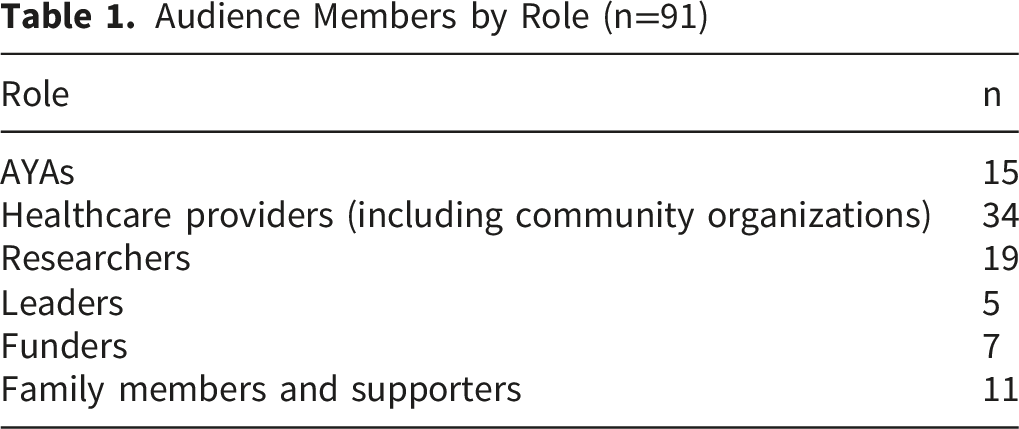
Most audience members were attendees of the BC Cancer Summit. Summit attendees registered to attend Imagine as part of their conference registration. Information about Imagine was outlined in the conference program and we sent an information email to potential audience members on Anew’s mailing list to invite them to register. As such, as sampling strategy was a blend of convenience and volunteer sampling. Groups of four to ten participants (usually eight) were invited into the performance space where they were guided through the immersive theatre experience.
Informed consent was obtained by all participants in the study. Specifically, written consent to participate as an audience member in Imagine was sought at the beginning of performance. The purpose of Imagine was first explained and then audience members were invited to review an information letter and sign the consent form. If audience members wished to experience Imagine, but did not want to participate in the research process, they were simply invited to not sign the consent form.
As part of the immersive theatre experience, audience members were also invited to complete a reflective questionnaire. It was a paper copy that audience members were prompted by the navigator to fill out the questionnaire before, during and after the immersive theatre experience. The results of these reflective questionnaires serve as the data for this paper. Questions included: 1) One thing I struggle with when offering care and support for AYAs is…; 2) One thing that really impacted me from today’s performance was…; 3) One thing that was new and/or surprising to me about AYA cancer care and support was…; 4) One thing I am going to do differently when offering care and support to AYAs is…; 5) One step I can take to make this happen is…. The last question then invited people to provide their name and email address in the event they wanted to engage in further studies related to Imagine.
All 91 audience members who consented to being a research participant completed the paper questionnaire in full, or in part. No audience members declined to participate.
All information in the qualitative questionnaires was deidentified and each audience member was assigned a participant number. Responses were thematically analyzed using Braun & Clarke’s six-step thematic analysis process 39 into three overarching clusters: struggles with providing care and support, impacts of the immersive theatre experience on audience members, and tangible actions to improve cancer care and support for AYAs. These overarching clusters were identified in alignment with the questions posed in the reflective questionnaire. Four researchers (two senior and two junior) were involved in the coding process and these researchers remained consistent through consensus building conversations.
Rigor and Ethics
We supported rigor in this study through the use of consistent questionnaires, collectively discussing emerging interpretations, and reporting results in a manner consistent with COREQ-informed qualitative reporting. 40 It is important to note that this study did not conduct interviews or focus groups and therefore many elements of the COREQ-informed qualitative reporting tool are not applicable. The study was approved by the Harmonized Research Ethics Board of British Columbia where Royal Roads University Research Ethics Board was board of record (H23-03406-A001, 8 November 2024). This study was conducted in accordance with the Tri-Council Policy Statement: Ethical Conduct for Research Involving Humans as revised in 2022, and the Helsinki Declaration of 1975, as revised in 2024.
Results
The results are organized into three overarching clusters: struggles with providing care and support, impacts of the immersive theatre experience on audience members, and tangible actions to improve cancer care and support for AYAs. These themes are presented below. Rather than framing the themes as statements, we have identified a guiding question to explore each theme.
Struggles: What do Audience Members Struggle With When Offering Care and Support to AYAs?
As audience members began the immersive theatre experience, they were invited to reflect on their struggles when offering cancer care and support to AYAs. Three key subthemes emerged.
Communication and Language
Most notably, audience members expressed difficulty about knowing what to do or say, and how to say it, and responses revealed uncertainty about language and timing as a central tension. Specifically, friends and family described struggling with “saying the right words or doing the right thing” (participant 51, family member), and “knowing what questions to ask and how much [AYAs] want to share about their cancer” (participant 75, supporter). These reflections point to a fear of overstepping, of saying too much or too little, or misreading the boundaries AYAs are actively negotiating amid illness. These uncertainties were echoed in responses by healthcare providers; however, their responses focused on their role in the cancer care of AYAs and the additional institutional and temporal constraints. Specifically, clinicians responses reflected on the challenge of “how to tell AYAs with cancer that they’ve got to halt their lives” (participant 36, healthcare provider), and “how to communicate issues with AYAs in a short time when you are also trying to decide treatment” (participant 62, healthcare provider). It is clear from audience member responses, that struggles and uncertainly around communication and language are present for most people when they are offering care and support to AYAs.
Limited Access to the Distinct Needs and Realities of Each AYA
Another struggle identified by audience members was a limited understanding of the complex realities that each AYA is experiencing beyond the clinical encounter, particularly the challenges of how cancer intersects with social life, work, school, and family responsibilities and how to best provide support. There was a general recognition that “[AYAs are] trying to live like normal but facing numerous uncertainty and obstacles” (participant 69, healthcare provider) and experience loss and loneliness; however, accessing the specific needs and realities of each AYA was not always possible. Audience members described how at times it was difficult to know what was going on for AYAs. One family member reflected that “[an AYA] didn’t let me in at times” (participant 19, family member), and this limited access to an AYA’s inner thoughts can be challenging when supporting AYAs through precarity. Clinicians also named the difficultly of not having “enough time to get to know their story” (participant 53, healthcare provider), underscoring how limited opportunities for connection can constrain their ability to recognize needs and mobilize appropriate supports. This tension of not enough time seems to be a common reality for many clinicians who are trying to provide the best care they can in resource constrained environments.
Limited AYA-Specific Resources
Linked to the struggle of providing support, audience members also noted the challenges of providing care and support to AYAs in a resource-limited environment. As one counsellor shared, “finding [AYAs] the resources that they need can sometimes be challenging… as the needs are diverse, and sadly resources are not always readily available in a timely manner” (participant 30, healthcare provider). As one clinician reflected: Getting caught up in my own emotions. I find it challenging to treat patients around my age because there are not enough resources and I never feel like I can care for them plus their families as well as I'd like to (participant 58, healthcare provider).
It is evident from the responses that audience members want to provide the best care and support to AYAs and their families, and often are unsure of how to do so in a supportive way that reflects the unique needs and realities of AYAs generally, and each AYA specifically.
Impact: How did the Immersive Theatre Experience Impact Audience Members?
Following the immersive theatre experience, audience members were invited to reflect upon the impact of the performance.
An Emotional, Visceral and Powerful Experience
Audience member reflections following the immersive theatre experience revealed a profound affective and cognitive shift, marked by being moved, unsettled, and reoriented in how they understand AYA cancer experiences. Many described the performance as deeply emotional and visceral, emphasizing how the experience exceeded what could be conveyed through statistics or clinical narratives alone. As one audience member noted simply, “the performance was powerful” (participant 24, healthcare provider), while others described moments of being brought to tears.
The Power of the Card Game
A particularly impactful element across responses was the card game entitled “The Game No One Wants to Play”, in which an AYA is playing a game against the cancer care system and must decide what personal resources (e.g. time, energy, money) they must give up to receive the best possible care. Many participants described this scene as unfair and destabilizing. Audience members repeatedly emphasized that the game’s lack of clear rules or logic mirrored the lived reality of navigating cancer systems as an AYA. The randomness and unpredictability of outcomes, combined with time pressure and constrained choices, evoked feelings of frustration, demoralization, and loss of control. One AYA noted that the game “made no sense and had no tangible rules, which is accurate” (participant 18, AYA), while a healthcare provider described it as feeling like “losing a battle with no end” (participant 49, healthcare provider), a powerful metaphor for the experience of cancer care without clear resolution or certainty.
Other Impactful Elements
Audience members also explicitly named many of other elements of the immersive theatre as impactful.
Some audience members referenced the birthday scene where an AYA is at their child’s birthday party and the audience members are privy to the comments made by guests and the interior thoughts of the AYA. Specifically, audience members referred to the layering of “things said out loud” (participant 29, family member) alongside interior thoughts, which illuminated the emotional labour of masking fear and uncertainty for others.
The text message exchange where an AYA was texting with a range of people in their life, was frequently cited for capturing the strain of trying to juggle school, relationships, and treatment while navigating isolation; several audience members described the moment when a friend stopped responding as particularly painful, underscoring how illness can quietly reshape or erode social ties.
Playing the hand-held maze in which each audience member had to maneuver a ball bearing through a maze while listening to population-level statistics heightened this dissonance, making structural inequities and systemic failures feel immediate and embodied. One clinician shared, “I felt the emotion and the experiences so visceral” (participant 49, healthcare provider). Further, the interactive nature of the maze, further emphasized the difficulty of moving through fragmented care structures.
Audience members also noted the power of the Imagine poem read aloud and the environmental details of the installation itself, down to the institutional tiles laid across the floor. As one audience member reflected, it was “a brilliant decision to bring in the hideous tiles to recreate the demoralizing impact of institutionalized settings” (participant 41, healthcare provider), underscoring how even the physical environment communicated the affective weight of clinical spaces. Together, these elements made the experience feel immersive.
Conveyed Social Isolation
The performance also powerfully conveyed social isolation. Audience members described feeling the loneliness and fragmentation that characterize many AYAs’ experiences. One audience member wrote when responding to what was most impactful was, “the embodied sense of isolation that was palpable during the performance” (participant 33, healthcare provider). Several people explicitly connected this isolation to systemic failures, noting that current health and social care systems are “not set up to support AYA needs” (participant 8, health leader) and often overlook the relational, developmental, and emotional dimensions of their lives.
Personal Resonance
For some audience members, the experience resonated personally, resurfacing memories of their own cancer journeys or those of loved ones. One family member wrote, “feeling viscerally what [AYA] went through for over 8 years” (participant 19, family member). Others described recognizing their professional roles differently, noting how the performance prompted clinicians to reflect on their own impact and on the limits of care practices that prioritize treatment delivery over emotional and relational support. As one researcher observed, the experience made visible “the seismic shift cancer has on AYAs. In our work we focus on care and not the emotional toll cancer has on patients” (participant 81, researcher). One clinician wrote, “I’m imagining what it is like to be that young adult and patients I have treated” (participant 73, healthcare provider).
Catalyst for Action
Collectively, these reflections point to the immersive theatre experience as a catalyst for both recognition and responsibility. Participants articulated a clear call to action: the need for more compassionate, flexible, and responsive forms of care; greater awareness among friends, families, workplaces, and institutions; and a commitment to imagining alternatives rather than defaulting to resignation. Several audience members emphasized the importance of resisting claims of neutrality or inevitability, instead practicing humility—learning to say, “I can only begin to imagine” (participant 47, researcher) rather than assuming understanding or not trying to imagine at all. In this way, the immersive theatre experience did not offer certainty or solutions but invited participants into a deeper, more accountable engagement with the complexity, precarity, and humanity of AYA cancer experiences.
Action or Change: What Is One Thing They Will do Differently?
Building on this sense of responsibility, audience members were invited to identify how these insights might translate into their own practices of care, extending the immersive theatre experience from reflection toward action.
A Shift Towards Trying to Imagine
Many responses described not immediate solutions, but a shift in orientation, particularly around imagination, language, and humility. Rather than retreating into the familiar refrain “I can’t imagine” (participant 1, researcher) participants committed to the harder work of staying with the complexity of AYA experiences. Several explicitly named the need to “try to imagine what it’s like” (participant 83, researcher), to “continue to imagine what AYA struggles with” (participant 8, health leader) and to “re-imagine their experience and do the work to put myself in their shoes instead of putting that burden on them” (participant 75, healthcare provider). One participant wrote simply, “I’ll never say I can’t imagine again” (participant 91, healthcare provider). In this way, imagination emerged not as empathy-as-feeling, but as a practice of accountability: a refusal to distance oneself from young people’s realities by claiming incomprehension.
Tangible Commitments to Connect With AYAs
For many audience members, this epistemic shift translated into commitments to slow down and attend more carefully to being present. They described offering more emotional support, taking time with AYAs, “asking more questions and being curious” (participant 52, researcher), and “listening instead of talking” (participant 34, family member). Others emphasized being “mindful of the words that come out of my mouth” (participant 29, family member), “thinking more before I speak” (participant 22, healthcare provider), and holding more space for emotions to surface without rushing to reassurance or solutions. These responses signal a move away from efficiency-driven interactions toward practices of slowness, attentiveness, and whole-person care, recognizing that “treating cancer requires mental strength not only medication” (participant 2, funder) and that understanding AYAs’ lives requires time, story, and trust.
A Call for Systemic Changes in AYA Cancer Care Practice and Research
Beyond individual encounters, some participants identified the need for collective and structural change. They described seeking additional training, sharing the immersive theatre experience with colleagues, and advocating for more flexible, developmentally responsive systems of care. Others committed to connecting AYAs with psychosocial supports earlier, bringing AYA stories to administrators and policy-makers, strengthening partnerships and transitions between pediatric and adult service provision, and including AYAs more directly in decision-making and research processes. For researchers, this meant being “more considerate and compassionate about the people behind our research” (participant 60, researcher), foregrounding relational ethics alongside outcomes.
A Redistribution of Responsibility
Considered together, these commitments suggest that the immersive theatre experience did not simply generate empathy but prompted a redistribution of responsibility. Rather than placing the burden on AYAs to explain, educate, or adapt, audience members articulated concrete ways they might change their own language, practices, and institutions. Action, here, was imagined less as heroic intervention and more as everyday acts of attention: listening longer, asking differently, advocating persistently, and making space for young people’s lives in their full complexity.
Discussion
The co-creation and sharing of Imagine garnered many learnings, many of which are beyond the scope of this paper. However, drawing on the results from questionnaires completed by audience members and existing literature, we have identified several key insights and considerations that we feel are important to advance AYA oncology and improve outcomes for AYAs with cancer in both research and praxis.
Tools Are Required to Better Equip Others to Provide Care and Support to AYAs
It is evident from audience member responses, that healthcare providers and supporters want to provide better care and support to AYAs; however, they lack tools and resources to do so. This is consistent with literature on AYA cancer care and support noting the strides still required to provide contextual care for AYAs.2-6 Specifically, friends, families, and healthcare providers entered the experience noting that they feel uncertain about language, timing, and how to respond to emotional and social complexity when providing care and support for AYAs. There is a need for contextualized tools, training, and resources to equip healthcare providers and supporters to meet the distinct needs of AYAs, and there is opportunity to draw on the expertise developed over the last two decades.7,8
Immersive Theatre Experience Offered an Embodied and Experiential Approach to Learning About the Experiences and Needs of AYAs
Audience member responses indicate that the immersive theatre experience was a powerful tool to support learning which is consistent with literature on the power of immersive theatre.17-19 The immersive theatre experience directly addressed the uncertainties that audience members noted at the beginning of Imagine, whereby the very areas participants named as challenging -- knowing what to say, how to understand AYAs’ inner worlds, and how to offer meaningful support -- became moments of affective and cognitive shift through embodied, experiential learning. Further the interactive, sensory, and narrative elements (e.g., the card game, scenes, soundscapes, environmental design) of the immersive theatre experience helped translate abstract knowledge into felt understanding, helping audience members move beyond statistics or testimonial based story-telling, to a more felt understanding of what it means to navigate cancer as AYA.
Affective Engagement Through Imagine Catalyzed Responsibility
Engagement through the immersive theatre experience created moments where audience members felt unsettled, moved, and/or implicated; however, rather than simply feeling empathy or disengaging, many audience members described reconsidering their own roles, language, and practices within systems of care. Through the immersive theatre experience, audience members recognized their role and responsibility to create change and committed to the ongoing work of imagining alongside AYAs to improve care and support.
Audience Members Identified Concrete Changes From the Interpersonal to the Structural to Improve AYA Cancer Care and Support
Linked to the sense of responsibility described above, most audience members committed to making tangible changes to improve cancer care and support for AYAs. Many reflected on what they would do in their own practice when working with AYAs and committed to slowing down, listening longer, asking more open questions, being mindful of their words, trying to imagine, and holding space. In essence these shifts support an orientation to person-centred care grounded in presence and attentiveness. Yet change also extended beyond the interpersonal to the structural. For example, audience members also described more macro-level actions to improve AYA cancer care and support including more advocacy, training, policy conversations, resource mobilization, and the integration of AYAs into decision-making. The actions identified by audience members suggest that the immersive theatre experience seeded both micro- and macro-level actions to improve AYA cancer care.
Immersive Theatre Experience With AYAs Helped to Highlight the Agency and Capacity of AYAs
As we spoke to audience members following the performance, many audience members reflected upon the creativity, agency and capacity of the AYAs involved in creating Imagine. They were impressed that the performance be designed, built and performed by AYAs with lived experience themselves and this recognition may have helped to broker a slight rebalancing or repositioning of power, where clinicians and healthcare providers in particular, witnessed and experienced the valuable insights, and perspectives that AYAs hold and considered how they might engage with AYAs differently in their practice. Aligned with the literature on Patient Oriented Research and knowledge translation,27-34 this process with AYAs reinforced the capacities of AYAs and their desire to positively contribute to creating change in their lives and in cancer care systems.35,36
Moving From Insight to Practice Requires an Invitation
In designing the immersive theatre experience, we were intentional to explicitly ask audience members what they would do differently now. Posing this question at the end of the performance helped to translate vulnerability and reflection into commitment. 25 It also highlights the importance of embedded structured prompts into immersive performances to help move audiences from insight to concrete practice and change.
Immersive Theatre Experiences May Function as Catalysts Rather Than Solution
In the instance of Imagine, the performance did not provide direct answers to audience members, rather it opened up space for ongoing reflection, responsibility, and practice change. Dialogic processes following the performance, similar to those employed in arts-based methods,14-16 may be an important consideration to deepen the process of reflection and meaning making for audience members.
Follow-Up Is Necessary to Understand Durability and Enactment
While written reflections during Imagine offered a low-burden way to capture audience members’ immediate responses both during and following the immersive theatre experience, they offer only a partial view of how learning may translate into sustained changes in practice. Additional follow-up is needed to understand the fuller and longer-term impacts of the experience. Currently we have reached out to audience members to invite them to complete a survey and/or participate in an interview to document the impacts from the Imagine experience one year on. These responses will explore whether and how these stated commitments translate into sustained changes in care practices, offering insight into the longer-term impact of arts-based interventions/immersive theatre experiences as more than knowledge translation.
Limitations
This study has several limitations. The study took place in Vancouver at the BC Cancer Summit, with participants already engaged in oncology work, which may limit transferability to broader audiences. The sample also primarily reflected those working with young adults rather than adolescents. We did not aim for theoretical data saturation, the brief questionnaires were intended as a starting point. Future research will include follow-up interviews to extend and deepen these insights.
Conclusion
The immersive theatre experience at the BC Cancer Summit, co-designed by AYAs with lived experience with cancer, offered an unconventional learning modality for audience members about the experiences of AYAs that encouraged reflection and meaning-making that extended beyond empathy to tangible actions to improve cancer care and support for AYAs. This approach, while time and labour intensive, is an innovative and powerful way to engage AYAs in sharing their experiences and working with audience members to initiate both dialogue and action towards improving outcomes for AYAs with cancer in both the short and long term. Further, immersive theatre experience offers a new possibility for healthcare research and knowledge translation practice that can inspire changes in the lives and care of AYAs.
Footnotes
Acknowledgments
We are grateful to the adolescents and young adult co-researchers who were at the heart of this work and the facilitators who supported it. Co-researchers: Ashley Tremblay, Jennifer L, Jodi Rethy, Jamie MacIver, Laura Floyd, Roxanne van Velzen, Shandy Bearman, Kaylie Rooke, Amber Baker, Stacey Brownell, Nellie Yee and Humera Jabir. Facilitators: Cheryl Heykoop, Alice O’Grady, Genevieve Stonebridge, Gary Lam, Tiffany Hill, Kat Dornian and Jennifer Wolfe. We are also deeply grateful to the many young adults who have shaped this work -- your work continues to improve and shape practice. Lastly, we are grateful to Alannah Smrke for her ongoing support, and Heena Vadgama and the rest of the team at BC Cancer for believing in us and supporting this work to happen at the BC Cancer Summit.

Ethical Considerations
The study was approved by the Harmonized Research Ethics Board of BC where Royal Roads University Research Ethics Board was board of record (H23-03406-A001, 8 November 2024).
Consent to Participate
Informed consent was obtained from all participants involved in the study.
Funding
The authors disclosed receipt of the following financial support for the research, authorship, and/or publication of this article: This research was supported by a New Frontiers in Research Fund Exploration Award (NFRFE-2022-00296), funds from the Canadian Partnership Against Cancer (Agreement #13087) and a Scholar Award from Michael Smith Health Research British Columbia (SCH-2021-1467).
Declaration of Conflicting Interests
The authors declared no potential conflicts of interest with respect to the research, authorship, and/or publication of this article.
Data Availability Statement
We were not granted permission from participants to share data in a relevant public data repository.