



Abstract
Objective
This systematic review and meta-analysis aims to assess the knowledge and awareness of oral cancer risk factors among medical and dental students.
Methods
This study followed the PRISMA guidelines and was registered in INPLASY (ID: 2024110035). Four databases were consulted (PubMed, Science Direct, Scopus, and Web of Science) from February 20th, 2005, to May 10th, 2024. The study selection and data extraction process was performed independently by 2 investigators. The risk of bias was assessed using the JBI tool, which can be found at: https://jbi.global/critical-appraisal-tools. A third investigator was consulted in case of disagreement. Meta-analysis results were systematically illustrated in a forest plot and expressed as odds ratio with 95% confidence interval. The I2 statistic assessed heterogeneity between studies. Funnel plot and Egger regression analysis were used for bias analysis. A P value <.05 was considered significant. All statistical analyses were performed using the STATA V.15 software.
Results
After the selection process, 41 studies met the eligibility criteria, comprising a total of 14,425 participants, 22% medical students and 78% dental students, primarily female (53%). The meta-analysis showed that 98% of students demonstrated relatively good knowledge about oral cancer risk factors. The most recognized risk factor was smoking (99%), followed by advanced age (68%), UV-rays exposure (64%), and alcoholism (57%). Knowledge of several other factors was comparatively lower, with less than 50% of students recognizing them. The studies indicated significant heterogeneity (I2 = 99.8%) and publication bias (P < .001).
Conclusions
These findings suggest that while medical and dental students have a strong understanding of key risk factors for oral cancer, there are gaps in knowledge regarding other important factors. Addressing these gaps through enhanced education and training is essential to improving early detection and prevention efforts.
Introduction
Oral cancer (OC) is the most common malignancy relative to head and neck cancer, 1 accounting for 3% of all cancers. 2 Its morbidity and mortality are high. The 5-year survival rate has been shown to be 50% and decreases as disease severity progresses, even after standard treatment, the recurrence rate is as high as 18-76%, 3 resulting in annual treatment costs of more than $2 billion. 4 This makes it to date a major social, economic and public health problem. 5
OC generally affects adults in the fifth to sixth decade of life. 6 However, its incidence in younger individuals has increased in recent years. 7 It is more common in men than in women with a 2:1 ratio. 8 According to worldwide reports, the highest proportion of OC is diagnosed in Asia and Europe and less frequently in Africa and Oceania. 9
Among the different risk factors that contribute to the development of OC are smoking (tobacco-related products), advanced age, UV-rays exposure, alcoholism, pre-existing oral potentially malignant oral disorders (OPMD) such as oral leukoplakia and erythroplakia, poor oral hygiene, human papillomavirus (HPV) infection, genetic predisposition, chronic mucosal trauma, nutritional deficiencies (malnutrition), immunosuppression and/or systemic diseases, among others. 10
Clinically, the lesions present as asymptomatic, non-healing ulcers of variable size, irregular margins and hard on palpation. 11 Frequently, the lesions mainly affect the lateral border of the tongue, followed by the floor of the mouth. 12 Facial disfigurement and functional deficits (swallowing, speech and taste) are characteristic of advanced stages. In addition, it can spread to the nearest lymph nodes. The lungs, bone and liver are typical sites of metastasis. This has a substantial impact on the oral health-related quality of life of patients. 13
Clinical examination of the oral cavity and surgical biopsy confirm the diagnosis of OC. Prognosis is evaluated according to different variables such as patient age, histologic grade of the tumor, TNM stage, smoking and alcohol consumption. However, despite this, prevention and early diagnosis are the most cost-effective long-term approaches to OC prognosis. 14 Finally, treatment is based on surgical resection with or without adjuvant treatment (chemotherapy and/or radiotherapy). 15
Undergraduate students in the fields of medicine and dentistry are the future health professionals, so before completing their studies they should be evaluated to determine deficient areas of OC knowledge. In addition, they should be encouraged to educate and raise awareness among patients about the possible risk factors that promote the development of OC with respect to its steadily increasing prevalence worldwide. This could be done by improving school curricula by raising awareness of OC, providing training on prevention and early detection.16,17
Numerous studies have investigated the level of knowledge and awareness of OC among medical and dental students through surveys in different parts of the world.16-56 However, currently, no systematic review summarizing the knowledge about OC etiology has been published. Therefore, the main objective of this systematic review and meta-analysis was to assess the knowledge of medical and dental students about the risk factors associated with OC.
Methods
The present work was conducted following the Preferred Reporting Items for Systematic Reviews and Meta-analysis (PRISMA) guidelines 57 and was registered in INPLASY (ID: 2024110035).
POT Items and Research Question
• Population: Medical and dental students. • Outcomes: Knowledge about associated risk factors in OC. • Time: Cross-sectional studies published after the year 2005.
The research question was as follows: “What proportion of medical and dental students know and are aware of the different risk factors that influence the development of OC?”
Study Selection Criteria
The review included: • English-language cross-sectional studies published after 2005. • Studies that assessed OC knowledge and awareness through surveys applied either directly or electronically to medical and dental students.
The review excluded: • Reviews, book chapters, short communications, letters to the editor, posters, encyclopedias, and editorials. • Studies assessing knowledge and awareness of OC among patients, general practice dentists and/or specialists from a particular medical institution.
Bibliographic Search
An electronic search was carried out in 4 databases: PubMed, ScienceDirect, Scopus and Web of Science, from February 20th, 2005, to May 10th, 2024. For PubMed, the following search strategy was employed: (((((( “Squamous Cell Carcinoma of Head and Neck/diagnosis” [Mesh] OR “Squamous Cell Carcinoma of Head and Neck/diagnostic imaging” [Mesh] OR “Squamous Cell Carcinoma of Head and Neck/drug therapy” [Mesh] OR “Squamous Cell Carcinoma of Head and Neck/prevention and control” [Mesh] OR “Squamous Cell Carcinoma of Head and Neck/therapy” [Mesh] )) OR “Mouth Neoplasms” [Mesh]) AND “Knowledge” [Mesh]) AND “Awareness” [Mesh]) AND “Students, Medical” [Mesh]) OR “Students, Dental [Mesh]. For the rest, the keywords “Oral Cancer,” “Education,” “Knowledge,” “Awareness,” “Dental Students,” and “Medical Students” were used along with the use of Boolean operators “OR” and “AND.” A manual search was also carried out in the following Journals: “Journal of Cancer Education,” “Cancer Radiotherapie,” “Journal of Cancer Research and Therapeutics,” “Bulletin Du Cancer,” “Bladder Cancer,” “Indian Journal of Cancer” and “Translational Cancer Research.”
Two investigators conducted the study selection process independently. First, duplicate articles and papers with irrelevant subject matter were discarded. Then, after reading the full text and applying the inclusion and exclusion criteria, a third reviewer was consulted to resolve any conflicts and, after reaching consensus, a final decision was made on the studies in disagreement.
Data Extraction and Study Bias Assessment
For this review, 2 investigators extracted the following information from the independently selected articles: • Sociodemographic characteristics of the study: comprising first and second author, year of publication, country, study design, ethics committee approval, and participants (medical and dental students). • Participant characteristics: Gender and age. • Methodological characteristics: Data collection (questionnaire used), dissemination of the questionnaire (direct application or by electronic means), duration of the survey activity. • Results: Assessment of OC knowledge and awareness.
Two investigators assessed study quality using the critical appraisal checklist for cross-sectional studies developed by the Joanna Briggs Institute (JBI), which is available at: https://jbi.global/critical-appraisal-tools. Studies with a score >7 low risk of bias. 58 For any inconsistencies a third reviewer was involved in the process.
Statistical Analysis
The results were systematically illustrated in a forest plot and expressed as odds ratios (OR) with a 95% confidence interval (CI). The I2 statistic assessed the heterogeneity among the studies. When heterogeneity exceeded 50%, which is statistically significant, a random effects model was utilized. To evaluate potential publication bias, a funnel plot and Egger’s regression analysis were created. A P value of <.05 was established as significant. All statistical analyses were conducted using STATA V.15 software (StataCorp LP, College Station, TX, USA).
Results
Search Strategy: Study Selection
Initially, 5166 articles were identified across 4 electronic databases: PubMed (4231 articles), Scopus (2 articles), ScienceDirect (929 articles), and Web of Science (4 articles). An additional 13 articles were located through manual search, totaling 5179 articles. During the identification phase, 69 duplicate articles were removed. Subsequently, 5110 studies were screened by title and abstract, leading to the exclusion of 4483 records, resulting in 627 articles. After applying eligibility criteria, 582 records were further excluded for the following reasons: reviews (197), editorials (73), book chapters (199), letters to the editor (85), encyclopedias (26), and short communications (6), leaving 45 potentially relevant records. Upon full-text analysis, 4 articles were discarded as they measured OC knowledge levels in children, patients, and general practice dentists. Consequently, 41 articles were included for qualitative and quantitative synthesis in this review. The study selection process is depicted in Figure 1. PRISMA flow diagram of the study selection process. PRISMA Preferred Reporting Items for Systematic and Meta-Analyses.
Publication Bias
Forty-eight point 7 percent of the studies had a moderate risk of bias,17,19,26,29,32,34,35,38,40,41,43,45-53,55 while 51.3% of the studies had a low bias (Figure 2).16,18,20-25,27,28,30,31,33,36,37,39,42,44,53,54,56 The main methodological shortcomings in the studies analyzed include the lack of clarity in the inclusion criteria and the absence of a detailed description of the study subjects. In addition, the identification and management of confounding factors were the least addressed aspects. Evaluation of the quality of the studies included in this systematic review. Evaluation of the bias of the studies included in this systematic review.
Baseline Features
A total of 41 articles with a cross-sectional design were reviewed in this study.16-56 All studies were approved by the corresponding ethics committee of each institution.16-56 The total number of individuals studied in the included investigations was 14,425 of whom 3148 (22%) were medical students and 11,277 (78%) were dental students. Fifty-three percent (7,609) were female, 41% (5902) were male, and the remainder (6%/1724) gender was not reported.17,21,23,29,38,41,43 Student ages ranged from 17 to 40 years, with a mean age of 23 years.16-56 Most of the surveys were administered directly to the students (46%).30,31,33,36,40-42,45-56 On average, the duration of survey administration was 7 months.16,18,21-25,27,28,30,31,35,37,39,42-45,49,50,54,55
Main Features of the Included Studies.

Meta-Analysis: Knowledge About Risk Factors in OC
A meta-analysis of 41 studies was performed on the knowledge of medical and dental students towards OC. The proportion of knowledge was .98 (95% CI [0.98, 0.98], P < .001) according to 41 studies. This means that 98% of all students had relatively good knowledge about the different risk factors contributing to the development of OC. The studies showed high heterogeneity, with an I2 of 99.8% and an H2 of 24,423. Funnel plot and Egger’s test indicated publication bias (t = 9.15, P < .001) (Figure 3, panel A and B). Panel (A) Forest plot of the proportion of knowledge about risk factors in oral cancer. Panel (B) Funnel plot to check to publication bias.
Ninety-nine percent of medical and dental students considered on the basis of their knowledge and experience that smoking is one of the main risk factors for OC (0.98 [0.98, 0.98] P < .001), followed by 68% for advanced age (0.68 [0.68, 0.65] P < .001), 64% by UV-rays exposure (0.64 [0.64, 0.64, 0.64] P < .001), 57% by alcoholism (0.57 [0.57, 0.58], P < .001), 48% by the presence of potentially malignant disorders (0.48 [0.47, 0.49] P < .001), 45% by poor oral hygiene (0.45 [0.44, 0.46] P < .001), 42% by previous infection caused by HPV (0.42 [0.41, 0.43] P < .001), 38% by genetic predisposition (0.38 [0.37, 0.39] P < .001), 25% by chronic trauma (0.25 [0.24, 0.26] P < .001), 23% by malnutrition (0.23 [0.22, 0.24] P < .001), 20% by immunosuppression (0.20 [0.20, 0.21] P < .001) and 0.5% by systemic diseases (0.05 [0.04, 0,06] P < .001) (Figure 4, Supplemental Figures 1-12). Main risk factors that contribute to the development of oral cancer. Created in BioRender. Sánchez, M. (2024) https://BioRender.com/y46q643.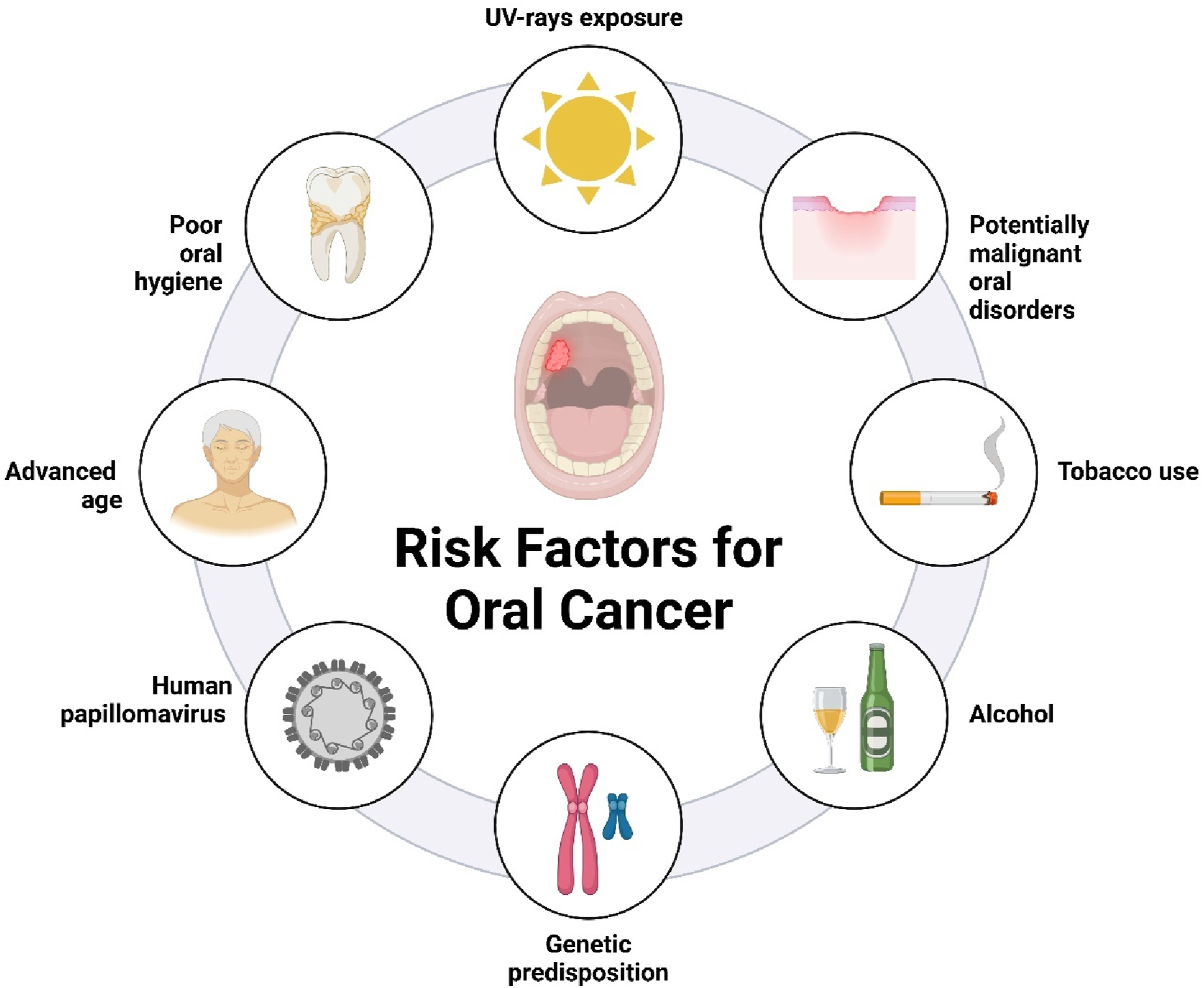
Discussion
The present study has several strengths, including a thorough analysis of medical and dental students’ knowledge of oral cancer risk factors across different countries and educational settings, which increases the generalizability of the results. By comparing the knowledge levels of both groups, the study identifies areas that could benefit from educational improvements. However, it also has limitations. These include the focus on studies published in English, variations in the size of the samples, and differences in the demographic characteristics of the participants, such as age, gender, and academic degree. In addition, factors such as educational profile (public/private institutions), socioeconomic conditions, health systems, instruments and timing of the assessment could have influenced the results. In addition, some risk factors analyzed are not well established as OC risk factors (trauma, oral hygiene, HPV), so this may also introduce variability in knowledge levels. For this reason, the results should be interpreted with caution. Despite these limitations, the study provides valuable insights for future educational interventions aimed at improving oral cancer awareness among healthcare students. An important point that emerges from this study is the need for a more comprehensive and holistic approach to educating healthcare students about OC risk factors. Some of the risk factors analyzed, such as trauma, oral hygiene, and malnutrition, are not yet firmly established as definitive risk factors for OC.59-61 This uncertainty in the scientific community could contribute to the lack of awareness or misunderstanding among students. As these factors are still the subject of ongoing research and debate, the level of emphasis placed on them in educational curricula might vary, which could explain the gaps in knowledge observed in this study. It is crucial for future educational programs to reflect the evolving nature of oral cancer research and ensure that students are updated on the latest evidence regarding these risk factors. This would help in minimizing misinformation and enhancing the effectiveness of training for early detection and prevention of oral cancer.
Across 41 studies with 14,425 participants, 98% of students demonstrated good knowledge and awareness of the different risk factors associated with OC. One of the most significant findings from this study is the near-universal recognition of tobacco as a risk factor for OC, with 99% of participants identifying it correctly. This aligns with previous studies emphasizing the central role of tobacco in the etiology of OC.23,35,56 However, advanced age, which is also a well-established risk factor, 62 was recognized by 68% of participants in our study. This percentage is relatively high compared to studies conducted in Egypt, Turkey, and Spain, where only 28%, 13%, and 13%, respectively, identified age as a risk factor.26,35,39 These regional differences highlight the variability in knowledge and suggest that further emphasis on age as a risk factor may be needed in certain educational contexts. While a high percentage of students recognize well-established risk factors, there are significant gaps in awareness concerning other lesser-known crucial factors, which could limit the effectiveness of preventive measures in clinical practices. When examining the recognition of other important risk factors such as UV-rays exposure, alcohol and OPMD, a significantly lower percentage of students identified these risks. For instance, only 57% of students in our study recognized alcohol consumption as a risk factor. In other studies, a significantly higher percentage of dental students, ranging from 84% to 95%,23,28,56 identified alcohol as a risk factor, while recognition among medical students varied, with rates ranging from 32% to 61%.28,56 The synergistic effect of alcohol, especially when combined with tobacco, in increasing the risk of OC is well established. 63 However, many individuals, particularly medical students, remain unaware of this crucial connection, suggesting a significant gap in education regarding the combined risks of alcohol and tobacco use for oral health. Regarding UV-rays exposure, 64% of participants in our study identified it as a risk factor, which is in line with previous research showing a range of recognition rates among dental students ranging from 56% to 83%.28,35,36 This variability indicates that while UV exposure is generally recognized as a risk factor, awareness levels can vary significantly depending on the study or population. On the contrary, less than 20% of medical students (ranging from 1% to 16%) acknowledged UV-rays exposure as a risk factor.30,39,41 Additionally, the under recognition of OPMD (only 48% of participants) suggests that these areas are not sufficiently covered in current educational programs. OPMDs are critical to recognize early, as they can progress into OC. 61 The low level of awareness around these factors may result in missed opportunities for early diagnosis and prevention. Healthcare professionals must be trained to identify early signs of cancer and potentially malignant conditions, as early detection is key to improving survival rates. Although HPV infection is still being studied as a definitive risk factor for OC, significant advances have been made in recognizing it as an etiological factor, particularly for oropharyngeal cancers. 61 Most HPV-related head and neck cancers arise in the oropharynx, especially in the palatine and lingual tonsils, with only a small proportion affecting the oral cavity. Genotype 16 is responsible for 90%-95% of oropharyngeal cancers, while oral cavity cancers show greater variability in genotype distribution. 61 In this study, only 42% of participants identified HPV infection as a risk factor. This lack of awareness is particularly concerning given the rising incidence of HPV-related oral cancers, especially among younger patients. 64 It is also worrisome because the development of these cancers often involves the oropharynx, an area that is routinely examined by both medical and dental students. This suggests a need for enhanced education on HPV as a risk factor in both medical and dental curricula.
As students progress in their education, it is crucial that they are equipped with not only theoretical knowledge but also practical skills to assess and manage the risk of oral cancer in their future practice. 63 The curriculum for both dental and medical students should place greater emphasis on the early detection and diagnosis of lesions with malignant transformation potential, such as OPMDs. In addition, students should be trained to recognize patient habits such as tobacco and alcohol use that contribute to the development of these conditions and oral cancer. Beyond identifying these lesions, students should also be prepared to counsel patients on the importance of addressing these risk factors. Early identification and intervention can play a critical role in preventing oral cancers and improving patient outcomes.65,66
Public health campaigns should further emphasize the synergistic relationship between alcohol and tobacco use, as well as the importance of a comprehensive risk assessment that includes other well-established risk factors. The findings from this study suggest that educational initiatives may need to be adapted to target specific gaps in knowledge, particularly regarding lifestyle-related risk factors. A more integrated, holistic approach to prevention could significantly improve awareness and early intervention. An important point that emerges from this study is the need for an interdisciplinary approach between medical and dental students. Although each group focuses on different aspects of healthcare, both should be trained to recognize common risk factors and collaborate on diagnosing and managing OC. Interdisciplinary collaboration in the prevention and early detection of OC could lead to improved outcomes, as both medical and dental professionals can play crucial roles in identifying risks and making appropriate referrals for further evaluation or treatment. By addressing these knowledge deficiencies, future healthcare professionals will be better equipped to implement effective prevention measures, promote early detection, and ultimately reduce the incidence of oral cancer. Given the multifactorial nature of oral cancer, it is crucial to recognize all risk factors that may contribute to its development. This review emphasizes the importance of strengthening education on less-recognized risk factors to improve public health outcomes.
Methodological shortcomings according to the JBI tool for cross-sectional studies were in relation to items 1, 2, 5 and 6. It is recommended that future research ensure clearer and more specific eligibility criteria, providing all critical information about participants so that other researchers can assess whether the sample is comparable to the target population. Furthermore, studies with robust methodological designs should not overlook the description of all potential confounding factors that could influence the results. It is also recommended to perform multivariate regression analyses to control for measured confounders, thereby improving the internal validity of the studies.
Conclusions
In conclusion, this systematic review and meta-analysis provides a comprehensive assessment of the knowledge of medical and dental students regarding the risk factors associated with OC. The findings indicate a generally high level of awareness among students, particularly in recognizing tobacco use and age as significant risk factors. However, knowledge gaps were identified, suggesting a need for targeted improvements in educational curricula. The study emphasizes the importance of strengthening training programs for both medical and dental students to ensure they are well-equipped to identify and manage the diverse risk factors associated with OC. Addressing these knowledge deficiencies will be crucial for improving early detection, prevention, and overall patient outcomes in OC care.
Supplemental Material
Supplemental Material - Knowledge and Awareness of Medical and Dental Students about Oral Cancer Risk Factors: A Systematic Review and Meta-Analysis
Supplemental Material for Knowledge and Awareness of Medical and Dental Students about Oral Cancer Risk Factors: A Systematic Review and Meta-Analysis by Lilibeth-Stephania Escoto-Vasquez, Mario Alberto Alarcón-Sánchez, Ruth Rodríguez-Montaño, Julieta Sarai Becerra-Ruiz, Sarah Monserrat Lomelí-Martínez, and Artak Heboyan in Journal of Cancer Control.
Footnotes
Author Contributions
Conceptualization, L.S.E.-V, A.H. and M.A.A.-S.; methodology, M.A.A.-S.; software, M.A.A.-S.; validation, L.S.E.-V and M.A.A.-S.; formal analysis, L.S.E.-V, M.A.A.-S, R.R.-M, J.S.B.-R, A.H. and S.M.L.-M.; investigation, L.S.E.-V and M.A.A.-S.; resources, L.S.E.-V and M.A.A.-S.; data curation, L.S.E.-V and M.A.A.-S.; writing—original draft preparation, L.S.E.-V and M.A.A.-S.; writing—review and editing, L.S.E.-V, M.A.A.-S, R.R.-M, J.S.B.-R, S.M.L.-M and A.H.; visualization, L.S.E.-V, M.A.A.-S, R.R.-M, J.S.B.-R, S.M.L.-M and A.H.; supervision, L.S.E.-V, M.A.A.-S, R.R.-M, J.S.B.-R, S.M.L.-M and A.H.; project administration, M.A.A.-S, and A.H. All authors have read and agreed to the published version of the manuscript.
Declaration of Conflicting Interests
The author(s) declared no potential conflicts of interest with respect to the research, authorship, and/or publication of this article.
Funding
The author(s) received no financial support for the research, authorship, and/or publication of this article.

Supplemental Material
Supplemental material for this article is available online.
Appendix
References
Supplementary Material
Please find the following supplemental material available below.
For Open Access articles published under a Creative Commons License, all supplemental material carries the same license as the article it is associated with.
For non-Open Access articles published, all supplemental material carries a non-exclusive license, and permission requests for re-use of supplemental material or any part of supplemental material shall be sent directly to the copyright owner as specified in the copyright notice associated with the article.
