




Abstract
Background
Human papillomavirus (HPV) is known as a common agent of sexually transmitted infections and cervical cancer. One of the most effective ways for parents to protect their children from HPV is by ensuring they receive vaccinations.
Aim
To determine the percentage of parents who intend to vaccinate their children against HPV and associated factors.
Method
A cross-sectional study was conducted on 365 parents who had children attending high school in Ha Tinh province, Vietnam, from April to May 2023, using stratified and random sampling methods. Data were collected by a self-administered questionnaire designed based on previous studies and the domains of the Theory of Planned Behavior and Health Belief Model. A multivariable logistic regression was performed to determine the association between several factors and vaccination status.
Result
A total of 365 participants took part in the study. The rate of parents intending to vaccinate their children against HPV was 55.9%. Knowledge about the HPV disease and vaccine (all P < .05) and the attitude of parents (P < .001) were determined as the motivation factors that affect the intention to vaccinate children against HPV.
Conclusion
Many parents still do not have the intention to vaccinate children against HPV. Health education communication should focus on the motivation factors, not only to improve the parents’ knowledge and perspective but also to increase the coverage of the vaccine to prevent cancers caused by HPV.
Plain Language Summary
Keywords
Introduction
Human papillomavirus (HPV) is a common agent of sexually transmitted infections in both genders, 1 which can spread during sex or close skin-to-skin with the infected person who may show no symptoms. 2 HPV has many genotypes that cause warts or cancer of the cervix, anus, vulva, vagina, penis, mouth, and throat in people. 2 The person who has abnormal Pap tests (i.e., HSIL) and a positive test for HPV type 16 should be treated by electrosurgical excision procedure. 3 According to the World Health Organization (WHO), cervical cancer is the fourth most common type of cancer among women globally, with approximately 640 000 new cases and 342 000 fatalities reported yearly. 4 In 2020, around 90% of the new cases and deaths occurred in low and middle-income countries such as Vietnam. 4 HPV is responsible for 4.5% of all cancer cases worldwide, with 630 000 new cases annually in both sexes, 8.6% in women and 0.8% in men.5,6
Early administration of HPV vaccination before exposure to risk behaviors is considered a safe and effective measure to help prevent HPV- related diseases. 7 Vaccines have been proven to prevent more than 90% of cancers caused by HPV. 8 A previous study indicates that providing HPV vaccination to both boys and girls could more effectively eradicate HPV and reduce HPV-related diseases compared to vaccinating only girls. 9 HPV vaccination rates are low in low- and middle-income countries. Only about 1% of girls aged 10 to 20 have received at least 1 dose of the HPV vaccine worldwide. 10 In Vietnam, there are 3 approved and recommended HPV vaccines for children and women aged 11 to 26 years including Cervarix, Gardasil 4 and 9.
Sexual activities are prevalent among adolescents, increasing the likelihood of sexually transmitted diseases such as HPV without necessary awareness and protection.11,12 Vaccination is one of the effective ways to ensure that young people are protected against HPV. Parents are the driving force for their children’s health, including receiving any vaccination. According to Ajzen’s Theory of Planned Behavior (TPB), the intention to vaccinate children against HPV may be based on attitude, perceived subjective norms, and perceived behavioral control toward HPV and vaccines, which helps to predict future parental behavior regarding HPV vaccination for their children. 13
The previous studies in Vietnam indicated that the percentage of parents’ intention to vaccinate against HPV is relatively low, ranging from 49.2% to 53.6%.14,15 Some studies have shown that Parents’ knowledge 16-20 and attitudes17,21-23 about HPV disease are associated with their children’s intention to get vaccinated against HPV. Other factors like age, marital status, and educational status of parents also contribute to the lack of HPV vaccination rates among young adults.16,21,24 TPB and The Health Belief Model (HBM) show usefulness, reliability, and applicability in research on individual behavior; specifically, the parents’ intention to vaccinate their children against HPV. 25 Our study aims to investigate parents’ intention to have their children receive the HPV vaccine and identify methods to increase HPV vaccination rates among young adults.
Materials and Methods
Study Design and Sample Size
A cross-sectional study was conducted on parents with children studying at Nguyen Thi Minh Khai High School in Ha Tinh Province, Vietnam, from April to May 2023. The current investigation utilizes the single population proportion formula with a 95% confidence interval, 5% margin of error (d), and population proportion (P = .378) as an estimate of the percentage of parents who intend to vaccinate their children against HPV, as discussed by Jean-Francois Huon et.al. 26 The minimum sample is 362 parents. Predicting a 10% sample loss, we calculated the sample size as 403 parents. The stratified sampling method was utilized to specify the number of students from each grade. We determined 124, 137, and 143 students in 10, 11, and 12 grades, respectively. We then randomly sampled students to participate in the research. For each student, we contacted their parent to inform them about the research. If they agreed to participate, researchers gave them a self-completed questionnaire. Each child had 1 parent enroll in the study. The Strengthening the Reporting of Observational studies in Epidemiology (STROBE) guidelines were used to ensure the reporting of this observational study. 27 The study received medical approval from the Ethics Committee for Biomedical Research, University of Medicine and Pharmacy at Ho Chi Minh City (No 375/HDDD on 20 March 2023). Subjects participated in the study voluntarily; if the parents agreed to participate, they were asked to sign a consent form before taking the survey.
Inclusion and Exclusion Criteria
The inclusion criteria were parents with children studying at Nguyen Thi Minh Khai High School in Ha Tinh Province, Vietnam, from April to May 2023 who agreed to join the study. The exclusion criteria were parents with children vaccinated with the HPV vaccine (at least 1 dose).
Instrument
A structured questionnaire was designed based on previous studies of author Zhang KC et al,
28
author Marlow LA et al,
29
Theory of Planned Behavior (TPB),
13
and The Health Belief Model (HBM).
30
The questionnaire comprises 5 parts, with 30 questions. The first part, with 7 questions, collected sociodemographic characteristics: age group (
The questionnaire was conducted in a pilot study on 30 participants before being used to provide clarity and understanding and address any biases. Parents in the pilot study were excluded from the main study.
Data Collection
Eligible participants were invited to complete the survey during school meetings. Investigators explained the study’s aims in detail before participants filled out the self-administered questionnaire, ensuring the accuracy and comprehensiveness of the collected data. Completing the survey took approximately 10-15 minutes.
Data Analysis
We used Epidata 3.1 and Stata 14.2 software for data entry and processing. The independent variable includes sociodemographic characteristics, knowledge about HPV disease, and attitude about HPV vaccination for the participant’s children. The dependent variable is the intention to vaccinate their child against HPV. The descriptive statistics with all variables were expressed as frequency and percentage. The univariate analysis employed the chi-square test. Next, significant variables (P-value <.05) were calculated using the multivariate logistic regression method, with odds ratio (OR) and 95% confidence interval (95% CI). Significance was considered when the P-value was less than .05.
Result
377 parents participated in the study (response rate was 93.5%). After screening according to the exclusion and inclusion criteria, 12 parents did not meet the requirements, and 365 parents were included in the data analysis.
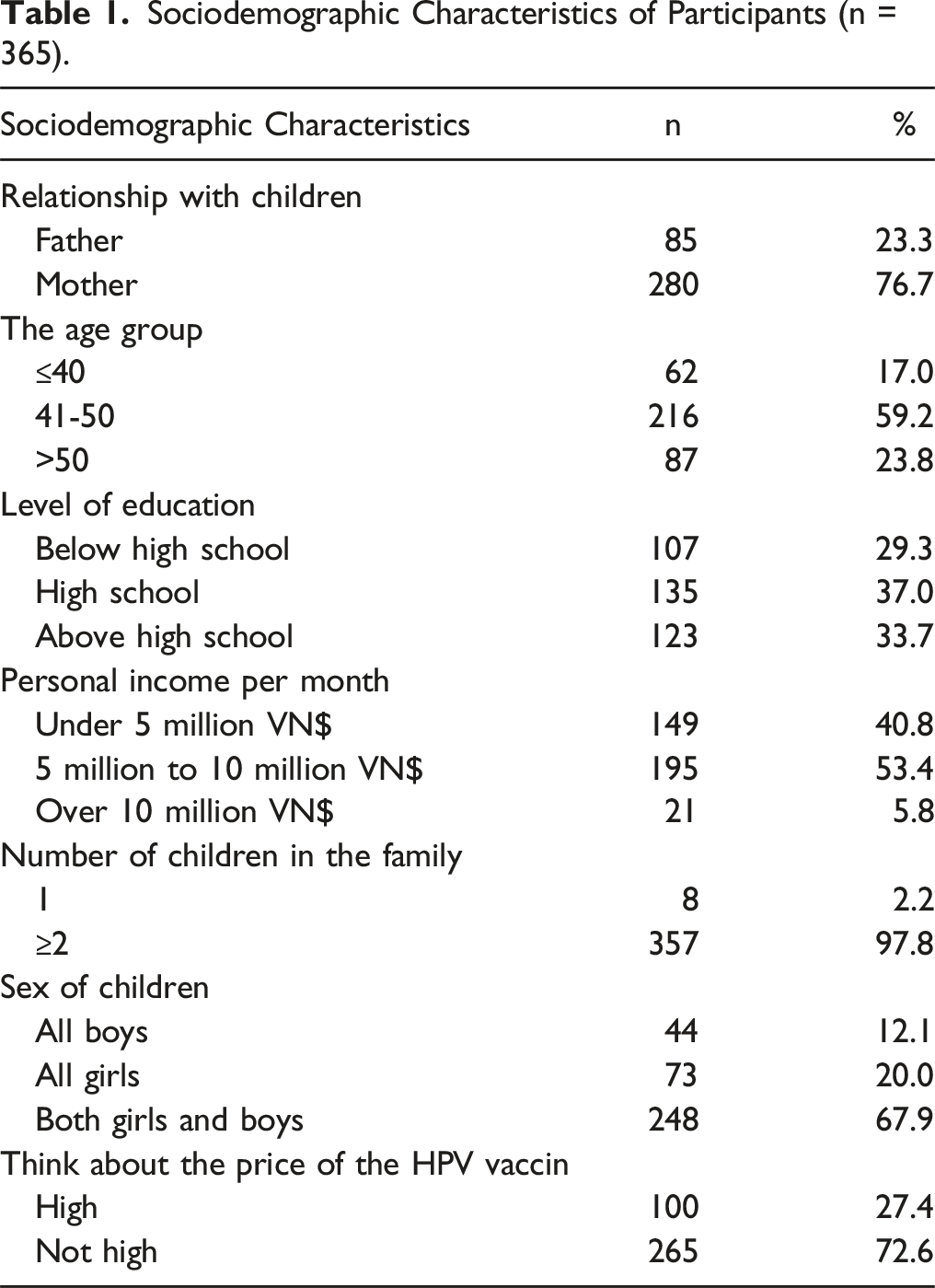
Sociodemographic Characteristics of Participants (n = 365).
Knowledge About the HPV Disease and the HPV Vaccine (n = 365).
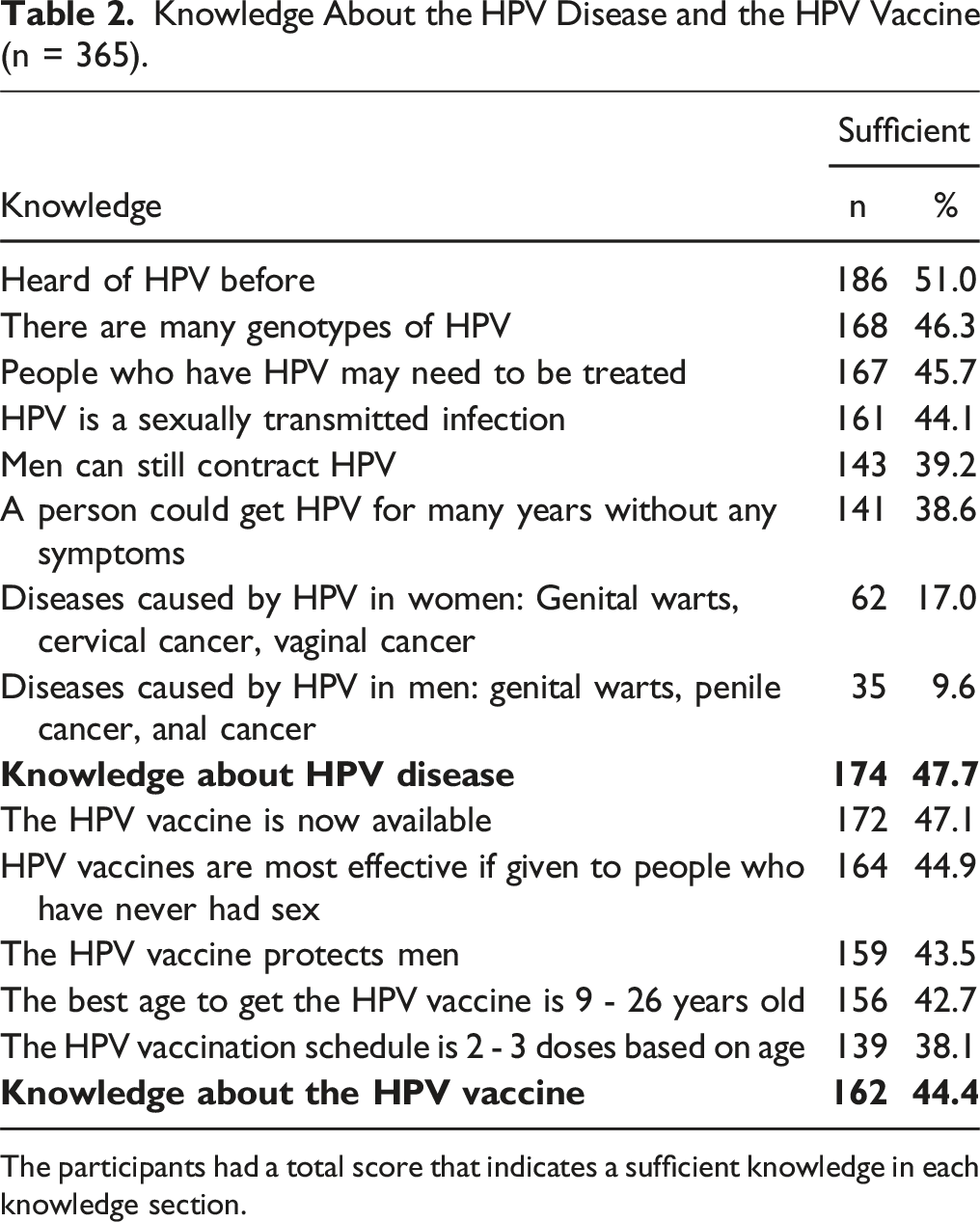
The participants had a total score that indicates a sufficient knowledge in each knowledge section.
Furthermore, 47.1% of parents had sufficient knowledge about the HPV vaccine, and 44.9% indicated that the vaccine is the most effective method to prevent HPV-related diseases. 43.5% of participants knew HPV vaccination could still protect men; 42.7% indicated that the best age to get the HPV vaccine is 9 - 26 years old. The percentage of participants with sufficient knowledge regarding the HPV vaccine was 44.4% (Table 2).
Parents’ Attitude About Children’s HPV Vaccination According to the Theory of Planned Behavior (n = 365).

The participants had a total score that indicates a positive attitude in the attitudes section.
Over half of parents (55.9%) intend to have their children vaccinated against HPV, and 44.1% do not intend to.
The Association Between Characteristics With Parents’ Intention to Vaccinate Their Children Against HPV (n = 365).

The P-value was calculated via the Chi-square test.
The Result of Multivariable Analysis of Associated Factors With Parents’ Intention to Vaccinate Their Children Against HPV.

The P-value was calculated via the multivariate logistic regression.
Discussion
The current result indicates that 55.9% of parents intend to have their children vaccinated against HPV. This result is lower than the study in India (78.0%), 22 Indonesia (96.1%), 21 Japan (93%), 32 Thailand (85%), 17 but higher in some studies in China (26.5%), 16 France (37.8%), 26 and Austria (32.4%). 24 It can be concluded that parents’ intention to vaccinate their children against HPV varies between countries. This may be due to the differences in parents’ characteristics in each country, such as knowledge about HPV, household income, religion, level of education, occupation, residence area, price of the HPV vaccine, and age of parents and children. These factors were indicated to have an effect on the intention of HPV vaccination of parents for their children in the previous studies.17,18,21,22,24 In addition, the disparity of health systems is an important reason. For instance, providing more information about HPV disease and HPV vaccines from health care workers, vaccine programs, getting the vaccine for free, or having the proper prices demonstrated could increase the acceptance and parents’ intention to vaccinate children.16-18,21,22,24,32
Approximately one-third of participants have good knowledge about HPV diseases and HPV vaccines, with percentages of 30.1% and 44.4%, respectively. These findings are in line with previous studies that a lack of awareness about HPV is common.15,18,19,33 This result may be due to: first, the effect of some characteristics. For instance, parents with higher income and levels of education will have greater HPV knowledge than those with lower levels.16,18 Additionally, the HPV vaccine has not been added to the Expanded Program on Immunization in Vietnam for children. This leads to this vaccine being less popular and not given as much attention in the community as the other vaccines. In Austria, the HPV vaccine is free to all children 9-12 years old, and 85.4% of participants have knowledge about the vaccine. 24 Compared with China where the HPV vaccine is not licensed, just 10% person know about the vaccine. 16 In this study, only 47.1% of parents knew the HPV vaccine was now available in Vietnam.
Parents with adequate knowledge about HPV diseases and the HPV vaccine have a higher percentage of HPV vaccination intentions for their children than parents who do not have knowledge by 3.34 times and 2.82 times, respectively. These results support the findings of previous studies.16-20 In a study by the author L. Jaspers in Indonesia, the most common reason parents decided to let children be vaccinated with HPV is they believe HPV vaccination is effective. The second reason is that it is a good way to protect their child. 21 Providing information about HPV might let parents recognize the high risk that this virus could have when infected. Moreover, they need to know that the HPV vaccine is the best way to protect their children, which may lead to the motivation to increase vaccine uptake rates.
Based on the analysis, individuals with a positive attitude were more inclined to vaccinate against HPV than those who did not have a positive attitude. This finding is consistent with the result of earlier research17,21-23 that suggests a parent’s attitude towards HPV vaccination significantly determines their intention to vaccinate their children. Moreover, our research found many individuals cited concerns related to the HPV vaccine. Specifically, 87.4% of participants were worried about the vaccine’s potential side effects, 78.6% believed that the protection provided by the HPV vaccine was only temporary, and 58.1% thought their child was afraid of getting vaccinated. The reasons mentioned above aligned with earlier studies conducted by L. Jaspers and Madeleine W.21,23 Some negative attitudes were identified and rarely mentioned in previous studies. For example, participants indicated they did not have time to get their children vaccinated, the children were afraid of vaccination, and they thought Vietnam still did not have an adequate supply of HPV vaccine. These negative attitudes about the HPV vaccine may decrease the percentage of parents who have the intention to vaccinate their children following the Theory of Planned Behavior. 34 Changing the parents’ attitude by providing the effect and safety of the HPV vaccine may help increase the intention to vaccinate their children. 22
Our study had some limitations. This is a cross-sectional study conducted at 1 point; each participant only collects information once and needs to be followed over time; hence, it is difficult to determine a cause-and-effect relationship. We provide more information to readers about the parents’ intention to vaccinate their children against HPV and identify the related factors, including knowledge and attitude, and how this may affect parents’ intention to vaccinate.
Conclusions
Many parents did not have the intention to vaccinate their children against HPV. Providing information about HPV diseases and vaccines to address the misconceptions that were identified may change the attitude regarding their intentions to vaccinate their children. The researchers hope that this study will increase the coverage of the HPV vaccination in children to prevent cancers caused by HPV.
Supplemental Material
Supplemental Material - Parents’ Intentions of Human Papillomavirus Vaccination for Students in Vietnam: A Cross-Sectional Study
Supplemental Material for Parents’ Intentions of Human Papillomavirus Vaccination for Students in Vietnam: A Cross-Sectional Study by Lam Thi Phuong Nguyen, Dung Quoc Phan, Araba Gyan, Han Thi Ngoc Nguyen, David Cassell, and Giao Huynh in American Journal of Health Promotion
Footnotes
Acknowledgments
We wish to acknowledge the support of the teachers at the high school in Ha Tinh province who facilitated the study. We thank all the participants for the time and effort that they devoted to the study.
Author Contributions
All authors contributed substantially to drafting, revising, and approving the article’s final version. Lam Thi Phuong Nguyen and Giao Huynh contributed to the conception and design of the study and acquisition of the data. Dung Quoc Phan and Lam Thi Phuong Nguyen cleared and analyzed the data. Dung Phan Quoc, Araba Gyan, Han Thi Ngoc Nguyen, David Cassell, and Giao Huynh were the contributors to the interpretation of the data.
Declaration of Conflicting Interests
The author(s) declared no potential conflicts of interest with respect to the research, authorship, and/or publication of this article.
Funding
The author(s) received no financial support for the research, authorship, and/or publication of this article.
Ethical Statement

Data Availability Statement
The datasets generated during and/or analyzed during the current study are available from the corresponding author on reasonable request.
Supplemental Material
Supplemental material for this article is available online.
References
Supplementary Material
Please find the following supplemental material available below.
For Open Access articles published under a Creative Commons License, all supplemental material carries the same license as the article it is associated with.
For non-Open Access articles published, all supplemental material carries a non-exclusive license, and permission requests for re-use of supplemental material or any part of supplemental material shall be sent directly to the copyright owner as specified in the copyright notice associated with the article.
