




Abstract
Introduction
Cancer is a major public health problem and a global leading cause of death where the screening, diagnosis, prediction, survival estimation, and treatment of cancer and control measures are still a major challenge. The rise of Artificial Intelligence (AI) and Machine Learning (ML) techniques and their applications in various fields have brought immense value in providing insights into advancement in support of cancer control.
Methods
A systematic and thematic analysis was performed on the Scopus database to identify the top 100 cited articles in cancer research. Data were analyzed using RStudio and VOSviewer.Var1.6.6.
Results
The top 100 articles in AI and ML in cancer received a 33 920 citation score with a range of 108 to 5758 times. Doi Kunio from the USA was the most cited author with total number of citations (TNC = 663). Out of 43 contributed countries, 30% of the top 100 cited articles originated from the USA, and 10% originated from China. Among the 57 peer-reviewed journals, the “Expert Systems with Application” published 8% of the total articles. The results were presented in highlight technological advancement through AI and ML via the widespread use of Artificial Neural Network (ANNs), Deep Learning or machine learning techniques, Mammography-based Model, Convolutional Neural Networks (SC-CNN), and text mining techniques in the prediction, diagnosis, and prevention of various types of cancers towards cancer control.
Conclusions
This bibliometric study provides detailed overview of the most cited empirical evidence in AI and ML adoption in cancer research that could efficiently help in designing future research. The innovations guarantee greater speed by using AI and ML in the detection and control of cancer to improve patient experience.
Introduction
Cancer is a significant public health problem worldwide, characterized by an increasing prevalence and mortality rate. 1 According to an update on global cancer burden using the GLOBOCAN 2020 database, about 19.3 million new cases and almost 10 million deaths were estimated. 2 Breast cancer remains the most prevalent, whereas lung, colorectal, prostate, and stomach cancers are the most commonly reported cases. Lung cancer remains the leading cause of cancer death, with an estimated 1.8 million deaths, followed by colorectal, liver, stomach, and breast cancers. 2 Treatment and prevention measures of cancer are still challenging 3,4, but the emergence of artificial intelligence (AI) and machine learning (ML) positively supports treatment and control of cancer.5,6
Recently, the increasing knowledge of AI techniques caused significant positive waves in healthcare by gradually altering the global landscape of healthcare and biomedical research. 7 Machine learning (ML) is a subfield of AI that can be regarded as an umbrella term encompassing various algorithms that can automatically learn and improve with experience. 8 Whereas Deep Learning (DL) is the subset of ML that uses neural network-based models to mimic the human brain’s ability for processing massive amounts of complex data, such as image recognition, languages processing, drug discovery, to name a few, all of which acts as a decision support system for humans. 9
Since the early 1970s, AI successfully made revolutions in medicine. 10 Oncology research focused on decoding the molecular onset of cancer by understanding the complex biological architecture of cancer cell proliferation. 11 Moreover, AI in clinical decision-making process was believed to increase the chances of early disease diagnosis and prediction by using next-generation sequencing (NGS) and high-resolution imaging techniques. 12 There was a recent successful application of AI in cancer classification through gene selection to determine whether those genes were active, hyperactive, or silent in normal or cancerous tissue. 12 On the other hand, the use of support vector machines in skin cancer diagnostic can potentially provide low-cost universal access to vital diagnostic care, 13 cancer gene expression signatures using artificial neural networks, 14 and in breast cancer research prediction and prognosis.15,16
Remarkable progress has been made in adopting innovative technology in cancer research to fast-track diagnosis, prediction, and possible treatment modes. Consequently, research reported the variety of AI and ML techniques as templates for global practices,7,9,16 which enabled big data and cognition capable computers to support cancer research specialists to revolutionize medicine by performing complex tasks to improve diagnostic accuracy, increase the efficiency of throughputs, improve clinical workflow, decrease human resource costs, and improve treatment choices. 17
Cancer research in lungs, breast, ovary, and pancreas has innovatively explored AI and ML to provide an evidence-based approach in the field. While some studies investigated the use of AI for breast screening based on ethical and social issues of the adoption 18 and radiologist performance, 19 there are evidences of new findings like DL supporting the discovery of lymph node metastases from breast cancer. 20 Similarly, by adopting CADe ML models in colorectal screening, endoscopic images and videos were processed in record time and gave allowance for real-time recognition of polyps with an excellent and high accuracy.21,22 Other ML learning approaches have been used to detect mismatch repair deficiency (dMMR) in colorectal screening. 23 In liver cancers, AI approaches using CS-SVM on liver cancer rehabilitation groups found that the methods can explicitly project the time and location of cancer reoccurrence. 24 While the adoption of AI and ML for cancer prediction, diagnosis, and rehabilitation is increasingly discussed among researchers, accessing the scope, progress, and achievement may serve as a reference for future research and applications of innovative technologies.
Notably, there is an increasing number of articles reporting the advancements in the AI and ML applications that enabled fast-tracked and ease in cancer screening, diagnostic, test precision, cancer classification, and cancer prediction and prognosis.7-19 As new approaches, AI and ML are practical tools to ensure improvements in patient care and control of cancer cases to reduce mortality rates globally.
Therefore, a bibliometrics analytical method was used to assess the research field’s critical areas to extend the discourse in this domain. Bibliometrics approach are widely adopted among researchers to identify various research themes and quality of the published work, thus providing information on research performance, publication patterns, and characteristics, determine research gaps, and predict the direction for future studies.25-31 Moreover, with global limited healthcare resources, bibliometric studies can be seen as a guiding tool for scientists and research funding agencies to map areas where restriction or increase in research may need to be considered.
32
The study adopted a bibliometric and systematic approach in exploring the top 100 cited articles to extend the empirical evidence on the adoption of ML and AI in cancer prediction, diagnosis, and other related research. Therefore, our study was timely conducted to provide a current and broad understanding of AI and ML in cancer research. The findings of this study can support the scientific community with a perspective on the evolution of cancer research adopting AI and ML over the past years and highlight possible future directions. This study aimed to; i. Identify and characterize the top 100 cited articles published on AI and ML application in cancer research and provide useful information on the citation analysis, manuscript impact, research performance, and author productivity in the scientific community. ii. Systematically determine and deliberate the status and current evidence and scopes of the top 100 cited articles. iii. Provide an overview of the conceptual framework and the thematic change and evolution of the mostly influenced topics regarding AI and ML application in cancer.
Methods and Material
Study Design
The study adopted a systematic search and thematic analysis to examine the top-cited research on AI and ML to accentuate their impacts and innovations. The study approach has previously adopted multiple research domains to monitor and evaluate research performance for direction and necessary future action.33,34
Data Source
The data used in this study was extracted from the Scopus database, a large repository for scientific publications (www.scopus.com/). The data was downloaded from public source databases, and no ethical approval is needed for this study.
Search Strategy
Documents relating to artificial intelligence (AI), machine learning (ML) applications in cancer research published between 1978 and July 10, 2021, were searched in Scopus (https://www.scopus.com/) database.
The search query was uniquely developed for the current study for all published documents using the following terms: Title (Benign neoplasms* or malignancy* or malignant neoplasms* or neoplasia neoplasm* or neoplasms* or benign* or tumors*), and (artificial intelligence* or machine learning* or deep learning* or convolution neural network* or neural network* or random forest* or support vector machine* or fuzzy logic* or computer vision* or automatic programming* or speech understanding* or autonomous robots* or intelligent tutoring* or intelligent agents* or neural network* or voice recognition* or text mining*).
Inclusion and Exclusion Criteria
The search results were subsequently refined to include only original articles and reviews published in English. Documents published in “(“Chinese” or “Japanese” or “Persian” or “German” or “Russian” or “Spanish” or “Polish” or “Korean” or “Portuguese” or “Turkish” or “Arabic” or “Danish” or “French” language were excluded from this study. We further restricted the search to the final publication stage, and other articles in the press were also excluded from the analysis.
In total, 3263 documents within the Timespan: 1978 to July 10, 2021 were identified and then the top 100 cited articles were selected based on the citation times. The Metadata was exported into comma-separated value (csv) excel and BiB TeX format files for further in-depth analysis. The retrieved data included citation information, bibliographical information, abstract and keywords, countries, institutions, funding agencies, funding details, and other information such as references.
Top-cited articles were sorted by the “Times cited” and two researchers independently screened the document’s based on the research title. All bibliographic information such as Title, authors, affiliation, keywords analysis (author keyword, abstract, and title keyword), and countries of origin were included with the aims of identifying the countries with the most significant number of publications based on the corresponding author, research categories, funding agencies, and journals sources.
Ranking of Top-performing Authors, Journals and Articles
The journal impact factor and journal quartile range were obtained from the Journal Citation Report (JCR), which offers an updated list of journals ranked by Journal Impact Factor (JIF) to assess the quality of contributed journals in AI, ML, and cancer research. We also investigated the association between citation number in journals, authors, and the number of publications per year with the number of citations. The frequency distribution analysis for scientific productivity for an author’s contributions in AI, ML, and cancer is evaluated in according to Lotka’s law. 35
Data Analysis
Data analysis was conducted using Bibliometrix, an R package applied in R version 4.0.4. The VOSviewer.Var1.6.6 36 was used to analyze the co-authorship regarding two standard weight attributes “Links attribute” (L) and “Total link strength attribute” (TLS). 37 The Spearman correlation coefficient ® was used to calculate the association between the number of publications and the number of times cited. GraphPad Prism 6.03 for Windows (GraphPad Software Inc., San Diego, CA, USA) 38 was used for statistical analysis and P-values less than .05 was considered statistically significant.
Results
Main Information on Artificial intelligence and machine learning in cancer.

aFrequency distribution of keywords associated with the document by Scopus.
bFrequency distribution of the authors’ keywords’.
cThe scientific collaboration on the social process by which two or more researchers are work together sharing their intellectual and material resources to produce new scientific knowledge.

Annual growth of publications and mean of Total Citation Per Year (Mean TC Per Year) on Artificial Intelligence and Machine learning in cancer.
Author with at least 3 articles and more in Artificial intelligence and machine learning in cancer.

SCR: Standard Competition Ranking; TNC: Total Number of Citation, TNP: Total Number of Publications.
Countries contributing at least 3 articles and more in Artificial intelligence and machine learning in cancer.

SCR: Standard Competition Ranking; TNP: Number of publications; TNC: Total Number of Citations; AAC: Average Article Citations; SCP: Single Country Publication (Intra-Country Collaboration). MCP: Multiple Country Publications (Inter-Country Collaboration).
aLower International Collaboration (Value: Less 0,50).
bHigh International Collaboration (Value: More than 0,50).
Journal with at least 2 articles and more in Artificial intelligence and machine learning in cancer.

SCR: Standard Competition Ranking; TNP: Total Number of publications; TNC: Total Number of Citations; IF: Impact factor.
The top 100 Keyword Plus were visualized and summarized using WorldCloud analysis for top 100 cited articles on AI, ML, and cancer research documents. The most frequently occurring keywords were: “Human” (85), “female” (76), “humans” (69), “aged” (57),’ adult (47), “sensitivity and specificity” (43), “artificial neural network” (38), “middle aged” (38), “artificial intelligence” (37), “computer-assisted” (31), “mammography” (30), “algorithms” (29), “breast cancer” (29), “machine learning” (29), and “deep learning” (26), among others keyword (Figure 2). WordCloud analysis of the top 100 Keywords based on the frequency occurrence of the keyword.
As a result of the co-occurrence analysis of Keywords Plus, a total of 179 keywords grouped in 16 clusters were uncovered with links (L=656) and a Total link Strength (TLS=688). Research involving breast cancer emerged as the hot researched area (L=48, TLS=56), followed by machine learning (L=27, TLS=33), and cancer classification (L=24, TLS=30), among others (Figure 3). Co-occurrence analysis of Keywords Plus based on the Total Links Strength (TLS).
Figure 4 shows the conceptual structure analysis using a thematic map, the horizontal axis denotes the Relevance Degree (Centrality) and the vertical axis represents Development Degree (Density), and four quadrants comprise as: first quadrant (top right): motor-themes, both important and well-developed; second Quadrant (top left): Niche themes or Highly Development and Isolated Themes, which have developed well but are not important for the current field; third quadrant (bottom left): emerging topic or disappearing themes for AI and ML in Cancer topics; fourth quadrant (bottom right): basic themes or basic and Transversal Themes, it is an important to the field AI and ML in Cancer research, but not well-developed. The basic concept of topic themes published in the file is presented in (Figures 4A–4C). Conceptual structure analysis using thematic map analysis for (A) KeyWord Plus, (B) Authors Keywords, and Title (C) for Topics reported in Artificial Intelligence and Machine learning in cancer literature.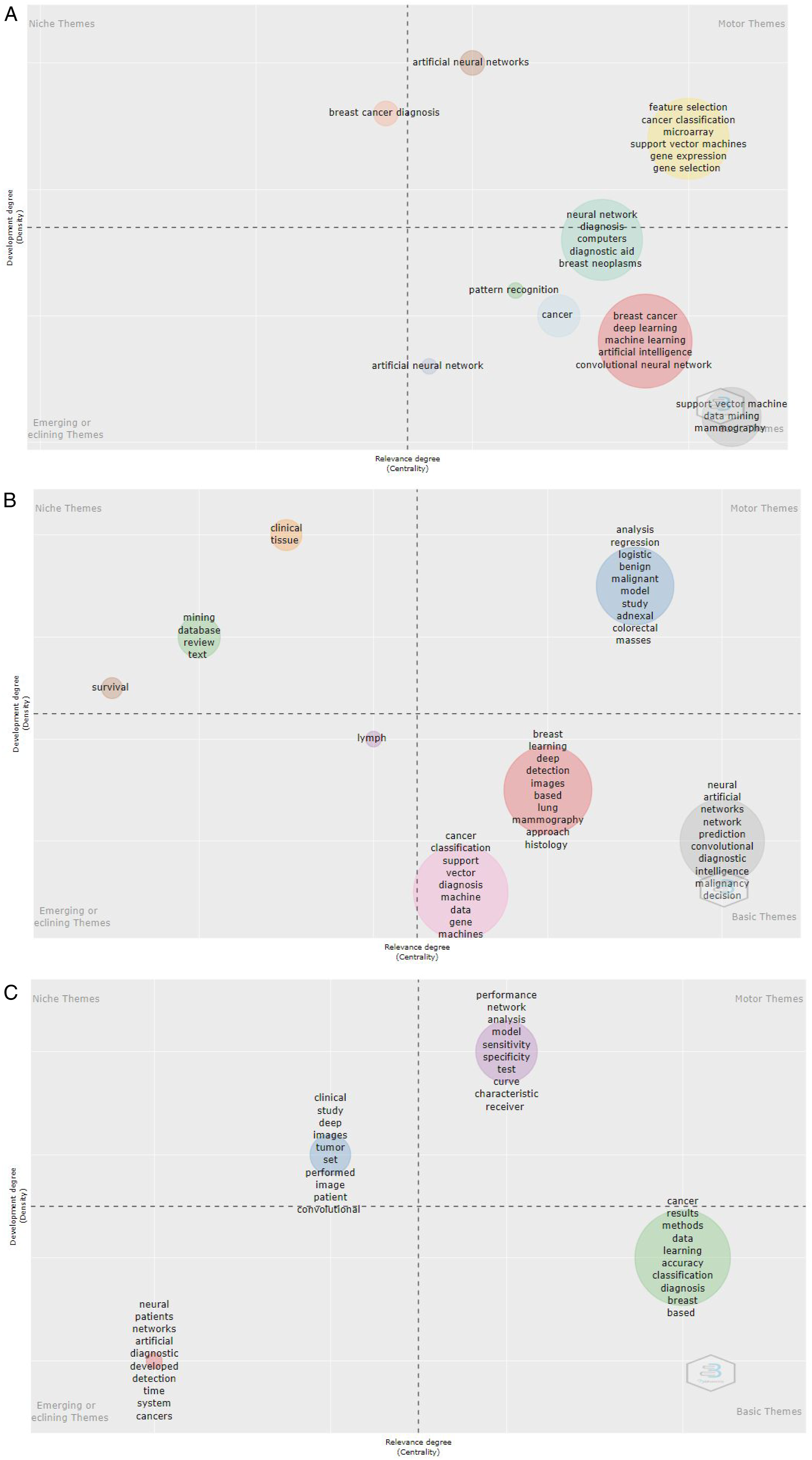
Analysis of the top 100 cited articles based on the number of received citations is depicted by Figure 5. A total of 59 top-cited articles formed 11 clusters with Links 85. The top-cited document was published by Guyon I (2002) and received (L=5758), followed by Esteve A. (2017), which received (L=3815) times Co-citation analysis between the top 100 cited documents by authors (A), Journal Sources (B), and country (C).
As previously mentioned, the initial analysis comprised a total of 57 journals. Only 41 journals met the threshold and formed 9 clusters with (TLS=79) times. Expert systems with the application (TLS=15), followed by Bioinformatics (TLS=13), Nature (TLS=10) and Nature medicine (TLS=9) times (Figure 5 B).
Only 39 countries met the threshold and are shown in the co-citations analysis across 9 clusters among the total contributed countries. The USA was the top-ranked country with (TLS=115), followed by the United Kingdom (TLS=95), Germany (TLS=40), Belgium (TLS=29), and the Netherlands (TLS=17) among other reported countries (Figure 5C).
The common conceptual structure for research in a dataset provides a clearer understanding for published research direction in the field. The common research, based on keywords associated with AI and ML in cancer research within the retrieved documents, was investigated using multiple correspondence analysis (MCA). The 50 keywords analyzed were clustered into five clusters. The first cluster included eight keywords (diseases, prediction, artificial intelligence, Algorithms, Classification, Neural networks, Cancer classification, and Tumor). The second cluster included had 22 keywords (Diagnostic accuracy, Networks computer, Sensitivity and Spasticity, controlled study, Diagnostic imaging, machine learning, deep learning, and pathology) as seen in Figure 6A. Multiple Correspondence Analysis (MCA) (A) and Correspondence Analysis (CA) (B) associated with Artificial Intelligence and Machine Learning in cancer literature analysis based on Keyword Plus.
Correspondence Analysis (CA) shows that the keywords most associated with AI and ML in cancer research studies are mainly grouped in two clusters 2 keywords (disease and data mining), 4 keywords (diagnosis, breast cancer, neural network, and tumors), 39 keywords (prediction, algorithms, and image processing computer-assisted), respectively
The identified themes and visualization of the topic evolution in AI and ML in cancer literature from 1993 to 2019 were explored. A thematic growth of the themes of research in AI and ML in cancer was detected in each period considering their keywords and evolution across four temporal periods, that is, (1993–2004), (2005–2010), (2011–2017), and (2018–2019) as shown as Figure 7 Thematic evolution of the research in Artificial Intelligence and Machine learning in cancer literature using: (A) KeyWords Plus, (1993–2019).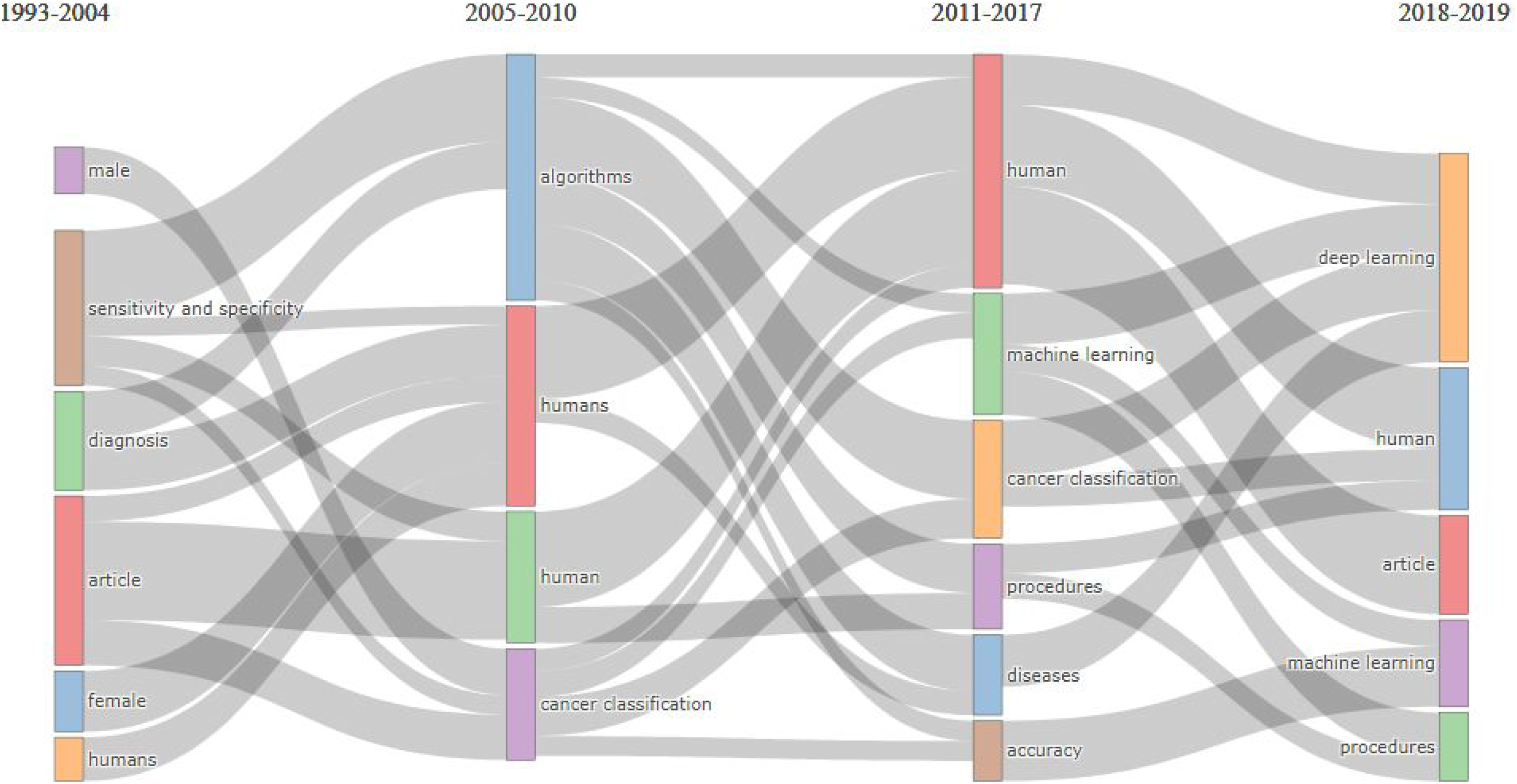
Top-Cited Articles by Cancer Types, Diagnosis, Prevention, and Treatment
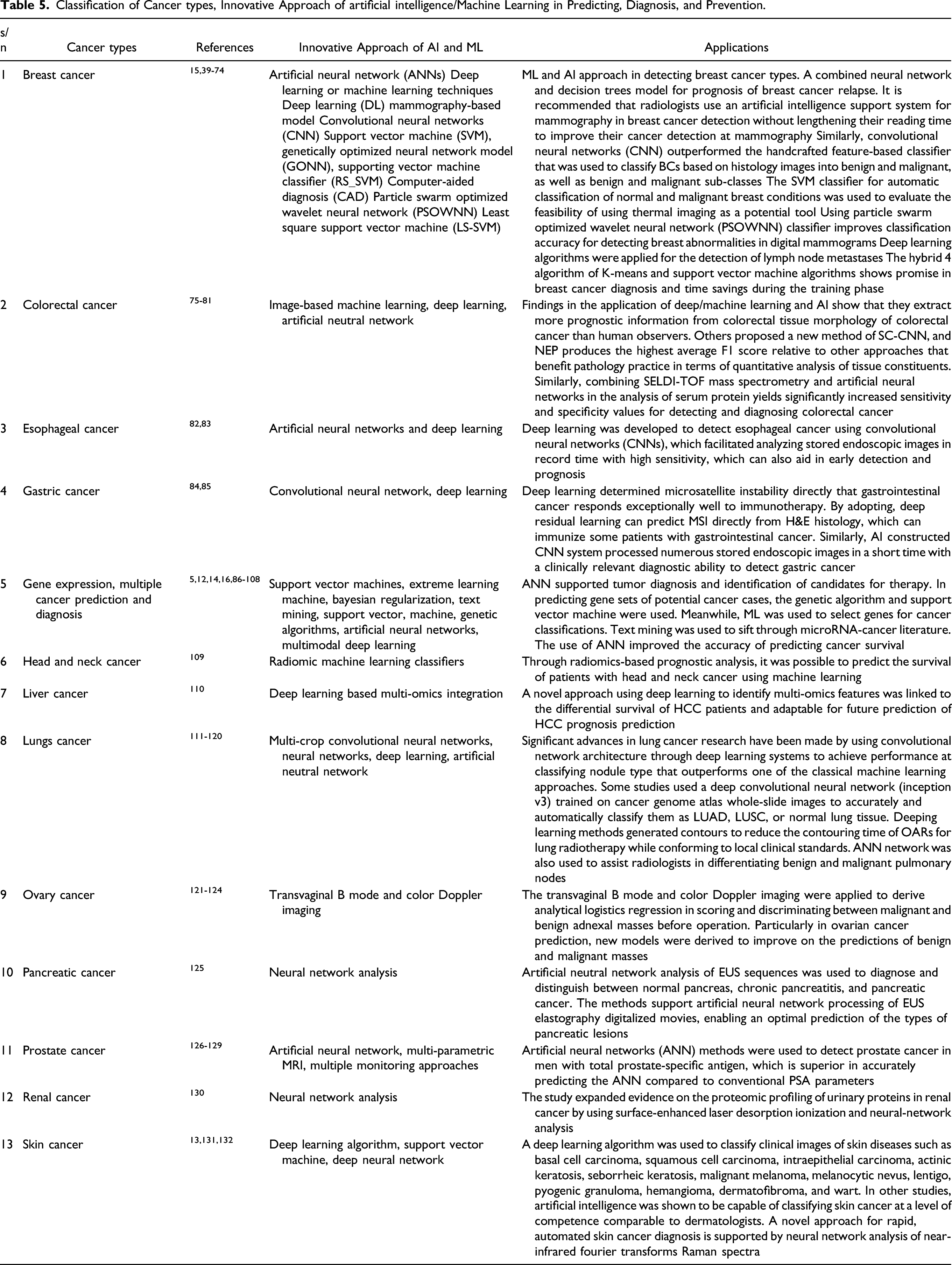
Classification of Cancer types, Innovative Approach of artificial intelligence/Machine Learning in Predicting, Diagnosis, and Prevention.
Discussion
The presented bibliometric study highlighted the characteristics of the 100 cited articles on AI, ML, and cancer research from the Scopus database. Our analysis shows the publication’s growth on AI and ML in cancer research. The cumulative amount of published documents showed increased interest in ML and AI techniques and applications that have improved the predictive ability and diagnosis in cancer research.5,96
AL and ML techniques were introduced in the medical diagnosis of cancer imaging starting from the late 1990s, 92 cancer immunotherapy, 133 and cancer diagnosis and prognosis. 134 Recently AI and ML have been increasingly implemented across healthcare and medical research.135-138 However, AI and ML-based approaches will have a more dominant influence in digital healthcare for diagnosis and treatment in the coming years.96,137 Among the articles published in 2015 is a review paper titled “Machine Learning Applications in Cancer Prognosis and Prediction,” which highlighted the use of AI in healthcare to identify the risk factors in patients with cancer.96,137 Another top-cited article focused on using AI to detect lymph node metastases in women with breast cancer in a healthcare unit. 139 Those published documents were premised on AI, ML to predict, diagnose, and control, or classify cancer diseases.
Breast cancer research was prominent in adopting AI and ML as evidence has shown it is a significant cause of death among women. 140 Meanwhile, it is confirmed that the early detection and accurate diagnosis of this disease might offer a long survival rate for the patients by using advanced tools such as artificial neural networks to predict breast cancer from mammographic findings.39,54,141 Using DL broader family of machine learning methods based on artificial neural networks techniques can be used to diagnose the disease of breast cancer with high classification accuracies.39,41,142 In addition, its application to the medical field can accurately detect breast cancer on screening mammograms using an “end-to-end” training approach. 40 ML techniques currently used in this field were to screen breast cancer with mammography as an effective method in reducing breast cancer–related death, or Neural network approach for early detection and identification of women at high risk of developing breast cancer 143 and prognosis of breast cancer. 40
In research on colorectal cancers, deep learning advances the approach of proposing a new approach using a new method of spatially Constrained Convolutional Neural Network (SC-CNN), and Neutral endopeptidase (NEP). Other researchers combine Surface-enhanced laser desorption ionization-time of flight mass spectrometry (SELDI-TOF) mass spectrometry and artificial neural networks to analyze serum protein with high production sensitivity and specificity values for detecting and diagnosing colorectal cancer.75,80 The esophageal and gastric cancer prognosis were conducted through CNNs constructed through AI to support early detection and speedy prediction.83,84 The application of AI and ML supported these outcomes and was evidence-based on the approaches’ speed and accuracy. Like in gene expression research applications, ANN supported tumor diagnosis, survival of patients, classification and identification of candidates for therapy, and genetic algorithm and support vector machine supported in predicting gene sets of potential cancer cases.82,88,144
AI and ML innovative approach cut across all cancer research to advance general healthcare practices. Significant achievements in lung cancer research have adopted convolutional network architecture through DL system achieves performance at classifying nodule type that surpasses one of classical machine learning approaches. Some studies used trained a deep convolutional neural network (inception v3) on whole-slide images of Cancer Genome Atlas to accurately and automatically classify them into LUAD, LUSC, or normal lung tissue.114,115 In ovarian prognosis, Transvaginal B mode and Color Doppler Imaging were applied to derive discriminating between malignant and benign adnexal masses before operation.97,124 While in liver cancer research, a novel approach using DL was used to identify multi-omics attributes of survival of HCC patients and adaptable for future HCC prognosis prediction. 110
Remarkable progress was made in adapting AI and ML to diagnose, predict, and control pancreatic, renal, skin, and prostate cancer research.86,92,125,130,145 A deep learning algorithm was tested to classify clinical images of skin diseases-basal cell carcinoma, squamous cell carcinoma, intraepithelial carcinoma, actinic keratosis, seborrheic keratosis, malignant melanoma, melanocytic nevus, lentigo, pyogenic granuloma, hemangioma, dermatofibroma, and wart.146,147 The study extended evidence on the Proteomic Profiling of Urinary Proteins in Renal Cancer by adopting Surface-Enhanced Laser Desorption Ionization and Neural Network Analysis. 130 Applied artificial neutral network analysis of sequences of EUS to diagnose and differentiate normal pancreas, chronic pancreatitis, and pancreatic cancer. The methods support artificial neural network processing of EUS elastography digitalized movies, enabling an optimal prediction of the types of pancreatic lesions. 125
Generally, the analysis shows that global interest among the scientific community is based on the number of times an article is cited, and we notice some articles received more than 1000 classical citations with the current study period.12-14,102 These studies can be considered baseline and fundamental building blocks for further studies. The articles describe, for example, the use of Support Vector Machines (SVM) in cancer classification, 12 Skin cancer, 13 and classification diagnostic and prediction of cancer using gene expression, Artificial Neural Network applications, 14 and use of automatic techniques to classify and validate cancer tissue in human. 102 A potential aiding factor to this rising interest can be attributed to the exponential growth of computing power and data storage capacity over the past few years.148,149 Aerts Hugo J. W. L, Collins William P and Doi Kunio were the most productive authors for using AI and ML technology in cancer research. The study also highlighted the multidisciplinary links among the authors and the interdisciplinary nature of AI and ML in cancer research.
Regarding the geographical distribution of the articles across countries, the USA published 30 articles and was the leading country in productivity based on a single country and multiple country publication, followed by China. Moreover, based on the analysis of Multiple Countries Publication (MCP), we notice that Germany and Belgium had a high ratio of collaboration in AI, ML, and cancer research productivity, respectively, which surpassed those of the China, USA, and the United Kingdom. This evidence leads us to believe that future collaboration for research in the field is highly required among the scientific community. Our findings show that the impact of articles published by the USA is higher. Nevertheless, and due to the massive technological advancements and rising interest, it is believed that the quality and quantity of studies coming from China and several other countries are expected to improve in the future.
In terms of journals, it was observed that the journal “Expert Systems with Applications” is the favorite publication destination, followed by the journal of “Scientific Reports”, the journal of “Radiology,” and the Journal of “Artificial Intelligence in Medicine”. We believe that further support and interest from publishing houses and journals such as launching special issues for works investigating the use of AI, ML in cancer research will help promote this field of research further. Through keyword analysis, it was observed that the focus on AI, ML, and cancer research within the distributed clusters offered an indicator that there is noticeable growth. There is a gradual shifting from “artificial neural network application using neural network (computer application)” to “use of computer application” in image processing, different diagnosis type of cancer such as (breast tumor, breast neoplasms, breast cancer, and mammography) over the past 26 years. Therefore, we believe that scientific breakthroughs might be related to these hotspots in recent years. As for future applications, we suggest that authors select research topics from the map and demonstrate their importance as a frontier hotspot. This approach might also support the funding organization in enhancing the research and directing the funds to a specific area yet to be covered by the scientific community.
Although this analysis is considered as the first comprehensive study of publications for AI and ML in cancer research, we also believe that there are some limitations regarding the survey techniques adopted in this study. Even though Scopus represents a comprehensive, abstract, and citation database with enriched data and linked scholarly content, including other similar databases such as Google Scholar, Web of Science, and PubMed can provide more insights and outlook into the field. Our study included only certain documents, such as original research articles and reviews published in English. Extending the analysis to include other document types and articles can also prospect future studies.
Despite the limitations mentioned above, and the best of our knowledge, this study is the first bibliometric analysis of publications involving AI and ML techniques for cancer research. Through this effort, we sought to provide researchers in the field and the general academic community with an overview of the evolution of publications over the past 26 years, current research status, and future research trends concerning the use of AI and ML techniques in cancer research. This study confirms our initial hypothesis that the use and implementation of recent computing paradigms in healthcare are enormously increasing.
Implications for Cancer Research and Control
AI and ML have the innovative potential and technological toolkit to diagnose, predict, and control cancer for global clinical and medical practices. This study demonstrated remarkable progress in clinical practices for cancer research and offered new methodological window for reviewing cancer research. Our findings showed that AI and ML have gained global interest and adoption, promoting accurate diagnosis of various cancer types. Nevertheless, significant challenges must be sorted to encourage robust global adoption. Ethical and private concerns should be resolved, especially those concerning patients and their privacy, which calls for global AI and ML control to ensure transparency, data protection, and best practices. Patient voice and opinion become relevant in the global adoption of AI and ML. Future studies should explore perception, attitude, and willingness to allow private information to go through the analytical process. The approach also supports disseminating AI and ML awareness in health systems to increase global support.
The study provides a comprehensive theoretical contribution of the top 100 cited articles in AI and ML in cancer research published from 1993 to 2019. AI and ML have ushered the theoretical approaches in understanding human behavior and potential behavioral changes. 150 These theories can develop insights by predicting behavioral changes of people with high-risk of cancer or undergoing cancer treatments. Similarly, AI and ML have achieved cutting-edge technical performance in precise cancer control and prevention. 151 While traditional screening methods have advanced research in the field, AI and ML can accurately monitor the health statuses of cancer patients, which can support the management of patients. 152 In particular, early detection of cancer through the adoption of AI and ML stands as one of the innovations of the 21st century that can significantly help control the prevalence of cancer globally. 153
The mapping and visualizing analysis of the keywords related to AI and ML in cancer research provides in-depth WordCloud analysis of the top 100 keywords based on the frequency, thematic analysis, structure, and development status of the topics found on similarities into five distinguish clusters, systematically and intuitively reveal the subject structure and development status and make predictions subject in the fields. From the systematic and bibliometric analysis findings, we revealed that AI and ML have helped push the limits of cancer control and reshape the future for better diagnosis, prevention, management, and control of cancer. Therefore, our research contributes to the literature on AI and ML in cancer control by helping researchers optimize research topic choices, seek collaboration with appropriate partners and scholars globally to understand better the current status of AI and ML in cancer research. Furthermore, it will assist researchers in staying up-to-date with the recent development and future research in the field of AI and ML application in cancer diagnosis, prevention, management, and control.
Furthermore, since the top-cited articles have shown that the global adoption is not parallel across different types of cancers, it becomes necessary to encourage the adoption of AI and ML in other unique prevailing cancers. While it is acknowledged that AI and ML advances the controlling, diagnosing and predicting various cancers types, clinical and medical practitioners need to be included in the adoption and learning to balance traditional cancer screening and treatment approval with technological advancement.
Conclusion
The progress of AI and ML techniques for cancer research is acknowledged, given the top 100 cited articles indexed in Scopus databases. The observed improvement towards cancer diagnoses and prevention gives insight into the rising global attention from the scientific community towards implementing advanced technology in this area. The progress in cancer research and control has enabled the early detection and accurate diagnosis of cancer through artificial neural networks to predict malignancies. Many cancer types have adopted deep learning in proposing a new approach using a new method of spatially SC-CNNs and NEP. AI and ML have achieved advanced precision in cancer control and prevention through accurately monitor the health statuses of cancer patients, which can support the management of patients.
One keynote for future consideration is the ethical and private concerns which call for global AI and ML control to ensure transparency, data protection, and best practices. Patient voice and opinion must be considered in adopting ML and AI in cancer research and control. Future studies should explore perception, attitude, and willingness to allow private information to go through analytical processes. The approach also supports disseminating AI and ML awareness in health systems to increase global awareness.
Supplemental Material
Supplemental Material - Artificial Intelligence and Machine Learning in Cancer Research: A Systematic and Thematic Analysis of the Top 100 Cited Articles Indexed in Scopus Database
Supplemental Material for Artificial Intelligence and Machine Learning in Cancer Research: A Systematic and Thematic Analysis of the Top 100 Cited Articles Indexed in Scopus Database by Ibrahim H. Musa, Ibrahim Zamit, Taha H. Musa, Hassan H. Musa, Andrew Tassang, and Tosin Y. Akintunde in Cancer Control.
Footnotes
Author Contributions
Ibrahim Hussein Musa: Substantial contributions to the study, which include (Conceptualization/design, Methodology, Formal analysis, and Data curation). Lukman O. Afolabi: Writing, review of analysis, editing of the revised manuscript and providing final approval of the version to be published. Ibrahim Zamit: Methodology, Investigation, and Formal analysis, Writing – review or editing of the manuscript and provides final approval of the version to be published. Taha Hussein Musa: Conceptualization/design, Methodology, Formal analysis, Resources, Writing – drafting the initial manuscript, and approved the version to be published. Hassan Hussein Musa: Writing – review or editing of the manuscript and provide the final approval of the version to be published. Andrew Tassang: Writing – review or editing of the manuscript and provide final approval for all aspects of the work of the version to be published. Tosin Yinka Akintunde: Writing – review or editing of the manuscript, drafted the article, revised it critically for important intellectual content, and provided final approval of the version to be published. Wei Li: Gave final approval of the version to be published, Funding acquisition, and review of the manuscript.
Declaration of Conflicting Interests
The author(s) declared no potential conflicts of interest with respect to the research, authorship, and/or publication of this article.
Funding
The author(s) disclosed receipt of the following financial support for the research, authorship, and/or publication of this article: This work was supported by Jiangsu Provincial Health Development Center Open Project in 2021 (JSHD2021018).
Data Availability
All data analyzed during this study are included in this article.
ORCID iDs

Supplemental Material
Supplemental material for this article is available online.
References
Supplementary Material
Please find the following supplemental material available below.
For Open Access articles published under a Creative Commons License, all supplemental material carries the same license as the article it is associated with.
For non-Open Access articles published, all supplemental material carries a non-exclusive license, and permission requests for re-use of supplemental material or any part of supplemental material shall be sent directly to the copyright owner as specified in the copyright notice associated with the article.
