



Abstract
This study explores cool and hot executive functions in brain networks using the Cool/Hot Simon Task, which distinguishes between neutral (cool) and emotional/motivational (hot) conditions by varying stimuli while maintaining a consistent task procedure. One hundred thirty-eight participants completed the Cool/Hot Simon Task and brain imaging. Behavioral results showed that reaction time was faster in the cool condition than in the hot condition, indicating that emotional stimuli influence performance. Within the hot condition, we further distinguished between preference (approach) and aversion (avoidance) stimuli, with faster reaction time and a stronger Simon effect for preference stimuli. Brain network analyses found only significant correlation between the hot Simon effect in the preference condition, which correlated positively with clustering coefficient, global efficiency, and local efficiency, and negatively with characteristic path length, suggesting higher neural integration efficiency when processing positive and preferred stimuli. Region-based analyses showed that the cool Simon effect was associated with nodal efficiency in the left superior parietal lobule. In contrast, hot Simon effect was associated with nodal efficiency in the left inferior frontal gyrus and superior temporal gyrus, emphasizing the role of emotion and motivative processing. The Cool/Hot Simon Task provides new insights and theoretical foundations for the assessment of the hot executive function.
Keywords
Executive functions are cognitive mechanisms that regulate and adjust behavior to achieve goals (Diamond, 2013; Lezak, 1982). Miyake et al. (2000) identified the core abilities of executive function through latent factor analysis. However, previous studies have found a gap between these core abilities and real-life impulsive behaviors (Wilson, 1993). This gap may stem from the complex interactions between executive functions and social environment. Some researchers have introduced the concept of hot executive functions and shown that they differ from traditionally neutral and decontextualized cool executive functions in terms of physiological mechanisms (Bechara et al., 1994; Salehinejad et al., 2021) and developmental trajectories (Hongwanishkul et al., 2016; Poon, 2018). However, most current research on cool and hot executive functions uses different assessment instruments, introducing task-related variability that makes direct comparisons and neural distinctions challenging. Moreover, few studies have integrated behavioral performance with brain structural network analyses to examine this issue. To address these gaps, this study develops the Cool/Hot Simon Task, a new assessment that isolates cool and hot attributes while maintaining a consistent task procedure, thereby minimizing task-related confounds. In addition, graph theory analysis is used to explore the relationship between cool and hot executive functions and brain networks, providing methodological and neuroscientific insights.
Cool and Hot Executive Function: Overview
Theoretical Background
Studies have shown that individuals who perform normally on standard tests of executive function may still have higher-order cognitive impairments in daily life. For example, Bechara et al. (1994) found that patients with lesions of the ventromedial prefrontal cortex (vmPFC) do not differ significantly from healthy individuals on intelligence, working memory, and certain tests of executive function; however, they do show abnormal learning patterns in reward and punishment mechanisms, making it difficult for them to learn from past experiences and plan for long-term benefits. The concepts of cool and hot executive function can explain such situations (Zelazo & Müller, 2002). Cool executive function involves abstract thinking, logical reasoning, and mechanistic responses that are typically independent of emotional or motivational factors. In contrast, hot executive function is emotionally and motivationally driven and influenced by potential rewards. Garon (2016) proposed that cool executive function primarily relies on the long-term memory systems which makes it relatively stable; and, hot executive function is more susceptible to situational feedback, which makes it more dynamic and adaptable.
Cool and hot executive functions differ in both their internal correlations and developmental trajectories. Hongwanishkul et al. (2016) found that cool executive function was positively correlated with intelligence in early childhood, whereas hot executive function showed no significant correlation with intelligence. It seems that cool executive function is closely related to cognitive abilities, whereas hot executive function may not yet be fully developed. Medeiros et al. (2016) observed that bullied children were more likely to make irrational decisions in the hot executive function task, indicating the cognitive deficits in aggressive children when processing emotional and motivational information. Differences in developmental trajectories also emerge in adolescence (Poon, 2018). Cool executive function follows a linear growth pattern, indicating that rational and abstract cognitive processes gradually improve with age and experience. Hot executive function follows an inverted U-shaped trajectory, indicating that it is least developed during adolescence, when individuals tend to prefer risk-taking and immediate rewards, before gradually improving in adulthood. Poon (2018) also found no significant correlation between cool and hot executive functions, reinforcing the idea that they represent distinct cognitive processes.
Neural Substrates and Brain Network
Previous research has distinguished executive function performance using the concepts of cool and hot executive functions. Cool executive function primarily involves purely cognitive processes, and hot executive function is associated with emotion, reward, and motivation (Salehinejad et al., 2021; Ward, 2015). Cool executive function is mainly activated in the lateral prefrontal cortex (lPFC), including the dorsolateral prefrontal cortex (dlPFC) and anterior cingulate cortex (ACC). In tasks requiring response inhibition, which involves suppressing irrelevant or inappropriate stimuli or responses, cool executive function engages lateral prefrontal regions, particularly the dlPFC and ventrolateral prefrontal cortex (vlPFC). Resting-state fMRI (rs-fMRI) studies have shown functional connectivity between executive function (inhibition) and both the dlPFC and the default mode network (DMN; Panikratova et al., 2020). Hot executive function is primarily associated with the ventral prefrontal cortex (vPFC), including the vmPFC, orbitofrontal cortex (OFC), and parts of the vlPFC. During cognitive control of emotional stimuli, activation is often observed in the medial prefrontal cortex (mPFC) and OFC (Ochsner & Gross, 2005). Since hot executive function involves emotion, reward, and motivation processing, it engages subcortical regions such as the amygdala, insula, and striatum, which are central to the limbic and reward systems. Furthermore, hot executive function often co-activates brain regions involved in cool executive function. For example, when regulating emotionally or motivationally charged stimuli, mPFC and OFC interact with vlPFC and ACC (Ochsner & Gross, 2005; Pessoa, 2009).
In recent years, researchers have progressively constructed brain network models related to cool and hot executive functions. Salehinejad et al. (2021) proposed the prefrontal-cingular network to explain the interaction between cool and hot executive functions within brain networks. Zelazo et al. (2024) introduced the hierarchical model of rule representation in the prefrontal cortex, suggesting that cool and hot executive functions are not completely independent but dynamically regulated based on the motivational significance of a situation. With advances in neuroscience, graph theory has been widely applied to the study of cognitive functions in networks (Farahani et al., 2019). Diffusion tensor imaging (DTI), a noninvasive technique, allows researchers to capture structural connectivity of white matter and construct brain network. Through graph theory analysis, various topological properties can be quantified, including clustering coefficient (degree of local connectivity), shortest path length (speed of information transfer), global efficiency (network information transfer efficiency), local efficiency (efficiency within subnetworks), small-world properties (balance between shortest path length and clustering coefficient), nodal efficiency (efficiency of a specific node in the network) (Bullmore & Sporns, 2009). Conceptually, these topological properties are not independent of one another. Global efficiency and characteristic path length are negatively related, reflecting, respectively, the efficiency of information integration and the shorter distances of transmission. Local efficiency is closely related to the clustering coefficient. The former captures the functional integration of neighboring nodes, and the latter reflects their structural tightness. Small-world properties can be viewed as a balance between global and local efficiency, providing a network structure that combines flexibility with stability. In addition, nodal efficiency provides a detailed metric for a single brain region by evaluating its role in transferring information within the network as a whole. Unlike global and local efficiency, which focus on the entire network or neighboring nodes, nodal efficiency reveals the critical contribution of specific regions to behavior.
Processing speed plays a central role in cognitive ability, and individual differences in processing speed are related to white-matter structure (Karahan et al., 2019). However, studies using graph theory analysis to examine cool and hot executive functions remain limited. Previous research indicates that cool executive function performance is closely related to global and local efficiency in brain networks. Stanley et al. (2015) found that lower local efficiency correlated with better working memory performance in n-back task. In addition, higher global efficiency was positively correlated with working memory performance in younger participants, suggesting that cool executive function may rely on neural network integration. Research on shift work disorder (SWD), which involves attentional deficits, especially in executive control, has found that patients with SWD show significantly reduced global efficiency and longer characteristic path length compared with healthy samples (Ning et al., 2022). This result reflects diminished integrative capacity of structural brain networks. Furthermore, Gong et al. (2016) investigated the effect of action video game training on brain plasticity and found that long-term gaming enhanced the integration between the central executive network and the salience network. This suggests that efficient network integration may enhance both reward processing and executive control abilities. These researches collectively indicate that cool executive function primarily relies on global network efficiency to support rapid, widespread information transfer. In contrast, hot executive function involves the efficient integration of networks related to motivation and emotion, reflecting functional integration among neighboring nodes within subnetworks.
Measurement
Cool and hot executive functions differ in brain regions (Bechara et al., 1994; Salehinejad et al., 2021; Ward, 2015) and developmental trajectories (Hongwanishkul et al., 2016; Medeiros et al., 2016; Poon, 2018). However, it remains difficult to directly compare the constructs of cool and hot executives. Cool executive function is typically assessed using general cognitive tasks, such as the Simon Task, the Stroop test, the Delis-Kaplan Executive Function System (D-KEFS; Delis et al., 2001), and the Dimensional Change Card Sort (DCCS; Frye et al., 1995; Zelazo, 2006). Hot executive function is measured through emotion- and reward-based decision-making assessments, such as the Gambling Task (Bechara et al., 1994) and Delay of Gratification (Mischel et al., 1989). Executive function is defined both as a set of core skills (e.g., inhibition, shifting, updating; Miyake et al., 2000) that deal with specific cognitive processes, referred to as core executive functions, and as a broader term encompassing various higher-order cognitive processes (Burgess et al., 2000), in which individuals use multiple underlying skills simultaneously to solve problems, referred to as higher-order executive functions (Vestberg et al., 2017).
In the assessment of cool executive functions, core executive functions and higher-order executive functions indicators have been widely applied. However, the evaluation of hot executive functions has largely been limited to higher-order executive functions (such as delay of gratification, risk assessment, emotional decision-making, and self-regulation; Mehsen et al., 2021). This discrepancy is largely due to from the fact that hot executive functions are conceptually regarded as higher-level cognitive abilities, with test designs that more closely resemble real-life situations. But does hot executive function lack core executive functions? We believe it does not. Hot executive function likely comprises more specific core executive function components. When an individual’s drives are activated, approach or avoidance tendencies arise, and these tendencies can influence social cognition (Cunningham & Zelazo, 2007), potentially leading to irrational behavior. The core skills of hot executive function are aimed at resisting such drives to carry out current goal-directed actions. Building on Miyake et al.’s (2000) core executive functions, hot executive functions may be conceptualized in terms of hot inhibition (approach inhibition, avoidance inhibition), hot shifting (approach shifting, avoidance shifting), and hot updating (approach updating, avoidance updating). Due to the inhibition is a common factor in executive function (Miyake & Friedman, 2012), we first examine the effects of cool and hot inhibition. In the following sections, we introduce our newly developed assessment of hot core executive function and the theoretical perspective behind it.
New Assessment Instrument of Cool and Hot Executive Function
The differences in assessment design between cool and hot executive functions make it difficult to determine whether variations in behavioral performance are due to differences in executive function types or are influenced by test characteristics and demands. If cool and hot conditions could be manipulated by changing the stimulus materials while keeping the task structure identical, the comparability between the two would be optimized. In studies of emotion regulation and emotional control, researchers have replaced neutral stimuli with facial expressions in general cognitive tasks to induce emotional responses and processing (Eastwood et al., 2001; Richards & Blanchette, 2004). For example, in the emotional Stroop task, the stimuli carry emotional significance. These affect participants’ performance even when the emotion is irrelevant to the task goal (Richards & Blanchette, 2004).
Theoretical Basis
According to Gray’s (1982) Reinforcement Sensitivity Theory (RST; Gray & McNaughton, 2000), the positive and negative emotions elicited by stimuli can have different effects on an individual’s cognitive functions. The RST proposes that individuals possess three primary neuropsychological systems: the Behavioral Approach System (BAS), the Fight-Flight-Freeze System (FFFS), and the Behavioral Inhibition System (BIS). The BAS is activated by appetitive stimuli (e.g., food-related cues), while the FFFS is triggered by negative stimuli. The BIS, on the other hand, is activated in response to conflicting stimuli, such as when both the FFFS and BAS are engaged simultaneously. The mechanisms of the BAS and FFFS are similar to the “simple approach-avoidance rule” in social cognition (Cunningham & Zelazo, 2007; Zelazo & Cunningham, 2007). Individuals typically hold stable positive or negative attitudes toward certain stimuli, and these attitudes are often expressed through an implicit system that operates automatically, resulting in rapid, unconscious, and stable responses (Greenwald & Banaji, 1995).
By examining cool and hot executive functions through consistent task structures, this study focuses on the differential effects of stimulus-evoked emotion valence on hot executive function. Based on Cunningham and Zelazo’s concept of the “simple approach-avoidance rule,” hot executive function can be further divided into approach and avoidance processes. The approach process refers to an individual’s ability to successfully complete a goal-directed task in the presence of positive emotions or rewards. In contrast, the avoidance process reflects an individual’s ability to effectively manage the impact of negative emotions or punishments while completing the goal-directed task.
Cool and Hot Inhibition: Cool/Hot Simon Task
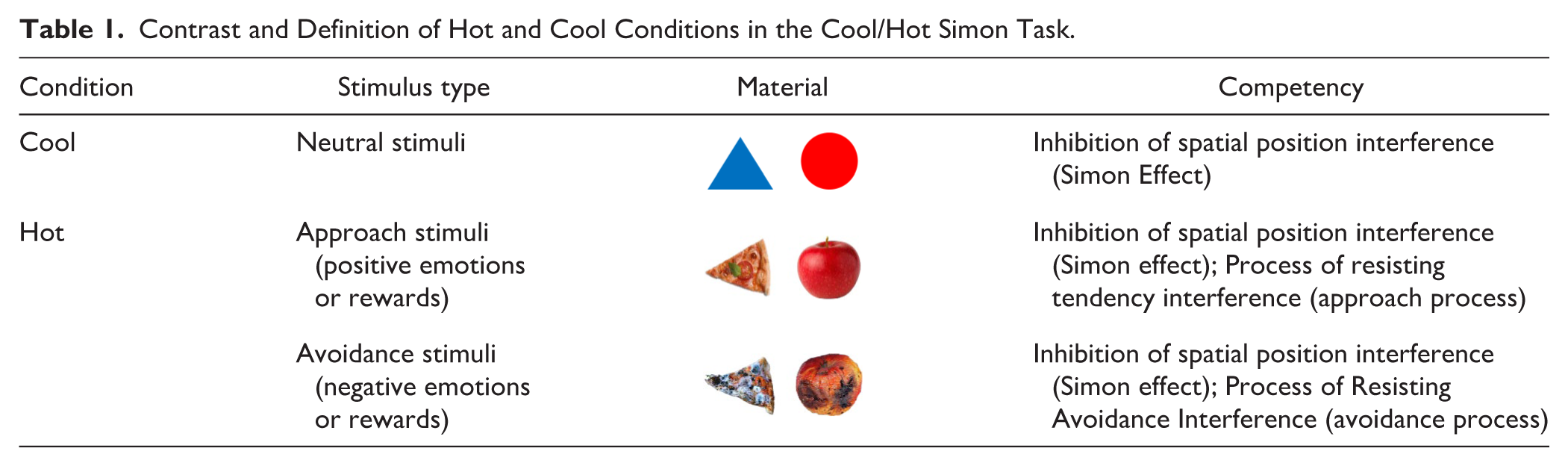
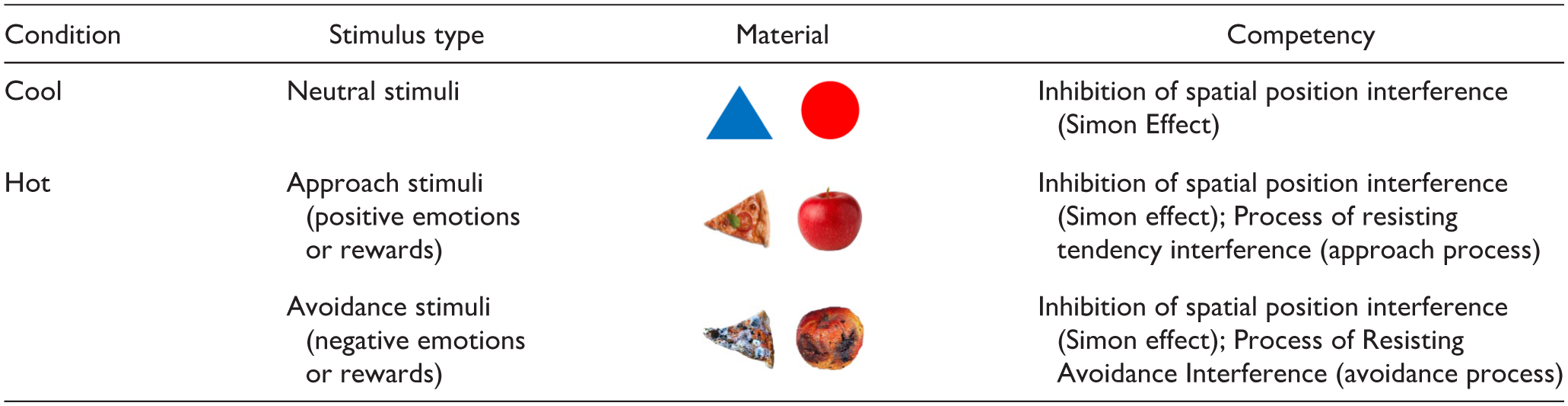
The Cool/Hot Simon Task was developed based on the Simon Task. The Simon Task is an assessment for assessing response inhibition, measuring an individual’s ability to suppress nontarget (distractor) stimuli by introducing spatial incongruence between stimulus location and response key location, a phenomenon known as the Simon effect. Table 1 presents a comparison and definition of the Cool/Hot Simon Task in cool and hot conditions. In the cool condition, the stimulus materials consist of neutral shapes (triangles and circles). In the hot condition, the stimuli are food images—pizza and apples. And, the hot condition uses images of both fresh and rotten food as experimental materials. The emotional properties of the stimuli are manipulated to alter participants’ motivation and reward processing. When individuals see appetizing food, it naturally elicits an approach tendency, whereas viewing spoiled food triggers an avoidance response, leading individuals to look away (Gray et al., 2002). These two conditions engage hot executive function processes related to inhibiting a preference for desirable items and suppressing aversion to undesirable ones. Specifically, images of fresh food attract attention and enhance participants’ motivation to respond, even when faced with spatial interference. In contrast, images of rotten food induce feelings of disgust, reducing participants’ attention and motivation to respond.
Contrast and Definition of Hot and Cool Conditions in the Cool/Hot Simon Task.
The Present Study
This study has two aims. First, it aims to develop and apply a new assessment instrument—the Cool/Hot Simon Task. The task maintains consistency in its basic operational procedure, distinguishing neutral situations (cool) from emotionally or motivationally significant situations (hot) by simply replacing the stimuli. Furthermore, the hot indicators are scored in two directions: approach and avoidance. The approach process refers to the ability to resist temptation and successfully complete a goal task when facing positive emotions or rewards. The avoidance process refers to the ability to maintain task performance despite negative emotions or the influence of punishment. This distinction helps to better understand the different aspects of how emotional value influences executive function and explores the role of the “simple approach-avoidance rule” (Cunningham & Zelazo, 2007; Zelazo & Cunningham, 2007).
Second, to examine the relationship between cool and hot executive function and the topological properties of brain structural networks by graph theory analysis, thereby filling gaps in the existing literature regarding methodology and understanding of neural mechanisms. Previous studies have shown that executive function is closely related to global efficiency (Gong et al., 2016; Ning et al., 2022; Stanley et al., 2015), suggesting that top-down executive control depends on the brain’s overall integrative capacity and that shorter information-transfer paths facilitate more efficient cognitive performance. In addition, hot executive function, which involves reward and motivation, relies not only on global integration but also on functional coupling among neighboring nodes within subnetworks (Gong et al., 2016). This is reflected by increased local efficiency and the clustering coefficient. Clinical evidence further shows that attentional deficits are accompanied by poorer executive control and lower global efficiency (Ning et al., 2022), implying that negative avoidance motivation may change the association between behavior and global efficiency. As the literature on small-world properties in relation to cool and hot executive function is inconclusive, we will examine their potential associations in an exploratory analysis. At the regional level, cool executive function is closely tied to spatial attention and inhibitory control. It may involve the nodal efficiency of the superior parietal lobule (SPL) and dlPFC (Salehinejad et al., 2021). Hot executive function is linked to emotion and drive processing. It relies on regulation by the prefrontal–cingulate network (Salehinejad et al., 2021). Specifically, the mPFC and OFC are more strongly implicated during cognitive control of emotional stimuli (Ochsner & Gross, 2005). Therefore, this study proposes the following hypotheses:
H1: Cool executive function performance will be positively associated with global efficiency and negatively associated with characteristic path length, and positively associated with nodal efficiency in the dlPFC and SPL.
H2a: Hot executive function performance will be positively associated with global efficiency and negatively associated with characteristic path length, and positively associated with nodal efficiency in the OFC and mPFC.
H2b: Within hot EF, approach inhibition will be positively associated with local efficiency and the clustering coefficient, whereas avoidance inhibition will show no association with topological properties.
Method
Participant and Procedure
This study recruited 138 participants (male = 60, female = 78; mean age = 22.2, SD = 2.85), all of whom were right-handed native Mandarin speakers. All participants began the research procedures after giving informed consent. The research procedures included two phases: behavioral data and brain imaging data acquisition, which took approximately 1 hour. Participants were paid NTD 600 upon completion of all tests.
Measure
Behavioral Data Acquisition
The Cool/Hot Simon Task was developed based on the Simon Task and included both cool and hot indicators. In this task, stimulus appear on the screen and participants must respond correctly according to the rules of the conditions. The task has three conditions. Condition 1 is the familiarization phase (20 trials), where the stimuli are a triangle and a circle, both appearing only at the center of the screen. The rule is to press the left key for a triangle and the right key for a circle. Condition 2 is the cool condition (32 trials), where the stimuli and rules remain the same as in Condition 1, but the stimuli appear on the left or right side of the screen. Condition 3 is the hot condition (32 trials), where the stimuli are a triangular pizza and a circular apple (see Table 1), representing positive (preferred food) and negative (aversive food) emotional valence. There were 16 trials each for preferred and aversive foods. These stimuli were presented in a single block in a pseudo-random order generated with a fixed random seed. The stimuli appear on either side of the screen, and the rule is to press the left key for the triangular pizza and the right key for the circular apple.
Each trial consists of 500 ms of fixation followed by 5000 ms of stimulus presentation (including the reaction period). During data processing, error responses and responses that are too fast (<200 ms) or too slow (>5,000 ms) are excluded. All indices are the larger the value, the better. These indices are calculated as follows:
Cool Simon Effect = Congruent reaction time in Condition 2 – Incongruent reaction time in Condition 2
Hot Simon Effect = Congruent reaction time in Condition 3 – Incongruent reaction time in Condition 3
Approach Simon Effect = Congruent reaction time for positive food in Condition 3 – Incongruent reaction time for positive food in Condition 3
Avoidance Simon Effect = Congruent reaction time for negative food in Condition 3 – Incongruent reaction time for negative food in Condition 3
Brain Image Data Acquisition
Brain imaging scan using a 3T Siemens high-field MRI scanner with a 32-channel head coil. Scanning was performed in the axial view, aligned to the anterior-posterior commissure (AC-PC), covering the entire brain. The imaging acquisition included T1-weighted imaging and DTI. The T1-weighted imaging was a high-resolution structural scan using a 3D-MPRAGE pulse sequence. The scanning parameters were as follows: TR = 3,500 ms, TE = 2.26 ms, matrix size = 256 × 256 mm², flip angle (FA) = 7°, field of view (FoV) = 256 × 256 mm², slice number = 192, slice thickness = 1 mm, and scan duration was 8 minutes. The DTI was used to track the movement of water molecules along brain fiber pathways, allowing for the observation of brain network connectivity. The scanning parameters were set as follows: TR = 11,000 ms, TE = 98 ms, number of diffusion-weighted directions = 64, plus five non-diffusion-weighted images (b = 0), b-value = 1000 second/mm², matrix size = 128 × 128 mm², FoV = 224 × 224 mm², number of slices = 70, slice thickness = 1.8 mm, and scan duration was 25 minutes.
Preprocessing and Brain Network
This study utilized Pipeline for Analyzing braiN Diffusion imAges (PANDA) (Cui et al., 2013) was used to preprocess the imaging data. The skull and other non-brain tissues were removed (Leemans & Jones, 2009), and corrections were applied to account for head motion and distortions introduced during the scanning process. Next, a brain network was constructed based on the automated anatomical labeling (AAL) standard template, dividing the brain volume into 1,024 cortical regions (512 per hemisphere) (Tzourio-Mazoyer et al., 2002), which served as the basis for defining network nodes. Finally, the fiber assignment by continuous tracking (FACT) algorithm was used to calculate the fiber tract connectivity between brain regions. The tracking process was terminated when the fiber turning angle exceeded 45° or when a portion of the fractional anisotropy (FA) value dropped below 0.2. A connection between two nodes was established if at least three fiber tracts met these criteria, resulting in a 1,024 × 1,024 binary brain network.
Network Analysis
Based on graph theory, this study employed GRETNA (Wang et al., 2015) to compute brain network connectivity efficiency using several indices: clustering coefficient (Cp), characteristic path length (Lp), small-world properties (ζ), global efficiency (Eglob), local efficiency (Eloc), and nodal efficiency (Enodal).
The clustering coefficient measures the degree of clustering among nodes in the network, reflecting the tightness of interconnections. Ei represents the actual number of connected edges, and ki is the number of connected nodes. It is calculated as:

The characteristic path length quantifies the efficiency of information transfer between nodes, computed as the average shortest path length between all node pairs. A smaller value indicates higher efficiency. lij denotes the shortest path length between two nodes. It is calculated as:

The small-world property, introduced by Watts and Strogatz (1998), describes networks with high clustering coefficients and short characteristic path lengths. It is computed as the ratio of the normalized clustering coefficient ( γ = Cp/Cprandom) to the normalized path length (λ = Lp/Lprandom). It is calculated as: ζ = γ/λ.
The global efficiency assesses the overall efficiency of information transfer across the entire network. It is calculated as:

The local efficiency evaluates the efficiency of information transfer within the immediate neighborhood of a node. It is calculated as the inverse of the average shortest path length within the subnetwork of node i. Gi represents the subnetwork formed by the neighbors of node i. It is calculated as:

The nodal efficiency measures the efficiency of a single node’s connectivity with all other nodes in the network. It is calculated as:

Statistical Analysis
First, we conducted an effect for the Cool/Hot Simon Task, using analysis of variance (ANOVA) to examine position (congruent vs. incongruent) and condition (cool vs. hot), and calculated four behavioral indices: cool Simon effect, hot Simon effect, approach Simon effect, and avoidance Simon effect. Next, we examined the relationships between these behavioral indices and clustering coefficient, characteristic path length, small-world properties, global efficiency, and local efficiency, setting the significance threshold at p < .05. For the nodal efficiency analysis, we examined the correlation between the four behavioral indices and nodal efficiency, setting the significance threshold at p < .001. Based on our hypotheses, (a) the cool Simon effect is expected to show a significant positive correlation with global efficiency and with nodal efficiency in the dlPFC and SPL. (b) The hot Simon effect is expected to show a significant positive correlation with global efficiency and local efficiency and with nodal efficiency in the OFC and mPFC.
Result
Behavioral Result
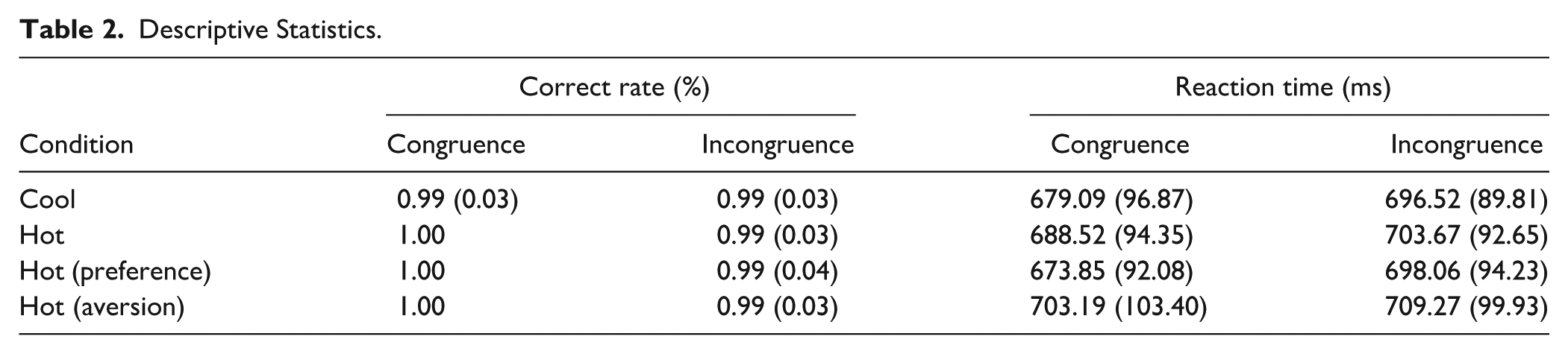
In this study, 2 (condition: cool vs. hot) × 2 (position: congruent vs. incongruent) two-way ANOVA revealed two significant main effects. First, a significant main effect of condition was observed, F(1, 137) = 4.12, p = .044, indicating that reaction times in the cool condition were significantly faster than in the hot condition. This suggests that stimuli in the hot condition (e.g., preferred and aversive food) may have induced additional processing demands, such as emotional processing. Second, a significant main effect of position was found, F(1, 137) = 53.19, p < .001, indicating that reaction times were significantly faster when stimuli appeared in a congruent position compared with an incongruent position. This finding is consistent with the spatial location effect commonly observed in the Simon Task. In addition, the interaction effect between condition and position was not significant, F(1, 137) = 0.29, p = .594 (see Table 2 and Figure 1).
Descriptive Statistics.
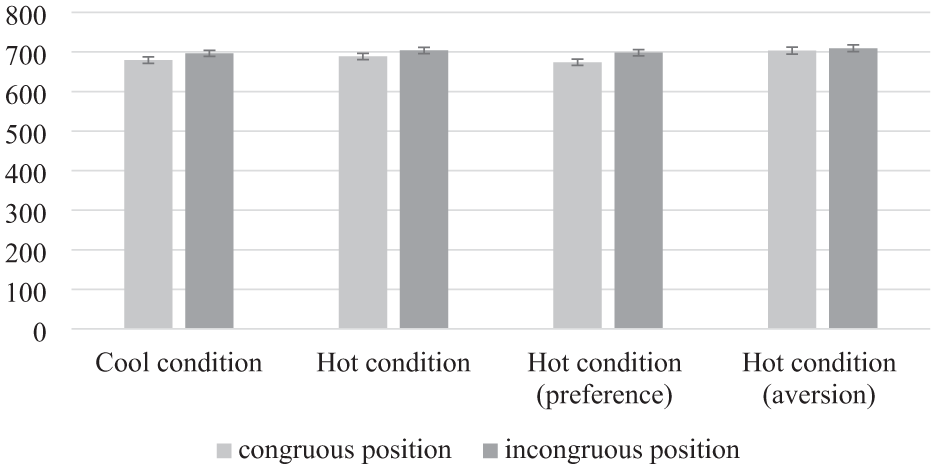
The Average Reaction Time in the Cool/Hot Simon Task.
In this study, 2 (stimulus type: preference vs. aversion) × 2 (position: congruent vs. incongruent) two-way ANOVA revealed two significant main effects. First, a significant main effect of stimulus type was observed, F(1, 137) = 28.27, p < .001, indicating that reaction times were significantly faster in the preference condition than in the aversion condition. Second, a significant main effect of position was found, F(1, 137) = 22.27, p < .001, indicating that reaction times were significantly faster when stimuli appeared in a congruent position compared with an incongruent position. In addition, a significant interaction effect between stimulus type and position was observed, F(1, 137) = 10.73, p = .001, indicating that the position effect differed between conditions. Further simple main effects analyses showed that in the preference condition, reaction times differed significantly between congruent and incongruent positions, t(137) = 5.70, p < .001, whereas in the aversion condition, this difference was not significant, t(137) = 1.44, p = .153. Moreover, comparisons of the position effect revealed that reaction times significantly differed between the preference and aversion conditions in both congruent positions, t(137) = 6.59, p < .001, and incongruent positions, t(137) = 2.26, p = .025. These results indicate that reaction times were generally faster in the congruent position, and that the preference condition facilitated even faster responses. This may reflect the influence of a simple approach-avoidance mechanism in hot executive function processing, where appetitive food stimuli may induce an approach tendency, directing participants’ attention toward the target, while aversive food stimuli may trigger an avoidance response, further modulating the position effect.
Brain Network and Behavioral Performance in Cool/Hot Simon Task
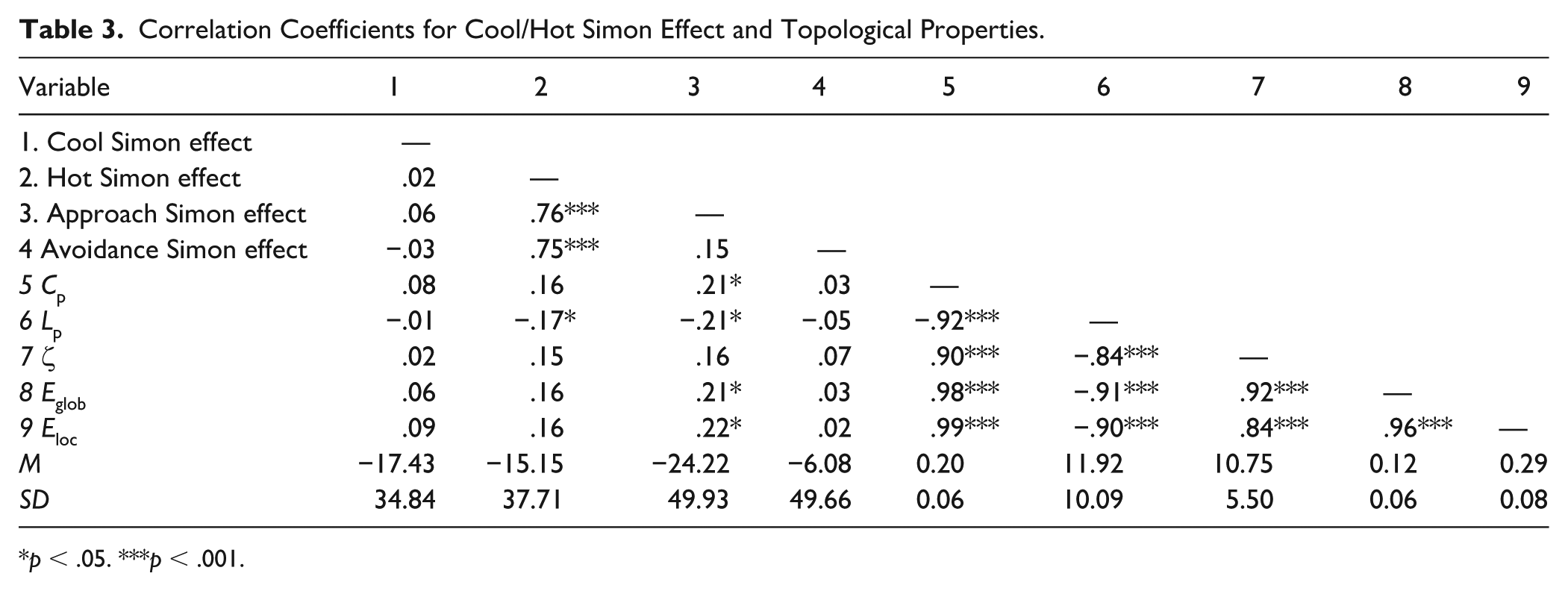
Table 3 shows the means and standard deviations of the cool and hot Simon effects alongside topological properties. A partial correlation analysis was conducted while controlling for gender and age. The results showed no significant correlations between the cool Simon effect and topological indices (rs = −.01 to .09, ps = .307–.913). However, the hot Simon effect was significantly negatively correlated with Lp (r = −.17, p = .048), indicating that better hot Simon effect performance was associated with shorter path lengths between brain nodes. When processing emotionally relevant tasks (such as the hot condition), individuals must efficiently integrate emotional, motivational, and behavioral regulation-related information. If the brain facilitates high efficiency information transfer for interregional coordination, relevant signals can be transmitted more rapidly from the limbic system (e.g., amygdala) to cognitive control regions (e.g., OFC, ACC, dlPFC, vlPFC, and rostrolateral prefrontal cortex) (Salehinejad et al., 2021).
Correlation Coefficients for Cool/Hot Simon Effect and Topological Properties.
p < .05. ***p < .001.
Furthermore, the hot Simon effect was divided into approach Simon effect and avoidance Simon effect. The results showed that the approach Simon effect was significantly positively correlated with clustering coefficient (r = .21, p = .017), global efficiency (r = .21, p = .015), and local efficiency (r = .22, p = .011), while it was significantly negatively correlated with characteristic path length (r = −.21, p = .016). This pattern shows that individuals exert stronger inhibition and cognitive control in response to preferred (approach) stimuli when the brain network exhibits better functional integration at both global and local levels and faster information transfer. In contrast, the avoidance Simon effect showed no significant correlations with topological indices (rs = −.05–.07, ps = .408–.796), suggesting that inhibitory performance toward aversive stimuli may not depend on overall network integration or transmission efficiency. These results suggest that the ability to resist approaching preferred objects involves more efficient neural network integration and interregional cooperation, whereas the ability to resist aversive objects is less influenced by the overall network structure.
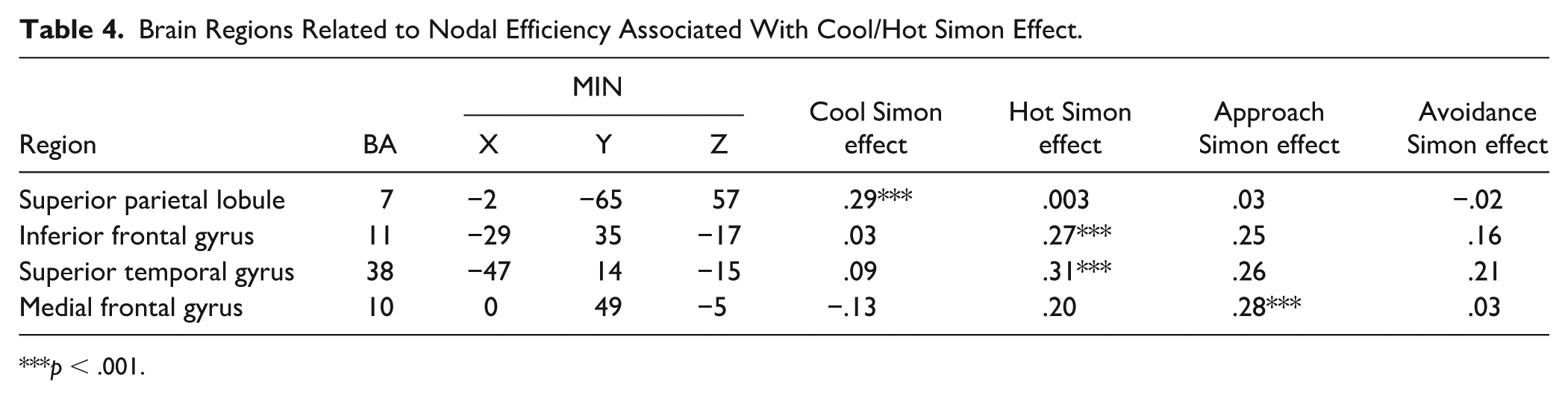
The correlation analysis between the Cool/Hot Simon effect and nodal efficiency (see Table 4 and Figure 2) showed that the Cool Simon effect was significantly positively correlated with the left SPL (BA 7) (r = .29, p < .001). The Hot Simon effect was significantly positively correlated with the left IFG (BA 11) (r = .27, p < .001) and left STG (BA 38) (r = .31, p < .001). These results suggest that the Cool and Hot Simon effects involve the connectivity between different brain regions. In addition, the correlation analysis between the approach and avoidance Simon effects and nodal efficiency revealed that the approach Simon effect was significantly positively correlated with the medial fontal gyrus (BA 10) (r = .28, p < .001). The avoidance Simon effect showed no significant correlation with nodal efficiency.
Brain Regions Related to Nodal Efficiency Associated With Cool/Hot Simon Effect.
p < .001.
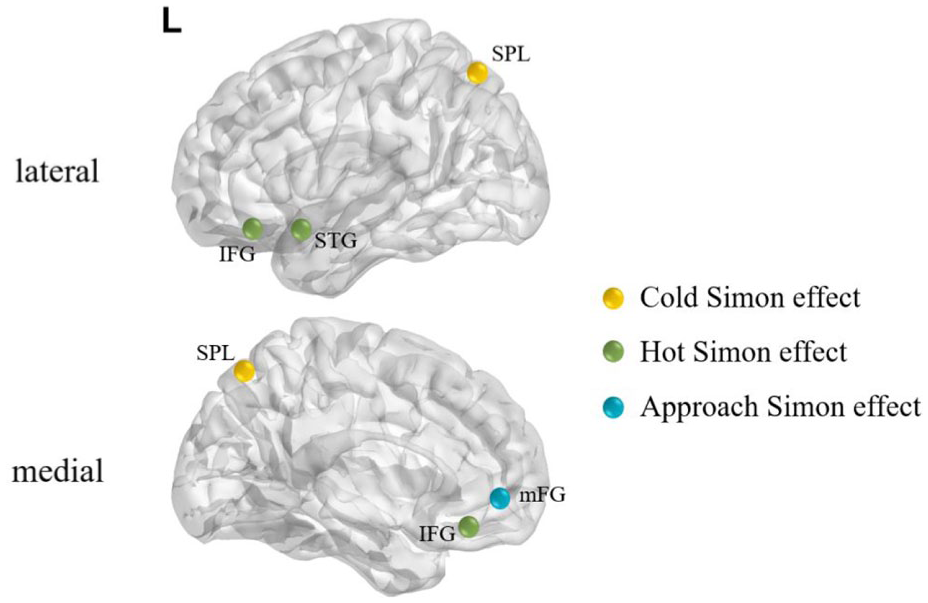
Nodal Efficiency Associated With Cool/Hot SIMON Effect.
Discussion
We had developed the Cool/Hot Simon Task, which manipulates cool (neutral stimuli) and hot (emotional or motivational stimuli) conditions by altering the emotional attributes of the stimuli (pictures of appetizing or spoiled food) while keeping the task structure identical. Furthermore, we had explored the relationship between cool and hot inhibition and the topological properties of the brain network. Behavioral results showed that reaction time was faster in the cool condition than in the hot condition, supporting the notion that emotional stimuli interfere with cognitive performance. Cool executive function primarily relies on pure cognitive control processes and is not influenced by emotional factors (Zelazo & Müller, 2002). In the hot condition, reaction times were faster for preferred stimuli than for aversive stimuli, and a significant Simon effect was observed only in the preferred condition. This suggests that positive emotional stimuli are more likely to induce spatial interference effects. This finding may be related to the higher motivational intensity of approach processes (Cunningham & Zelazo, 2007), making individuals more susceptible to spatial attention when encountering preferred stimuli. Notably, the Simon effect may be reduced by avoidance tendencies in response to an aversive stimulus. Aversive-induced attentional withdrawal (Lee et al., 2025) reduces spatial encoding of the stimulus location and the automatic activation of ipsilateral responses. This influences the salience of spatial advantages or interference.
Furthermore, brain network analysis revealed no significant correlation between the cool Simon effect and network topological indices. However, the hot Simon effect was significantly negatively correlated with characteristic path length. This indicates that emotion/motivation-related information must be transmitted rapidly across brain regions to support hot executive function. The functional connectivity between the prefrontal cortex and the limbic system is stronger in hot executive functions (Salehinejad et al., 2021). After subdividing the hot effect into the approach and avoidance Simon effects, the results suggested that resisting the strong tendency to approach preferred stimuli relies not only on global network integration but also on tight local coordination among regions. Information propagates along shorter paths to counter approach drives. In the aversive condition, no significant correlations were found, suggesting that the ability to resist aversive stimuli (avoidance processes) is less influenced by the overall network. Aversive stimuli typically elicit attentional withdrawal (Lee et al., 2025), which limits the resources devoted to such information and potentially prevents the effective recruitment of global or local networks. This may be because it relies on the processing of a single region or pathway (Wabnegger et al., 2022).
Regarding the nodal efficiency, the cool Simon effect was positively correlated with the node efficiency of the left SPL (BA 7). The SPL is part of the parietal-premotor circuit activated during object exploration processes (Seitz et al., 1991) and plays a role in object recognition and information maintenance (Iacoboni, 2000). The SPL is closely related to spatial shifting, which is based on attentional priority, and is responsible for spatial transitions and attentional reallocation (Molenberghs et al., 2007). However, the functions of the left and right SPL differ. Activation of the right SPL is typically associated with attentional processes, whereas activation of the left SPL is more likely related to information maintenance in working memory (Stoeckel et al., 2004). As a key node for working memory maintenance, the left SPL may help individuals to effectively deal with spatial interference in cool conditions, thereby improving their spatial abilities.
The hot Simon effect was positively correlated with the left IFG (BA 11) and the left STG (BA 38). BA 11 is located in the OFC. According to the Hierarchical Model of Rule Representation in the Prefrontal Cortex (Zelazo et al., 2024), the OFC is involved in stimulus-reward associations, evaluating the value and consequences of stimuli. The OFC is also a key region for food reward evaluation (Small et al., 2001). The hot Simon effect relies on the reward processing system of the OFC, where activation of this region helps to integrate emotional and task-related goals when participants encounter emotionally or motivationally relevant stimuli. In addition, BA 38 is located at the anterior end of the temporal lobe, known as the temporal pole. The temporal pole is involved in social and emotional schemas and is responsible for the storage and retrieval of social scripts (Frith & Frith, 2003; Van Overwalle, 2009). Such as past experiences and evaluations of the good/bad of food. In the hot Simon effect, positive or negative emotional stimuli may engage an individual’s social scripts and social reasoning processes related to emotional experiences. Among the approach and avoidance Simon effects, only the approach Simon effect showed a positive correlation with the node efficiency of the mFG. The mFG is closely related to social cognition and plays a role in emotional evaluation and social judgment (Amodio & Frith, 2006; Molenberghs et al., 2016). According to a meta-analysis by Molenberghs et al., the posterior mFC, the anterior part of the dorsal mPFC, and the ventral mPFC are all associated with reasoning about the mental states of others, although their functions differ. Notably, the vmPFC has been found to be associated with arousal in response to emotional stimuli (Nejati et al., 2021). The activation of the mFG—particularly the vmPFC—during the approach Simon effect requires further validation through functional neuroimaging studies. In addition, this study found no significant association between the avoidance Simon effect and nodal efficiency. Participants may deliberately avoid aversive stimuli (Lee et al., 2025), and this process does not depend on white matter pathways. Compared with approach processes, resisting avoidance may depend more on limbic and emotion-related structures (Viviani, 2013). The interactions of these structures are often supported by functional coupling, such as coordination between the amygdala and vmPFC. Future research could use functional magnetic resonance imaging to examine the neural mechanisms underlying avoidance processes.
Limitation
This study has limitations. First, the sample consisted primarily of university students, which may affect the findings of cognitive performance. According to a study by Stanley et al. (2015), which sampled 14 adults (mean age = 27.21 years, SD = 4.00), a significant positive correlation was observed between global efficiency and cool executive function. However, the present study did not find a similar result. This difference may be due to the fact that university students are generally at their peak cognitive performance. Zero-order correlation analyses indicated that age was not significantly associated with the four behavioral indices (ps = .230–.762) nor with the topological properties (ps = .513–.926). As a result, performances in cool inhibition may be more related to attention or motor speed rather than inhibitory control for university students. Future research should consider expanding the age range of participants to examine whether cool executive function primarily relies on the frontoparietal network (Salehinejad et al., 2021). In addition, future research could also further examine the suitability and developmental trajectories of cool and hot executive functions in children and adolescents within the paradigm proposed in this study, thereby deepening the understanding of cool and hot executive function processes across different age groups.
Implications for Future Research: Hot Shifting and Hot Updating
This study focused exclusively on inhibition—specifically, the common executive function factor (Miyake & Friedman, 2012)—and further defined it as hot inhibition, including resistance to approach and resistance to avoidance. This methodology helps to clarify the similarities and differences between cool and hot inhibition. However, the present does not consider for shifting and updating, the other two core executive functions. This limitation may affect the overall understanding of hot core executive functions.
This study conceptualizes hot executive function as the capacity to resist approach or avoidance in order to achieve goals. Specifically, when individuals encounter positive or negative stimuli, they develop evaluative attitudes that prompt an approach or avoidance response. This increases or decreases the allocation of attentional resources. This process can disrupt focus on task-related goals. Evaluations that induce approach draw more attention toward the stimulus, whereas evaluations that induce avoidance reduce task-directed attention, thereby affecting performance. Individuals with better hot executive function can regulate their behavior in the face of temptation or threat by balancing the distribution of their attention. According to the “unity and diversity” framework of executive functions proposed by Miyake and Friedman (2012), shifting and updating can be viewed as combinations of a common executive function component and process-specific components, whereas inhibition is largely subsumed by the common executive function. In other words, the common executive function reflects the shared construct underlying inhibition, shifting, and updating, and differences are expressed via the specific components of each subfunction.
Because inhibition substantially overlaps with common executive function, its outcomes can be viewed as observations of the core component of executive function. In the present study, we apply this model to the framework of hot executive function: Hot inhibition can be regarded as the common hot executive function, and its cognitive operation involves resisting tendencies to approach or to avoid. Hot shifting reflects the process of redirecting attention in emotional contexts after resisting one’s evaluative impulses. In other words, individuals must first counter an approach or avoidance drive, and then shift their attention toward avoidance or approach, respectively. For example, a person who is already full sees a favorite cake. From a health perspective, the cake is unnecessary calories, and someone engaged in dietary control must first inhibit the drive to eat (resist approach) and then shift attention to the goal of “avoiding overeating” (shift to avoidance). Conversely, a person who is afraid of dogs encounters a dog blocking the path. The person must first resist the instinct to flee (resist avoidance) and then shift attention to “approaching the dog to pass safely” (shift to approach). Hot shifting entails regulation under emotional arousal and motivational conflict and may require greater involvement of limbic structures (e.g., the amygdala), the vmPFC, and the ACC (Salehinejad et al., 2021).
In addition, hot updating refers to the process by which individuals can effectively adjust and balance cognitive resources to maintain the stable operation of goal-relevant information in working memory when facing stimuli with emotional or motivational value. This occurs after resisting approach or avoidance tendencies. In other words, individuals with good hot updating can avoid forming an excessively strong imprint of a stimulus due to an approach bias, or overlooking/losing stimulus-related information due to an avoidance bias. This process reflects the dynamic regulation of attention and working memory resources under emotional arousal. It ensures that task performance remains focused on goals rather than being overly swayed by stimulus valence. For example, in an exam, a student encounters two types of items: one familiar and confidence-inducing, which may attract excessive checking (approach stimulus), and one difficult or unfamiliar, which may induce anxiety and the urge to skip (avoidance stimulus). A student with strong hot updating can counter these natural tendencies and allocate attention appropriately, thus maintaining balanced problem solving: neither dwelling on the easy item nor evading the difficult one. As another example, when processing important information, favorable or interesting topics tend to receive more attention and be remembered better (approach stimulus). Conversely, disliked or stressful topics may be ignored (avoidance stimulus). Hot updating balances attentional resources after resisting approach or avoidance evaluations, enabling clear memory for both positive and negative topics and reducing biased understanding.
This study proposes that hot executive function can be divided into three processes: hot inhibition, hot shifting, and hot updating. Hot inhibition involves resisting approach or avoidance. Hot shifting involves shifting one’s evaluative stance after countering the initial evaluation. Hot updating involves balancing working-memory resources after resisting that evaluation. Future research could explore hot shifting and hot updating to provide a more complete theory and underlying neural basis of hot executive functions.
Conclusion
We used a novel assessment, the Cool/Hot Simon Task, to reveal differences between cool and hot inhibition at both the behavioral and neural network levels. These findings provide theoretical insights into cool and hot executive functions. The Simon Task inherently assesses response inhibition (i.e., the Simon effect), which we refer to as cool inhibition. In this study, we introduced positive and negative food stimuli to engage participants’ reward evaluation processes and required them to complete tasks related to these stimuli, thereby measuring hot inhibition. Through this novel assessment, we found that cool and hot executive functions were not significantly correlated in behavioral performance. Cool executive function was associated with the parietal lobe; and, hot executive function involved the OFC, mPFC, and temporal pole regions. This finding is closely consistent with previous empirical studies and theoretical models (e.g., Bechara et al., 1994; Poon, 2018; Salehinejad et al., 2021). This indicates that they operate independently within the core common executive function framework in terms of motivational drive, processing content, and neural circuitry. Cool executive function maintains goals through affect-decontextualized, abstract control, whereas hot executive function requires regulation by emotion–reward networks. In addition, this study incorporated RST (Gray & McNaughton, 2000) and the simple approach-avoidance rule (Cunningham & Zelazo, 2007; Zelazo & Cunningham, 2007) to further differentiate approach and avoidance processes within hot executive function. These two processes operate independently of each other. When individuals regulate their responses to positive stimuli, brain regions associated with emotional processing and reward systems show more efficient cooperation and information transfer. However, in response to negative stimuli or avoidance situations, processing may rely more heavily on specific emotional or cognitive regions.
Based on the findings of this study, we constructed a multilevel framework of inhibition (Figure 3), which consists of four levels: ability, context, valence, and neural efficiency. At the ability level, inhibition is regarded as one of the core executive functions. At the context level, we distinguish between cool and hot inhibition based on operational conditions. Cool inhibition applies to emotionally neutral contexts and requires pure response inhibition, whereas hot inhibition involves emotional and reward-related factors and requires response control in situations of emotional value. At the valence level, we distinguish between neutral inhibition, approach inhibition (controlling responses to positive stimuli), and avoidance inhibition (controlling responses to negative stimuli). Finally, at the neural efficiency level, cool and hot inhibition involve different brain regions and network mechanisms. Cool inhibition is primarily associated with the efficiency of nodes in the superior parietal lobule. Hot inhibition is closely related to interactions in the OFC and temporal pole. This level reflects how individuals effectively use neural resources for inhibition under specific contextual and valence conditions. In addition, the association between approach inhibition and the mPFC further reveals the social-cognitive interactions involved in inhibition within emotionally and reward-driven contexts. In summary, this multilevel framework not only highlights the differences and similarities between cool and hot inhibition but also underscores the critical roles of context, valence, and neural efficiency in the inhibition process. It provides a systematic and integrative perspective for understanding how inhibitory functions operate.
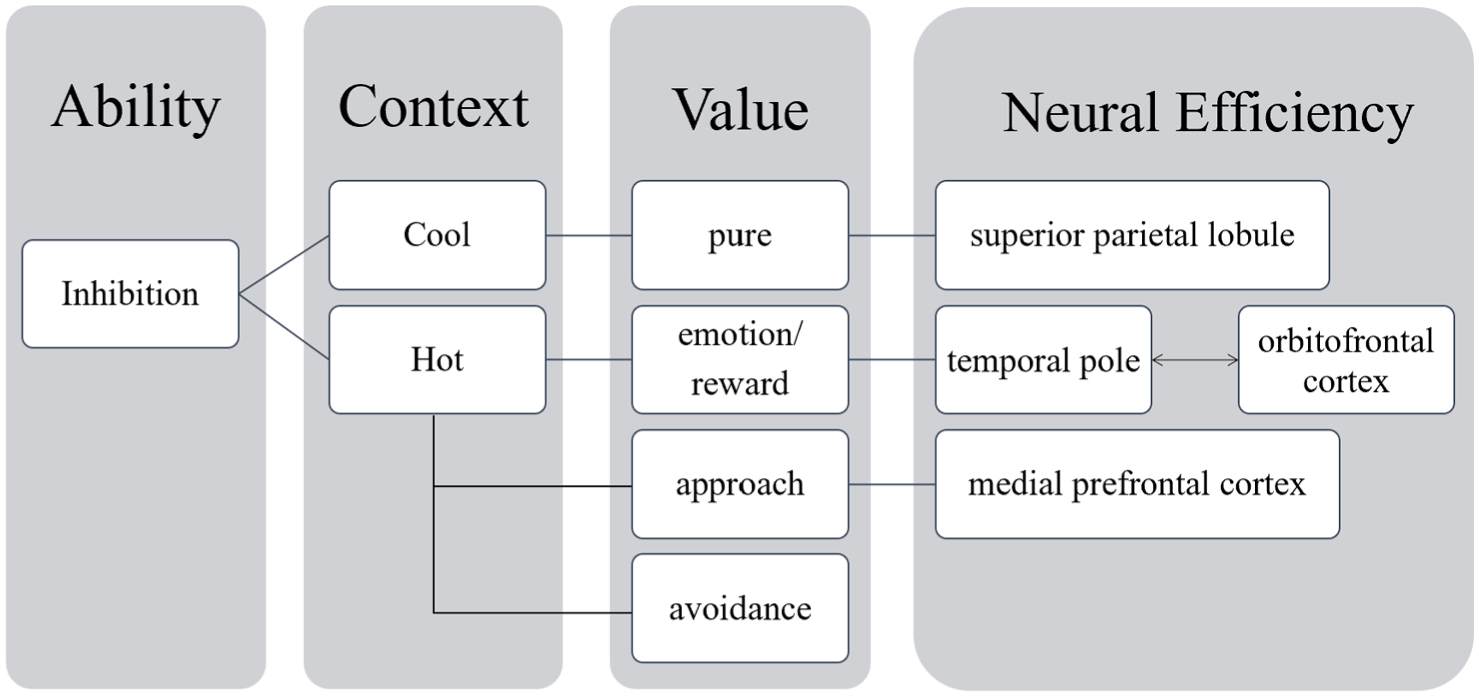
A Multilevel Framework of Inhibition: Integration of Context, Value, and Neural Efficiency.
Footnotes
Acknowledgements
This work was financially supported by the “Institute for Research Excellence in Learning Sciences” and “Social Emotional Education and Development Center” of National Taiwan Normal University from the Featured Areas Research Center Program within the framework of the Higher Education Sprout Project by the Ministry of Education in Taiwan. In addition, we thank Taiwan Mind & Brain Imaging Center (TMBIC) and National Chengchi University for consultation and instrumental availability. TMBIC is supported by the National Science and Technology Council, Taiwan (R.O.C.).
Data Availability Statement
Data can be accessed by contacting the corresponding author.
Declaration of Conflicting Interests
The authors declared no potential conflicts of interest with respect to the research, authorship, and/or publication of this article.
Funding
The authors disclosed receipt of the following financial support for the research, authorship, and/or publication of this article: This work was financially supported by the National Science and Technology Council of Taiwan and the Ministry of Education in Taiwan.
Ethical Approval
This study was approved by the Research Ethics Committee at National Taiwan Normal University (no. 202205HM047).
Informed Consent Statements
All participants completed the procedure of informed consent.
