



Abstract
Sexual violence includes a wide variety of behaviors, ranging from harassment to coercion, to rape, to sexual homicide. Although the criminal justice system distinguishes these forms of sexual violence, several studies have suggested that they represent different degrees of severity of an underlying continuum, named the Agonistic Continuum. Such model proposes that sub-categories of sexual violence share a core, unifying construct. The aim of the present study was to develop and test the psychometric properties of a new Agonistic scale. Classical test theory, exploratory factor analyses, taxometric analyses, and two-parameter item response theory analyses were conducted on a combined sample of MTurk workers and university students. Analyses revealed that the new 30-item Agonistic scale is psychometrically sound. These results have several implications, ranging from moving away from the arbitrary categorization of sexual violence to encompassing the last decade of research on harassment and coercion following the #MeToo movement.
Keywords
Since the initial proposal and rejection from the third version of the Diagnostic and Statistical Manual of Mental Disorders (DSM III; American Psychiatric Association [APA], 1980) of a “sexual assault” paraphilic coercive disorder (PCD), the validity of a distinct diagnosis for a sexual coercion paraphilia has been debated. The diagnosis was rejected from all subsequent DSMs. Most recently, the DSM-5 paraphilias’ sub-workgroup proposed a possible criterion set for diagnosing PCD, but after the completion of field trials, consideration of public comment, and significant lack of consensus among workgroup advisors, they decided not to recommend it for inclusion either in the DSM-5 (APA, 2013) proper or in the Section III “Conditions for Further Study.” Nonetheless, several researchers continue to argue for the viability of PCD as a separate disorder distinct from sadism (e.g., Zinik & Padilla, 2016).
Traditionally, the DSMs have provided options for the diagnosis of purported mental disorders for which criteria sets are not included among the specified disorders, using categories such as atypical, not otherwise specified, and other specified mental disorders. The frequent use of such exceptional diagnoses in Sexual Violent Person/Predator civil commitment hearings has attracted significant criticism (e.g., Frances et al., 2008; Holoyda & Blum, 2023). Because such diagnoses are used without any consensus about the accepted criteria, forensic evaluators have not been able to achieve reliability in making these diagnoses (Levenson, 2004; Perillo et al., 2014). Unfortunately, forensic experts are still using PCD as a “valid” diagnosis even though several court challenges have ruled that Other Specified Paraphilic Disorder (OSPD), Nonconsent or Coercive Disorder, does not meet either Frye or Daubert standards for evidence admissibility (e.g., Cause No. 17SL-PR02459, Div. 13). The continuing controversy and pervasive forensic use of the construct have had the positive effect of motivating research on multiple aspects of paraphilic coercion, including the criteria used to define it, the structure of the scales purported to measure it, and the place it maintains in the nomological network of variables related to sexually aggressive behavior.
Paraphilic Coercive Disorder
In his seminal work on paraphilias, Freund and colleagues postulated that a significant subgroup of rapists appeared to be driven by aberrant sexual arousal to coercion that served as a key motivational component in the rape process (e.g., Freund et al., 1986). They called offenders in this subgroup preferential rapists and hypothesized that like voyeurs, exhibitionists, and frotteurists, these rapists constituted a distinct paraphiliac cluster of courtship disorders. They differentiated this cluster from algolagnic paraphilic disorders, which included sadism.
The idea of a distinct group of rapists primarily motivated by “sexual” fantasies was also proposed in early typologies for offenders who sexually offended against adults (e.g., Knight et al., 1985; Proulx et al., 1999). A sexually oriented subtype was hypothesized having coercive behaviors motivated by fantasies that avoided the connection between sex and the extreme violence that characterizes sadistic offenders but nonetheless included some arousal to the coercive nature of the encounter (Knight & Prentky, 1990). Both these typological speculations and penile plethysmography (PPG) data that suggested that some rapists appeared to be more sexually aroused by coercive rape scenarios than depictions of consensual sex (e.g., Abel et al., 1977; Quinsey & Chaplin, 1984; Quinsey et al., 1981) buttressed the concept of paraphilic coercion. Recent research has, however, challenged the hypothesis that PCD is a distinct construct more closely related to courtship disorders than algolagnic disorders (Knight et al., 2013; Longpré, Knight, et al., 2020).
Discriminating PCD From Sadism
Discriminant validity is essential for any proposed diagnostic category. Thornton (2010) argued that sadism was different from paraphilic coercion because sadists had not consistently been found to have the highest rape indices. When, however, PPG studies of sadists were sorted into studies that used reliable rating scales versus studies that used the unreliable DSM criteria for sadism, the former found that sadists consistently produced the highest rape indices (Knight, 2010; Looman et al., 2008). Thornton (Knight & Thornton, 2011) subsequently acknowledged that there is a coercion continuum that includes both paraphilic coercion and sadism. Consistent with this conclusion, Thornton et al. (2011) found that only a moderate level of reliability could be achieved to distinguish paraphilic coercion from sadism in the ideal research conditions of their DSM-5 reliability field trial. Also consistent with this explanation, Knight et al. (2013) reported high correlations between self-report scales of paraphilic coercion and sadism.
The Agonistic Continuum
Knight and colleagues (Knight, 2010; Knight et al., 2013) proposed the idea that sexual sadism is the endpoint of an Agonistic Continuum that ranges from no coercive fantasies to non-sadistic sexually coercive fantasies (the purported PCD) to bondage, humiliation, hurting, and severe sexual sadism. The term “Agonistic,” from the Greek agonia, captured the idea of struggle, anguish, and agony present in paraphilic coercion and sexual sadism. Knight et al. (2013) found convincing evidence, drawn from factor analyses, taxometric analyses, and Item Response Theory (IRT) analyses, that supported the hypothesis of an Agonistic Continuum that is distributed as a dimension (Knight et al., 2013). Furthermore, they found evidence that the Agonistic Continuum was ordered as a probabilistic Guttman scale, where items are hierarchically organized so that the endorsement of an item at X level means a high probability of endorsing items of lower intensity (Longpré, Sims-Knight, et al., 2020). If paraphilic coercion and sadism were ordered as a probabilistic Guttman scale, sadists would always qualify as likely having paraphilic coercive fantasies and behaviors, but there would also be individuals lower on the scale who enjoyed coercing their victims but did not manifest more severe sadistic characteristics. The Agonistic Continuum provides a reconciliation of the discrepancies between the evidence of a sexually coercive latent trait and the assumed different phenotypes (paraphilic coercion [PC+] and sadism).
Longpré, Sims-Knight, et al. (2020) replicated and extended Knight et al.’s findings. Exploratory factor analyses yielded the same four sub-factors that Knight et al. (2013) found. Tucker’s congruence indices, an index of the similarity between factors, were calculated between factors obtained in both studies (Lorenzo-Seva & Ten Berge, 2006). The Tucker’s congruence indices were .98 for the first factor (PC+), .96 for the second factor (Desire to Kill the Victim), .98 for the third factor (Bondage), and .88 for the fourth factor (Beating the Victim), which indicated a strong similarity between the two studies. Exploratory and confirmatory factor analyses supported the viability of proposing a single underlying dimension comprising these four factors. Latent class analysis yielded either a single-class solution or a 2-class solution in which the classes differed only in severity. Taxometric analyses demonstrated that the Agonistic Continuum and its sub-components were distributed as a dimension with no categorical distinctions and no taxonic peaks. Finally, IRT analyses also found that the Agonistic Continuum was ordered as a probabilistic Guttman scale.
A sample comprising college students, community individuals, and non-sex offenders was also examined with the Knight et al.’s scale (Longpré, Knight, & Guay, 2018), replicating the data from the two prior studies and indicating that results from non-sexual offenders and non-offenders were similar to sexual offenders. These results support the hypothesis that the Agonistic Continuum is not restricted to individuals who have sexually offended. This is consistent with research on community individuals (Knight et al., 2018) and suggests generalization beyond individuals who have committed sexual offenses is warranted. Consistency across multiple procedures, measures, and samples is both a cornerstone and a necessary component of any investigation of the latent structure of psychological constructs (Meehl, 2004). The presence of a continuum of sexual violence, above and beyond the Agonistic Continuum terminology, has also been supported by several studies, across populations and genders (e.g., Balcioglu et al., 2023; Reale et al., 2017; Trottier et al., 2021). As such, the strong and consistent support of a continuum should preclude the desire to create an unreliable categorical diagnosis for a sexual coercion paraphilia distinct from sadism.
Current Agonistic Scale
Knight et al.’s (2013) Agonistic scale psychometric properties and latent structure have been cross-validated on different samples (college students, community individuals, non-sexual violent offenders, and sexual offenders) and across genders (men and women). These results showed that the Agonistic Continuum is a dimensional construct that is not restricted to individuals who have committed sexual offenses. The original Agonistic Scale has, however, some limitations. Longpré, Sims-Knight, et al.’s (2020) research sample more closely replicated Knight et al.’s (2013) results than did their clinical sample, suggesting that the greater anonymity of research testing may be required to identify the best ordering of the anchors in the middle range of the scale. Moreover, the Test Information Function (TIF) analysis indicated that although the Knight et al.’s (2013) Agonistic scale assessed the low severity end of the spectrum, it was more accurate at assessing the intermediate and high severity range (TIF ranged from −3 to +4 with a peak at 1.8; Longpré, Sims-Knight, et al., 2020). We attempted to address these limitations in the new scale developed in the present study.
Possibly because of the bad track record of PCD in both psychiatric (DSM-5 and ICD-11) and criminal justice arenas, research on the lower, paraphilic coercion end of the Agonistic Continuum has continued to be limited. Empirical studies focusing on paraphilic coercion remain essential, however, not only because of the misuse and overuse of the construct in SDP commitment trials, but also because of the need for a fuller understanding of its role in sexual coercion and sadism. Converging evidence across variables, independent analytic methods of measuring the construct, and the use of different samples or populations are required (Meehl, 1995). As such, cross-validations through different samples and methods (i.e., Knight et al., 2013, 2018; Longpré, Knight, & Guay, 2018; Longpré, Sims-Knight, et al., 2020) are required to ascertain that this construct is not sample-related or method-related.
Aims
The present study aimed to develop and test a new Agonistic scale. First, the psychometric properties of a substantially revised 30-item Agonistic scale were examined with classical test theory (CTT), exploratory factor analyses (EFA), taxometric analyses, and Two-parameter (2PL) IRT. Second, external correlation with Knight et al.’s (2013) Agonistic scale was calculated to test the convergent validity of the 30-item Agonistic scale.
Method
Participants
The original sample comprised 402 participants who were recruited from a North-East USA university (n = 48) and Amazon Mechanical Turk (MTurk; n = 354). To eliminate uncooperative or duplicitous respondents, participants were excluded if either of the following criteria were met: (a) Uncooperative > 3 missing items (10%) or (b) Scored 2 SD above the mean of the MIDSA community control standardization sample on the Positive Image Scale (PIS). These are standard thresholds for exclusion recommended in the MIDSA manual and used in other studies (e.g., Rohrer et al., 2025). The PIS is a nine-item scale with each item measured on a 5-point Likert-type scale, rated from 1 to 5, with options Strongly Disagree, Disagree, Neutral, Agree, and Strongly Agree (MIDSA, 2011). Higher scores on this scale indicate higher levels of attempting to project a positive image. An example of an item is “I am always polite, even to people who are rude”.
Six participants were removed because too many of their responses were missing, and eight participants were withdrawn because of their high scores on the Positive Image scale (i.e., > 2 standard deviations from the mean of the sample). From the initial 402 participants, 388 were retained in the current study. The mean age of the sample at the time of testing was 34.45 years (SD = 11.77; ranges 18–78), and comprised predominantly male (52.4%), Caucasian (74.6 %), married (41.9%), and heterosexual (88.9%) individuals.
Procedures
An initial phase of testing was conducted at a university located in North-Eastern USA. Forty-eight undergrad students in psychology were recruited through the SONA system, a worldwide cloud-based participant management software that is used in more than 1,000 universities. Students’ participation did not involve financial compensation. Rather, they were granted course credit for volunteering for research participation.
In a second phase, 354 participants were recruited through MTurk, a crowdsourcing internet marketplace that allows researchers (called requesters) to find participants (called workers) online in exchange for monetary compensation. Workers were paid $10US in exchange for their participation. MTurk workers are primarily located in the United States, with demographics similar to the overall internet population (Ipeirotis, 2009). Several safeguards—such as higher monetary compensation, GPS coordinate screening, random-generated code, study of response patterns, reading time, and PIS scores—were used to detect automated programs (bots) that automatically fill out questionnaires. All suspicious participants were rejected before payment. Both samples had to answer 264 items that assessed several domains, including hypersexuality, personality disorders, psychopathic traits, vindictive cognitions, social desirability, and the Agonistic Continuum, with a median time of 38.18 min (mean = 47.33 min) to complete the survey.
Before merging both samples, independent samples T-test was conducted on the TACS total score, and no significant differences were found, t (386) = .164, p = .870, between the student (M = 37.94; SD = 7.95) and the MTurk sample (M = 38.24; SD = 12.19). This sampling technique has been used in previous studies on sexual violence and has produced stable results across measures and analyses (e.g., Beckett et al., 2025 [Rape Myths]; de Roos et al., 2025 [Paraphilias]; Du & Knight, 2024 [Hypersexuality]; Longpré et al., 2022 [Paraphilias]).
The Agonistic Continuum Scale (TACS)
To develop the scale, a review of the literature on sexual coercion, paraphilic coercion, sexual sadism, and sexual murder was conducted. Seventy-four items that measure either fantasy or behavior were selected. This list of items was sent to five experts on sexual sadism and severe sexual violence, who were familiar with the components of the Agonistic Continuum. Raters resided in Canada (n = 2), UK (n = 1), and USA (n = 2). This procedure is similar to the one Marshall and Hucker (2006) employed in the creation of the Sexual Sadism Scale. All experts were asked to rate each item on a scale, ranging from 1 to 4, on how well they thought each item was able to assess at least one component of the Agonistic Continuum.
Following the experts’ feedback, the list of items was reduced. First, all items that were graded “1” by at least one expert were discarded. Second, all items that did not have at least 65% (13/20) of endorsement rate by the experts were discarded. Third, with the items that were measuring the same behavior/fantasy, only the highest-scoring items according to the experts were kept. With five reviewers, Fleiss’ Kappa analyses were conducted. The analysis of agreement between the five raters yielded an average value of .79, with no Kappas under .71 and with all raters in the same range, indicating a substantial agreement between the experts. The consensus was both on the items included in the final version of the TACS and the items discarded. The TACS comprises 30 items (see Table 2), rated on a 5-point rating scale, rated from 0 to 4, with options Never, Once, Sometimes, Fairly Often, and Very Often.
Analyses
To assess the psychometric properties of the 30 TACS items, four analytic strategies were applied. In a first set of analysis, an EFA was calculated to test the unidimensionality of the scale. In a second set of analysis, the unidimensionality was confirmed using a taxometric procedure. Three conceptually distinct procedures were employed: Mean Above Minus Below a Cut (MAMBAC; Meehl & Yonce, 1994), MAXimum EIGenvalue (MAXEIG; Waller & Meehl, 1998), and Latent Mode Factor Analysis (L-mode; Waller & Meehl, 1998). Comparison curves were generated to examine the relative fit of the obtained data generated by each taxometric procedure to the expected simulated categorical or dimensional curves (Ruscio et al., 2006). A sample size of over N = 300 is sufficient to produce stable taxometric results (Longpré et al., 2023; Ruscio et al., 2006). In a third set of analyses, 2PL IRT were calculated to assess the probabilistic Guttman scale ordering of the items and the psychometric properties of the items. A sample size of over N = 250 and/or a ratio of 10:1 participants/ parameters are considered as sufficient to produce stable and reliable IRT parameters (de Ayala, 2009; Stefanska et al., 2020). In a fourth set of analysis, convergent validity was assessed by correlating the 30-item TACS with the Knight et al. (2013) Agonistic Scale.
Results
The Cronbach’s alpha for the 30 items was .93, which indicates an excellent internal consistency. This index could not be increased by deleting any of the items in the scale. Item-total correlations ranged from .41 to .72 (M = .57).
Factor Analyses
An EFA with principal axis factoring and OBLIMIN rotation yielded four factors that accounted for 50.46 % of the variance (see Table 1). Correlations between factors ranged from .40 to .70. This is similar to Knight et al. (2013), who reported correlations between factors ranging from .45 to .69. Although sub-factors are found, the subgroups are most of the time better conceptualized as differing along a continuum (Lahey & Waldman, 2003) rather than having natural boundaries (Ruscio et al., 2006), which was supported by previous studies (Knight et al., 2013; Longpré, Knight, & Guay, 2018; Longpré, Sims-Knight, et al., 2020). For more details on how to interpret the dimensional versus taxonic status of factors extracted with EFA and classes yielded by latent class analysis, see Longpré, Knight, et al. (2020).
Exploratory Factor Analysis With Principal Axis Factoring and OBLIMIN Rotation.
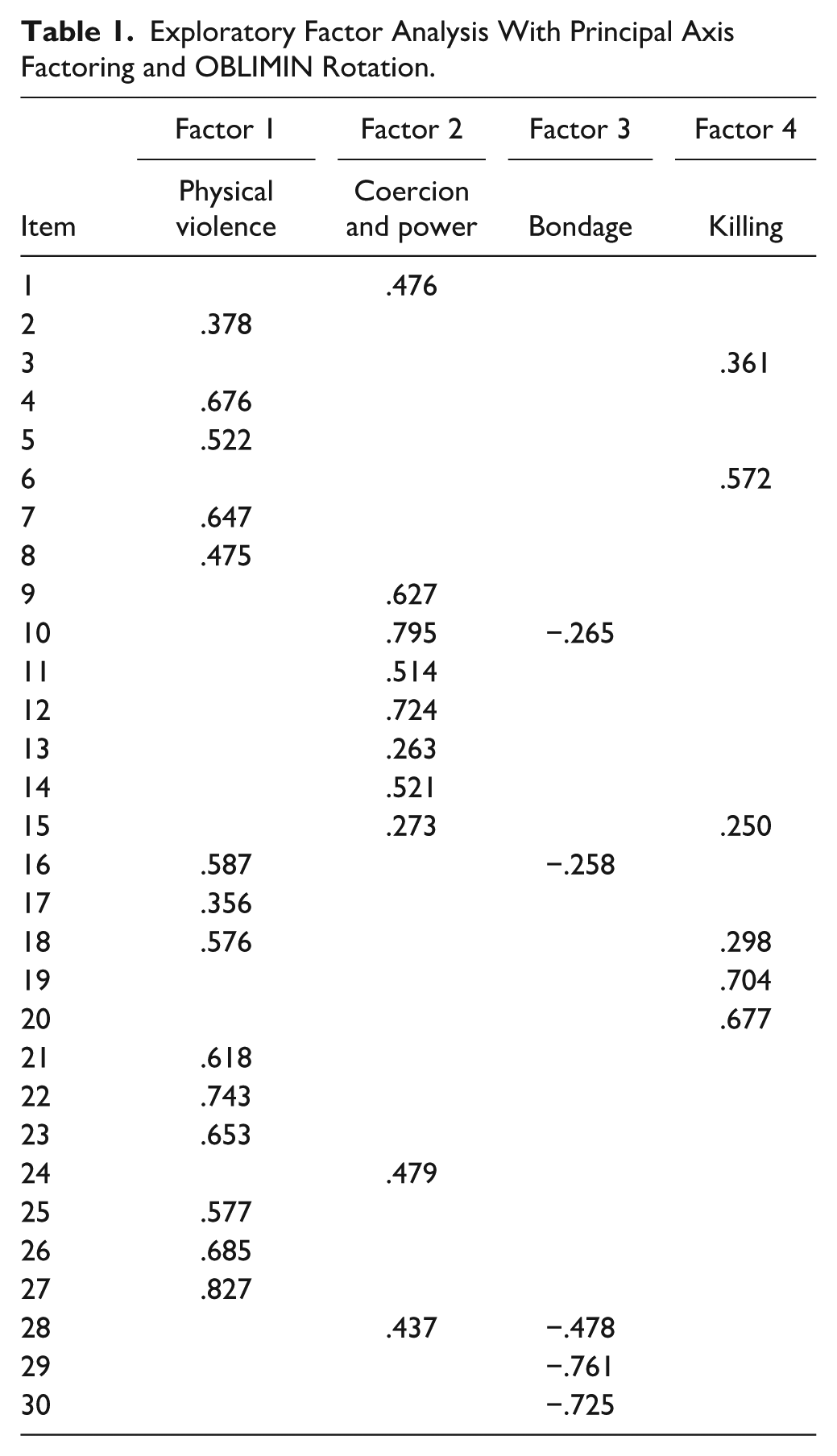
The four-factor solution yielded comparable factors to those found in prior studies (i.e., Knight et al., 2013; Longpré, Sims-Knight, et al., 2020). The first factor, named Physical Violence (Beating the victim; Knight et al., 2013; Longpré, Sims-Knight, et al., 2020), included items such as I have beaten someone while having sex. The second factor, named Coercion and Power (PC+; Knight et al., 2013; Longpré, Sims-Knight, et al., 2020), included items such as Making someone do what I want turns me on sexually. The third factor, named Bondage (Bondage; Knight et al., 2013; Longpré, Sims-Knight, et al., 2020), included items such as I have tied someone up while we were having sex. The fourth factor, named Killing (Desire to kill the victim; Knight et al., 2013; Longpré, Sims-Knight, et al., 2020), included items such as I have fantasized about killing someone during sex.
Furthermore, EFAs with principal axis factoring and OBLIMIN rotation were conducted on the men (n = 204) and women (n = 179) sub-samples, as well as on the students (n = 48) and the MTurk (n = 354) sub-samples. A similar four-factor solution was found, with little differences across genders or sub-samples. This is consistent with a previous study on the Knight et al.’s (2013) Agonistic scale (e.g., Longpré et al., 2019). However, while EFAs indicated that the factor structure seems invariant across genders and populations, these results need to be interpreted with caution because of the size of some sub-samples and need to be replicated.
The larger the amount of variance explained by the first component, the better are the chances that the construct is unidimensional (Bertrand & Blais, 2004; de Ayala, 2009). The first factor accounted for 36.96% of the variance, which exceeds the recommended limit of 20% for considering the model as unidimensional (Bertrand & Blais, 2004). Comparative fit index (CFI) and root mean square error of approximation (RMSEA) support a one-factor higher-order factor solution for a single dimension, suggesting that the scale satisfies the unidimensionality assumption.
The unidimensional structure of the TACS is further supported by Davidson and Healey (2024), who conducted CFA on a sample of 248 adults—composed of members from the general population with no interest in BDSM (n = 60) and BDSM practitioners (n = 188)—who completed the TACS. While they reported some limitations, likely due to the sample composition (i.e., smaller sample size; mostly composed of women), their analyses revealed that the four-factor bifactor model provided the best fit. Overall, the convergence of results is supporting the unidimensionality of the TACS (and the Agonistic Continuum), across samples and genders, and on the basis of non-redundant analytic strategies.
Taxometric Analyses
Taxometric analyses were employed to further assess the unidimensionality assumption. Meehl’s pre-taxometric requirements were met, and the sample generated base rate was of 12%. Therefore, MAMBAC, MAXEIG, and L-Mode analyses were calculated using estimated base rates of 10% and 15%. MAMBAC, MAXEIG, L-Mode, and mean over method Comparison Curve Fit Indices (CCFIs) were respectively .427, .447, .454 (M = .442) with a 10% base rate, and .416, .456, .424 (M = .432) with a 15% base rate (curves and full taxometric results can be provided on demand). Whereas the farther the CCFI falls below .50, the greater the support is for a dimensional structure, the farther the CCFI is above .50, the greater the support is for a taxonic or categorical structure (Ruscio et al., 2006). Taxometric analyses were also conducted on the MTurk sub-sample only, and similar outcomes were found, further supporting that both sub-samples could be merged. The CCFI results were consistent with what one would expect when studying a dimensional structure, and no taxonic peaks were evident. Moreover, the curves and the CCFIs in the present study were similar to the curves and CCFIs of the original Agonistic Continuum scale (Knight et al., 2013; Longpré, Sims-Knight, et al., 2020).
Item Response Theory Analyses
The third set of analyses examined the ordinal structure of the TACS using 2PL IRT analyses (see Table 2). The IRT analysis aims to identify whether items are structured as a probabilistic Guttman scale. In the current context, IRT assesses the extent to which respondents who endorse most sadistic items are likely also to endorse items lower on the continuum, whereas respondents lower on the continuum will agree only items at their same level or lower, but less or not at all with items that are higher on the continuum.
Two Parameters Item Response Theory Results (N = 388; 0–2).
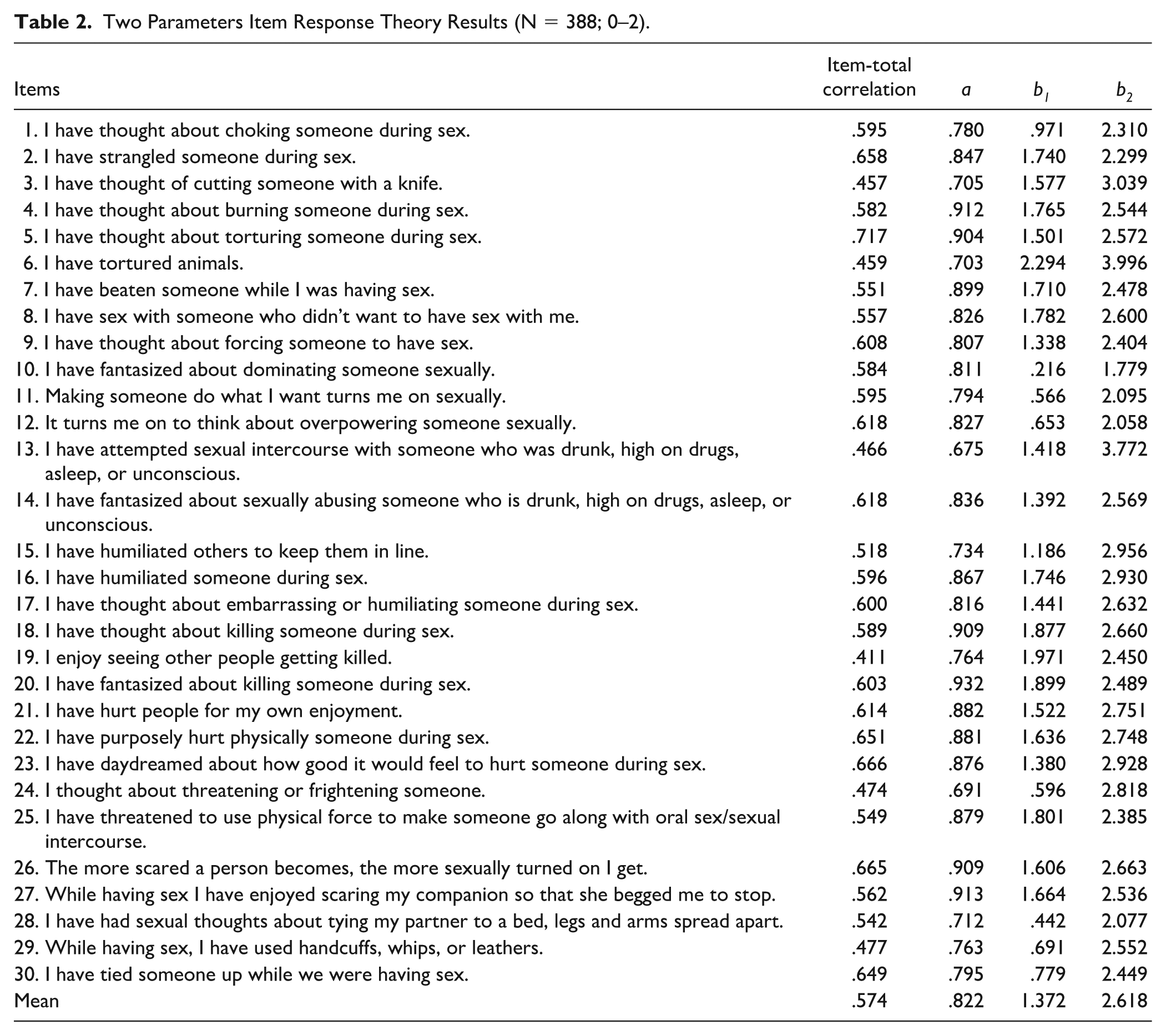
Analyses indicated that the scale was sufficiently unidimensional to allow IRT analysis. Furthermore, consistent with prior studies, the taxometric analyses of the current data supported the dimensional structure of the TACS. The internal consistency was also excellent (i.e., .93), further supporting the appropriateness of IRT analysis. The average item-total Pearson product-moment correlation coefficient (r) was .57, with no items presenting problematic correlations. Model fit indices for a single factor were also very good— RMSEA = .09; CFI = .97; Tucker Lewis index (TLI) = .97. Finally, the standardized residuals for both univariate and bivariate model fit indicated that no items reached or exceeded the problematic threshold of ±3. The IRT model fit indices were over the recommended threshold (Hu & Bentler, 1999), indicating a stable unidimensional model and corroborating the prior conclusion supporting unidimensionality from internal consistency, EFA, and taxometric.
As can be seen in Table 2, 2PL IRT yields two types of parameters, the discrimination parameter (α) and the difficulty parameter (b). To reduce the problem of low probability response choices, the five-point scale was collapsed into a three-point scale (0, 1, 2) by combining the lowest two (0) and the highest two (2) response options. The discrimination parameter (α) is the degree to which an item has the power to differentiate between individuals who have or do not have the corresponding b level of a particular latent trait (de Ayala, 2009). The αs in this study ranged from .68 to .91 and fell within the adequacy range of .5 to 2.5 proposed by Bertrand and Blais (2004). A value of .3 and above should be interpreted as good, and a value of .6 and above should be interpreted as very good (de Ayala, 2009). The items, I have attempted sexual intercourse with someone who was drunk, high on drugs, asleep, or unconscious (α = .68) and I thought about threatening or frightening someone (α = .69), were the least discriminating items. The items While having sex I have enjoyed scaring my companion so that she begged me to stop (α = .91) and I have fantasized about killing someone during sex (α = .93), were the most discriminating.
In the trichotomous restructuring of the items, b1 is determined by the level at which the Item Characteristic Curve (ICC) passes through the threshold at which the respondent has a .50 chance of endorsing the item at Level 1 (i.e., endorsing the item at 1 on the three-point scale), and b2 is the threshold at which the respondent has a .50 chance of endorsing the item at Level 2 (i.e., endorsing the item at 2 on the three-point scale). The b parameters usually vary from −3 to 3, where items located below 0 are considered easy or commonly endorsed, and items above 0 are considered difficult, serious, or more infrequently endorsed (de Ayala, 2009). The difficulty parameters ranged from .22 to 2.29 for b1 and 1.78 to 3.99 for b2. The items I have fantasized about dominating someone sexually (b1 = .22) and I have had sexual thoughts about tying my partner to a bed, legs, and arms spread apart (b1 = .44), were the easiest and most frequently endorsed. The items I enjoy seeing other people getting killed (b1 = 1.97) and I have tortured animals (b1 = 2.29) were the most difficult and least likely to be endorsed.
In the trichotomous restructuring of the items, b1 is measuring if participants have “sometimes” had these fantasies or acted out on it, while b2 is measuring if participants have “fairly often” or “very often” had these fantasies or acted out on it. Therefore, the difference between the two betas indicates the level of involvement for each behavior/ fantasy, rather than measuring absence vs presence. Overall, the items showed a good concordance on how the items were ranked on b1 and b2. The easiest items to be endorsed at b1 were also the easiest to be endorsed at b2, with little variation. For example, the items I have fantasized about dominating someone sexually (b2 = 1.78) and I have had sexual thoughts about tying my partner to a bed, legs, and arms spread apart (b2 = 2.08) were also the easiest and most frequently endorsed at b2; while the items measuring torture and killing were also the most difficult and least likely to be endorsed, with some items being ranked slightly more difficult or easier (but still within the same range) to be endorsed between b1 and b2. This is consistent with what was previously reported by Knight et al. (2013).
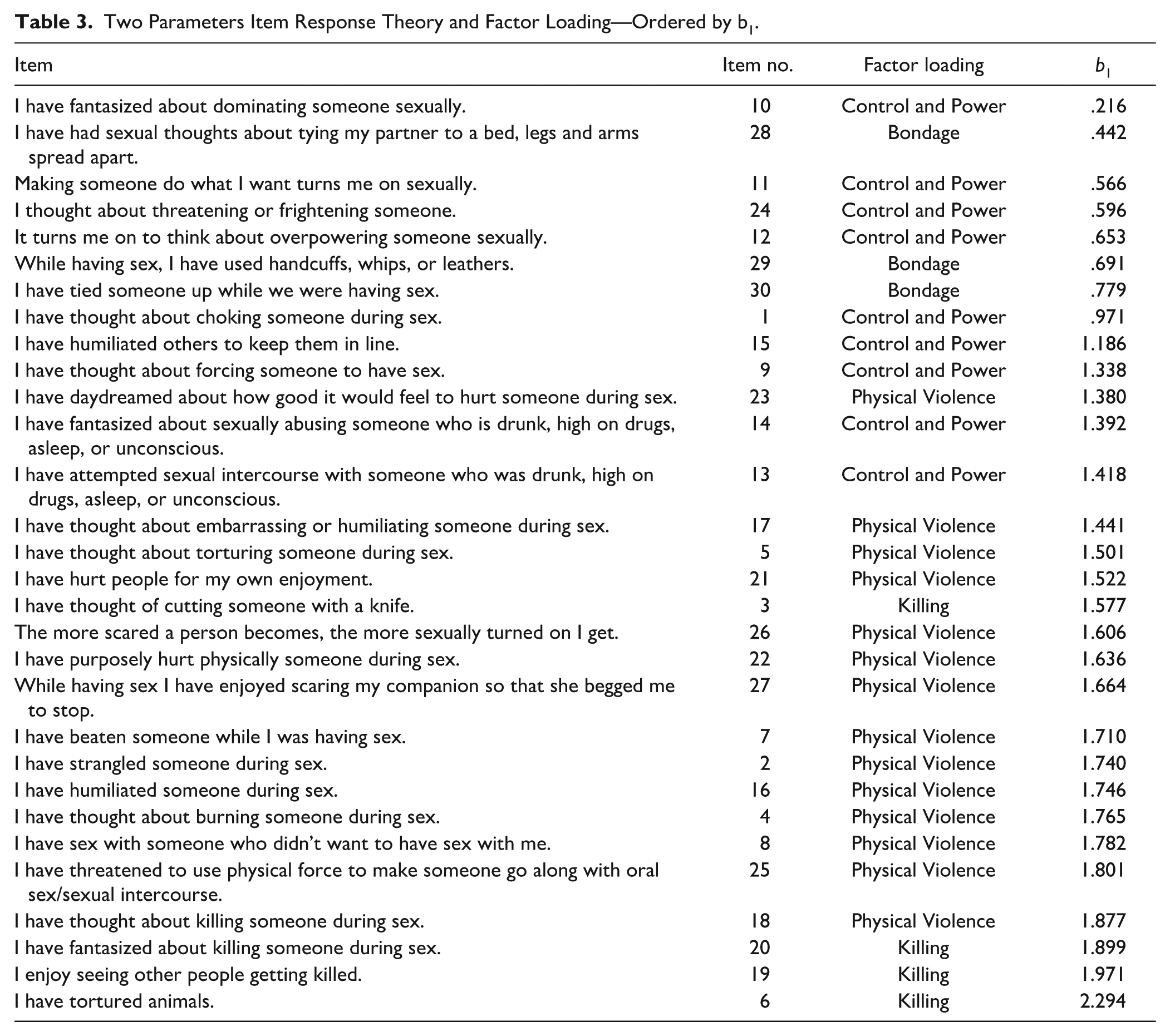
In Table 3, we reordered the items presented in Table 2 by b1 and indicated the factor on which each item primarily loaded in the EFA. As can be seen, items measuring Control and Power as well as Bondage were located on the lower end of the TACS, and items measuring Physical Violence and Killing were located at the upper end. Apart from Item 3, “I have thought of cutting someone with a knife,” all killing items fell at the extreme upper end of the TACS. Table 3 corroborates the hypothesis that items in the TACS are ordered as a probabilistic Guttman scale, with PC+ at the lower end and more severe sadism items at the high end. These results are consistent with the ordering of items in Knight et al.’s (2013) original Agonistic Continuum scale, with a rank order correlation of .76, and comply with the theoretical structure that has been proposed for the Agonistic Continuum.
Two Parameters Item Response Theory and Factor Loading—Ordered by b1.
Finally, 2PL IRT were conducted on the men (n = 204) and women (n = 179) sub-samples to assess whether item parameters for discriminability and difficulty were similar across genders (see Table 1 in Supplementary Materials). The αs ranged from .61 to .93 for the men sub-sample, and from .60 to .98 for the women sub-sample. Overall, the αs scores were similar (men: mean = .78; women: mean = .81), indicating that items are discriminating similarly across genders. Similar concordances between genders were also found for the b1 scores (men: mean = 1.305; women: mean = 1.623), with most items measuring Control and Power and Bondage located on the lower end, and items measuring Physical Violence and Killing located at the upper end. However, because of the lower sub-sample sizes, these results need to be considered carefully. While preliminary results from EFA and 2PL IRT are revealing an overall good stability of the TACS across genders, with expected variations (for more details on the endorsement of sexually violent items across genders, see Beckett et al., 2025), replication is needed.
External Correlations
The convergent and concurrent validity of the TACS was measured to test whether the total score of the new scale was consistent with another validated scale measuring the same construct. In the current study, Pearson’s r correlation was used to assess the correlation between the TACS and the Knight et al.’s (2013) Agonistic Continuum scale. The correlation was positive and significant (r = .64, p < .01), indicating a moderate to strong convergence. Recent studies have also supported the validity and reliability of the TACS in samples from the general population and BDSM practitioners (Canada; Davidson & Healey, 2024), and sexual murderers (Australia & New Zealand; Darjee & Davis, 2025). Longpré et al. (2018, 2019) also examined the nomological networks of Knight et al.’s original Agonistic Continuum scale and the TACS. Similar covariations emerged for external measures of psychopathic traits, antisocial traits, narcissistic traits, and vindictive cognitions, indicating good criterion-related validity, supporting the hypothesis that the two scales occupy the same nomological space.
Discussion
Overview of the Results
The creation of a dimensional assessment scale of sexual violence is consistent with the current paradigm shift away from categorical approaches. Although from a criminal justice system perspective these forms of violence have been considered categorically, several studies have supported the hypothesis that different levels of sexual violence are part of a single continuum, which Knight, Longpré and colleagues (Knight, 2010; Knight et al., 2013; Longpré, Sims-Knight, et al., 2020) named the Agonistic Continuum. The presence of a continuum of sexual violence has been supported by several studies and across populations and genders (e.g., Balcioglu et al., 2023; Longpré et al., 2019; Reale et al., 2017; Trottier et al., 2021).
The present study aimed to develop a new scale measuring the Agonistic Continuum and assessing its psychometric properties with classical test theory, exploratory factor analyses, taxometric analyses, and 2PL IRT. Analyses revealed that the 30-item TACS evidenced good psychometric properties. Although the TACS maintains many of the advantages of the Knight et al.’s (2013) Agonistic Continuum scale (e.g., good internal consistency, good discriminating power, good convergence validity, good face validity), it also improves some of its limitations (e.g., wider assessment of the spectrum severity; content validity). These results have several implications, ranging from moving away from the arbitrary categorization of sexual violence to encompassing the last few years of research on sexual harassment and sexual coercion.
Psychometric Properties of the TACS
Recent empirical investigations have made it increasingly evident that a dimensional approach represents the future of research on sexual violence. A closer look at the EFA revealed that the TACS comprised four factors—Coercion and Power, Bondage, Physical Violence, and Killing. This structure is consistent with Knight, Longpré and colleagues’ previous findings (i.e., Knight, 2010; Knight et al., 2013, 2018; Longpré, Knight, et al., 2020; Longpré, Sims-Knight, et al., 2020), and the higher-order factor analysis of these components suggests that these factors are simply correlated indicators of a single underlying dimension. Furthermore, it is further supported by Davidson and Healey (2024), who reported that the four-factor bifactor model provided the best fit. Conceptually, this corroborates both the integration of PC+ with sexual sadism and the hypothesis, consistently found across samples, scales, and genders in previous research, and supported by non-redundant analytical strategies, that they are both part of an Agonistic Continuum (e.g., Knight et al., 2013, 2018; Longpré, Knight, et al., 2020; Longpré, Sims-Knight, et al., 2020).
In the IRT analysis, the difficulty parameter, or beta (b), supported the ability of the TACS to measure different levels of “difficulty,” or in this case, different levels of the severity of the construct. B1 scores ranged from .22 to 2.29, and B2 scores ranged from 1.78 to 4.00. Items that were expected to be more frequently endorsed, such as those on the Control and Power factor, which captured fantasies and behaviors of domination and control, and those on the Bondage factor, which comprised restraint items, were found to have lower beta scores. Items that were expected to be more difficult to endorse, and therefore to be more severe, such as humiliation, scaring, and hurting fantasies and behaviors, yielded middling beta scores. Finally, items that were expected to be rarely endorsed and most severe, such as torture and killing fantasies and behaviors, produced the highest beta scores. Although the exact ordering of items in the IRTs in various studies of the Agonistic Continuum has varied slightly, conceptually, the distribution of items on the difficulty parameter has been reasonably consistent across studies on atypical sexuality (e.g., de Roos et al., 2025; Joyal & Carpentier, 2022; Knight et al., 2013; Longpré et al., 2022).
Moreover, all items manifested good discriminating power (α), ranging from .68 to .91. These fell within Bertrand and Blais’ (2004) adequacy range of .5 to 2.5. The discrimination parameters represent an indicator’s ability to differentiate among the varied levels of a construct, supporting the effectiveness of the TACS to adequately discriminate the different levels of the Agonistic Continuum. Furthermore, the reported discriminating patterns were similar to Knight et al.’s (2013) results, indicating a good convergence of results across both scales, and highlighting that this construct is not sample-related or scale-related. Although the two items with the lowest discrimination power were in the acceptable discrimination range, nonetheless, they might suggest avenues for improving the scale. The item, I have attempted sexual intercourse with someone who was drunk, high on drugs, asleep, or unconscious (α = .68) may have been too specific in the kind of sexual coercion it asked about, and I thought about threatening or frightening someone (α = .69) might suggest that lower levels of non-sexual agonistic behavior are less discriminating. Although adequate and similar to Knight et al.’s (2013), the items presented a similar range of discriminability, with no items going over 1, suggesting avenues for improving the scale.
Importance of the Findings
Additional Disconfirmation of PCD as a Distinct Diagnostic Syndrome
Despite the mounting evidence that PCD does not constitute a separate diagnostic syndrome independent from sadism, it has continued under the guise of OSPD (nonconsent) to be the second most common diagnosis of individuals who have been committed as sexually violent in the USA (Holoyda & Blum, 2023). The present data on TACS are consistent with prior research that challenges the validity of PCD and its use in this capacity.
Moving Toward a Dimensional Assessment of Sexual Violence
The original research from the Knight’s lab focused on the conceptualization, measurement, and latent structure of the Agonistic Continuum in criminal samples. In the last decade, the importance of studying such violence beyond convicted samples has been emphasized (Benbouriche & Parent, 2018). The vast number of sexually aggressive acts in the general population go unreported or unprosecuted (Bonneville & Trottier, 2021; Parent et al., 2018; Saravia et al., 2023; Trottier et al., 2021), or if prosecuted, unconvicted (Benbouriche & Parent, 2018; de Roos & Jones, 2020). The #MeToo movement has shed light on the high prevalence of sexual violence and has highlighted its systemic underreporting (de Roos & Jones, 2020). Studying sexual violence on a continuum allows us to unify our knowledge of lower forms of sexual harassment and coercion (e.g., Beckett & Longpré, 2024; Longpré et al., 2025; Saravia et al., 2023) with severe forms such as sadistic rape and sexual homicide (Reale et al., 2017; Stefanska et al., 2020).
Previous studies have revealed that lower forms of sexual violence share similar predictors with more extreme forms (e.g., Beckett & Longpré, 2024; Bonneville & Trottier, 2021; Longpré et al., 2025; Saravia et al., 2023). Therefore, creating non-existent categories undermines our ability to properly study, prevent, and treat sexual violence. Furthermore, it is creating a climate where victims of lower form of sexual violence such as sexual harassment and sexual coercion remain silent, are scared to come forward, or feel that they are not believed or supported by the criminal justice system (Bonneville & Trottier, 2021; de Roos & Jones, 2020). This has led some countries to consider the creation of special courts for sexual offenses, where judges will be specifically trained for sexual violence. Moreover, there is an urgent need to educate police forces on sexual violence and break an underlying culture of banalization (Delicato, 2022). Following the kidnapping-rape-murder of Sarah Everard by a London Metropolitan Police Constable in 2021, a report revealed that the Metropolitan Police Service police was institutionally misogynistic. The report details several stories of sexual assault, covered up or downplayed by officers. Leaked messages revealed that some officers were praising rapists in a WhatsApp group. A movement toward a dimensional assessment will allow for a better recognition of all forms of sexual violence and will allow professionals to tackle the causes at the roots while improving our practices at every level, from police culture to court practices, to prevention and treatment. Scales such as the TACS adequately cover the wide array of sexual violence and can be used to strengthen this much-needed holistic approach. Recent work by Darjee and Davis (2025) supports this movement toward a dimensional assessment of sexual violence, even for extreme forms of sexual violence such as sadistic offenses and sexual homicide and have identified the TACS as an alternative to consider in terms of best practice in sex offender assessment and management.
The critical consequences for assessment, research, and explorations of etiology that derive from identifying a construct as dimensional rather than categorical have been discussed at length in other places (i.e., Knight, 2025; Longpre, Guay, et al., 2018; Longpré, Sims-Knight, et al., 2020) and will not be detailed here. It is sufficient to say that these are significant, helping to bridge an understanding of sexual violence across its multiple manifestations. The continuing accumulation of data supporting the dimensionality of the Agonistic Continuum informs how we should study and use this construct in the future.
It is important to note that measuring sexual violence on a continuum does not mean that all levels of violence are considered as being equal. Consistent with the recent initiative to create an objective risk language across assessment metrics, research on the Agonistic Continuum recognize that there are legal and societal impediments that might affect their application. The cutoffs for “viable candidate for a primary prevention college training” and “recommended for civil commitment” should be radically different. Not all sexual violence behaviors are equal, even if they are part of the same continuum; hence, not all levels of risk require similar interventions, either from a criminal justice perspective or from a treatment/ prevention perspective.
Limitations
This study is not without limitations. First, these data were collected from a self-reported survey administered to MTurk workers and university students using convenience sampling. Gathering self-reported data on a sensitive topic such as sexual violence might have partially impacted the results. Responses may have been influenced by a need to appear socially desirable, whether conscious or unconscious, leading to underreporting. Several control and safeguarding measures were implemented to minimize the risk of using inaccurate responses—requiring voluntary participation and complete anonymity, providing financial compensation (i.e., MTurk workers), analyzing completion time and excluding respondents who did not devote sufficient time on the survey, eliminating uncooperative participants, and using the Positive Image scale in an attempt to mitigate the risk of social desirability bias. Although our results need to be replicated, and future studies should employ more systematic and random sampling techniques with representative samples, our findings are consistent with previous studies conducted on different samples and scales, demonstrating a good convergence of results.
Second, although the TACS yielded very good psychometric properties, the scale is in its developmental stage and therefore has its limitations. For example, although all the items were within the recommended range, no items presented a discriminability parameter (α) over 1. This suggests room for improvement. Consistent with Meehl’s (1995) emphasis on the importance of establishing construct validation, the TACS has to demonstrate consistency of results across fundamentally different families of analyses (e.g., latent class analysis, factor analyses, taxometric, IRT) and across different samples. While this paper analyzed two convenience samples that differ from the general population (i.e., MTurk workers and university students), our results were replicated to some extent in two other studies, with samples from the general population, BDSM participants, and sexual murderers. As such, the TACS is showing consistent results across samples, above and beyond the legal definition of rape. Ultimately, different methods will have to be devised, and the TACS will have to demonstrate convergence with them. The TACS is also currently under study, alongside the Knight et al.’s Agonistic scale, in different prisons and forensic samples. Furthermore, the scale was translated into French and Dutch and is being used with general population and in prison samples. Preliminary results have supported its validity and reliability across samples, populations, countries, and languages.
Conclusion
The aim of the present study was to develop and test the psychometric properties of a new Agonistic scale, named The Agonistic Continuum Scale (TACS), with classical test theory, exploratory factor analyses, taxometric analyses, and Two-parameter Item Response Theory. External correlation with Knight et al.’s (2013) Agonistic scale was also calculated to test the convergent validity of the 30-item scale. Analyses revealed that the TACS presents good psychometric properties (e.g., good internal consistency, good discriminating power, good convergence validity, good face validity, content validity). This scale is part of a movement toward the dimensional assessment of sexual violence, and this study provides further empirical support, challenging the hypothesis that PCD and sadism constitute distinct disorders and corroborating the reconceptualization of both on a single dimension.
Supplemental Material
sj-docx-1-asm-10.1177_10731911251382063 – Supplemental material for Development and Validation of The Agonistic Continuum Scale (TACS)
Supplemental material, sj-docx-1-asm-10.1177_10731911251382063 for Development and Validation of The Agonistic Continuum Scale (TACS) by Nicholas Longpré and Raymond A. Knight in Assessment
Footnotes
Declaration of Conflicting Interests
The authors declared no potential conflicts of interest with respect to the research, authorship, and/or publication of this article.
Funding
The authors received no financial support for the research, authorship, and/or publication of this article.
Ethical Approval
All procedures performed in studies involving human participants were in accordance with the ethical standards of the institutional and/or national research committee and with the 1964 Declaration of Helsinki and its later amendments or comparable ethical standards.
Informed Consent
Informed consent was obtained from all individual participants included in the study.
Disclosure
This study was not preregistered. We report how we determined our sample size, all data exclusions, all manipulations, and all measures in the study.

Supplemental Material
Supplemental material for this article is available online.
References
Supplementary Material
Please find the following supplemental material available below.
For Open Access articles published under a Creative Commons License, all supplemental material carries the same license as the article it is associated with.
For non-Open Access articles published, all supplemental material carries a non-exclusive license, and permission requests for re-use of supplemental material or any part of supplemental material shall be sent directly to the copyright owner as specified in the copyright notice associated with the article.
