




Abstract
Most juvenile risk assessment tools heavily rely on a risk-focused approach. Less attention has been devoted to protective factors. This study examines the predictive validity of protective factors in addition to risk factors, and developmental differences in psychometric properties of juvenile risk assessment. For a national Dutch sample of 354 juvenile and young adult offenders (16-26 years) risk and protective factors were retrospectively assessed at discharge from seven juvenile justice institutions, using the Structured Assessment of Violence Risk in Youth (SAVRY) and Structured Assessment of Protective Factors for violence risk – Youth Version (SAPROF-YV). Results show moderate validity for both tools predicting general, violent, and nonviolent offending at different follow-up times. The SAPROF-YV provided incremental predictive validity over the SAVRY, and predictive validity was stronger for younger offenders. Evidently both the SAVRY and SAPROF-YV seem valid tools for the assessment of recidivism risk in juvenile and young adult offenders. Results highlight the importance of protective factors, especially in juvenile offenders, emphasizing the need for a balanced risk assessment.
Assessing the risk of violence or other criminal (re)offending is a primary task for professionals working in correctional or forensic mental health services. To structure mental health professionals’ risk evaluations, over the past several decades a wide variety of risk assessment tools have been developed. Information gathered by applying these tools is used to identify individuals at high risk of (re)offending, guide legal decisions regarding the intensity of interventions or community reintegration, and help therapists identify targets to reduce the risk of (violent) reoffending. As such, risk assessment tools play an important role in the decision making and safety planning in offender treatment. Especially for young offenders, effective risk assessment is needed, as this can guide early interventions and contribute to a reduction in the emotional, social and economic costs of life course persistent offending (Cohen et al., 2010). This highlights the importance of research on the psychometric properties of juvenile risk assessment tools for forensic settings and for society at large.
While risk assessment tools had originally been developed for the prediction of the likelihood of reoffending, most researchers now agree that the vital role of clinical risk assessment is not predicting reoffending, but preventing recidivism, and managing and ultimately reducing the level of risk (e.g., Andrews & Bonta, 2010; Hart & Logan, 2011; Heilbrun, 1997). Bonta and Andrews (2016) suggest that applying empirically validated risk assessment tools will aid in adhering to the Risk, Need and Responsivity principles (RNR model; for an overview, see Andrews et al., 1990; Bonta & Andrews, 2016), which ultimately results in reduced levels of reoffending. Their theory suggests that risk assessment tools can be used to formulate evidence-based and individually tailored interventions aimed at reducing an individual’s risk level. This is supported by a considerable amount of studies reporting that interventions that adhere closely to the RNR principles are more effective at reducing reoffending (e.g., Hanson et al., 2009; Lowenkamp et al., 2006; Prendergast et al., 2013). Especially risk assessment tools that employ a Structured Professional Judgment (SPJ) approach are considered to be useful when bridging risk predictions with risk management strategies, as these tools have a profound focus on changeable (or dynamic) risk and preferably also protective factors to guide clinical decisions regarding intervention needs and intensity (Vincent, 2006).
The empirical validation of SPJ risk assessment tools is essential to warrant the use of these tools and effectively reduce recidivism risk in offenders. A considerable body of research focused on the empirical validation of several juvenile risk assessment tools. These studies have primarily concerned concepts that contribute to the phenomenon of (violent) crime. Aspects that reduce the likelihood of (violent) reoffending have received considerably less attention. These risk reducing aspects are generally known as protective factors or strengths. Protective factors seem promising for the improvement of risk prediction and risk management. Nowadays many clinicians and researchers agree that incorporating both risk and protective factors in risk assessment enables a balanced appraisal of offenders’ risk of violent behavior, and leads to more positive treatment goals enhancing a strength-oriented approach in treatment (de Vogel et al., 2011; Lösel & Farrington, 2012; Rogers, 2000; S. Viljoen et al., 2017). This view is supported by a growing body of research increasingly demonstrating the vital role of protective factors in desistance from reoffending (de Vries Robbé, de Vogel, Douglas, et al., 2015; Desmarais et al., 2012; Lodewijks et al., 2010; Rennie & Dolan, 2010). Especially during adolescence, protective factors may be of great importance due to the potential for positive change in this dynamic life phase, in order to prevent life course persistent offending (Shepherd et al., 2016; J. L. Viljoen et al., 2010).
Following these advances, several juvenile risk assessment tools have to some extent incorporated protective factors. For example, the Structured Assessment of Violence Risk in Youth (SAVRY; Borum et al., 2002) incorporates risk factors and to a lesser extent also protective factors. Although the SAVRY is one of the most widely used SPJ tools and currently the most widely used measure for protective factors in juvenile offenders (Dickens & O’Shea, 2017), the number of protective factors addressed is limited and available studies on the predictive and incremental predictive validity of the SAVRY protective factors on desistance from offending have shown mixed results (e.g., Dolan & Rennie, 2008; Hilterman et al., 2014; Lodewijks et al., 2010; Rennie & Dolan, 2010; Shepherd et al., 2014; Spice et al., 2010). Recently, results concerning the protective factors in the SAVRY were summarized in a systematic review which concluded that the SAVRY protective factors were somewhat associated with desistance from reoffending but did not provide incremental predictive validity over risk factors (Dickens & O’Shea, 2017).
In order to increase the focus on protective factors in predominantly risk-focused assessments, the Structured Assessment of Protective Factors for Violence Risk–Youth Version (SAPROF-YV; de Vries Robbé, Geers, et al., 2015) was developed. This tool entirely encompasses protective factors and is designed to be used in conjunction with (primarily) risk-focused assessment tools, such as the SAVRY or the Youth Level of Service/Case Management Inventory (Hoge & Andrews, 2002). Studies with the adult counterpart of this tool (SAPROF-Adult version; de Vogel et al., 2012) showed promising results regarding the predictive validity of the SAPROF (e.g., Abidin et al., 2013; de Vries Robbé et al., 2011). However, studies exploring whether the SAPROF provided incremental predictive validity over and above risk factors produced mixed results (de Vries Robbé et al., 2013; Kashiwagi et al., 2018; Neil et al., 2020). Promising results with the SAPROF-YV are emerging and support the link between the SAPROF-YV protective factors and desistance from reoffending (de Vries Robbé et al., 2020). However, to date, very few studies have been published yet on the predictive validity of the SAPROF-YV and SAVRY combination in young offenders released from juvenile justice institutions. In a recent study by Kleeven et al. (2020), the predictive accuracy of the SAVRY and SAPROF-YV was compared with that of adult risk assessment tools (Historical Clinical Risk Management–20V3 and SAPROF). However, that study only included young adults between the ages of 18 and 26 years and did not investigate the incremental predictive validity of the SAPROF-YV over and above risk factors in juvenile risk assessment tools.
Hoge et al. (2012) have discussed the need for investigating the predictive accuracy of risk assessment in specific age groups. The predictive validity of juvenile risk assessment tools may change with age (Vincent et al., 2019) as the individual weight of specific risk and protective factors may vary with age (Lloyd et al., 2019). While very few publications are available addressing developmental differences in risk assessment in the juvenile and young adult offender population, two recent studies in this area found no age-related bias for total scores on juvenile risk assessment tools (de Vries Robbé et al., 2020; Vincent et al., 2019), while Wijetunga et al. (2018) found that the Juvenile Sex Offender Assessment Protocol–Revised was significantly better at predicting recidivism in younger sex offenders. It has been suggested that the predictive accuracy of various dynamic risk factors is U-shaped: the predictive value decreases from the age of 12 years, reaches a low point in early adulthood (17-23 years) and then rises again (Spruit et al., 2017; van der Put et al., 2011). This decline in predictive accuracy could be related to the process of desisting from crime in the development from adolescence to adulthood. While a small group of adolescent offenders continue to show delinquent behavior into adulthood, the largest proportion of adolescent offenders abstains from criminality (Moffitt, 1993, 2017). As a result, offenders with a relatively high number of initial risk factors might still desist from crime due to the development of vital protective factors during adolescence. In general, limited temporal validity and moderate predictive accuracy of risk assessment measures during adolescence has been found (e.g., Schwalbe, 2007), which might be a result of the unstable nature of attitudes, behavior, and relationships in this versatile age period.
Present Study
The current study aimed at providing a retrospective validation of the SAVRY and SAPROF-YV in a national sample of young offenders released from juvenile justice institutions in the Netherlands. First, the interrater reliability and convergent validity of these measures was examined. Second, the SAVRY and SAPROF-YV ratings at the time of discharge were related to official recidivism data at different follow-up times after discharge, in order to assess the predictive validity of the tools separately and to examine the incremental predictive validity of these tools combined. A primary follow-up period of 6 months was employed (as recommended in the SAPROF-YV manual), with three different outcomes: general reoffending, violent reoffending, and nonviolent reoffending. In addition, longer follow-up periods of 12 months and 24 months were also used to assess the predictive validity of the tools for long-term offending behavior. Adding to the limited body of research on developmental differences in juvenile risk assessment (de Vries Robbé et al., 2020), the secondary aim of this study was to investigate age differences with respect to the predictive accuracy of the SAVRY and SAPROF-YV for (violent) reoffending. Therefore, the predictive validity of the SAVRY and SAPROF-YV was examined separately for the subsamples of juvenile offenders (with ages below 18 years) and of young adult offenders (between 18 and 26 years). This is one of the first studies on the incremental predictive validity of the SAPROF-YV in addition to the SAVRY, examining the predictive validity of these measures combined in a sample of juvenile and young adult offenders released from a juvenile justice institution. Based on the results of Lodewijks et al. (2010) and de Vries Robbé et al. (2020) a high interrater reliability and convergent validity were expected for both tools. It was anticipated that both the SAVRY and SAPROF-YV provided medium to large predictive validity for different types of reoffending, with better predictive validities for shorter follow-up times. Incremental predictive validity of the SAPROF-YV over the SAVRY protective and risk factors was expected. Additionally, based on the results from Spruit et al. (2017) and van der Put et al. (2011) the predictive validity of the SAVRY and SAPROF-YV was expected to be higher for juveniles (younger than 18 years) than for young adults (18-26 years).
Method
Setting
The current study is part of a larger retrospective study examining the effectiveness of risk assessment within the Dutch Juvenile Justice system (for a data transparency statement, see Appendix A in the online Supplement Material). In the Netherlands, juvenile offenders between 12 and 25 years can be sentenced to serve (pretrial) detention or mandatory treatment in a juvenile justice institution. These institutions are closed facilities where young offenders receive treatment and guidance aimed at reducing the risk of reoffending. Screening and diagnostic tests are performed to identify mental health problems. Young offenders follow a strict daily schedule including school and training aimed at (moral) development, conflict management and social skills. Individual treatment is provided aimed at individual needs. By means of accompanied or unaccompanied leaves, young offenders are gradually prepared for their return to society. In all Dutch juvenile justice institutions, risk assessment is performed with the SAVRY often in combination with the SAPROF-YV. Violence risk is first assessed after approximately 6 months of treatment and updated every 6 months thereafter. Updated assessments are required for the approval of supervised or unsupervised leaves (Borum et al., 2014). Among all young offenders discharged from these juvenile justice institutions, overall official general recidivism within 2 years is 63% (Weijters et al., 2019).
Participants
For eligibility, files of 620 youth offenders discharged from a Dutch juvenile justice institution between January 2013 and May 2016 were reviewed. Exclusion criteria were as follows: (a) no history of violent behavior (n = 53); (b) insufficient information in the participant’s casefile (n = 92); (c) insufficient follow-up duration (n = 101); (d) transfer to another correctional facility (n = 10); (e) deportation or emigration after discharge (n = 9); or (f) deceased (n = 1). Participants with no history of violent behavior were excluded, as the risk assessment tools in the current study were developed to assess recidivism risk for adolescents who have been violent in the past (de Vries Robbé, Geers, et al., 2015). Participants who had at least 2.5 years postdischarge at-risk time to recidivate were selected, based on recommendations by the Dutch Scientific Research and Documentation Centre (WODC) The WODC suggests a time at risk of 2.5 years is necessary to accurately employ a 24-month follow-up time. This minimum period was maintained as it can take some time before new criminal offenses are registered in the judicial system. Shorter time at risk periods would likely result in an underestimation of the true criminal recidivism.
The final sample included a total of 354 offenders (342 males, 96.6%) between 13 and 26 years of age at discharge (M = 18.5; SD = 2.06). Treatment duration ranged from 16 to 2,465 days (M = 301.95, SD = 416.22). Index offenses are found in Table 1. Preceding the index offense the young offenders had an average of 2.68 (SD = 3.80) prior convictions in general and 1.05 (SD = 1.83) prior violent convictions. Of all offenders in the current study, 257 (72.6%) suffered from at least one disorder on Axis I or Axis II of the Diagnostic and Statistical Manual of Mental Disorders–Fourth edition (DSM-IV). Most frequently reported disorders were as follows: Conduct Disorder (n = 109, 30.8%); Mild Intellectual Disability (n = 76, 21.5%); Attention Deficit and Hyperactivity Disorder (n = 68, 19.2%); Oppositional Deviant Disorder (n = 53, 15.0%); and Substance Abuse (n = 49, 13.8%). For 24.6% (n = 87) of the offenders concerns were raised regarding the development of a possible personality disorder.
Sample Characteristics.
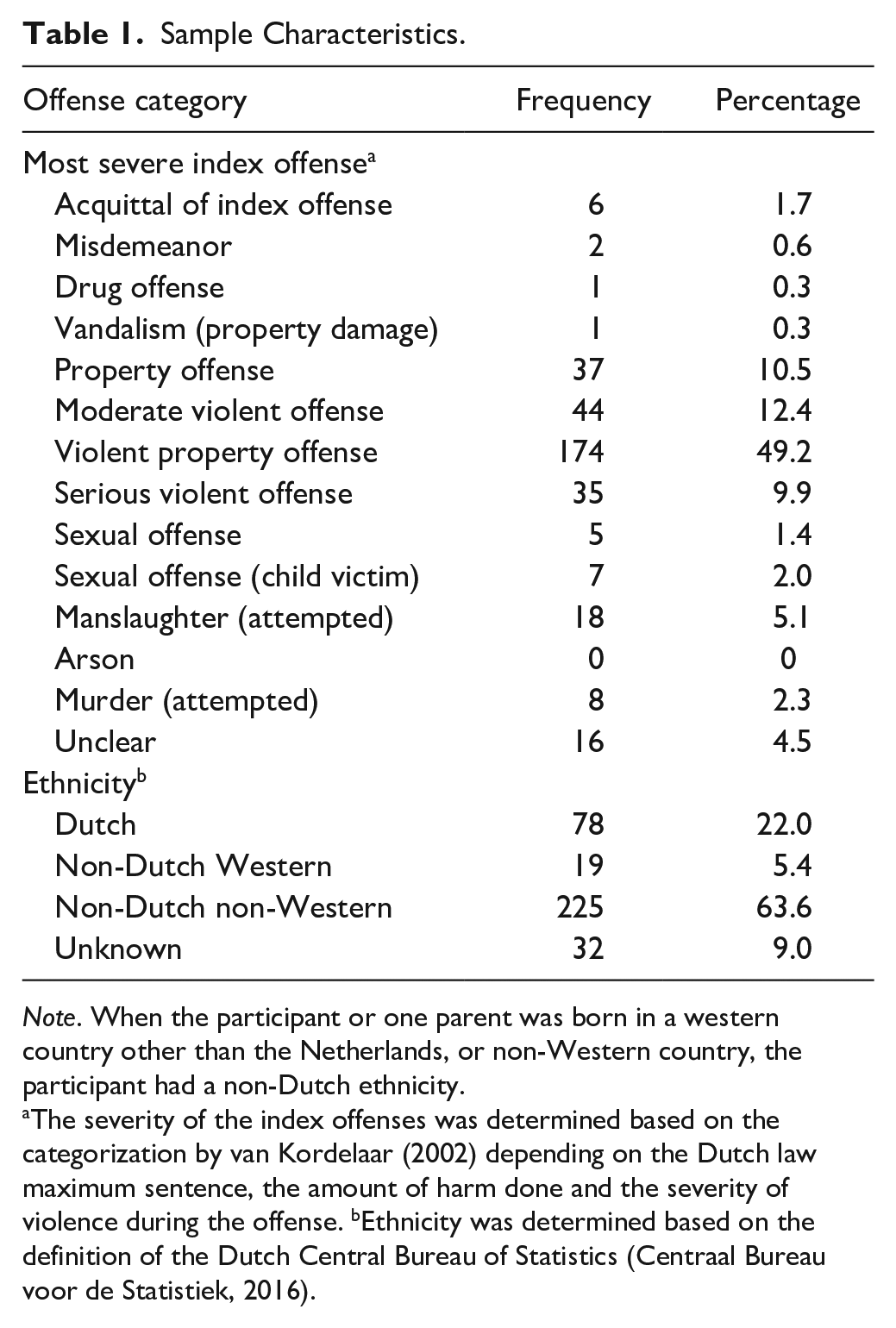
Note. When the participant or one parent was born in a western country other than the Netherlands, or non-Western country, the participant had a non-Dutch ethnicity.
The severity of the index offenses was determined based on the categorization by van Kordelaar (2002) depending on the Dutch law maximum sentence, the amount of harm done and the severity of violence during the offense. bEthnicity was determined based on the definition of the Dutch Central Bureau of Statistics (Centraal Bureau voor de Statistiek, 2016).
Measures
SAVRY
The SAVRY (Borum et al., 2002) is one of the most widely used risk assessment tools for juveniles. It is composed of 24 risk factors: ten historical risk factors, six social/contextual risk factors, and eight individual/clinical risk factors. See Table S1 in Appendix B (available in the online Supplemental Material) for an overview of the SAVRY items. The risk factors in the SAVRY are rated on a 3-point scale: 0 = low, 1 = moderate, or 2 = high. Additionally, the SAVRY includes a protective domain with six protective factors that are rated as either present or absent. The risk factors of the historical scale are rated regarding someone’s entire past, while the risk factors of the dynamic social/contextual and individual/clinical scales reflect functioning in the past 6 months, and ratings on the protective factors concern the past 12 months. In practice, the SAVRY is a SPJ tool in which a final risk judgment is composed based on the assessed factors combined with clinical judgment. For research purposes, the SAVRY risk factors may also be summed up in a total risk score that ranges from 0 to 48. The protective domain of the SAVRY can be summed up in a total score ranging from 0 to 6.
SAPROF-YV
The SAPROF-YV (de Vries Robbé, Geers, et al., 2015) has been designed for the comprehensive assessment of protective factors for violence in juveniles or young adults and should be used in combination with a (predominantly) risk-focused assessment tool, such as the SAVRY. It consists of 16 dynamic protective factors: four resilience, six motivational, three relational, and three external factors. See Table S2 in Appendix B (available in the online Supplemental Material) for an overview of the SAPROF-YV items. The items are rated as follows: 2 = clearly present, 1 = present to some extent, 0 = not or hardly present. The possible addition of a plus (+) or minus (−) to the scores of 0, 1, 2 results in a 7-point scale (0, 0+, 1−, 1, 1+, 2−, 2), reflecting the extent to which they are present as a protective factor for the individual in a particular situation in the near future. While the SAVRY factors concern the (entire or recent) past, the SAPROF factors concern the near future (coming 6 months) and are therefore context dependent. In the current study, the most probable context postdischarge was used. Thus, the timeframe and context for which the protective factors in the SAPROF-YV are rated is different from that for the SAVRY factors. Although the SAPROF-YV is also an SPJ tool, for the purpose of this study the SAPROF-YV items were recoded into a 7-point scale (0 = 0, 0+ = 1, 1− = 2, 1 = 3, 1+ = 4, 2− = 5, 2 = 6), and summed up in a total score ranging from 0 to 96.
Summary Risk Ratings
In the SPJ procedure, the final conclusion of the assessment constitutes an overall final risk judgment (summary risk rating) composed by the assessor resulting from carefully combining, weighing, and integrating the findings in the assessment. In this study, based on the combined findings regarding the risk factors and protective factors assessed with the SAVRY and SAPROF-YV, two integrative summary risk ratings regarding the likelihood of reoffending after discharge were composed by the assessors for each individual. Summary risk ratings were made on a 5-point scale: low, low-moderate, moderate, moderate-high, or high risk of (a) violent behavior, or (b) nonviolent criminal behavior, reflecting the structured clinical judgment regarding the estimated risk of violence or nonviolent criminal behavior within the first 6 months after discharge.
Recidivism
Recidivism data were obtained from official criminal records in the Judicial Documentation register of the Dutch Ministry of Justice. A minimum time at risk duration of 30 months was used in the current study of which 24 months were required to measure reoffending, and another 6 months were required for the reoffenses to be adjudicated. The total time at risk ranged from 32 to 69 months (M = 49.08, SD = 14.68). Recidivism data were coded for several follow-up periods starting on the day offenders were released from the juvenile justice institution, and ending 6 months later for the 6-month follow-up period, 12 months later for the 1-year follow-up period, and 24 months later for the 2-year follow-up period. New offenses were classified as convictions for violent offenses or nonviolent offenses committed after the release date (excluding technical breaches of order). Violent recidivism was defined as any (attempted) act intended to cause physical or psychological harm to others (Borum et al., 2002). Violent and nonviolent offenses were combined in a third measure of recidivism: general recidivism, defined as any new offense that led to official judicial conviction, violent or nonviolent.
Procedure
The SAVRY and SAPROF-YV were retrospectively coded by Graduate students in Forensic or Clinical Psychology, Criminology, or related studies, based on file information at the time of discharge. The research team included 24 qualified researchers who all participated in a 1-day workshop on the use of the SAVRY and SAPROF-YV. In addition, all students received 2 weeks of training by the principal investigator, which included testing of the quality of scoring to ensure the files were read and rated as intended. Support from the principal investigator was available at all time. Patient files included psychological and psychiatric reports, daily reports by social workers, treatment plans and treatment evaluations, diagnostic information and questionnaires, and demographic and judicial information (e.g., criminal history, court decisions). Prior to rating the risk assessment tools, inclusion criteria were reviewed by a member of the research team. Another member of the research team rated the risk assessment tools. At the time of rating, researchers were not aware of information concerning recidivism and blind to any reports written after the date of discharge from the facility. Recidivism data were coded after all risk assessments were completed by a researcher who did not carry out the risk assessment. To determine the interrater reliability, the files of 29 randomly chosen individuals (8% of total cases) were rated separately by two researchers in mixed pairs. After these files were rated independently, researchers agreed on consensus scores. These consensus scores were used in the analyses concerning the predictive validity of the tools. The scores made by the two researchers independently were only used to calculate the interrater reliability.
Statistical Analyses
Data were analyzed using IBM SPSS statistics version 22 and Rstudio Version 3.2.1. Interrater reliabilities of the SAVRY, SAPROF-YV, and summary risk ratings (for violence and nonviolence) were examined with the intraclass correlation coefficient (ICC), using a two-way random effect model and absolute agreement type, single measure. Critical values for single measure ICC’s are: ICC < .40 = poor, 40 ≤ ICC < .60 = moderate, .60 ≤ ICC < .75 = good, and ICC ≥ .75 = excellent (Fleiss, 1986). Pearson’s correlations were calculated between the SAVRY total risk score, SAVRY total protection score and SAPROF-YV total score and summary risk ratings. In addition, Pearson’s point-biserial correlations were calculated between the total scores on these measures and (general, violent, and nonviolent) recidivism within the different follow-up times.
To assess the predictive validity for (general, violent, and nonviolent) recidivism, Receiver operating characteristics (ROC) analysis was used with the SAVRY and SAPROF-YV (total scores and domain scores), and the summary risk ratings (violence and nonviolence) as variables. A follow-up period of 6 months was chosen based on the advised timeframe in the SAPROF-YV manual (de Vries Robbé, Geers, et al., 2015). In addition, the predictive validity for longer follow-up periods was also investigated with ROC analysis using a 12-month, and 24-month follow-up. ROC analysis expresses the predictive validity in the area under the curves (AUC) which reflects the probability that a randomly chosen recidivist would score higher on a given risk assessment tool than a randomly chosen nonrecidivist (Hanley & McNeil, 1982). AUC values between .56 and .64 are perceived as small, AUC values above .64 are perceived as medium, and AUC values above .71 are perceived as large (Rice & Harris, 2005). To investigate whether the predictive validity was significantly different between follow-up times, obtained AUC values were compared with the method by DeLong et al. (1988) for correlated ROC curves (same sample different measure) using the pROC package (Robin et al., 2020) in Rstudio Version 3.2.1.
Age-related differences on the SAVRY and SAPROF-YV scores (domains and total scores) were examined with independent samples T tests, and age-related differences in summary risk ratings and recidivism rates were examined with chi-square tests. To examine whether age moderated the relationship between the scores on the SAVRY and SAPROF-YV and different types of recidivism, moderated hierarchical logistic regression analyses were performed (see J. L. Viljoen et al., 2008). Interaction terms were produced through multiplying the scores on the risk assessment tools by age. For each tool, three hierarchical logistic regression analyses were performed (for general, violent, and nonviolent recidivism within 6 months) for each of the domain and total scores, in which the domain or total scores were entered in the first step, age was entered as covariate in the second step, and the interaction terms in the third step. In addition to the logistic regression analyses, age-related differences in the predictive power of the risk assessment tools were examined with ROC analyses for general, violent, and nonviolent recidivism (6 months follow-up), separately for juvenile offenders (age 13 to 17 years) and young adult offenders (age 18 to 26 years). ROC curves for juvenile and young adult offenders were compared using the bootstrapped percentile method for uncorrelated ROC curves (same measure different sample) in the pROC package (Robin et al., 2020) in Rstudio Version 3.2.1. This method is based on computation by Hanley and McNeil (1982) for independent ROC curves computed with (n = 2,000) bootstrapped replicates (Robin et al., 2011).
Finally, the incremental predictive validity of SAVRY and SAPROF-YV protective factors over SAVRY risk factors was assessed with stepwise hierarchical logistic regression analyses. Separate analyses were conducted for general, violent, and nonviolent recidivism within 6 months. Since the aim of these analyses was to investigate the incremental influence of protective factors on top of risk factors, the SAVRY risk factors were added in the first step. In a second step, protective factors of the SAVRY and SAPROF-YV were added using a backward selection. For descriptive purposes, comparability with other studies, and interpretability of the results, additional ROC analyses were performed using the predicted probabilities from the final logistic regression models.
Results
Interrater Reliability
Reliability analysis of 29 cases showed single measure ICC’s of .82 for the SAVRY total risk factors score, .74 for the SAVRY total protective factors score, .76 for the SAPROF-YV total protective factors score, and .61 and .63 for the summary risk ratings (violence and nonviolence). All subscales showed moderate to excellent interrater reliabilities, ICC’s ranging from .54 for the social/contextual domain in the SAVRY to .85 for the individual/clinical domain in the SAVRY.
Correlations
Correlation analyses between the total scores on the SAVRY and SAPROF-YV revealed a high negative correlation between the SAVRY total risk factors score and SAVRY total protective factors score (r = −.50, p < .001), and a high negative correlation between the SAVRY total risk factors score and the SAPROF-YV total protective factors score (r = −.61, p < .001). A high positive correlation was found between the SAVRY protective factors and the SAPROF-YV protective factors (r = .65, p < .001). Finally, a high positive correlation was found between the SAVRY total risk score and both SPJ summary risk ratings (violence: r = .50, p < .001, nonviolent criminal behavior: r = .49, p < .001), while a high negative correlation was found between the SAVRY total protective score and the summary risk ratings (violence: r = −.42, p < .001, nonviolent criminal behavior: r = −.35, p < .001), and between the SAPROF-YV total score and the summary risk ratings (violence: r = −.51, p < .001, nonviolent criminal behavior: r = −.50, p < .001). Pearson’s correlations between the total scores on the SAVRY and SAPROF-YV, the summary risk ratings, and recidivism at different follow-up times are shown in Table S2 in Appendix B (available in the online Supplemental Material).
Predictive Validity
Official criminal records showed that 91 of the 354 offenders (25.7%) were reconvicted for a new criminal offense within 6 months after discharge, 28 offenders (7.9%) were reconvicted for a violent offense, and 76 offenders (21.5%) were reconvicted for a nonviolent criminal offense. Within 12 months following release, 154 of 354 offenders (43.5%) were reconvicted for any criminal offense, 69 offenders (19.5%) were reconvicted for a violent offense, and 126 offenders (35.6%) were reconvicted for a nonviolent criminal offense. At 24 months follow-up, 204 of 354 offenders (57.6%) were reconvicted for any criminal offense, 108 offenders (30.5%) were reconvicted for a violent offense, and 176 offenders (49.7%) were reconvicted for a nonviolent criminal offense.
Table 2 presents results from the ROC-analyses for general, violent, and nonviolent recidivism at different follow-up times. Scores on the protective factors of the SAVRY and the SAPROF-YV were related to nonrecidivism and scores on the SAVRY risk factors and summary risk ratings were related to recidivism. The SAVRY total risk score showed small to moderate predictive validity for general, violent, and nonviolent reoffending (AUC’s ranging from .62 to .67, ps < .01). The historical subscale in the SAVRY produced the highest AUC values among all SAVRY subscales. The SAVRY total protection score demonstrated less predictive accuracy (AUC’s ranging from .58 to .61, ps ranging from n.s. to < .01), which was not significant for the prediction of violent offending in shorter timeframes. The SAPROF-YV total score (protection) showed moderate and almost equal predictive validity to that of the SAVRY total risk score (AUC’s ranging from .65 to .70, ps < .01), with the SAPROF-YV motivational items showing the highest predictive values for general and nonviolent reoffending, and the relational items showing the highest values for violent reoffending. For both the SAVRY and the SAPROF-YV, the predictive validity was similar across the different follow-up periods.
Area Under the Curve SAVRY and SAPROF-YV for Official Recidivism.
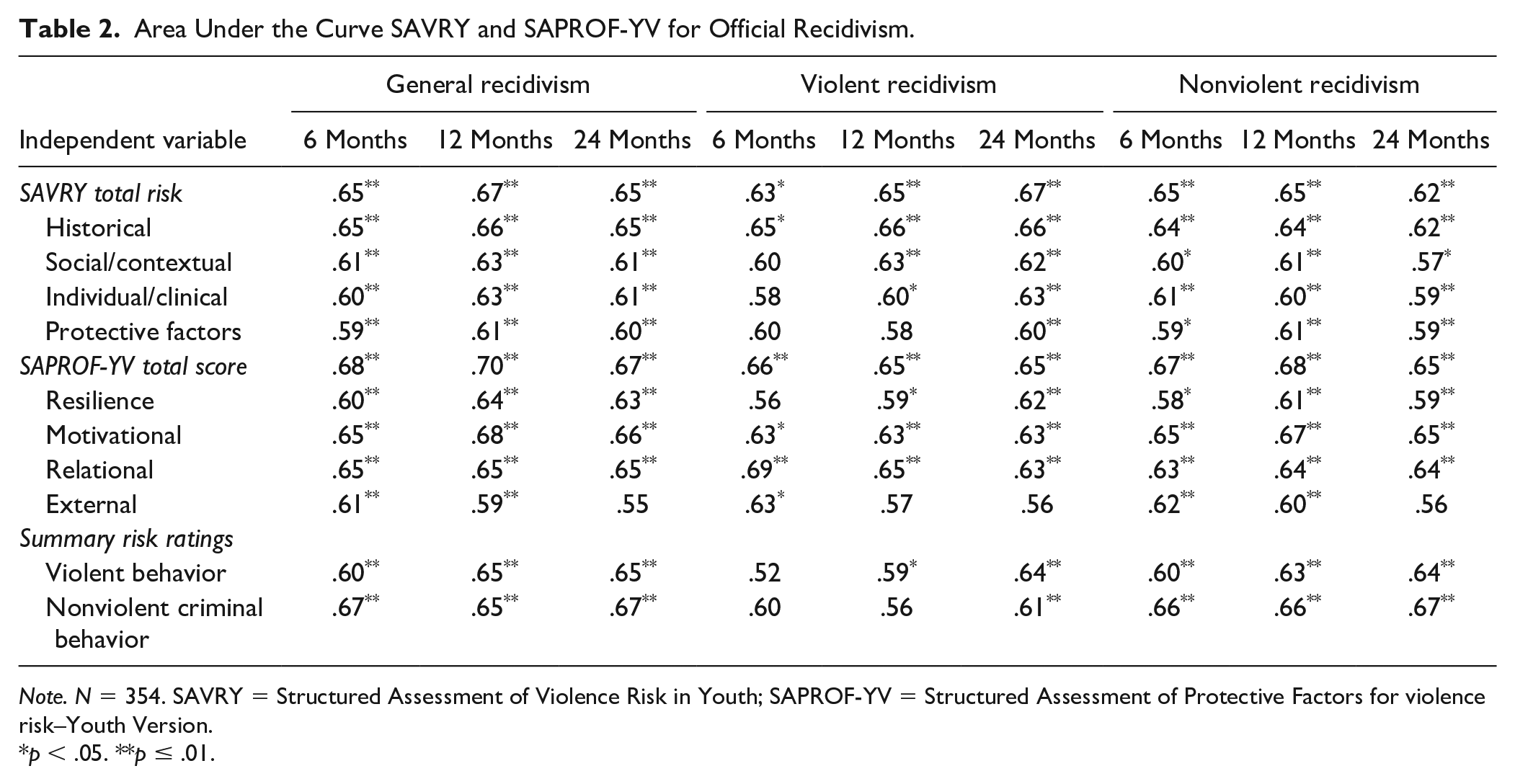
Note. N = 354. SAVRY = Structured Assessment of Violence Risk in Youth; SAPROF-YV = Structured Assessment of Protective Factors for violence risk–Youth Version.
p < .05. **p ≤ .01.
The predictive validity of the summary risk ratings for violent and nonviolent behavior was first explored by examining recidivism percentages in each of the risk categories, see in Figure 1. Based on Figure 1, it becomes clear that in general higher risk categories are associated with higher recidivism rates. Surprisingly, the highest risk category for violent behavior (which comprises 5% of the total sample) showed the smallest violent recidivism rates within 6 and 12 months. At 24 months after discharge, this high-risk category recidivated at a higher rate. These results are also reflected in the AUC values for the summary risk ratings, shown in Table 2. Nonsignificant predictive validity was found for the summary risk rating for violence when predicting violent recidivism within 6 months, low predictive validity was found for 12 months, while moderate predictive validity was found for the 24 months follow-up period. The AUC values for the summary risk ratings for nonviolent behavior were within the moderate range and remained fairly stable over longer follow-up periods.
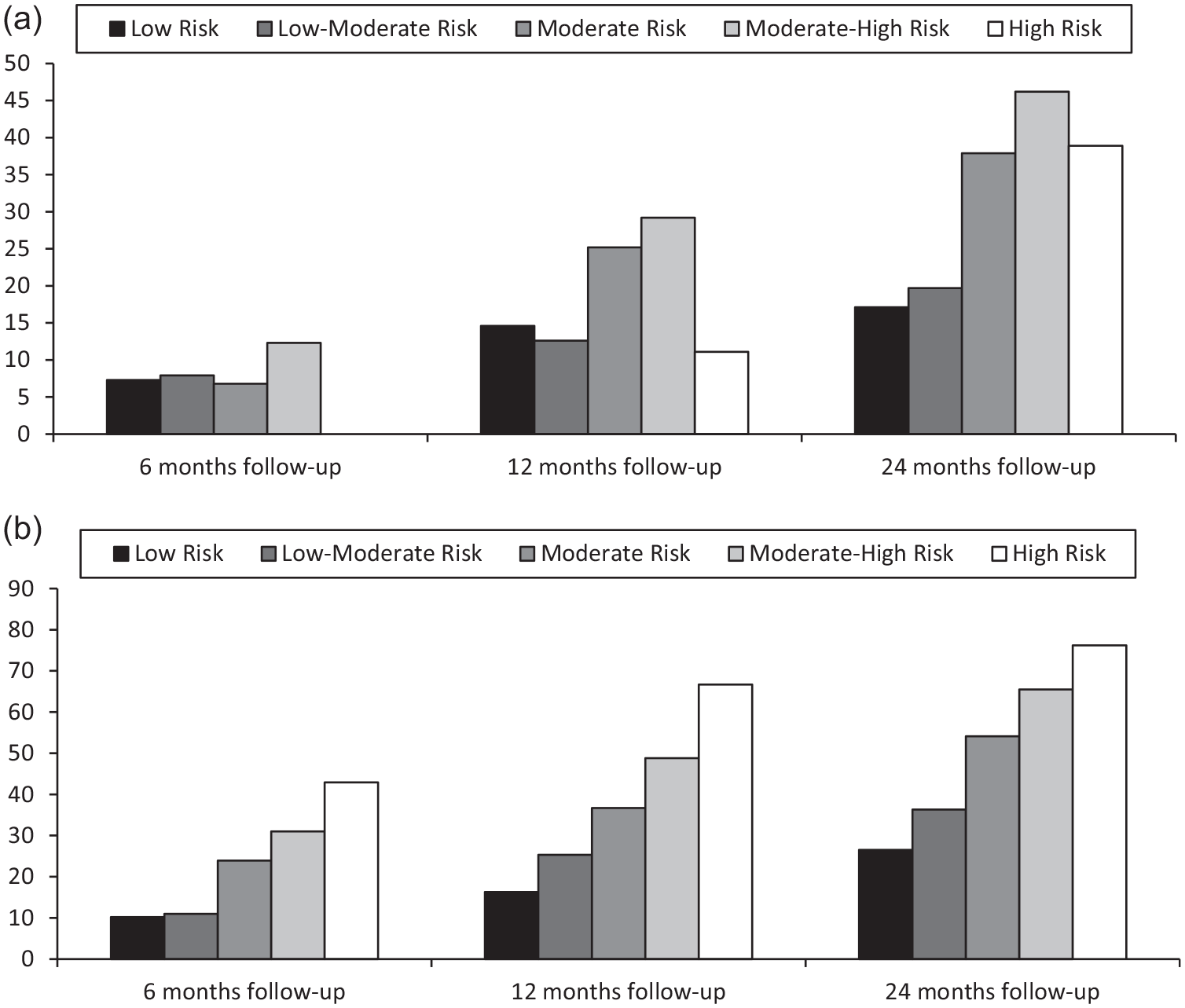
Percentage offenders showing a violent reoffense within different risk categories based on the summary risk ratings for violent reoffending. (a) Low Risk n = 41, Low-Moderate Risk n = 127, Moderate Risk n = 103, Moderate-High Risk n = 65, High Risk n = 18. (b) Low Risk n = 49, Low-Moderate Risk n = 91, Moderate Risk n = 109, Moderate-High Risk n = 84, High Risk n = 21.
Age Differences in SAVRY, SAPROF-YV Scores, and Summary Risk Ratings
Based on age at discharge from the institution, the sample was separated in a juvenile group (n = 151; Age: M = 16.69, SD = 0.97, range = 13-17) and a young adult group (n = 203; Age: M = 19.85, SD = 1.57, range = 18-26). Table 3 presents mean scores and standard deviations on the measures for the total sample, and the juvenile and young adult group separately. Comparative analyses between the juvenile and young adult group revealed that young adult offenders showed more SAVRY historical risk factors, t(352) = −4.68, p < .01, and more SAPROF-YV resilience factors, t(352) = −1.97, p = .05, while juvenile offenders showed more protective factors on the external domain of the SAPROF-YV, t(352) = 3.07, p < .01.
SAVRY, SAPROF-YV, and Summary Risk Ratings for the Total Sample, Juvenile Group and Young Adult Group.
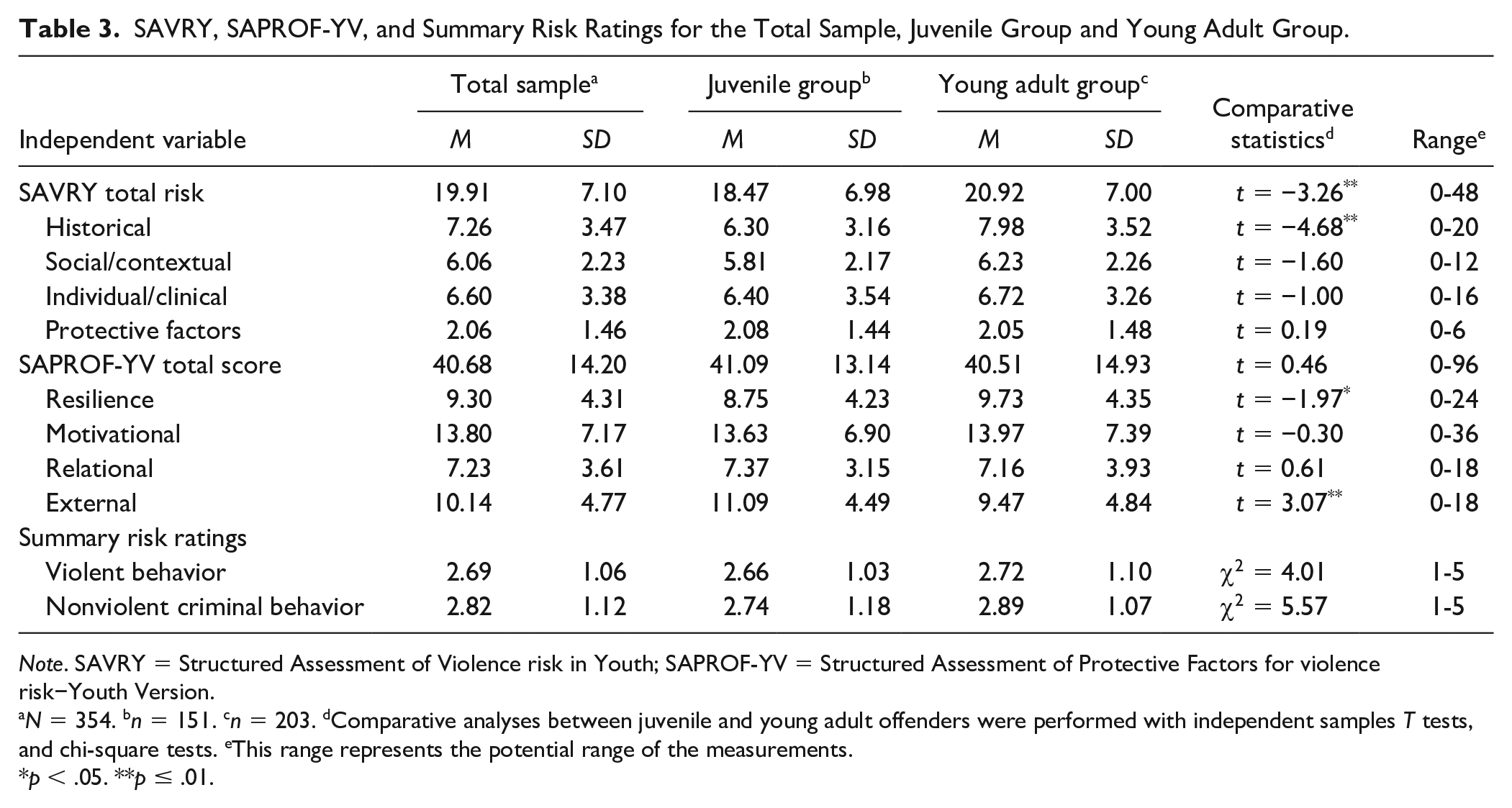
Note. SAVRY = Structured Assessment of Violence risk in Youth; SAPROF-YV = Structured Assessment of Protective Factors for violence risk−Youth Version.
N = 354. bn = 151. cn = 203. dComparative analyses between juvenile and young adult offenders were performed with independent samples T tests, and chi-square tests. eThis range represents the potential range of the measurements.
p < .05. **p ≤ .01.
Age Differences in Predictive Validity
At 6 months follow-up, young adult offenders had higher general reoffense rates (30.0%) than juvenile offenders (19.9%), χ2(1, N = 354) = 4.70, p = .03, and higher nonviolent reoffense rates (27.6%) than juvenile offenders (13.2%), χ2(1, N = 354) = 10.56, p < .01. There were no significant age differences in the numbers of violent recidivism (7.3% vs. 8.4%, respectively). No significant age differences were found in the ability of the SAVRY and SAPROF-YV total scores to predict general, violent, and nonviolent reoffending. However, moderation analyses with the SAPROF-YV subscales revealed that the SAPROF-YV relational domain was significantly better at predicting general recidivism in younger offenders, β = .04, standard error [SE] = .02, Wald = 4.70, p = .03, odds ratio (OR) = 1.04 [1.00, 1.09]. The SAPROF-YV external domain was significantly better at predicting nonviolent recidivism in younger offenders, β = .04, SE = .02, Wald = 6.28, p = .01, OR = 1.04 [1.01, 1.07]. Results of these significant moderation analyses are presented in Table 4. Results of all nonsignificant moderation analyses are not presented.
Results Moderation Analyses SAPROF-YV Relational and External Domain for Official Recidivism at 6 Months Follow-Up.
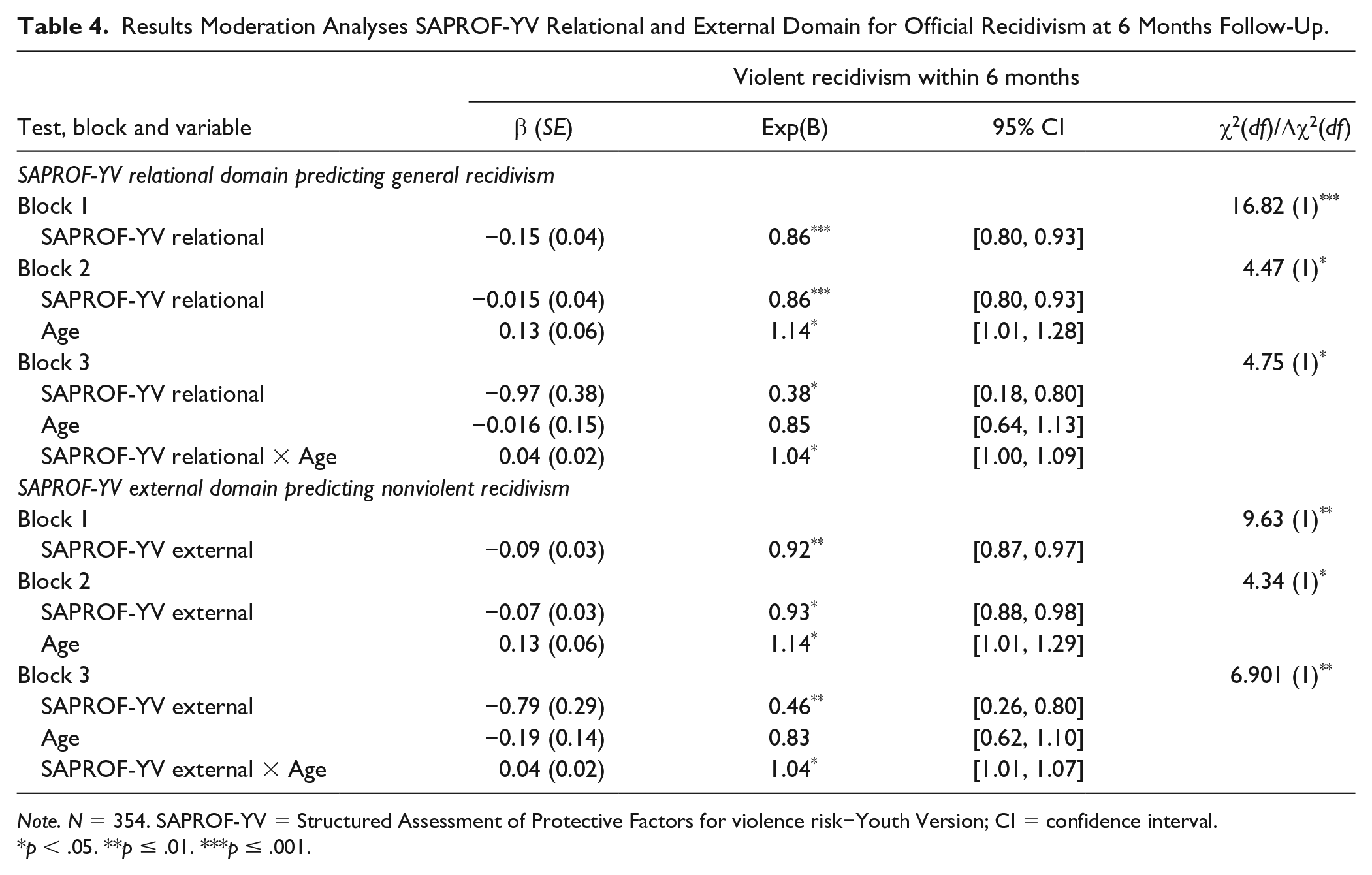
Note. N = 354. SAPROF-YV = Structured Assessment of Protective Factors for violence risk−Youth Version; CI = confidence interval.
p < .05. **p ≤ .01. ***p ≤ .001.
AUC values for the SAVRY, SAPROF-YV, and summary risk ratings for recidivism at 6 months follow-up time for both juvenile and young adult offenders are shown in Table 5. Comparing the AUC values of juvenile and young adult offenders revealed age-related differences in the predictive accuracy for only the SAPROF-YV external domain. AUC’s for violent recidivism for the SAPROF-YV external domain were significantly lower for the juvenile group than for the young adult group (AUC = .49 vs. .71; Z = −2.23, p = .03). On the contrary, AUC’s for nonviolent recidivism for the SAPROF-YV external domain were significantly higher for the juvenile group than for the young adult group (AUC = .72 vs. .55; Z = 2.50, p = .01).
Area Under the Curve Values SAVRY and SAPROF-YV for Official Recidivism at 6 Months Follow-Up in Juvenile and Young Adult Offenders.
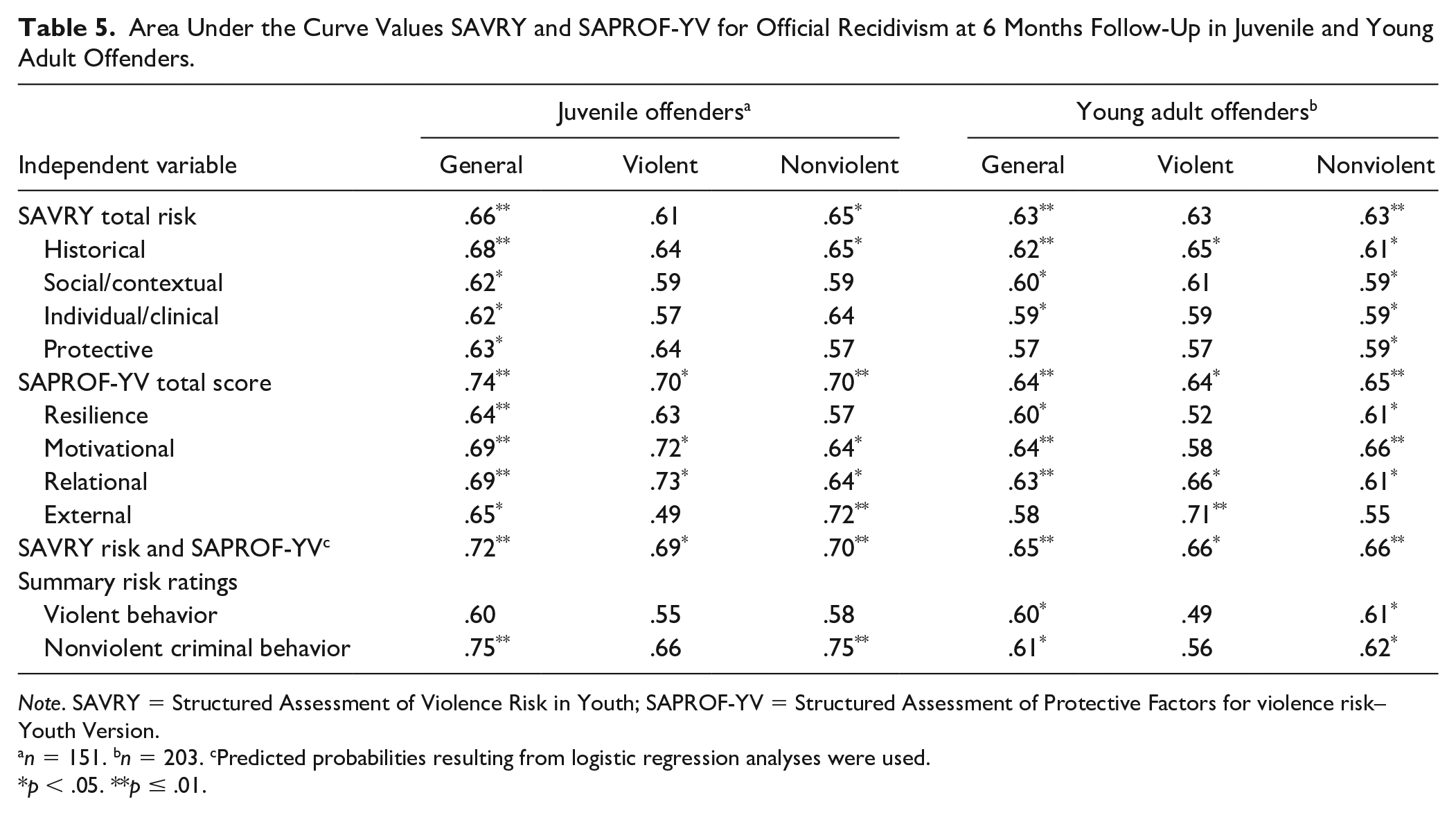
Note. SAVRY = Structured Assessment of Violence Risk in Youth; SAPROF-YV = Structured Assessment of Protective Factors for violence risk–Youth Version.
n = 151. bn = 203. cPredicted probabilities resulting from logistic regression analyses were used.
p < .05. **p ≤ .01.
Incremental Predictive Validity
Incremental predictive validity of SAVRY and SAPROF-YV protective factors over SAVRY risk factors was examined for 6 months follow-up. The SAVRY risk factors significantly predicted general recidivism, χ2(1, N = 354) = 20.04, p < .001, R2 = .08, violent recidivism, χ2(1, N = 354) = 5.83, p = .02, R2 = .04, and nonviolent recidivism, χ2(1, N = 354) = 16.82, p < .001, R2 = .07, in the first step of each of the hierarchical logistic regression analyses. In the second steps, only the SAPROF-YV total scores provided incremental predictive validity over the SAVRY risk factors for general recidivism, Δχ2(1, N = 354) = 9.66, p < .01, R2 = .12, violent recidivism, Δχ2(1, N = 354) = 3.78, p = .05, R2 = .06, and nonviolent recidivism, Δχ2(1, N = 354) = 7.03, p <.01, ΔR2 = .10. The SAVRY protective factors did not add predictive validity over the SAVRY risk factors for general (p = .33), violent (p = .86), and nonviolent recidivism (p = .41), and were removed from the analyses. When tested for multicolinearity, a variance of inflation (VIF) of 1.33 (r = −.50, p < .001) was found for SAVRY risk and protective factors scores, a VIF of 1.58 (r = −.60, p < .001) was found for SAVRY risk and SAPROF-YV scores, and a VIF of 1.73 (r = .65, p < .001) was found for SAVRY protective factors and SAPROF-YV scores, pointing to minimal multicolinearity between predictors which is unlikely to affect the results from the logistic regression analyses. AUC values using the predicted probabilities resulting from the final logistic regression models were calculated. Overall, moderate predictive validity was found for the SAVRY risk and SAPROF-YV combination for all offense types (general recidivism: AUC = .69, p < .001; violent recidivism: AUC = .67, p < .01; nonviolent recidivism: AUC = .68, p < .001).
Incremental predictive validity was also analyzed for each of the age groups separately. In the juvenile group, significant incremental predictive validity of the SAPROF-YV over the SAVRY risk factors was demonstrated for general and nonviolent recidivism, general recidivism: Δχ2(1, n = 151) = 10.47, p < .01, ΔR2 = .10, nonviolent recidivism: Δχ2(1, n = 151) = 6.03, p = .01, ΔR2 = .07, while this was not found for violent recidivism, Δχ2(1, n = 151) = 2.92, p = .09, ΔR2 = .04. In the young adult group, significant incremental predictive validity of the SAPROF-YV was only found for nonviolent recidivism: Δχ2(1, n = 203) = 3.70, p = .05, ΔR2 = 02, while this was not found for the other outcomes, general recidivism: Δχ2(1, n = 203) = 3.22, p = .07, ΔR2 = .02, violent recidivism: Δχ2(1, n = 203) = 1.36, p = .24, ΔR2 = .01. Table 5 shows the corresponding AUC values using the predicted probabilities from the final logistic regression models for the different age groups and different outcomes.
Discussion
In juvenile risk assessment, most assessment tools to date focus primarily on risk factors, while little attention is being devoted to protective factors. To increase the emphasis on protective factors in juvenile risk assessment, the SAPROF-YV has recently been developed as an additional strength-focused risk assessment measure. The current study is among the first to examine the predictive validity of this new tool in combination with the SAVRY, a widely used predominantly risk-focused tool for the assessment of recidivism in juveniles. First, the interrater reliability and convergent validity of the SAPROF-YV and SAVRY were examined for a sample of juvenile and young adult offenders. Second, the predictive validity for general, violent, and nonviolent recidivism within 6 months following release was examined. In addition, longer follow-up periods were investigated, as well as age-related differences in predictive validity. Finally, the incremental predictive validity of the protective factors in the SAVRY and SAPROF-YV over the SAVRY risk factors was examined. This study aimed to provide insight into the added value of protective factors to the risk assessment of juvenile and young adult offenders.
Reliability
Good to excellent interrater reliability was found for both the SAVRY and SAPROF-YV total scores, as well as the SPJ summary risk ratings for violent and for nonviolent reoffending, indicating that both tools could be scored reliably. The interrater reliability for the SPJ summary risk ratings was somewhat lower than for the numerical total scores on both tools, suggesting that summarizing the scores in an overall risk rating was more complicated than rating the items separately. Other studies examining the SAVRY also reported somewhat lower reliability for the summary risk ratings when compared with total scores (Borum et al., 2010). It should be noted that the SAVRY and SAPROF-YV manuals contain detailed item descriptions. Composing summary risk ratings is done through integrating and interpreting ratings on the items, which likely makes them more subjective.
Prediction of Reoffending
Overall, the SAVRY and SAPROF-YV provided moderate predictive validity for general, violent, and nonviolent reoffending within 6 months following release from the institution. These results are reasonably in line with previous studies on the predictive validity of risk assessment in juvenile offenders (for an overview, see Olver et al., 2009; Schwalbe, 2007). A recent systematic review found that the SAVRY has been reported to produce a wide range of effect sizes ranging from small to large, with moderate effect sizes being the most common (Koh et al., 2020). Koh et al. (2020) consider these differences to be related to setting, length of follow-up, and other differences in study characteristics, which complicate the comparison of the current results to other studies. Nonetheless, the AUC values for the SAVRY found in the current study appear to be on the lower end of this continuum of reported effect sizes. This may in part be due to the fact that the current sample also included young adult offenders, for whom the predictive validity was somewhat lower. As age differences in the predictive validity were also present for the SAPROF-YV subscales, the inclusion of young adults in the full sample decreased the overall predictive validity. In addition, the retrospective nature of the current study might have complicated the rating of some items in the risk assessment tools which could also have decreased the overall predictive validity. As expected, the predictive validity of the SAVRY and SAPROF-YV for different reoffense types was similar. Although these tools were developed for the assessment of violence risk, it appears that they also predict other types of offending. Previous studies also showed that the SAVRY and other commonly used juvenile risk assessment tools were also predictive for nonviolent reoffending (Olver et al., 2009).
For general and nonviolent reoffending all SAVRY subscales showed significant predictive validity. The historical subscale had the highest predictive validity of all subscales in the SAVRY, showing the importance of static factors when predicting general and violent reoffending. These results seem conflicting with previous studies showing that the dynamic factors in the SAVRY (social/contextual and individual/clinical domain) were more strongly related to violent reoffending than the static historical factors (Gammelgard et al., 2008; Lodewijks et al., 2010; Vincent et al., 2010). Importantly, based on these results it should not be concluded that static risk factors outperform dynamic risk factors when predicting reoffending, as these differences were not significant and dynamic risk factors also showed significant predictive validity for the different outcomes. For the SAPROF-YV, the motivational scale and relational domain had the highest predictive, showing the importance of family and peers, and of motivational factors such as future orientation, school/work, and motivation for treatment in the prediction of reoffending when young offenders reintegrate in the community. These protective domains are commonly identified in the literature and are in line with a recent study by Shepherd et al. (2018) showing the importance of prosocial involvement, commitment to school, and positive attitudes toward intervention as being the most salient positive attributes promoting desistance from juvenile reoffending.
The predictive validity of both tools remained stable when longer follow-up periods (i.e., 12 and 24 months) were used. These results are surprising, as it is generally assumed that youth risk assessment has a limited temporal validity and frequent reassessment is essential as dynamic factors might be subjective to chance over longer periods of time after the assessment (e.g., J. L. Viljoen et al., 2016). Given the importance of historic factors in the predictive validity of the SAVRY and the mean age in the current sample, it is not surprising that the predictive validity of the SAVRY remained fairly stable over 24 months, indicating that static risk factors may have long lasting negative effects on reoffending. In a meta-analyses among incarcerated youth, static risk factors such as criminal history were the strongest predictors of reoffending (Cottle et al., 2001). Although these factors are not subject to change trough treatment planning, they can have an important role in recognizing high-risk offenders in need for intensive rehabilitation programs (Bonta & Andrews, 2016). Contrary to the SAVRY, the SAPROF-YV factors are all dynamic in nature and rated context dependently. Therefore, the current findings regarding the temporal stability of their predictive validity imply that, although SAPROF-YV factors are dynamic, improvements in protective factors may have long lasting positive effects in terms of recidivism prevention. These results were supported by research on the adult counterpart of the SAPROF-YV (SAPROF; de Vogel et al., 2012). In general, studies on the SAPROF that utilized a shorter follow-up period reported higher predictive values (de Vries Robbé & de Vogel, 2013). However, several studies found significant predictive validity for the SAPROF when assessing violent reoffending up to even 10 years follow-up (Coupland, 2015; de Vries Robbé et al., 2013; de Vries Robbé, de Vogel, Koster, et al., 2015).
It should be recognized, that both the SAVRY and SAPROF-YV rely on the SPJ approach in which the items are usually not summed up in clinical practice, although this is a common procedure in risk assessment research. Following the SPJ procedure, the overall pattern of risk and protective factors is evaluated to arrive at an overall judgment of violence risk. In the current study, the predictive validity for these SPJ summary risk ratings was explored in addition to the total scores. In general, the predictive validity for the SPJ summary risk ratings was slightly lower when compared with the numerical total scores for the SAVRY and SAPROF-YV. Reduced predictive validity for summary risk ratings was especially observed when predicting violent recidivism. Closer examination of recidivism rates in the risk categories revealed that the individuals in the highest risk category did not recidivate with a violent reoffense within the 6 months follow-up, while they did at longer follow-up periods. As a relatively large proportion of this group (38.9%) recidivated with a nonviolent reoffense shortly after release, it is possible that this group was not fully at risk for committing violent reoffenses due to incarceration for a nonviolent reoffense during part of the follow-up time. For future studies, it is advised to take time at risk and new incarceration periods into account, especially when predicting violent recidivism.
Developmental Differences SAVRY and SAPROF-YV
Developmental differences were found for the presence of SAVRY historical risk factors, with young adult offenders (18-26 years) showing a higher historical risk profile than juvenile offenders (13-17 years). This finding was expected, as the historical domain includes problem behavior from an individual’s entire past and adolescents cumulatively tend to encounter more problems or show more antisocial behavior when more time passes. No developmental differences were found in the predictive validity of the SAVRY, suggesting that this tool was equally capable of predicting reoffending in younger and older adolescents. In line with these results, Vincent et al. (2019) found no age-related bias in the predictive validity of the SAVRY risk factors. In contrast, Viljoen et al. (2008) found that the SAVRY risk factors were significantly less effective in predicting reoffending among younger adolescents compared with older adolescents up to 19 years old. However, that study only included juvenile offenders up to 19 years which complicates comparison of these results with the current findings.
When the SAPROF-YV was compared between juvenile and young adult offenders, developmental differences were found in both SAPROF-YV subscale ratings and predictive validity. Young adults showed more protective factors relating to resilience than juvenile offenders, which could be a result of factors in the resilience domain, such as impulse control and social competence, developing more strongly with age during adolescence. Juvenile offenders showed more external protective factors than young adult offenders when they were released from the juvenile justice institution. With regard to predictive validity, age-related differences were found for the SAPROF-YV relational domain and external domain. For the relational domain, higher predictive validity for general recidivism was found for younger offenders. When comparing AUC’s between juvenile and young adult offenders for the external domain, predictions of nonviolent recidivism were significantly higher in the juvenile offenders, while young adults showed higher AUC values for violent reoffending. These results suggest that juvenile offenders showed more external protection, such as structure and boundaries in the living environment, treatment interventions, and judicial measures, which was more strongly related to the prevention of nonviolent recidivism. In addition, strong bonds with prosocial peers, parents/guardians or others also seems to have a more profound effect on diminishing recidivism for younger individuals. Young adult offenders function more independently with a lesser amount of external protection from professionals or parents/guardians, but when external protection is provided it has a greater impact on the reduction of violent recidivism than for juveniles.
When interpreting these results, it must be noted that young adult offenders were more often charged with a mandatory treatment order which is the most severe measure for adolescents and is only imposed when offenders show severe criminal behavior. As a result the young adult group may represent a more severe group of offenders which is also shown in higher rates on the historical domain of the SAVRY. To control for possible differences in severity due to the treatment measure, the comparative analyses between juveniles and young adult offenders were repeated without offenders with mandatory treatment orders. Differences in the external domain of the SAPROF-YV were only marginally significant when offenders with a mandatory treatment order were excluded, suggesting that differences related to the imposed treatment measure partly explain the differences in ratings and predictive validity of the SAPROF-YV external domain between juvenile and young adult offenders.
Incremental Predictive Validity
The SAPROF-YV provided incremental predictive validity over the SAVRY risk factors when assessing general, violent, and nonviolent recidivism at 6 months follow-up. Adding the SAPROF-YV increased the predictive validity for all types of reoffending, and moderate predictive validity was found for the SAVRY and SAPROF-YV combination. These results suggest that a more profound focus on protective factors adds unique variance to the prediction of reoffending, which provides empirical support for the inclusion of protective factors in juvenile risk assessment. The incremental predictive validity of the SAPROF-YV over the SAVRY risk factors was stronger for juvenile offenders. In young adult offenders, the incremental predictive validity was less substantial and only found for nonviolent recidivism. Taken together, these results suggest that the SAPROF-YV might be more effective in aiding the prediction of reoffending in juvenile offenders up to 18 years old, the population for which this tool was originally designed.
Contrary to the SAPROF-YV, The SAVRY protective factors provided marginal or insignificant predictive validity for general, violent, and nonviolent reoffending, and no incremental predictive validity was found over risk factors. Although it must be acknowledged that substantial differences in range (0-6 for the SAVRY protective factors and 0-96 for the SAPROF-YV) complicate comparing these observations, these findings suggest that the SAPROF-YV is able to capture strengths more comprehensively than the SAVRY protective factors. This result is in line with earlier studies on the SAVRY that found marginal or insignificant predictive validity (Penney et al., 2010) and no incremental predictive validity over risk factors (Hilterman et al., 2014; Vincent et al., 2010) of the SAVRY protective factors. However, as Borum et al. (2010) pointed out, research in this area is mixed, with other studies finding that the SAVRY protective factors did add incrementally to risk factors (e.g., Dolan & Rennie, 2008; Lodewijks et al., 2010). More recently, Shepherd et al. (2018) suggested that the SAVRY protective factors might be more effective at predicting violence in low risk samples. It should be noted that the mean score on the SAVRY protective factors in the current study was low, with 38.4% of the sample showing only one or no protective factors, which highlights the relatively high-risk level in this sample. The fact that the SAPROF-YV did demonstrate a more abundant presence of protective factors indicates that the SAVRY protective factors appear to suffer from limited sensitivity, likely in part due to their binary rating scale and the limited number of protective factors included.
Limitations and Future Directions
The present study has been one of the first attempts to thoroughly examine the predictive validity of the SAVRY and SAPROF-YV combination and provides an important contribution to the literature regarding the value of protective factors in juvenile risk assessment, as well as regarding the differences between juveniles and young adults in the validity of risk assessment. Nevertheless, results should be interpreted in the light of several limitations. First, while the SAVRY has been validated in different samples, the body of literature on the predictive validity of the SAPROF-YV is still small, which makes it difficult to determine to what extent study and sample characteristics influenced the predictive validity findings. It is important to note that the current sample represented a relatively high-risk subgroup of young offenders. It has been acknowledged that youth offenders from Dutch juvenile justice institutions show complex mental health problems, and exhibit severe levels of antisocial behavior (Vreugdenhil et al., 2004). In the current study, only offenders with a history of violent behavior were selected, which possibly increased the overall risk level even further. In addition to the relatively high-risk level, the current sample had a strong mental health problems component, with the majority of offenders being diagnosed with one or more disorders in the DSM-IV. Therefore, caution should be exercised when current results are generalized to lower risk and community-based samples or samples with fewer mental health problems. It could be hypothesized that the predictive validity of these tools would be better in samples with greater diversity in risk levels, community integration, and mental health problems. However, future studies are needed to investigate if the predictive validity of the SAVRY in combination with the SAPROF-YV is robust for random sampling error, and if the current results could be translated to other samples as well.
Second, it is important to bear in mind that the assessment tools in the current study were rated retrospectively based on file information, which differs from how these tools are generally used in clinical practice. As a result, additional information could not be retrieved and offenders could not be observed in clinical practice, which complicated the rating of some risk and protective factors. Moreover, risk assessment ratings in the current study were carried out by graduate students, rather than by experienced clinicians. This may have affected the ratings on the different tools and especially the summary risk ratings, for which clinical experience generally provides a valuable reference. Future prospective research is recommended to establish the generalizability of current results to a real-life context. We encourage additional research on the SPJ summary risk ratings to further study the additional value of the SPJ procedure for risk prediction and violence prevention. In addition, we recommend future studies to investigate the predictive validity of juvenile risk assessment in different age groups, in order to be able to examine developmental differences in the importance of specific risk and protective factors for a range of negative and positive outcomes. In these studies, it would also be valuable to differentiate findings for subgroups of individuals that differ on characteristics such as gender, offense history, and psychopathology. In examining the empirical validity of risk assessment measures for young adult offenders, we suggest to also include adult risk assessment tools in future studies, in order to be able to compare youth and adult tools for this understudied group of offenders in emerging adulthood. Finally, it must be acknowledged that although the sample size in this study was significant, the number of analyses carried out was relatively large, which may have increased the possibility of Type I error. The current study aimed to provide a profound validation of the SAVRY and SAPROF-YV and therefore addressed multiple research questions. The limited number of studies in this field that are presently available complicate comparison of the results from this study and highlight the importance of replicating current findings.
Conclusion
Notwithstanding these limitations, the findings in this study provide novel insights regarding the application of juvenile risk assessment in clinical practice. First, the results suggest that the SAVRY and SAPROF-YV are both valid tools for the assessment of violence risk in juvenile and young adult offenders released from juvenile justice institutions. Second, the findings in this study highlight the importance of protective factors for the predictive validity of risk assessment in young offenders, especially juvenile offenders up to the age of 18 years, for a wide range of criminal outcomes. As such, a balanced evaluation of strengths and weaknesses is recommended in order to provide the most accurate assessment of (violence) risk, and to determine individualized guidelines for a strength-based case management plan to effectively mitigate recidivism risk. Additional (prospective) research in different settings is warranted to determine whether these results translate to clinical practice and to other young offender populations, as well as whether change on dynamic risk and protective factors is associated with abstaining from recidivism.
Supplemental Material
Supplement_material – Supplemental material for Risk Assessment in Juvenile and Young Adult Offenders: Predictive Validity of the SAVRY and SAPROF-YV
Supplemental material, Supplement_material for Risk Assessment in Juvenile and Young Adult Offenders: Predictive Validity of the SAVRY and SAPROF-YV by Anneke T. H. Kleeven, Michiel de Vries Robbé, Eva A. Mulder and Arne Popma in Assessment
Footnotes
Acknowledgements
We would like to thank all Juvenile Justice Institutions (JJI Den Hey-Acker, JJI De Hunnerberg, JJI De Hartelborgt, JJI Intermetzo Lelystad, Forensisch centrum Teylingereind, SJSJ Via Het Keerpunt, Het Poortje Jeugdinrichtingen JJI Juvaid) for participating in the current study.
Authors’ Note
This research was part of a larger study on the effectiveness of risk assessment within the Dutch juvenile justice system. Results of parts of this data set will be published in separate manuscripts each focusing on a separate theme. The current article addresses the predictive validity of the SAVRY and SAPROF-YV in the full juvenile justice population. A second article (Kleeven, de Vries Robbé, Mulder and Popma, 2020) focusses specifically on the young adult offender group within this population and aims to compare the efficacy of juvenile and adult risk assessment tools.
Declaration of Conflicting Interests
The author(s) declared the following potential conflicts of interest with respect to the research, authorship, and/or publication of this article: Coauthor de Vries Robbé is also one of the authors of the SAPROF-YV, which could be perceived as a conflict of interest.
Funding
The authors received financial support for the research, authorship, and/or publication of this article: This research was supported in part by grants from the Dutch Ministry of Justice and Security, the Academic Workplace Youth at Risk (AWRJ), and VU University Medical Center Department of Child- and Adolescent Psychiatry.

Supplemental Material
Supplemental material for this article is available online.
References
Supplementary Material
Please find the following supplemental material available below.
For Open Access articles published under a Creative Commons License, all supplemental material carries the same license as the article it is associated with.
For non-Open Access articles published, all supplemental material carries a non-exclusive license, and permission requests for re-use of supplemental material or any part of supplemental material shall be sent directly to the copyright owner as specified in the copyright notice associated with the article.
