



Abstract
The importance of self-beliefs in prominent models of social phobia has led to the development of measures that tap this cognitive construct. The Self-Beliefs Related to Social Anxiety (SBSA) Scale is one such measure and taps the three maladaptive belief types proposed in Clark and Wells’s model of social phobia. This study aimed to replicate and extend previous research on the psychometric properties of the SBSA. Replicating previous research, in an (undiagnosed) undergraduate sample (n = 235), the SBSA was found to have a correlated three-factor structure using confirmatory factor analyses, and the SBSA and its subscales demonstrated good internal consistency and test–retest reliability. The SBSA and its subscales also had unique relationships with social anxiety and depression, the majority of which replicated previous research. Extending previous research, the SBSA and its subscales showed good incremental validity in the undergraduate sample and good discriminative validity using the undergraduate sample and a sample of individuals with social phobia (n = 33). The SBSA’s strong theoretical basis and the findings of this study suggest that the SBSA is an ideal research and clinical tool to assess the cognitions characteristic of social phobia.
In prominent models of social phobia (Clark & Wells, 1995; Hofmann, 2007; Rapee & Heimberg, 1997), it is proposed that specific and enduring beliefs contribute to the persistence of the disorder. Recently, measures that tap such core beliefs characteristic of social phobia have been developed. Given the novelty of these measures, there is a need to further validate them.
Specific beliefs related to the self and social-evaluative situations form an integral part of models of social phobia. In Clark and Wells’ (1995) model, it is proposed that three specific maladaptive belief types are activated when a social-evaluative situation is encountered (high standard beliefs, e.g., “I have to get everyone’s approval”; conditional beliefs, e.g., “If I make mistakes, others will reject me”; unconditional beliefs, e.g., “People think I’m inferior”) and lead to the experience of anxiety in the situation. In Rapee and Heimberg’s (1997) model, on entering a social-evaluative situation, an individual with social phobia compares his or her mental self-representation with what he or she thinks is expected by other people in the situation. This comparison process determines the individual’s beliefs about the probability and consequences of negative evaluation from the other people. If negative evaluation is deemed likely and the costs are considered high, then anxiety is experienced. Similarly, in Hofmann’s (2007) model, individuals with social phobia believe that they are evaluated against high social standards possessed by other people. They desire to meet these perceived high standards in order to convey a favorable impression to others but they believe that they are unable to achieve this. When a social-evaluative situation is encountered, such beliefs contribute to the experience of anxiety and an attentional shift to the self. As a result, other maladaptive beliefs become salient. For example, there is the belief that the social-evaluative situation is likely to lead to a negative outcome and that such an outcome will be associated with high costs. Across these models of social phobia, the persistence of maladaptive beliefs related to the self and social-evaluative situations contribute to the maintenance of the disorder and experience of anxiety whenever social-evaluative situations are encountered.
The importance of beliefs in models of social phobia has led to the development of instruments that seek to measure them. Interestingly, while the beliefs proposed in models of social phobia are characterized as enduring and theorized to lie dormant until activated when a social-evaluative situation is encountered, many of the measures developed to measure cognitions in social phobia tap more transient thought-like constructs (cf. schemas vs. automatic thoughts; Beck, Rush, Shaw, & Emery, 1979). For example, questionnaires have been developed to examine cognitions related to specific types of social-evaluative situations. In relation to speech situations, Hofmann and DiBartolo (2000) developed the Self-Statements During Public Speaking Scale (e.g., “What I say will probably sound stupid”) and Rapee and Lim (1992) developed the Performance Questionnaire (e.g., “had a clear voice,” “appeared nervous”) to assess appraisals related to public speaking performance. In contrast, Glass, Merluzzi, Biever, and Larsen (1982) developed the Social Interaction Self-Statement Test to assess thoughts related to social interactions (e.g., “If I blow this conversation, I’ll really lose my confidence”). All these measures have been shown to be positively associated with social anxiety.
More recently, measures of cognitions related to social phobia have been developed that capture beliefs of an enduring nature, consistent with models of social phobia. Turner, Johnson, Beidel, Heiser, and Lydiard (2003) developed the Social Thoughts and Beliefs Scale (STABS) to assess core beliefs that are characteristic of social phobia (e.g., “Other people are more socially capable than I am”). Using a sample of individuals with social phobia, individuals with other anxiety disorders, and normal controls, a factor analysis of the STABS demonstrated that it is composed of two factors (Turner et al., 2003). One factor labeled Social Comparison contained beliefs that other people are more socially competent while the second factor labeled Social Ineptness contained beliefs related to behaving in an awkward manner or appearing anxious in social-evaluative situations. More recently, using an undergraduate sample, Fergus, Valentiner, Kim, and Stephenson (2009) replicated the two-factor structure of the STABS. In addition to the STABS, Rodebaugh (2009) developed the Core Extrusion Schema measure that assesses the tendency for socially anxious individuals to conceal aspects of the self due to fear of negative evaluation from others (e.g., “I’m afraid that people will realize what I’m really like”). The Core Extrusion Schema has four subscales (Rejection of True Self, Hidden Self, Avoid Mistakes, Present Rejection). Another measure of beliefs is the Maladaptive Interpersonal Belief Scale (Boden et al., 2012) that measures interpersonal beliefs related to social phobia (e.g., “If people knew how nervous I get, they would think I was weird”).
While these aforementioned measures of enduring beliefs related to social phobia have been derived based on the emphasis on cognitions in models of social phobia, none are linked to a specific model. However, a recently published measure—the Self-Beliefs Related to Social Anxiety (SBSA) Scale (Wong & Moulds, 2009, 2011a)—indexes enduring beliefs that are related to social phobia and was developed on the basis of a specific model. The SBSA is a 15-item measure that contains three subscales that tap the three types of maladaptive beliefs (high standard, conditional, and unconditional) proposed by Clark and Wells (1995) and was originally used to test the impact of ruminative thinking on these belief types (see Wong & Moulds, 2009). High standard beliefs (e.g., “I need to be liked by everyone”) contain perceived high social standards that an individual with social phobia believes that they need to attain to avoid negative evaluation in social-evaluative situations. However, such standards are difficult to reach, leading to anxiety (Clark & Wells, 1995). Conditional beliefs (e.g., “If I don’t say something interesting, people won’t like me”) highlight for an individual with social phobia that if they meet a particular criterion (e.g., not saying something interesting), then negative evaluation will result (e.g., people won’t like me). Unconditional beliefs (e.g., “People think I’m inferior”) indicate to an individual with social phobia that other people consistently think negatively of them. It thus appears that high standard and conditional beliefs ultimately function as operating principles for socially anxious individuals when social-evaluative situations are encountered because they highlight what the individual should and should not do to avoid negative evaluation. The unconditional beliefs appear to be more absolute, global, and conclusive (Wong & Moulds, 2011a) and may result from multiple (perceived) negative social-evaluative experiences.
Initial testing of the SBSA in an undergraduate sample demonstrated that it had good internal consistency (Cronbach’s α = .92 for the full scale, Cronbach’s α = .83 for four-item high standard beliefs subscale, Cronbach’s α = .89 for seven-item conditional beliefs subscale, and Cronbach’s α = .80 for four-item unconditional beliefs subscale) and good test–retest reliability (r = .82 for the full scale, r = .73 for the high standard beliefs subscale, r = .78 for the conditional beliefs subscale, r = .72 for the unconditional beliefs subscale; Wong & Moulds, 2011a). In terms of construct validity, the SBSA was uniquely and positively associated with social anxiety, and the magnitude of this association was significantly stronger than the association between the SBSA and depression, and the association between the SBSA and general anxiety. Interestingly, when comparing the relative capacity of social anxiety, depression, and general anxiety to predict the SBSA subscales, social anxiety was the only significant predictor of high standard beliefs. For the conditional beliefs, social anxiety and depression were significant predictors, and social anxiety was a significantly stronger predictor than depression. For the unconditional beliefs, social anxiety and depression were significant predictors, but they were similar in predictive strength (Wong & Moulds, 2011a). In terms of the factor structure of the SBSA, an exploratory factor analysis (EFA) suggested a two-factor structure, with conditional and unconditional beliefs loading on the first factor and high standard beliefs loading on the second factor. However, a subsequent confirmatory factor analysis (CFA) that compared (a) a theoretically derived three-factor model (one factor for each of the belief types; Clark & Wells, 1995), (b) the empirically derived two-factor model (from the exploratory factor analysis), and (c) a parsimonious one-factor model suggested that the three-factor model was the best-fitting model (Wong & Moulds, 2011a).
Given that the development of tools to assess the maladaptive beliefs related to social phobia is in its infancy, further tests of the measures in this area need to be conducted to confirm their psychometric properties so that the measures may be used more widely in both clinical and research contexts. For the SBSA, this would mean attempting to replicate previous findings on its psychometric properties (Wong & Moulds, 2011a) as well as providing new tests of its psychometric properties to extend previous research. The current study thus had several aims. First, to attempt to replicate previous findings, this study aimed to provide a further test of the factor structure of the SBSA in a new undergraduate sample using CFA. Second, this study aimed to replicate previous findings on the test–retest reliability, internal consistency, and convergent and divergent validity of the SBSA using an undergraduate sample. Finally, this study aimed to provide new tests of the validity of the SBSA. More specifically, we aimed to test the incremental validity of the SBSA with an undergraduate sample to see whether the SBSA uniquely contributed to the measurement of core maladaptive beliefs related to social phobia beyond that of another measure of these beliefs, the STABS (Turner et al., 2003). We also aimed to test the discriminative validity of the SBSA with an undergraduate sample and a social phobia sample.
Hypotheses were as follows. First, based on the Clark and Wells (1995) model and previous research (Wong & Moulds, 2011a), we predicted that in an undergraduate sample, a correlated three-factor model would emerge as the best-fitting model (three factors corresponding to each of the three belief types) compared with competing two- and one-factor models. Second, we predicted that the SBSA would have good test–retest reliability and internal consistency in an undergraduate sample. Third, for the test of convergent and divergent validity, we predicted that in an undergraduate sample, the SBSA would have a significant positive association with a social anxiety measure, and this association would be significantly larger than the association between the SBSA and a measure of depression. Fourth, also for the test of convergent and divergent validity, it was predicted that in an undergraduate sample, the conditional and unconditional beliefs subscales would be significantly and positively associated with measures of both social anxiety and depression while the high standard beliefs would only be significantly associated with the measure of social anxiety. Fifth, for the test of incremental validity in an undergraduate sample, it was predicted that the SBSA and each of its subscales would have unique and significant positive associations with a measure of social anxiety, over and above the STABS. Finally, for the test of discriminative validity, we predicted that a sample of individuals diagnosed with social phobia would score higher on the SBSA and its subscales compared with an undergraduate sample.
Method
Participants
The undergraduate sample was composed of 235 undiagnosed undergraduate psychology students (186 females; mean age = 23.84 years, SD = 7.29) at Macquarie University who participated in the study as part of a class assignment. Participants were asked to complete measures at two time points (see Procedure section for administered measures). Of the 235 participants who completed the measures at Time 1, 154 of these participants also completed the measure at Time 2 (66% retention rate). There were no differences on any of the Time 1 measures between those participants who completed measures at both time points and those who completed only Time 1 measures (all ps > .05).
The social phobia sample was composed of 33 individuals (20 females; mean age = 22.73 years, SD = 3.58) who met the Diagnostic and Statistical Manual of Mental Disorders, Fourth Edition (DSM-IV; American Psychiatric Association, 1994) criteria for social phobia, and this disorder was considered to be their principal diagnosis (i.e., based on considerations of symptom severity and level of impairment in functioning). All participants of this sample were diagnosed using the Structured Clinical Interview for DSM-IV Axis I disorders (First, Spitzer, Gibbon, & Williams, 1996). Participants in the social phobia sample had responded to either a careers website recruitment advertisement or flyers posted around the campus of the University of New South Wales and were reimbursed financially for taking part in the study. Of the 33 participants in the social phobia sample, 7 had a second (comorbid) disorder. Comorbid conditions were major depression (9%), specific phobia (6%), substance dependence (3%), and generalized anxiety disorder (3%).
Materials
Self-Beliefs Related to Social Anxiety Scale
The 15-item SBSA (Wong & Moulds, 2009, 2011a) assesses the strength of beliefs about the self in a social context. It includes items that tap the belief types proposed by Clark and Wells (1995): (a) 4 items that tap excessively high standards for social performance (Items 4, 7, 11, 15), (b) 7 items that tap conditional beliefs concerning social evaluation (Items 1, 3, 5, 8, 10, 12, 13), and (c) 4 items that tap unconditional beliefs about the self (Items 2, 6, 9, 14; see Figure 1). Participants were asked to rate the extent to which they agree with each belief at the moment when they were administered the questionnaire on an 11-point Likert-type scale (0 = do not agree at all, 10 = strongly agree). Participants were not asked to think about a social-evaluative situation or relate the items to a social interaction at the time when they rated the items. SBSA subscale total scores were obtained by summing the item scores within each subscale, and the SBSA total score was generated by summing the subscale total scores.
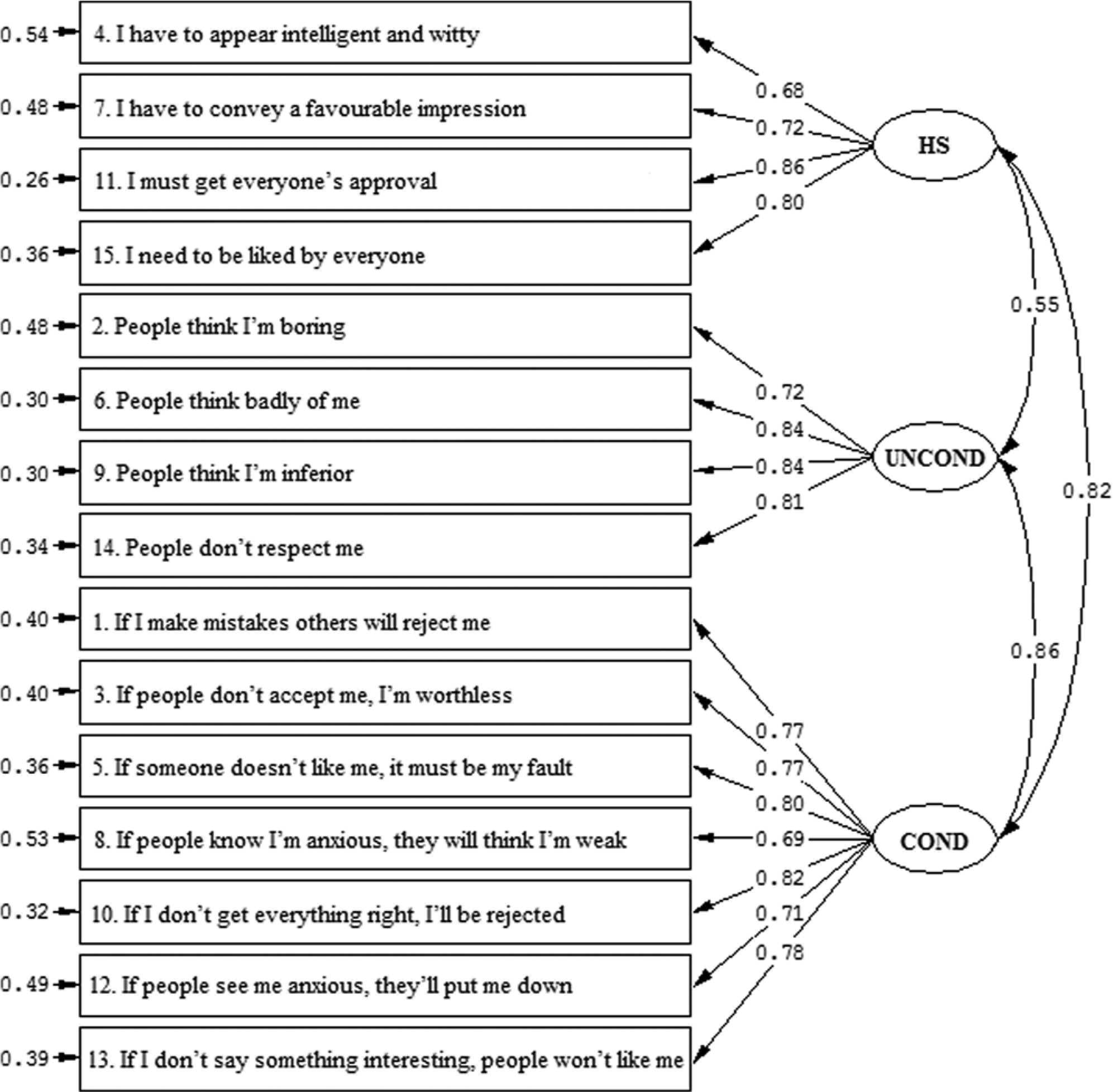
Correlated three-factor solution for the SBSA.
Social Phobia Scale
The 20-item Social Phobia Scale (SPS; Mattick & Clarke, 1998) measures fear associated with evaluation by other people while performing routine activities (e.g., eating). The SPS is typically administered with the Social Interaction Anxiety Scale (Mattick & Clarke, 1998). However, considering that performance fears has been shown to be more common than interactional fears in the general population (e.g., Furmark et al., 1999; Ruscio et al., 2008), we chose to administer the SPS as our measure of social anxiety. Participants rated the items on a 5-point Likert-type scale (0 = not at all true of me to 4 = extremely true of me). The SPS has good internal consistency (Cronbach’s α = .91 in the current study) and has been shown to have good validity in a sample of individuals with social phobia (Mattick & Clarke, 1998).
Depression Anxiety Stress Scales
The 21-item short version of the (Depression Anxiety Stress Scales (DASS; Lovibond & Lovibond, 1995) assesses depression, stress, and anxiety over the past week. Each of the subscales have good internal consistency (in the current study, depression subscale, Cronbach’s α = .90; anxiety subscale, Cronbach’s α = .85; stress subscale, Cronbach’s α = .88). The subscales have also been shown to have good validity in a mixed clinical sample (Antony, Bieling, Cox, Enns, & Swinson, 1998). Each subscale total score was doubled to obtain the full DASS score equivalent. Only the depression subscale was used in analyses.
The Social Thoughts and Beliefs Scale
The 21-item STABS (Turner et al., 2003) is a measure of core beliefs that are characteristic of social phobia. Participants rated items on a 4-point Likert-type scale (1 = not at all characteristic to 4 = extremely characteristic). The STABS has good internal consistency (Cronbach’s α = .94 in the current study) and has been shown to have good validity in a nonclinical sample (Fergus et al., 2009).
Procedure
For the undergraduate sample, after participants provided informed consent, they completed the SBSA, SPS, DASS, and STABS at Time 1. These measures were administered in a randomized order. Participants completed a second SBSA on average 9.68 days (SD = 4.35) later at Time 2. For the social phobia sample, after participants provided informed consent, they completed the SBSA, SPS, and the DASS as part of a set of baseline measures before being entered into an experimental protocol.
Results
Factor Structure
SBSA data from the undergraduate sample was analyzed. SBSA items had skewness values that ranged from −.83 to 1.38 and kurtosis values that ranged from −1.35 to 1.31. Given particular items exhibited elevated skewness and kurtosis (e.g., Item 14, skewness = 1.38 and kurtosis = 1.31), we conducted CFA with robust maximum likelihood extraction to guard against such departures from distributional normality (Fabrigar, Wegener, MacCallum, & Strahan, 1999). LISREL 8.80 (Jöreskog & Sörbom, 2009) was used to conduct the CFA.
To select the optimal model from the CFA, the following fit indices were used (see Brown, 2006): the Satorra–Bentler Scaled chi-square (SBS χ2; the smaller the value, the better the fit), the Comparative Fit Index (CFI; a value ≥.90 suggests acceptable fit; the higher the value, the better the fit), the nonnormed fit index (NNFI; a value ≥.90 suggests acceptable fit; the higher the value, the better the fit), the root mean square error of approximation (RMSEA; a value ≤.08 suggests acceptable fit; the lower the value, the better the fit), the standard root mean square residual (SRMR; a value ≤.08 suggests acceptable fit; the lower the value, the better the fit), and the Akaike information criterion (AIC; the smaller the value, the better the fit and the more likely the model is to cross-validate). Besides examining fit indices, scaled difference-in-χ2 tests (Satorra & Bentler, 1994) were also conducted to test the difference in fit between the three-, two-, and one-factor models.
The fit indices for the correlated three-factor model, the correlated two-factor model, and the one-factor model are presented in Table 1. Of the three models tested, the correlated three-factor model provided the best fit to the data according to the fit indices. Indeed, the correlated three-factor model was the only model with fit indices within recommended cutoff values based on the current state of the structural equation modeling literature. Scaled difference-in-χ2 tests indicated that the correlated three-factor model provided a significantly better fit to the data compared with the correlated two-factor model, χ2(2) = 83.74, p < .01, and the one-factor model, χ2(3) = 403.82, p < .01. Figure 1 shows the standardized factor loadings for the correlated three-factor model. All factor loadings were significant (ps < .01).
Fit Indices for the Three Models Tested in the Undergraduate Sample (N = 235).
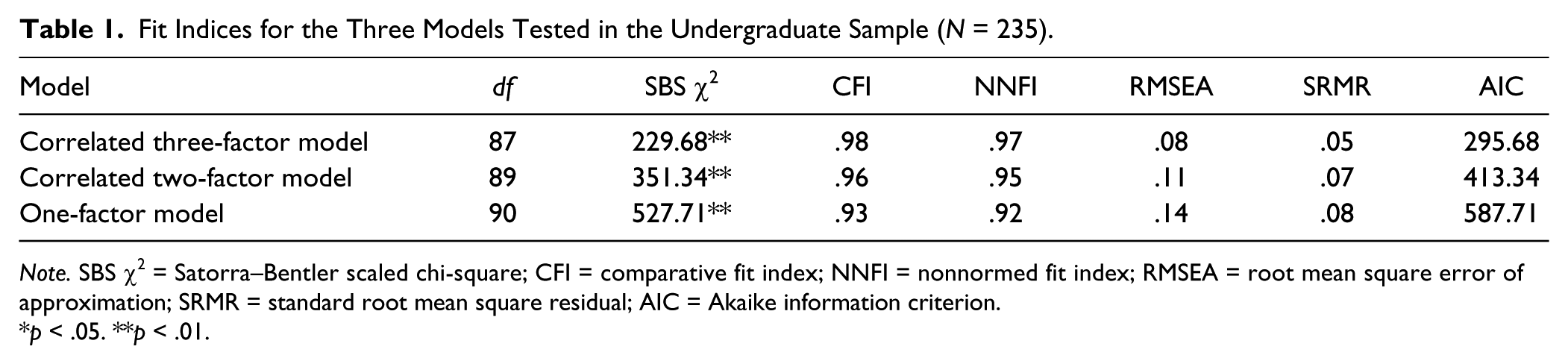
Note. SBS χ2 = Satorra–Bentler scaled chi-square; CFI = comparative fit index; NNFI = nonnormed fit index; RMSEA = root mean square error of approximation; SRMR = standard root mean square residual; AIC = Akaike information criterion.
p < .05. **p < .01.
Internal Consistency
SBSA data from the undergraduate sample were analyzed. The full SBSA had good internal consistency (Cronbach’s α = .94, item-total correlations ranged from .65 to .81). The subscales of the SBSA also had good internal consistency (four-item high standard beliefs subscale, Cronbach’s α = .85, item–total correlations ranged from .79 to .86; seven-item conditional beliefs subscale, Cronbach’s α = .91, item–total correlations ranged from .76 to .84; four-item unconditional beliefs subscale, Cronbach’s α = .87, item–total correlations ranged from .84 to .87). For the full SBSA and each of the subscales, Cronbach’s alpha decreased if any of the items were deleted.
As an exploratory exercise, we also examined the internal consistency of the SBSA and its subscales in the social phobia sample. The full SBSA had good internal consistency (Cronbach’s α = .85, item–total correlations ranged from .34 to .70). The subscales of the SBSA also had good internal consistency (four-item high standard beliefs subscale, Cronbach’s α = .81, item–total correlations ranged from .70 to .87; seven-item conditional beliefs subscale, Cronbach’s α = .78, item–total correlations ranged from .54 to .77; four-item unconditional beliefs subscale, Cronbach’s α = .81, item–total correlations ranged from .76 to .82). For the full SBSA and each of the subscales, Cronbach’s α decreased if any of the items were deleted.
Test–Retest Reliability
SBSA data from the undergraduate sample were analyzed. The full SBSA had good test–retest reliability (r = .81, p < .01). Each of the subscales also had good test–retest reliability (high standard beliefs subscale, r = .78, p < .01; conditional beliefs subscale, r = .78, p < .01; unconditional beliefs subscale, r = .78, p < .01).
Convergent and Divergent Validity
Table 2 shows the means and standard deviations for the measures administered to the undergraduate sample as well as the correlations between these measures. To examine the convergent and divergent validity of the SBSA, four multiple regression analyses were conducted. Each of these analyses had one of the SBSA scales (i.e., full scale total or subscale total) as the dependent variable, and the SPS and DASS depression entered simultaneously as predictors. Additionally, to determine whether there were differences in the magnitude of obtained associations, tests of significance for differences between beta (β) coefficients were conducted (Cohen, Cohen, West, & Aiken, 2003). Given the skew of the SPS and DASS depression variables (SPS = 1.22, DASS depression = 1.57), we also ran the four multiple regression analyses with square root–transformed SPS and DASS depression scores. We note that the majority of results from the analyses with the transformed variables were similar to the original analyses. In these cases, we only report the results from the original analyses. However, where results differ, we report the results from both the original analyses and the analyses with the transformed variables.
Means, Standard Deviations, and Correlations for the Measures Administered to the Undergraduate Sample (N = 235).
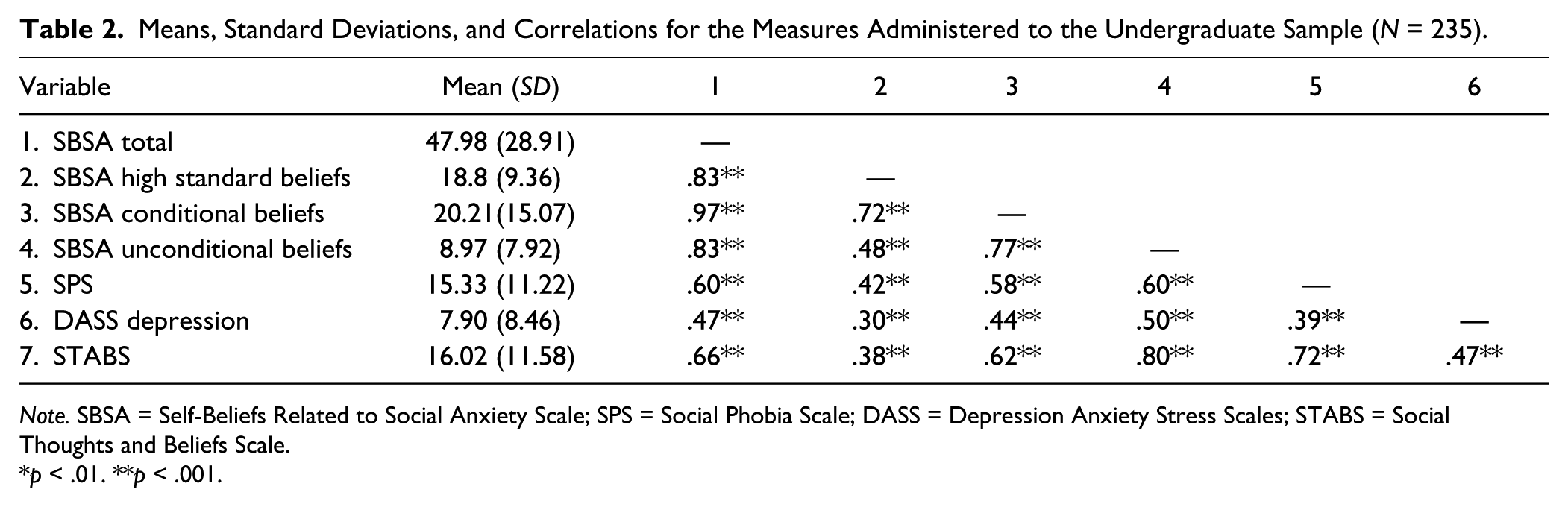
Note. SBSA = Self-Beliefs Related to Social Anxiety Scale; SPS = Social Phobia Scale; DASS = Depression Anxiety Stress Scales; STABS = Social Thoughts and Beliefs Scale.
p < .01. **p < .001.
Table 3 shows the results of the original analyses. The SBSA total had unique and significant positive associations with both the SPS and DASS depression. The SPS was a significantly stronger predictor of SBSA total scores than DASS depression, t(232) = 2.53, p = .01. For the SBSA subscales, the high standard beliefs subscale had unique and significant positive associations with both the SPS and DASS depression. In the original analyses, both predictors were similar in predictive strength as the test of the difference in βs only approached significance, t(232) = 1.88, p = .06. However, in the analyses with the transformed SPS and DASS depression variables, both predictors were significantly associated with the high standard beliefs subscale (transformed SPS β = .39, p < .01; transformed DASS depression β = .16, p < .01), but the test of the difference in βs was significant, t(232) = 2.21, p = .03. In the original analyses, the conditional beliefs subscale had unique and significant positive associations with both the SPS and DASS depression, with the SPS a significantly stronger predictor than DASS depression, t(232) = 2.47, p = .01. In the original analyses, the unconditional beliefs subscale also had unique and significant positive associations with both the SPS and DASS depression. The predictors were similar in predictive strength, t(232) = 1.80, p = .07.
Regression Analyses Predicting the SBSA and Its Subscales in the Undergraduate Sample (N = 235).
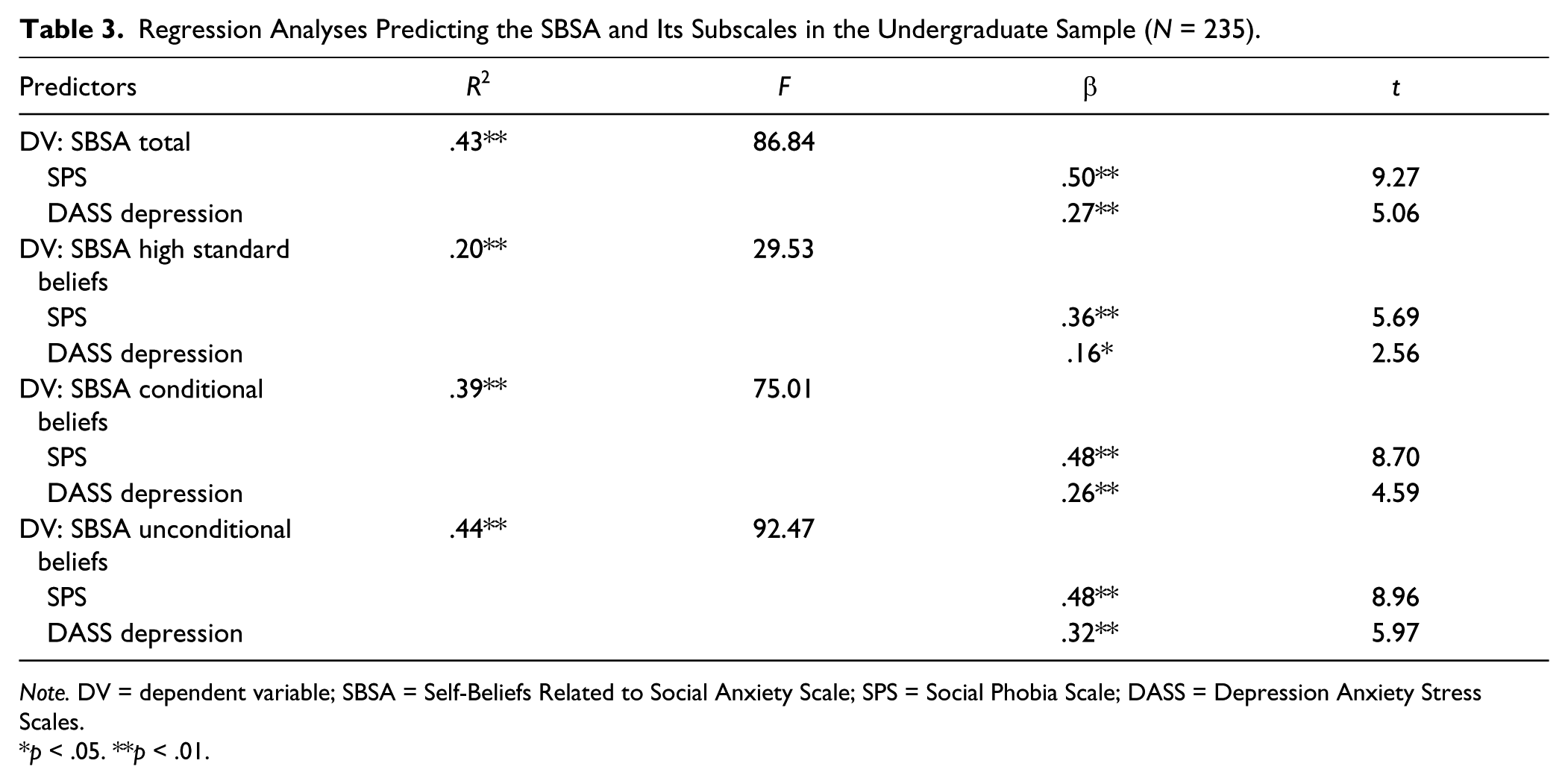
Note. DV = dependent variable; SBSA = Self-Beliefs Related to Social Anxiety Scale; SPS = Social Phobia Scale; DASS = Depression Anxiety Stress Scales.
p < .05. **p < .01.
Incremental Validity
To examine the incremental validity of the SBSA and its subscales, four multiple regression analyses were conducted using data from the undergraduate sample. Each analysis had the SPS entered as the dependent variable, the STABS subscales (Social Comparison and Social Ineptness) as measures of core beliefs related to social phobia entered on the first step and one of the SBSA scales (i.e., full scale total or subscale total) entered on the second step. Given the skew of the SPS and STABS Social Ineptness variables (SPS = 1.22, STABS Social Ineptness = 1.37), we also ran the four multiple regression analyses with square root–transformed SPS and STABS Social Ineptness scores. We note that all results from the analyses with the transformed variables were similar to the original analyses. Hence, we only report the original analyses.
Table 4 shows the results of the original analyses. In all four analyses, both the STABS subscales had unique and significant positive associations with the SPS on the first step. Notably, of the SBSA scales that were examined as predictors entered on the second step in the four analyses, the SBSA total, high standard beliefs subscale, and conditional beliefs subscale were all significant predictors of the SPS, over and above the STABS subscales. The unconditional beliefs subscale was not a significant predictor of the SPS when it was entered as a predictor following the STABS subscales.
Regression Analyses Predicting the SPS in the Undergraduate Sample (N = 235).
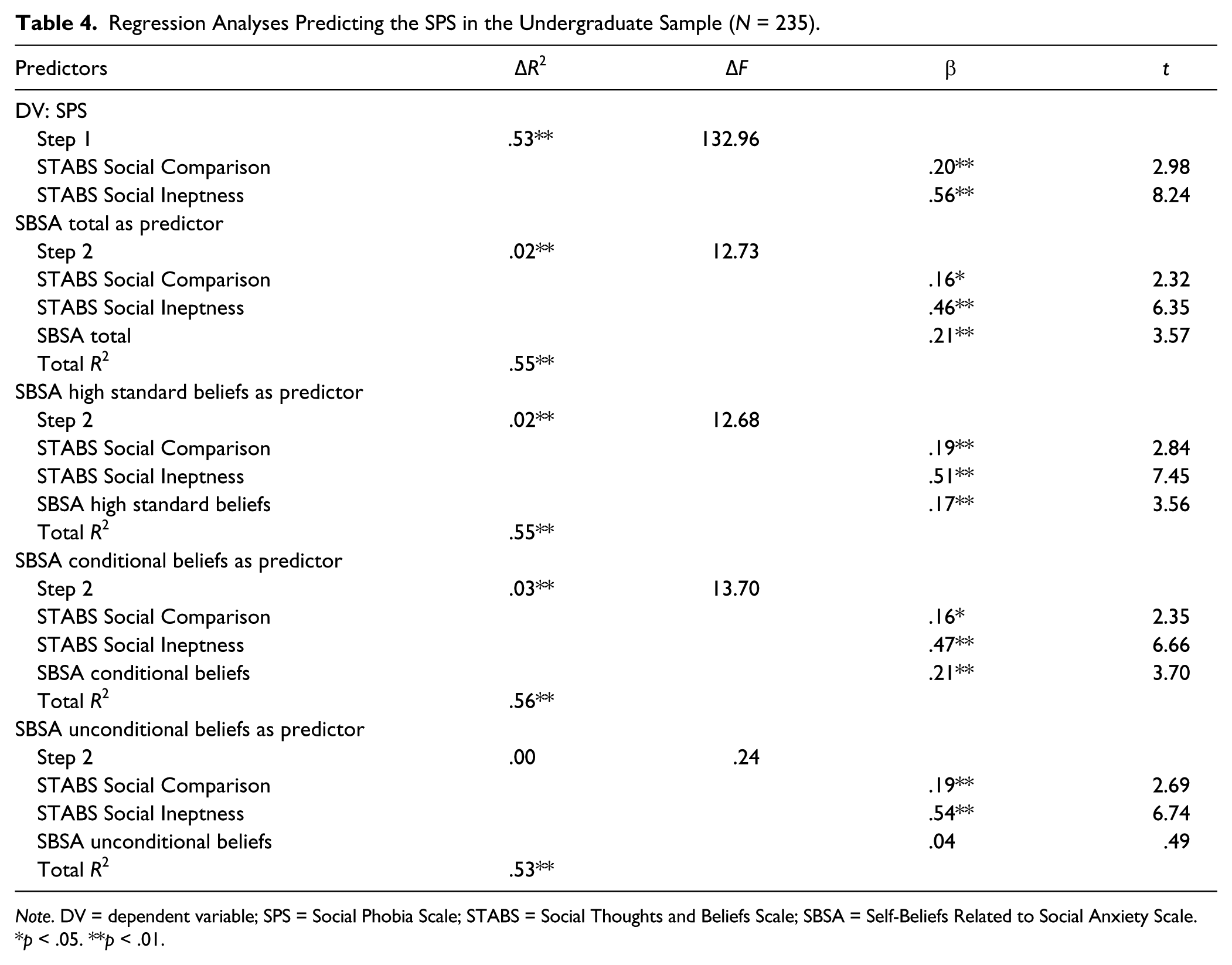
Note. DV = dependent variable; SPS = Social Phobia Scale; STABS = Social Thoughts and Beliefs Scale; SBSA = Self-Beliefs Related to Social Anxiety Scale.
p < .05. **p < .01.
Discriminative Validity
The undergraduate sample and social phobia sample were compared on the SBSA, the SBSA subscales, the SPS, and DASS depression. Given the skew of the SPS and DASS depression variables in the undergraduate sample, we also ran our analyses with the square root-transformed SPS and DASS depression scores. We note that all results from the analyses with the transformed variables were similar to the original analyses. Hence, we only report the original analyses.
Table 5 shows the results of the original analyses. The social phobia sample scored significantly higher on all the measures than the undergraduate sample. The analyses specifically comparing the SBSA and its subscales between the undergraduate and social phobia samples were repeated with DASS depression entered as a covariate (once with the untransformed DASS depression variable and once with the transformed DASS depression variable). The difference in SBSA scores and SBSA subscale scores between the two samples remained significant in all analyses (all ps < .001).
Comparison Between the Undergraduate Sample (N = 235) and the Social Phobia Sample (N = 33).
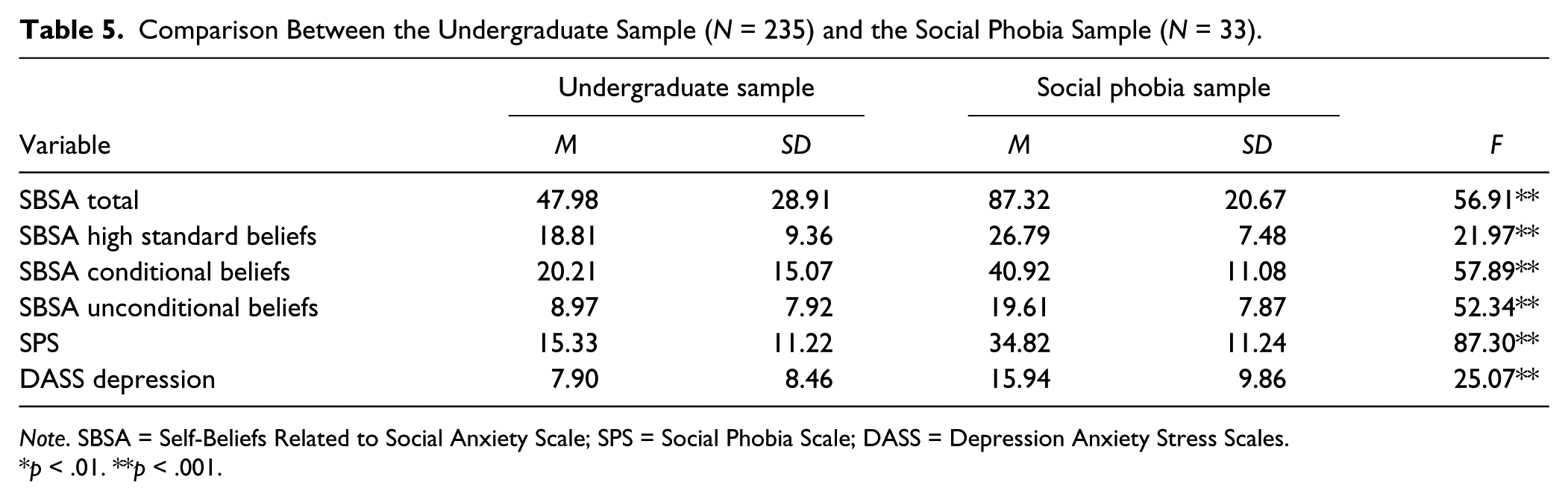
Note. SBSA = Self-Beliefs Related to Social Anxiety Scale; SPS = Social Phobia Scale; DASS = Depression Anxiety Stress Scales.
p < .01. **p < .001.
Discussion
The current study aimed to provide further tests of the psychometric properties of the SBSA. As predicted, the CFA of SBSA responses from an undergraduate sample demonstrated that a correlated three-factor model provided the best fit to the data relative to competing two- and one-factor models. The SBSA and its subscales also demonstrated good internal consistency and test–retest reliability in the undergraduate sample, as predicted. In terms of the convergent and divergent validity of the SBSA in the undergraduate sample, the SBSA total had unique and significant positive associations with both social anxiety and depression, with social anxiety having a significantly stronger association than depression, as predicted. In terms of the convergent and divergent validity of the SBSA subscales in the undergraduate sample, consistent with hypotheses, the conditional and unconditional beliefs subscales each had unique and significant positive associations with both social anxiety and depression. Interestingly, the conditional beliefs subscale was more strongly associated with social anxiety than with depression while for the unconditional beliefs subscale, there was no difference in the strength of its associations with social anxiety and depression. Against predictions, the high standard beliefs subscale had unique and significant positive associations with both social anxiety and depression. The high standard beliefs subscale was more strongly associated with social anxiety than with depression. In terms of the incremental validity of the SBSA in the undergraduate sample, supporting hypotheses, the SBSA total, high standard beliefs subscale, and conditional beliefs subscale each were uniquely and significantly related to social anxiety, over and above another measure of core beliefs characteristic of social phobia. Against prediction, the unconditional beliefs subscale was not uniquely related to social anxiety over and above the other measure of core beliefs characteristic of social phobia. In terms of the discriminative validity of the SBSA, the social phobia sample scored significantly higher on the SBSA and its subscales (even after controlling for depression) compared with the undergraduate sample, as predicted. These results suggest that the SBSA and its subscales have good psychometric properties.
The emergence of the correlated three-factor model as the optimal solution in the CFA of the current study replicates CFA findings from a previous study (Wong & Moulds, 2011a). The consistency of the results over two separate studies increases confidence in these findings. Moreover, the CFA results are consistent with Clark and Wells’s (1995) categorization of the maladaptive beliefs characteristic of social phobia into three types (i.e., high standard, conditional, and unconditional). The CFA results of the current study are thus important from both an empirical and theoretical standpoint, and accordingly, provide strong justification for future researchers to use the SBSA and its subscales. In particular, the SBSA will be useful when researchers wish to examine the maladaptive belief types that are characteristic of social phobia, especially in the context of Clark and Wells’ (1995) model. In addition, this instrument will assist researchers to investigate how components of this model interact (e.g., Wong & Moulds, 2009, 2011b; see also Hirsch, Clark, & Mathews, 2006).
The SBSA and its subscales also had good internal consistency and test–retest reliability. The results from the current study (e.g., Cronbach’s alpha ranged from .85 to .94; test–retest rs ranged from .78 to .81) were comparable to the results from a previous study (e.g., Cronbach’s alpha ranged from .80 to .92; test–retest rs ranged from .72 to .82; Wong & Moulds, 2011a) and point to the robustness of the findings in undergraduate samples. Interestingly, the current study showed that the SBSA and its subscales also have good internal consistency in a sample of individuals with social phobia.
In relation to the validity of the SBSA, the current study replicated several previous findings using an undergraduate sample. Replicating Wong and Moulds (2011a), the current study demonstrated that the SBSA total was more strongly related to social anxiety than to depression. While this highlights the good convergent and divergent validity of the overall SBSA, it is interesting to note the results related to the SBSA subscales. Further replicating the results from Wong and Moulds (2011a), we found that the conditional beliefs were more strongly related to social anxiety than depression, while the unconditional beliefs had similarly strong associations with social anxiety and depression. The conditional beliefs (e.g., “If people don’t accept me, I’m worthless”) may be related to depression because of the negative self-evaluative component of this belief type (e.g., I’m worthless). However, the social element and uncertainty (i.e., whether or not people accept me) inherent in this belief type may explain why it is more strongly related to social anxiety compared with depression. In contrast, the unconditional beliefs (e.g., “People think I’m inferior”) contain a social element, which may explain the relationship between this belief type and social anxiety. However, unconditional beliefs also contain a negative self-evaluative component (e.g., I’m inferior) and can be considered absolute, global, and conclusive in nature (Wong & Moulds, 2011a). These latter qualities are characteristic of depressive thinking (Dent & Teasdale, 1988; Kovacs & Beck, 1978). This may explain why the unconditional beliefs were associated not only with social anxiety but also with depression.
The findings related to the high standard beliefs did not exactly replicate previous findings. In Wong and Moulds (2011a), high standard beliefs had a significant and positive association with social anxiety but were not significantly associated with depression. In the current study, while the high standard beliefs had unique and significant positive associations with social anxiety, consistent with Wong and Moulds (2011a), the high standard beliefs also had unique and significant positive associations with depression. High standard beliefs (e.g., “I need to be liked by everyone”) contain (perceived) high social standards that an individual with social phobia believes that they should achieve. However, such standards are difficult to reach. According to Clark and Wells (1995), the difficulty in reaching these standards leads an individual to experience anxiety and concern about their ability in social-evaluative situations. However, based on the results of the current study, it may also be the case that if an individual perceives that they have failed to reach these high standards (e.g., experiences multiple failures at reaching the standards), the individual may consequently experience low mood, rather than anxiety. Future research is needed to test these possibilities.
The fact that the SBSA subscales were related to social anxiety and depression also has wider implications in terms of explaining the comorbidity between social phobia and depression. Social phobia and depression typically co-occur (Kessler, Stang, Wittchen, Stein, & Walters, 1999; Wittchen & Fehm, 2001), and cognitions of the type that are captured by the SBSA may be one possible vulnerability factor that contributes to the co-occurrence of the two disorders. This is consistent with other research that has demonstrated that the cognitions of individuals with social phobia and the cognitions of individuals with depression have similar properties (Dozois & Frewen, 2006). It would be fruitful for future research to further examine this issue by comparing the SBSA responses of a sample of individuals with social phobia, a sample of individuals with depression, and a sample of individuals with comorbid social phobia and depression.
Extending previous research (Wong & Moulds, 2011a), the current study examined the incremental validity of the SBSA and its subscales in an undergraduate sample. The results of the current study indicated that the overall SBSA, and specifically the high standard and conditional belief subscales, appear to capture unique aspects of the cognitions characteristic of social phobia, over and above the cognitions captured by the STABS (i.e., beliefs about how other people are more socially capable, and beliefs about appearing awkward or anxious in social-evaluative contexts). Interestingly, the unconditional beliefs of the SBSA were not related to social anxiety over and above the STABS. This result suggests that there may be overlap in the content of beliefs tapped by the STABS and the unconditional beliefs subscale of the SBSA, such that the unconditional beliefs subscale does not explain additional variance in social anxiety scores beyond that of the STABS. One possibility is that, like the unconditional beliefs subscale of the SBSA, the STABS also captures beliefs that contain a social element, a negative self-evaluative component, and are absolute and global in nature. Examination of STABS items (e.g., “I am a coward when it comes to interacting with other people,” “Other people are bored when they are around me”; Turner et al., 2003) suggests that this may be the case.
The current study also extended previous research on the SBSA (Wong & Moulds, 2011a) by examining the discriminative validity of the SBSA and its subscales. It should be noted that the social phobia sample of the current study had similar SPS and DASS depression scores compared with samples of individuals with social phobia included in previous studies (e.g., SPS, M = 35.3, SD = 16.4; DASS depression, M = 18.7, SD = 11.0; Abbott & Rapee, 2004; see also Clark et al., 2003; McEvoy, 2007; Rapee & Lim, 1992). Importantly, the social phobia sample of the current study scored significantly higher on the SBSA and its subscales compared with the undergraduate sample, even after controlling for depression. This suggests that the SBSA and its subscales have good discriminative validity.
The findings of the current study have implications for clinical practice and research. Given the good psychometric properties of the SBSA and its theoretical link with Clark and Wells’ (1995) model, the SBSA is ideally positioned as an assessment tool for social phobia. The SBSA may be used in clinical practice as part of a battery of formal measures administered during assessment. Indeed, the SBSA subscales may be used to inform clinicians of specific maladaptive belief types that may be relevant to an individual and targeted during treatment. The SBSA may also be administered at posttreatment to evaluate individual change in maladaptive beliefs. In relation to these clinical applications, important future directions will be to determine norms for the SBSA as well as investigate what constitutes clinically meaningful change on the SBSA. In terms of research, the SBSA may be useful for investigating the interaction between components of the Clark and Wells (1995) model (cf. Hirsch et al., 2006). The SBSA may also be used as an outcome measure in randomized controlled trials of treatment protocols for social phobia and is particularly relevant for treatments that have been derived from Clark and Wells’ (1995) model (e.g., Clark et al., 2003).
The current study has several limitations. First, we used a sample of individuals diagnosed with social phobia that was relatively small, and this did not allow certain analyses to be performed (e.g., CFA). Given that two separate studies using large undergraduate samples (N >200) have now demonstrated that the SBSA and its subscales have good psychometric properties (Wong & Moulds, 2011a, and the current study), the next step will be to further examine the psychometric properties of the SBSA using a large sample of individuals with social phobia. Second, our social phobia sample had low rates of comorbidity compared with previous research (see Wittchen & Fehm, 2001). This may limit the generalizability of our social phobia sample findings to other samples of individuals with social phobia. Third, there are still several aspects of the validity of the SBSA that can be examined. For example, future research may examine the predictive validity of the SBSA (e.g., prediction of severity of social anxiety over time). Furthermore, future research may examine the construct validity of the SBSA using other measures (e.g., measure of depressive cognitions). Fourth, the test of the discriminative validity of the SBSA in the current study involved comparing an undergraduate sample and a sample of individuals with a principal diagnosis of social phobia. In place of the undergraduate sample, future studies should use a nonclinical sample where it has been confirmed that individuals comprising the sample do not meet criteria for any DSM-IV disorder. Future studies that examine the discriminative validity of the SBSA should also include a sample of individuals with other anxiety disorders for comparison.
Notwithstanding these limitations, the current study has replicated previous findings demonstrating the good psychometric properties of the SBSA (factor structure, internal consistency, test–retest reliability, convergent and divergent validity). The current study also extended previous research on the SBSA by demonstrating its incremental validity and discriminative validity. Together with the SBSA’s theoretical link with Clark and Wells’ (1995) model of social phobia, the findings of the current study render the SBSA an ideal research and clinical tool to assess the cognitions characteristic of social phobia.
Footnotes
Declaration of Conflicting Interests
The authors declared no potential conflicts of interest with respect to the research, authorship, and/or publication of this article.
Funding
The authors disclosed receipt of the following financial support for the research, authorship, and/or publication of this article:
This study was supported by a National Health and Medical Research Council Early Career Fellowship (APP1037618) awarded to Dr. Quincy J. J. Wong.