



Abstract
In this paper, I critique the use of anthropometry in interior design. First, I present an overview of the problematic history of anthropometry, revealing how supposedly objective measurements of human physical diversity were used by scientists, colonial administrators, eugenicists, generals, and engineers to advance immoral projects of racism, domination, control, and violence. Next, examining a case study of the ergonomic design for a seated computer operator, I discuss the practical difficulties designers encounter when relying upon anthropometric data to solve design problems. Discussion of the limitations and inadequacies of scientific/technocratic discourses, such as anthropometry, for understanding cultural objects, such as human bodies, frames the conclusion. I call for the development of new paradigms for understanding the human body in interior space that are responsive to and supportive of the widest possible diversity of human physical and social forms.
It is possible to name everything and to destroy the world. Joe and Josephine are austere line drawings of a man and a woman, and they occupy places of honor on the walls of our New York and California offices. They are not very romantic-looking, staring coldly at the world, with figures and measurements buzzing around them like flies, but they are very dear to us. . . Joe enacts numerous roles. Within twenty-four hours he may determine the control positions on a Linotype, be measured for an airplane chair, be squeezed into an armored tank, or be driving a tractor; and we may prevail upon Josephine to do a day’s ironing, sit at a telephone switchboard, push a vacuum cleaner around a room, type a letter (Figure 1).
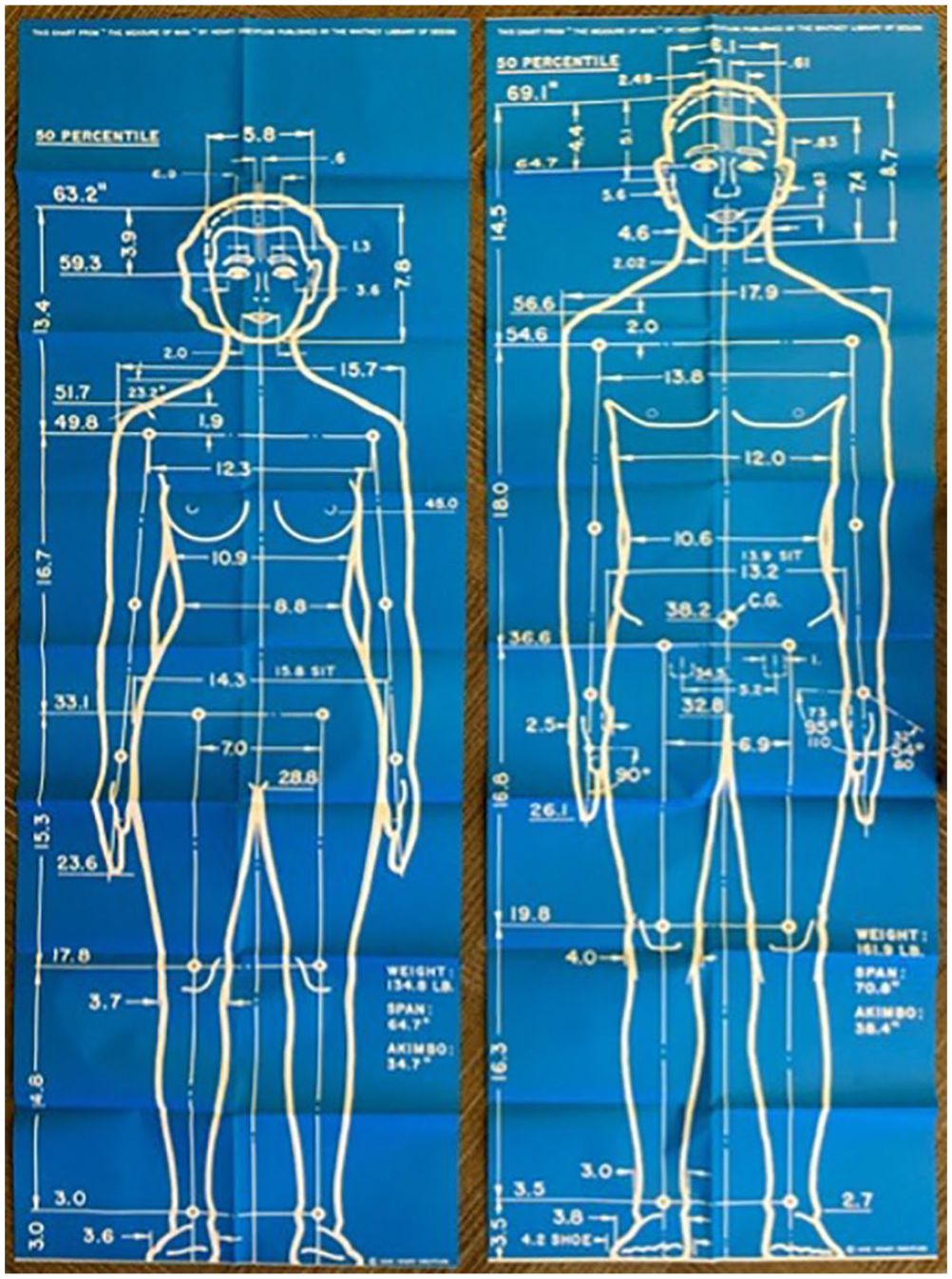
Henry Dreyfus, “Joe and Josephine,” approximately 1.9 m, in The Measure of Man: Human Factors in Design, 2nd rev. ed. (New York, NY: Whitney Library of Design, 1967), unnumbered, unpaginated fold-out drawings.
Introduction
Anthropometric data 3 —the widespread, systematic, and scientific measurement of human bodies—have been available to architects and interior designers for about eighty years. In 1941, Los Angeles architect Ernest Irving Freese first published anthropometric summary drawings for professional designers, “Dimensions of the Human Figure,” in the influential reference guide Architectural Graphic Standards. 4 Freese’s inaugural and minimal drawings were expanded significantly by industrial designer Henry Dreyfuss, who published his findings first in the 1955 book Designing for People, and then more influentially in The Measure of Man: Human Factors in Design: Revised 2nd Edition (1967). Numerous anthropometry-in-design publications followed: Dreyfuss’ collaborators Alvin Tilley and Niels Diffrient published HumanScale: A Manual (1974 and 1981), John Croney published Anthropometrics for Designers (1971), and Julius Panero and Martin Zelnik published Human Dimension and Interior Space (1979). In the same period, a significant number of anthropometry-focused academic journals (including ergonomics, human factors, and human engineering) were established. 5 The recently published version of Architectural Graphic Standards (12th Edition, 2016) continues the escalating trend and includes fifteen pages of anthropometric drawings and data. For many years, designers working around the world have augmented the project by contributing drawings highlighting non-Western anthropometric data sets in diverse global contexts (Figure 2).
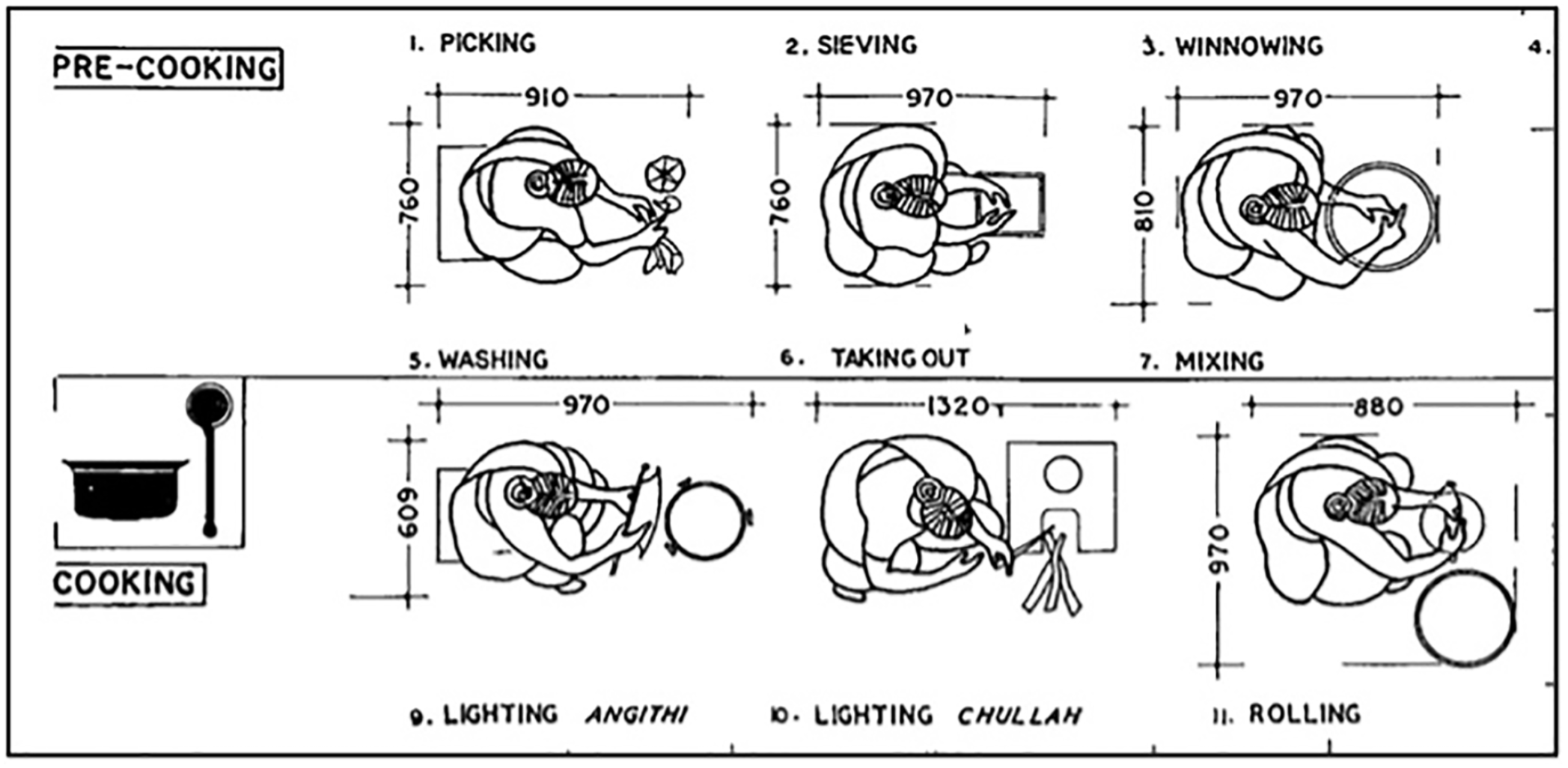
K. L. Datta and T. N. Gupta, “Anthropometric Studies: Food Preparation, Pre-Cooking and Cooking,” in “Anthropometrics and Residential Spaces,” Journal: Central Building Research Institute India 32, no. 1–2 (1966): 14, Figure 2.
When regarding Dreyfuss’ Joe and Josephine “with figures and measurements buzzing around them like flies,” it seems reasonable to wonder: Where did these now commonplace anthropometric design drawings come from? From what historical conditions did anthropometry emerge? When did people first begin systematically measuring large numbers of bodies, what instruments did they use to do so, and for what purposes were their measurements intended? In the contemporary world, how have designers made use of this inherited anthropometric data? What kinds of problems have anthropometric drawings helped designers to solve? How confident should we be that these drawings meaningfully capture something important and necessary about human beings and their bodily existences?
To try and answer these questions, an overview of the troubling history of anthropometric measurements is presented, describing how measurements of human bodies were used as tools for racist domination, economic exploitation, social control, and violence. Next, examining a case study of the ergonomic design for a seated computer operator, the practical difficulties designers encounter when relying upon anthropometric data to solve design problems are examined. Discussion of the limitations and inadequacies of scientific/technocratic discourses, such as anthropometry, to holistically understand complex and dynamic cultural objects, such as human bodies in interior spaces, concludes the paper.
In this article, I aspire to unsettle anthropometry as both a form of authoritative knowledge and a useful tool. As disability theorists have persuasively argued, any systemic construction of norms and standards is intellectually inseparable from the construction of their opposites—the abnormal, the nonstandard, and the deviant. Beneath anthropometry’s veneer of scientific objectivity, it has in practice discounted entire categories of human bodies, most particularly the feminine, the colonized, and people with disabilities, rendering them, in Tanya Titchkosky’s haunting phrase, as merely “included as excludable.” 6 An honest accounting of the legacy of anthropometry in interior design demands that we acknowledge both sides of the ledger: not only what was gained when designers began using anthropometry but also what was paid and what was lost. Has the profession’s overreliance on scientific/technocratic 7 forms of knowledge like anthropometry crowded out other epistemological frameworks—social, historical, cultural, and esthetic—that have the potential to create more inclusive, beautiful, and just interiors? What future tools might we develop to expand the parameters of acceptable bodies, capable of viewing our enduring human physical diversity as not a challenge to be overcome, but rather as fundamental, desirable, and liberating?
On the History of Measuring Bodies
As recounted by the ancient Roman architect Vitruvius in his treatise The Ten Books on Architecture (c. 30 BCE), the Greeks had explicit intention to convert human bodily measurements into proportional systems for architectural beauty: Without symmetry and proportion there can be no principles in the design of any temple; that is, if there is no precise relation between its members, as in the case of those of a well-shaped man. For the human body is so designed by nature that the face, from the chin to the top of the forehead and the lowest roots of the hair, is a tenth part of the whole height; the open hand from the wrist to the tip of the middle finger is just the same; the head from the chin to the crown is an eighth, and with the neck and shoulder from the top of the breast to the lowest roots of the hair is a sixth. . . Wishing to set up columns in that temple [to Apollo], but not having rules for their symmetry, and being in search of some way by which they could render them fit to bear a load and also of a satisfactory beauty of appearance, they measured the imprint of a man’s foot and compared this with his height. On finding that, in a man, the foot was one sixth of the height, they applied the same principle to the column, and reared the shaft, including the capital, to a height six times its thickness at its base. Thus the Doric column, as used in buildings, began to exhibit the proportions, strength, and beauty of the body of a man.
8
Greek ideas about measuring bodies (as transmitted by Vitruvius) echoed through centuries of European architecture, as many Renaissance and Enlightenment-era architects drew their own versions of the classical orders and proposed various modified systems of architectural proportion. These same architects superimposed drawings of the human form onto the plans for churches and overlaid human faces onto the profile lines of ornamental moldings (Figure 3). In recent centuries, scholars began studying the nuances of differing historical proportional systems, 9 and modernist architect Le Corbusier even proposed a rival proportioning system he named Modulor.
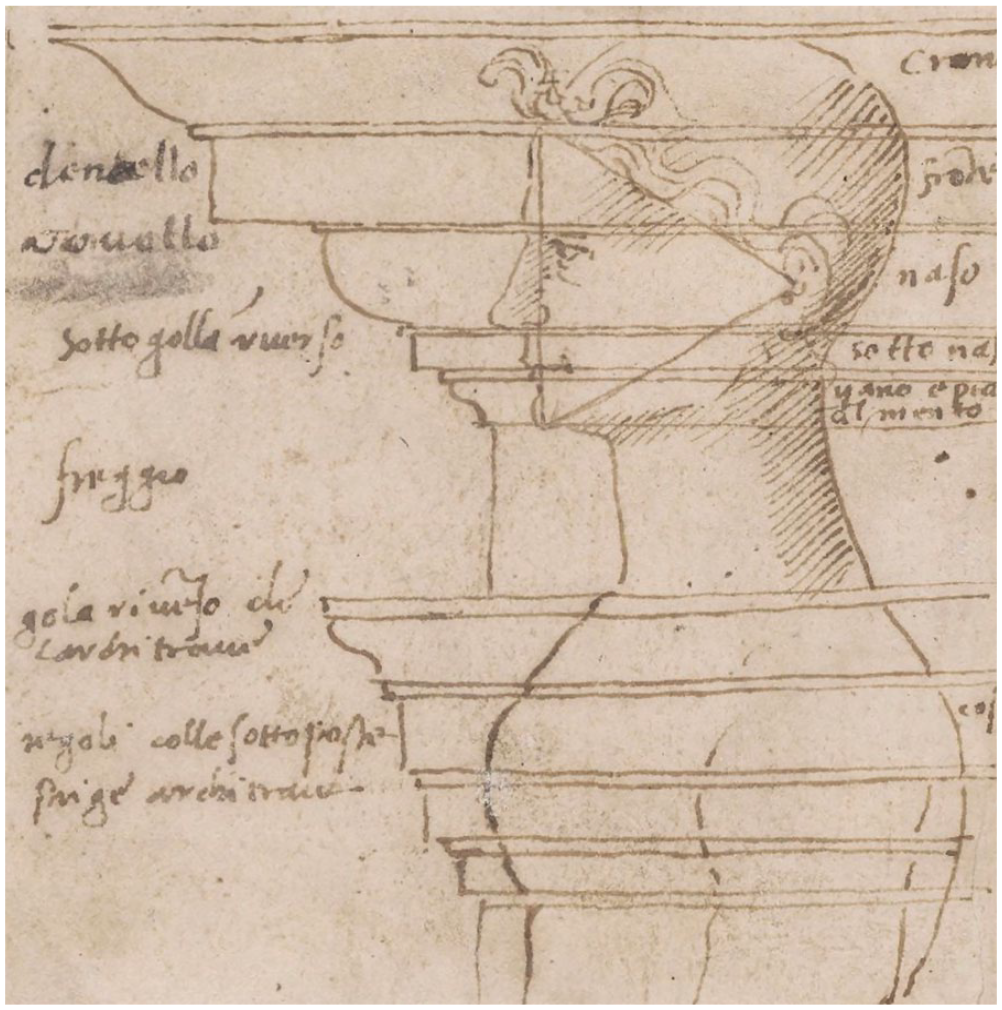
Francesco di Giorgio Martini, illustration from Trattati di architettura, ingegneria e arte militare (early sixteenth century).
Although similar in superficial respects to Greek proportional systems (and their derivatives through the centuries), the modern scientific practice of anthropometry only began in the early 1800s with the new science of physical anthropology. 10 Confronted with the diversity of human forms rendered increasingly visible by colonial encounters, early Western anthropologists found themselves obliged to reconsider the biblical story of human origins: Were humans really one species, all descended from Adam and Eve, or alternately, might humans have emerged independently across the globe in different forms? If different populations of humans had emerged independently, could those differences be measured and classified, as the biologist Carl Linnaeus (1707–78) had done so successfully with plants, animals, and minerals? A network of naturalists, doctors, and anthropologists, including physician Samuel George Morton (1799–1851), collected anthropometric data to shed light on these questions. Morton acquired approximately 1,200 human skulls, to establish categorical anatomical differences between the various human populations. 11 As a related goal, Morton also claimed that cranial volume could be a useful surrogate measure of human intelligence, mistakenly imagining that larger skulls must belong to smarter people. If humans could indeed be separated into different species, which Morton, following the convention of the day named “races,” 12 it should then also be possible to measure a hierarchy of supposedly higher (more intelligent) and lower “races” (Figure 4).
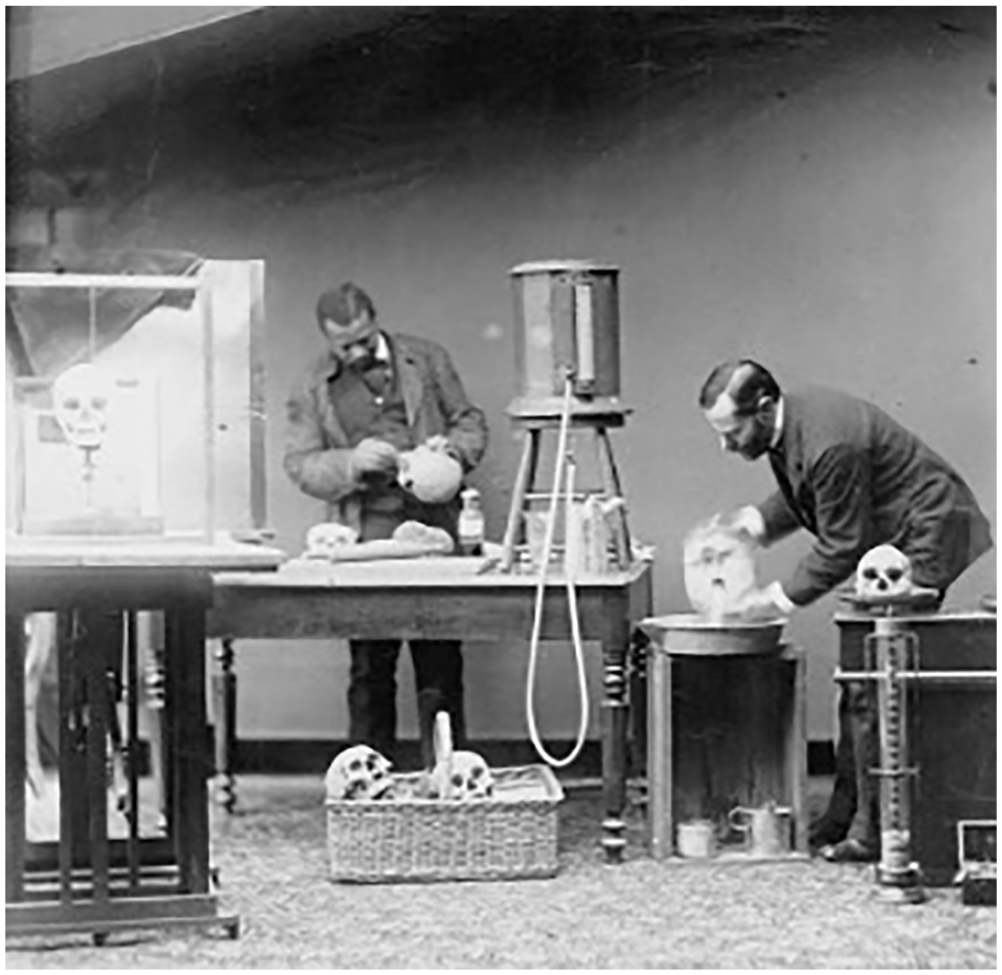
Washington Mathews’ photograph of measuring skulls for cranial capacity at the US Army Medical Museum published in “On Composite Photography as Applied to Craniology; and on Measuring the Cubic Capacity of Skulls,” Memoirs of the National Academy of Sciences III, pt. 2, 13th memoir (1885): 103–116, photograph #3.
From his “scientific” examination of the skulls, Morton claimed to have proven that different human populations had indeed emerged independently on earth (the so-called theory of polygenesis) and were distinct species. He also claimed that his data on cranial volumes, when categorized by “race,” established a quantifiable ranking of human populations by average intelligence. By Morton’s measurements, the “Caucasian race” (Europeans, bizarrely represented in his published drawings by the head of a Greek sculpture) were found to be the most intelligent and capable, while the other “races” ranked in order below that: “Mongolian, Malay, American, and Ethiopian.”
13
As biologist and Harvard University professor Louis Agassiz (1807–73) summarized the theory: Men must have originated in nations, as the bees have originated in swarms. . . There are upon the earth different races of men, inhabiting different parts of its surface, which have different physical characters; and this fact. . .presses upon us the obligation to settle the relative rank among these races, the relative value of the characteristics peculiar to each, in a scientific point of view. . .The indomitable, courageous, proud Indian – in how very different a light he stands by the side of the submissive, obsequious, imitative Negro, or by the side of the tricky, cunning, and cowardly Mongolian!
14
Today, Morton and Agassiz’s work is understood as being a paradigmatic example of “scientific racism,” whereby blatantly immoral racist ideas were “validated” by ideologically driven interpretations of quantifiable data. 15 When later in the late nineteenth century, the theory of polygeny was replaced by Darwinian theories of biological evolution, scientists’ earlier “demonstrations” of racial inferiority were adapted to fit the new scientific model. Now, rather than the different “races” emerging independently from independent ancestors, the differing physical appearances of human populations were understood as a demonstration of the logic of natural selection. In the contestation among peoples and nations, the observed dominance of some over others was understood as a natural phenomenon of survival of the fittest, in which the dominant “naturally” subdue the inferior. For this reason, European, American, and Japanese colonial administrators were all too happy to take up the work of anthropometry, finding in the measured bodies of their colonized subjects the inescapable marks of their inferiority, barbarism, and primitiveness, and thus their own (colonizers’) “natural” fitness to conquer and rule.
These racist anthropometric ideas would prove stubbornly durable. Despite the repeated failure of the measurement of skulls and other forms of anthropometry to produce the desired data on intelligence, or to conclusively establish the biology of race and racial difference, the racist practice of cranial and bodily measurement would continue deep into the twentieth century. In the United States, progressive and supposedly well-intentioned scientific elites relied upon anthropometric data as justification for the forced (and legal) sterilization of tens of thousands of Black citizens and citizens with mental and physical disabilities. 16 Analogously, racist immigration opponents relied on anthropometry when arguing for limits on the importation of “inferior breeding stock,” especially Slavs, Italians, and Jews from Southern/Eastern Europe, and Asians from Japan and China. 17 At state fairs in the 1920s, a prominent American eugenics society conducted extensive anthropometric measurements of white Protestant families for their “Fitter Families Competition,” which awarded medals embossed with the slogan “Yea, I have a goodly heritage” to the most “desirable” competitors. 18 And of course, in 1930s fascist Germany, anthropometry was used by Nazi scientific personnel to horrific deadly effect, with anthropometrical measurements supposedly helping to distinguish “Aryan” from “Non-Aryan” citizens, using the data sets to build an inventory for the genocidal mass murder of millions. 19
When nineteenth-century scientists, doctors, and anthropologists began to systematically measure human anatomical diversity, older pre-modern ideas about the human body as a reflection of a divine ideal (“man created in the image of God”) were discarded. In their place, the anthropometrists created a new model—the average or statistically “normal” body. As discussed by Lennard Davis in his essay “Constructing Normalcy: The Bell Curve, the Novel, and the Invention of the Disabled Body,”
20
French statistician Adolphe Quetelet (1796–1874) generalized the so-called “astronomer’s law of errors” (a method of averaging observed astronomical readings to smooth out errors) to create a more universal model of standards and norms. Quetelet proposed that all of the human sciences might be studied using statistical methods. He claimed that if scientists could measure a sufficiently large number of individuals within a defined (or imagined) group, it would be possible to mathematically determine the “mean” or average for any human characteristic. For example, statisticians could ascertain the average stride of walking farmers, the average length of the human forearm, the mean height of male soldiers in the French army, etc. Extending his model, Quetelet imagined a composite figure comprised of the average measurements of all values in the data set, which he named “L’homme moyen” (“The Average Man”). If the sample set was wide enough, covering say an entire ethnic or linguistic group, “L’homme moyen” could function as a composite portrait of a nation. Crucially, Quetelet did not view this composite figure as merely a neutral statistical amalgam of the data. He also assigned to it exemplary aesthetic and moral qualities: An individual who epitomized in himself, at a given time, all the qualities of the average man, would represent at once all the greatness, beauty and goodness of that being. . . deviations more or less great from the mean [average] have constituted ugliness in body as well as vice in morals and a state of sickness with regard to constitution.
21
In this way, Quetelet’s proposal was both a mathematical innovation and a rhetorical deception, turning measured data sets into claims about aesthetic and moral virtue. With a sleight of hand, he overloaded the new mathematical concept “normal” (a word which amazingly did not exist in its modern form in English before 1840) 22 with both profound statistical and social meanings. Mathematically, the normal is a term of neutral description, inseparable from our contemporary epistemology of naturally occurring normal distributions (bell curves) and standard deviations. Socially, Quetelet’s “normal” smuggled within it a paradoxical idealization: the normal not just as the frequent or typical but also as the exceptional, a condensed instance of aesthetic and moral perfection.
In interior design practice today, there exists many self-evident relationships between the mathematical measurement of the human body and the construction of “norms.” One thinks here of normal spacing, normal equipment height, normal clearances, normal perceptions, etc. It is a mathematical fact, however, that by definition all statistical bell curves (“normal distributions”) include tails representing data divergent from the mean. The spread of this curve—its steepness or flatness, relative to its vertical axis of symmetry—is measured by what statisticians refer to as “standard deviation.” 23 In anthropometry, these divergent regions of the data mark the human outliers: the short and the tall, the wide and the narrow, the uncommon, the noncompliant, the marginalized, the injured, and the differentially abled. In Quetelet’s society of measured bodies defined by norms, nonstandard bodies, living two or three deviations from the mean, are by definition the “deviants.”
Modern vernaculars of rationality, hygiene, and bureaucratic order made the sorting of different peoples an imperative of life scientists, as well as of lawmakers and the police. Efforts to measure the ears of criminals, the clitorises of prostitutes, and the facial contours of “perverts” fueled a feverish desire to classify forms of deviance, to locate them in biology, and thus to police them in the larger social body. _Jennifer Terry and Jacqueline Urla, Deviant Bodies: Critical Perspectives on Difference in Science and Popular Culture (1995)
Racist colonial anthropologists, statisticians, and medical doctors were not the only professionals with an interest in measuring bodies in the nineteenth century. In booming industrial cities such as London, Paris, New York, and Chicago, with populations swelling into the millions, and in which people moved rapidly into and out of neighborhoods on steam-powered railroads and electric trams, the streets were often bewilderingly (and terrifyingly) teeming with strangers. 24 The conditions for new forms of social disorder were high. Riding the railroads, a criminal might wake in his bed in Rouen, rob anonymously from a department store in Paris at lunchtime, and then sell the stolen goods that evening in Bordeaux. Subversive communist leaflets might be printed in Philadelphia on a Monday and pressed into strikers’ hands in Chicago on Tuesday. Policemen and civil-authority bureaucrats, anxious to regulate this anonymous and itinerant mass, and threatened by the new forms of social unrest they imagined it portended, turned to anthropometry to standardize and stabilize shifting social identities.
French bureaucrat Alphonse Bertillon (1853–1914), working in the Paris police department, developed a complex system of anthropometric measurements to ascertain an individual’s unique and stable biometric identity. Bertillon’s system combined measurements of a subject’s head (length and breadth), middle finger, left foot, foreman (cubit), and eye color, combined with a standard photographic pair, now called a “mug-shot” (Figure 5). This information was stored on a standard-format card, with thousands of cards organized together in a novel cross-referenced filing system that facilitated rapid comparisons and retrieval. 25 In a Paris of strangers, in which both the law-abiding citizen and nefarious criminal might move through urban space with anonymity, Bertillon’s measurements promised a reliable and reproducible system for identifying a unique individual body. Highly influential, the Bertillon anthropometric system was adopted by police departments around the world.
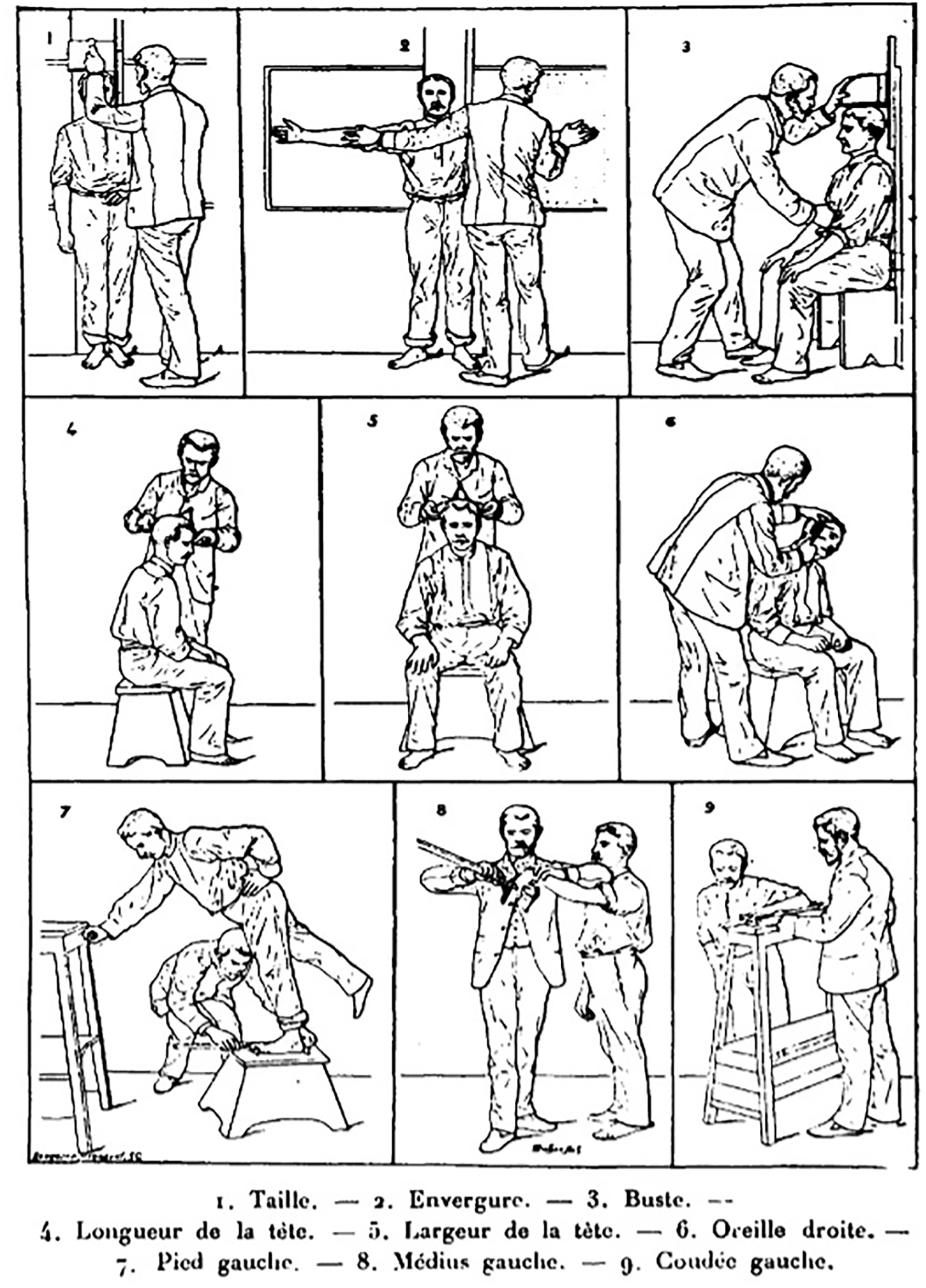
Frontispiece from Alphonse Bertillon’s Identification Anthropométrique: Instructions Signalétiques, demonstrating the measurements required for his anthropometric identification system (Melun, France: Administrative Printing, 1893).
Italian criminologist and medical doctor Cesare Lombroso (1835–1909), confronting similar circumstances as Bertillon, also developed a system of criminal anthropometry. Lombroso’s anthropometry was not simply documentary like Bertillon’s (to stabilize identity), but aimed to be predictive—a “science” capable of assessing an individual’s potential for future criminality. 26 In his 1876 book The Criminal Man, Lombroso argues that criminals are evolutionarily more primitive than law-abiding citizens: “the criminal is an atavistic being, a relic of a vanished race.” 27 Thus, a careful policeman, relying on exact anthropometric measurements capable of sorting modern bodies from “atavistic” ones, and paired with a policeman’s discerning social observation of slang, gait, shifty eyes, etc., should be able to conclusively identify a criminal, even before the crime was attempted. In short, for Lombroso, the appearance of certain measurable shapes or forms in the human body was, in itself, definitive evidence of future social pathology.
Another famous example of anthropometric “predictions” of deviance was discussed by Sander Gilman in his chapter “The Jewish Foot: A Foot-Note to the Jewish Body.” 28 Gilman describes how late nineteenth-century Austrian medical authorities identified and measured several “pathologies” of the European urban-Jewish body, including flat feet, deformed musculature, and a crippled gait. 29 These so-called deformities, theorized by the physicians to have been produced by the “degeneracy” of modern Jewish urban life, biologically marked the “race” as anatomically defective, both feeble and nervous, and thus categorically unfit for military service. And since Jewish men could not therefore fulfill their civic obligation for service in the Austro-Hungarian army, they were de facto unworthy of full citizenship in the modern nation-state.
Other nineteenth- and twentieth-century anthropometrists measured bodies to augment the forces of production and power. Frederick Winslow Taylor (1856–1915) was an American engineer and factory manager who developed an organizational and administrative practice he named “scientific management.” The system was designed to optimize human labor in factories and offices. Taylor’s scientific management was predicated upon the exhaustive study of each minute task undertaken by an individual worker. No subject was too small for measurement and analysis: the volume of a shovel scoop, the number of steps walked, keystrokes per minute, the frequency of water breaks, the exact position of writing materials on the desktop, etc. (see Figure 6). Taylor employed stopwatches, measuring tapes, graphs, and photography to analyze, step by step, each posture and action taken by a worker’s body. Each day Taylor would modify one variable of the work task—for example, subtly shifting the mounting height of the typewriter keyboard to shift the angle of the typist’s forearm, storing unlaid bricks on the left side of the mason rather than the right, or installing a second water cooler in an office interior—and then meticulously measured the worker’s output over the subsequent workday. This process was repeated for every possible configuration, covering the entire scope of the workforce and each task and subtask necessary to be performed. Taylor was confident that with sufficient measurement and analysis, he could unequivocally determine the most efficient configuration of bodies, tools, and work sequences. 30
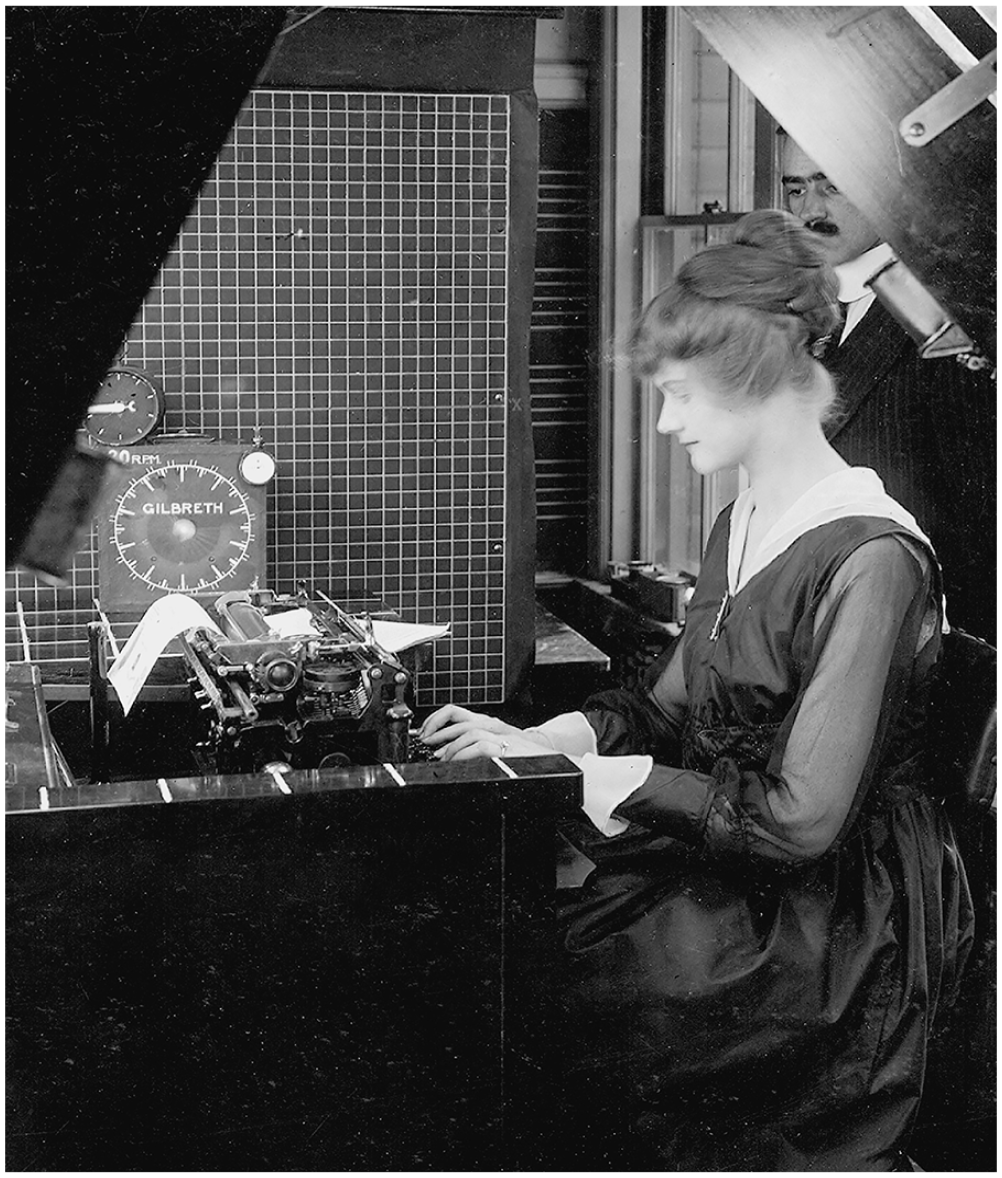
Margaret Owens in a time-and-motion typing study in the Lillian Gilberth studio/laboratory, 1916. Courtesy of Purdue University Libraries, Karnes Archives and Special Collections.
The Taylorist scientific manager had one clear goal for his work: the transformation of the physical body of the worker into a biological analog to the machine in the factory, optimized for exactly one specific high-efficiency output. All expertise and decision-making about the work task—the tools to be used, the techniques for use of those tools, and the speed and sequence of the work—would be removed from the worker and assigned to the engineer. Bodies, materials, and machines would be brought into a biomechanical alignment for maximum production.
Taylor was quite explicit in the need for top-down standardization, as he saw the industrial worker as fundamentally imbecilic. Describing his invention of scientific management, Taylor recounts the story of the laborer “Schmidt,” whose output of carried pig iron was to be optimized. Taylor writes, One of the very first requirements for a man who is fit to handle pig iron as a regular occupation is that he shall be so stupid and so phlegmatic that he more nearly resembles in his mental make-up the ox than any other type. The man who is mentally alert and intelligent is for this very reason entirely unsuited to what would, for him, be the grinding monotony of work of this character. Therefore the workman who is best suited to handling pig iron is unable to understand the real science of doing this class of work. He is so stupid that the word “percentage” has no meaning to him, and he must consequently be trained by a man more intelligent than himself into the habit of working in accordance with the laws of this science before he can be successful.
31
When Taylor abstracted Schmidt’s body and its work tasks into measurable units, when he regarded Schmidt as simply an aggregation of mechanisms, geometries, and capabilities (steps per minute, angles for the forearm muscle, tons of pig iron per day), he transmuted Schmidt from a person, whole and possessive of innate moral standing, into a biomechanical data table.
Finally, the US military was also a major producer of anthropometric data. Measurements first began in the years following the Civil War; however, data collection then was rudimentary and applied to basic and obvious questions like: Is a draftee too malnourished to fight? What size boots should be ordered? etc. With the widespread adoption of mechanized war-fighting equipment in the twentieth century, however, the situation changed. Now, a growing catalog of mechanical fighting environments demanded an ever-increasing precision of bodily measurements. Spaces like airplane cockpits, submarine hatches, gun turrets, and armored vehicles, produced by the hundreds of thousands, were almost always highly spatially constrained. Body clearances were minimal (and expensive), but performance requirements could not be compromised. To operate and kill effectively, the mechanized weapon had to function in perfect alignment with the biological body of the soldier. Designers needed exact anthropometric data to design eject pathways, head clearances, unblocked sight lines, depressible foot–pedal controls, survivable recoil forces, etc.
Seeking a way to visualize and summarize the rapidly swelling tables of military-collected anthropometric data after WWII, weapons designers at Wright-Patterson Airbase constructed three-dimensional “man models” for use in their weapon prototypes. The “man models” were fabricated in three sizes (Figure 7). Each was a full-scale, articulated test dummy representing a certain range of the anthropometric data. These plastic men were used to confirm operational and egress clearances in proposed Cold War era military equipment. They were also sculptural expressions of anthropometry directed at the augmentation of a man/machine hybrid “cybernetic” weapons system. 32 Going much further than Taylor, these biomechanical assemblages were the subjects of extensive scientific, mathematical, and information-theory modeling to optimize the “cybernetic” interface, and here anthropometry proved central in the Cold War military’s efforts to maximize the killing capacities of the new man/machine hybrids. With their vacant stares and haunting translucent bodies, the man models simulated the quintessential Cold War soldier, cool and dispassionate, ready to mate himself to ever more awesome killing machines.
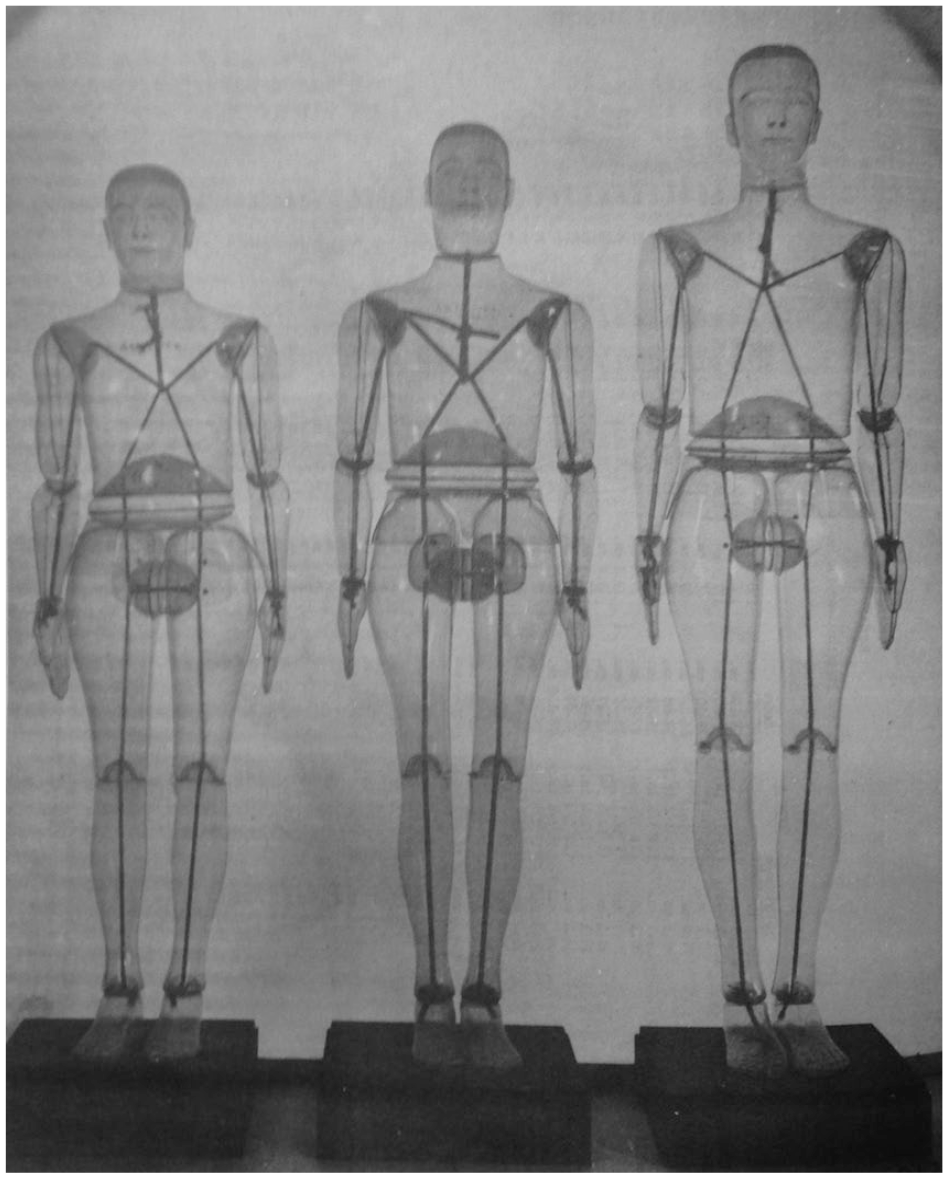
“Man Models” in Francis E. Randall et al., Army Air Forces Technical Report No. 5501: Human Body Size in Military Aircraft and Personal Equipment (Dayton, OH: War Department Army Air Forces Air Materiel Command, 1946), 196.
As we have seen, the “figures and measurements buzzing around [Joe and Josephine] like flies,” are the product of a complex and painful history. Anthropometric data were rarely collected by well-intentioned gentleman hobbyists nor for some benign notion of human betterment through design. Rather, human bodies were measured to serve specific and often brutal ideological purposes. These measurements, and the scientific/technocratic authority they helped to foster, were tools of racists and eugenicists. Anthropometric measurements justified colonial brutalities, and they provided rationales for the involuntary sterilization of people with disabilities. They were used to legitimize the murder of the “inferior.” Anthropometric measurements were invoked to deny US immigration to “inferior breeding stock” from Asia and Eastern and Southern Europe. Measurements were recorded as proof of social deviance and criminality and as marks of civic unworthiness. They were mechanized by engineers to augment the amplification of industrial and military power.
Here it is vital to stress that anthropometry’s dark history does not arise solely because certain bad actors made indefensible choices, although many clearly did. Rather, the history of the systematic measurement of human bodies in the scientific age has always been inseparable from the contexts in which those measurements were commissioned. Decisions about who and what to measure, and why measurements seemed necessary, were never (and are never) neutral and disinterested questions. The economic, social, cultural, and political frameworks in which those measurements held meaning have always mattered and are inextricably entangled with the numerical data gathered.
One risk for designers today is that we disregard anthropometry’s complex and bloody history, allowing ourselves to be assuaged by its comforting veneer of objectivity. We may find ourselves again tempted by a false and simplistic hope that seemingly neutral empirical methods, resting themselves atop the epistemological authority of science and mathematics, can provide perfectible solutions to contemporary design problems. If that is the case, then it is surely a useful and fortunate irony that, when considered in actual design practice, anthropometry has proven itself such an ineffectual tool.
On (Not) Solving Design Problems With Anthropometry, or “How to Sit”
In 1990, Marvin J. Dainoff, professor of human factors design, ergonomics, 33 and psychology at Miami University (Ohio), published a research article in the Journal of Interior Design titled “Reducing Health Complaints in the Computerized Workplace: The Role of Ergonomic Education.” 34 In the article, Dainoff discusses the surprising prevalence of workplace injuries sustained by computer-terminal operators. Speculating about the new injuries, Dainoff perceptively observes that previous constraints on the pace of human office-worker performance (e.g., the speed limit of mechanical typewriters, or the need to physically reload and then file printed papers) had been eliminated in the computerized office. Without these limits, operators were being asked to work faster, and without either scheduled or unavoidable breaks. Given the increasing reliance on computers for the conduct of office work, Dainoff saw that repetitive strain injuries were primed to increase. He believed better, ergonomically targeted solutions were urgently needed (Figure 8).
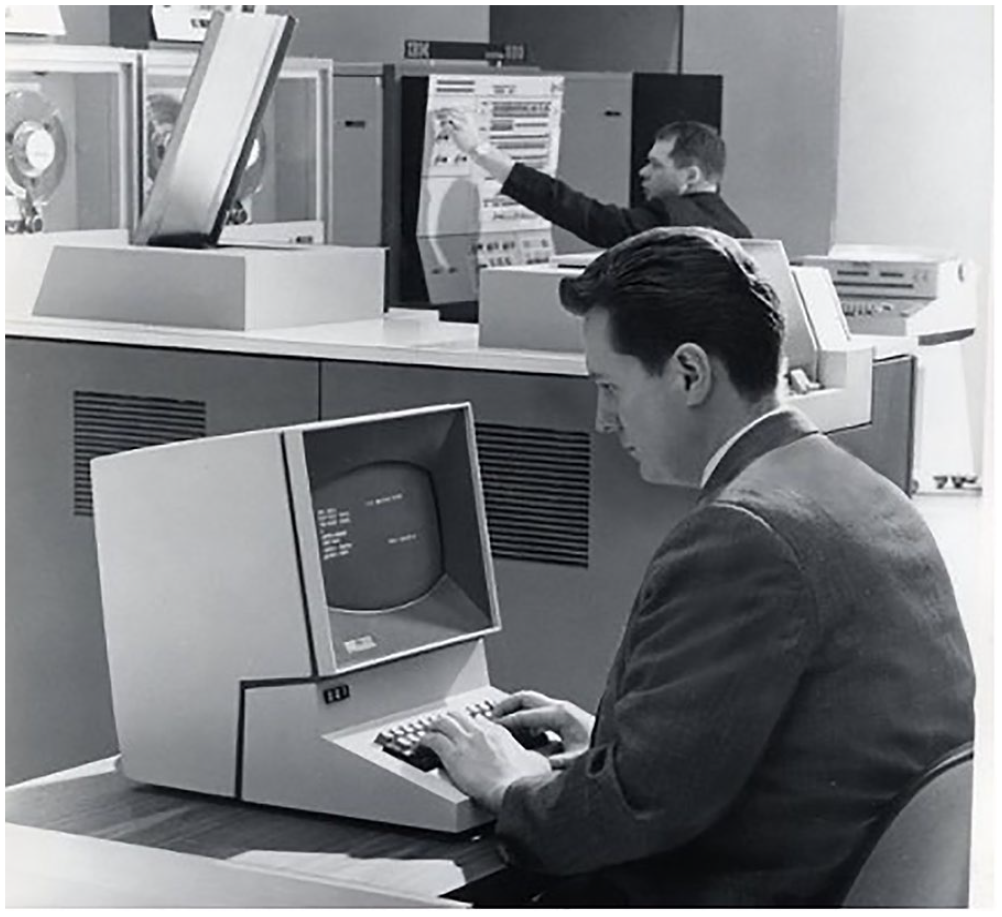
Working on an IBM 2260 computer, c. 1964. Image courtesy of the Norsk Teknisk Museum (Norway) and distributed under “Creative-Commons Attribution and Share-Alike 4.0 License.” https://digitaltmuseum.no/011015240147/22-0-ibm-modell-360-370.
Dainoff begins his paper with a literature review. First, he notes Bell Laboratories’ 1983 recommendations for the posture of the computer operator, which suggested an orthographic posture. Dainoff somewhat bizarrely names this “the 90° cubist approach.” Here, the chair seat is parallel to the floor, the operator’s feet rest flat, the chair back is perpendicular to the seat (thereby positioning the thighs and trunk at right angles), and the arms reach forward to a keyboard, spanning parallel to the floor. The head is inclined slightly down at −15° to look at the screen, with an independent keyboard positioned on the surface of the desk, above the thighs. Summarizing this posture Dainoff writes, “The task of the designer would then be to provide sufficient ranges of adjustability of seat pan height, working surface height, and display monitor height to accomplish this goal. These ranges of adjustability would be determined by the use of appropriate tables of anthropometric dimensions.” 35
As soon as Dainoff completes his description of the “cubist approach,” he abandons it. First, citing the work of Swiss physician E. Grandjean published in the journal Human Factors, Dainoff recommends that the chair back be tipped backward off the vertical by −15° (“or more”) to reduce stress on the lower back. Then Dainoff cites an alternative study by Danish physician A. C. Mandal that, contrarily, returns the back to a vertical orientation but recommends that the seat pan be tipped forward, producing “[a] resulting posture which is quite similar to that obtained while riding a horse,”
36
a posture again proposed to decrease injuries to the lower back. Aware of the emerging contradiction, Danioff notes: Are these two arguments contradictory? . . . in fact, both forward and backward leaning work postures can be effective. . .. if the visual tasks require attention to fine detail, such as reading paper copy, the backward posture places the eyes too far away from the copy. Thus, the forward tilting posture is preferred for close work. On the other hand, if the work primarily involves reading from the display screen, the backward leaning posture is appropriate, since screen characters are typically much larger than those on printed copy and thereby can be read at a distance. These arguments were supported in a series of laboratory experiments involving simulated data entry tasks.
37
While attempting to square this circle, but not surprisingly, Dainoff declines to discuss the additional recommendations of Mandal, published in his earlier book The Seated Man: Homo Sedens (1985), which had been reviewed in the Journal of Interior Design in 1986. In that book, Mandal paired his recommendation for a +15° declined seat pan with a −30° backward spinal tilt. When combined together, Mandal recommends a seated position with a 135° angle between thigh and spine, which is to say a seated position halfway toward lying down. 38
In the face of all of these contradictory recommendations, the ergonomic solution ultimately endorsed by Dainoff is a chair and workstation completely customizable by the user, capable of producing the entire range of supposedly optimum configurations. But this solution has two enormous drawbacks, which Dainoff immediately notes: first, the tremendous costs to manufacture furniture with such mechanical complexity. And second, and perhaps even more difficult, “. . .the operator has [to have] the knowledge and skill to properly use the tool. There is evidence that this requirement appears to be problematic for the furniture industry in the sense that ‘teaching people how to sit’ has not traditionally been a high priority.” 39
At this point, any designer reading Dainoff’s analysis is surely ready to throw up their hands. Even for the most routine of office tasks—sitting before a stationary computer and typing, a task which produces a fixed body position performing in essence a single operation—the anthropometric data fail to produce a consensus best solution. Contrary to all claims and expectations, it seems that there is no optimized ideal configuration for the seated computer operator. Maddeningly, the ultimate recommended design solution was obvious from the start: provide the workers with highly customizable tools to configure their own workspaces to suit their needs and preferences. Here, a designer is surely beginning to wonder: if anthropometric analysis cannot optimize even this one straightforward design problem, what use can it be in more complex human environments, in which dozens or even hundreds of differing activities, users, and spatial configurations must be accommodated?
To justify the immense costs of manufacturing the user-configurable furniture that will be required for anthropometric optimization, Dainoff points to an anticipated uptick in worker productivity: “increased keying speeds,” “increased performance,” “reduced [staff] turnover,” and a “drop in error rate” should all be expected. But surely this analysis is too simplistic. Are there no other alternatives that may yield similar or even superior productivity results in comparison to anthropometric optimization, but at a lower cost? For example, might it not be cheaper and more effective for the employer to simply allow the workers a few more breaks during the workday (a solution already well known to lower incidents of repetitive strain injuries and decrease errors)? Or perhaps it might be less expensive for the employer to increase worker pay to decrease turnover? For that matter, what of all the other design variables that an interior designer would suggest are also worthy of including in a comprehensive cost–benefit analysis: Would proximity to daylight and fresh air produce these same beneficial results? How about providing a larger workspace, with more visual and auditory privacy? What about a more humanely designed workspace that encourages personalization and provides sensual stimulation with plants, bubbling water, and beautifully colored and textured materials? Most frustratingly of all, even in cases where obvious ergonomic solutions could be easily defined and cheaply implemented—for example providing a stool for a standing retail- checkout cashier—a corporation might well determine that the cost to productivity (and thus profitability) overrides any potential ergonomic benefit to the employee. In other words, if a standing checkout worker becomes injured and cannot work, maybe, from the corporation’s viewpoint, instead of proactively buying a stool and incurring a drop in productivity, it would be cheaper, in the long run, to terminate the worker, pay a small worker’s compensation fee, and then hire additional (but still stool-less) workers. 40
Pulling back the analysis still further, the very question that Dainoff was attempting to study—what is the anthropometrically ideal body position for the seated computer operator?—was itself a question that only emerged as a consequence of shifting social, economic, and technological forces that led to the widespread adoption of office desktop computers in the late 1980s (Figure 9). But these forces are obviously not static—Dainoff was aiming at a moving target—and with the benefit of hindsight, it is now clear that Dainoff’s central question is fading in significance. In 2023, digital office work on computers is increasingly likely to take place on portable laptops, tablets, or mobile phones rather than at fixed workstations. These new machines can function untethered for hours or days at a time, so as a result are frequently used at café tables, in railroad seats, in conference rooms, reclining on a lounge chair (where I currently sit writing this document on a laptop), at outdoor picnic tables, or even lying in bed or walking down a sidewalk. Furthermore, and partly in recognition of this new mobile reality, contemporary offices may be designed without fixed worker locations. Today’s worker may begin their day by “checking in” and selecting a workspace, which might be alongside others at a shared worktable, in a reserved traditional office, a café table in the cafeteria, or a small telephone-booth-sized cabinet, or perhaps walking on a treadmill facing a standing desk. Other workers may elect not to come into the office at all, spending days or weeks performing work tasks from home or while traveling. While surely some of these use cases are ergonomically better than others, and while no doubt many smart contemporary designers think deeply about this, what remains clear is that we should expect that whatever today’s solutions, no matter how optimized, will likely poorly meet tomorrow’s needs.
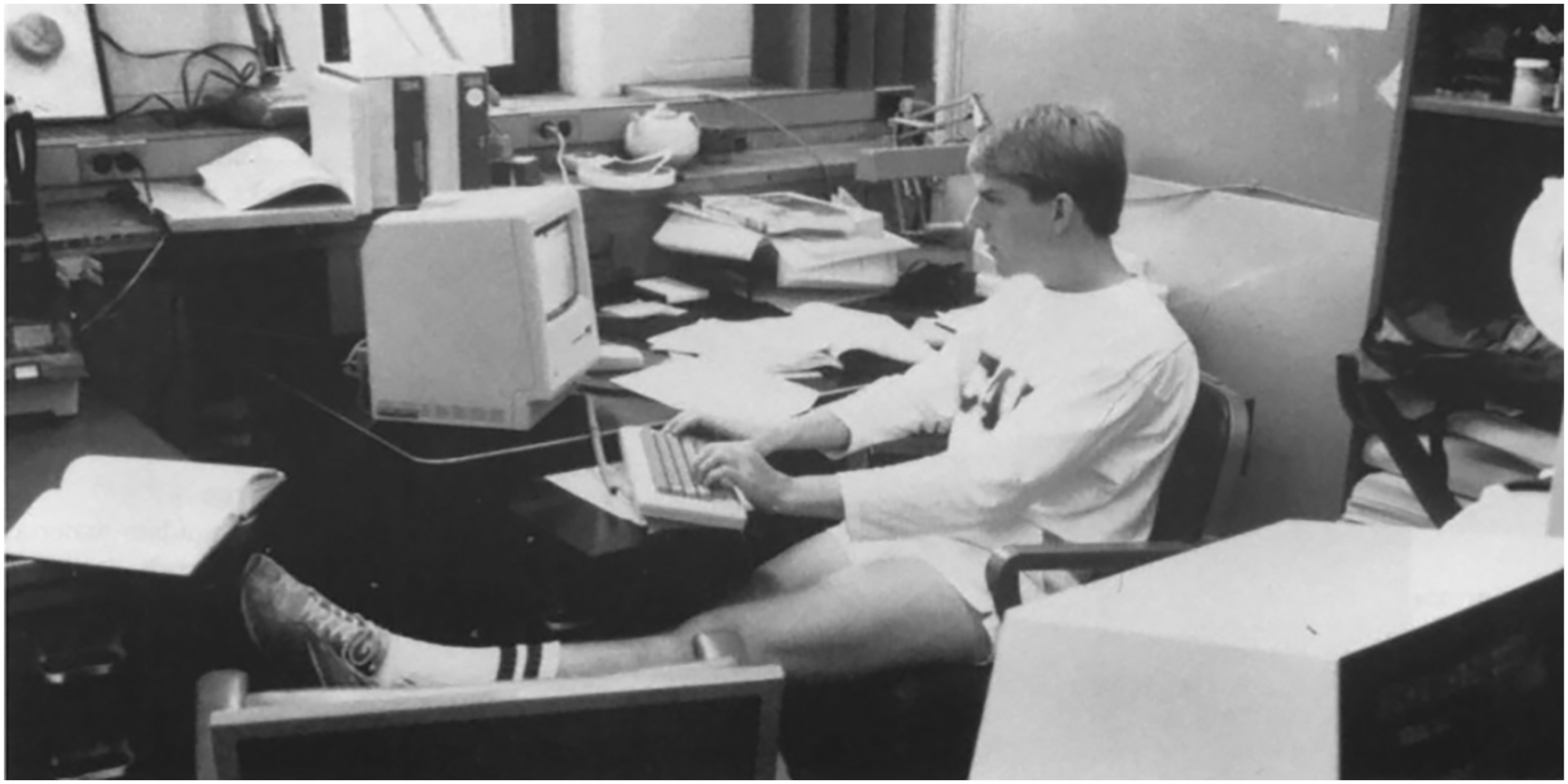
Cornell physics professor working on his computer c. 1986; in Paul Eshelman, “Quality of Personal Computer Work Settings: Assessment in Facilities with Decentralized Control,” Journal of Interior Design 12, no. 1 (1986): 24.
Lastly, it is one of the greatest ironies of all that Dainoff’s search for the anthropometrically optimized posture for the seated computer operator is now regarded, by today’s ergonomic design experts, as a dangerously wrongheaded question. To the contemporary scientific consensus, seating itself, no matter how well optimized, is regarded as a dangerous long-term threat to human health, associated with life-shortening conditions of obesity, heart disease, stroke, and diabetes. 41 According to twenty-first-century ergonomic authorities, the optimized seating position is standing.
On the Human Body as a Cultural Object
In his influential 1966 book, The Measure of Man: Human Factors in Design: Revised 2nd Edition, industrial designer Henry Dreyfuss, widely regarded as one of the world’s foremost experts in using anthropometry to design human environments, published a drawing anticipating the size of the average US man in the year 2000 (Figure 10). 42 The drawing was a predictive extrapolation that claimed thirty-four years in the future, the average full-grown US male would reach 70.0″ inches tall and weigh 165 lbs.
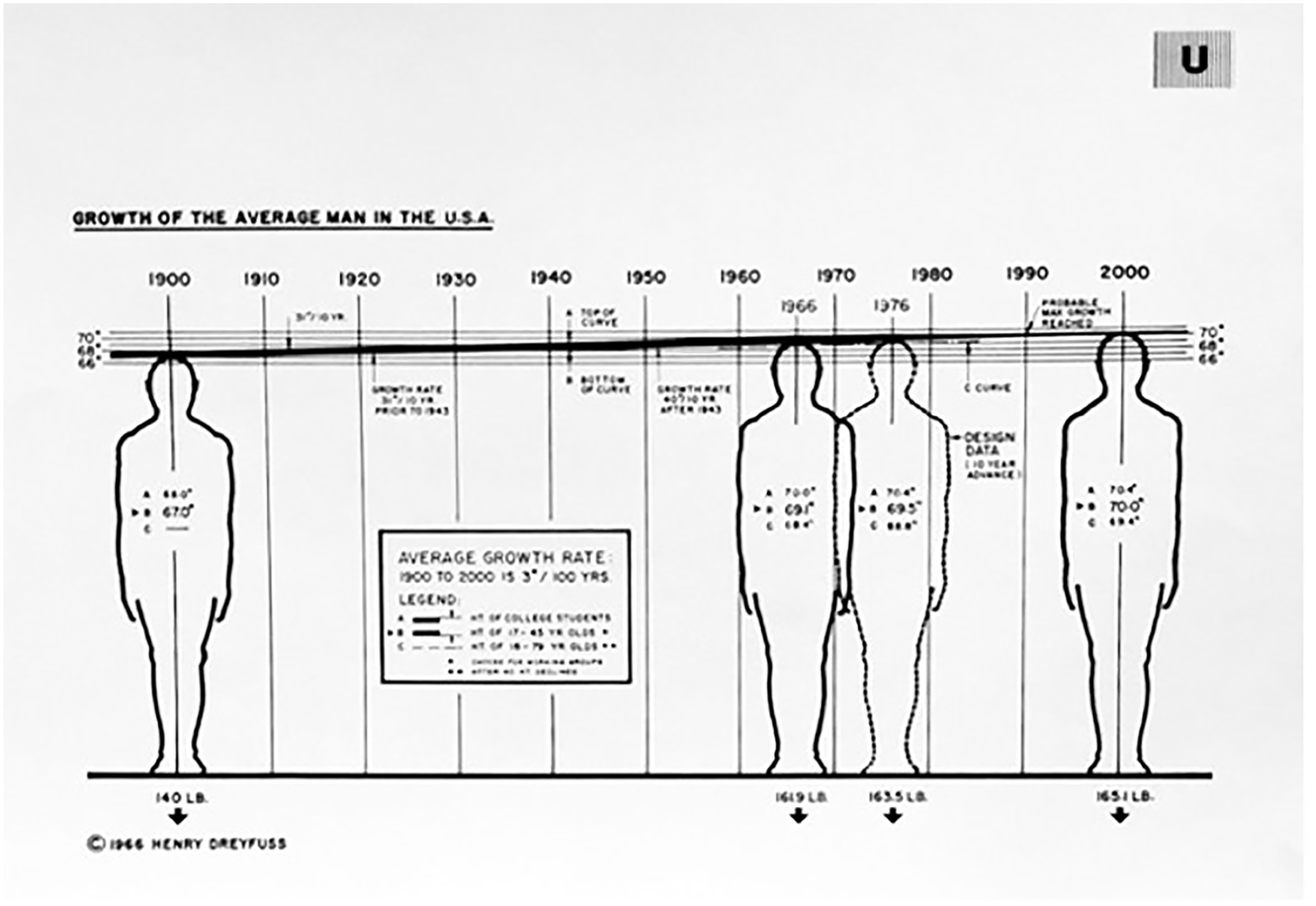
Henry Dreyfus “Growth of the Average Man in the U.S.A,” approximately 28 cm, in The Measure of Man: Human Factors in Design, 2nd rev. ed. (New York, NY: Whitney Library of Design, 1967), unnumbered, unpaginated drawing “U.”
Dreyfuss was interested in precise measurements of the body because his studio had specialized in designing objects and environments deployed close to the human body, things like railroad passenger seats, fountain pens, John Deere tractors, typewriters, combat tank compartments, telephone handsets, vacuum cleaners, and steamship sleeping cabins. Dreyfuss considered it vital to have a precise mathematical understanding of the “human dimensions” 43 of the bodies that would use his designs. His studio had been gathering such measurements ad hoc for many years, and the publication of The Measure of Man was meant to condense all of those myriad data into a “single body of knowledge we could turn to for all the odd facts we might need. . .a single package that a designer could refer to. . ..” 44 Having worked with anthropometric data for some time, Dreyfuss was also aware that the bodies he wished to quantify were not fixed; Americans were changing sizes, having grown both taller and heavier since the beginning of the century. His year-2000 predictions were thus an attempt to preserve his anthropometric data’s relevance for the future, ensuring that future users would still be accommodated by his mid-1960s designs. Unsurprisingly, as typically happens with predictions made about the future, Dreyfuss’s extrapolations were completely wrong. In the year 2000, the average male in the United States was 69.3″ tall and weighed 190.4 lbs. 45 Dreyfuss’s predictions were egregiously wrong—the predicted change in height was too high by a factor of 4, and the predicted change in weight too low by a factor of more than five. For anyone confident about the utility of anthropometric data, this must be regarded as both a clarifying and humbling failure; had Dreyfuss simply used the 1966 figures unchanged, he would have been better off. 46
It is worth reflecting on why Dreyfuss got his prediction so wrong, and what this suggests about the limitations of anthropometry as a form of knowledge about human bodies. First, let us consider Dreyfuss’ predictions about height. Here, with hindsight, we observe that Dreyfuss failed to note the enormous changes in the patterns of US immigration just beginning in 1966. 47 With the arrival of millions of new immigrants from Asia and Latin America, populations that have historically been of smaller stature than most European populations, the average height of the American adult male began to decline in the final decades of the twentieth century. 48
Dreyfuss’s weight predictions were also shockingly wrong. Here again, with hindsight, we now understand that the cause of Dreyfuss’ error was a complex interaction of social, political, economic, technological, and cultural factors, rather than anatomical ones. In short, Dreyfus did not, and could not, have foreseen the “obesity epidemic.” While an exact understanding of this epidemic remains elusive, it is generally agreed that its causes result from the complex interaction of many changes, including the following: 49
Forty years of well-intentioned but often misguided US federal nutrition guidelines.
the dramatic reorganization of the global food industry, including a massive increase in the consumption of industrially processed food products, and concomitantly, the dramatic growth of fast-food restaurants.
an increase in so-called “sedentary lifestyles” attributed to white-collar office work, cable television and the internet, low-density automobile-dependent housing, and the widespread adoption of air conditioning.
changes in household cooking and eating patterns, somewhat correlated with the increasing percentage of married women working in paid employment outside of the home.
the United States failed to create some form of universal healthcare insurance, limiting access to preventative medical care for millions.
changes in child-rearing and education practices, including generalized parental fears of unsupervised play and the curtailing of school recess and gym class in favor of classroom drills and standardized testing.
Considering all of these complicated social factors, the obvious shortcomings of Dreyfuss’ simplistic numerical extrapolation are clear. It was naïve to imagine that quantitative analysis could ever hope to anticipate the shifting dynamic forces of a complex human society.
Whereas Dreyfuss, when drawing his chart, imagined the mid-century average male body as a medico-scientific object, fundamentally comprehensible by anatomical (and perhaps biochemical) discourses, with hindsight it is clear how much that body was being fundamentally shaped by historical trends, economic forces, political alignments, and shifting social and cultural dynamics. Whereas Dreyfuss saw the male body and reached for a ruler, he might more productively have asked, “What are the social conditions that bring that male body into existence and shape its destinies? How might those social conditions develop and change in the future? And of course. . . What about all of the other bodies?” Answers to questions of this sort are nowhere to be found on the markings of a ruler.
As disability theorists remind us, there is inescapably a cost to be born anytime society establishes any generalized standard or norm. Human bodies that fall outside of that standard—in recent centuries, the colonized, the feminine, the exploited, the differentially abled, the noncompliant, and the deviant—are left to carry the cost of nonconformity, the so-called “burden of difference.” 50 Design theorist Jos Boys describes this condition as a “mis-fitting.” 51 When anthropometry was instrumentalized by interior designers in their theorizing and professional practice, exactly these sorts of “mis-fittings” were materialized into being and constructed into the world. It is surely past time that we reconsider the costs of those decisions: In spite of our best intentions, who has been left outside of interior design’s norms? Who has been left to carry the burden of difference?
Many well-intentioned design theorists, in an attempt to articulate a specific and defensible knowledge base for interior design, have upheld anthropometry as a kind of gold standard. They have argued, essentially, that since anthropometry is a unique knowledge realm not shared with any of the adjacent professions, and its practical application (via ergonomics) is both technical and complex, anthropometry might act as a guarantor for professional legitimacy and protected legal status. 52 Furthermore, in being a technocratic knowledge area, anthropometry is legitimated by the authority of scientific objectivity and testable, empirical observations. In this, it can serve as a model for all evidence-based design practices in interior design. 53 For some, perhaps, this promise of a scientific/technocratic authority suggests an escape from the long-standing cultural insecurities that spring from interior design’s deepest anxieties about gender, ornament, and decoration. 54
But I believe this is a false hope, and ultimately a damaging one. While numbers themselves may be expressions of universal abstract mathematical knowledge, numbers about bodies are, as we have seen, inescapably cultural ideas. The desire to measure has always been a desire to impose certain forms of ideological and social order onto the world. This is not a question of inaccuracy in the data nor of certain historical blind spots of anthropometrics in failing to measure a sufficient diversity of bodies. To me, it is not at all clear that the measurements can ever be made more “correct.” Medical and scientific/technocratic discussions are always inadequate to explain the human body because bodies are fundamentally cultural objects, shaped by the profound interactions of inherited truths, economic and technological exigencies, cultural habits, material conditions, political agendas, and frameworks of meaning and desire. To make this point more concretely: like all of humanity, I watched with amazement and horror as fifty years of carefully constructed proxemic science was overturned in two weeks in March 2020 with the declaration of a global pandemic, as new spatial and bodily realities were created almost overnight.
If interior designers truly wish to open themselves to designing for the full diversity of human bodies, outmoded paradigms must be discarded. Falsely comforting technocratic discourses like anthropometry, hiding as we have seen agendas of regulation, domination, exploitation, and control behind a veneer of scientific objectivity, may no longer serve our purposes. What is needed are radically alternative theoretical models that insist on seeing the human body as, unalterably and desirably, a diverse, complex, and contested social reality. The development of these new frameworks may require what design theorists Ann Heylighen and Daniel S. Friedman, quoting Richard Rorty analyzing the magisterial film The Shape of Water, call “imaginative projection”—using a novelistic imagination to move across boundaries, overcome inherited habits, and seed transformative new modes of empathy. 55 They challenge us to imagine “a more commodiously inclusive world. . .in which ‘ordinary’ environments contain the kernel of extraordinary experience, which can beneficially influence, even restructure, encounters between and among diverse bodies and the diverse worlds we design to accommodate our differences.” 56 If these worlds are ever to be realized, they will arise only from the certainty that human physical diversity is a fundamental and wondrous gift.
The Greek mythological villain Procrustes offered weary travelers a comfortable night’s rest. Any stranger who accepted his hospitality was treated to a rich meal and promised a night on his magical bed, which he bragged would always perfectly fit the sleeper. What Procrustes declined to mention was the brutality of his anthropometric magic—if the traveler was too short for the bed, he was stretched on the rack; if too tall, his limbs would be chopped off. Thankfully, the Greek hero Theseus turned the tables on Procrustes “fatally adjusting him to fit his own bed.” 57 Who can be our Theseus, ending the tyranny of the normal, the average man, the right size, the man model, the one best way, and the sexist Joe and Josephine? Who will make space for the richness of all the bodies of the world, and for the fantastical purposes, many as yet undreamed, those bodies are capable of pursuing?
Footnotes
Declaration of Conflicting Interests
The author(s) declared no potential conflicts of interest with respect to the research, authorship, and/or publication of this article.
Funding
The author(s) received no financial support for the research, authorship, and/or publication of this article.
