



Abstract
Gaming has become ingrained in our modern culture, with many students playing more than 10,000 hours of video games by the time they graduate from high school (McGonigal, 2011). One hundred and 54 participants were randomly assigned to one of three game conditions: perspective-shift game, puzzle game, or video. Our findings suggested that only 30-min of game play that required strategic perspective-shifting significantly increased creativity, however, these results were not driven by participants self-identifying themselves as either gamers or non-gamers. This study directly addresses the gap in evaluating the far transfer of skill sets developed during gameplay to other tasks or contexts.
Introduction
Evaluating how players are behaving in gaming environments can help us understand skill acquisition and its impact on performance and learning outside of the game (Bainbridge et al., 2022; Farah et al., 2022; Lie et al., 2022; Rahimi & Shute, 2021; Stolaki & Economides, 2018; Wheatcroft et al., 2017). This has been an important research area in recent years, albeit one that is difficult to capture experimentally (Granic et al., 2014; Mayer, 2014). Evidence of transfer of learning or creativity from games to other domains outside a game is both limited and mixed (Blanco-Herrera et al., 2019; Gee, 2003; Jackson & Games, 2015; Mayer, 2014).
Transfer of Skills in Games
Transfer of skills can be categorized into: near (transfer of skills across similar domains) and far (transfer of skills across domains that are dissimilar or lightly related). Researchers must assess the feature and requirements overlap of domains to define the transfer type (Barnett & Ceci, 2002). Researchers have focused on examining near transfer of attentional and spatial skills (Green & Bavelier, 2003; 2007; Sala et al., 2019; Spence & Feng, 2010). Most frequently, first-person shooters (FPS) and puzzle games (Inchamnan et al., 2013) are chosen in these studies, due to the ease of evaluating near transfer. Far transfer has been less researched.
Perspective Shifting Strategies in Games
Players may develop cognitive strategies or metacognitive skills in games that they can transfer outside of games (Granic et al., 2014; Kim et al., 2009; McGonigal, 2011). Perspective shifting is a cognitive strategy important for creativity, and potentially developed in some video games. Perspective shifting requires people to make sense of their current situation and identify potential alternative courses of action (Klein et al., 2007). For example, Yeh (2015) found that players’ creativity performance after playing a 10-min action game was higher than for a non-action (puzzle) game.
Current Contributions
The current study makes two critical contributions. First, it extends prior research on the transfer of learning in video games to performance outside the game with a focus on creativity (Adachi & Willoughby, 2013; Green & Kaufman, 2015; Roose et al., 2017; Yeh, 2015). Second, it involves a randomized-controlled experiment evaluating both game genre (differing in cognitive requirements) and game play. From our research question, “Does video game play make people more creative?” we evaluated two hypotheses:
H1: Video game play improves creativity, but it depends on the game. Participants playing the Perspective-shift Game will demonstrate better creativity transfer outside the game than those in the Puzzle Game or the Control Video conditions.
H2: Creativity improvement will depend on whether the person is a Gamer or Non-gamer.
Methods
Participants
The study had 154 total participants (two were dropped for missing data), with 103 males and 51 females who averaged 19-years old. About 55% (n = 84) were self-reported gamers, but participants were not recruited based on gamer status (Boot et al., 2011).
Experimental Design
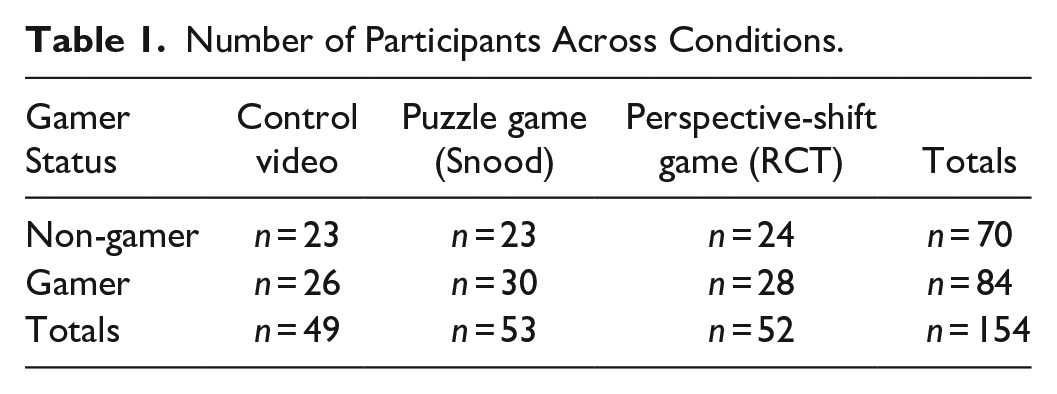
Data were analyzed using a 3 Game Conditions (Perspective-shift Game, Puzzle Game, Control Video) × 2 Gamer Status (gamer vs. non-gamer) between-subjects ANOVA. Participants were randomly assigned to one Game Condition. We measured gamer status (Table 1).
Number of Participants Across Conditions.
Game Conditions
RollerCoaster Tycoon: Deluxe (Perspective-Shift Game)
RollerCoaster Tycoon: Deluxe (RCT [Atari & Infrogames, 2003]) is a construction/park management simulation game (Figure 1), in which players build and supervise their own theme park, while attempting to manage various resources (e.g., money, rides, staff, or scenery). In the game, players deal with random events (e.g., storms, ride crashing, or winning an award) and guest-induced troubles (e.g., trash or ride boredom). Players needed to assess both long-and short-term problems, identify areas of improvement, and develop creative solutions. We feel that RCT consistently requires players to engage in these cognitive behaviors to accomplish their goals during game play: (a) Have ≥ 250 guests in the park, and (b) Achieve a park rating of ≥ 600.
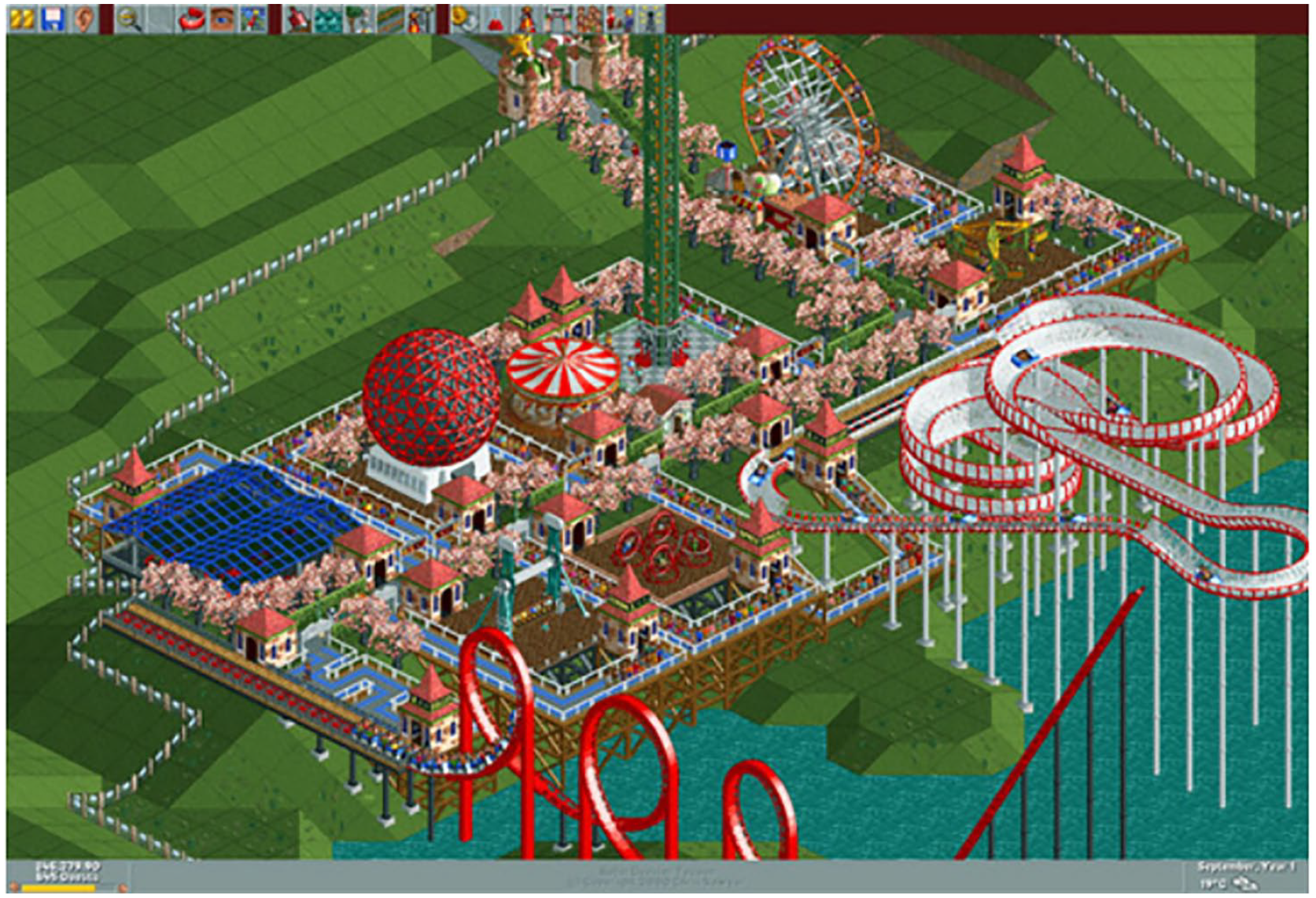
A screenshot from RollerCoaster Tycoon: Deluxe.
Snood Plus (Puzzle Game)
Snood Plus (Dobson, 1996) is a puzzle game in which players attempt to remove the multi-colored pieces (Snoods) from the screen by connecting three or more together (Figure 2). Players need to pay attention to which colored Snood is being shot next, and where to focus the most. To advance, players must clear the entire board.
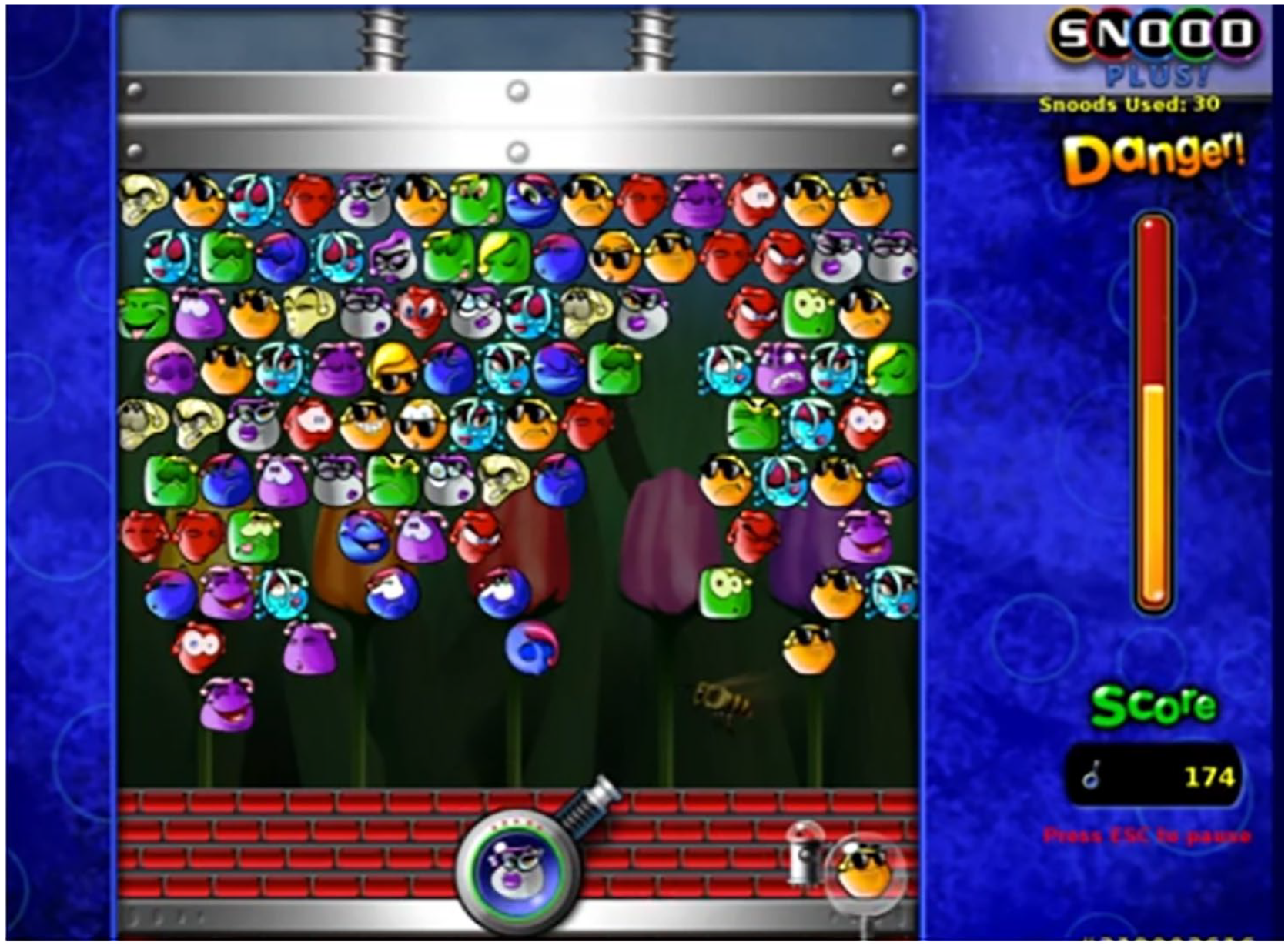
A screenshot from snood plus.
Control video
2081 (Tuttle, 2009) was a short science-fiction dystopian film based on Kurt Vonnegut’s short story “Harrison Bergeron.” The film was chosen due to its duration (approximately 30 min), and the unlikelihood participants had already seen it.
Alternate Use Task (AUT)
The AUT is a standard creativity measure (Guilford, 1967). It was designed to measure divergent thinking, a cognitive skill in which an individual creatively generates multiple solutions in a short amount of time (Wilson et al., 1954). These ideas were evaluated on four dimensions, further described in the next section: originality, elaboration, fluency, and flexibility. The AUT is our primary measure of creativity that serves as an indicator of the extent of transfer from in game to another context.
Procedure
Participants were randomly assigned to a Game Condition (Perspective-shift Game, Puzzle Game, Control Video) and engaged in their task for 30-min. Afterwards, they were asked to complete several problem solving and creativity tasks, including an Alternate Use Task. Participants were given two minutes to respond to: “List as many uses for a shoe as you can.” The AUT task is our transfer of performance measure.
Coding Scheme for Alternate Use Task
Two coders independently coded each AUT response on the four standard creativity dimensions: originality, elaboration, fluency, and flexibility. Coders practiced on a new subset of training data set until the coding reliability was high for each creativity sub scale (Cohen’s Kappa = 0.73). Each “response” was defined as a listed idea or item and was scored individually for each dimension.
Originality
Originality was measured as the total score of all individual response ratings. Each answer was coded on a 4-point scale of 0 (not original) to 3 (highly original), considering the standard purpose or “use” of a shoe. For example, “protection from rough ground” was coded as a 0, and “making a decoration” scored a 3. This dimension is most characteristic of “creativity,” as it standardly is defined by novelty or innovation of a thing (e.g., an idea or process).
Elaboration
Elaboration was measured as the total word count for each AUT answer, which depicted level of detail. For example, “step on glass without injuring foot” was coded as a 6 for that item.
Fluency
Fluency was measured as the raw number of individual ideas for each AUT item. For example, “fly swatter, walking, hammer” was coded as a 3.
Flexibility
Flexibility was measured as the number of conceptual categories (determined by coders) the set of AUT responses were matched to, demonstrating idea range. Some example categories included: protection, sports, or storage. For example, a participant providing 15 ideas that fell into only two categories would be scored as a 2.
Results
Our results did support H1 but did not support H2. Participants in the Perspective-shift Game (RCT) demonstrated higher scores in the AUT creativity transfer task than both those in the Puzzle Game (Snood) and Control Video conditions. Originality and elaboration sub scores were significantly higher, but fluency and flexibility showed no significant differences.
Supporting H1, there was a significant main effect of Game Condition on originality, F (2, 151) = 3.476, p = .033, Cohen’s d = 0.46) As seen in Table 2, planned comparisons revealed that the RCT group scored higher than the Snood t-test and the Control t-test. There was no difference between the Video and Snood. (Table 2). Planned comparisons indicated that people playing the Perspective-shift Game t (103) = 2.532, p = .033 (M = 8.19, SD = 6.83) scored higher on the originality sub score than Puzzle Game (M = 5.66, SD = 5.71, Cohen’s d = 0.4), and Control Video conditions t (99) = 2.886, p = .018, (M = 5.31, SD = 5.49). There was no interaction, F (2, 148) = 1.837, p = .163, or effect of Gamer Status on originality: F (1, 152) = 0.000, p = .996.
Means and Standard Deviations for Shoe Originality Scores Across Game Conditions and Gamer Status.

The main effect of Game Condition on elaboration was significant. The planned comparisons (Table 3) show the Perspective-shift Game t (99) = 8.144, p = .018, (M = 28.98, SD = 16.82) generating more words, than the Control Video condition (M = 20.84, SD = 10.80, Cohen’s d = 0.58), F (2, 151) = 4.165, p = .017. There was no interaction with, F (2, 148) = 1.181, p = .31, or main effect of Gamer Status on elaboration: F (1, 152) = 2.412, p = .122.
Means and Standard Deviations for Shoe Elaboration Scores Across Game Condition and Gamer Status.

There was no effect of Game Condition on fluency (Table 4): F (2, 151) = 1.851, p = 0.161. The effect of Gamer Status was not significant either: F (1, 152) = 1.322, p = 0.252. The interaction was also not significant: F (2, 148) = 0.016, p = 0.985.
Means and Standard Deviations for Shoe Fluency Across Game Condition and Gamer Status.

Similarly, there was no main effect of Game Condition on flexibility (Table 5), F (2, 151) = 1.302, p = 0.275. Gamer Status was not a significant effect either. F (1, 152) = 0.046, p = .830. The interaction was not significant: F (2, 148) = 0.084, p = .919.
Means and Standard Deviations for Shoe Flexibility Across Game Condition and Gamer Status.

Discussion
This experiment contributes to research examining what skills transfer from video games to outside of games, an area of research with few positive examples (Lie et al., 2022; Liu et al., 2022; Veinott et al., 2013). In this study we show that not all gameplay supports creativity, or multiple dimensions of it. Those in the Perspective-shift Game condition generated more unique and elaborative ideas, than those in the Puzzle Game or Control Video conditions after only 30-min of game play. Self-described gamers and non-gamers showed the same effect.
During RCT gameplay, participants had to maintain an accurate assessment of guest needs, while executing an effective plan to manage resources. If an unexpected event occurred (e.g., a ride crashes, which causes unhappy guests and a loss of money), participants needed to rapidly create solutions to solve their problem. Their perspective of the game state, as well as their plan would need to dynamically shift to apply new solutions. Snood players were significantly more limited in their creative boundaries of problem solving due to the game mechanics and scope.
Our findings suggest that game play requiring more complex problem-solving skills and strategies has a positive effect on individuals’ creativity. The ability to exhibit divergent thinking and use the output to identify new paths forward or optimize the current path is valuable across many fields. Individuals such as firefighters, intelligence analysts, or doctors face challenges in which they need to swiftly generate courses of action or explanations based on a time sensitive and volatile situation (Zsambok & Klein, 1997). These results suggest a potential promise of leveraging certain video games to help facilitate transfer of complex skill sets (e.g., problem solving) to other environments.
Limitations
Participants were asked to complete multiple problem solving and creativity measures after their 30-min activity. The tasks may have caused some performance fatigue, although the extent is unclear. Gamer Status was determined by asking participants, “Do you self-identify as a gamer?” Some participants did not but disclosed that they do play video games during the week. Per Boot et al. (2011), we did not advertise any gameplay in the recruitment advertisement, so no one knew games were involved. In the demographic questionnaire, we did not define the term, so participants may feel that “gamer” has specific connotations.
Future Research
The AUT is one task that captures divergent thinking, and subsequent work might utilize other previously used tasks to investigate other creativity dimensions or skills. Future work may also compare the impact of games to other “creative activities,” such as painting, creating music, or writing poetry.
Footnotes
Declaration of Conflicting Interests
The author(s) declared no potential conflicts of interest with respect to the research, authorship, and/or publication of this article.
Funding
The author(s) received no financial support for the research, authorship, and/or publication of this article.
