



Abstract
General age-related declines in sensory perception, cognition, and physical abilities may impact older adults’ abilities to maintain independence. The development of smart home technologies can compensate for these declines and assist older adults in their daily lives. This study aims to understand the key challenges and opportunities in designing effective smart home products for older adults. We conducted a virtual focus group with 10 participants (five healthy and five with health conditions) aged 65 to 80 to explore their perspectives on smart home technology. These discussions revealed five key themes: concerns, barriers, perceived benefits, adoption motivators, and future outlook. It was interesting to note the similarities and differences that both groups proposed regarding various aspects influenced by their different health situations. Findings will inform future smart home design decisions and the development of more inclusive smart home solutions that support and empower senior citizens to lead independent and fulfilling lives.
Introduction
Advancements in healthcare technologies have directly contributed to an increased lifespan for the elderly population. Globally, individuals aged 65 years and older have become the fastest-growing population. This age group is expected to be 16% of the global population by 2050 (World Population Prospects, 2022). With the growth in this demographic, we face challenges and opportunities. Many in this age group prefer to continue living in their own homes due to a strong attachment, mainly if they have resided there for an extended period (Lebrusán & Gómez, 2022). Staying at home also aids in maintaining family connections and helps them stay socially active. However, this desire is affected by various factors, such as loneliness and the perceived burden on others (Wiles et al., 2012).
This growing need emphasizes the importance of technology in reducing their dependency on others while living at home, referred to as “assistive technology.” These technologies help people with disabilities and older adults with tasks that may otherwise be difficult and are crucial to participation in activities necessary for daily living (Yusif et al., 2016). Such technologies facilitate interaction with remote devices in addition to existing healthcare systems. Often referred to as “smart home technology,” these innovations support aging by aiding tasks such as cleaning, cooking, and health monitoring (Ghorayeb et al., 2021). Adopting smart home technologies promotes a sense of independence (Zhang et al., 2023) and supports wellness by increasing social interaction, hence positively influencing social acceptance (Shah et al., 2022). Despite the various benefits, further study is necessary to fully understand the nuances of integrating these technologies into the lives of older adults. Insufficient research exists on the acceptance of technology by the older population, as well as on how their perceptions are impacted by prior use of smart home technologies (Turjamaa et al., 2019).
Various factors can affect the acceptance of technology by older adults. Klimova and Poulova (2018) found that higher education levels correlate with greater acceptance of new technology. Peek et al. (2014) identified concerns, needs, social influence, and perceived benefits as key factors influencing the acceptance of smart home technology, noted that perceptions can change between the pre- and post-implementation phases. Understanding these influences, including needs, education, and concerns, is crucial for ensuring that older adults can benefit from smart home technology. Most older adults are unaware of all the benefits and believe such technologies are more suited for those in poorer health conditions (Peek et al., 2014). Singh et al. (2018) noted that older adults are more likely to adopt smart home technology if it helps their doctors and caregivers. Limited studies have explored the impact of health conditions on the perception of smart technologies.
This study aims to understand older adults’ perceptions of smart home technology and identify differences and similarities between those with and without health conditions, offering insights for future technology developments to increase acceptance.
Method
Participants
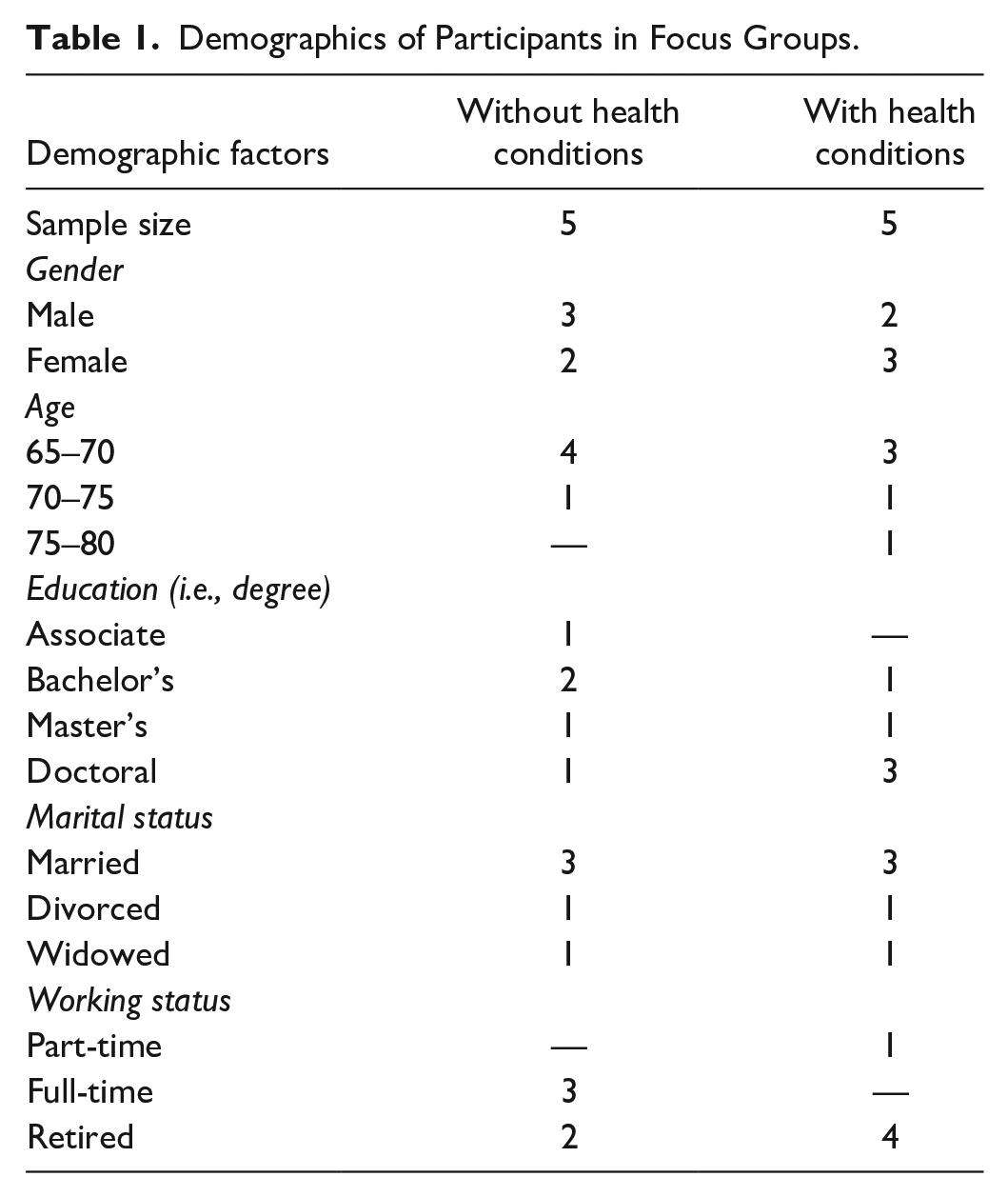
A total of 10 volunteers (five male and five female) participated in the study, all aged between 65 and 80. They were divided into two groups: with health conditions (five participants) and without health conditions (five participants), based on self-reported physical and mental health ratings and any ailments that might interfere with their daily activities. Participants with health conditions reported ailments such as chronic back pain, knee replacements, and osteoarthritis. All participants had at least a bachelor’s degree, with two having a master’s and four having doctoral degrees. See Table 1 for more details.
Demographics of Participants in Focus Groups.
Procedure
Focus groups were conducted virtually to ensure accessibility (Cook et al., 2022). Each session lasted an hour and a half, encompassing four phases: screening, introduction, discussion, and conclusion. Screening determined participants’ eligibility and collected health information, which was used to assign them to the with or without health condition groups. During the introduction, the study’s purpose, relevance, and informed consent were explained, and consent was obtained from each participant. The discussion phase, guided by a moderator using a script of pre-determined questions, explored participants’ perceptions and experiences with smart home technology. Sample questions included: “What does smart home mean to you?” and “Have you ever experienced gesture control, voice control, or variable devices at home? If so, how was your experience? If not, what are your thoughts on that?” These questions aimed to understand the impressions of technology in both groups. The focus groups concluded once all questions were addressed, and participants had no further comments. In the final phase, participants were encouraged to ask questions and were compensated with a $100 gift card for their time. The study was approved by San Jose State University’s Institutional Review Board (Protocol ID: 21278).
Data Analysis
The focus group sessions were recorded and transcribed using a text-to-speech AI tool, Tactiq.io. The transcripts were thoroughly reviewed for accuracy against the recordings, and errors were corrected. Text mining techniques were employed to systematically extract and analyze patterns within the data, leading to the identification of themes and sub-themes from the focus group responses. Subsequent discussions among the researchers resulted in the final set of themes and sub-themes.
Results
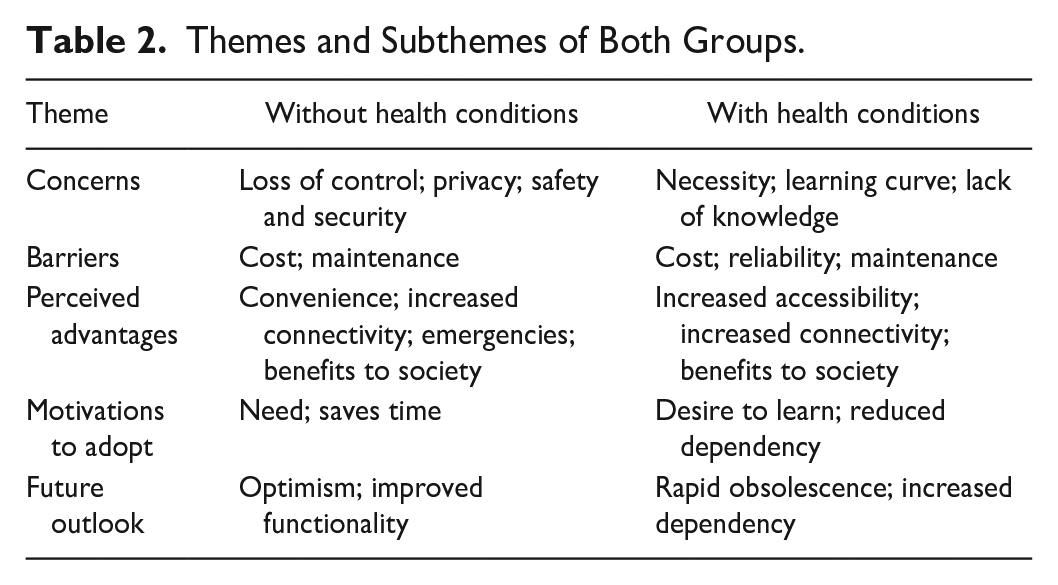
Five themes were identified from the data analysis of both group transcripts: concerns, barriers, perceived advantages, motivations to adopt, and future outlook.
Concerns refer to participants’ internal struggles or doubts when using smart home technologies, including thoughts that hinder their full utilization of these technologies. Barriers represent the external issues and problems associated with these technologies that make participants more hesitant to use them, as perceived by the participants. Perceived Advantages refer to the benefits associated with using such technologies as perceived by the participants. Motivations to adopt are the various factors that encourage participants to adopt such technologies into their daily lives. Future Outlook encompasses how the participants perceive the future of smart home technologies, and their aspirations and concerns.
Similarities and differences between the two groups in their perception of smart home technologies are presented in Table 2. Supporting evidence of these themes and subthemes is reported using direct participant quotes, where “P#” represents the participant’s number.
Themes and Subthemes of Both Groups.
Without Health Conditions Group
Concern
(a) Loss of control. Participants expressed concerns that prioritizing convenience in their daily lives using smart home technologies, such as smart lights and thermostats, could lead to a perceived loss of personal autonomy. P3: “If my home is smarter than me, then I’m concerned. I’d like to have a certain amount of control.”
(b) Privacy. Participants feared that their personal information and private conversations would be at risk with more use of technology. They feared being hacked due to stories and news reports they had heard. P1: “I prefer to keep my life private, and I don’t want the idea that others would be spying on me.” P3: “. . .because they think it’s listening to them all the time.”
(c) Safety and security. Increased use of smart devices makes them more interconnected and vulnerable to hacks (e.g., compromised smart home security systems and users being watched in their homes). P4: “But you are connected, you are at risk.”
Barriers
(a) Cost. The high costs of smart home technologies are a major barrier to adoption for participants. P1: “. . .only other thought that comes to mind is cost and availability. . .” P3: “. . .for the majority of the world that could potentially benefit from that. That’s, I think, a ways away.”
(b) Maintenance. Participants highlighted the need for ongoing maintenance support for these technologies. There is a potential requirement for regular software updates with technological improvements, which presents a potential burden in terms of additional costs and time commitment. P3: “. . .it would definitely require ongoing tech support.”
Perceived Advantages
(a) Convenience. Almost all participants acknowledged smart home technologies for their convenience in simplifying daily tasks, such as turning on the air conditioner before reaching home or turning off the lights. P4: “Smart home is when it takes that additional step and adds an intelligence that not only adds comfort and value, but it takes a lot of far away from you on concerns.”
(b) Increased connectivity. Despite limitations in replicating in-person interactions, participants acknowledged these technologies’ ability to facilitate connection with friends and family when in-person meetings are impossible. P4: “I think that part is extremely important. Connecting them to the world and integration.”
(c) Emergencies. Many participants appreciated the ability of smart technologies to facilitate immediate contact with family members in case of emergencies such as a bad fall. P3: “I might have had an alert on my phone, Julia had fallen and she can’t get up, and I could come home immediately, something like that.”
(d) Benefits to society. The potential of smart home technologies to enhance societal well-being, especially for the elderly and disabled people, was highlighted by the participants. P2: “. . .the fact that this could be a great benefit to people with disabilities, or older people that are sick. . .”
Motivations to Adopt
(a) Need. While the participants were generally reluctant to use these technologies, they were willing to utilize them when needed, primarily in physical or mental health conditions. P1: “there will come a time when I wish to have access to some of the things, we talked about. . .as I start losing my cognitive abilities. . .”
(b) Saves time. The participants cited the benefit of saving time while performing mundane daily tasks compared to manually doing them as a key advantage. P3: “. . .it’s actually really nice. Because you can set it up ahead of time.”
Future Outlook
(a) Optimism. The participants had a very positive outlook about the future of these technologies and anticipated that alternate options would be available with lower costs. P4: “And that’s going to change as time goes on. I would think it would get cheaper and cheaper, you know, as it becomes more popular. And people who are manufacturing this stuff, you know, get everything in place. . .”
(b) Improved functionality. The expectation of more options available led to the hope of more sophisticated technology with fewer errors and a decrease in the need for regular maintenance. P1: “if technology really actually works, then I would be open to it.”
With Health Conditions Group
Concern
(a) Necessity. Participants expressed reservations about utilizing smart home technologies in their daily lives. Whether these technologies were necessary or merely convenience-driven emerged as a significant concern. P2: “I don’t see the necessity. It seems like more of a luxury than something I really need.”
(b) Learning curve. Concern was expressed related to the learning curve associated with smart home technologies. The fear stemmed from the perceived complexity of these systems, raising doubts about the ease and viability of learning them. P5: “I worry about the learning curve. It feels overwhelming to understand and use all these new gadgets.”
(c) Lack of knowledge. The lack of familiarity and understanding of smart home technologies emerged as a recurring theme. Participants voiced unease about their limited knowledge, raising doubts about their ability to effectively integrate and troubleshoot these technologies. P6: “I feel lost with all this tech stuff. I don’t have enough knowledge to confidently use these gadgets.”
Barriers
(a) Cost. A significant obstacle, as perceived by the participants, pertains to the cost of these technologies. These are not accessible for a substantial portion of the population and require thoughtful planning and budgeting, making them unattainable for many. P1: “I don’t suspect that if your son runs into certain challenges with his technology, he can kinda fix it himself, so to speak.”
(b) Reliability. A critical barrier highlighted was the dependability of smart home devices. Participants expressed concerns about the reliability of these devices and were reluctant due to the fear of inconsistency in performing their intended functions, leading to a lack of trust and confidence. P3: “. . .maybe it’ll work better, cause I think that’s part of the problem is this stuff doesn’t work that well.”
(c) Maintenance. The participants expressed maintenance concerns similar to those in the without health conditions group. P1: “I kind of just hold back kind of like what P4 said a little bit, and then I might wait 5 years and so far, I haven’t needed anything.”
Perceived Advantages
(a) Increased accessibility. Participants found comfort due to enhanced accessibility in daily tasks provided by such technologies, especially for those with chronic pain or disabilities. P5: “For someone dealing with chronic pain, having the ability to control aspects of your home environment with minimal physical effort is a game-changer.”
(b) Increased connectivity. The participants expressed the same connectivity benefits as the other group. P3: “Being unwell often limits my ability to meet people face-to-face. Technology allows me to bridge that gap and stay connected.”
(c) Benefits to society. Participants in this group agreed that smart home technologies contribute to society’s overall well-being. P2: “Considering the difficulties people like me encounter, these technologies could be a lifeline. It’s not just about personal convenience; it’s about societal support for the vulnerable.”
Motivations to Adopt
(a) Desire to learn. Irrespective of the challenges, participants express interest in smart home technologies, driven by a desire to learn more about their applications, especially in health and safety. P1: “It’s a big Maybe. It’s just unknown until the circumstances mature, and then I’ll make a choice.”
(b) Reduced dependency. Participants believe these technologies allow enhanced autonomy and reduce reliance on external support. P2: “Right now, no. Five years from now, maybe. When it comes to the point where I’m immobile and I really, really need it, then I will move in that direction.”
Future Outlook
(a) Rapid obsolescence. Participants expressed concerns about rapid technological obsolescence, fearing that investments made today might quickly become outdated. P1: “I worry about what I invest in today becoming useless tomorrow.”
(b) Increased dependency. Participants fear relying too much on these technologies due to potential vulnerabilities from technical failures or breakdowns. P3: “I see the convenience, but I don’t want to end up more dependent and helpless if something goes wrong.”
Discussion
This paper aimed to study the perception of smart home technologies as a case of older adults with and without health conditions. Overall, both groups showcased various similarities in their perceptions; however, several differences were also found, providing insights into aspects that motivate and discourage participants from using smart home technology.
Similarities Between Groups With and Without Health Conditions
We found various similarities between the groups regarding smart home technology. In particular, both groups demonstrated very positive attitudes towards the ability of smart home technologies to assist and their general benefits for senior citizens. They recognized these technologies’ potential to improve the quality of life for individuals with health conditions and contribute to a more inclusive society. Most participants highlighted the potential of smart home technologies to enhance social connectedness by helping users stay in touch with loved ones, mainly when physical interactions are limited (e.g., during the pandemic). This common perception underscores the potential of smart home technology to go beyond individual convenience and illustrates the positive impact of smart homes in promoting healthy aging and independent living. This societal impact aligns with the findings of Peek et al. (2014), who highlighted the ability of smart home technology to support aging in place.
Despite these positive attitudes, both groups also expressed significant concerns regarding cost and maintenance. They were apprehensive about the initial financial investment required for smart home technologies and the ongoing costs associated with maintenance. This shared concern highlights the need for cost-effective smart home solutions and accessible maintenance support to increase adoption among older adults. Ghorayeb et al. (2021) also identified cost as a primary barrier to older adults’ adoption of smart home technology. Additionally, both groups expressed negative attitudes toward smart home technology due to a lack of trust and privacy concerns. This emphasizes the need for secure smart home technologies focusing on data privacy and protection. Pirzada et al. (2022) also identified privacy as a significant factor influencing the adoption of smart home technology.
Differences Between Groups With and Without Health Conditions
While there were many similarities between the perspectives of both groups, some differences were also observed.
Increase or Decrease Dependency
While all participants acknowledged the benefits of smart home technology, healthy participants feared becoming over-dependent and avoided it for convenience. In contrast, those with health conditions saw it as a way to reduce dependency on others. These differences highlight the need for better communication about the technology’s benefits and ease of use to address these concerns.
Desire to Learn
All participants acknowledged a learning curve for adopting smart home technology, but their motivations differed. For participants with health conditions, the immediate benefit of increased independence drives their willingness to overcome the learning curve. This suggests that training programs should focus on practical applications that directly impact their daily lives. On the other hand, healthy participants are more future-oriented, indicating that they may benefit from scenarios and simulations that prepare them for eventual declines in physical or cognitive abilities. Understanding these motivational differences is crucial for designing effective educational interventions and support systems.
Safety and Security
Both groups had concerns about safety and trust in the technology. Participants with health conditions were more inclined to use features like voice control despite higher connectivity risks, citing past benefits in daily tasks. Participants without health conditions were more worried about the risks of interconnected devices. The willingness of participants with health conditions to accept higher connectivity risks for practical benefits highlights a critical trade-off between convenience and security. This suggests a need for robust security features that do not compromise usability, especially for those who rely on these technologies for daily functioning. In contrast, the heightened security concerns among healthy participants indicate a potential barrier to adoption that could be addressed through transparent communication about safety protocols and continuous improvements in technology security.
Limitations
There are several limitations to this study. The sample was homogeneous, with all participants having higher education and residing in the Bay Area, California, which limits the generalizability of the findings. Future research should include a more diverse sample in terms of education and location to offer a broader perspective. Additionally, the study relied on self-reported data regarding participants’ health conditions without verification, potentially introducing bias. Future research should include objective data analysis or collaborate with medical professionals for detailed health assessments to address this limitation.
Conclusion
This study highlights older adults’ positive and negative attitudes toward smart home technology. Positive perceptions included time-saving, assistive functions, convenience, and societal benefits, while negative views focused on privacy, security, costs, and reliability. We specifically analyzed differences in perceptions between older adults with and without health conditions. Older adults with health conditions valued technology for its convenience and ability to reduce dependency on others, whereas those without health conditions were more concerned about becoming over-dependent on technology. Both groups shared concerns about privacy, security, and obsolescence. The findings of this study will help inform the design of accessible, low-maintenance, and user-friendly smart home products for older adults.
Footnotes
Declaration of Conflicting Interests
The author(s) declared no potential conflicts of interest with respect to the research, authorship, and/or publication of this article.
Funding
The author(s) disclosed receipt of the following financial support for the research, authorship, and/or publication of this article: This study was supported by the National Science Foundation (PI: Gaojian Huang; Award #: 2153504).
