



Abstract
The objective of this study is to investigate the long-term effects of the COVID-19 pandemic on the perceived stress and mental health of parents. Specifically, this study aims to provide preliminary evidence on specific changes in children’s behaviors caused by the lockdown and the impact of these behaviors on the mental well-being of the parents. A survey was designed to achieve this, and N = 713 respondents completed it. The survey consisted of demographic questions, validated questionnaires—Adverse Childhood Experiences (ACES) and Positive Childhood Experiences (PCES), Perceived Stress Scale (PSS), Ages and Stages Questionnaires (ASQ), and a few other questions on parental stress. The quantitative and qualitative findings revealed several variables that significantly influenced the perceived stress and affected the mental health of parents with children born during the pandemic. The findings underscore the vital need for implementing coping strategies to mitigate the effects of these adverse stressors.
Introduction
The COVID-19 pandemic brought about unique challenges for parents, significantly reshaping many aspects of daily life. The task of parenting in these difficult times, with energetic children isolated inside homes for months without any options to socialize with other children, was exhausting and stressful. The shutdown of schools, work-from-home mandates, and isolation from society due to lockdowns caused a seismic shift in the lifestyles of parents and children. Parents juggled multiple roles within the family, such as employees, teachers, and daycare providers, to navigate these unprecedented challenges (Lucassen et al., 2021). Several studies showed that these challenges increased stressors, exhaustion, and mental health issues among parents (Marchetti et al., 2020; Wu et al., 2020). For instance, parents with a younger child(ren) or parents with multiple children experienced heightened parenting-related exhaustion (Marchetti et al., 2020). Similarly, parents of special needs children experienced significantly higher exhaustion during the pandemic (Marchetti et al., 2020).
The changes brought about by the pandemic can be challenging in many ways. Some families encountered emotional distress due to economic hardships during the pandemic, especially those with low socioeconomic status (Conger & Donnellan, 2007). The parents were concerned by the financial burden and emotional strain due to the limited availability of basic needs like food, healthcare, education, and changes in children’s behavior (Carroll et al., 2020). In addition to the stress on parents, isolation from society due to long-term home quarantine negatively impacted children’s mental and physical health by altering their behavior (Ellis et al., 2020). Changes in sleeping patterns, lack of personal space at home, and decreased physical movement also caused changes in behavioral patterns, leading to aggressive behavior and distancing oneself from the family. These changes in children’s behavior significantly impact the perceived stress of parents, highlighting the interconnectedness of the issues.
Past studies have examined food insecurity during the COVID-19 pandemic and its association with stress (Jansen et al., 2021; Ling et al., 2022; Ward & Lee, 2022). It is evident that food insecurity is a common factor that causes stress among parents (Crandall et al., 2022). Disruptions to the supply chain causing food scarcity led to major food insecurities within families during the pandemic, resulting in parents struggling to secure at least their basic meals during the day for their children. Moreover, children showing problematic feeding behaviors and irregular feeding practices are associated with parenting stress (González et al., 2022). Similar to the stress caused by food limitations, challenges in accessing primary healthcare services were a stressor for parents during the pandemic (Hasan & Muda, 2021). The increased demand for healthcare systems due to the pandemic has made it difficult for families to receive the least basic medical care. Furthermore, families were reluctant to visit hospitals due to fear of the children or themselves being exposed to the virus.
Though several studies explored the challenges faced by families and parents during the pandemic, there needs to be more evidence of the long-term implications of these challenges (i.e., post-pandemic effects). Hence, the overarching objective of this study is to investigate the current parenting challenges associated with caring for children born during the COVID-19 pandemic. Additionally, this study aims to provide preliminary evidence on specific changes in children’s behaviors caused by the lockdown and the impact of these behaviors on the mental well-being of the parents.
Methodology
A survey was designed to investigate the relationship between the limitations in accessing necessities during the pandemic and parents’ perceived stress and mental health. The study specifically targeted parents and caregivers of children born between June 2019 and May 2023. The survey included demographic questions and other validated questionnaires, such as Adverse Childhood Experiences (ACES) and Positive Childhood Experiences (PCES), Perceived Stress Scale (PSS), and Ages and Stages Questionnaires (ASQ). ACES and PCES measure the adverse and positive childhood experiences of parents, respectively; PSS measures the perceived stress level of the parents, and ASQ focuses on parents’ perception of age-appropriate development in their children. In addition, an open-ended question, “Is there anything that you found difficult in caring for the child/children (born between June 1, 2019, and May 31, 2023) that was not covered in the above questions?” was included in the survey.
To analyze the quantitative data, descriptive and inferential statistical methods were employed to the survey data. The statistical analysis only includes the variables significantly associated with perceived stress in parents. Linear regression analysis was performed to explore the impact of various factors on perceived stress scores and parents’ mental health. Participants’ responses to the open-ended responses were qualitatively coded using thematic analysis. Two raters coded the entirety of the responses using open and axial coding, and any disagreements during the coding were discussed until complete consensus was achieved.
Results
Demographic Findings
A total of 713 participants completed the entire survey. The respondents had an average age of 31.21 (±5.59) years. Most respondents were White (n = 452), had a college degree (bachelor-level; n = 279), were employed full-time (n = 483), and earned $40,001 to $60,000 annually (n = 291). Most families had one child born during the pandemic (n = 493), and n = 652 respondents were biological parents. A few of the families also had at least one child born before the pandemic (n = 489). Furthermore, most of the respondents reported having some form of insurance (n = 601). When asked how often they struggled to get food or other basic resources for their children, a majority of respondents (n = 281) reported to have struggled “sometimes” (see Figure 1a).
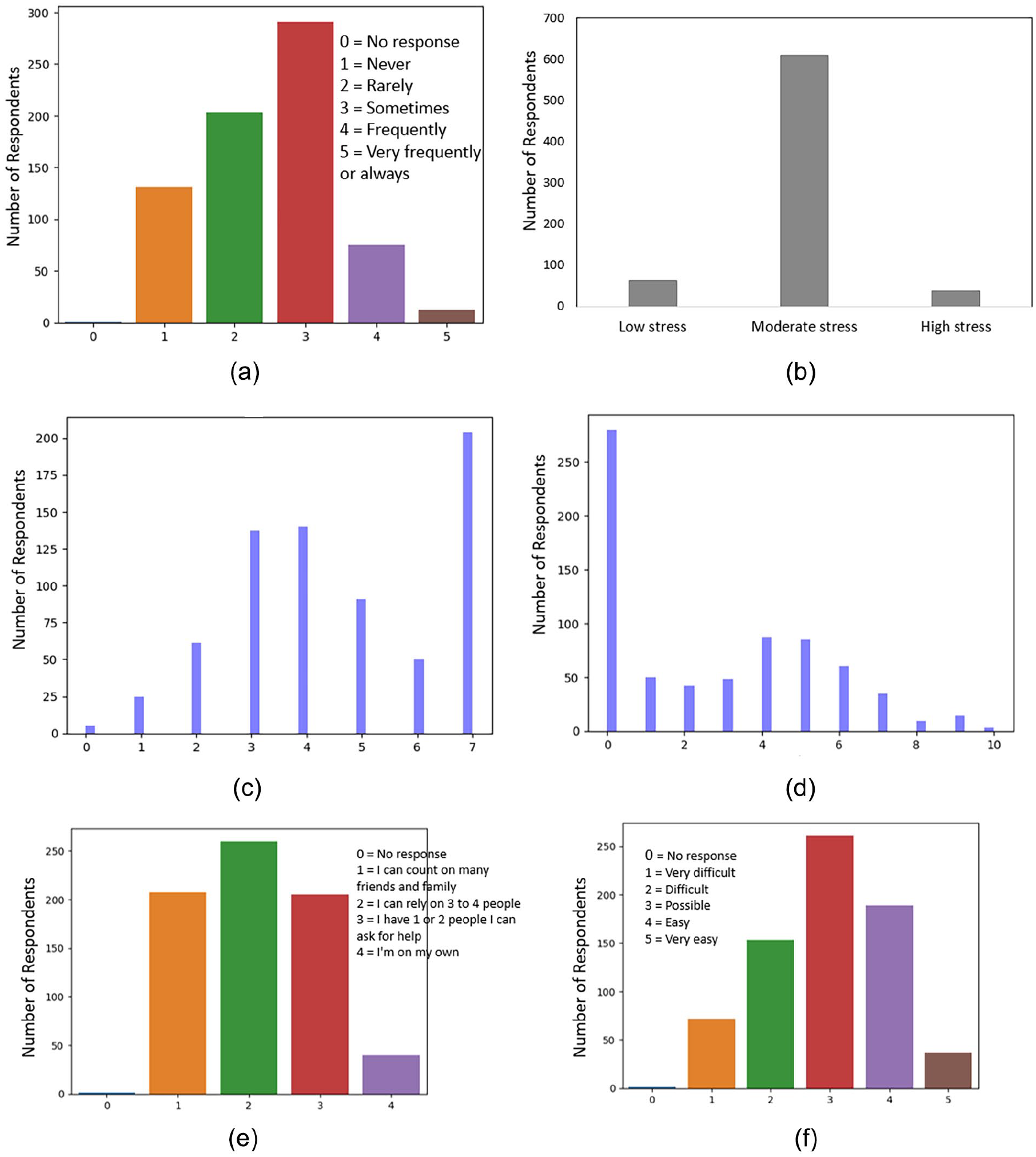
Descriptive findings from the survey: (a) since 2020, how often have you struggled to get food or other basics for your child(ren)? (b) perceived stress, (c) PCES (scored 0–7), (d) ACES (scored 0–10), (e) how many people can you call when you really need help? and (f) how easy is it to get practical help from neighbors if you should need it?
Validated and Other Questionnaire Findings
PSS findings (Figure 1b) revealed that 600 out of 713 respondents experienced moderate stress. When asked how many days during the past 30 days their mental health was not good, the respondents revealed an average of 7.85 ± 6.53 days. ACES and PCES findings showed that most of the respondents experienced more positive and no adverse childhood experiences, as shown in Figure 1c and d, respectively. Most respondents mentioned that they can rely on “3 to 4 people when they need help” and that it was “possible” to obtain practical help from neighbors if need be (see Figure 1e and f, respectively).
In the ASQ questionnaire, participants were asked—“Thinking about the child born closest to June 1, 2019, how often did you worry that they were doing the following things at the typical or right age as other children?” (see Figure 2, a–h) and were given eight items. Findings showed that respondents, on average, were “sometimes” worried about their children across all eight items, indicating occasional concerns about anomalies in certain age-specific activities. As a result, parents opted to seek special therapies and/or programs for their children.
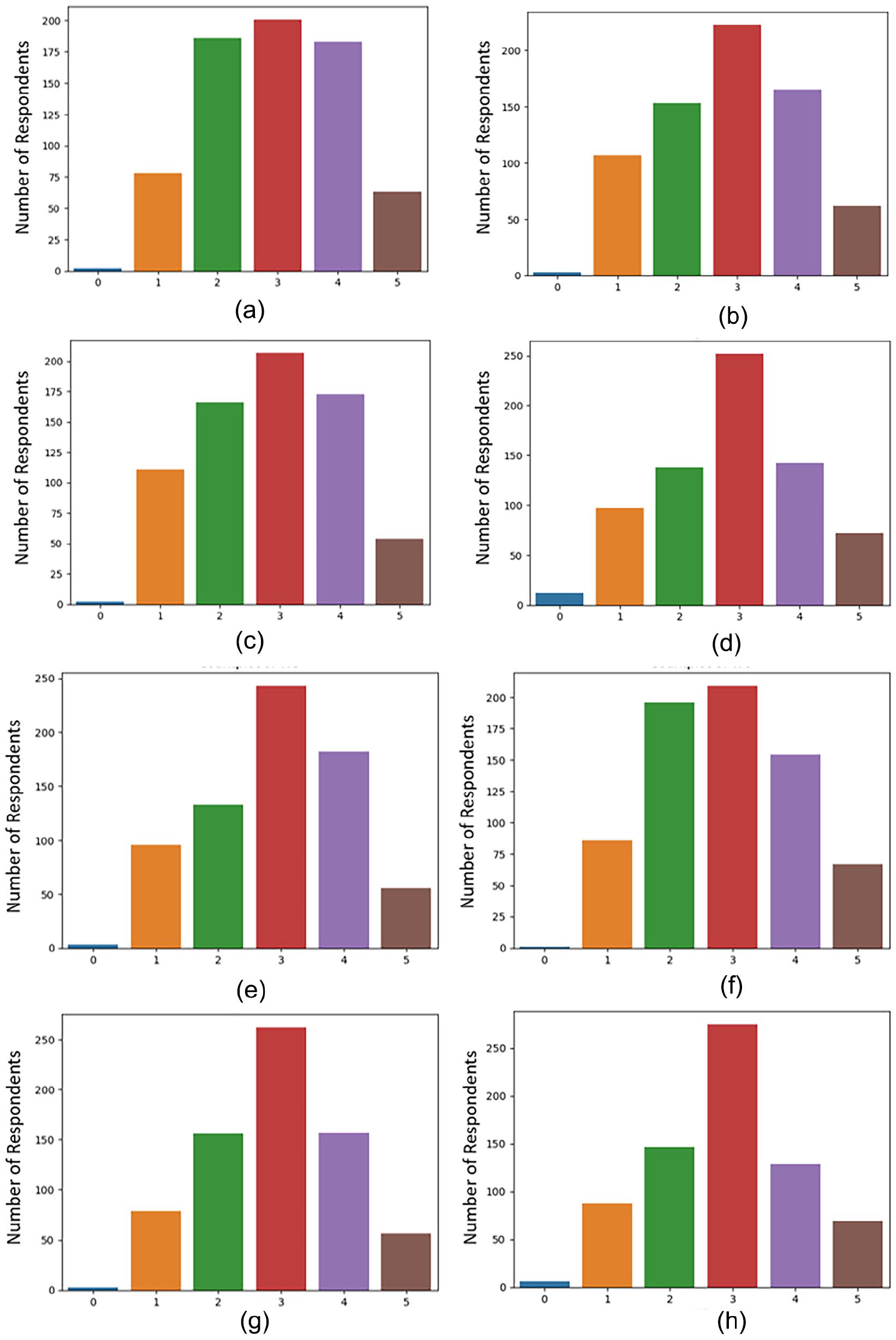
ASG questionnaire findings (0 = No response, 1 = Never, 2 = Rarely, 3 = Sometimes, 4 = Frequently, and 5 = Constantly): (a) sleeping through the night, (b) sitting up, (c) crawling, (d) walking, (e) learning to talk, (f) following simple directions, (g) calming/soothing themselves, and (h) playing with other children.
Linear Regression
Two regression analyses were performed. The first analysis focused on studying what pandemic-related factors affected perceived parental stress, and the second focused on the pandemic-related factors that affected parents’ mental health. The first analysis revealed that struggle to get food and basics for their child (t = 5.46, p < .001), poor mental health (t = 4.65, p < .001), the child not following simple directions significantly (t = 3.43, p = .001), and presence of people that can help (t = 2.70, p < .001) affected the perceived stress scores of parents.
Second analysis showed that inability of child play with other children (t = 2.79, p < .01), the inability of the child to calm/soothe themselves (t = 2.61, p < .01), parents’ perceived stress (t = 5.57, p < .001), adverse childhood experiences (t = 6.27, p < .01), presence of insurance (t = 5.69, p < .05), number of children (t = 2.90, p < .01), and employment (t = 2.11, p < .05) significantly affected the mental health of parents.
Qualitative Findings
Thematic coding of the participants’ open-ended responses, when asked about other difficulties in caring for the child/children born during the pandemic, revealed five themes. The themes are (1) lack of time for self-care, (2) abnormal behavior, (3) parental fear and anxiety, (4) lack of recreational and social activities, and (5) cost of childcare and other financial burdens.
Lack of parental self-care: Several participants mentioned that the pandemic affected their time and resources for self-care, since they had to take care of their children and other family members for several months without a break. One respondent mentioned that “The biggest difficulty is that I have no time to myself and no way to realize my own interests, which makes me very sad,” emphasizing lack of time to care for themselves.
Abnormal behavior: Participants mentioned that the pandemic instilled some abnormal behavior in their children. Parents described such abnormal behaviors as “non-cooperative,” “authoritative,” “provocative,” “bad tempered,” and “retaliatory.”
Parental fear and anxiety: Several participants expressed fear and anxiety with parenting during the pandemic. The primary cause for such fear and anxiety stemmed from worrying that their children or other family members might get sick from COVID-19 and with home schooling. A few participants mentioned that they fear letting their child(ren) socialize, as quoted by a participant as “my kids are afraid to socialize. I have difficulty feeling confident asking for others to watch my kids and being ok with letting kids go to social gatherings.”
Lack of recreational and social activities: A few participants also mentioned that the lack of recreational and social activities during the pandemic affected them while caring for children. Specifically, participants mentioned that “keeping my [their] child engaged and entertained at home for extended periods of time” as a difficulty. Another participant quoted that, “balancing the child’s need for physical activity with limited access to parks or recreational spaces,” as a pandemic-related difficulty.
Cost of childcare and other financial burdens: Several participants discussed the cost of childcare and affordability of groceries as a difficulty in caring for their children during the pandemic. For example, a participant commented that, “I do not have enough resources to have been able to afford college and now have no money, while job searching. The economy makes getting basic necessities difficult, and I have nothing for myself after buying everything for my child.”
Discussion
This study significantly contributes to the field by delving into the unique challenges faced by parents caring for children born during the COVID-19 pandemic. Our focus on the stress and mental health of the parents, and the impact of the pandemic on both the mental well-being of parents and the behavioral development of children, provides fresh insights. The findings of this study have several important implications for parenting practices and childcare during a time of distress. Children’s behavior during the pandemic changed for some families under the study, which dictated the stress and mental health of the parents. Our findings are consistent with those derived by Dillmann et al. (2022), highlighting the association between child development and parental well-being during the pandemic.
Similarly, Dawes et al. (2021) addressed the issues faced by parents in getting regular support networks during the pandemic. Our research extends the analysis by including the effect of specific child behaviors. Survey responses from the parents indicate that parents were worried about child behaviors like sleeping habits, learning to talk, walking, socializing, or playing with other children, inability to follow directions, and calming or soothing themselves during the period of the pandemic. Moreover, the regression analysis further established that the child’s inability to follow simple directions affected the perceived stress scores of parents. In contrast, the child’s inability to play with other children and to calm/soothe themselves caused a disturbance in the mental health of the parents. Thus, our approach adds to the existing research and highlights specific areas where parental support programs can be developed to mitigate these stressors.
Lastly, our findings also focus on the mental health of the parents, highlighting the long-term implications of the pandemic on parental mental health, suggesting that the effects may persist beyond the pandemic. Similar to our results, Whaley and Pfefferbaum (2023) had previously identified significant stressors such as disruptions in healthcare, education, and social support systems, which disrupt the mental health of the parents during the pandemic. Our survey results also show how long the parents suffered from mental issues during the pandemic. The correlation results further show the influence of specific protective factors, such as insurance and employment stability, on the parent’s mental health, suggesting that these socioeconomic factors serve as crucial factors against the stressful effects of the pandemic on parenting. Furthermore, the effect of the adverse childhood experiences of the parents also had an association with mental health during parenthood. This predictor particularly is not due to the pandemic and might lead to a broader future research scope. However, the majority of the parents had positive childhood experiences, indicating that the changes in parenting practices most possibly ignited the perceived stress they experienced due to the COVID-19 pandemic. Overall, further research must address these stressors and their effects on parenting during the post-pandemic era to investigate if these challenges still prevail. This can aid in better understanding if the stress factors were developed solely due to the pandemic or if there are more latent factors.
The recommendations of this research can guide future researchers in exploring the factors that disrupt parents’ mental condition. Future research recommendations include investigating the long-term effects of these stressors after the pandemic and developing strategies to mitigate their impact on parents’ mental health. Furthermore, expanding the scope of research to diverse populations and settings will enhance our understanding of how different demographic, social, and cultural factors also affect perceived parental stress and mental health, offering hope for a more comprehensive understanding of these issues.
Despite the comprehensive nature of our research on unveiling the effects of the pandemic on parenting practices, we acknowledge that certain limitations do prevail in our research. Since the survey is based on the participants’ self-reported responses, there may be some individual and demographic biases that may include some uniquely different influences on the overall results. Moreover, certain confounders can affect the results of the regression analysis. For example, if the parents had previous mental health issues, their stress or mental health condition could be dictated by those conditions rather than the immediate effect of the pandemic.
Conclusion
The results highlight the importance of finding the association of these factors on the stress and mental health of the parents to find ways to relieve the stress. Moreover, the findings indicate that coping strategies to mitigate stress should focus on economic and societal support and ensuring access to healthcare and mental health services, which are vital for childcare during emergencies. In conclusion, the findings of this study indicated that the variables considered impacted the perceived stress and mental health of parents based on the correlation analysis. The findings would help address the immediate and long-term effects of pandemic-related stressors on parenting practices.
Footnotes
Declaration of Conflicting Interests
The author(s) declared no potential conflicts of interest with respect to the research, authorship, and/or publication of this article.
Funding
The author(s) disclosed receipt of the following financial support for the research, authorship, and/or publication of this article: We would like to acknowledge Pott’s Family Foundation for funding this study.
