



Abstract
The future Trajectory-Based Operation (TBO) management method aims to increase the efficiency and predictability of flight operations. The use of time constraints, such as Required Time of Arrival (RTA) at specific points throughout the flight, enables flight trajectories to be better controlled. In this study, we conducted seven interviews with air traffic controllers, pilots, and civil aviation engineers to analyze the RTA management in the current airspace and to identify differences expected with its use in TBO. We found that in the current airspace, RTAs are used tactically to resolve short-term conflicts, which limits their benefits compared to a more strategic approach. From the pilots’ perspective, accepting RTAs requires an in-depth analysis of its impacts on the mission. Temporal information displayed in the cockpit is limited to support pilots’ decision-making. These results highlight the importance of studying human factors for RTA management in current airspace to address the challenges and limitations expected within TBO.
Introduction
The continuous increase in air traffic presents many challenges, particularly in terms of air pollution, airspace congestion, and safety (IATA, 2023). In the face of these issues, the concept of Trajectory Based Operations (TBO) emerges as a promising solution. TBO is an essential component of the Federal Aviation Administration (FAA) NextGen programs and EUROCONTROL SESAR (Single European Sky ATM Research), with deployment planned for 2040. It marks a major transition in air traffic management, shifting from traditional control, based on clearances, to management based on flight trajectories (FAA, 2011).
One of TBO’s main goal is to improve strategic trajectory planning (Johnson & Barmore, 2016). By sharing precise information about flight trajectories (spatial and temporal dimensions) among different air traffic stakeholders, it results in better predictability of trajectories earlier in time. This optimizes the use of airspace by minimizing unplanned, short-term tactical interventions for conflict resolution for example, vectoring, holding patterns.
A key enabler to strategic trajectory planning is the 4-Dimensional Trajectory (4DT), which offers the exact position of aircraft from departure to arrival. It adds a new time dimension (described next) to the 3D spatial coordinates of waypoints along the flight plan. 4DT is negotiated and shared between air and ground stakeholders before takeoff, then is continuously updated in real-time through ongoing trajectory information exchange.
Air-to-ground 4DT trajectory sharing is expected to improve airspace conflict anticipation and the handling of unforeseen events. Moreover, precise and optimized trajectory planning leads to more efficient use of airspace, thereby reducing flight times and fuel consumption benefiting to both airlines and the environment (ICAO, 2016; Rodriguez-Sanz et al., 2019).
Time Dimension
The temporal dimension in 4DT trajectories is represented by estimates of arrival times at each waypoint along the trajectory. Each waypoint is associated with a time and flight level in addition to the lateral position, thus creating a precise 4DT estimate. During TBO flight phases, aircraft may need to comply with strict time constraints such as Controlled Time of Arrival (CTA) for better traffic management. The CTA concept has gained importance over the years as Air traffic controllers (ATC) already specify CTAs at specific waypoints along the trajectory, mainly to merge and sequence traffic flows in congested airspace (Enea & Porretta, 2012). These constraints must be met with the required precision, generally represented as a time window [(t)min, (t)max], using feedback control. This control can be ensured by aircraft systems for example, avionics, or ground instructions for example, speed adjustments (ICAO, 2019).
The management of CTA in modern aircraft is currently done through the Required Time of Arrival (RTA) function integrated into the Flight Management System (FMS). This feature allows entering a CTA at a specified waypoint and continuously calculating the speed needed to reach the RTA within the defined window, while constantly adjusting thrust and drag (Park et al., 2016). Studies and flight simulations have shown that aircraft equipped with the RTA function can achieve arrival time errors of less than 10 s under optimal conditions (Balakrishna et al., 2011; De Smedt & Putz, 2009).
Although these trials validated the improvements made to the FMS and demonstrated its effectiveness in meeting time constraints, they also highlighted human factors issues related to CTA. Cardosi and Lennertz (2020) mentioned that the FMS RTA function has been identified as a useful, yet underutilized, tool for managing arrival traffic at airports, thus avoiding holding patterns and reducing fuel consumption. Pilots also reported being surprised by the way the speed and throttles would “overreact” to the addition of an RTA. The authors also found several limitations to the large-scale deployment of RTA such as air-ground datalink communication delay and uncertainty on the aircraft speed when flying an RTA. Pilots also complained on the lack of status information displayed on the avionic page to know to what extend the aircraft respects the allowed time window around the RTA (Guerreiro et al., 2017; Lancaster et al., 2012). Graphic representation of the time window improved pilots’ situational awareness (Schmidt, 2012) but has yet to make it way to the aircraft. Finally, initial implementation of RTA added difficulties for ATC to monitor its compliance as the data was available only on the flight deck (Cardosi & Lennertz, 2020). This problem is likely to disappear thanks to the introduction of Automatic Dependent Surveillance-Contract (ADS-C), which allows aircraft to automatically transmit their active flight plan to ATC.
Although previous work evaluated the use of RTA in simulated environment or display design, there is still little research on the actual use of RTA in flight and its impact on the pilot’s task. Consequently, this study aims (a) to analyze the current RTA management to identify pilots’ objectives and actions, and (b) to identify differences expected with the use of RTA in TBO.
Method
This study adopted a qualitative approach based on semi-structured interviews.
Participants
We interviewed two ATC, 3 pilots and two civil aviation engineers to understand time management in current traffic. ATCs had over 10 years of experience in en-route and oceanic control or approach control. One of these ATC was also a twin-engine pilot with 900 flying hours. Pilots included a private jet charter first officer pilot with 3 years’ experience, and two commercial pilots with 15,500 flight hours and 600 flight hours, respectively. Both pilots operate long-haul flights across European and American airspace. Aviation engineers were a Human Factors and Cockpit Design specialist. All participants signed an informed consent form before the interview (CER-2324-21-D).
Procedure
The interviews were conducted online, enabling easy and flexible participation by the participants. Interviews varied in length from 40 to 60 min, providing sufficient space to explore participants’ experiences and perspectives in depth. Participants were invited to share their understanding and experiences of managing RTAs in today’s air traffic environment. Each interview aimed to understand existing practices in RTA management from the point of view of pilots and ATC, and the challenges encountered. In this interview, it was essential to include ATCs, as they are the ones who generate, transmit and monitor RTA operations. The engineers helped us to identify current RTA issues and to better understand the requirements for the transition to TBO.
The following topics were covered during each interview: (a) the type of situations in which RTAs are used, (b) methods for calculating and selecting RTAs, (c) management of RTAs by ATC and pilots and (d) difficulties encountered in using or monitoring RTAs.
Results
We analyzed results using a qualitative approach, analyzing the discourse, similarities and differences between the experiences of pilots and ATCs. This approach yielded useful insights into the management of RTAs in today’s traffic (see Figure 1)
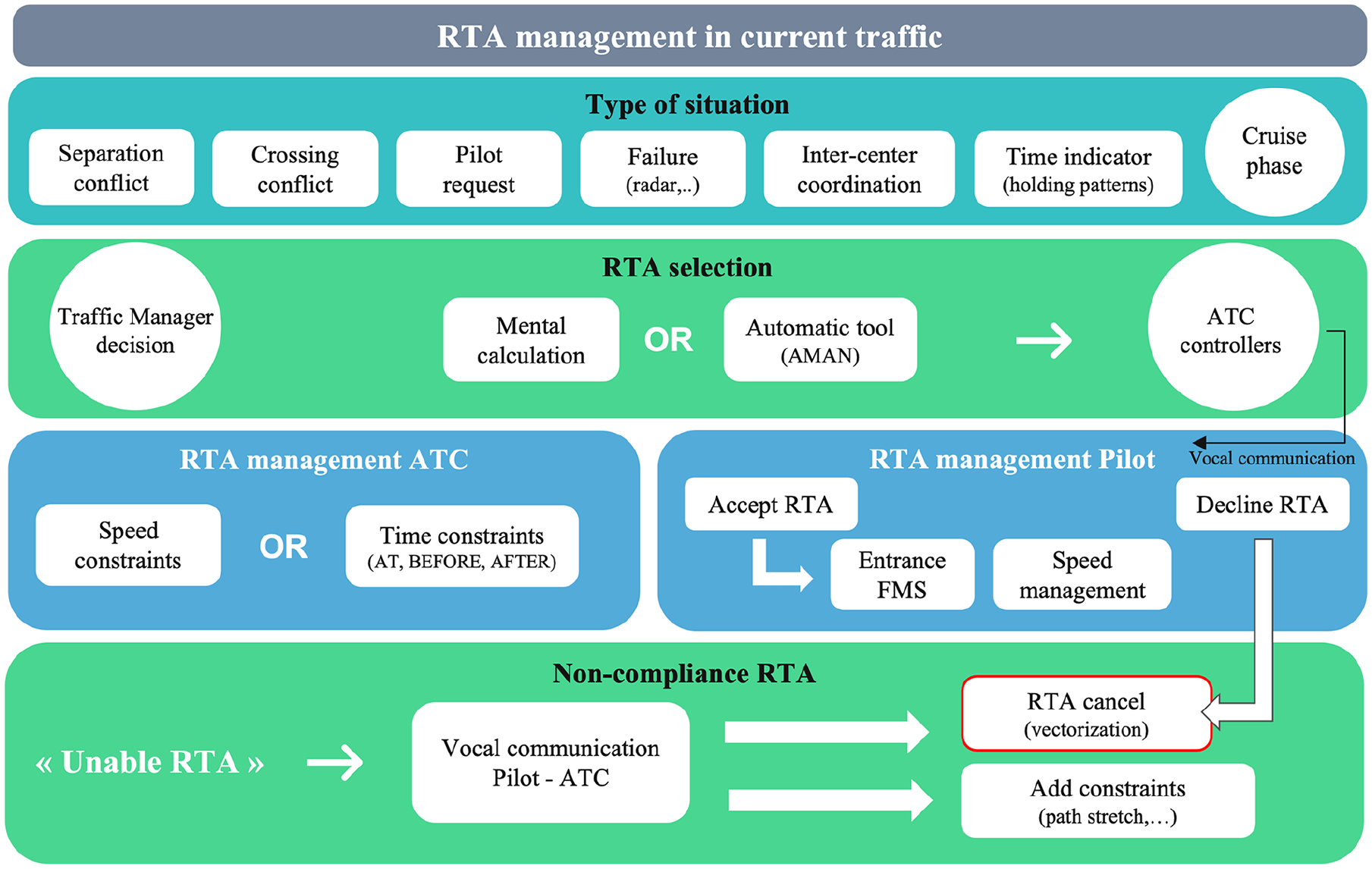
Schematic representation of RTA management in the current airspace.
RTA Management in Current Traffic
Situations in Which RTAs are Used
Participants reported various situations for using RTAs in current air traffic. RTAs can be used to sequence aircraft entries into control sectors, particularly in oceanic airspace, and to avoid holding patterns in flight. They can also serve as a short-term tactical measure to resolve separation or crossing conflicts between aircraft. For example, an RTA can be assigned as a time indicator to exit a holding pattern, to enable direct-to operations, or as a respond to an altitude change requested by the pilot: “Over the Atlantic, I requested to climb to 39,000 feet. Since we’re following each other and out of radar coverage, ATC told me I could go, but I had 8 min to finish climbing, otherwise I would be in conflict.” RTAs are supposed to reduce ATCs’ workload through airborne management. However, for sequencing aircraft during descent, controllers reported using RTA in situations of low to moderate traffic, as it would increase their workload having to manage a mix of RTA and non-RTA aircraft. Moreover, RTAs are very rarely used during the descent phase, as the speed, often associated with lateral and vertical constraints, becomes difficult to maintain if RTAs are not anticipated in advance in the descent profile or when this information is transmitted too late to pilots. Controllers reported that they would rather use vectoring, a tactical maneuver, to manage descent as it offers a finer-grained control on the aircraft speed and position. ATC: “During the approach phase, instead of instructing the pilot to do everything possible to meet the RTA, the ATC directs the aircraft to the left or right with a specific heading or asks the pilot to reduce speed because the aircraft is not stable.”
Methods for Calculating and Selecting RTAs
It is the Traffic Manager (TM) or Coordinator who decides to impose RTAs according to traffic forecasts and constraints. For equipped control centers, the AMAN (Arrival Manager) tool is used to define RTAs, although TMs can also calculate them mentally according to the aircraft’s performance and surrounding traffic. Once the RTA has been defined, it is transmitted to the ATC in charge of the aircraft concerned, who then communicates it to pilots. All the participants specified that the RTAs were communicated by voice and mainly to reduce the aircraft’s speed. Pilot 1: “Times I’ve had RTAs it’s really been to brake. In cruise phase, we’re often already flying at or near maximum speed, so an acceleration RTA means you’re going to push the machine beyond its limits, it won’t work.”
Managing RTAs by ATCs and Pilots
Once calculated, the RTA is transmitted to the pilot as a strict time constraint or sometimes as a speed constraint. RTAs can be communicated in different temporal forms, such as: “cross MALOT AT/BEFORE/AFTER 9:06.” ATCs specify that RTA clearances can be refused by pilots if they believe they do not have enough fuel or if the integrity of their flight is at risk. Otherwise, pilots must accept and comply with the clearance.
Pilots reported having several verification points to make before accepting an RTA (see Figure 2). Most importantly, pilots evaluate the impacts of RTA on the cost index (time vs. fuel ratio) and the time of arrival at destination. Some pilots refuse an RTA because they consider the cost-benefit ratio (fuel vs time) to be unacceptable. Additionally, duty time can also influence some pilots’ decisions to accept RTAs due to the consequences it entails. Pilot: “Sometimes, we are already close to our duty time limit, and the RTA constraint adds 15 to 20 min of delay. This can sometimes make us exceed our maximum duty time. This is one of the reasons why I may refuse to slow down, as I cannot afford it.”
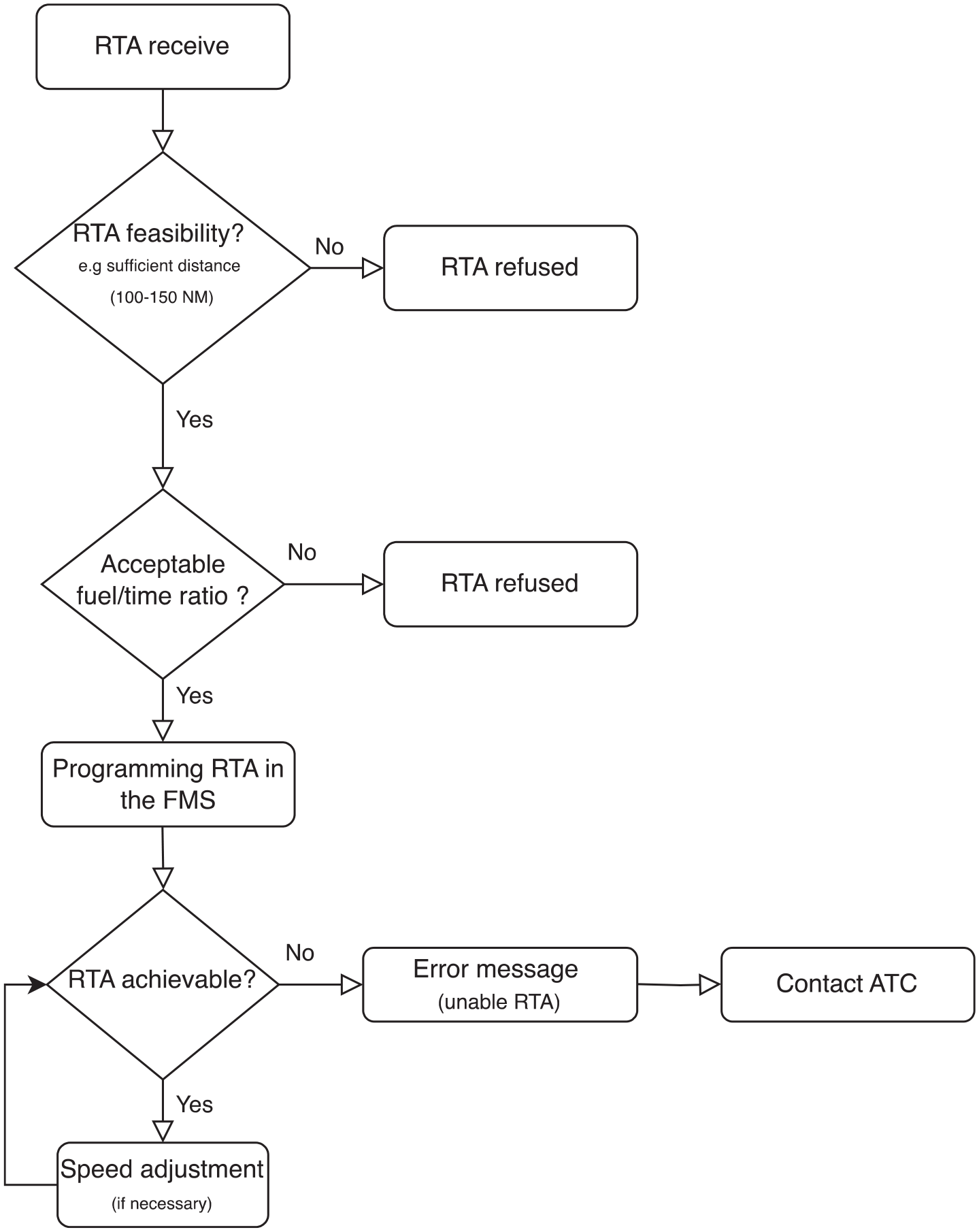
RTA compliance by pilots.
On the flight deck, time information related to RTA is displayed as numerical value on the FMS LEGS page and on the navigation display next to the waypoint’s name. The FMS RTA page offers additional information, such as the RTA error that is, time difference between the RTA and ETA, and the adjusted speed target. When the FMS detects that the RTA error exceeds its allowed time window, an FMS message is displayed to the crew to inform them that the RTA is unachievable (ex. UNABLE RTA).
Difficulties in Using or Monitoring RTAs
Pilots have mentioned that RTAs are often communicated too late, meaning the remaining distance to the waypoint with the RTA is too short for the aircraft to meet the required speed constraints. This situation leads to sudden and abrupt speed changes, creating discomfort for passengers or requesting RTAs that are beyond the aircraft’s capabilities. Speed adjustment margins can be restricted during the cruise phase. Additionally, reducing speed can be problematic: “Depending on the aircraft’s weight and flying conditions (turbulence), I don’t want to be nose-high at low speed and risk stalling the aircraft.”
Another major issue is the negative impact of RTAs on the cost index, with constraints that can lead to unacceptable time losses or fuel consumption from the pilot and airline’s perspective. Pilots also reported inconsistencies in RTA management between sectors. For example, one pilot stated: “I had a time constraint at the top of descent and the previous sector ATC told me to accelerate to my best speed, but when I reached the next sector, another ATC told me to slow down to minimum and I was put in a hold. It didn’t make sense and it didn’t work.” When interviewing the participating ATCs, they explained that, except in emergencies (such as airport closures), they lacked communication and situational awareness of traffic with adjacent centers, as well as effective coordination tools. This lack of between-sector communication and coordination tools make it difficult to anticipate and coherently manage RTAs, exacerbating the challenges faced by pilots and compromising the overall efficiency of air traffic management.
Discussion
In this study, we examined the current management of RTA in navigation, based on seven interviews conducted with experts. The interviews revealed a verification task for pilots upon receiving RTAs. Pilots analyze the impact of the RTA on several crucial parameters such as cost index, arrival time, and duty time to accept or reject the constraint. However, the information available to them is often limited, preventing a full assessment of an RTA’s impact on the entire flight. Additionally, pilots have only one lever to manage RTAs: speed adjustment. When non-compliance with the RTA is detected by the automation system, the pilot is alerted by the FMS. Pilot is responsible for contacting the ATC, who will then resort to vectoring guidance (heading, altitude change, etc.).
Thus, in current traffic, RTAs are used as a tactical measure, similar to a change in altitude or heading. They are applied in the short term, generally in the sector where the aircraft is located and about 10 to 15 min before the concerned waypoint. In contrast, TBO transforms the management of time constraints from a speed-centered approach to a comprehensive 4DT management, impacting all phases of flight and allowing for longer-term forecasts. RTAs will be managed mainly strategically, planned before departure, or scheduled well in advance using mechanisms such as extended metering (Itoh et al., 2017). However, this strategic approach presents challenges: limited inter-sector communication complicates the anticipation of RTAs, the impact on the cost index, and the narrow margins for speed variation may call into question the expected benefits in terms of fuel consumption and delay absorption. RTAs may not be the sole solution for reducing delays and fuel consumption.
The main limitation of this study is its small sample size. With only seven interviews conducted, the conclusions drawn may not fully represent the diversity of RTA management. Nonetheless, this work provides some avenues for further reflection.
In conclusion, the current study examined human factors issues in RTA management. Applying this understanding in current operations will help prevent these issues from adversely affecting operations in TBO. We encourage other researchers working on TBO to regularly involve concerned operators in real situations and to use human factors methods to better understand the effects of TBO on air operations. The next steps of this project involve developing a decision support tool for pilots to manage RTAs throughout a flight, using a TBO flight scenario as an example application.
Footnotes
Declaration of Conflicting Interests
The author(s) declared no potential conflicts of interest with respect to the research, authorship, and/or publication of this article.
Funding
The author(s) disclosed receipt of the following financial support for the research, authorship, and/or publication of this article: The research project was funded by NSERC (ALLRP 567177-21), CRIAQ (Explo-354), and by the following industrial partners: Bombardier, CMC Electronics, Marinvent, Presagis and Thales.
