



Abstract
Effective teamwork requires both individual domain-specific knowledge and social cognitive skills. In this paper, we discuss a theoretical approach that incorporates metacognitive training to enhance social cognition and theory of mind within teams. By using scaffolding techniques to address cognitive biases, we aim to facilitate efficient collaborative problem-solving. Our goal is to develop individual and team metacognitive awareness in social contexts through various interventions implemented during the preparation, execution, and reflection stages of training. We suggest that metacognitive strategies implemented during team training can enhance individuals’ ability to navigate social interactions and understand others’ perspectives. This approach provides a foundation for researchers interested in studying methods to improve collaboration, for teams seeking to enhance interpersonal understanding, and beneficial for those creating interventions to reduce social cognitive biases and improve theory of mind within collaborative problem-solving scenarios.
Introduction
The ever-increasing interrelatedness of technology and society in domains like aviation, space exploration, and industrial control has led to highly complex and multifaceted problems (Letsky et al., 2008) which demand a collective approach to problem-solving (He et al., 2017). This has led to a growing focus on developing individuals with the skills needed for effective collaboration (Care et al., 2016). Collaborative problem-solving (CPS) brings people together to leverage their diverse knowledge, skills, and abilities to transform problems into desired outcomes (OECD, 2017). At the highest level, the two main facets of CPS are cognitive and social (Hesse et al., 2015). In the cognitive dimension, group members collaborate to understand the problem, share information, devise strategies, and adjust until goals are met. The social dimension involves interpersonal elements, like communication amongst team members, which can facilitate or impede collaboration (Duruaku et al., 2024; Graesser et al., 2018). Effective collaboration often suffers due to limitations in social cognitive abilities, like theory of mind. Specifically, individuals may struggle to understand perspectives, intentions, and mental states. This poses a need for interventions that enhance team performance through targeted training on social-cognitive dimensions.
We draw upon principles from social cognitive theory, ToM research, and metacognitive theory to discuss the impact of metacognitive training on social cognition and theory of mind within teams with a focus on cognitive biases. Social cognition (SC) posits that individuals’ cognitive processes are influenced by social context (Hamilton & Stroessner, 2020), affecting how they perceive and interpret interpersonal cues while ToM allows individuals to predict and explain others’ behavior and collaborate effectively (Frith & Frith, 1999). One significant challenge to SC and mental state attribution is the presence of cognitive biases. We describe cognitive biases as unconscious sources of error in thinking that distort how we process information (Jones & Roelofsma, 2000), leading to errors in social perception, especially because humans adopt various cognitive shortcuts, can rely on type 1 (automatic) thinking (Kahneman, 2011), and act as cognitive misers (Fiske & Taylor, 1991).
Metacognitive training emphasizes the importance of self-awareness and self-regulation in cognitive processes, suggesting that individuals can improve their cognitive abilities through metacognitive strategies. While the benefits of metacognitive training are being explored in various contexts, research directly examining its impact on social cognition, theory of mind (ToM), and subsequent influence on team collaboration remains an underexplored area. In this paper, we redress this gap by proposing how metacognitive scaffolding, which supports individuals and teams in gaining awareness of their own cognitive processes, abilities, and limitations (e.g., Hill & Hannafin, 2001), can enhance social cognition and ToM within teams to improve collaboration. Our goal is to show how metacognitive scaffolding, as a training intervention, can improve collaborative problem-solving (CPS). We provide a set of research propositions to guide training researchers in exploring how these techniques may influence team members’ awareness of their own and others’ cognitive processes during collaborative problem-solving.
We begin by describing social cognition and theory of mind in team collaboration, metacognition as a cognitive mechanism for collaborative problem solving, and the common cognitive biases that impact social cognition and ToM.
Social Cognition and Theory of Mind in Team Collaboration
Successful team collaboration requires more than just individual technical skills and expertise. Teams need to navigate the social dynamics at work, and two key cognitive processes are crucial for this: social cognition (SC) and theory of mind (ToM). Social cognition is the mental process through which individuals perceive, interpret, and respond to social cues, including the thoughts, intentions, emotions, and behaviors of others (Fiske & Taylor, 1991; Frith, 2008). It includes a range of skills that are relevant to teamwork; when team members utilize these social cognitive skills they can build trust, communicate clearly and coordinate efforts towards a common goal. Dual process theories of social cognition propose that we have two distinct ways of processing information in social settings (Evans & Stanovich, 2013; Wiltshire et al., 2014). This may affect how teams collaborate on problems. Type 1 processing is fast and automatic. This might help teams move swiftly, coordinating actions based on immediate social assessments. Type 2 processing is slower and more deliberate. This might allow for the consideration of different viewpoints and strategizing effectively.
Theory of mind takes social cognition a step further. It refers to the ability to attribute mental states such as beliefs, desires, and intentions to oneself and others, and to understand that these mental states can differ from one’s own (Premack & Woodruff, 1978). Findings from social neuroscience reveal two frameworks for explaining the process involved in how we understand others’ behavior (Alcalá-López et al., 2019): Theory Theory (TT) and Simulation (ST). In TT, people use abstract principles about human behavior, learned from experience, to interpret and predict others’ mental states and actions (Carruthers, 2009; Gopnik & Wellman, 1992). In ST, individuals mentally simulate others’ experiences, using their own minds as models to understand others’ mental states (Gallese & Goldman, 1998; Saxe, 2005). Over time, various tests have been designed to assess ToM capabilities, including tasks like “Reading the Mind in Eyes” and “Reading the Mind in Film,” which require participants to identify mental states depicted in visual stimuli (Lobato et al., 2014).
During team collaboration, ToM would help individuals predict the behavior of other team members by understanding their thoughts and intentions (Woolley et al., 2010). Ultimately, we suggest that SC and ToM enable team members to navigate social complexities, understand each other’s perspectives, and coordinate their efforts to achieve shared objectives in collaborative problem-solving contexts.
Metacognitive Training in CPS
Metacognition involves an individual’s understanding of how their cognitive abilities function. As already described, it encompasses awareness, assessment, and regulation of one’s own thinking processes (Flavell, 1979; Victoria & Athanasios, 2023). As such, it is a necessary component of problem solving, in general (Schaeffner et al., 2021) and CPS in particular. CPS requires a group of individuals working together to identify, analyze, and resolve complex issues or challenges to change a problem state into a desired state (Fiore et al., 2017; Graesser et al., 2018). While existing research has established connections between metacognition, ToM, and social cognition in enhancing collaborative problem-solving, there is a little research on how metacognitive training can be specifically applied to improve ToM and social cognition for this purpose. Hence, we begin by describing how metacognitive scaffolding can address this gap.
Metacognitive training focuses on enhancing team members’ awareness and control over their own cognitive processes. Research has demonstrated that metacognitive skills are advantageous in communication (Flavell, 1979), complex problem-solving, and expertise development through task training (Fiore et al., 2002). Evidence from learning and cognition studies at the individual level show that reflecting on the comprehension process improves knowledge acquisition (for a discussion, see Fiore & Vogel-Walcutt, 2010). We suggest that training researchers explore how to optimize team collaboration using metacognitive training through scaffolding.
Metacognitive scaffolding is the support structure put in place to facilitate the development and application of metacognitive skills within a team. Effective scaffolding should conform to three essential elements: diagnosis, calibration, and fading (Puntambekar & Hübscher, 2005). Continuous “diagnosis” allows facilitators to “calibrate” scaffolds that promote ToM and SC in teams. As teams improve, the scaffolds “fade,” fostering stronger team dynamics and task performance. Therefore, we propose that:
Proposition I: Metacognitive scaffolding techniques will enhance social cognition and theory of mind within teams and lead to effective problem solving.
Following earlier theorizing on metacognitive training for teams, we delineate three phases based on the stages of learning, known as the “training cycle” (Fiore & Vogel-Walcutt, 2010). This includes preparation, execution, and reflection and each phase plays a critical role in developing and applying metacognitive strategies within teams to improve their problem-solving capabilities. We suggest that the preparation phase be used to help team members calibrate their ToM. In the execution phase, social cognitive interventions can help teams attend to social cues during collaboration. These should also be devised to provide feedback (e.g., are team members accurate about their ToM assessments). The last phase involves reflection on some performance episode (cf. Gabelica et al., 2016). In this phase, not only should team members attend to their performance, but interventions can also help them focus on ToM by, for example, trying to assess teammate intentions or beliefs at critical points that affected CPS outcomes. From the above distinctions, we propose that:
Proposition II: Implementing metacognitive scaffolding techniques into the three phases of training will increase team awareness of their own cognitive processes and that of their team members during CPS.
There is existing evidence that cognitive biases influence social interactions and theory of mind during teamwork, hindering effective problem-solving. Recognizing these biases is crucial for developing strategies to enhance team performance. Thus, we will describe these in the next section.
Cognitive Biases Influencing Social Cognition and ToM
Teamwork thrives on our ability to understand each other. However, this capacity is shaped by our backgrounds, experiences, and cultures. Because collaboration involves individuals with different cultural and interpersonal exposures (Gehlbach & Vriesema, 2019), it creates room for biases that lead to errors in social perception and judgment. Biases are systematic deviations from rational judgment that arise when people process and interpret information (Tversky & Kahneman, 1974). We describe the cognitive biases that affect SC and ToM that may cause disruptions in CPS.
Confirmation Bias
This refers to an individual’s inclination to prefer information that supports or reinforces their preexisting beliefs or values (Gatlin et al., 2017; Nickerson, 1998). In social contexts, people are primed to focus on cues from team members that support their expectations and devalue those that do not, thus impairing theory of mind. This distorted social cognition can hinder effective CPS, as decisions are based on a limited view of others’ perspectives.
Correspondence Bias
This refers to a cognitive tendency where people attribute others’ behaviors to their personality traits regardless of whether the behavior is socially constrained or caused by situational factors (Gilbert & Malone, 1995; Nier et al., 2013). This bias can lead to misinterpretations of the mental states of others (i.e., ToM) and interpretation of behaviors (i.e., SC) leading to misunderstandings during collaboration.
Anchoring Effect
This bias occurs when the first piece of information (i.e., the “anchor”), we encounter heavily influences our subsequent judgments, even if it’s completely unrelated (Wickens et al., 2010; Wilde et al., 2018). This bias makes it difficult to gauge the mental states of others because we rely heavily on initial impressions.
Availability Bias
This refers to the mental shortcut where we judge the likelihood or importance of something based on how easily examples of it come to mind (Tversky & Kahneman, 1974). It can lead to misattributions of mental states based on how easily we can recall similar experiences and disproportionately affect judgments of social behaviors.
Halo & Horn Effects
The halo effect is the tendency to let a single positive characteristic about someone color our perception of their entire personality (Radeke & Stahelski, 2020) while the horn effect is the tendency to let a single negative characteristic taint our entire impression of someone (Cook et al., 2003). The halo/horn effects skew how we perceive and evaluate people, often based on superficial traits.
Group Think
This is when the desire for harmony and conformity results in irrational or dysfunctional decision-making outcomes (Janis, 1991) in teams. In social settings, members may refrain from voicing disagreements or alternative viewpoints to avoid conflicts or rejection. The presence of psychological safety plays a crucial role in mitigating groupthink. When team members feel safe to express their opinions and concerns without fear of negative consequences, they are more likely to share diverse perspectives (Edmondson, 1999).
In-Group Bias
This refers to the tendency for individuals to favor and prioritize the interests of their own group over those of out-groups (Tajfel et al., 1979). In teams, members tend to attribute positive behaviors to in-group members while attributing negative traits to out-group members (cf. Brewer, 1979). They may find it harder to accurately infer the mental states of out-group members due to a lack of empathy and understanding (Molenberghs, 2013). Based on the above, we propose that:
Proposition III: Implementing metacognitive training programs designed to target specific cognitive biases will lead to improvements in social cognition and theory of mind required for effective CPS.
Theoretical Approach
Enhancing social cognition can be achieved through a targeted approach that focuses on training both individuals and teams about the ways in which cognitive biases interfere with their ability to accurately interpret and understand others’ behaviors (ToM). We adopt an approach that recognizes that our innate biases often act as barriers to effective social understanding and interaction. By bringing these biases to light and providing strategies to mitigate their effects, individuals and teams can develop more accurate and nuanced social cognitive skills. This, in turn, can lead to improved communication and better teamwork.
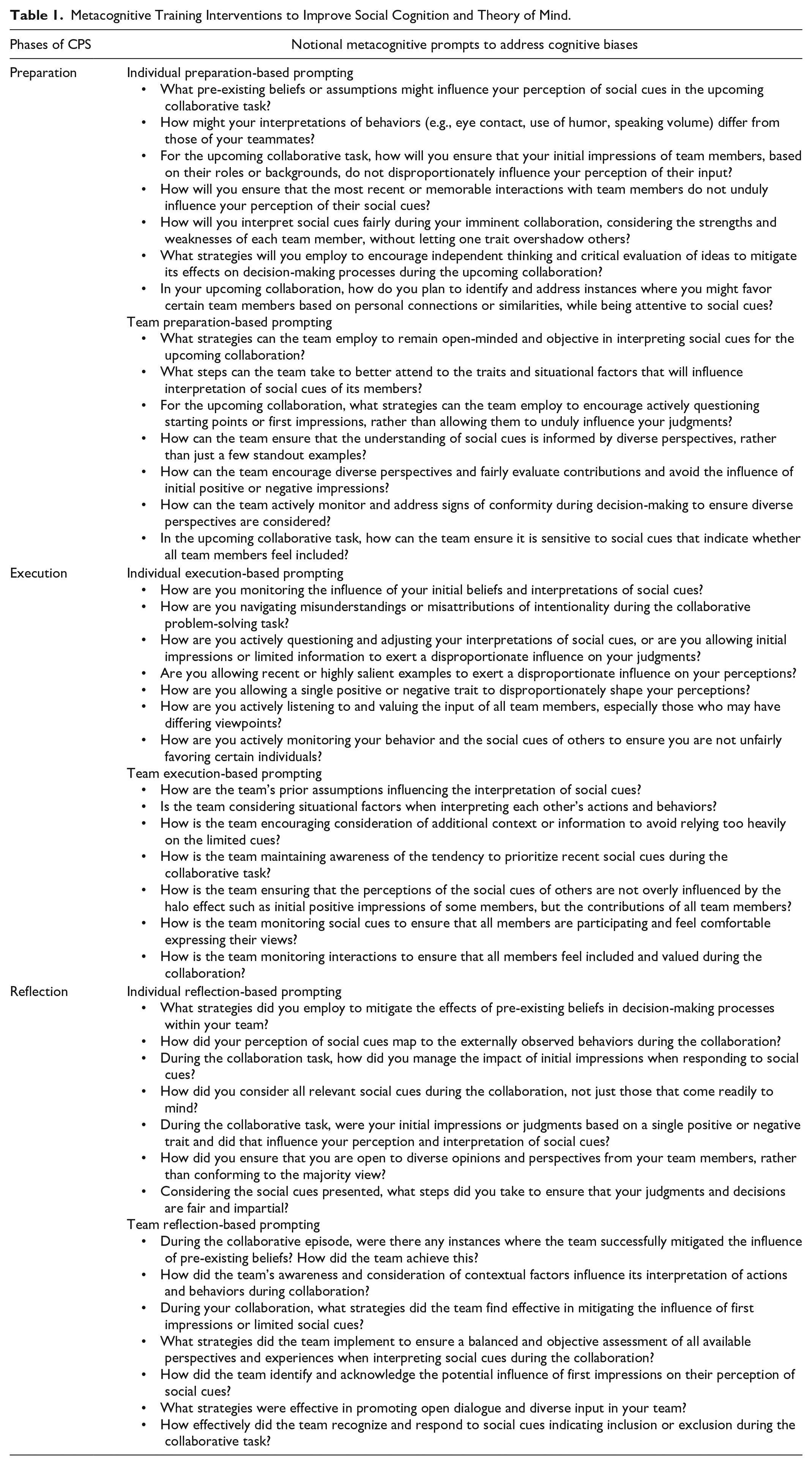
Our framework is based upon an integration of theoretical factors centered on improving learning. We adapt the training cycle (Fiore & Vogel-Walcutt, 2010), which outlined the phases of learning and tailored the scaffolds appropriately, namely: preparation, execution, monitoring, and reflection scaffolds (Newton et al., 2018; Wiltshire et al., 2014). From this, we provide metacognitive prompts (see Table 1) to scaffold cognitive biases that can influence SC and ToM during CPS. Note that we provide representative prompts tailored for both the individual and the team. From this, training researchers are able to adapt as needed for interventions aimed at the individual or team level, or both. Further, for the execution phase prompts, it is expected that they be introduced in a “stop and think” type format; that is, training scenarios can be interrupted to some degree such that a prompt is introduced, allowing team members to reflect on the prompt. For the reflection phase, following the tenets of team reflexivity (Gabelica et al., 2016), it is expected that these prompts not only be asked, but that trainees also reflect on how to refine these strategies for future interactions. We anticipate that the proposed approach will be useful for team researchers seeking to manage social cognitive biases and improve theory of mind and social cognition within collaborative problem-solving scenarios.
Metacognitive Training Interventions to Improve Social Cognition and Theory of Mind.
Conclusion
By integrating metacognitive scaffolding techniques into team processes during planning, execution, and reflection, teams can achieve heightened awareness of their cognitive processes and improve coordination and communication during CPS tasks. In practical terms, this paper offers actionable research directions for designing and implementing metacognitive training programs in real-world team settings. Ultimately, our goal is to help guide future training research to explore and test metacognitive scaffolding in team settings to unlock its full potential and drive positive outcomes in teamwork and collaborative problem-solving.
Footnotes
Declaration of Conflicting Interests
The author(s) declared no potential conflicts of interest with respect to the research, authorship, and/or publication of this article.
Funding
The author(s) disclosed receipt of the following financial support for the research, authorship, and/or publication of this article: The writing of this paper was partially supported by the US Air Force Office of Scientific Research (AFOSR) grant FA9550-22-1-0151 awarded to Stephen M. Fiore. Any opinions, findings, and conclusions expressed in this material are those of the authors and do not necessarily reflect the views of the AFOSR or the University of Central Florida.
