




Abstract
Advertisement blindness is a general term that refers to people’s tendency to automatically and unconsciously ignore advertisements. The phenomenon was originally identified in banner ads, then later in text and native ads on websites. Today, social media is an effective tool for advertisers, yet research investigating users’ interaction habits with social media ads in mobile applications is unexplored. This study expands the ad blindness concept to mobile social media apps, examining its presence and whether target position has an influence. To test these questions, we used a search task where participants browsed a mock scrollable Facebook news feed and identified posts that fit certain semantic categories. The study found that participants had higher accuracy in content posts than in ad posts, also ad avoidance was prevalent in the last third of the news feed. Overall, these results revealed the first evidence of ad blindness on social media mobile applications.
Objectives
Social media has become one of the key communication tools for advertisers to reach consumers and the number of ads displayed on social media are constantly increasing (Maslowska et al., 2021). Data shows that mobile devices bring the most annual internet ad revenue to the table. Yet users’ perception of advertisements on social media has rarely been studied on smartphone and tablet devices. Even though advertisements on social media are a significant source of revenue, users may experience advertisement blindness. Advertisement blindness is a general term that refers to people’s tendency to automatically and unconsciously ignore advertisements. The phenomenon was originally identified in desktop banner ads. When people use their computers to browse a website, they tend to ignore large, graphical advertisements, despite being told that search targets will appear in the ads (Benway, 1998). Further research using desktop computer stimuli established that participants also ignore text advertisements on webpages (Owens et al., 2011, 2014), and native ads on social media websites (Barreto, 2013; Bode et al., 2017).
To our knowledge, ad blindness has not been studied in social media apps viewed on smartphone devices. This study is the first that expands the ad blindness concept to mobile social media apps, examining its presence and whether target position has an influence. To test these questions, we used a search task where participants browsed a mock scrollable Facebook news feed and identified posts that fit certain semantic categories (travel, education, etc.). They were instructed to find targets that could appear in both content and advertisement posts. Based on previous ad blindness research on website stimuli, we anticipated that participants would experience more difficulty locating targets in advertisements than in content posts. Moreover, in line with prior research, we expected that participants would have higher accuracy in locating targets in the top positions than in the bottom positions (Nielsen, 2006; Owens et al., 2014; Pernice, 2017).
As social media advertising becomes increasingly prevalent, it is essential to understand users’ impressions of social media ads on mobile phones. Ad blindness suggests that people automatically ignore ads (Barreto, 2013; Benway, 1998; Owens et al., 2011), and one theory postulates this occurs due to habituation (Portnoy, 2012). Habituation is a phenomenon that occurs when repeated presentations of a stimulus reduce a response (Harris, 1943). Users see ads (stimuli) repeatedly on their social media platforms, and since they see them so often (about 70 advertisements per week; Galán et al., 2019), they stop paying attention to them. Habituation could provide a mechanism that explains ad blindness. The appearance (“sponsored” label, link, and call to action button) and repetition habituate (Kim & Wogalter, 2009) and train users to avoid the non-informative elements of the feed. Habituation, smaller screens and ad appearance may all contribute to users ignoring advertisements on social media apps (Maslowska et al., 2021; Portnoy, 2012). We investigate whether these factors play a role in users’ visual attention to ads on a smartphone and therefore might drive ad dismissal (Ohme et al., 2021).
Approach
Previous studies have examined attention to social media content on social media websites, but many had methodological shortcomings. Bode et al. (2017) used static images as stimuli, however, static images would not resemble the natural way users interact with social media platforms. Windels et al. (2018) asked participants to use their own social media accounts in the study (similar to Barreto, 2013), which limited internal validity. Learning from past mistakes, Maslowska et al. (2021) designed experimental stimuli for a desktop and mobile environment that allowed for a more realistic experience of social media browsing that let participants scroll through the stimuli. The present research adapts Maslowska et al.’s (2021) design to explore ad blindness on a scrollable dynamic news feed on a smartphone.
Participants were a mix of college-aged students, and older adults; the mean age was 25 years (SD = 9.6). Out of the 65 participants, 45 were female, 19 were male, and one identified as non-binary. They reported that, on average, they spent more than 2 hr per day on social media and 30 min on Facebook, which is similar to what other surveys have reported in the past (Statista, 2021, 2022). In the study, the young adults performed semantic searches (e.g., “You and a friend are planning to travel in the near future. Select every post that is related to travel.”) within a stream of ad and content posts (Figure 1), with varied target positions on their phones.
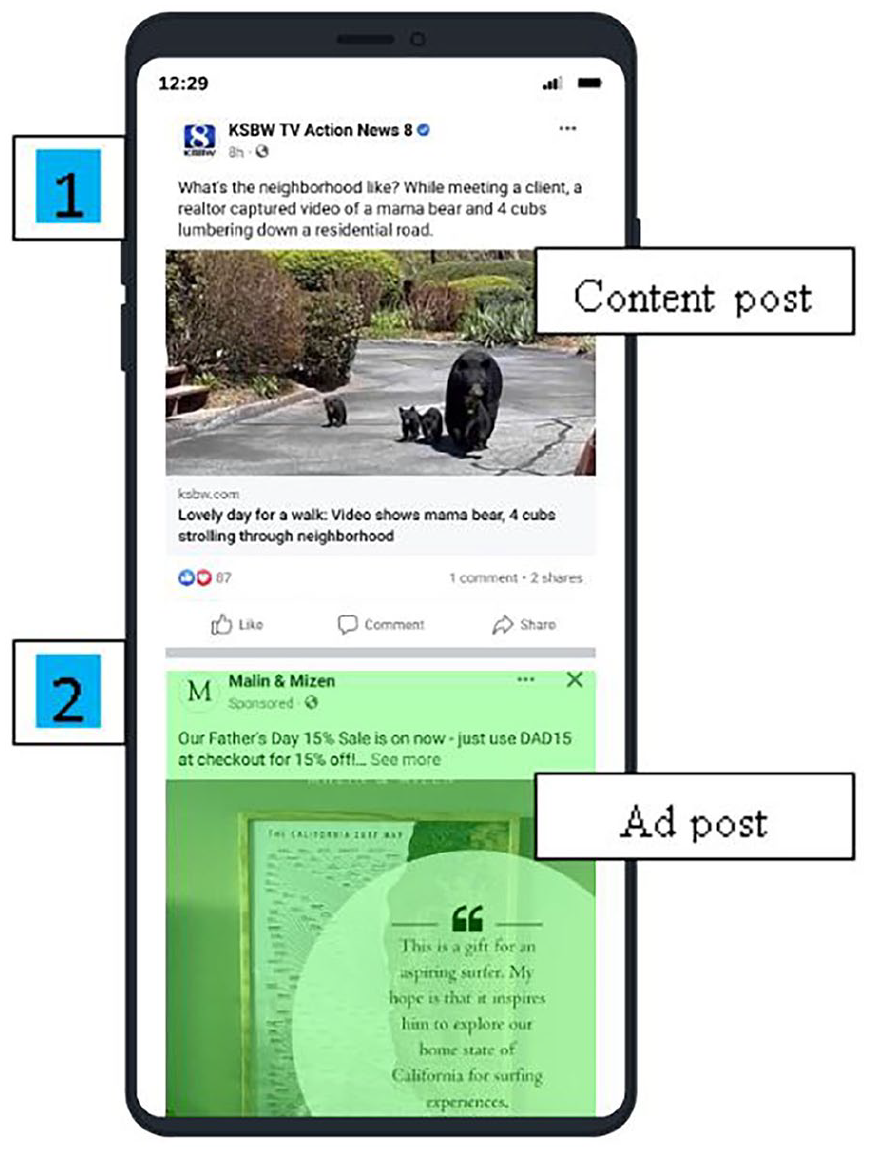
Example of a content and ad post stimuli.
There were 23 trials (see example trial in Supplemental Information) in the study and each trial contained a feed of 18 posts (images; Figure 2).
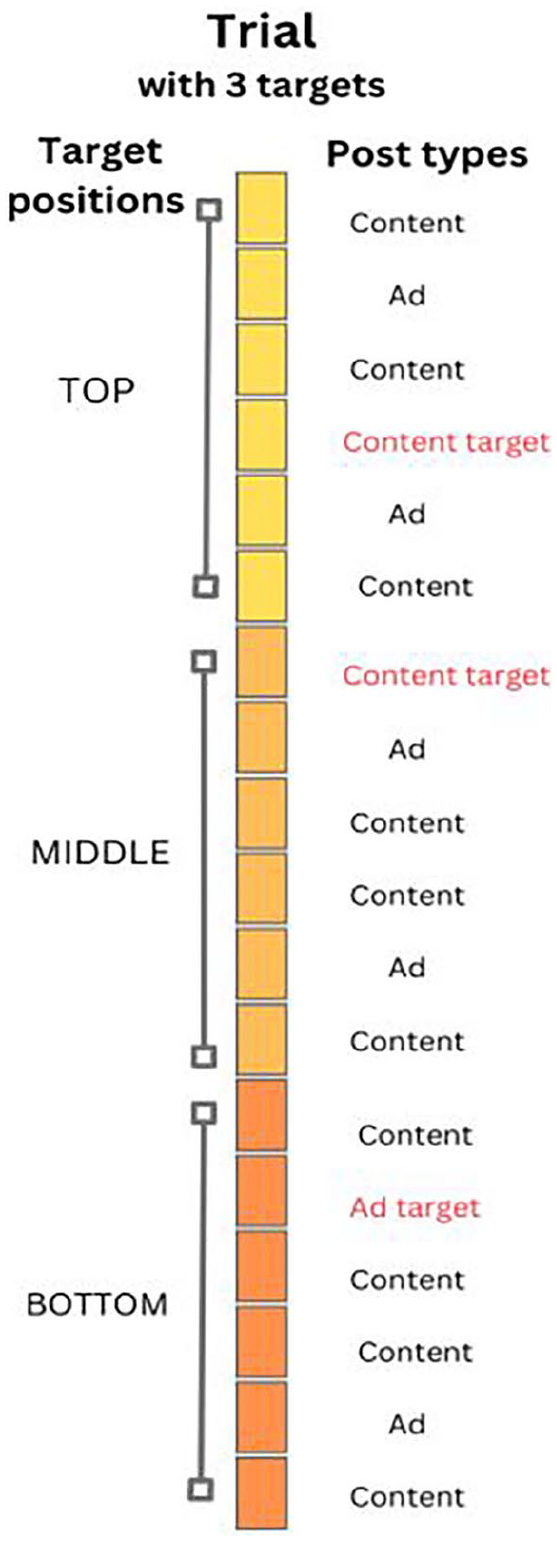
Example trial with three targets located in the three different positions (top, middle, and bottom).
The 63 targets in the study were counterbalanced across trials and positions (top, middle, and bottom areas) of the news feed. Participants clicked on any posts that fit the search criteria, and we recorded how many content and ad targets were successfully located in the top, middle, and bottom regions.
Findings
We conducted a 2 (post type [advertisement, content]) × 3 (target position [top, middle, bottom]) within-subjects analysis of variance (ANOVA) to assess if there were main effects of post type or target position, or a two-way post type × position interaction effect. Proportion correct data were arcsine transformed to avoid violations of sphericity.
The ANOVA detected a significant main effect of post type, F(1, 64) = 4.60, p = .036,
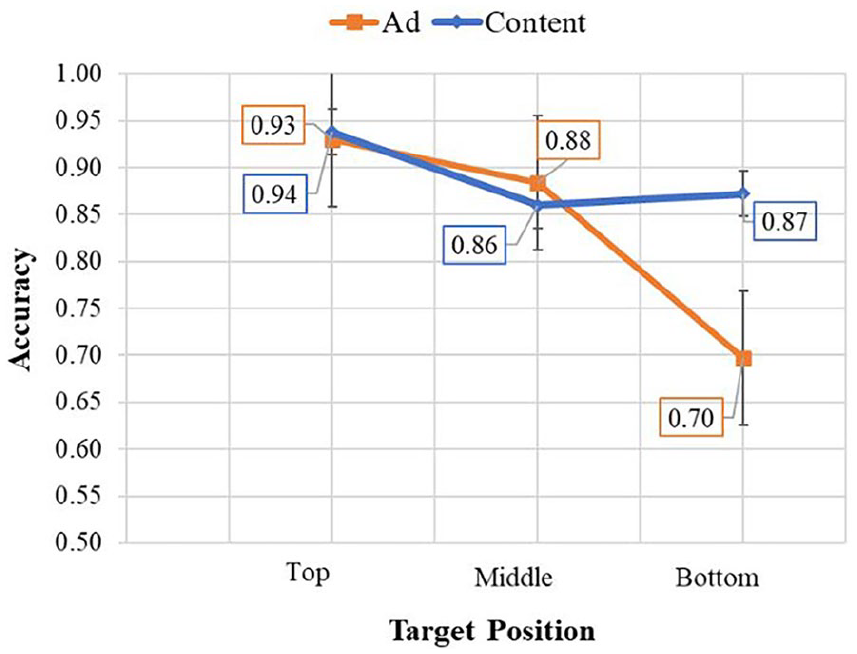
Accuracy of identifying targets in different post types in different locations.
Overall, the findings support the notion that users show ad blindness when viewing social media content on smartphones. Participants were worse at locating targets in ad posts than content posts and were worse, overall, at identifying targets later in the feed. The ad blindness effect, interestingly, was only significant for posts in the bottom third of the feed.
Takeaways
This research provides some of the first evidence for ad blindness on smartphone apps. Participants ignored ad posts more than content posts, especially in the bottom of the news feed. This suggests that participants treated content posts as information sources and skipped advertisements, demonstrating ad blindness—a phenomenon previously established on desktop websites (Barreto, 2013; Benway, 1998; Owens et al., 2011, 2014).
The study also found target position to be an important factor for in-app advertising. Accurately identifying targets depended on their location, such that posts in the top position are reviewed closely while posts in the bottom are scanned, consistent with the “F” shape reading pattern observed in previous research (Nielsen, 2006; Pernice, 2017). This finding suggests a real-world implication for companies and marketers, highlighting the importance of ad position in mobile ad strategies.
Furthermore, this study introduced a novel approach by creating a scrollable dynamic news feed that closely resembled a real Facebook experience to study ad blindness. In summary, this study broadens the ad blindness concept to social media apps and introduces a design methodology that allows for more realistic assessment of user behavior in a dynamic online environment.
Future studies should explore ad blindness across social media platforms (e.g., LinkedIn, Instagram), and investigate perceived differences between civil, commercial, and non-profit ad types. Ad labeling and visibility are another avenue for future studies. Findings could inform lawmakers and advocates who petition for better user experience and have concerns about intrusive ads with low information value.
Supplemental Material
sj-pdf-1-pro-10.1177_10711813241275903 – Supplemental material for Advertisement Blindness in Mobile Social Media Apps
Supplemental material, sj-pdf-1-pro-10.1177_10711813241275903 for Advertisement Blindness in Mobile Social Media Apps by Nora Szladovics and Evan M. Palmer in Proceedings of the Human Factors and Ergonomics Society Annual Meeting
Footnotes
Declaration of Conflicting Interests
The author(s) declared no potential conflicts of interest with respect to the research, authorship, and/or publication of this article.
Funding
The author(s) received no financial support for the research, authorship, and/or publication of this article.
Supplemental Material
Supplemental material for this article is available online.
References
Supplementary Material
Please find the following supplemental material available below.
For Open Access articles published under a Creative Commons License, all supplemental material carries the same license as the article it is associated with.
For non-Open Access articles published, all supplemental material carries a non-exclusive license, and permission requests for re-use of supplemental material or any part of supplemental material shall be sent directly to the copyright owner as specified in the copyright notice associated with the article.
