




Abstract
Recent innovations in building materials, design methods, and construction techniques have allowed architects to experiment with new and daring architectural forms. While Modernist and Contemporary architecture may be innovative, its effects on human users tend to be mixed. This study aims to assess the effectiveness of traditional and modern styles of ecclesiastical (church) architecture in supporting certain aspects of human psychological and physiological well-being, namely restorative and focusing effects. A literature review was performed to identify spatial, lighting, and decorative design features thought to support these human factors, with a particular focus on the design theories of Biophilia and Prospect-Refuge. These features were compared to design aspects of traditional and modern church architecture. Traditional architectural styles were found to incorporate more features identified as supporting restorative and focusing effects than modern styles. Recommendations were developed for adjustments to church spaces to improve the subjective experience of visitors.
Keywords
Introduction
The 19th and 20th centuries saw a revolution in building materials and construction techniques, accompanied by advances in structural design methods and computerization. These changes allowed for architects and structural engineers to experiment with new and daring architectural forms. Contemporary architecture continues this trend of spatial experimentation. While Modernist and Contemporary architectural styles may be innovated, their effects on the human user tend to be mixed, especially when compared to more “traditional” styles. Some studies have found that certain design features of Modernist or Contemporary structures can lead to feelings of isolation or anxiety (Roessler, 2012).
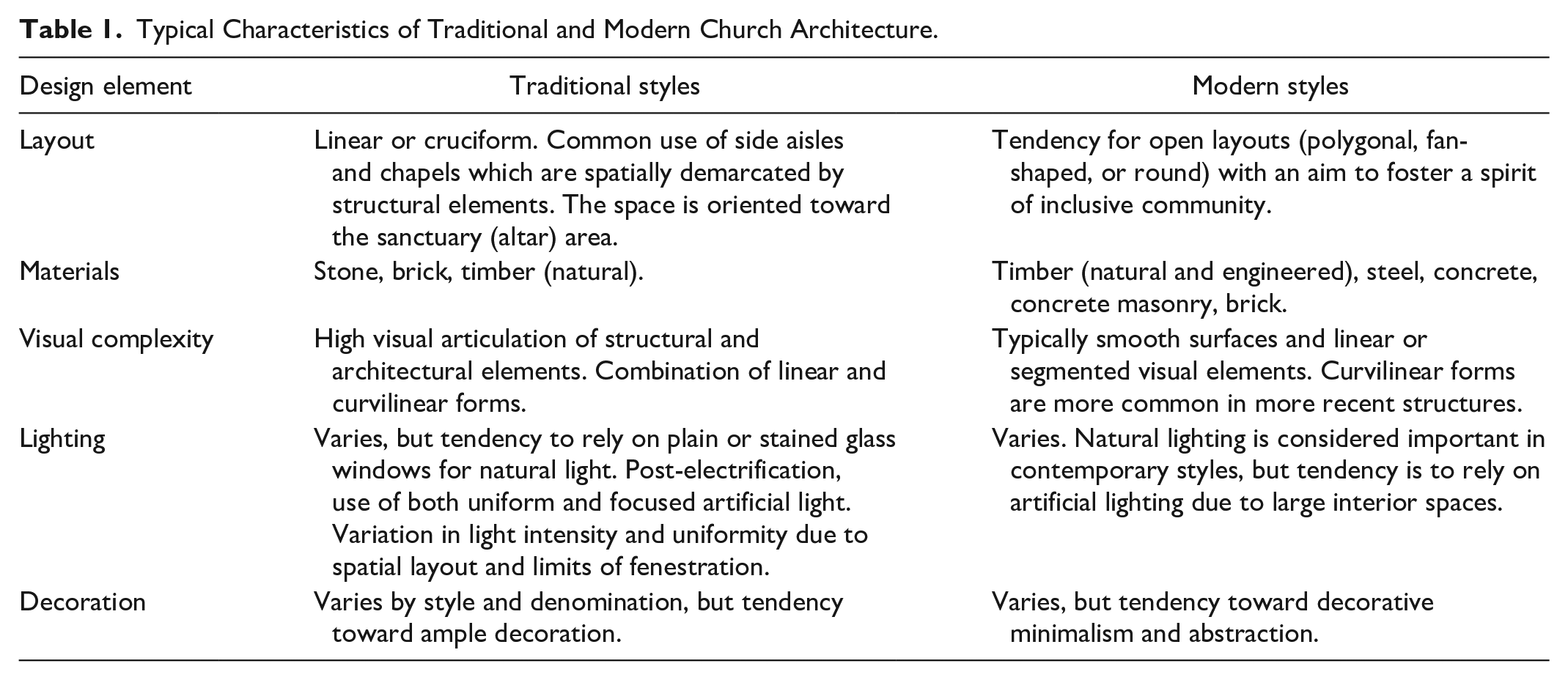
For the purpose of this discussion, “traditional” architecture refers to any of the architectural styles dominant until the start of the twentieth century (Classical, Romanesque, Gothic, etc.), which, in the context of church design, are characterized by spatial demarcation and high visual detail in architectural and structural elements. Modern style architecture here refers to styles emergent starting in the early twentieth century, including Modernism, Postmodernism, and Contemporary, and which particularly gained traction in ecclesiastical design after the Second World War. In the context of church design, these styles tend toward the use of open layouts and linear visual elements. A summary of typical design features of traditional and modern church architecture and example photographs of church interiors are provided in Table 1, Figures 1 and 2.
Typical Characteristics of Traditional and Modern Church Architecture.
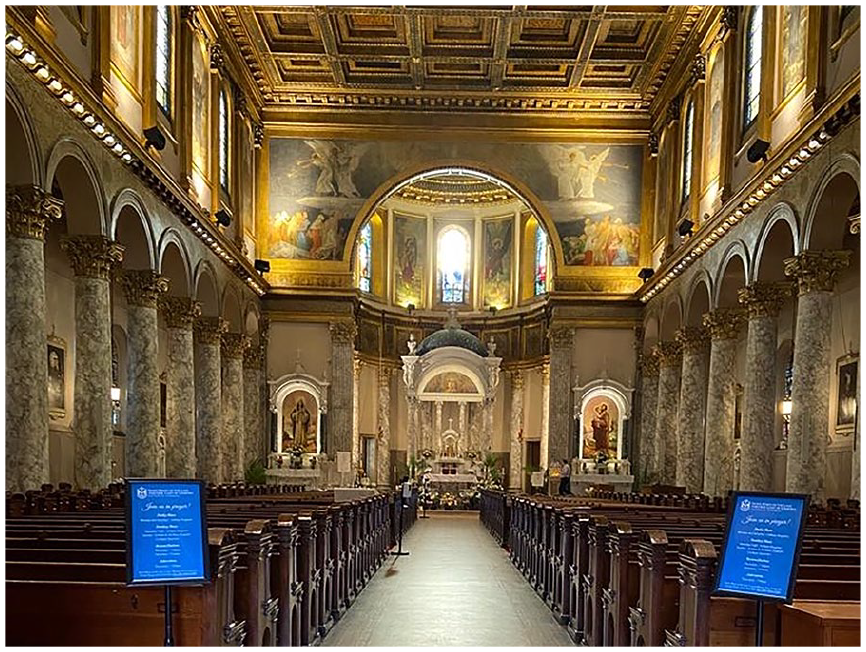
Traditional-style church interior.
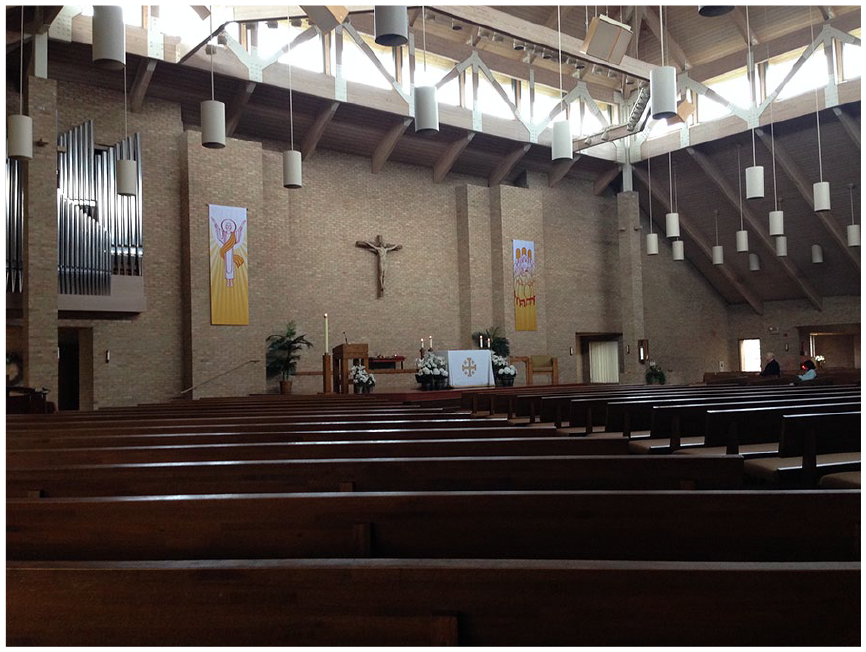
Modern-style church interior.
Modernist or Contemporary architectural innovations are particularly contentious in the field of ecclesiastical (church) architecture. For example, the Contemporary-style Cathedral of Our Lady of the Angels in Los Angeles has been described by a critic as lacking “intimacy,” having a scale which works to “diminish the presence of individual visitors,” and failing “to convincingly achieve a sense of awe, mystery, or reverence that one often seeks in monumental or religious structures” (Gamez, 2004, pp. 266–267). Similarly, an informal survey of 214 visitors to a Roman Catholic magazine website found that 73% of respondents considered traditionalism to be important in church architecture (DeSanctis, 2021, pp. 33). The same survey also found that when asked in which style of space worshipers felt “most at home in,” 45% and 44% of respondents reported “Large stone cathedral” or “Gothic stone churches” (traditional styles of church architecture), while only 10% selected “Churches built in the round” (a more modern style of church layout; DeSanctis, 2021, pp. 33).
These observations raise the question of why traditional church layouts and designs tend to be preferred over modern styles. In an attempt to answer this question, this literature review will examine some of the psychological and physiological human factors of spatial layout, lighting, and decorative features, and compare these to typical features of traditional and modern church architecture, primarily in the context of Roman Catholic and Orthodox Christian church design. Finally, this study will propose recommendations for adjustments to church spaces to improve the subjective experience of visitors.
While this discussion is focused on church architecture, it can be applied to most sacred spaces (mosques, synagogues, temples, etc.), subject to the liturgical constraints of the particular religions, as well as to secular structures.
For this study, a successful structure is defined as one that meets the functional liturgical requirements of the particular religion, while also creating an environment that supports the physical, emotional, and mental needs of visitors to religious spaces. Two desired outcomes are for the space to provide restorative (healing) and focusing effects. Restorative effects include both physical and cognitive healing, manifested by a lowering of stress, anxiety, and fatigue levels and an increase in an overall sense of well-being (Daelemans, 2020). Focusing effects assist occupants to direct their attention to specific spatial locations, activities, or concepts, while limiting external distractions which could divide attention (United States Conference of Catholic Bishops [USCCB], 2000). These effects also include creating a suitable environment for meditation and contemplation.
Spatial Factors
Beginning in the 1970s, a series of related design theories emerged which attempted to explain certain human reactions to the built environment based on evolutionary psychology and sustainable design principals. These theories can be grouped into Biophilia and Prospect-Refuge. Though both theories overlap to a degree, each will be discussed separately.
Biophilia Theory
Biophilia has been defined as “the deep-seated need of humans to connect with nature” (Ryan et al., 2014, p. 62). This theory speculates that human physical, psychological, and cognitive well-being and performance are tied to an environment’s similarity or connectedness with nature.
The beneficial physical and psychological effects of nature are well documented. In a seminal study, Ulrich (1984) found that patients in post-operative care having a window view of trees typically required less pain medication and were discharged earlier, compared to patients with a window view of a brick wall. Similarly, Hartig et al. (1991) found that individuals tended to have higher self-reported positive moods and increased attention performance after exposure to natural environments, as compared to other forms of relaxation or typical daily routines. These and similar studies suggest that natural environments have restorative effects on emotional and physical well-being and mental performance.
Biophilia Theory does not merely recommend that natural elements, such as plants, be placed in buildings. Biophilic design also argues for incorporating visual and non-visual nature analogues in design features such as spatial layout, structural forms, materials, colors, and ornamentation (Ryan et al., 2014; Söderlund & Newman, 2015). Studies have noted a strong aesthetic preference among humans for naturalistic architecture (Coburn et al., 2019), and research suggests that naturalistic features in the built environment have comparable restorative effects to nature. In a study by Berto et al. (2010), mentally fatigued individuals were presented with natural and built-environment images having either high or low levels of “fascination” (visual complexity generally correlated with “naturalness”). The study found that the cognitive performance measures of reaction time and memory recall generally improved with presentation of either natural or high-fascination built environments (Berto et al., 2010).
Prospect-Refuge Theory
Prospect-Refuge Theory argues that specific human preferences in the built environment are driven by evolutionary survival instincts which originally developed in the context of natural habitats, specifically the savanna (Augustin, 2009, pp. 10–12). The theory’s name refers to the survival advantage of being able to gather environmental information (“Prospect”), while at the same time being in or near a protected position that offers the potential for safety (“Refuge”; Appleton, 1984).
Various additional environmental qualities have been proposed as expansions to Prospect-Refuge Theory, including “Ordered Complexity,” “Enticement,” and “Peril” (Hildebrand, 1999), in order to explain nuances in human environmental preferences. Most of these additional criteria are related to a perceived need for stimulation in either the “prospected” scene or the “refuge,” though for different evolutionary reasons.
Spatial Evaluation Criteria
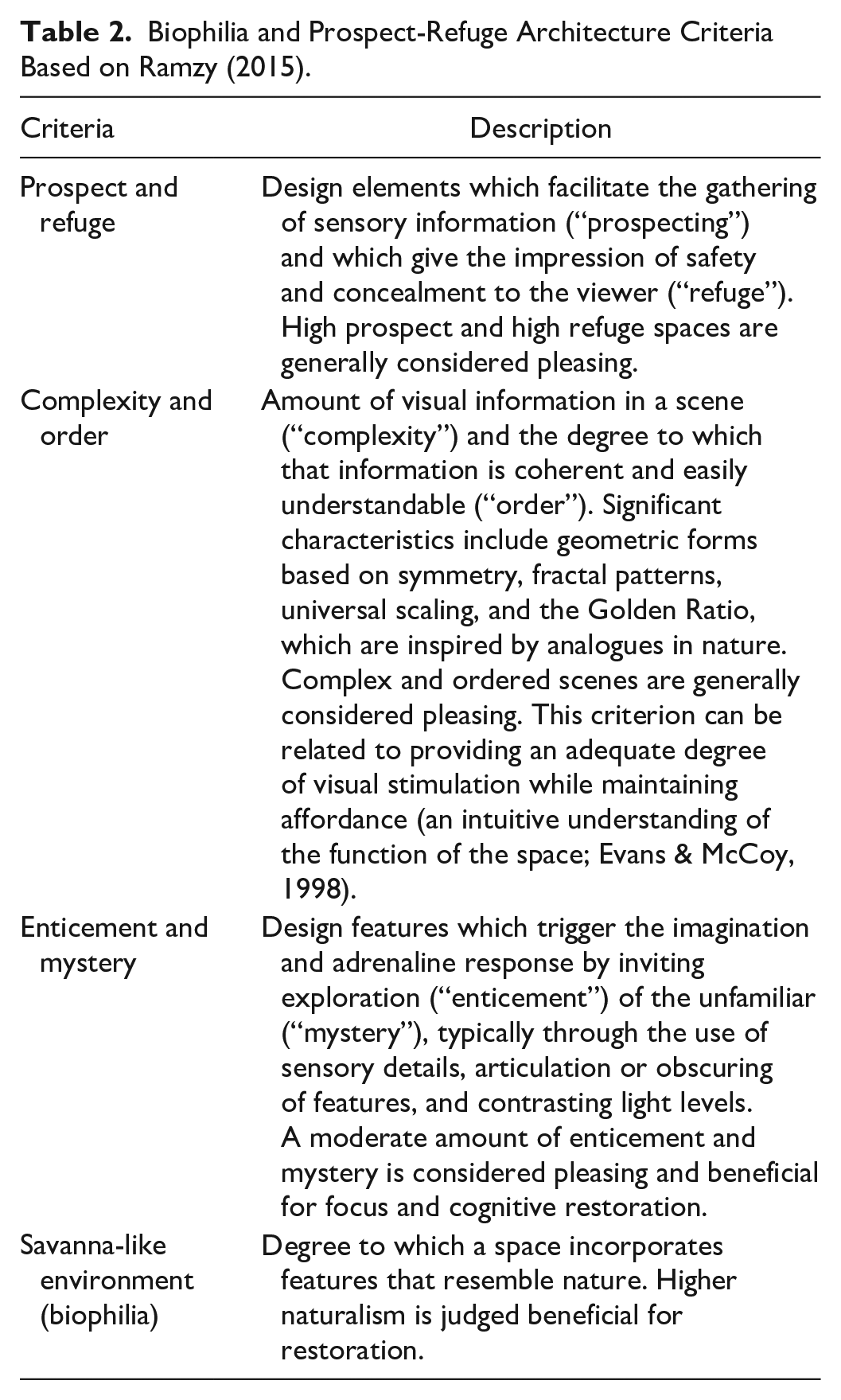
Various sets of criteria have been proposed to satisfy the principals of Biophilia and Prospect-Refuge in architectural design (see for example, Evans & McCoy, 1998; Hartig et al., 1997; Hildebrand, 1999; Ramzy, 2015). The criteria of Ramzy (2015) were selected for assessing traditional and modern ecclesiastical architecture, since they capture and consolidate most elements of the two design theories. These criteria are summarized in Table 2. In Ramzy’s formulation, “Savanna-like environment” is functionally equivalent to a biophilic/naturalistic design.
Biophilia and Prospect-Refuge Architecture Criteria Based on Ramzy (2015).
Lighting Factors
Biophilia and Prospect-Refuge theories also address human preferences in lighting patterns and quality. In addition to the well-studied benefits of natural light (Beauchemin & Hays, 1996; Walch, et al., 2005), both theories argue for the use of varying light levels, with some areas of an interior space more strongly illuminated and others less. These contrasting light levels are intended to support some of the preference criteria of Prospect-Refuge Theory and to increase the resemblance of the space to a forest-edge environment (Augustin, 2009; Ramzy, 2015).
Studies have found that contrasting light levels tend to be preferred by humans and to have stress-reducing effects. Li et al. (2020) found that self-reported and physiologically-measured stress levels improved most significantly when participants were presented with a moderately bright virtual forest environment, as compared to a forest with more extreme (very bright or very dark) lighting conditions. Similarly, exposure to light and dark fractal patterns has been found to enhance mood and stimulate interest (Abboushi et al., 2019).
While it may be obvious, directed light levels can also be used to focus attention on particular areas of a space or to enhance the restorative effects of other design features. In a study of the effects of light focus on stress reduction, Nikunene and Korpela (2009) found that participants who were presented with outdoor nighttime scenes where light was focused on natural elements (vegetation) reported higher positive emotional states than participants presented with the same scenes but with light focused on man-made elements (roads and parking lots). The implication for church lighting design is that light can be used to either present positive features, such as devotional images (discussed below), to worshipers, or to mask unsightly or distracting features.
Decorative Factors
The restorative effects of natural and naturalistic imagery have already been discussed, but studies have also demonstrated both positive and negative effects of religious imagery on human behavior and psychology. Wiech et al. (2009) found that when practicing Catholics were presented with an image of the Virgin Mary, they exhibited higher pain tolerance and the activation of areas of the brain associated with pain modulation. This effect was not observed when the Catholic subjects were presented with a visually similar secular image, or when non-religious participants were presented with either the Virgin Mary or secular images.
A series of experiments performed by Weisbuch-Remington et al. (2005) showed that religious-themed images can have positive and negative behavioral effects even if they are presented subconsciously. In one experiment, positive and negative Christian religious images were masked and subconsciously presented to study participants completing a tile-counting task. When subsequently asked to prepare a speech on an existential topic, participants presented with the negative image exhibited greater threat response cardiovascular patterns than those presented with the positive image. Similar results were observed by Baldwin et al. (1990), who found a negative trend in self-reported self-conception in Roman Catholic students after subconscious presentation with an image of a Pope with a disapproving expression.
Based on these studies, devotional religious imagery and symbolism can stimulate positive or negative reactions in visitors to churches, such as amplifying a sense of well-being and mission or encouraging a spirit of penitence. Devotional imagery can also provide restorative effects and help cognitively focus the congregation on particular concepts and themes. In fact, a design motif used in some historic Catholic churches was to place uplifting images related to Heaven and God in the sanctuary (front) of the church, images of saints or other human role models along the sides of the church (where one would look to see fellow congregants), and negative images either in the back of the church (which would be visible as warnings while exiting) or near the confessionals.
Based on Baldwin et al. (1990) and Weisbuch-Remington et al. (2005), devotional imagery does not necessarily need to consist of monumental pieces within the primary visual area. Since subconscious presentation is sufficient to stimulate responses, multiple minor pieces placed in the periphery of a church can also have beneficial effects.
Assessment
Traditional and modern architectural styles were assessed against the spatial, lighting, and decorative factors identified above. In the case of spatial factors, an assessment was performed for each of the criteria of Ramzy (2015).
Assessment of Spatial Factors
Prospect and Refuge
Traditional church buildings typically provide ample opportunities for both “prospecting” and “refuge” through the use of basilica and cruciform floor plans and architectural features such as arcades and colonnades. For example, the basilica floor plan consists of a high and open central nave (supportive of “prospecting”), flanked by lower and spatially differentiated side aisles (offering refuge). The refuge effect is amplified by secluded side chapels and typically dimmer lighting in the side aisles.
With an abundance of open space and unobstructed sight-lines, modern-style churches provide ample opportunities for “prospecting.” However, due to the open floorplans and a lack of spatial demarcation, modern styles do not provide sufficient “refuge” space. There is simply no place to hide in a circular open floorplan.
Complexity and Order
Many traditional architectural styles are characterized by high levels of detail in visual ornamentation and exposed structural forms, such as vaulting, arcades, and cupolas. Traditional architecture typically uses symmetry, fractal patterns, and universal scaling to create a high degree of order in spatial layout, ornamentation, and structural elements (Ramzy, 2015, pp. 46–47). These features provide a high level of visual stimulation and coherence.
The physical forms of modern-style churches typically have a low level of complexity and a correspondingly high level of order due to decorative minimalism and simple spatial layouts. Visual stimulation can sometimes be enhanced through the use of exposed structural members. However, open layouts can also create a detrimental level of complexity and high disorder when the space is filled with congregants. In circular or fan-shaped layouts, the field of view from most locations includes a large portion of the congregation. Since human attention is particularly drawn to movement and human faces, this can lead to divided attention and mental fatigue.
Enticement and Mystery
As noted above, traditional architecture incorporates high levels of visual details, which support enticement. Features such as spatial division, side aisles, side chapels, alcoves, and contrasting light levels facilitate a sense of mystery which helps focus attention and provides cognitive restoration.
The decorative minimalism, simple spatial layouts (open floorplans), and uniform artificial light levels which are common to modern spaces do not significantly support either enticement or mystery.
Savanna-like Environment (Biophilia)
Traditional church architecture often incorporates natural themes both implicitly and explicitly. The columns and vaults of traditional Romanesque and Gothic churches have been compared by many commentators to the trunks and canopies of trees (Ramzy, 2015, pp. 48). This is particularly apparent in lierne and fan vaulting. Traditional building materials such as timber and stone also enhance the connection with nature. Nature is also sometimes explicit in animal or floral-inspired decorative features and in Corinthian and Composite column capitals, which represent the leaves of the acanthus plant.
The simple geometric forms and tendency for linear elements in modern-style churches do not visually resemble natural analogues. Furthermore, the use of building materials such as steel trusses, concrete, and masonry units imparts an explicitly man-made and artificial appearance. While nature-inspired decorative features are sometimes incorporated, these are often minimalistic.
Assessment of Lighting Factors
Traditional church buildings have historically relied on natural lighting for a significant portion of their interior illumination, allowing these spaces to take advantage of the restorative effects of natural light. The extensive use of stained glass windows and the interplay between light and dark regions also supports the contrasting light effect recommended by biophilic and Prospect-Refuge design principals. However, without artificial lighting, historic church interiors from certain periods have the potential to be excessively dark due to limited window penetrations, which can inhibit focusing and restorative effects.
Due to advances in structural design, modern churches have the potential to include many windows for natural light. However, artificial lighting is typically required to adequately illuminate the interior of open layout floorplans. Although contrasting light levels can be created using artificial lighting, uniform light levels are usually maintained in practice.
Assessment of Decorative Factors
The use of decoration varies widely by style and denomination in both traditional and modern styles of architecture. However, traditional-style churches tend toward an abundance of devotional decorative features such as sculptures, paintings, or stained glass windows. Even relatively austere styles frequently include elaborate altarpieces at the front of the church.
Though modern architectural styles do not preclude the use of devotional imagery, in practice, many modern spaces tend toward either visual minimalism with little devotional artwork, or an abstract approach in which the underlying concepts of the imagery may inadvertently be masked.
Conclusions and Recommendations
This study examined how well certain spatial, lighting, and decorative features of traditional and modern styles of church architecture support beneficial psychological and physiological effects in visitors, with a particular focus on the design theories of Biophilia and Prospect-Refuge. Traditional styles were found to incorporate more design features which are supportive of restorative and focusing effects and also to exhibit a stronger conformance to Biophilia and Prospect-Refuge design principals.
Based on this assessment, certain modifications can be made to the design of new or retrofitted church spaces. Higher levels of spatial demarcation and decorative complexity can be incorporated to enhance the sense of “refuge” and “enticement.” Lighting can be adjusted to both match natural spectrums and to better resemble the varying, dappled quality of light found in many natural environments. Plain window glass can be replaced with stained glass to enhance the contrasting light effect. Varying patterns of bright and less-bright illumination can help visitors focus on keys areas of the space, thereby facilitating cognitive restoration by easing the demand on directed attention. Where appropriate, devotional religious imagery can be added, and these decorative elements can incorporate biophilic themes to stimulate restorative effects.
Incorporation of features promoting restoration and focus can bring psychological and physiological benefits to visitors and improve overall end-user satisfaction. This study focused on ecclesiastical (church) architectural design; however, these design insights can be extended to other religious spaces (mosques, synagogues, temples, etc.) as well as to secular structures—the benefits of a human-centered built environment are universal.
Footnotes
Acknowledgements
The author would like to thank the Pietre Vive community of Chicago, who helped provide the inspiration for this study and contributed the photograph in Figure 1.
Declaration of Conflicting Interests
The author(s) declared no potential conflicts of interest with respect to the research, authorship, and/or publication of this article.
Funding
The author(s) received no financial support for the research, authorship, and/or publication of this article.