




Abstract
For decades, falls have been a leading cause of preventable injury and death in the United States. Slip and falls, which are often caused by a contaminant(s) on the walkway, are one of the most prevalent types of falls in several industries. There were two main purposes of this study. The first was to evaluate whether the English XL Tribometer could reliably measure the slip resistance of contaminants other than liquids, including semi-liquids and dry goods. The second purpose was to evaluate the slip resistance properties of various walkway surface contaminants on different types of flooring surfaces using an English XL Tribometer. The findings showed that the English XL Tribometer is capable of reliably measuring the slip resistance of surfaces when they are contaminated with not only liquids, but also semi-liquids and dry goods. The findings also showed that surfaces that were slippery and hazardous for pedestrians when contaminated with water became even more slippery when contaminated with other contaminants such as common beverages, condiments, personal cleaning products, and various dry goods like sugar, cornmeal, and oats. The findings also indicated that even surfaces that were “slip resistant” and “safe” when wet with water can become slippery and hazardous for pedestrians when contaminated with more viscous contaminants such as condiments and personal cleaning products, along with dry goods like sugar, cornmeal, and oats.
Keywords
Introduction
For many decades, falls have been a leading cause of preventable injury and death in the United States. According to the National Safety Council (NSC), in 2022, falls were the leading cause of preventable injuries treated in hospital emergency departments, with over 8.5 million people being treated for injuries due to falls (National Safety Council [NSC], 2024). Not only did the NSC report that falls were the leading cause of preventable injury in 2022, but they were also the second leading cause of preventable death, with “poisoning” (which includes drug overdoses) being the leading cause. Specifically, the NSC reported that there were nearly 47,000 preventable deaths due to falls in 2022 alone (National Safety Council [NSC], 2024).
Falls can generally be broken down into two main categories. Falls to a lower level occur when a pedestrian falls from one level down to a lower level, such as a pedestrian falling off of a roof down to a surface below. Alternatively, falls on the same level include falls that occur when a pedestrian loses their balance and falls onto a surface at the same general elevation that they are walking on, such as if a pedestrian experiences a slip and a resultant loss of balance and fall. Falls to a lower level and falls on the same level result in billions of dollars in direct costs each year. For example, Liberty Mutual Insurance’s 2023 Workplace Safety Index noted that in 2020, falls to a lower level were the third leading cause of nonfatal workplace injuries resulting in directs costs of $6.09 billion dollars (Liberty Mutual, 2023). Falls on the same level were the second leading cause of nonfatal workplace injuries, resulting in direct costs of $8.98 billion dollars (Liberty Mutual, 2023).
Slip and falls are one of the most common types of falls on the same level, and they often occur when there is a sudden and unexpected decrease in the available friction between the pedestrian’s footwear and the flooring surface. Specifically, slips occur when the available static friction is less than the utilized/required friction of the pedestrian.
There are two primary types of friction relevant to pedestrian slip incidents, including static friction and dynamic friction. The static coefficient of friction (SCOF) is generally defined as the ratio of the minimum horizontal force necessary to induce motion divided by the vertical force acting on the object. Alternatively, the dynamic coefficient of friction (DCOF) is the ratio of the horizontal force necessary to keep an object that is already in motion and sliding over another surface divided by the vertical force acting on the object (American National Standards Institute, 2022). While both types of friction come into play in a slip event, SCOF is the relevant friction for preventing a slip from occurring, whereas DCOF comes into play after the slip has already started. For decades, it has been widely recognized that, as a basic safety principle, the minimum SCOF of a horizontal walking surface should be at least 0.50 to be considered safe for pedestrians (American National Standards Institute & American Society of Safety Engineers, 2012; Lin et al., 1995; Miller, 1983).
Over the last several decades, there has been a variety of research on pedestrian traction demand and the amount of friction pedestrians utilize when walking. This research indicates that pedestrians typically utilize a peak SCOF in the range of 0.20 to 0.35 across a range of walking speeds (Burnfield & Powers, 2002; Burnfield & Powers, 2006). The generally accepted minimum SCOF value of 0.50 was derived by taking the average traction demand of pedestrians and incorporating a factor of safety to account for factors such as variability in pedestrian walking speeds and/or gait, variability in footwear, and the like.
For nearly a century, researchers have utilized tribometers to measure the coefficient of friction of dry and wet surfaces when using a material that is representative of a shoe sole, such as leather or rubber. The English XL is a Variable Incidence Tribometer (VIT) that closely mimics the “heel strike” phase of pedestrian gait. SCOF/slip resistance measurements taken by the English XL have also been found to correlate well with force plate measurements (Burnfield & Powers, 2006).
The English XL VIT is typically used on dry surfaces and surfaces that are wet with water. One purpose of this study was to evaluate whether the English XL VIT could reliably measure the SCOF/slip resistance of surfaces when they are contaminated with substances other than just water, such as semi-liquids and dry goods. Another purpose of this study was to evaluate the slip resistance properties of different flooring surfaces when they are contaminated with various contaminants to aid in the current understanding of the effects of different types of contaminants on the SCOF/slip resistance.
Method
Equipment and Materials
The tribometer utilized in this study was an English XL VIT—Excel Tribometers, LLC (Chesapeake, VA). The tribometer had a current manufacturer’s calibration, as well as a current ASTM F2508 validation and calibration. When performing testing, the tribometer’s test foot was prepared following the protocol outlined in the manufacturer’s current User Guide. Additionally, the testing protocol for taking SCOF/slip resistance measurements was also performed in accordance with the current User Guide. When performing testing in each condition, measurements were taken in four perpendicular directions.
Four different flooring materials were selected for this study. The first flooring material was Armstrong “Excelon” Vinyl Composition Tile (VCT). This material was selected because VCT is a flooring material that is commonly found in grocery stores, retail facilities, restaurants, and the like. The specification sheet for this flooring material stated that the SCOF was greater than 0.50 using the ASTM D2047/UL 410 test method (using the James Machine). The second flooring material was “Statuario Bianco—Marble Look” smooth porcelain tile. The specification sheet for the “marble” tile noted that it had a wet slip resistance of 0.73 when measured using the ASTM C1028 test method. The third flooring material was “Disk” lightly textured porcelain tile. This tile was advertised as having a dynamic coefficient of friction (DCOF) of greater than 0.42 using the ANSI A 137.1 test method. Finally, the fourth flooring material was Belgard’s “Quartziti 2.0” rough textured porcelain paver. This surface was selected as it was advertised as being a “non-slip” surface that is suitable for patios, pool decks, and walkways. Figure 1 depicts each flooring material.
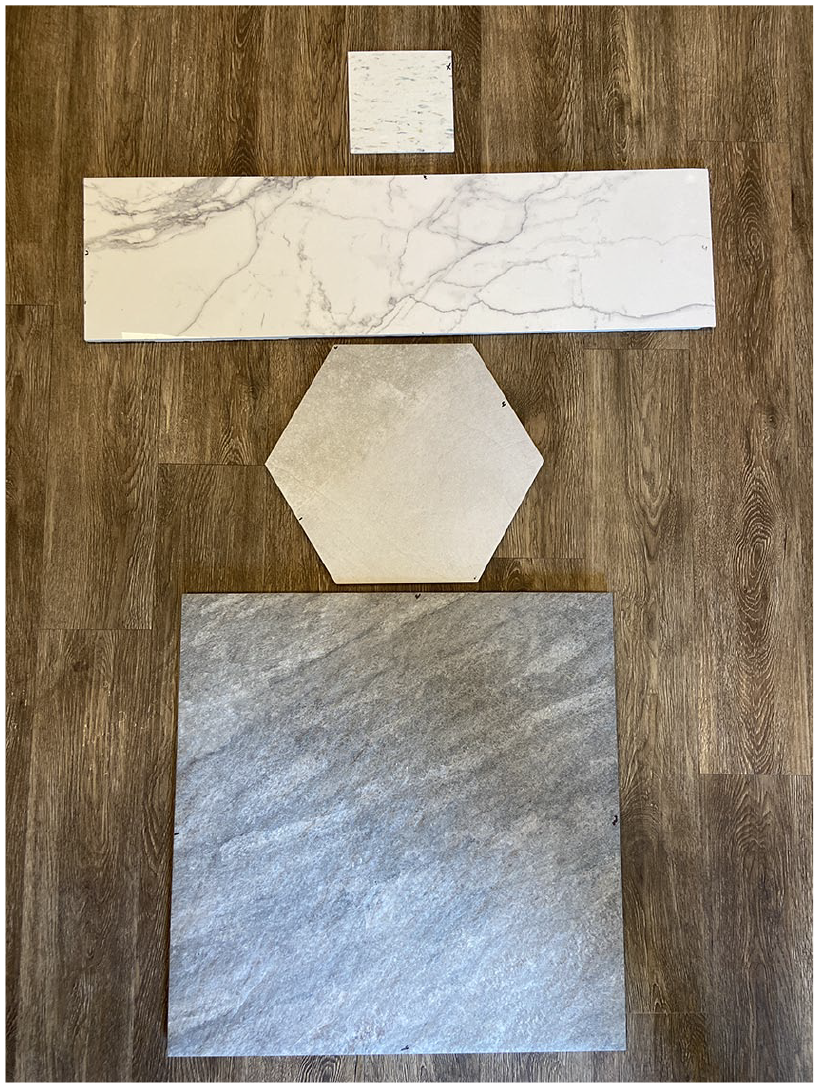
Walking surface materials.
We selected a variety of different contaminants that can be found in public environments, such as retail and grocery stores. Specifically, we chose contaminants including beverages, condiments, personal cleaning products, and dry goods. It should be noted that the first author of this publication has personally investigated and analyzed injury incidents involving a pedestrian slipping on each type of contaminant used in this study. The beverages we selected included Water, Coca-Cola, Diet Coca-Cola, Orange Juice with No Pulp, Orange Juice with High Pulp, Fat Free Milk, and Whole Milk. For condiments, we selected Ketchup, Mustard, and Mayonnaise; for personal cleaning products, we selected Hand Sanitizer Gel and Liquid Hand Soap. Finally, we also chose to measure the SCOF/slip resistance of the surfaces when they were contaminated with dry goods including sugar, cornmeal, and oats. Figure 2 below depicts the liquid/semi-liquid contaminants including beverages, condiments, and personal cleaning products selected for our study. Figure 3 depicts the dry goods selected for our study.
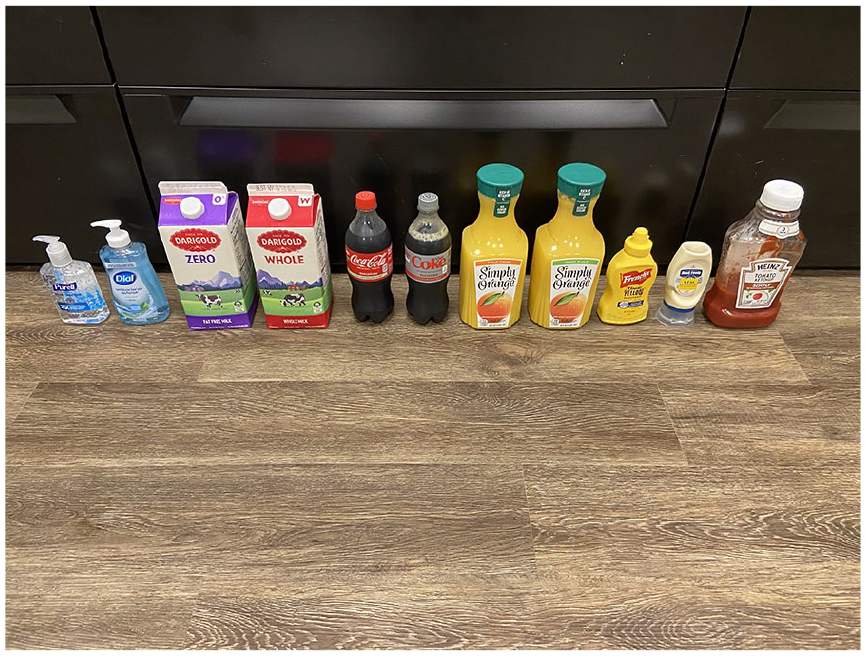
Liquid/semi-liquid contaminants.
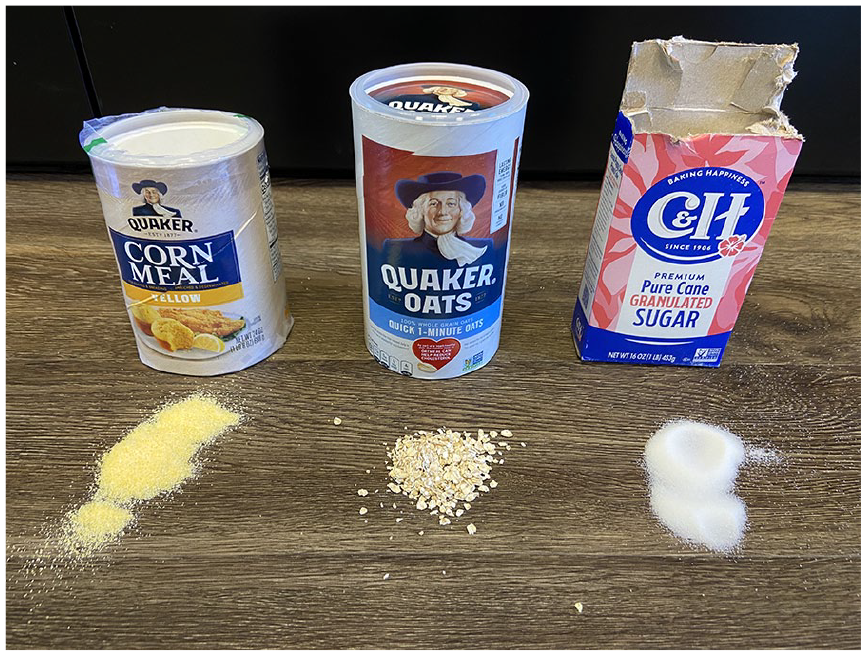
Dry goods.
Experimental Procedures
After obtaining the “contaminants” used in the study, the various beverages and condiments were placed in the refrigerator to bring them to a consistent temperature of approximately 40ºF. The personal cleaning products and the dry goods were left at a “room temperature” of approximately 70ºF.
Before performing any measurements, the tribometer’s calibration was verified using a certified calibration tile while following the testing procedure outlined in the English XL VIT’s current User Guide. Prior to testing, each flooring surface was cleaned with warm water and dish soap then allowed to completely dry. This procedure was performed after each set of measurements for any given combination of flooring material and contaminant to ensure that the flooring surface was in a clean condition prior to performing measurements with a new contaminant. Additionally, after each set of measurements for any given combination of flooring material and contaminant, the tribometer’s neolite rubber test foot was cleaned with warm water and dish soap, then allowed to dry completely before it was sanded for the next set of measurements.
Initially, the calibrated English XL VIT was used to measure the Static Coefficient of Friction (SCOF) of each flooring material following the protocol outlined in the English XL VIT User Guide for dry testing; each of the dry SCOF measurements was recorded. Following dry testing, the slip resistance of each flooring material and contaminant combination was measured by following the protocols outlined in the English XL VIT User Guide.
When performing testing with the beverages, an “unbroken film” of the liquid was placed on the flooring material, which is consistent with the test protocol outlined in the User Guide. For condiments and personal cleaning products, approximately one tablespoon of the contaminant was used for the testing and was generally replenished after each “slip” because the “slip” would cause some of the contaminant to often be thrown forward off the flooring material. When testing the dry goods, approximately ½ teaspoon of cornmeal or sugar were placed on the surface to create a thin layer of contamination. However, because the oats were much larger/coarse than both the cornmeal and sugar, a full tablespoon of oats was used to ensure that there was adequate surface area for the neolite test foot to strike the oats without also encountering a significant portion of the flooring material on which it was placed.
Results
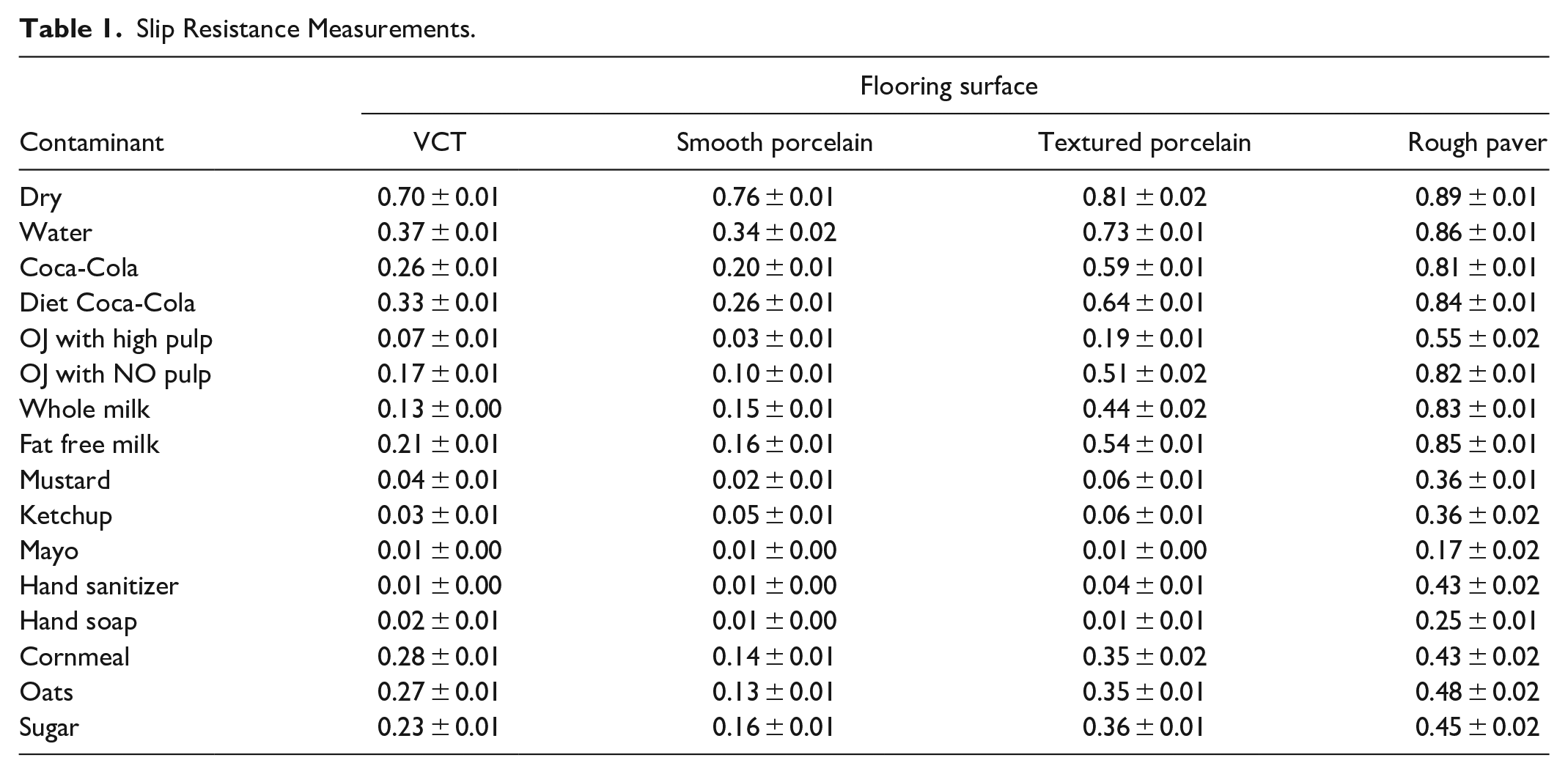
Table 1 below displays the results of the testing performed in this study. On the left side of the table, the various contaminants are displayed. At the top of the table, the various flooring surfaces are displayed. Finally, each cell in the table displays the average measured slip resistance value along with the standard deviation of the sample.
Slip Resistance Measurements.
Discussion
There were two main purposes of this study. The first was to determine whether the English XL VIT could reliably measure the slip resistance of walkway surface contaminants other than just plain water, including semi-liquids and dry goods. The second was to evaluate the effects that various walkway surface contaminants had on the SCOF/slip resistance when they were placed on various flooring surfaces.
The findings from this study showed that the English XL VIT did reliably measure the slip resistance of the various walkway surface contaminants when they were placed on various flooring materials. For example, the User Guide for the English XL VIT recommends a maximum standard deviation of 0.03 when measuring relatively uniform walkway surfaces. As seen in Table 1 above, every contaminant and flooring surface combination resulted in a standard deviation that was less than 0.03. In short, our findings showed that when using a calibrated English XL VIT while following the test protocol outlined in the User Guide, the slip resistance of walkway surface contaminants including liquids, semi-liquids, and even dry goods can be reliably measured.
Each flooring material that we selected had a SCOF well above 0.50 when dry, indicating that such floors would be “safe” and “slip resistant” when they are in a clean and dry condition. However, the smooth “marble” tile and the VCT were both slippery and hazardous when wet with water alone, whereas the textured porcelain and the rough textured paver were both “safe” and “slip resistant” when wet with water. The “marble” tile and VCT being slippery and hazardous when wet is not surprising given they are smooth non-porous surfaces that do not have prominent surface asperities (i.e., microscopic peaks and valleys) to provide a high resistance to slipping.
This is of particular concern as smooth porcelain/marble and VCT flooring are surfaces that are often found in environments that are at risk of getting wet with water and other contaminants, such as in hotel lobbies, restaurants, and retail/grocery facilities. While such surfaces may be easier to clean and have a visually attractive appearance, they typically expose pedestrians to a serious risk of slipping and falling when they are wet due to their low resistance to slipping. This is of particular concern because smooth porcelain/marble and/or VCT are often “shiny” and produce specular reflection that tends to mask the presence of clear liquids, especially small amounts. This increases the risk of a pedestrian not detecting the contamination and unexpectedly stepping into it where they are at risk of experiencing a sudden decrease in traction due to the low resistance to slipping that wet smooth porcelain/marble and VCT typically provides.
While water is a lubricant that generally decreased the slip resistance of each flooring material relative to when each surface was dry, several of the beverages were even more “slippery” and resulted in even lower slip resistance values. For example, the presence of Diet Coca-Cola resulted in each surface having a lower slip resistance than when it was wet with water. Notably, the presence of regular Coca-Cola, which contains a high amount of sugar, resulted in measurements that were even lower than Diet Coca-Cola.
This same type of trend was observed when comparing different types of orange juice (i.e., no pulp and high pulp). For example, Orange Juice with No Pulp was more slippery than water alone and resulted in the slip resistance of the “marble” tile and VCT being generally comparable to the slip resistance of rubber on ice. However, the Orange Juice with High Pulp was even more slippery than the Orange Juice with No Pulp. For example, the Orange Juice with High Pulp resulted in average slip resistance values of 0.03 ± 0.01 and 0.07 ± 0.01 for the “marble” tile and VCT, respectively. Such values are extremely slippery and hazardous for pedestrians, and they expose pedestrians to a serious risk of slipping if they were to encounter these conditions. This data suggests that the presence of the “high pulp” content reduces the friction due to the pulp creating a greater separation between the pedestrian’s shoe sole and the flooring material itself.
Similar to the discussion above, the Fat Free Milk and Whole Milk had different slip resistance values, with the Whole Milk being more “slippery” than the Fat Free Milk. This is not surprising given that fats and oils are known to have lubricating effects that make surfaces more slippery due to the decreased friction. Notably, the textured porcelain tile in our study generally had a high resistance to slipping when wet with water (i.e., an average of 0.73); however, when it was contaminated with whole milk, the slip resistance dropped to 0.44, which is below the generally accepted “safe” value of 0.50.
When measuring the slip resistance of the various flooring materials when contaminated with Ketchup, Mustard, and Mayonnaise, we found that each condiment resulted in a significant decrease in slip resistance compared to when the surfaces were dry or wet with water. Specifically, the presence of these condiments on the “marble” tile, the VCT, and even the lightly textured porcelain tile resulted in extremely slippery conditions. That is, the combination of any of the selected condiments on any of these three flooring materials resulted in an average slip resistance of 0.06 or below. Such a low resistance to slipping creates extremely slippery and dangerous conditions for pedestrians that put them at high risk of slipping. Notably, the rough textured paver was found to have high slip resistance when wet with water (i.e., an average of 0.86) that would make a pedestrian slip highly improbable. However, when the paver became contaminated with any of the three condiments selected in our study, it dropped well below the “safe” value of 0.50. This data indicates that condiments like Ketchup, Mustard, and Mayonnaise, which are generally more vicious than other liquids like water, soda, and juice, can create a slip hazard for pedestrians even on surfaces that are otherwise “slip resistant” and “safe” even when wet with water.
The personal cleaning products were also found to be dangerously slippery when they were placed on the various walkway surfaces, including the rough textured paver. Consistent with the condiments, the Hand Sanitizer and Hand Soap were both more viscous contaminants that would be more prone to creating a larger separation between the shoe sole and the walkway surface.
The presence of the selected dry goods also illustrated that such contaminants can create a slip hazard when they fall onto a walkway. For example, all three dry goods had an average slip resistance comparable to rubber on ice when they were placed on the VCT flooring. Similarly, when the dry goods were placed on the “marble” tile and the lightly textured porcelain tile, the slip resistance was still significantly below the “safe” value of 0.50, which illustrates that such contaminants can create a slip hazard. Finally, it should also be noted that despite the rough textured paver being highly slip resistant when wet with water, the presence of dry goods decreased the slip resistance to below the “safe” value of 0.50.
The findings from this study are particularly important as they relate to pedestrian safety, as they indicate that a variety of contaminants can result in dangerously slippery conditions that expose pedestrians to a slip hazard. This is particularly important in environments that operate with a “self-service” mode of operation, such as grocery or retail stores, where patrons routinely interact with merchandise that can be dropped, spilled, and/or leaked throughout the store. In these types of facilities, it is relatively common for the walkway surface to be constructed of a relatively smooth non-porous surface that is easy to clean. However, the findings of this study indicate that when the floor inevitably becomes contaminated with contaminants such as those in this study, pedestrians will be exposed to a potential slip hazard given the propensity for such contaminants to lower the slip resistance of the walkway and create a potential slip hazard for pedestrians.
The results of this study indicate the need for an entity responsible for safety to proactively minimize the risk of slipping by installing high-traction flooring surfaces in areas where it is predictable that contamination will fall on the floor. Additionally, the predictable presence of contaminants that are viscous in nature and which can significantly lower the slip resistance of even rough surfaces, like condiments and personal cleaning products like sanitizer gels and soaps, underscores the importance of developing a robust safety plan to identify such contaminants and mitigate them in a timely manner to decrease the risk of pedestrians being exposed to stepping into/onto them and experiencing a potential slip and fall incident, which can result in severe consequences.
Conclusion
The findings of this study show that the English XL VIT is capable of reliably measuring the slip resistance of contaminants other than just water, including various beverages, condiments, cleaning products, and even dry goods. The findings also showed that relatively smooth floor materials such as “marble” tile and VCT, both of which are often found in environments that are at risk of becoming contaminated, provide low resistance to slipping and expose pedestrians to a slippery and hazardous condition. Finally, this study showed that contaminants, particularly those that are more viscous in nature, can create potential slip hazards for pedestrians even on a surface that is otherwise “slip resistant” and “safe” for pedestrians when wet with water.
This study was limited to four different types of flooring materials and a limited set of contaminants. Further studies using additional flooring materials and additional contaminants would provide more information about the slip resistance properties of walkway surface contaminants on different types of flooring surfaces.
Additionally, all tests were performed with an English XL VIT. Practitioners and researchers should use caution when generalizing these results to the results obtained with other tribometers.
Footnotes
Declaration of Conflicting Interests
The author(s) declared no potential conflicts of interest with respect to the research, authorship, and/or publication of this article.
Funding
The author(s) received no financial support for the research, authorship, and/or publication of this article.