



Abstract
There has been little research comparing patients’ perceptions of the quality of care in outpatient and inpatient settings between general and specialized hospitals. This study aimed to address this gap by examining 1,337 outpatients and 1,833 inpatients across all general (n = 5) and specialized (n = 7) tertiary public hospitals in a major city in China. Patients’ perceptions of the quality of care were assessed across six dimensions: safety, tangibility, reliability, responsiveness, assurance, and empathy. Dimension gap scores were used to compare perceptions of each dimension between the two hospital types, and statistical differences were determined using the Wilcoxon signed-rank test. Negative dimension gap scores were identified in the safety, tangibility, reliability, responsiveness, assurance, and empathy of outpatient and inpatient care in general and specialized hospitals, except for the tangibility of inpatient care in general hospitals. The negative dimension gap scores for specialized hospitals were significantly larger than those for general hospitals across all six dimensions of both inpatient and outpatient quality of care, except for assurance of inpatient care. Overall, outpatients and inpatients in both general and specialized hospitals did not experience the care they expected, and outpatient and inpatient care in specialized hospitals were perceived as lower quality than in general hospitals. Patient perceptions indicated that both outpatient and inpatient care in both general and specialized hospitals need further enhancements.
Introduction
Numerous studies have compared the quality and cost of care received in general and specialized hospitals to determine whether specialized hospitals offer higher-quality care at a lower cost (Barro et al., 2006). However, these studies have produced inconsistent results, making it difficult to draw definitive conclusions. In addition, to make these comparisons, most studies have focused on objective patient outcomes (e.g., mortality and postoperative complications), while only a few have considered patient perception. Patients’ perception of the care they have received are important metrics that can help identify areas in the care-delivery process that should be improved (Campbell et al., 2000; Xie & Or, 2017). Moreover, the limited research into patient perception of quality of care has not included examination of outpatient and inpatient care, and there have been methodological limitations in terms of the unstandardized identification of specialized hospitals and the use of a limited single indicator to measure patients’ perception of quality of care (Siddiqui et al., 2014; Vera et al., 2018). Therefore, it is difficult to know whether patients consider specialized hospitals to provide better outpatient and inpatient care than general hospitals.
In the present study, we assessed and compared patients’ perceptions of the quality of care received in both outpatient and inpatient settings in general and specialized tertiary hospitals. These hospitals had comprehensive medical, teaching, and scientific research capabilities, and they provided high-level specialist care across regions, cities, and provinces within China’s three-tier health system.
Methods
Hospitals and Participants
In 2019, we conducted a comparative cross-sectional questionnaire survey of 522 outpatients and 898 inpatients from five general hospitals, and 815 outpatients and 935 inpatients from seven specialized hospitals, in a major city (Shenzhen) in China. Outpatients who had finished their visits, and inpatients who had a minimum of three consecutive days of hospitalization were invited to complete the study questionnaire. Acutely ill patients, critically ill patients, and patients with mental health conditions were excluded. Sample size for outpatients and inpatients from each sampled hospital was determined based on the monthly outpatient visits and inpatient discharges. A convenience sampling technique was used to recruit outpatients from the outpatient departments and inpatients from the wards within the hospitals. Written informed consent was obtained from all participants before they completed the study questionnaire.
Instruments and Scoring
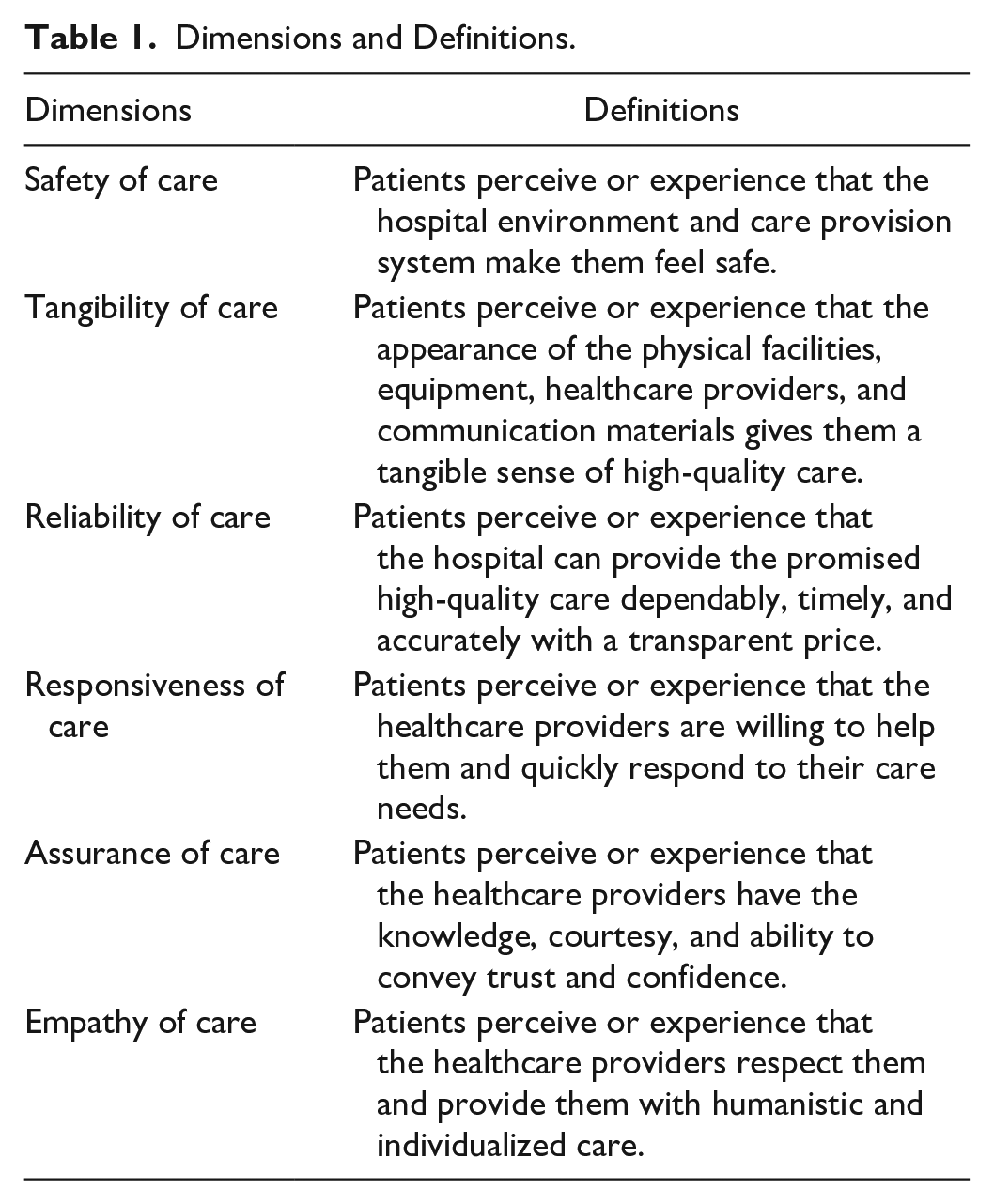
Two questionnaires were developed based on the SERVQUAL model: one with 23 items to assess the quality of outpatient care, and another with 22 items to measure the quality of inpatient care (Lin et al., 2022; Parasuraman et al., 1988). Quality of care was assessed across six dimensions: safety (five items for outpatient care; four items for inpatient care), tangibility (four items), reliability (three items), responsiveness (four items), assurance (three items), and empathy (four items). The definitions of the six dimensions are presented in Table 1. In the survey, outpatients and inpatients were asked to rate the importance, expectation, and experience of each item using a 9-point Likert scale ranging from 1 (extremely unimportant/low/bad) to 9 (extremely important/high/good).
Dimensions and Definitions.
Primary Outcomes
The primary outcomes of the study were the dimension gap scores for the six dimensions calculated for the four patient groups (outpatients and inpatients in general and specialized hospitals). The scores were obtained in three steps.
Item Gap Scores for Each Patient
First, we started by calculating the item gap score for each item for each patient. This score was the difference between the patient’s scaled experience and the expected scores for the item multiplied by the weight assigned to the item by the patient. The weight of each item for each patient was determined by dividing the item’s importance score by the sum of the importance ratings for all 23 (outpatient care) or 22 (inpatient care) items scored by the patient.
Item Gap Scores for Each Patient Group
Next, the item gap scores for each patient group were computed. These scores were calculated for each item by averaging all patients’ item gap scores within each patient group.
Dimension Gap Score for Each Patient Group
Finally, the dimension gap score for each patient group was computed by averaging the item gap scores for all items in that dimension. A negative dimension gap score indicates that the actual quality of the care in the quality of care dimension, as experienced by patients, fell short of their expectations. This indicates that patients’ care expectations were unmet and improvements in this area should be considered. In general, a larger negative dimension gap score indicates a greater difference between patient experience and expectations, suggesting that the dimension requires more attention and improvement.
Statistical Analysis
The Wilcoxon signed rank test was used to compare the dimension gap scores in the outpatient and inpatient settings between general and specialized hospitals. The significance level was set at p < .05.
Results
Figures 1 and 2 present the results of the assessment and comparison of patients’ perceived quality of care in the outpatient and inpatient settings, respectively, in general and specialized hospitals. As shown in Figures 1 and 2, the dimension gap scores for the six dimensions of outpatient care in the general and specialized hospitals and inpatient care in the specialized hospitals were all negative. For inpatient care in general hospitals (Figure 2), the dimension gap score for tangibility was positive (mean = 0.0017), while the dimension gap scores for the other five dimensions were negative.
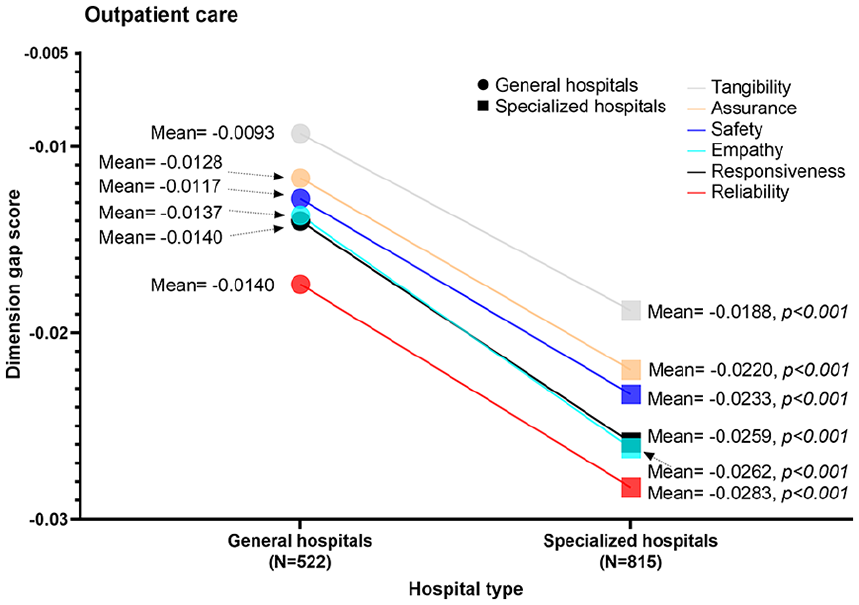
Mean dimension gap scores for six dimensions of outpatient care quality sorted by hospital type.
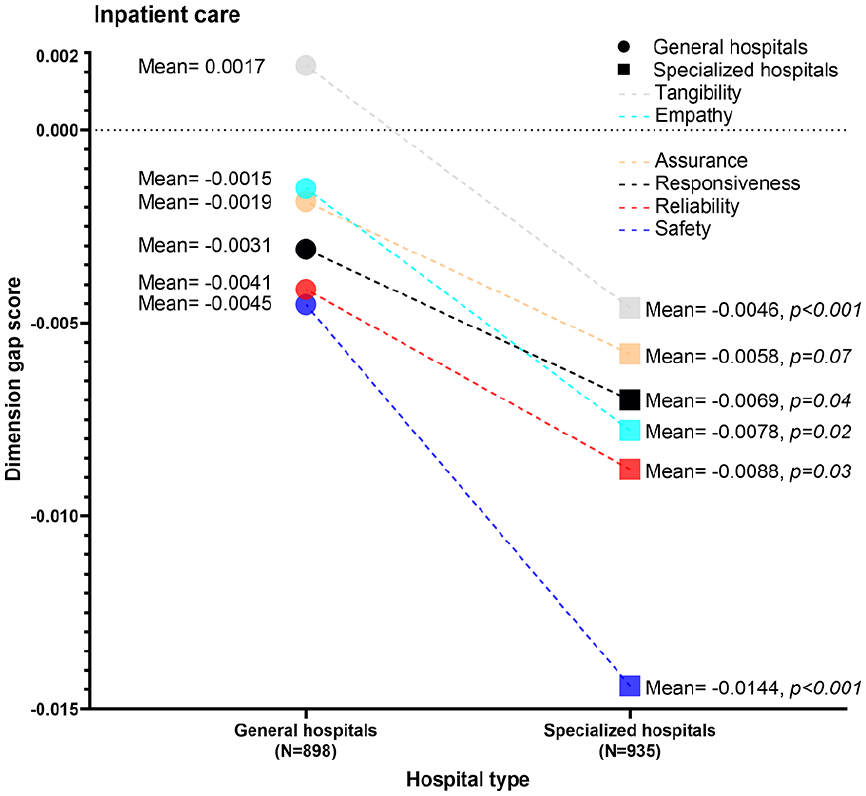
Mean dimension gap scores for six dimensions of inpatient care quality sorted by hospital type.
In both the general and specialized hospitals, the largest negative dimension gap score for outpatient care was identified for reliability (Figure 1, general hospitals: mean = −0.0140 vs. specialized hospitals: mean = −0.0283), while for inpatient care, it was identified for safety (Figure 2, general hospitals: mean = −0.0045 vs. specialized hospitals: mean = −0.0144).
Except for assurance of inpatient care (p = .07), the negative dimension gap scores for specialized hospitals were significantly larger than those for general hospitals across all six dimensions of both inpatient and outpatient quality of care (p < .05).
Discussion
The observed negative dimension gap scores indicate that outpatients and inpatients in both general and specialized hospitals did not experience the care they expected in terms of safety, tangibility, reliability, responsiveness, assurance, or empathy. The only exception was for the tangibility of inpatient care in general hospitals, which had a positive dimension gap score. The results suggest that improvements are needed in areas corresponding to these dimensions to enhance patient experiences in both general and specialized hospitals. In light of our findings, the reliability of outpatient care and safety of inpatient care require the most urgent improvements. Specifically, based on the definition of the six dimensions and the measurement items we used, to improve the reliability of care, hospitals should provide more dependable, timely, and accurate care, along with transparent pricing. To improve the safety of care, hospitals should enhance the hospital environment and care provision system to make patients feel safer.
Our finding of lower negative dimension gap scores for general hospitals suggests that patients perceived the quality of outpatient and inpatient care in general hospitals to surpass that of specialized hospitals. These findings contradict previous research that suggested that specialized hospitals provide higher-quality care, as demonstrated by fewer adverse outcomes after total knee replacement (Cram et al., 2007), better long-term survival after ovarian cancer treatment (Vernooij et al., 2007), and a lower risk of having coexisting conditions after a percutaneous coronary intervention or coronary-artery bypass graft (Cram et al., 2005) in specialized hospitals compared with general hospitals. The results further highlight the necessity of considering patients’ perceptions as a component of quality of care assessments. Previous studies of patients’ perceptions of quality of care, using single indicators such as overall rating (Vera et al., 2018) and willingness to recommend (Siddiqui et al., 2014) as measurements, found that patients perceived the quality of care to be better in specialized hospitals. However, due to differences in measurement methods, comparisons between these previous findings and our findings should be made with caution. Future studies should explore the factors that have contributed to the negative dimension gap scores for outpatient and inpatient care in the two types of hospitals. These explorations will help hospital managers to develop strategies to improve care and better meet patients’ needs.
Conclusions
Patient perceptions indicated that both outpatient and inpatient care in both general and specialized hospitals need further improvements. To achieve this, changes must be made to further enhance the quality of care in terms of safety, tangibility, reliability, responsiveness, assurance, and empathy.
Footnotes
Declaration of Conflicting Interests
The author(s) declared no potential conflicts of interest with respect to the research, authorship, and/or publication of this article.
Funding
The author(s) disclosed receipt of the following financial support for the research, authorship, and/or publication of this article: This study was supported by the National Natural Science Foundation of China—Youth Science Fund (Grant Nos. 7200040839; Principal Investigator: Dan Zhang).