



Abstract
Vote-by-Mail (VBM) has become increasingly popular over the last decade, but the process is executed differently even between jurisdictions within the same state. Currently, most VBM literature focuses on topics from the perspective of political science, and little-to-no work features analysis of operational aspects or human-machine interactions. Depending on the jurisdiction size, these VBM process steps are executed by humans, machines, or a combination of machines supporting humans. The opening-extraction process step of envelope opening and ballot extraction is always necessary. Therefore, the literature needs to consider the process execution of VBM ballots, the possible support of machines, and human-machine interactions in the VBM tabulation processes. This study compares two opening-extraction options to open envelopes and extract ballots in the VBM tabulation process. This research demonstrates that no one system of opening-extraction is generally better than the other, but some trade-offs need to be considered.
Introduction
Even though the procedure of processing votes is different and decentralized throughout the United States (U.S.) (National Conference of State Legislatures, 2023a), the operational objective of elections remains the same—to count the voters’ choice for a particular ballot question. Even jurisdictions in the same state may execute the Vote-by-Mail (VBM) process differently, sometimes doing the same thing as neighboring counties and sometimes doing steps that are wholly their own (Otte et al., 2023). Therefore, methods for achieving a common goal may have different executions.
The opening-extraction process step of opening envelopes and extracting ballots is always necessary in the VBM process; however, several differences have been observed between various counties across the U.S. One opening-extraction option is to use a machine that has integrated the opening of the envelopes on two sides and holds the envelope open for access to the ballot, so the worker can grab the ballot with one hand, which would be considered as one process step. Other opening-extraction options use a machine to open the envelope on one side, but the extraction of the ballot occurs manually, separate from the envelope-opening machine, or all steps are done manually, without any machine assistance. Usually, one envelope contains one ballot. Often, the choice depends on the jurisdiction’s size and available equipment and staff resources, but it can also be a preference of the election official.
A significant portion of the current VBM literature focuses on topics from the perspective of political science concerning voter turnout or voter behavior, and little-to-no work features operational aspects or human-machine interactions. Additional research is needed regarding the overall VBM process, the manual and machine-assisted steps, the execution of ballot processing, and the operational procedures. The foremost publication on processing times, rates, and distributions of the VBM processes is from 2023 (Otte et al., 2023). Therefore, more research needs to be conducted on the execution processes of VBM ballots, the possible support of machines, and human-machine interactions in the VBM processes.
This study compares two opening-extraction options to open envelopes and extract ballots in the VBM process. The analysis includes a general description of the procedure options for opening and extraction and reporting the processing rates per process step and the total combined. A simulation model is used to determine the processing times for the connected process steps. The findings, as well as the processing times, may assist election administrators in making data-informed process decisions.
Background
The option to vote by mail has become increasingly popular over the last decade (Stewart III, 2023). In states that hold all mail elections, every registered voter receives a ballot by mail that they may return through the postal service, drop boxes, or they are deciding to vote in-person at polling locations or state offices (McGhee et al., 2020; National Conference of State Legislatures, 2024a). In other states, voters need to request a VBM ballot before the election, with some states requiring a valid excuse for the request before receiving a ballot by mail (National Conference of State Legislatures, 2023b, 2024b). The VBM procedure to process and tabulate ballots is based on state and county regulations as well as the preferences and experiences of the local election officials in charge (National Conference of State Legislatures, 2023a). The following steps are included in processing VBM ballots: opening the outer and inner envelope to extract the ballot and unfolding the ballot to tabulate and count the voter’s selections (Otte et al., 2023). Depending on the size and preferences of the jurisdiction, some of these process steps are executed by humans, machines, or a combination of machines supporting humans (Otte et al., 2023).
Research has been conducted on the VBM system from various perspectives, like voter turnout (Barber & Holbein, 2020; Berinsky et al., 2001; Gronke & Miller, 2012; Kousser & Mullin, 2002, 2007; McGhee et al., 2020; McGhee et al., 2022; Monroe & Sylvester, 2011; Southwell, 2010), ballot errors like undervotes and residual votes (Alvarez et al., 2012; Menger et al., 2018), and VBM voter demographics (Plescia et al., 2021). However, there is limited research on the VBM process itself and its performance. The foremost publication on processing times, rates, and distributions of the VBM processes is from 2023 (Otte et al., 2023), which provides times per process step but does not consider the total time of multiple process steps performed in sequence.
In the broader area of elections, researchers have analyzed how the performance of elections can be measured (Alvarez, 2009; Stewart III, 2018). For instance, the Caltech/MIT Voting Technology Project explored, at the beginning of the 2000s, the performance of used voting technology and recommendations to improve it (Voting Technology Project, 2001). Over the subsequent years, the Caltech/MIT Voting Technology discussed methods to measure the performance of elections and options to evaluate voting experience (Voting Technology Project, 2001); these ideas inspire the Election Performance Index, which measures 17 factors, like turnout, voting wait time, and voter registration rate, to estimate the performance of an election in each U.S. state (Stewart III, 2018). These performance measurements evaluate turnout and the voting experience aspects of an election but do not consider the performance of the process of voting and counting ballots itself.
For in-person voting systems, researchers have evaluated process performance under various conditions, like the COVID-19 pandemic (Bernardo et al., 2022; Schmidt & Albert, 2022), the layout of voting equipment (Bernardo et al., 2020; McCool-Guglielmo et al., 2022), resource allocation strategies (Bernardo & Macht, 2022; Bernardo et al., 2020), and robustness against disruptions (Simidchieva et al., 2010). The researchers McCool-Guglielmo et al. (2022) investigated the impact of different room layouts of a two-step voting process with discrete-event simulation on an in-person voting system. Whereas, Bernardo et al. (2020) used a discrete-event simulation model to analyze differences in voting process performance by changing the layout and the number of resources per vote center under COVID regulations. Discrete-event simulation is used in other fields like manufacturing (Huynh et al., 2020; Riskadayanti et al., 2019; Roy, 1998; Velumani & Tang, 2017) and health care (Berg et al., 2009; Günal & Pidd, 2010) as well to explore the process performance of the whole system or specific aspects. This research will expand upon the utilization of simulation in election systems, while presenting comparable performance outcomes for multiple different processes.
Regarding human factors and ergonomics of these environments, there is no literature in this VBM area. However, it is known throughout election science that the number of workers available to do these jobs is reducing, and recruiting is becoming more difficult. Not only that, but the option to VBM nationally is gaining more traction, so understanding the tradeoffs between the traditional question of humans or machines for processing is omnipresent. Therefore, the time to start assessing these challenges with an HF/E lens is becoming more critical.
Research on process performance has been conducted in various fields, with different perspectives; however, there is no research on the process performance for the VBM process.
Methodology
This analysis focuses on VBM envelope opening-extraction options: (a) using a machine to open envelopes and hold the envelope open to give easy access to the ballot for the worker to extract it as one connected process step, and (b) using a machine only to open envelopes as a process step, and where workers extract ballots from envelopes without machine support as a separate process step. Therefore, time studies of the process steps described will be statistically and deterministicly assessed through discrete-event simulation. This comparison aims to describe a processing performance overview of the opening-extraction process options employed in VBM operations and estimate the efficiency of machine usage.
Data Collection
Time studies were conducted in the Salt Lake City region of Utah to understand the VBM process. For this paper, the following anonymized counties are considered:
Small County (28,570 registered voters)
Medium County (191,890 registered voters)
Large County (591,999 registered voters)
The time studies of VBM systems were conducted in each county during the midterm election in 2022 over multiple days preceding and on Election Day. The medium and large counties use a machine that combines the envelope opening and ballot extraction tasks in one process step (see Option 1 in Figure 1). The small county performs the tasks of opening the envelope and extracting the ballot as separate processing steps, as seen in Option 2 in Figure 1, but the task of extraction is combined with the task of unfolding the ballot for tabulation.
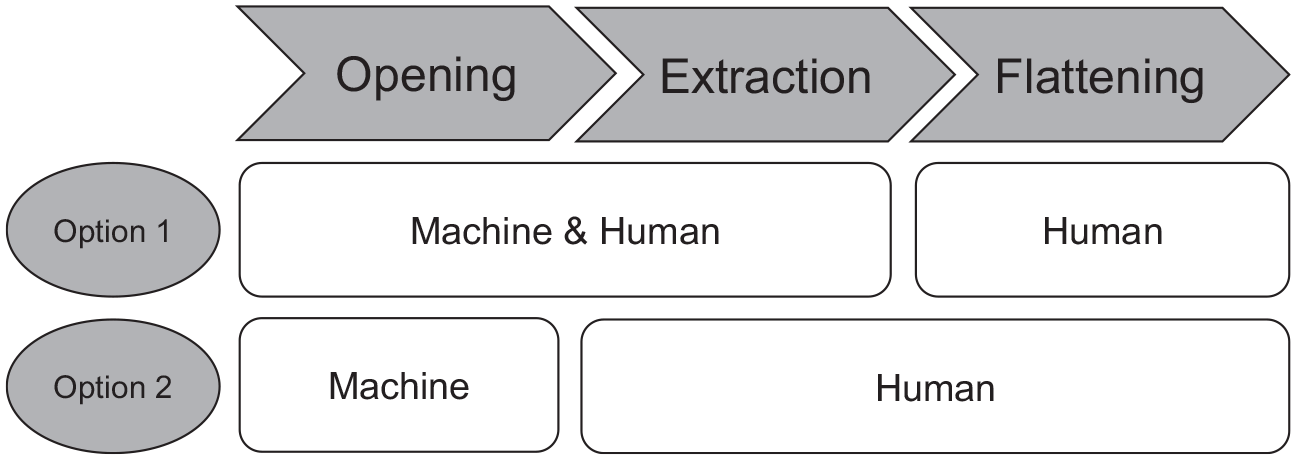
Opening and extraction options.
Data Cleaning
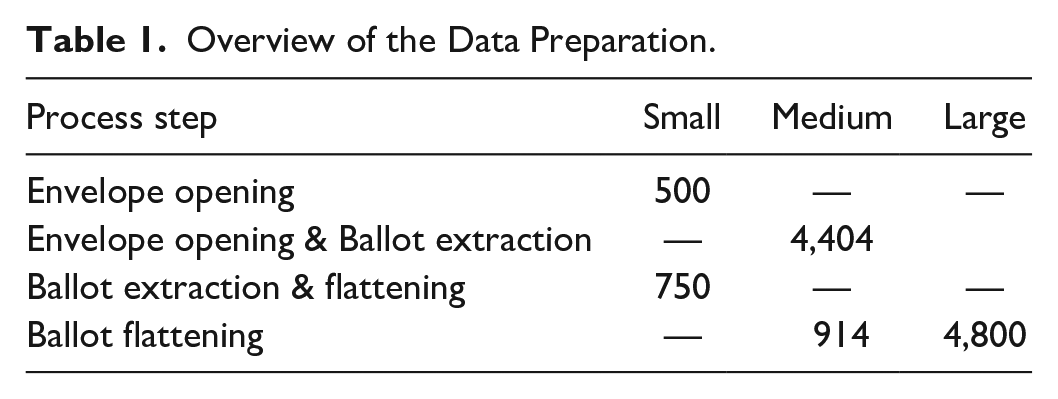
Prior to moving forward with the data, process step names are standardized throughout all data sets from the different counties and observers. Through this data preparation stage, the process steps of Envelope Opening, Envelope Opening & Ballot Extraction, Ballot Extraction & Flattening, and Ballot Flattening were extracted from the overall dataset of VBM processing times. The data were cleaned, and video recordings of process steps were coded to generate data per processing step considered in this analysis.
All data points with a zero value for the duration were eliminated from the data set. These zero values were considered invalid and removed as processing times are inherently positive, non-zero values in nature. An additional column denoting the batch size was added to indicate the number of envelopes processed per recorded time study in each county. The batch size determined the process step’s duration per ballot, allowing for accurate process comparisons between counties with different batch sizes and the generalizability of processing times. For example, with a batch size of 100, the duration per ballot is calculated by dividing the total duration by 100. To represent all observed ballots from a batch in the dataset, the duration per ballot is included in the adjusted dataset as many times as there are ballots in a batch. In this case, the duration per ballot value would appear 100 times in the dataset.
Table 1 provides an overview of the amount of opening and extraction data used for the following statistical analysis.
Overview of the Data Preparation.
Statistical Approach
The collected and cleaned data observations are statistically analyzed to identify processing rates and distributions for the various stages of the opening-extraction processes.
Firstly, the descriptive statistics for each process step per county are determined. Secondly, the Mann-Whitney U-Test is performed to identify statistical similarities between different counties and investigate whether they can be merged (Mann & Whitney, 1947). The dataset from two counties can be merged if the p-value exceeds .05. Lastly, Anderson-Darling-and Kolmogorov-Smirnov test statistics (Anderson & Darling, 1952; Smirnov, 1939) are computed to fit distributions quantitatively and are visually assessed for the Goodness-of-Fit to each process step. The corresponding distribution parameters are identified and presented for each process step in a county.
Simulation Analysis
A discrete-event simulation model is used to compare different opening-extraction options to open envelopes and extract ballots in VBM. This simulation model determines the throughput time of the ballots through all process steps of each opening-extraction option per county. The determined throughput time, as well as the previously ascertained processing times per process step, will be used to evaluate the performance of the two opening-extraction options.
In the simulation model, each station represents one processing step with its bespoke processing time as a statistical distribution. The capacity of the station is one, meaning that ballots are processed one at a time. The connection between the stations does not include any transportation time. The arrival time is an exponential distribution with a lambda of 1 to ensure an arrival rate of one ballot per hour to exclude the wait time between stations in this scenario. The number of replications for each county is 20.
Results
This section presents the statistical analysis results of the processing times and rates for each opening and extraction process step in a county and the throughput time for both process steps followed by each other with a discrete-event simulation model.
Descriptive Statistics
The descriptive statistics and 95% Confidence Intervals (CI) for the processing rates were statistically evaluated through a Mann-Whitney U-Test (Mann & Whitney, 1947) and are reported in Table 2.
Descriptive Statistics & Distributions of the VBM Process Steps.
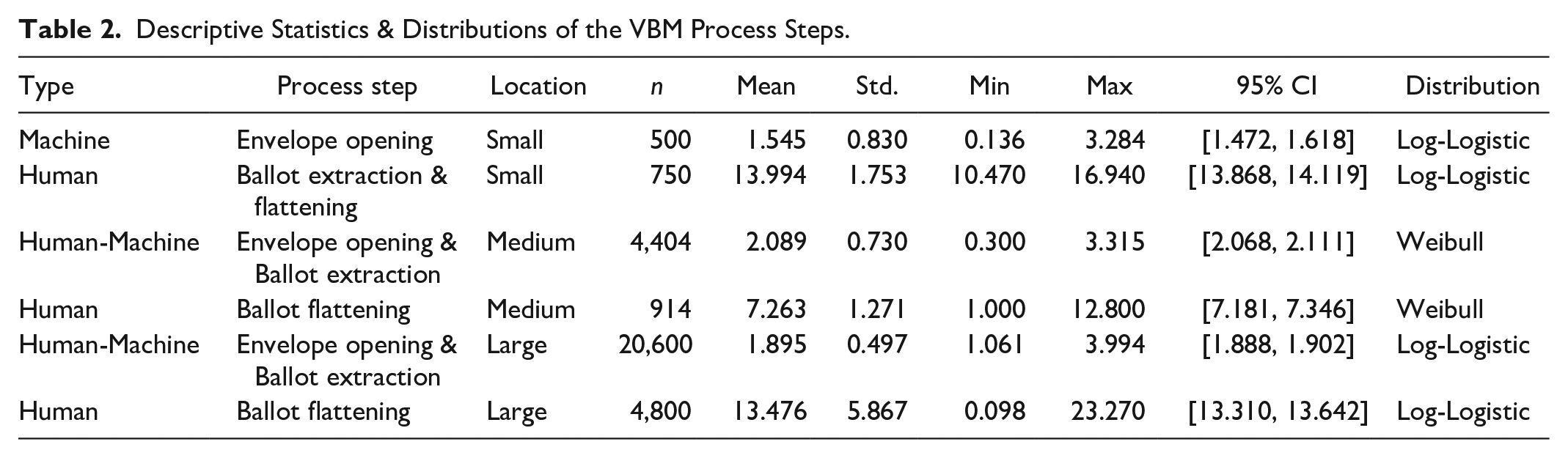
The time to open the envelope and extract the ballot with a machine for the medium county is 95% CI [1.578, 2.275] seconds per ballot and 95% CI [1.815, 2.016] seconds per ballot for the large county. The small county needs 95% CI [0.920, 2.170] seconds per ballot to open the envelope and 95% CI [12.989, 14.998] seconds per ballot to extract and unfold the ballot as one process step. The processing speed of unfolding the ballots in the counties must be considered when comparing these times. For the unfolding of the ballot, the medium county needs 95% CI [4.885, 5.696] seconds per ballot, and the large county 95% CI [10.946, 16.007] seconds per ballot.
In addition to the descriptive statistics, the corresponding distributions were determined visually and quantitatively with histograms and the Anderson-Darling- and Kolmogorov-Smirnov test statistics (Anderson & Darling, 1952; Smirnov, 1939). The fitted distributions per process step for each county are illustrated in Table 2.
Simulation Results
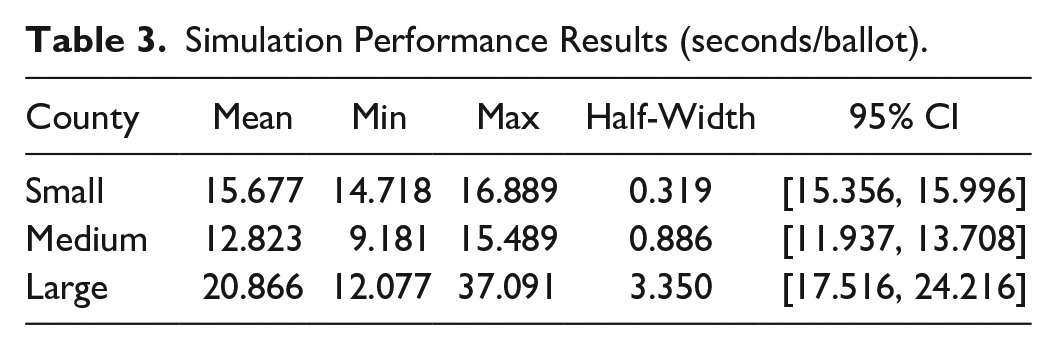
A discrete-event simulation model combines one county’s two connected process steps to determine the throughput time. Option 1’s throughput time is 95% CI [11.937, 13.708] seconds per ballot for the medium county and 95% CI [17.516, 24.216] seconds per ballot in the large county. In contrast, the throughput time for Option 2 is 95% CI [15.356, 15.996] seconds per ballot. The simulation results are shown in Table 3 for direct comparison.
Simulation Performance Results (seconds/ballot).
Discussion
Through the comparison of two opening-extraction options with discrete-event simulation, the results indicate that it is not always faster to use a machine to open and extract ballots like in the large county instead of a simple envelope-opening machine from the small county. However, adding advanced machines to the process can improve processing times, as the medium county demonstrates. This study reveals also that no one option is better than the other. The three considered counties have different numbers of registered voters and, therefore, various demands for ballot processing. In addition, depending on the county, a worker shortage and the high initial cost of machines can impact the decision for or against an opening-extraction system. Furthermore, not every election has the same turnout, so the system should be adaptable to fluctuating demands and should be able to meet the rigid deadlines for election results publication and election certification. The bespoken trade-off between demand per election, worker availability, and cost should be considered before deciding on an opening-extraction option, but the published processing times can give a first indication for a data-influenced decision process.
The challenge with these results is that not one opening-extraction option is better than the other, based on processing times. As the medium county demonstrates, the use of machines can speed up the process, but it can also expose the workers to occupational risks. Comparing these two counties, which use the same equipment for opening envelopes and extracting ballots and a similar procedure to flattening the ballots afterward, shows that the medium county in both processes is faster than the large county. When examining the effects that could lead to this difference in performance, we noted the qualitative differences are the environment in which these election workers execute for a couple of weeks a few times a year. In the observed larger counties, the process locations were in basements or warehouses with little to no natural light, mostly older chairs and tables, limited cosmetic alterations, or empty walls. Meanwhile, the medium space had large windows with glass exit doors, modern adjustable chairs, colorful signage, and walls. Yet, without measurements, we cannot attribute these performance differences to the surrounding working environments. However, with knowledge of human factors and ergonomics, we can encourage election planners to consider the secondary effects of the work environment on seasonal election workers. Examples to consider for improvement are ergonomic chairs, adjustable surfaces/tables, and team-building activities supporting the creation of a friendly and comfortable working space.
This study is one of the first publications to analyze different VBM process options that are necessary parts of the VBM system and compare the process performance of two options. Previously, the Election Performance Index assessed an election by state with survey and statistical data (Stewart III, 2018). To evaluate the election process, researchers (Bernardo et al., 2022; Bernardo & Macht, 2022; Bernardo et al., 2020; McCool-Guglielmo et al., 2022; Schmidt & Albert, 2022; Simidchieva et al., 2010) explored the performance of the in-person voting process using mostly discrete-event simulation as a measurement for evaluation. This research compares two opening-extraction options quantifiably, which are vital to the success of the VBM process.
The opening-extraction phase is vital to the success of the VBM process, and the goal is to put data toward the conversation of different options to execute the opening-extraction procedure. This work stemmed from conversations with election officials who wanted to know which processing option was better, faster, and more affordable because of the flexibility in creating an individual process in the decentralized voting sphere. The results of this study aim to provide election officials and administrators with a baseline for making data-enabled decisions for VBM opening and extracting processes.
As previously discussed, the bespoken trade-offs indicate that just considering the processing times to compare opening-extraction options in the VBM system gives a limited view of the complex system. More factors should be considered in future comparisons to find the right variation for each county. Furthermore, this study only includes two options with processing times from three counties. In upcoming research studies, more counties with similar and different process variations and alternative machines capable of performing the same task should be embraced.
In future research studies, more aspects must be included in this comparison to make a comprehensive decision, such as worker training, capital investment for the machines, labor costs, and machine availability. In addition, the ergonomic aspects and possible drawbacks of performing the work, which include posture, workers cutting themselves on paper, and machine noise, need to be considered.
Conclusion
Opening and extracting mail ballots from their envelope can occur in various ways in the VBM system. Two options are presented, compared, and evaluated in this paper. The results show that no one system is generally better than the other. Trade-offs, like the number of registered voters, shortage of poll workers, and machine cost, need to be considered per county.
This study can support election officials and administrators planning to implement the VBM process in their jurisdiction or planning to expand or update their current process. These research findings can impact future election planning, such as necessary investment, number of resources (e.g., equipment, space, labor), and start time of counting and tabulating votes.
Footnotes
Declaration of Conflicting Interests
The author(s) declared no potential conflicts of interest with respect to the research, authorship, and/or publication of this article.
Funding
The author(s) disclosed receipt of the following financial support for the research, authorship, and/or publication of this article: Ms. Leonie Otte’s research was funded by the Fulbright Program and a University of Rhode Island Graduate School Fellowship for First-Year-Doctoral Students. The Democracy Fund supported travel for data collection.
