



Abstract
Imagine you open a new application on your computer for the first time, and a help wizard appears on the screen. Do you follow the step-by-step tutorial, or do you dismiss it and tinker with the interface? Previous studies show that designing for both types of users yields a more gender-inclusive design. This paper explores the question: if those studies were based on participants born several technology-generations earlier, does this research need an update? Children now have greater access to smartphones and STEM outreach opportunities than before, which may have shifted girls’ technology learning preferences. This research found that most studies about gender and tinkering were conducted before 2006, revealing a research gap about younger generations. Future work could explore whether preferences to learn by process or by tinkering are still disproportionately represented in different genders. This work has implications for how human factors professionals design gender-inclusive products and training.
Introduction
In the quest to create a more equitable society, human factors researchers and practitioners use their work to promote social justice (Bhushan et al., 2023; Gomes et al., 2020; Wooldridge et al., 2019). Inclusive design (Clarkson et al., 2003) and universal design principles (Story et al., 1998) emphasize the need to design for all users. These principles have been applied to create methods like GenderMag, which identifies gender-inclusivity software bugs (Burnett et al., 2016).
GenderMag draws on five user characteristics, or cognitive facets, which are (a) disproportionately represented in men and women, (b) relevant to interaction with software and technology, and (c) easily understood by a layperson (Burnett et al., 2016). One facet describes two methods of learning about technology: learning by process (more common in women) or learning by tinkering (more common in men). Someone who learns by process is more likely to follow a specific procedure, use tutorials, and wait for instructions. Someone who learns by tinkering is more likely to take an open-ended approach; they might tinker with settings and menus, explore advanced options, and click on elements without knowing what will happen.
Universal design principles say that an interface should work well for people with either of these preferences, but sometimes designers are not able to test their product on a diverse set of users. In this case, they can use GenderMag to identify gender-inclusivity issues. Identifying issues related to technology learning preferences can then lead to trade-offs. Should the screen space be used for more buttons or for more explicit labels? How prominently should help wizards be displayed? Should software training be more procedural or more open-ended? An ideal, universal design will account for all users and preferences, but sometimes decisions about default settings and usage of screen space must prioritize one user need over another. It may help them to think about which option will negatively affect the fewest users. This process requires a knowledge of users, including their preferred learning method. However, this characteristic may vary with both gender and age.
Since the iPhone appeared in 2007, many children and toddlers use a tablet or smartphone (Radesky et al., 2020). Organizations such as Girls Who Code and FIRST offer opportunities for children of all genders to become comfortable with technology. Just as COVID-19 led to changes in technology use in education (Abu Talib et al., 2021; Zhao & Watterston, 2021), increasing use of technology in young girls may have also shifted their learning preferences and confidence to tinker with software.
Outside of classrooms and the tech industry, female characters such as Tinker Bell and scientists have been represented more positively (S. Jones, 2016) and realistically (Steinke & Tavarez, 2017) in popular culture. This trend of greater female representation in STEM fields and greater access to technology inspired the research question: Has the female-trending preference for learning how to use technology by process, rather than by tinkering, persisted in younger generations?
Methods
The research question was addressed by conducting a literature review about tinkering and gender. Articles were identified in January 2023 by using the following keywords in Google Scholar: tinker AND (gender OR female OR male OR sex). Additional papers were found in February–March 2023 by snowballing the references from these search results and by repeating the search using Dimensions (www.dimensions.ai) in May 2024. From these results, 11 papers that included empirical, gender-disaggregated data about tinkering were selected for inclusion. This resulted in a final list of eight papers. One paper described three independent studies, so the final count of studies was eleven.
The papers were reviewed to identify the publication year, participants’ age, number of participants, domain of tinkering (hardware or software), and the key findings. Based on the publication year and participants’ age, another set of data was extrapolated: birth year of the participants. These results are described in Table 1.
Twelve Studies (Described in Nine Papers) With Gender-Disaggregated Empirical Data About Tinkering Were Identified in This Review.
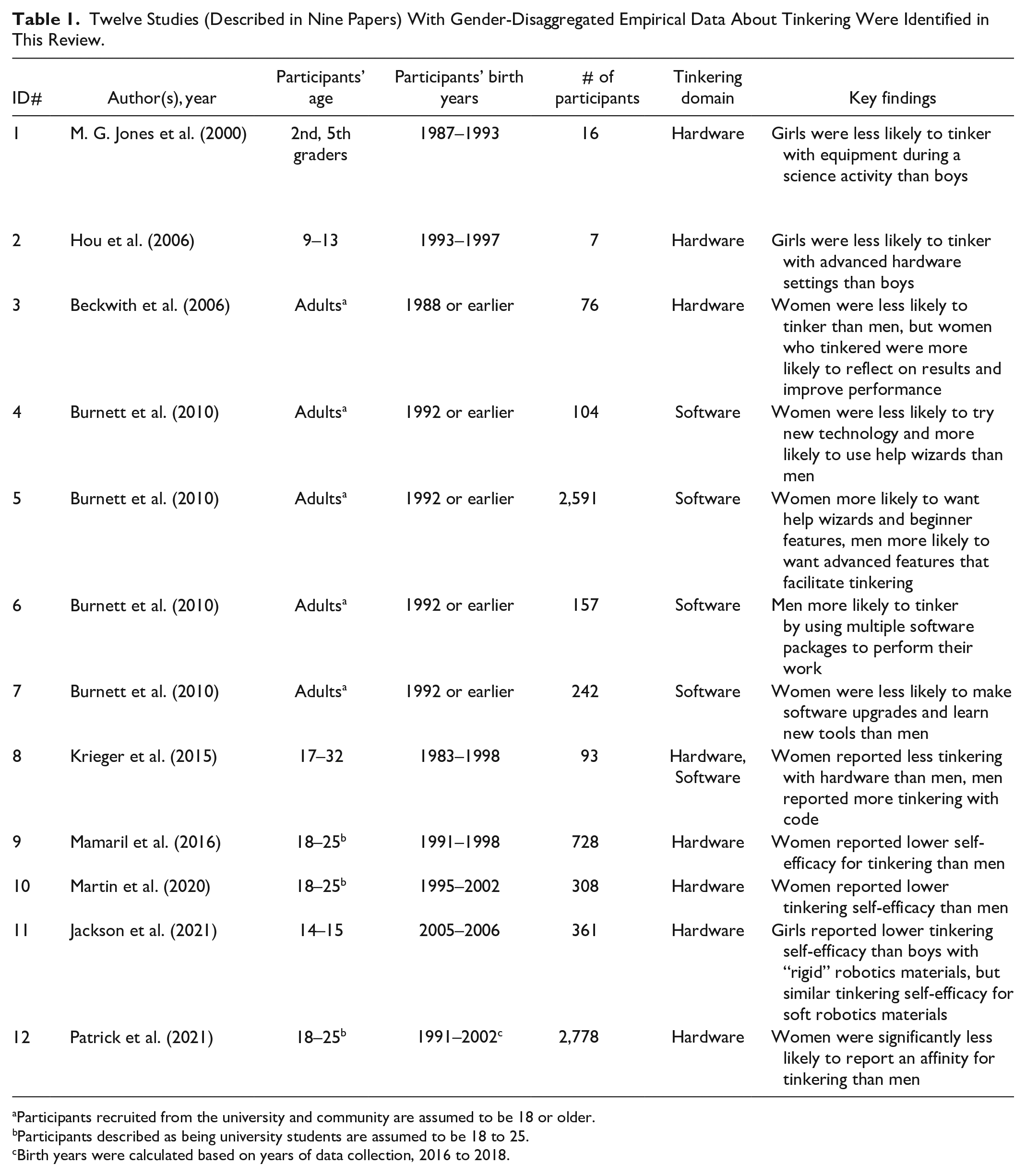
Participants recruited from the university and community are assumed to be 18 or older.
Participants described as being university students are assumed to be 18 to 25.
Birth years were calculated based on years of data collection, 2016 to 2018.
Results
None of the studies in this review included participants born after 2006. Ten studies included participants who were born in the 1990s, and seven studies included participants who were born in the 1980s or earlier. Nine studies included only adult participants, either college students or working professionals. Two studies included only child participants.
In all studies, women and girls reported or demonstrated a lower inclination for tinkering than men and boys. Six studies measured tinkering with only hardware, four studies measured tinkering with only software. One study measured tinkering with both hardware and software.
These results demonstrate a strong basis for promoting gender-inclusivity by accommodating both users who prefer to learn by process and by tinkering. The consistency among generations of participants in these studies suggests that women and girls continue to favor learning by process over learning by tinkering. However, these results also suggest that there is a research gap about software and hardware learning preferences for young adults and children born after 2006 (Figure 1).
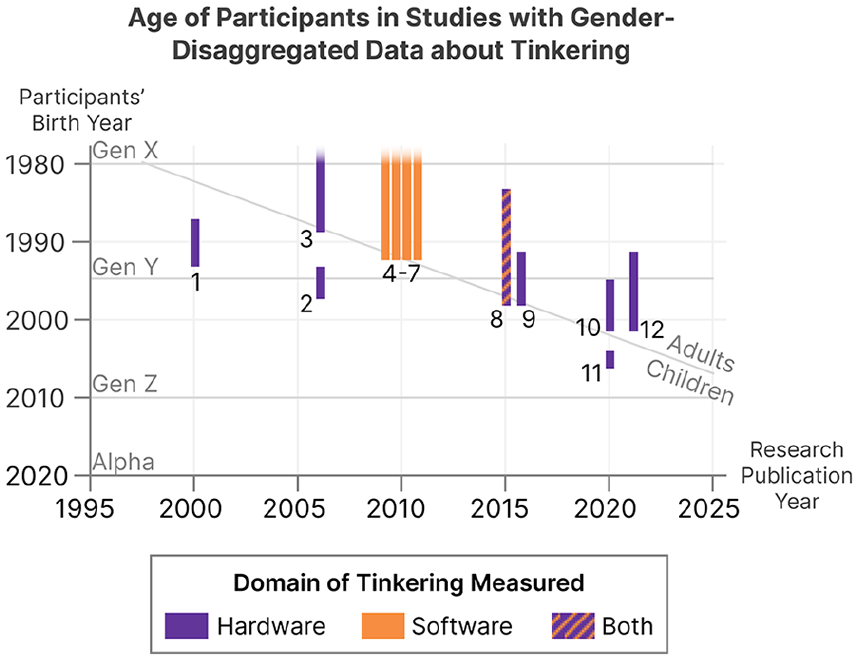
Research about gender and tinkering has focused on participants born in 2006 or earlier. Faded bars (e.g., Study IDs 4–7) indicate that some participants were born prior to 1980.
Discussion
Previous research has indicated that designing interfaces to support both learning by process and learning by tinkering leads to better outcomes and more gender-inclusive designs (Burnett et al., 2016). More generally, designing interfaces and tools to accommodate gender-trending facets has led to greater use of debugging tools and higher self-efficacy (Grigoreanu et al., 2008). When engineers, programmers, and designers develop new interfaces, it is important for them to understand different learning preferences and trends in their users to create inclusive products. The papers reviewed in this study suggest that women and girls have consistently been less likely to prefer tinkering than men and boys, but that this phenomenon has not been fully explored in people born after 2006. This means that all the participants in this review were older than the Apple iPhone, which was released in 2007. Since then, mobile devices have become common in preschool classrooms (Dore & Dynia, 2020) and at home (Radesky et al., 2020), with thousands of studies exploring the effects of mobile devices on children (Yan, 2018). In addition to identifying an opportunity to study tinkering in younger generations, this research also identified related topics for future work.
Future Work
Most papers in this review focused on tinkering with either hardware or software, but not both. Future research could analyze whether preferences for tinkering are consistent across the hardware and software domains. This would answer questions about whether designing for non-tinkerers is equally important in hardware and software.
Exploring the relationship between preferences for tinkering and hardware would also have implications for the development of personas; perhaps some users are comfortable exploring a software interface but not the associated hardware. This persona might want a very simple hardware experience (e.g., a “plug and play” solution for installing smart home devices) with advanced software settings (e.g., the ability to program their smart home devices to respond to certain conditions). On the other hand, if tinkering with hardware and software are closely intertwined, it may be appropriate to pair simple hardware and software designs for one persona, and advanced hardware and software designs for another persona.
The differentiation between tinkering with hardware and software may also be an important distinction when studying younger adults and children. Women and girls who were born after 2006 and were frequently exposed to programing activities though school and outreach events may be inclined to tinker with software, but not with hardware.
These results also suggests that additional demographics should be considered. Previous research has indicated that socioeconomic status is predictive of technology literacy (Scherer & Siddiq, 2019), how people use technology (Hargittai, 2010), and participation in STEM outreach programs (Liu & Schunn, 2020). If greater access to technology in younger generations is associated with a greater inclination toward tinkering, the change in learning preferences might be more prominent for people in high than low socioeconomic situations. This potential result again suggests that human factor professionals should consider demographics and learning preferences in the development of personas and interfaces.
Future work could also explore the interaction of learning preferences with newer technology, including AI tools and Large Language Models (LLMs). There is an opportunity to explore methods of teaching users how to work with new AI technologies. Current tools, like ChatGPT, encourage users to tinker by trying different prompts in an endlessly scrolling chat window. Through this exploration users learn more about ChatGPT’s capabilities, and they create a more comprehensive and accurate mental model of the ChatGPT.
Users who are less inclined to tinker may not use new AI tools to their full capability simply because they do not know what the tool can do for them. These users may benefit from more integrated scaffolding or suggestions of how to create effective prompts. On the other hand, some users who prefer to learn by process may be more likely to tinker with LLM prompts, due to the psychological safety afforded by interacting with a non-judgmental computer. In one study, participants who prefer to learn by process were more likely to use an LLM-based assistant to debug their code than participants who prefer to learn by tinkering, who instead were more likely to tinker with their code than use the assistant (Nam et al., 2024). Altogether, these results suggest that while preferences for tinkering may be underexplored in users born after 2006, they continue to be an important consideration for user interface design.
Limitations
The papers included in this review were identified due to their use of the term “tinker.” Future work could expand this review to include other related terms, such as trial-and-error, constructionism in learning, computational thinking, learning by process, tinkerability, bricolage, or learning styles.
The papers in the review used different methods to measure participants’ inclination for tinkering. The consistency in gender-trending results, regardless of measurement instrument, adds credibility to the findings. However, the difference in methods also limits the extent to which the findings can be fairly compared. Future research could include greater efforts to reach consensus on methods to measure preferences for tinkering.
Conclusions
This literature review suggests that gender-disaggregated data about software and technology learning preferences, one facet of gender-inclusive design, is due for an update. Future work should explore the preferences of the current generation of children and young adults when they learn how to use new technology.
Future research could address the questions of whether preferences to learn by process or by tinkering are still disproportionately represented in men and women, whether tinkering with hardware and software are correlated, and whether preferences for tinkering are related to other demographics such as socioeconomic status. Future work could also expand on this research by exploring the preferences of children and young adults of other gender identities.
Updating our knowledge about gender-trending methods to learn how to use software and technology has practical human factors implications in multiple domains. When designing interfaces, human factors professionals can make more informed decisions about design trade-offs if they have a deeper knowledge of their users, particularly children and young adults who are less represented in the workplace. When creating technology for children, designers can be intentional about updating interfaces to match the current learning preferences of children. When designing curriculum for STEM courses, instructors can more accurately cater to the needs of their current generation of students. Research about learning preferences can also be used to create representative user personas and develop more inclusive interfaces for new technology, such as AI tools and LLMs.
Footnotes
Declaration of Conflicting Interests
The author(s) declared no potential conflicts of interest with respect to the research, authorship, and/or publication of this article.
Funding
The author(s) received no financial support for the research, authorship, and/or publication of this article.
