



Abstract
This paper evaluates the ergonomics performance of automotive driving systems through a new computational model, aiming to enhance vehicle control design more cost-effectively than traditional experimental human factors research in the automotive field. Parameters such as spatial coordinates and control dimensions were measured for different driver interaction controls (e.g., hazard light switches, steering wheel buttons) across three typical passenger vehicles. These parameters were integrated into the QN-MHP-U to simulate driver operational behaviors and predict task performance. A computational method was introduced to assess the ergonomic scores of automotive control designs based on the modeling results. The QN-MHP-U provides a systematic and universally applicable solution for evaluating and comparing vehicle control designs within automotive driving systems. This allows automotive designers to assess and improve vehicle control designs from an ergonomic perspective more efficiently in terms of time and economic costs.
Keywords
Background
Recent research based on the Queuing Network-Model Human Processor (QN-MHP) is now upgrading this model to a unified model: QN-MHP-U, “U” stands for two meanings: “Unifications” of various human factors, psychology, and other behavioral science findings, and easy of “usage” with which users of the model can build or predict human performance and behavioral model with minimal efforts in computer programming. QN-MHP-U has garnered significant attention from scholars across various disciplines, underscoring its utility in academic exploration and practical applications. Spanning fields from cognitive science to traffic engineering, and from psychology to information technology, these research directions collectively illuminate the broad applicability of the QN-MHP-U in explaining human behavior, assessing task execution efficiency, and optimizing system design.
In the realm of cognitive science, researchers have employed the QN-MHP-U to simulate human cognitive processes, thereby probing cognitive mechanisms in tasks such as visual search, transcription typing, and menu selection. J. Lim (2007) used the queuing network model to describe the cognitive processes in visual search tasks, deriving new cognitive insights by simulating information processing and attention allocation mechanisms within these tasks. R. Feyen (2002) adopted the queuing network-based Model Human Processor (QN-MHP) to model human performance, breaking tasks into multiple processing steps and simulating the queuing and competitive relationships among these steps to predict task efficiency and accuracy. J. Lim (2004) utilized this model to simulate human behavior in visual search and menu selection tasks, examining how iterative top-down and bottom-up processes affect learning and decision-making in eye movement behavior. This exploration provided crucial insights into the fundamental mechanisms of cognitive control (J. Lim et al., 2009). B. T. W. Lin and Hwang (2012) applied the queuing network model human processor to model the behavior and decision-making processes in numeric typing, revealing how rhythm, finger strategies, and urgency influence typing performance, thus laying a theoretical foundation for enhancing efficiency and accuracy in numeric typing. Fu et al. (2014) simulated processes of human perception, memory, and judgment using this model. By integrating approaches from computer science and cognitive science, they effectively described human cognitive processes, offering new directions and methodologies for research in the field of artificial intelligence. These studies not only deepen our understanding of human cognitive behavior but also pave new pathways for advancements in artificial intelligence.
In the field of traffic engineering, researchers have utilized the Queuing Network Model Human Processor Unified (QN-MHP-U) to analyze driver behavior, encompassing aspects such as workload, vehicle control, night driving, and pedestrian detection. Zhao et al. (2011) employed the Queuing Network-Model Human Processor coupled with rule-based decision field theory for mathematical modeling of average driver speed control. Bi et al. (2012) explored lateral vehicle control by drivers under conditions with and without cognitive distraction tasks using a queuing network model. Lin and Wu (2012) analyzed the impact of different time intervals on driver performance using the same model. Tsimhoni et al. (2003) introduced a method for modeling steering behavior using the Queuing Network-Model Human Processor (QN-MHP). Bi et al. (2015) integrated neuromuscular dynamics into a queuing network-based driver model to better describe driver behavior in lateral control tasks. Wu and Liu (2006) modeled the differences in psychological workload and performance across different age groups of drivers, revealing how these differences impact driver behavior. Wang et al. (2023) modeled the workload of pilots using the QN-MHP model, optimizing the cockpit human-machine interaction and functional distribution for single-pilot driving modes, demonstrating the applicability of the QN-MHP model for workload modeling of pilots. These studies not only contribute to enhancing the level of intelligence in transportation systems but also provide theoretical support for the safety of intelligent transportation systems and vehicles.
In the field of psychology, researchers have employed the QN-MHP-U for modeling and analyzing phenomena such as psychological load and inhibitory periods. Wu and Liu (2007) described the cognitive load and performance of drivers during driving using a queuing network-based model. Wu and Liu (2008) analyzed the phenomenon of psychological inhibitory periods and proposed a model based on queuing networks to explain the mechanisms of inhibitory periods. Wu and Lin (2007) utilized the queuing network model to model the workload and performance of drivers, analyzing the cognitive and operational processes during driving tasks, and providing theoretical support for designing more human-centered intelligent transportation systems. Rhie et al. (2019) used the queuing network model to more accurately assess driver performance under different cognitive loads, offering significant insights for intelligent transportation systems and vehicle safety. These studies provide new perspectives on human psychological processes and contribute to the understanding of cognitive control mechanisms.
Furthermore, the QN-MHP-U has been widely applied in other areas such as crime information management (Chikodili et al., 2017), data mining (C. Lin et al., 2014), and intelligent human-machine task allocation (Wu et al., 2012). These studies demonstrate the versatility and effectiveness of the QN-MHP-U across various tasks and domains. Concurrently, it has garnered widespread validation and recognition from both academic and industrial sectors, offering significant reference points for interdisciplinary research and applications.
Objectives
The driver system of a car is typically equipped with intricate interactive controls, and the assessment of the efficiency and safety of each component holds great importance in evaluating the overall driver-automotive ergonomic performance of the vehicle. Previous human factors research in the automotive domain often relies on measuring performance indicators of driver behavior through experimental methods. However, such approaches may lead to substantial experimental costs and introduce errors that deviate from real driving scenarios.
A new computational approach has been proposed: the QN-MHP-U, designed to simulate the behavioral performance of drivers. This model is based on the queuing network theory of human neurophysiology, it can model the process of human cognition and behavior to accurately predict task performance. The QN-MHP-U (Queuing Network Model Human Processor Unified) is a theoretical driven mathematical model based on neuroscience research in brain regions (Wu, 2020). In this model, the functions and connections of the processing servers are designed based on their corresponding brain area. The model simulates the transmission and processing of information in the human cognitive system through the operation of entities between different servers, as illustrated in Figure 1. QN-MHP-U has transferability, can predict human behavior without training the model, and can quantify human behavior mechanisms, opening up the “black box” of cognitive processing when humans perform tasks. The QN-MHP-U was employed to analyze and predict human reaction times, accuracy, and effort in performing various tasks. Compared to traditional behavioral experiments, the QN-MHP-U possesses characteristics such as ease of usage, enhanced convenience, and cost-effectiveness, because it does not require the recruitment of subjects. Each simulation run takes less than 5 min, allowing the completion of data measurement and analysis for 200 subjects within a single day.
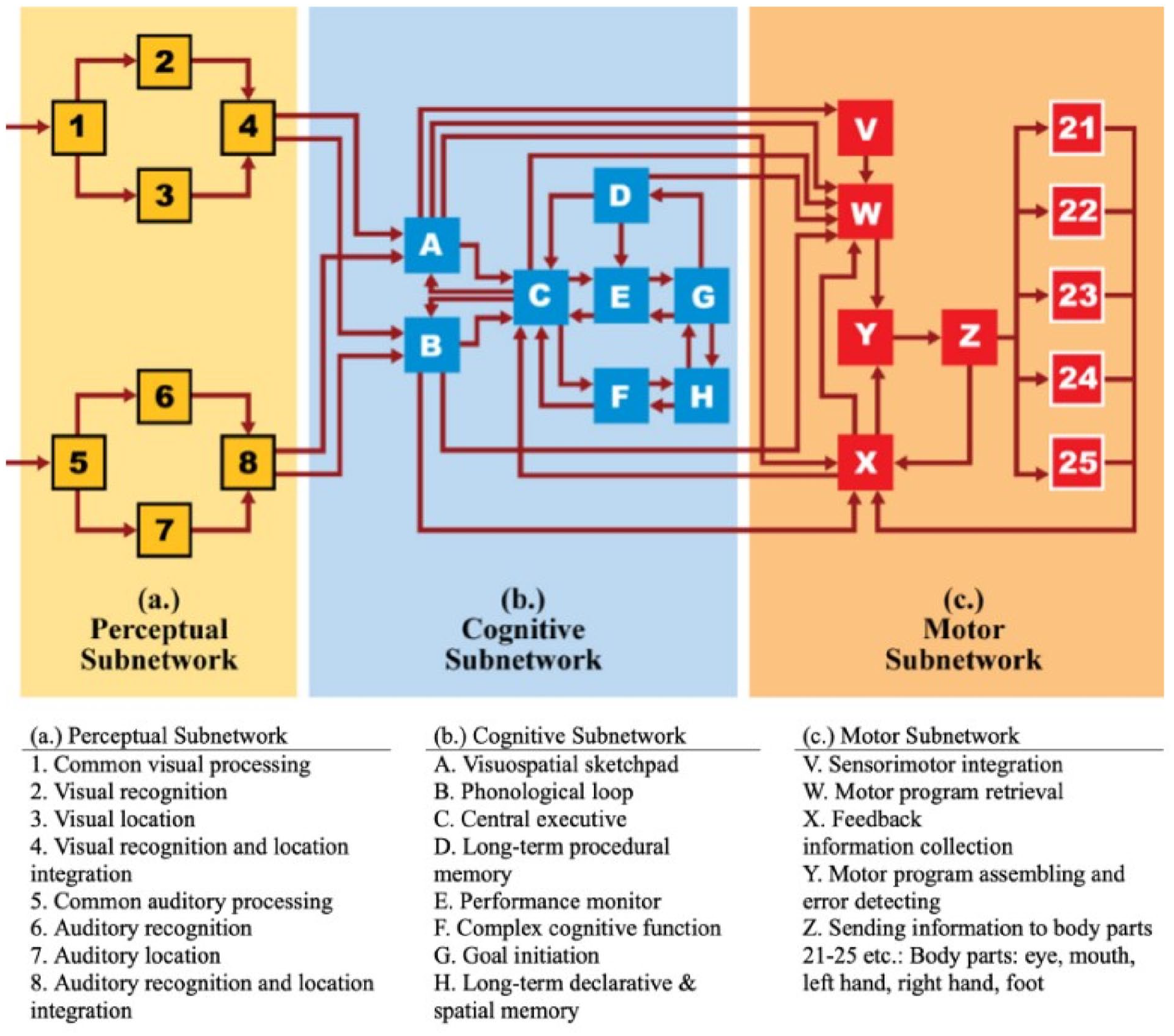
The general structure of QN-MHP-U.
Subsequently, the Ergonomics Score for vehicle control designs is assessed based on the modeling outcomes. Together, this framework offers a systematic and universally applicable solution for the assessment and comparison of automotive control design within vehicle driver systems. This can help automotive designers evaluate and improve automotive control design from an ergonomic perspective in a more convenient and cost-effective way.
Approach
In this research, typical passenger vehicles from manufacturers A, B, and C were selected for study. Subsequently, measurements were taken for seventeen interactive controls within these vehicles, including the hazard light button, steering wheel buttons, interior light controls, air conditioning adjustment buttons, ignition button, driving mode selector, parking brake, headlight switch, volume control button, seat adjustment button, media playback controls, navigation device controls, window controls, sunroof controls, turn signal controls, windshield wiper controls, and gear shifter. Parameters such as spatial location coordinates and control dimensions were recorded. These parameters were then applied in the Queuing Network Model Human Processor Unified (QN-MHP-U) for modeling driver operational behavior. The QN-MHP-U, embedded within computer software, facilitates convenient non-programmatic modeling. The modeling and simulation software used in this study—Human Cognition and Behavior Simulation Software (Provided by Excellent User Experience and Ergonomics: www.excellentuxe.com) as illustrated in Figure 2
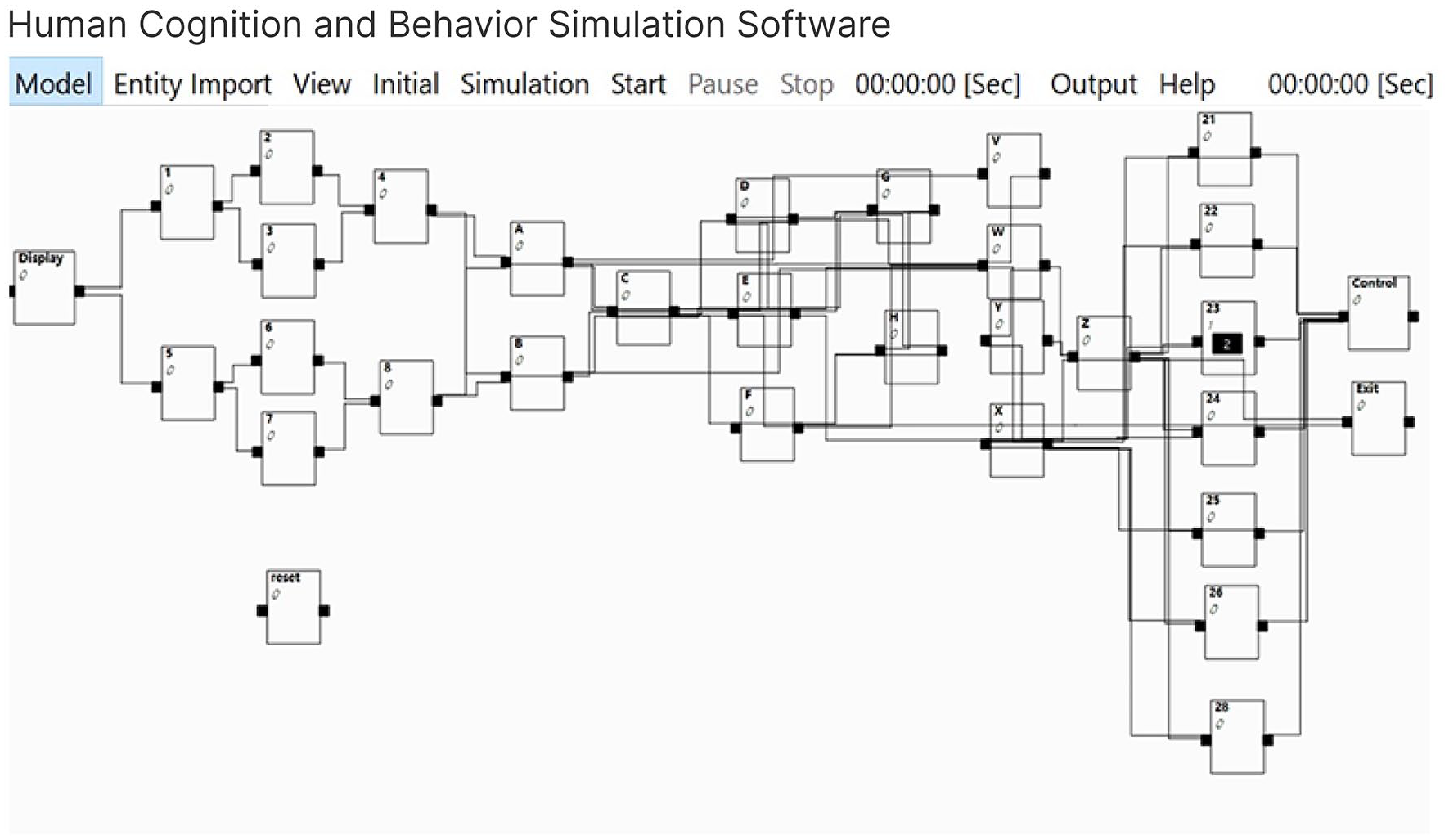
Human cognition and behavior simulation software implementing QN-MHP-U, copyright from excellent user experience and ergonomics LLC (https://excellentuxe.com/).
The modeling outcomes include drivers’ behavioral performance in manipulating different controls while driving, which are used for further calculations. Subsequently, a method to compute an Ergonomic Score (ES) for automotive human factors was established. ES=
Findings
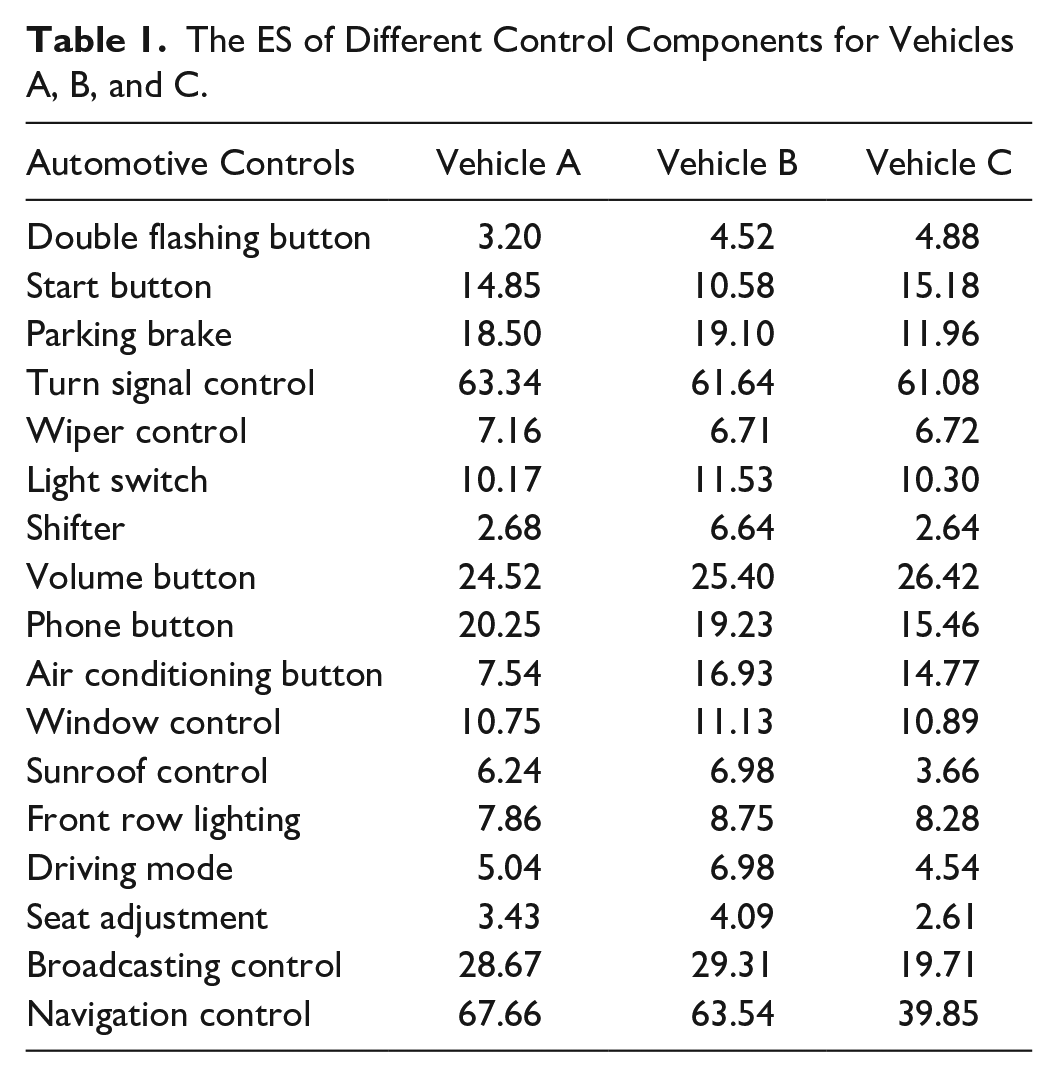
As shown in Table 1, the operational behavior of drivers was simulated using the QN-MHP-U model, and the ergonomic scores (ES) for different control components in vehicles A, B, and C were calculated. As illustrated in Figure 3, the overall human-vehicle ergonomic scores were derived, indicating that vehicle B exhibited the best driver-vehicle ergonomic performance, while vehicle C was the poorest. It is important to note that simulations were conducted sequentially for individual tasks, resulting in minimal server congestion. In scenarios involving multitasking, more urgent tasks, or tasks with higher difficulty, more pronounced differences in overall human-vehicle ergonomic scores could be expected between different vehicles.
The ES of Different Control Components for Vehicles A, B, and C.
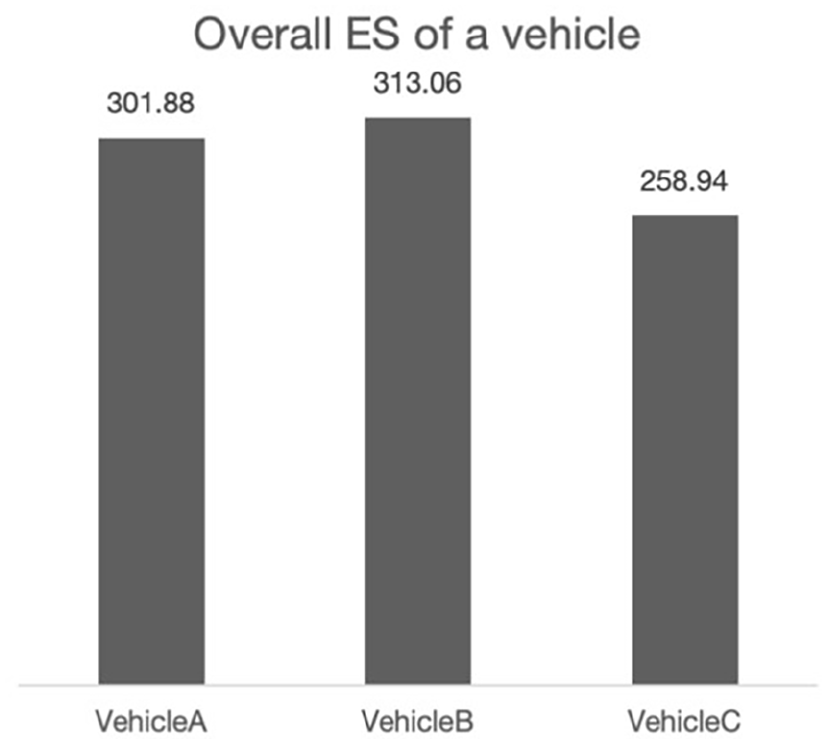
The overall ergonomic scores of the three cars.
Additionally, real vehicle driving experiments were conducted to measure drivers’ response times in operating control devices. The behavioral experiment results showed no significant differences from the modeling results, further validating the high efficacy of the model in predicting human behavioral performance.
These findings collectively demonstrate that the traditional evaluation of Automotive Control Design primarily relies on experimental methods, which necessitate considerable time and human resources. In contrast, the rapid assessment approach based on the QN-MHP-U for automotive control design offers a more cost-effective and time-efficient method for predicting human performance. Leveraging non-programmatic modeling, this method enables swift design evaluations, rendering it convenient, reliable, and economically viable.
Takeaways
In summary, a convenient and reliable method for evaluating automotive control design from the perspective of driver-automotive ergonomics is provided. It can help automotive design timely identify and solve the ergonomic problems of controls within driver interaction systems, also with higher efficiency and lower cost than traditional experimental methods.
Furthermore, QN-MHP-U is applicable for modeling human behavioral performance across all task actions, offering diverse output metrics. This model-based assessment method demonstrates high generality and scalability, as evidenced in cognitive science (J. Lim, 2007; Wu & Liu, 2008), traffic engineering (Wang et al., 2023; Wu & Liu, 2007; Zhao et al., 2011), psychology (Wu & Liu, 2008), data mining (Lin et al., 2014), among others. It has been successfully employed to quantify human performance in various tasks (Wang et al., 2023), with automotive control design evaluation being just one example. Similarly, this method can establish new computational frameworks for specific metrics based on any particular requirements, thus addressing practical issues in various domains of human factors engineering. It provides crucial support for advancing the understanding of human behavior and optimizing system design.
Footnotes
Declaration of Conflicting Interests
The author(s) declared no potential conflicts of interest with respect to the research, authorship, and/or publication of this article.
Funding
The author(s) received no financial support for the research, authorship, and/or publication of this article.