



Abstract
Home healthcare has been identified amongst the most hazardous industries in healthcare. Many of the tasks being conducted by home healthcare workers are associated with significant demands including physical demands such as mobility and repositioning activities as well as psychological demands which is attributed by dealing with a complex environment whilst administering medical and life saving care to patients, and social demands that encompasses dealing with dying and grieving patients. With the homes in United Kingdom having potentially unique exposures due to the healthcare system and design of the homes such as multi-floors, smaller condensed rooms, and limited ventilation, the purpose of this study was to investigate the exposures for home healthcare workers in the United Kingdom. Ergonomic hazards were observed through various tasks such as repositioning in bed (34.8%), transfer from bed to chair (30.4%), transfer from bed to chair (26.1%), and transfer from chair to chair (26.1%) and particularly for nursing aides. Lifting hoists were only used 13 times (19%) and predominantly by nursing aides (12 of 13, 92%). A slip sheet or slide board was used 7 times (10.1%), all being nursing aides using them.
Introduction
Home health care workers have no or limited control over the environment that they are working in as they go from house to house. Each home is a unique work environment with potentially different exposures such as poor lighting, uncomfortable and cramped workspaces, awkward work positions, cluttered or unclean environments, distractions from others in the home, unfamiliar surroundings, presence of small children and pets, working alone, and potential for violence.
Home healthcare has been identified amongst the most hazardous industries in healthcare. Many of the tasks being conducted by home healthcare workers are associated with significant demands including physical demands such as mobility and repositioning activities as well as psychological demands which is attributed by dealing with a complex environment whilst administering medical and life saving care to patients, and social demands that encompasses dealing with dying and grieving patients. With the homes in United Kingdom having potentially unique exposures due to the healthcare system and design of the homes such as multi-floors, smaller condensed rooms, and limited ventilation, the purpose of this study was to investigate the exposures for home healthcare workers in the United Kingdom.
Methods
This cross-sectional study a trained supervisor for direct observation of the occupational setting. Standardized observations as well as data collection were completed using the validated Home Healthcare worker observation tool (HHCWO). The trained supervisor observed nurses and nurse aides working in the homes in the period of 30 to 60 min.
Results
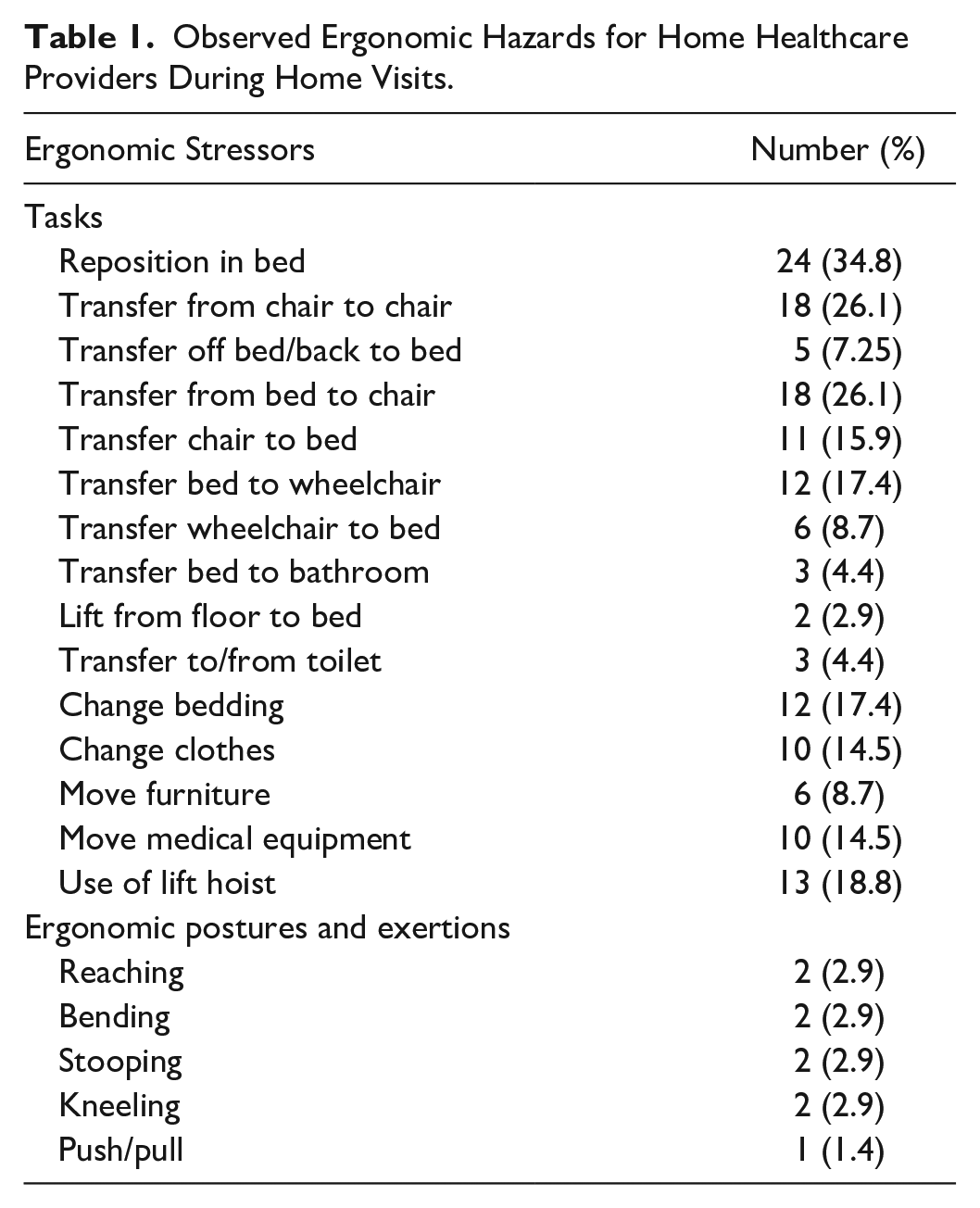
The results of the direct observations are in Table 1. HHCWs routinely reposition and transfer patients in their homes (over 25%). Few utilized any type of lift assist device.
Observed Ergonomic Hazards for Home Healthcare Providers During Home Visits.
Key Take Aways
Direct observation confirmed some of the perceived ergonomic exposures of home healthcare workers in the United States, indicating similarities on some level in the United Kingdom.
Direct observations of home health care workers provided avenues and opportunities for various health and safety specialists to appreciate the occupational exposures and challenges that home health care workers face in the unique home care environment and pro-actively identify mitigation measures of the respective occupational hazards.
Footnotes
Declaration of Conflicting Interests
The author(s) disclosed receipt of the following financial support for the research, authorship, and/or publication of this article: This study was partially funded by the U.S. National Institute for Occupational Safety and Health (NIOSH) Grant T42 OH00843206 and Fulbright Scholar Program.
Funding
The author(s) received no financial support for the research, authorship, and/or publication of this article.
