



Abstract
In professional driving, maintaining alertness throughout the journey can be challenging. Despite efforts to address decreased alertness, there is no agreed method to investigate mind-wandering in transportation. Trigger-based data collection methods are most common, but can influence participants’ mental condition, reducing mind-wandering occurrences. Besides, in real-life test rides it is not desirable to interrupt and question drivers. Building upon existing research, a mind-wandering investigation protocol and questionnaire were developed to address this. The protocol was tested and refined by querying train drivers about their mind-wandering experiences on a train simulator, allowing drivers to assess mind-wandering across multiple journey phases. The results show that the proposed protocol can provide greater insight into driver alertness and mind-wandering in professional driving settings.
Introduction
When driving in a professional setting, such as a truck or train driver, it can be challenging to remain sufficiently alert throughout the entire journey. Therefore, research is being conducted in various transportation domains to develop driver condition monitoring techniques capable of detecting decreased alertness and fatigue (Fitzharris et al., 2017; Hermens, 2020; Mueller et al., 2021; Rudin-Brown& Filtness, 2023). However, there is currently insufficient understanding of how frequently drivers fail to stay mentally engaged and start mind-wandering, which can result in drivers who fail to visually scan their environment.
Many methods have been reported for investigating mind-wandering. Nevertheless, there is no consensus on a method to be used in a transportation context. Often a method is used that requires reflection on the thoughts present during task performance. However, the triggers that are used to collect information while driving can themselves influence participant’s mental condition, reducing the occurrence of mind-wandering. Besides, in real-life test rides it is not desirable, and often not allowed, to interrupt and question train drivers while driving.
Building upon a review of methods for investigating mind-wandering by Weinstein (2018), we have developed a mind-wandering investigation questionnaire and administration protocol to assist in the study of driver alertness.
Method
We developed a categorical mind-wandering scale (MWS), which consists of six categories. In addition to the ascending scale, the drivers had the option to indicate that they did not know which category had applied to a journey part. Drivers were asked to use the categorical scale to report back upon their mind-wandering state during each part of the journey, after a drive on a train simulator. The journey parts were related to the journey part just before or just after a train station, or the journey part between two stations.
We first tested the scale with two train drivers in a cabin simulator while using a simple “on task first” protocol, which is most commonly used in similar studies (Weinstein, 2018). “On task first” means that the scale starts with the category in which the driver is mentally focused on the driving task. Both train drivers only reported lower levels of MWS, indicating “on task” or task related thoughts. In-depth interviews afterwards, however, showed that other forms of mind-wandering had occurred, which were not mentioned during the administration of the initial interrogation protocol. For example, “I was thinking whether I had just put my electric car on the charger” was mentioned during evaluation, but during the “on task first” protocol-based interview the participant only reported that thoughts about or related to the driving task had occurred.
Evaluation of these trials revealed that two known phenomena limited the usability of an “on task first” protocol. Both “satisficing” (participants stop assessing options once they encounter one that adequately captures their mental state) and “social desirability” (participants adapt their answer to the social norms, and perceive mind-wandering as undesirable) occurred, resulting in participants choosing options that represent little or no mind-wandering (Weinstein, 2018). For train drivers, vigilance, even during long boring journeys, is a core quality on which they have been tested and selected. The risk of “social desirability” effects is therefore particularly high on this topic for this group. To counteract tendencies of “satisficing” and “social desirability,” we developed a stricter assessment protocol following an “off-task first” approach. This resulted in the following MWS:
6. I was dozing off / half asleep
5. I had no conscious thoughts, but an empty mind
4. I was thinking about something in the past or in the future and I was thinking about something other than the driving task, for example, this weekend we have a birthday; shall we go by car or train?
3. I was with my thoughts in the here and now, but I was thinking about something other than the driving task, for example, I’m hungry, is there food in my bag?
2. My mind was on things that are indirectly related to the driving task, for example, given their current state, would there be plans to replace older switches here?
1. My mind was on things that are important for carrying out the driving task, for example, view signal aspect, check speed, monitor train system.
0. I can’t remember how alert I was during this part of the ride.
Post-Trip Mind-Wandering Assessment Protocol
In addition to the MWS, we developed an assessment protocol. The purpose of this protocol was to minimize the effects of “satisficing” and “social desirability.” The protocol also ensures that the query remained the same for all tests, so that the results can be used to validate the MWS.
The protocol started with a uniform introduction to be given to the participant prior to the first trip: “When you’re driving, you can’t be fully focused all day. There are moments when your attention wanes a bit, but also moments when you are driving with full attention again. In this research, we want to gain more insight into this natural process. Try to ride as naturally as possible on all rides. And therefore, not extra alert, or extra inattentive. At the end of each ride, we will ask you the following question: Can you recall whether you experienced the following on that part of the track? (showing the scale)”
The following protocol was used for administering the mind-wandering questionnaire after each trip:
0. The participant remains seated in the simulator to ensure that answering the questions is an inseparable part of the task. Distraction of all kind is prevented.
1. The researcher with neutral attitude asks the following question, without adding additional comments: “You’ve completed this ride now. I would now like to know from you what your experience with this ride was. I’m going to ask you some questions about that. Can you recognize a clear moment (somewhere in the entire ride) where your mind was NOT on the task?” If yes, the participant is asked to describe the characteristics of that moment in their own words. If the answer is no, the researcher does not push further but concludes: “Okay, so you didn’t experience a very clear moment of decreased alertness.”
2. The researcher then administers the mind wandering scale with the participant orally, applying a passive tone of voice, and in “off task first” order by asking the following: “Now we’re going to zoom in on parts of the ride. I will ask you to indicate what happened with your attention for each section of the track. Try to mentally place yourself in driving that section of the track in the simulator and recall what happened with your thoughts. The first part is “departure from Lelystad” Go back to that moment. Can you recall if you have experienced “6—off” on that section of track?” The researcher starts with 6. “Dozing off” and follows the rest of the categories in the “of task first” order until the participant mentions to recognize that this level of alertness is appropriate to what was experienced during this part of the journey. The participant is asked to further explain the recognized level to further activate the memory. All nine ride parts are discussed in the order in which they were ridden.
Experiment Design
The study was conducted in an open-cabin research simulator, where eight train drivers completed five 25 min trips on the Lelystad–Zwolle track. To make it possible to investigate the validity of MWS, the trips varied in factors expected to impact alertness. The order in which the various rides were offered per participant is shown in Table 1.
Trip Conditions per Participant.
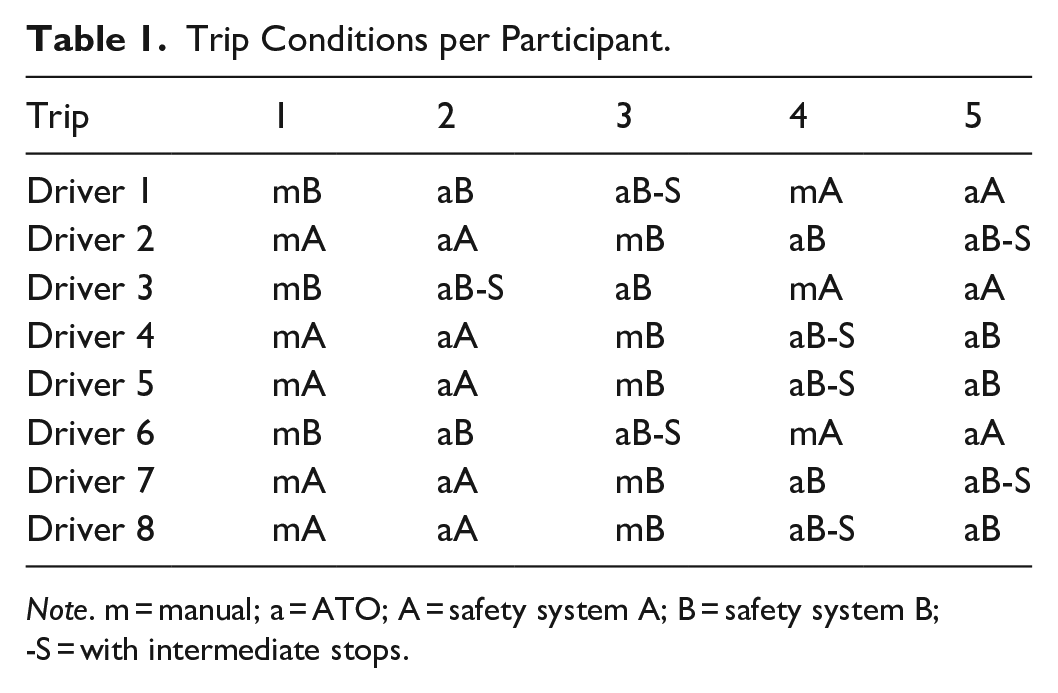
Note. m = manual; a = ATO; A = safety system A; B = safety system B; -S = with intermediate stops.
Train drivers are expected to show good vigilance, so low MWS, in regular drives. However, driving the same route in a simulator multiple times in a row, with nothing special happening, makes it increasingly difficult to stay alert. It is our assumption that during the first ride, participants will be alert. During the day they are expected to become less alert due to fatigue. After a break, participants are likely more alert than before the break. To test the validity of MWS with this assumption, there was a break between Trip 2 and Trip 3.
With automatic train operations (ATO), implemented in line with TSI (European Union [EU], 2023), the driving task becomes a monitoring task. It is known that during monitoring tasks, reduced alertness can occur after approximately 10 min (Levine et al., 1973; Neerincx, 2003; Parasuraman, 1986). Two ATO trips (aA and aB) involved 25 min uninterrupted drives, expected to result in reduced alertness reports, while one ATO trip (aB-S) included stops at intermediate stations to interrupt the monitoring task and maintain alertness.
Enhanced digitalization to increase the level of protection against signals passed at danger (SPAD) may lead to higher MWS. Such effect, however, should be less pronounced than the effect of ATO. Besides, such an effect is not yet proven by previous research. Test rides with both safety system A (less digital) and B (enhanced digitalization) are implemented to assess whether MWS could detect smaller differences. Familiarization rides preceded the test rides for both safety systems.
Results
Eight train drivers completed all five trips and reported nine MWS per trip. Evaluation revealed that the protocol prompted train drivers to report instances of reduced focus on the task. All categories of the MWS, from 1 to 6 and the additional category 0, were mentioned multiple times by the drivers. Table 2 gives the frequency of reported MWS categories for each subsequent trip.
Overview of How Often Each MWS Score Was Reported by All Drivers Together After the 1st, 2nd, 3rd, 4th, and 5th Trip of the Day.
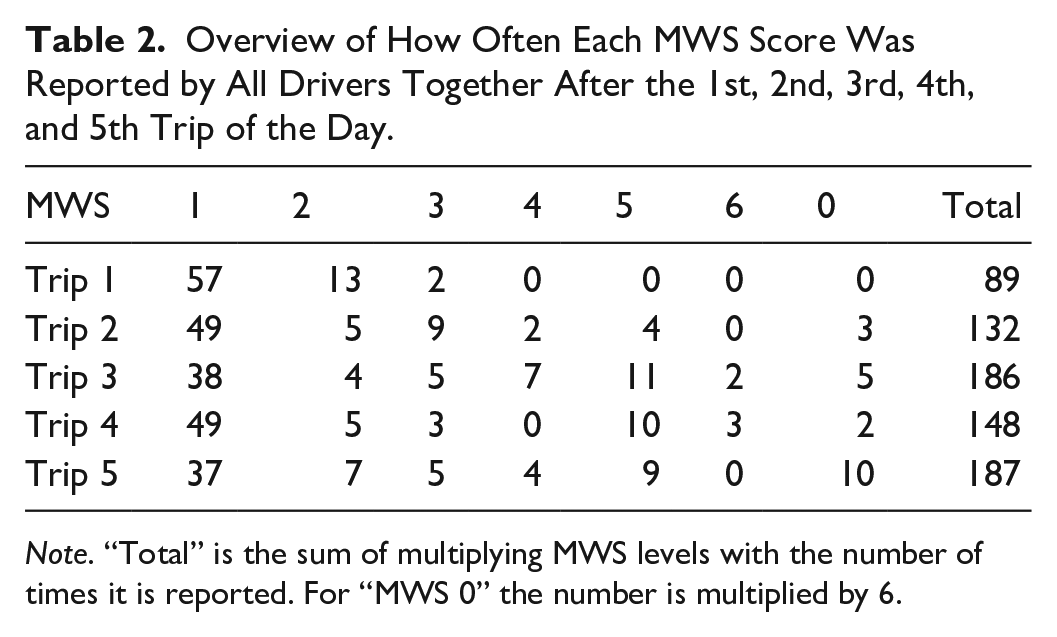
Note. “Total” is the sum of multiplying MWS levels with the number of times it is reported. For “MWS 0” the number is multiplied by 6.
At the start of the test day, all drivers reported a low MWS (high alertness) while driving in the simulator. MWS 1 was reported 57 of the 72 MWS scores for Trip 1. Higher MWS did occur during subsequent test drives. MWS 4, 5, and 0 were first reported after Trip 2, MWS 6 after Trip 3. It is striking that MWS 6 was not mentioned by drivers after Trip 5. However, an MWS 0 was reported ten times in Trip 5, while MWS 0 was reported less often in the other trips.
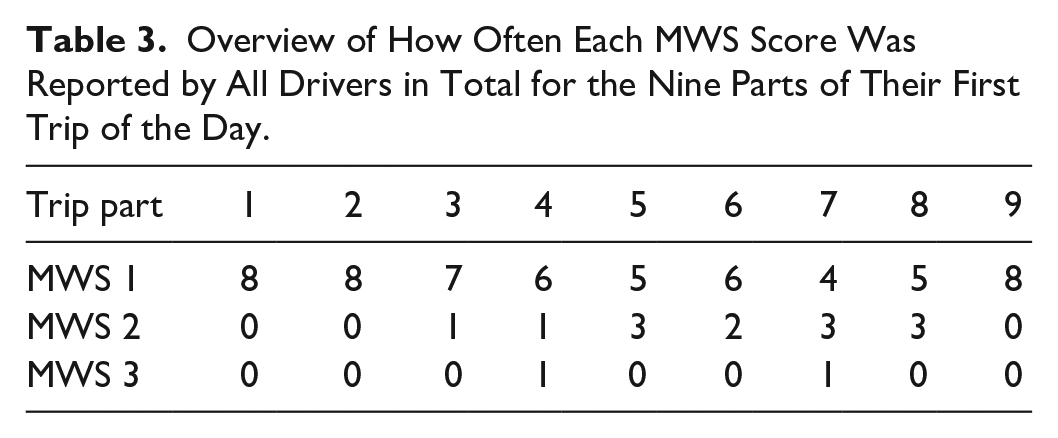
All train drivers reported an MWS 1 for the first two parts and the final part of Trip1, see Table 3. Only one train driver twice reported MWS 3 after the first trip. Three participants reported only MWS 1 for all nine parts of the first ride. No participant reported a MWS of 4 or more or an MWS 0 in any of the nine parts of the first ride. Also after the manual drive under safety system A, none of the participants reported an MWS 0. Table 4 gives the frequency of reported MWS categories for each condition. In 15 out of 20 times that a participant reported an MWS 0, this was after a trip in which the participant had driven under ATO and did not stop at intermediate stations during the trip.
Overview of How Often Each MWS Score Was Reported by All Drivers in Total for the Nine Parts of Their First Trip of the Day.
Overview of Reported MWS Scores by all Drivers Together.
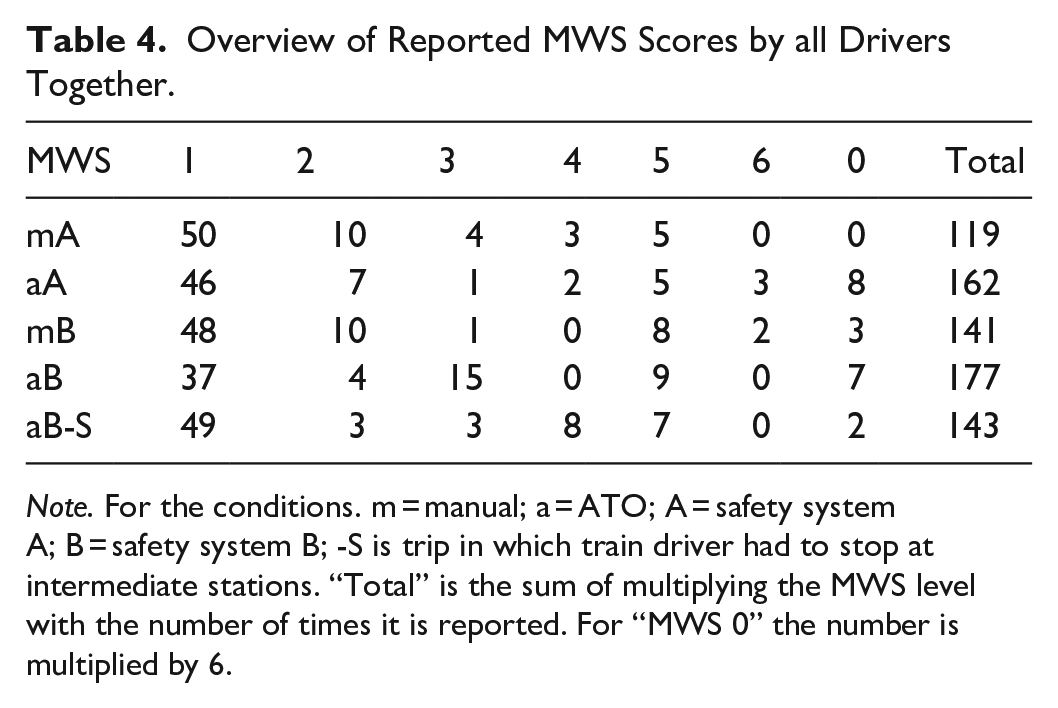
Note. For the conditions. m = manual; a = ATO; A = safety system A; B = safety system B; -S is trip in which train driver had to stop at intermediate stations. “Total” is the sum of multiplying the MWS level with the number of times it is reported. For “MWS 0” the number is multiplied by 6.
Discussion
To assess whether the MWS with the assessment protocol can provide reliable insight into alertness and the occurrence of mind-wandering while driving, it must be examined whether the results of this study are in line with human factors knowledge. In this study we can assess the results based on two aspects that have been frequently investigated within the human factors research community. Namely the increasing decline in alertness during a day with repetitive tasks. And the development of reduced alertness during a monitoring task when it lasts longer than about 10 min. In addition, we can compare the results with assumptions made by human factors specialists from the rail domain, which have not yet been properly substantiated by research. Namely that driving with safety system A leads to higher alertness, and therefore lower MWS, than driving with safety system B. This assumption is based on human factors knowledge that a higher degree of digitalization leads to lower workload in an environment where there is already a risk for underload.
Before we can compare the results of the different conditions, we must decide how to deal with the anomalous MWS 0. How does this score compare to the other scores? The results of this study show that participants use MWS 0 at times when they are no longer mentally active. In particular, the fact that in Trip 5 of the day a score of MWS 6 was not given, but MWS 5 and 0 MWS were given, creates the impression that MWS 0 can be an equivalent of MWS 6. Even though the train drivers themselves do not recall MWS 5 or 6 for these journey phases, we do set a score of MWS 0 equal to MWS 6 in our further evaluation of the results. This step allows us to calculate a total MWS score, with which we can easily compare the different conditions. We can now calculate a total score for both the effect of fatigue (Trip order) and the effect of the different conditions (manual, ATO, safety system, intermediate stops) by taking the sum of multiplying the MWS level with the number of times it is reported. For example, Total Trip 1 = (1 × 57) + (2 × 13) + (3 × 2) + (4 × 0) + (5 × 0) + (6 × 0) + (6 × 0) = 89. And Total of manual safety system A = (1 × 50) + (2 × 10) + (3 × 4) + (4 × 3) + (5 × 5) + (6 × 0) + (6 × 0) = 119. The outcomes of these calculations are given in Tables 2 and 4.
Increased decline in alertness during the day can be evaluated on two points. Increasing MWS on consecutive Trips, and lower MWS after a break. Our results show all drivers were highly alert at the start of Trip 1 and that from Trip 1 to Trip 3 the total MWS increases significantly from 89 to 132 to 186. After Trip 4 it decreased to 148, and after Trip 5 it increased again to 187. Instead of a temporary decrease after the break between Trip 2 and Trip 3, we see a decrease in Trip 4. A possible explanation is that MWS captured a post lunch dip phenomenon; a reduction in cognitive function and performance is previously reported particularly after a large midday meal (Yung et al., 2017).
For validation from the perspective of the effect of ATO on alertness, we also have two points to look at. Firstly, we expect a higher MWS for trips without stops driven under ATO than for manual trips. We can look at this effect twice, namely for journeys under safety system A and under safety system B. In addition, we expect that this effect will be less, or even disappear, when stops are made during journeys under ATO. Our results show that all three expectations are met. For drives under safety system A the total MWS when driving manually is 119, and when driving under ATO it is 162. For safety system B this is 141 and 177 respectively. For driving under safety system B under ATO but with intermediate stops the total MWS is 143, which is very comparable with manually driving without stops. This last result is important, because the sequence of driving with and without stops occurred equally often in both sequences. This therefore shows that the effect of ATO was not simply an order effect.
In line with our expectations, the results show a higher MWS with safety system B compared to safety system A, in which the difference is less significant compared to the effect of ATO. However, there is a limitation in our data due to an imbalance in the order of driving under safety systems A and B. Five of the participants first drove under safety system A and three first under safety system B. As a result, the data may have an order effect. The direction of this effect in this case will be in the same direction as the effect of the system itself. The effect will therefore be enhanced by this imbalance. Consequently, while these findings support the validity of MWS, they do not allow for conclusions regarding the impact of different safety systems.
Possibly the conditions of this research that led to these good results do not apply in similar contexts. Although this method allowed us to get nine MWS for a 25 min drive, this was only possible because drivers were able to relate the nine parts to train stations. With routes with less clear points of reference it might be more difficult to break down a route into small sections which drivers can mentally refer to post-trip. In our specific context, all drivers were also very familiar with the route. Especially in cases where off-task thoughts occur, it might be much more difficult to report the journey part in which a higher MWS occurred if the route is less familiar to the participant. This can be a limitation of copying this method to a different context.
To conclude, the proposed mind-wandering scale (MWS) and administering protocol allowed to evaluate train driver focus across multiple journey parts of a high familiar 25 min route by professional train drivers. Further validation is required to understand some of the unexpected outcomes. Multiple stations, and thus multiple journey parts to evaluate, within a 25 min drive is common in the Netherlands, but it might not be the case in other countries. More research is needed to gain insight into the maximum duration and maximum amount of journey parts of which professional train drivers are able to report back reliable MWS. Besides, more research is needed to determine whether the proposed protocol is also suitable for determining occurrences of mind-wandering in different conditions. As this method relies on relating the mental state in relation to landmarks, this method may work less well on routes that the driver is not or less familiar with. Familiarity with the route will often be the case in the rail domain, but this may be different for other professions, such as truck drivers.
Footnotes
Declaration of Conflicting Interests
The author(s) declared no potential conflicts of interest with respect to the research, authorship, and/or publication of this article.
Funding
The author(s) disclosed receipt of the following financial support for the research, authorship, and/or publication of this article: This research has been supported by NS, Principal Dutch passenger railway operator.
