



Abstract
The existing United States nuclear power plants are in need of modernization of digital technologies to reduce their operating cost. However, they have been historically reluctant to adopt digital technologies due to a range of regulatory and technical challenges. Addressing human and technology integration considerations are one key technical barrier that needs to be addressed. This work describes an approach to addressing such challenges in nuclear power plant modernization. This work describes the methodology through the lens of work optimization of a nuclear power plant, discussing its key features, and use of emerging systems thinking methods in its integration into a broader business case framework.
Introduction
Existing nuclear power contributes to roughly 20% of the total electricity generation and consistently provides the highest capacity factor of any other electricity generating resource in the United States (U.S.). Despite these advantages, the existing nuclear power plants (NPPs) in the U.S. have been enduring significant challenges in providing electricity in a cost-competitive manner, which has ultimately threatened the long-term economic viability of these plants. A major contributor has been the continued reliance on a large workforce who perform their work under an operating model that has largely remained unchanged since the commissioning of these NPPs. Unfortunately, while this operating model has provided safe and reliable electricity, other industries have already began transforming their workforce through the use of advanced digital technology and automation that has reduced their operating and maintenance costs significantly.
For the U.S. nuclear industry to remain economically viable, a similar transformation must be considered. To effectively integrate these new capabilities, the technology being implemented must have a mature technology readiness level (TRL), as well as human readiness level (HRL; HFES/ANSI, 2021). Therefore, a multidisciplinary approach is needed that addresses technical and sociotechnical considerations for continued safe, reliable, and efficient use of these new technologies in existing NPPs. This work describes an extension of the human and technology integration methodology that enables expanding HFE beyond main control room modernization into other work domains within a NPP (Kovesdi et al., 2023), herein referred to as the Human Integration and Technology Task Force for Work Management Optimization (HITT), to support the safe, reliable, and efficient use of proposed innovations with the intended users in their intended environment to perform their intended tasks (Figure 1). It should be noted that this work is based on INL/RPT-24-77684 (Kovesdi et al., 2024), and the reader is referred to this technical report for further details.
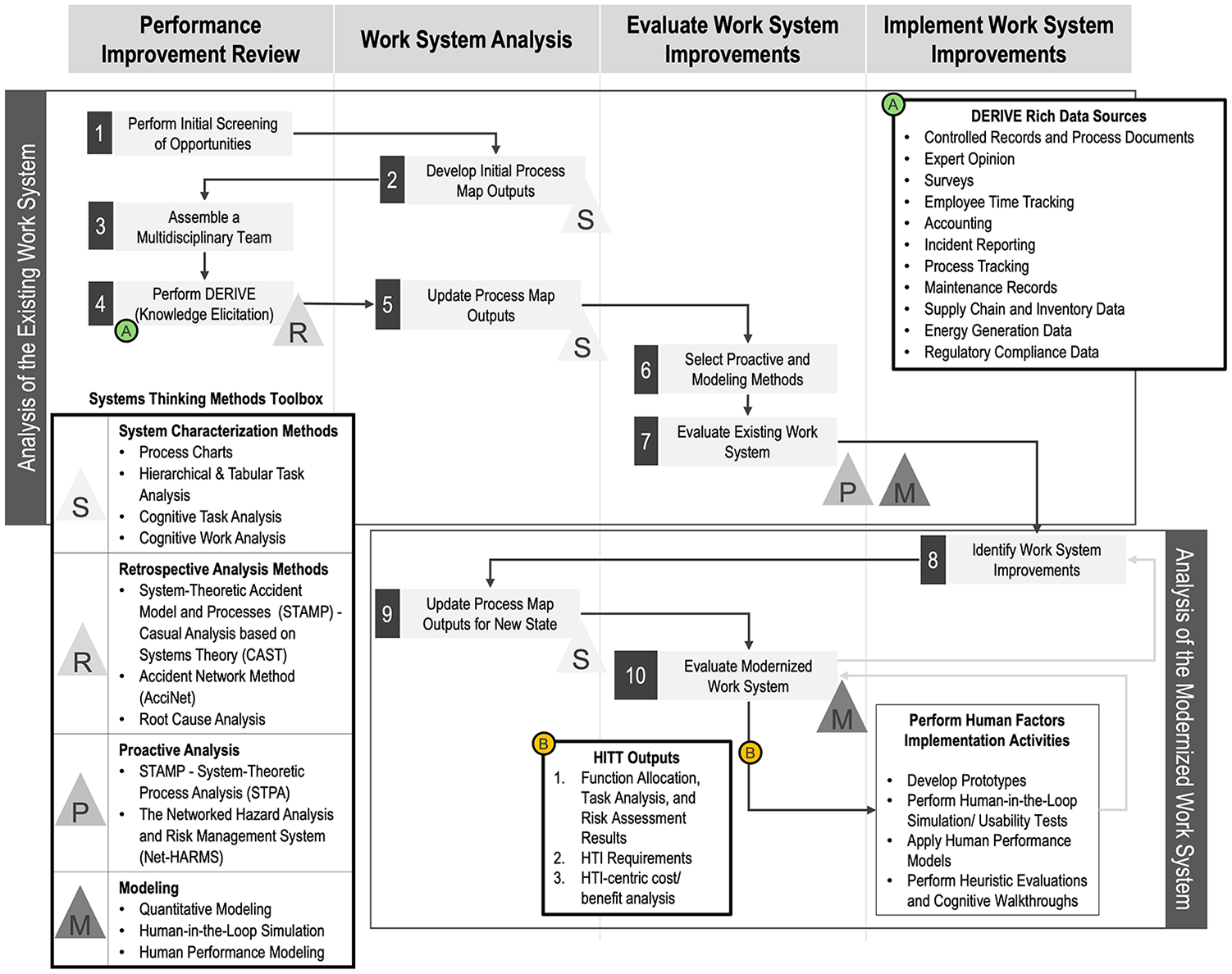
HITT process overview.
Key Features of HITT
Knowledge Elicitation Using Rich Data Sources
HITT emphasizes knowledge elicitation early to understand how work is intended to be performed, how work is actually performed, the modernization vision, and potential gaps in work performance. Knowledge elicitation is achieved by engaging domain experts throughout the “DERIVE” process.
The rich data that comes from the DERIVE process forms the basis of the subsequent analyses within HITT, minimizing the number of assumptions needed to identify work system risks and innovation opportunities, as well as model system behavior. A diverse source of data is used and is presented next to the DERIVE step in Figure 1. Each data source provides unique insights that contribute to a holistic understanding of the plant’s operations, efficiencies, and potential areas for improvement. Together, these data sources provide a comprehensive view of the plant’s operations, enabling a robust analysis and quantification of the processes.
Systems Thinking Methods Toolbox
Another key feature of HITT is the systems thinking methods toolbox (Figure 1). This toolbox leverages the systems thinking methods described in Leveson and Thomas (2018), Salmon et al. (2022), as well as Dallat et al. (2018). Retrospective analysis approaches are used to support learning from past events to better inform system design. System characterization approaches are used to describe the work system’s goals and functions, understand work performed, and identify cognitive and communication requirements of the work system based on a conceptualized assignment of function. Proactive analysis approaches are used to predict potential system risks and identify “leverage points” for work optimization within an existing work system, as well as the proposed redesign. Finally, modeling approaches are used to analyze the behavior and dynamics of complex systems over time (i.e., including economic performance, time, or cognitive processes).
10-Step HITT Process
Step 1. Initial Screening of Opportunities
In the first step, modernization opportunities are screened through structured interviews. The goal is to assimilate comprehensive insights within a set timeframe, focusing on understanding the nuances of the processes under review. These conversations aim to extract valuable insights from the operational experiences, identify the core challenges faced, draft an initial outline of the current process flow, and provide initial insights that can be used later on when determining organizational readiness for potential work system improvements. At this initial stage, gaining an understanding of the organization’s approach to benchmarking their performance against other organizations is important, as the way organizations define and measure their performance will shape what key performance indications (KPIs) the organization uses and how effective these KPIs are as an actual performance assessment.
Step 2. Develop Initial Process Map Outputs
In the second step, the focus shifts to developing initial process map outputs for the screened-in opportunities. This involves creating visual representations of the current processes to identify inefficiencies, redundancies, and bottlenecks. Here, system characterization methods are used; the outputs should be detailed enough to facilitate a clear understanding of each process step and its interrelations with other steps.
Step 3. Assemble a Multidisciplinary Team
A multidisciplinary, cross-functional team is needed to support the execution of the remaining HITT steps. The team should include:
End users and stakeholders (e.g., operations, training, engineering, maintenance, management).
Subject matter experts in the work domain.
Human factors engineering (HFE) and quantitative modeling professionals.
Vendors (i.e., if selected).
Step 4. Perform DERIVE (Knowledge Elicitation)
Define the New State Vision
While facilitated by the HITT team, the new state vision will ultimately be defined by the stakeholders and captured through the DERIVE process. The new state vision may vary in terms of scope (e.g., process efficiencies vs. plant performance) and will ultimately enable identifying work system improvements through HITT.
Identify Relevant Performance Information
There are many sources of information that can be evaluated to elicit departmental and process performance. Some of these are measured through published KPIs and others can be derived from data sources, such as raw work order performance data. Figure 1 presents a list of these sources.
Review Performance Information
Once all of the data sources have been identified, an in-depth review of the data is performed to fully assess the process performance. Retrospective methods may be used to enrich the review; methods include Casual Analysis based on Systems Theory (CAST; Leveson, 2004), Accident Network Method (AcciNet; Salmon et al., 2020), or root cause analysis approaches. The goal is to accurately assess the current performance against the desired new state to identify potential gaps. Another gap that may be identified could be the gap between the perceived new state and that of high-performing external organizations or NPPs. The breadth of team experience will help identify these gaps.
Interview and Survey Stakeholders
Interviews are performed to provide a completely different perspective on a process by providing a more humanistic viewpoint of a process and how the end users or stakeholders are affected by the current execution of the work process. Further, surveys can be used to collect feedback from stakeholders regarding their current pain points, as well as willingness to embrace new technologies.
Converge Findings and Achieve Stakeholder Buy-in
The last step of the DERIVE process is to converge findings through the multiple data sources to identify gaps in work performed (i.e., as well as pain points), why certain identified solutions are being proposed (i.e., if certain solutions are currently identified before completing HITT), and the organization’s readiness to be able to implement the various proposed solutions.
The process map outputs in Step 2 are used to identify where key work enhancement opportunities are within the process. Collaboration with stakeholders, especially those interviewed, will ensure accurate results and that the proposed improvements are feasible and acceptable by stakeholders.
Step 5. Update Process Map Outputs
After the DERIVE process, the initial process map outputs from Step 2 are updated with the newfound insights and data.
Step 6. Select Proactive and Modeling Methods
This step entails selecting proactive and modeling methods to be used to evaluate the existing work domain (Step 7), identify work improvements (Step 8), and support the analysis of the impacts of proposed improvements (Steps 9 and 10). Here, the HITT team uses the systems thinking methods toolbox to decide what methods to use. Proactive methods entail the use of System-Theoretic Process Analysis (STPA; Leveson & Thomas, 2018) or The Networked Hazard Analysis and Risk Management System (Net-HARMS; Dallat et al., 2018). Quantitative modeling is also used to understand the probabilistic outcomes of different decisions and actions within the system (Spangler et al., 2023).
Step 7. Evaluate the Existing Work System
Step 7 entails performing an evaluation on the existing work system, using a combination of selected proactive and modeling approaches. Using the results from Steps 4 and 5, this step entails performing a proactive analysis on the existing work system, developing the quantitative process model of the existing work system, and then quantifying the impacts using the model.
Perform Proactive Analysis
The first substep for Step 7 entails performing STPA (Leveson & Thomas, 2018) and/or Net-HARMS (Dallat et al., 2018) on the existing work system with HFE and modeling professionals, as well as work domain subject matter experts. It must be emphasized that the findings gleaned during the DERIVE process is used to inform the development and use of these proactive analysis techniques to ensure their accuracy. The goal here is to identify system-based and emergent risks, as well as begin to identify potential work system improvements or “leverage points” that address these risks to improve performance while also ensuring plant and personnel safety and reliability. The output here therefore informs the remaining substeps in Step 7, as well as Step 8.
Develop Process Model
The purpose of this substep is to develop a quantitative model that can be used to quantify the impacts of the identified risks. While the proactive analysis (e.g., using Net-HARMS or STPA) is applied to broadly analyze the work domain and to identify potential risks, this step begins to develop a more specified model of the identified risks. Key elements of this model entail characterizing the (a) tasks performed, (b) decisions made, and (c) data and information flows used within the work system (Spangler et al., 2023).
Specific modeling techniques that can be used include a combination of approaches including Markov models, steady-state analysis, influence diagrams, process cost estimation, and sensitivity analysis (Spangler et al., 2023). These approaches are applied to enable data-, decision-, task-mapping, and performance metric identification to quantify the impacts of the risks identified from the proactive analysis.
Quantify Impacts
Next, the impacts of the decisions and actions identified in the process model are quantified. The goal here is to understand the probabilistic outcomes of different decisions and actions within the work system, with particular focus on cost, time, resource allocation, and risk.
Step 8. Identify Work System Improvements
In Step 8, work system improvements are identified to address system risks identified from proactive analysis, as well as pain points found during the DERIVE process (Step 4). A starting point may entail considering any innovations already identified by the organization and considering any innovations associated with screening (Step 1). Further, identifying work system improvements may start with those that are the simplest and lowest cost (e.g., administrative controls), before considering costlier improvements (e.g., technological modifications). Shown in Figure 1, there are feedback loops between Step 10 and Step 8, which indicate this stepwise review of potential improvements.
A point here is that work system improvements that are technological in nature are reviewed within the context of their TRL and HRL (HFES/ANSI, 2021). There are two likely cases that may be identified here:
First, certain technological improvements may be both high TRL and HRL. In this case, the role of HFE may focus on verification and validation (V&V) aspects of work system integration. An example of such technologies includes those that have already been implemented at other (similar) NPPs for the same use case.
The other case entails the selection of commercial-off-the-shelf technologies that have been implemented in related industries, but not for the specific uses case identified. Here, TRL is high, but HRL is lagging and therefore requires HFE efforts that facilitate requirements gathering and design activities, before being submitted to V&V.
Step 9. Develop Process Map Outputs for New State
Step 9 entails developing the process map outputs for the “new state” work system with the improvements being conceptually integrated. The outputs here will illustrate how the system may function with the work system improvements incorporated. As such, the outputs from Step 5 may be updated with revised workflows, decision points, and information flows. The reuse of the proactive analysis techniques used in Step 7 may also be considered if there are notable changes to the work process (e.g., including process automation or decision support technologies).
Step 10. Evaluate the Modernized Work System
The final step concludes with a comparative evaluation of the existing work system to the modernized work system. Using the outputs of Step 9, Step 10 first begins with quantifying the impacts of the work system improvements identified in Step 8 to enable a cost-benefit analysis of these proposed improvements. If the benefits are favorable, a design decision can be made to consider the innovations and begin implementing them.
Quantify Impacts and Compare to the Existing Work System
This substep evaluates the impact of the modernized work system. A comprehensive evaluation that quantifies and compares the effects of the new system against the existing one is performed. The focus of this comparative evaluation may include range of criteria, spanning measures of efficiency and cost-effectiveness to safety, reliability, and employee satisfaction. The KPIs identified during the DERIVE process is used to identify these measures.
Determine if Cost/Benefit is Acceptable
Finally, the results from the quantified comparative impacts are used to determine the financial viability of the redesigned work system through a discounted cash flow analysis. This quantitative analysis is completed by calculating the expected cost savings and the required investment to derive the net present value and to determine if the cost/benefit ratio is acceptable (i.e., the benefits outweigh the costs). This evaluation guides whether further iterations on the work system are needed to optimize the balance between costs and benefits. If the proposed improvements are not acceptable, then Step 8 is repeated with the next tier of improvements (e.g., from administrative controls to engineering controls).
Use of the Results From HITT
HITT enables an informed decision on whether to proceed in implementing specific work system improvements. Of particular importance, HITT enables early integration of HFE into the modernization process by embedding into a broader business case strategy for modernizing aspects of an NPP. HITT thus provides a mechanism for HFE professionals to develop human-centered requirements that have a positive business impact, whether directly (i.e., through the reduction of cost) or indirectly (i.e., through improved quality of life for workers). Further, the HITT process can better position HFE into later phases of implementing the identified technologies. The assessment of the proposed technology’s HRL in HITT provides a way determine the level of involvement for HFE in these subsequent phases.
Final Remarks
This work presents a human and technology integration methodology to enable modernization of work systems across a NPP or fleet of NPPs. The next step will entail demonstrating HITT at a major United States NPP, with a target improvement of 10% in efficiencies while maintaining safety. The lessons learned from this work will be documented to support broad deployment of the methodology across the nuclear industry. It is envisioned that HFE professionals within this industry will be able to apply these lessons learned to address human readiness of new technologies incorporated in existing NPPs.
Footnotes
Acknowledgements
This manuscript has been authored by Battelle Energy Alliance, LLC under Contract No. DE-AC07-05ID14517 with the U.S. Department of Energy. The United States Government retains and the publisher, by accepting the article for publication, acknowledges that the U.S. Government retains a nonexclusive, paid-up, irrevocable, world-wide license to publish or reproduce the published form of this manuscript, or allow others to do so, for U.S. Government purposes.
Declaration of Conflicting Interests
The author(s) declared no potential conflicts of interest with respect to the research, authorship, and/or publication of this article.
Funding
The author(s) received no financial support for the research, authorship, and/or publication of this article.