



Abstract
The Metaverse, encompassing virtually enhanced physical reality and physically persistent virtual space, holds vast potential applications yet faces developmental challenges. Technological advancements have alleviated many barriers, yet the realization of a successful Metaverse is still in its early stages. This study proposes a human-centered metric system to guide the design and evaluation of Metaverses. Departing from traditional approaches, it emphasizes human experience over technical concerns, defining five key attributes—Immersiveness, Usability, Social Capability, Creative Capability, and Perceived Privacy & Security. These metrics go beyond just usability and user experience but also a broader view that includes considerations of social and creative aspects of the overall system. Each metric is paired with more detailed quantifiable metrics, which provide the readers with actionable items for evaluating each human metric. Lastly, the significant implications of adopting human-centric metrics for evaluating Metaverse are discussed.
The concept of the Metaverse has evolved significantly over time. Scholars have redefined it to encompass both virtually enhanced physical reality and physically persistent virtual spaces. The key categories of Metaverses include Virtual Worlds, Mirror Worlds, Augmented Reality, and Lifelogging (Smart et al., 2007). Ongoing research and development have demonstrated the vast array of applications the Metaverse can offer to enhance our lives and environments. With the advancement of the Internet, computer processors, digital displays, and virtual reality headsets, many technological barriers to creating this 3D virtual world have been significantly reduced. However, Metaverse research is still in its early stages. A truly successful Metaverse environment has not yet been developed, and many current experimental Metaverses have struggled to attract a sufficient user base to thrive. Additionally, there is a lack of standardized metrics focused on human-centered aspects within the Metaverse. This study aims to develop a system to help designers, researchers, and developers evaluate the critical human factors necessary for a successful Metaverse. Instead of a traditional user-centered approach that primarily addresses technical issues, we adopt a more holistic design perspective, focusing on creating human-centered Metaverses (Gasson, 2003).
We believe it is essential to construct these Metaverses with a focus on human-centric attributes. The development of any Metaverse inherently revolves around human interaction and experience. To create a Metaverse that prioritizes the human experience, it is crucial to maintain a clear understanding of the underlying objectives behind each Metaverse’s creation. We achieve this by defining five key human-centered metrics. Using a top-down conceptualization method, we argue that a successful Metaverse should embody and excel in the following five key attributes: Immersiveness, Usability, Social Capability, Creative Capability, and Perceived Privacy & Security. These metrics extend beyond usability and user experience, encompassing broader considerations of social and creative aspects of the overall system.
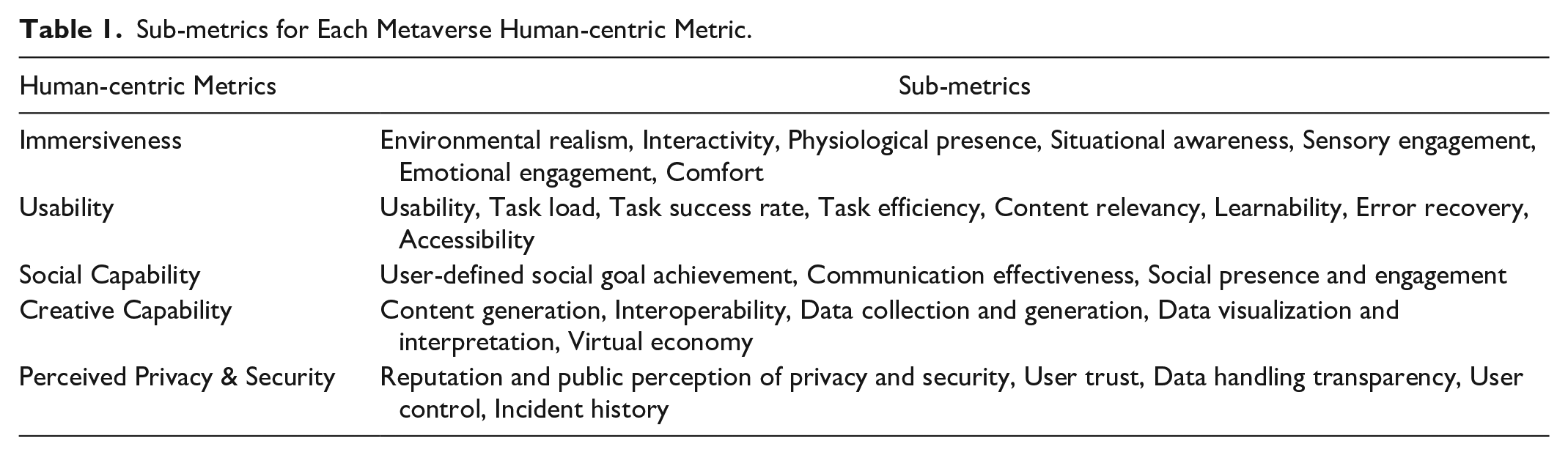
Each metric is further subdivided into detailed and directly measurable sub-metrics, providing preliminary suggestions on which metrics to prioritize in different Metaverse scenarios, as shown in Table 1. Immersiveness includes environmental realism, interactivity, physiological presence, situational awareness, sensory engagement, emotional engagement, and comfort. Usability metrics include task load, task success rate, task efficiency, content relevance, learnability, error recovery, and accessibility. The Social Capability metric encompasses user-defined social goal achievement, communication effectiveness, and social presence and engagement. For Creative Capability, we propose metrics such as content generation, interoperability, data collection and generation, data visualization and interpretation, and virtual economy. Finally, the Perceived Privacy & Security metric includes reputation and public perception of privacy and security, user trust, data handling transparency, user control, and incident history.
Sub-metrics for Each Metaverse Human-centric Metric.
Ultimately, we discuss the significant implications of adopting human-centric metrics for evaluating Metaverse. Our work lays the groundwork for establishing standardized human-centric metrics for the interpersonal Metaverse, which designers, researchers, and developers can use to better evaluate the Metaverse systems they construct. To further expand on this body of knowledge, we invite others to critique, improve, and build upon our framework.
Footnotes
Declaration of Conflicting Interests
The author(s) declared no potential conflicts of interest with respect to the research, authorship, and/or publication of this article.
Funding
The author(s) received no financial support for the research, authorship, and/or publication of this article.
