



Abstract
Outreach programs can play a pivotal role in Science, Technology, Engineering, and Mathematics (STEM) education by providing hands-on experiences and exposure to real-world applications. These programs bridge the gap between classroom learning and practical engagement. The research team has developed a short experiential learning module built on training tasks in the Fundamental of Laparoscopic Surgery curriculum for K-12 students to learn about medical science, training and expertise, workstation design, teleoperations, statistics, and gamification/motivation. This outreach module is derived from a research project on studying expertise in surgery, illustrating the potential of translating a research platform into an outreach platform. In an ever-evolving technological world, our outreach module derived from research can serve as catalysts to develop students’ abilities to think analytically, problem solve, and adapt to challenges.
Introduction
Science, Technology, Engineering, and Mathematics (STEM) education is an interdisciplinary approach to teaching and learning. Despite its significance for filling our labor demands, there exists major gaps including age, race, gender, methodological, and socioeconomic gaps in STEM education to name a few (Bean et al., 2016). Young students lose interest in science and mathematics given the strict requirements of these disciplines (Chen, 2013). Fewer women pursue STEM careers compared to men (U.S. Bureau of Labor Statistics, 2017). There is also a disconnect between learning in the classroom and real-world application (Nguyen et al., 2020).
These challenges demand more novel methods to build STEM interests in K-12 students. We must foster positive attitudes toward STEM studies and careers from an early age for students to develop essential skills such as “engineering design, critical thinking, and science process skills” (Sungur Gul et al., 2023). This mission must also include promoting diversity and inclusion to provide equal opportunities and resources among all students to succeed in STEM.
Outreach programs can play a pivotal role in getting students to pursue further studies or careers in STEM-related fields. Additionally, they can provide hands-on experiences on real-world applications, bridging the gap between classroom learning and practical engagement, and inspiring students to see themselves as future scientists, engineers, innovators, and problem solvers. In an ever-evolving technological world, where STEM fields lead to new ideas and advancements for society, outreach programs are important catalysts to develop students’ abilities to think analytically, solve complex problems, and approach challenges with creativity and innovation (Kennedy et al., 2021). Furthermore, outreach programs can promote diversity and inclusion, ensuring that all students have equal opportunities and resources needed to succeed in STEM disciplines.
Human factors and ergonomics (HF/E) community must also play a part in STEM outreach to raise awareness of the discipline, profession, and contributions in the society. This can be achieved through outreach programs designed to engage diverse K-12 students, illuminating the array of education and career opportunities available and inspiring future generations to explore this impactful discipline. The Systems Cognition Engineering Laboratory (SCEL) at Virginia Tech developed an experiential learning module to engage K-12 students in interactive and hands-on activities built around a laparoscopic surgery trainer box to inspire a new generation of HF/E professionals. The K-12 students can learn more about HF/E through “Do, Reflect, Think, and Apply” (Butler et al., 2019). This experiential learning module was field-tested in the Science Exploratory class at a middle school in southwest Virginia.
Our research also aims to expose K-12 students to learn more about human factors in industrial and systems engineering before applying to post-secondary education. It is not easy for K-12 students to decide their major before they become college students due to their lack of knowledge and understanding about the existing fields and career opportunities. Through outreach, the students might learn more about the college majors and reduce their needs to change majors that can be very costly. Sometimes, misunderstanding could discourage students from starting or continuing with engineering majors (Ngambeki, 2009). Experiential learning outreach is one approach to solving this issue.
To provide the best outreach experience, the team created an experiential learning platform and education module. The experiential learning focuses on the peg transfer task with a laparoscopic surgery trainer box outlined in the Fundamentals of Laparoscopic Surgery (FLS, Soper et al., 2008). The peg transfer task offers hands-on experience in laparoscopic surgery training, hand-eye coordination, training and expertise, workstation design and tele-robotics, and data analytics. The experiential learning module also includes a final and optional component of a peg transfer task tournament to gamify learning. The module emphasizes reflection and connection across components in a fun way that could be an invaluable tool for academics, practitioners, and teachers to adopt for their STEM and HF/E outreach initiatives. This experiential learning module can impart knowledge in human factors and related fields to K-12 students with an engaging learning experience for them to consider pursuing our discipline in their post-secondary education.
Experiential Learning Module
The experiential learning module relies on the laparoscopic surgery trainer-box platform and is comprised of five components covering (a) minimal invasive and robotic surgery, (b) hand-eye coordination, (c) training and expertise, (d) human factors and telerobotics, and (e) data analytics. All five components include demonstrations, data collection, hands-on activities, homework, and self-reflection to foster learning and stimulate contemplation.
Laparoscopic Surgery Trainer-box Outreach Platform
The hands-on experience revolves around the laparoscopic surgery trainer-box platform designed for surgeon trainees to practice representative motor-control tasks in preparation for laparoscopic surgery. The platform shown in Figure 1 is comprised of a laparoscopic trainer box instrumented with an HD camera inside to capture the interiors and inserted medical equipment for practicing the tasks required by FLS. This platform costs approximately $1,200 excluding the laptop computer (required but not in the Figure). The platform requires an adjustable table and tripod mounted with an LCD monitor to display the interior of the trainer box. The adjustable table and tripod ensure that the trainer box and the monitor are placed at a height comfortable for the arms and eye-sights of individual students. This platform allows K-12 students to practice five FLS training tasks that surgeon trainees must practice to experience and understand the wealth of STEM topics surrounding laparoscopic surgery, including medical sciences, minimally invasive surgery in technology, human factors in engineering, and statistics and data analytics in mathematics in addition to many research discoveries on laparoscopic surgeries from the HF/E discipline.
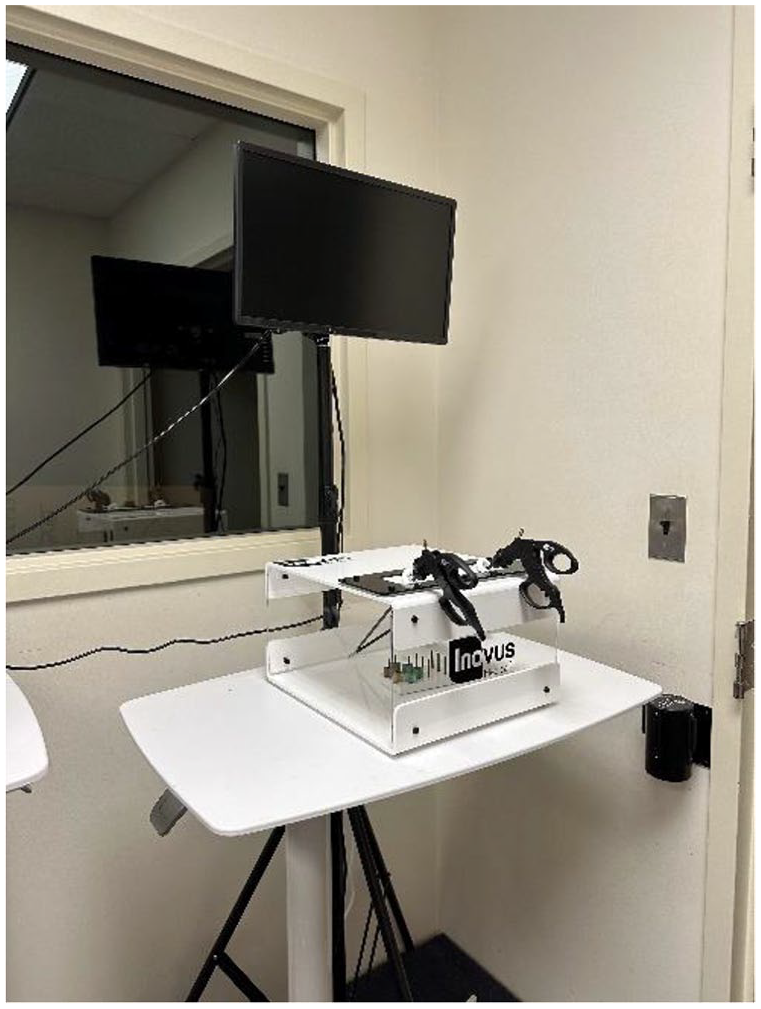
Experiential learning platform (excluding laptop).
Minimal Invasive and Robotic Surgery
The first component focuses on basic concepts of laparoscopic surgeries and reviews the five essential FLS training tasks. The students tried out various FLS tasks using the trainer box and practiced peg transfer tasks as interactive activities to learn about laparoscopic surgery. The students also begin to collect completion time and error data on every trial. The learning objective is to understand the reduced invasiveness and recovery time associated with laparoscopic surgery. The component also alludes to the importance of supporting the surgeons to realize the benefits of laparoscopic surgery and patient safety as a preview to human factors concepts in subsequent components. The hands-on activities demonstrate the translation of theoretical knowledge about injuries and healing into medical technology and practice.
After practice and discussion of the FLS tasks, the students should be able to articulate the merits of minimal-invasive surgery and experience the first-hand challenge in performing such surgeries.
Hand-Eye Coordination
The second component focuses on hand-eye coordination with respect to human sensory and motor abilities and limitations in the context of surgery. Students then practice the FLS task and record data for subsequent components. The learning objective is to understand the perceptual-motor control skills required in laparoscopic surgery, such as dexterity in manipulating the Maryland grasper and perception in visualizing 3-dimensional space with (2-dimensional) display monitor. The hands-on activity of practicing the peg transfer task helps students to relate sensory and motor capabilities to performance and patient safety that are central to HF/E. After practice and some discussion of the peg transfer task, the students should be able to articulate the relevant human capabilities in hand-eye coordination for performing laparoscopic surgery and the importance of designing technology with considerations for those capabilities.
Human Performance and Training
The third component focuses on data collection of human performance data and graphing the data to show the impact of training on performance. The students practice the peg transfer task, record their completion time and error for every practice trial. Then they graph the completion time and error over practice trials (on paper or with a spreadsheet application).
The learning objectives are to understand (a) how to collect speed and accuracy data for assessing human performance and training, (b) how to improve performance by training, and (c) how to graph and analyze performance data to reflect training effectiveness. The hands-on activities of practicing the peg transfer task and graphing performance data help students to relate the performance data they collected with training effect they accrued by graphs and numbers. Collecting human performance data, developing training programs, and visualizing training effects are fundamental to HF/E. After collecting and graphing data from the practice trials, the students should be able to articulate how to collect speed and accuracy data and how to improve performance with training as well as graphing data to illustrate training effects.
Human Factors and Telerobotics
The fourth component focuses on human factors engineering and design, specifically on accessibility in workstation design and feedback in telerobotic applications. The students practice the peg transfer task with the trainer-box outreach platform adjusted to extremely low, comfortable, and extremely high heights that would in effect improve or hinder their performance. The students also seek to adjust the workstation height to find their personal optimal settings.
Additionally, students practice the peg transfer task with time delays to experience the challenges in teleoperation, especially managing space vehicles, like Mars rovers. The learning objectives are to understand the impact of (a) ergonomic design, specifically related to anthropometry, on surgical and task performance, and (b) delayed feedback on performance that are common in remote-control operations, like telerobotic application in space. The hands-on activities of practicing the peg transfer task at optimal and suboptimal settings help students to relate how human factors engineering can impact performance and how time delays of feedback can be a major human performance shaping factor. After participating in these activities, students should be able to appreciate how engineering design and delayed feedback directly impact human performance and the importance of optimizing these factors for both comfort and effectiveness in surgical or other task environments.
Data Analytics
The fifth component focuses on basic statistics and data analytics, such as a means and standard deviation and their relationships to sample size. Students practice the FLS tasks and utilize the recorded data to compute descriptive statistics of their own performance data. The learning objectives are to (a) understand basic statistical concepts and to (b) acquire skills in computing statistics with calculators and spreadsheet applications. The statistical concepts are essential for HF/E as well as other areas, such as understanding survey results that are relevant even for non-STEM fields. The hands-on activity of analyzing ones’ own data helps stimulate their interests as the results can be related to themselves and their classmates. After participating in analysis and discussion of performance statistics of individual students and the whole class, the students should be able to calculate and compare means from different data sets, articulate how these statistical measures are affected by sample sizes.
Tournament
The final component wraps up the outreach program with a peg transfer task tournament, encouraging students to reflect on and apply lessons from previous components for success. This component could be previewed to the students at the beginning of the program to leverage gamification for learning. The learning objectives are to (a) synthesize and apply relevant knowledge on motor skills, hand-eye coordination, and ergonomic practices in prior components, (b) explore impact of motivation and competition on performance, and (c) exercise teamwork in maximizing the collective scores in the peg transfer task. The students form teams to compete against each other in an elimination style tournament. Each member of every team must participate, and the team can optimize the outreach platform for a short period of time before every competing trial. This activity not only tests student ability to perform under pressure but also reinforces teamwork and peer learning as they observe and learn from each other. The component asks students to consider and reflect on HF/E, including management of stress and fatigue during competition, strategies for maintaining concentration and precision throughout the tournament. After participating in the team tournament, the students should be able to understand the importance of a supportive learning environment for continuous improvement and collaborative success.
Outreach Experience
As a preliminary assessment, the project team carried out a 2 hr outreach in one afternoon during a Science Exploratory class in a middle school in southwest Virginia.
The outreach team consisted of four undergraduate students, two graduate students and one faculty member, setup the four packaged platforms in about 15 min, presented some general information about laparoscopic surgery, and gave instruction on the peg transfer task. Then, the students took turns trying out the peg transfer task and recorded their completion time and errors. Finally, middle school students participated in a team tournament and the team concluded the outreach with a brief interactive discussion about training and surgery.
This outreach allowed the team to make observations on student reactions to the experiential learning platform and modules. The team observed that middle school students were very engaged with all the hands-on activities, fostering a sense of curiosity across the aforementioned scientific topics. For example, in one component introducing 0.5 s time delay in the video feed to simulate the experience of operating a rover far in space, many students struggled initially but persisted, then discussed the challenge of delayed feedback.
This activity really demonstrated the significance of human factors to pre-college students. Further, the element of friendly competition in the tournament further motivated some students to actively participate. However, a few students who may not be intrinsically competitive expressed some reservation to compete. The gamification element probably motivated many students to further explore the field, but some might need another form of encouragement.
Discussion
The development of the experiential learning platform and module followed by the outreach activities at a middle school offered several lessons learned for those interested in K-12 outreach activities. First, the efforts in translating a research platform for studying FLS training into an experiential learning platform with a module for K-12 students were relatively modest. This work was completed by four undergraduate students with guidance of one faculty member and two PhD graduate students over one semester. Further, the equipment cost is relatively low (when using unofficial FLS equipment). Thus, academics and practitioners can easily purchase the equipment, build the experiential learning platform, and follow/adapt the aforementioned components to begin HF/E outreach to K-12 students. This project also suggests that some other HF/E research platforms could be readily adapted for engaging K-12 outreach programs.
The project team was able to carry out the outreach activities to gauge student reactions because Virginia Tech has established a partnership with the middle school. This partnership was essential for gaining permission for the outreach activities at the middle school. Thus, HF/E academics and practitioners should connect with pre-college teachers and administers for successful outreach. Virginia Tech aims to partner with additional institutions and organizations to expand the reach of the experiential learning module, allowing for a broader audience and providing valuable insights into the effectiveness of the hands-on learning experiences in inspiring students to pursue STEM careers.
Future work includes formal evaluation of student learning and the impact of the experiential learning outreach program on career choices. Tracking this impact could help the HF/E community develop programs that inspire the future generation of our discipline. The team also intends to incorporate other HF/E topics to cover more of the discipline.
Conclusion
Our research outlines steps to developing a suitable outreach program from materials to curriculum ideas to engage students utilizing foundational concepts within the HF/E and FLS fields. This outreach module highlights the opportunity to adapt research platforms and training tasks for K-12 experiential learning, inspiring future STEM and HF/E professionals. Such efforts can benefit the HF/E community by emphasizing the importance of human factors and ergonomics in shaping the future. With more implementation of this concept to different topics and fields, further improvements to STEM education can be made. The team’s previous experience with outreach has proven a success in engaging and motivating students to critically think about the presented STEM topics and activities (Figure 2).
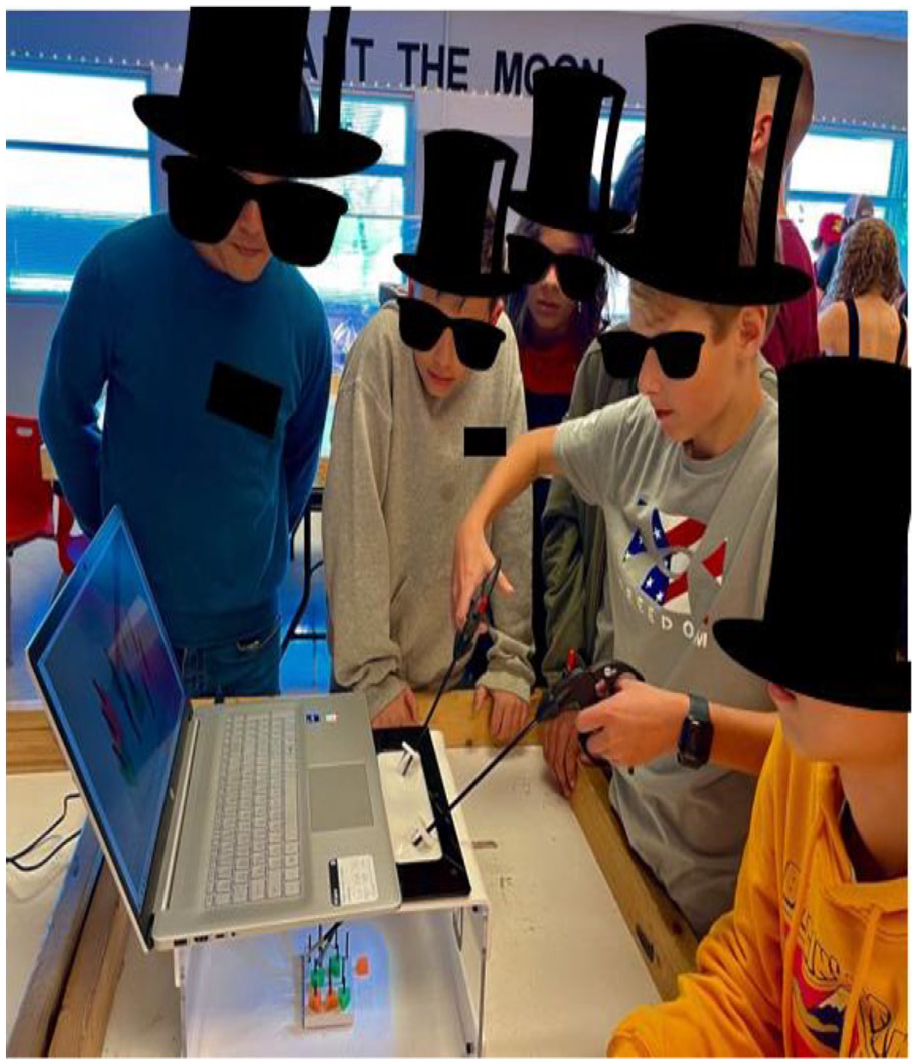
Middle school outreach event.
Footnotes
Acknowledgements
This project is supported by the Virginia Space Grant Consortium. We thanked Cindy Watson for her effort in supporting us with the outreach activity at the middle school.
Declaration of Conflicting Interests
The author(s) declared no potential conflicts of interest with respect to the research, authorship, and/or publication of this article.
Funding
The author(s) disclosed receipt of the following financial support for the research, authorship, and/or publication of this article: We received funding through Virginia Space Grant Consortium.