



Abstract
This study examines how adding scents to a virtual reality (VR) environment impacts immersion, anxiety levels, and mood. Participants (N = 40), aged 18–44 years with varying levels of VR technology experience, were randomly assigned to either the control (no scent), congruent (i.e., scents that match the visual scene), or incongruent scent conditions. Participants were assessed on changes to mood, anxiety levels, immersion, and performance on a memory recognition task. Results suggest that while the VR experience significantly reduced anxiety and lifted mood, scent did not significantly affect memory performance or immersion in the VR experience. Future directions for research include exploring the use of scent to engage participants more fully in exposure therapies.
Introduction
Virtual reality (VR) has been used in a variety of settings, including training, games and entertainment, and exposure therapy for treating psychological disorders such as phobias, anxiety, and posttraumatic stress disorder (Foster & Meech, 1995). VR typically engages the user’s sense of sight and hearing, but introducing the other senses may help increase the realism of the virtual environment. Olfactory cues have been relatively neglected in VR applications. Because olfactory cues provide important information about our environment (e.g., hazards), recent studies have explored the impact of scent on VR users’ sense of presence and realism (Flavian et al., 2021; Harvey et al., 2018; Howell et al., 2016). The purpose of the current study is to assess whether olfactory cues increase immersion, decrease anxiety, and/or improve mood. Such a finding may help inform the use of multi-sensory VR for therapeutic purposes (Kass, 2022).
Olfactory Cues
Because olfactory input is processed through the limbic system’s hippocampus and amygdala, the sense of smell heavily influences both memory and emotion, respectively (Aiken & Berry, 2015). Many studies have shown the potential of different smells to cue emotional memories or enhance affective associations to verbal and visual cues for long-term memory retrieval, especially during highly emotional or stressful episodes (Wiemers et al., 2014). Herten et al. (2016) found that when olfactory cues are present during a startling event, even 24 hours later, these odors (both related and those unrelated to the stressor) would trigger more intense startle responses compared to visual triggers. In a study targeting smokers, Cortese et al. (2015) found that several odors, including cigarette smoke and fresh tobacco and loosely associated smells of fresh-cut grass and coffee, could be used to elicit physiological cravings. Addressing odor triggers in the early stages of exposure treatment helped elicit reactions specific to those who smoke and may reduce the incidence of relapse.
Congruent Versus Incongruent Olfaction
Well-designed VR scenarios can provide remarkably immersive experiences. While touch, sight, and sound can all be part of the VR package, evidence suggests that the effects of VR are increased with added stimuli and decreased with missing or contradictory input (Rose et al., 2018). Chen (2006) asserted that scents in the virtual world are used to engage participants, affect their attention, and immerse them in the scene. According to Cooper et al. (2018), utilizing a multi-modality of sensory input is much more effective in establishing a sense of presence, only limited by practical considerations of technology, funding, or facilities. Another study instructed participants to play an emotionally charged VR action game and answer questions about what they observed afterward (Tortell et al., 2007). They found that injecting incongruent (out of context) odors into the scenario distracted participants and caused fewer correct answers to questions about the environment they were asked to recall. On the other hand, situationally appropriate odors aided in the recall.
Flavián et al. (2021) found that congruency between pleasant odors and visual cues resulted in a more enriched experience. In a non-VR olfactory-enhanced multimedia experience, Ghinea and Ademoye (2012) found a significant relationship between olfactory and visual cues, which enrich the overall experience when the signals are congruent. Harvey et al. (2018) asked participants to view images of various fruits with scents attached. They found that participants quickly and accurately matched fruits with congruent scents, while mismatched scents caused participants to perform worse than no scent when asked to identify the fruit under timed conditions. They suggested that olfactory cues can make the need for salient visual detail in virtual assignments less necessary, as it is easier to control what the participant is attending to, making it possible to use less detail on unattended areas of the environment because it draws the user’s attention to the desired area of focus.
Immersion, Olfaction, and VR in Research
Most studies examining the sense of smell in VR confirm the olfactory system’s vital role in human memory and emotion. According to Doty (2001), the olfactory system has direct access to the amygdala, the part of the limbic system that is responsible for processing emotions. For the other primary senses, the thalamus plays a significant role in interpreting sensory input before it is registered by the limbic system to classify, categorize, and decide how to respond to input (Courtiol & Wilson, 2015). As a result, olfactory stimuli result in more emotionally intense memory than verbal or visual modalities (Munyan et al., 2016), but these emotions are not necessarily attributed to the olfactory input. This may explain why emotional reactions to olfactory cues can be more severe, particularly in certain clinical conditions like post-traumatic stress disorder (PTSD).
Impact of VR on Anxiety and Mood
Some anxiety-related disorders (e.g., PTSD and specific phobias) are sometimes treated using exposure therapy. Exposure therapy is a treatment that allows therapists to help their clients face their fears in a safe environment and build coping skills (American Psychiatric Association, 2000). While this treatment can be done in a therapist’s office using simple stimuli such as pictures of the feared object or situation, it can also be completed in VR. Virtual Reality Graded Exposure Therapy (VRGET) allows a therapist to control the severity and type of triggers and gradually increase elements like presence to develop coping skills (Rizzo et al., 2006). VRGET can reduce how long treatment takes, as well as a general improvement of symptoms when compared to cognitive-behavioral therapy (CBT), with a significant reduction of relapses up to 3 years later (Wiederhold & Wiederhold, 2005).
Past VR therapies for combat veterans with PTSD include Virtual Vietnam, described as having images of jungle scenery in different weather and times of day accompanied by helicopter noise, gunfire, explosions, and soldiers yelling (Wiederhold & Wiederhold, 2005). Recent iterations include more current battlegrounds relevant to the newer generation of combat veterans. The critical factor in this improvement is the accurate tailoring of the VR experience to gradually immerse patients in the scenario where they need to learn to cope. One study investigated how olfactory stimuli would affect a VR user’s sense of immersion in anxiety-inducing environments to judge if additional stimuli in exposure therapy would have additive effects on the user’s distress (Munyan et al., 2016). Immersion did increase significantly in response to the addition of scent, yet there was no measurable increase in anxiety levels, which suggests adding scent to exposure therapies may improve immersion but will not necessarily impact anxiety.
In contrast, Rizzo et al. (2006) chose olfactory stimuli designed to trigger memories of a specific combat environment. They found that while olfactory triggers were practical when combined with audio and visual inputs, there were no significant additive effects. However, this finding may be related to the limitations of the scent delivery mechanisms, as researchers had little control over the duration and intensity of the scent in the experience or with presenting odors paired with visual stimuli of the associated objects, creating congruency issues.
Purpose of Current Research
This study assesses whether adding olfactory stimuli to a VR environment impacts immersion, anxiety, or mood. Past research suggests congruent olfactory stimuli can be effective at increasing immersion as well has having positive impacts on mood, memory, and anxiety.
The current study hypothesizes that (1) memory retrieval is most accurate when the participant is presented with an olfactory stimulus that is congruent with the audio and visual cues associated with the VR experience compared to control (no olfaction), but memory retrieval is less accurate than control when an non-congruent olfactory stimulus is introduced; (2) when presented with an uplifting VR experience, positive affect is increased when a congruent olfactory stimulus is added compared to control, but is not affected by non-congruent olfactory stimuli, and (3) when presented with a relaxing VR experience, anxiety levels are reduced when a congruent olfactory stimulus is added compared to control, but is not affected by non-congruent olfactory stimuli.
Method
Participants and Design
Forty participants were recruited from the undergraduate student body and assigned to either the control (n = 13), congruent (n = 13), or incongruent (n = 14) conditions. Participants ranged in age from 18 to 44 years (M = 21.23, SD = 6.16) with a median age of 19. Of those surveyed, 20% (n = 8) reported owning or having regular access to VR technology, and all of these estimated their weekly use to be between 0 and 2 hours. Additionally, 20% (n = 8) of participants reported that this was their first time using VR technology, and 57.5% (n = 23) reported having had limited experience (e.g., using a friend’s device or participating in a museum VR exhibit). In comparison, 2.5% (n = 3) reported extensive use in the past, though they do not currently own or regularly use a headset.
The study employed a mixed factorial design with both between and within groups measures. Participants were assigned to one of three conditions: (1) a VR scenario containing audio and video cues only (Control), (2) a VR scenario containing audio and video with congruent olfactory cues (Congruent), or (3) a VR scenario containing audio and video with incongruent olfactory cues (Incongruent). Because of the logistical problems of clearing the lab of previous scent conditions, rather than a pure random assignment, scent conditions were scheduled to be performed on different days each week by the researcher before the experiment phase began, and students signed up for lab appointments without this information, creating a semi-random assignment to each scent condition. All participants were measured on the dependent variables of mood state, anxiety level, and memory recognition.
Materials
Scent Conditions
Scents were chosen with the goal of them being pleasant or neutral. The control group had no olfactory cues, the congruent group had concurrent scents of grass, pine, and wood smoke, and the incongruent group had a scent that would not be expected in that environment (strawberry mint bubblegum).
Anxiety
Participants were asked to rate themselves on a shortened version of the State and Trait Anxiety Inventory (Spielberger, 1983), published and validated by Marteau and Bekker (1992). For this study, state anxiety was the variable of interest, specifically, reductions in transient anxiety levels rather than factors of each participant’s personality. The pre- and post-survey was used to establish a baseline and measure changes after the VR experience, respectively.
Mood
Participants were asked to rate themselves on the Positive and Negative Affect Scale (PANAS; Watson et al., 1988). This scale has 10 positive affect and 10 negative affect items that were scored on a 5-point Likert scale from “Strongly Disagree” to “Strongly Agree.” Participants rated themselves both before entering VR and again immediately after exiting.
Memory
This study implemented a 15-item, two-alternative forced-choice task using scenes from the VR scenario to evaluate the memorability of the VR experience. Participants viewed pairs of images, one being a screen capture of various objects (birds, butterflies, trees, rocks, flowers, and animals) they saw during their experience. The other image was a plausible foil from a different scenario. Participants were instructed to select the image they remembered viewing during the VR scenario.
Presence and Immersion
To gather information about immersion after the VR experience, participants were asked to answer questions from Witmer and Singer’s Presence Questionnaire (1988). The questionnaire consists of 24 items in which participants rank their responses on a 5-point Likert scale from Not at All to Always. An example item is, “How closely were you able to examine objects?”
As a manipulation check, two additional questions were added regarding olfaction to gain a self-report of the salience of olfactory cues. These questions asked participants to rate on a 5-point Likert scale “How much did the environment’s olfactory (scent) aspects involve you?” and “How well could you identify smells?”
Procedure
Participants signed informed consent and completed a demographics survey followed by the anxiety and mood measures. All participants experienced the same VR scenario depicting a pine forest with flowers, trees, a vista of pine-covered hills, and a variety of animals to interact with along with congruent auditory cues. Participants experienced the VR scenario according to their assigned group’s olfactory conditions. During this experience, participants were verbally encouraged to explore the environment, play with features, and then directed to perform mini-tasks, such as moving animals from one location to the other using virtual breadcrumbs, marking the location of specific trees containing birds and butterflies and finding them later, or using the program’s features to alter the environment’s time of day or weather conditions to help find less visible clues. After the 20-minute experience, participants completed the anxiety, mood and memory tasks. Finally, participants received a debrief explaining the purpose of the study.
Results
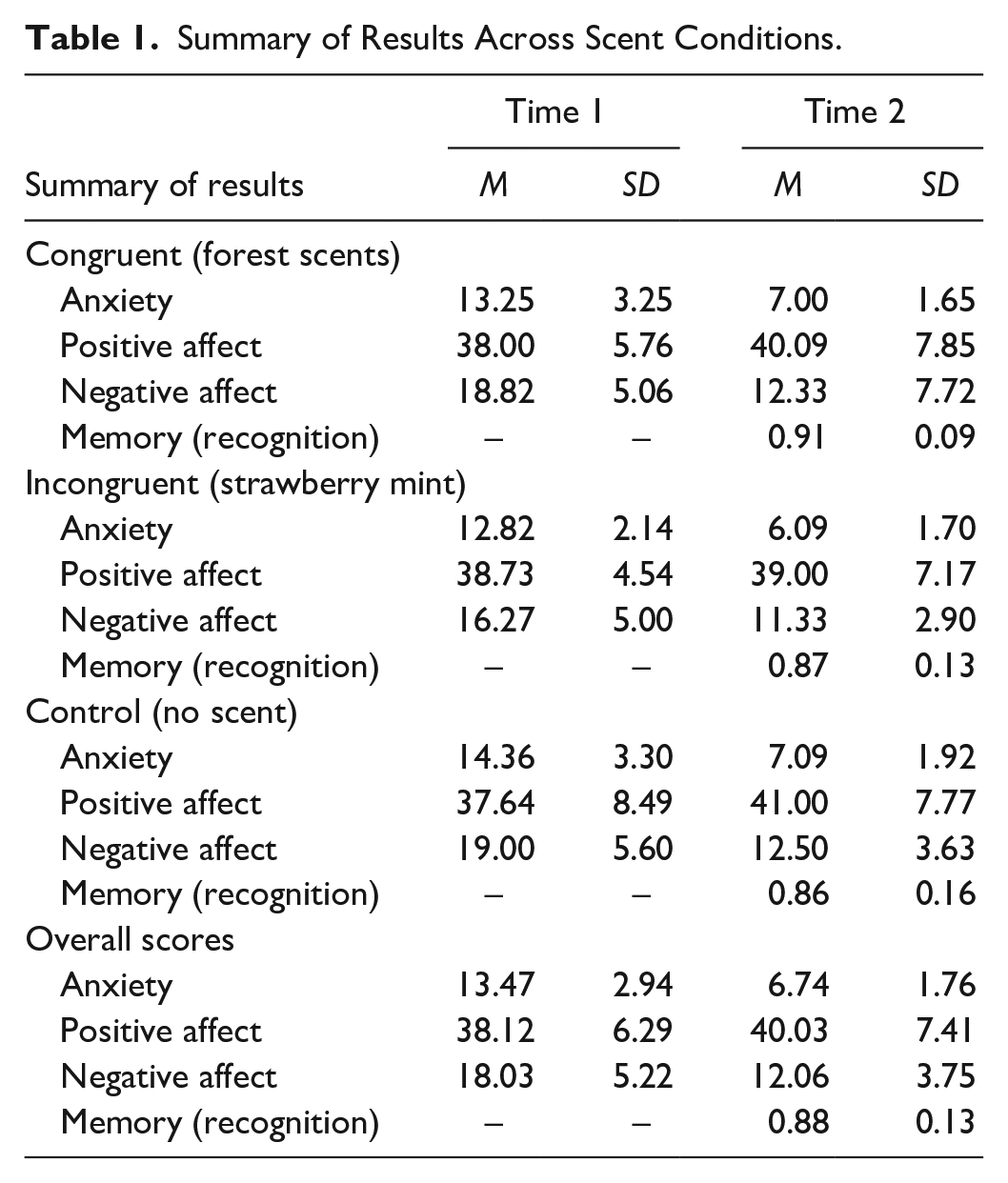
All 40 participants were included in the analyses. Two mixed factorial 2 (time: T1 and T2) × 3 (olfaction: control, congruent, and incongruent) ANOVAs were conducted to examine the effect of time and scent condition, with scent included as a between-subjects variable. Additionally, a one-way ANOVA was conducted to compare the results of a memory test across scent conditions. A summary of the study’s findings can be found in Table 1.
Summary of Results Across Scent Conditions.
Positive/Negative Affect
The main effect of time on positive affect was significant, with positive affect increasing slightly from T1 to T2, F(1, 30) = 6.64, p = .015, η2 = 0.181. The main effect of scent was not significant, with positive affect scores being similar among the control, congruent, and incongruent scent conditions, F < 1. Additionally, the time by scent interaction was not significant, F(2, 30) = 1.465, p = .247, η2 = 0.089. While the VR program worked as designed to lift positive affect, the effect was small and was not impacted by olfactory cues.
The main effect of time on negative affect was significant, as negative affect decreased from T1 to T2, F(1, 30) = 50.97, p < .001, η2 = 0.629. However, the main effect of scent was not significant, as negative affect scores were similar across the control, congruent scent, and incongruent scent groups, F < 1. Additionally, there was no significant interaction between time and scent, F < 1. The study found that the VR experience significantly decreased negative affect but did not find any effect of scent or interaction.
Anxiety
The main effect of time on anxiety was significant, with anxiety decreasing from T1 to T2, F(1,30) = 164.97, p < .001, η2 = 0.07. The main effect of scent was not significant, with anxiety scores being similar among the control, congruent scent, and incongruent scent conditions, F < 1. Additionally, the time by scent interaction was not significant, F < 1. While the VR program effectively reduced anxiety overall, the scent did not appear to affect anxiety levels.
Memory
Memory was tested only during T2. Those in the congruent condition did not perform significantly better than those in the control condition or in the incongruent scent condition, F < 1. Scent condition did not affect recognition.
Immersion
While there is no significant effect of scent condition on the user’s experience of involvement, adaptation, or the user’s experience of interface control, users’ reported experience of sensory fidelity approached significance, F(2, 37) = 3.20, p = .052, partial η2 = 0.147. Overall, olfaction did not impact the levels of immersion and presence in VR but may impact sensory fidelity.
Discussion
Overall, our findings support previous research, confirming that VR programs designed to be relaxing positively impact mood. However, we found no significant impact of scent condition on anxiety, mood, or memory. Additionally, we found no evidence that the inclusion of olfactory cues impacted presence or immersion in VR, though we found a small positive impact on sensory fidelity. Below we discuss the practical implications and limitations of our results.
Practical Implications
The VR Experience
Despite the non-significant effect of scent condition, the results showed a significant decrease in negative affect and state anxiety between Time 1 and Time 2. In all conditions, participants found the VR experience of performing simple tasks and interacting with nature relaxing and uplifting. This result supports the research on clinical applications of VR technology in improved meditation and mindfulness. It could allow VR to be used to supplement existing therapies to enhance relaxation and uplifting effects.
The design may have been more effective if the target populations’ lived experiences were considered. The choice of scene and scent could be tailored to individual users for clinical application. That is, the lack of effect of scent on mood or memory may be due to participants’ lack of meaningful associations with those particular scents (i.e., pine, dirt). However, scents that are more tailored to the participant may prove more successful in eliciting the desired affect or memory. For example, the scent of salt air and sunscreen may increase the impact of a VR beach scene for eliciting happier days of summer vacation for some participants, while for others the same VR scene could elicit anxiety or panic as it elicits traumatic memories of a loved one’s near drowning at the beach. Therefore, the same combination of visual, auditory, and olfactory cues could be used to help patients relax in their “happy place” or could elicit anxiety when used in another patient’s treatment for PTSD.
Other Potential Uses
The importance of olfactory cues is often overlooked when creating virtual environments. In our everyday lives, olfactory cues serve as omnidirectional warnings alerting us to hazards such as fire, gas or chemical leaks, or the presence of other humans or animals. The implications of introducing meaningful scents into training are extensive. For example, first responders could be trained to identify the location of a fire or gas leak in VR. However, poorly designed virtual environments which include incongruent scents may provide conflicting cues and lead to negative transfer of training. More research is needed to learn how best to optimize the use of scent in virtual environments.
Limitations and Future Directions
Scent Condition Control
How scents are delivered is a challenge for any olfactory research, particularly in applied settings. Greater control over the strength and duration of the scent may be necessary to better match the simulated olfactory environment to the visual environment. While the current study could not find significant support for hypotheses related to the use of olfactory cues for therapeutic virtual reality applications, future studies could further explore other interesting questions, such as ways to apply scent to enhance immersive therapies, including exposure therapies for phobias or PTSD.
Individual Differences in Olfaction
Scents can be experienced differently by everyone, which impacts individual responses to VR stimuli. Even scents that are traditionally considered relaxing, such as lavender, may be stressful to someone who encountered it during a traumatic experience (Lin et al., 2018). More commonly, a previously pleasant smell an individual encountered during a food poisoning experience may be aversive for that individual afterward. Odors associated with a threat or negative experiences tend to be repulsive, while smells related to good food cause salivation and stomach growling. These reactions to olfactory cues are reflexive and emotional, often without conscious awareness. These varied experiences make implementing olfactory cues in VR technology challenging and, for recreational uses, somewhat impractical.
Exploring the Effect of PTSD in VR Experience
Research shows virtual reality therapies and experiences have varying effectiveness depending on the individual user, which may account for some of the variability in reporting. According to Mistry et al. (2020), contrary to their hypothesis that VR meditation would be more effective for those experiencing PTSD than non-VR meditation (which tends to cause distress), they found little difference in the amount of negative affect and distress experienced by participants who reported PTSD symptoms. While this study did not examine a clinical population with PTSD, an important future direction would be to replicate a similar study in a clinical population to see if additional benefits exist for those individuals. Given the established impact of scent cues in trauma-related experiences, however, a VR experience designed to trigger an emotional response or stress reaction (such as with exposure therapy) might be more effective for those with PTSD, given the right scents.
Conclusion
This study examined how olfactory cues impact the VR experience, including the impact on anxiety, mood, and memory. Of particular interest was how congruent sensory stimuli might create a more profound sense of immersion and realism in virtual reality, which has important implications for any therapeutic applications of VR technology. While the results of this study showed significant reductions in negative moods after participants experienced the VR simulation, the scent condition (congruent, incongruent, or control) did not make a significant difference. This finding could mean that while this research supports the body of research on using VR technology to enhance mindfulness and relaxation techniques effectively, the scent may not play a significant role. Alternatively, it is possible, or even likely, that problems with scent choice, salience, or control (delivery/removal) confounded the results. Further research should address these issues.
Footnotes
Declaration of Conflicting Interests
The author(s) declared no potential conflicts of interest with respect to the research, authorship, and/or publication of this article.
Funding
The author(s) received no financial support for the research, authorship, and/or publication of this article.