



Abstract
Future long-distance space missions (LDSM) present formidable challenges due to prolonged isolation, communication delays, and extreme conditions, which affect individual and team cognitive functions, crucial for mission success. This necessitates a higher degree of autonomy, emphasizing the importance of team cognition in managing the complexities of LDSMs. Although prior research has largely focused on individual cognition, the collective cognitive processes that support effective team performance in space have been less studied. This oversight is critical as factors like microgravity and isolation can impair individual level cognitive functions vital for teamwork, such as attention and working memory. This paper employs the Macrocognition in Teams Model to study publicly available transcripts from the Apollo space missions to understand the challenges to collaborative problem-solving in these complex and high stress environments.
Keywords
Introduction
Future space exploration missions will be characterized by extended periods of isolation, confinement, and communication constraints caused by the extreme distances involved. The space environment, coupled with social and physiological demands, will affect individual and team cognitive processes (Fiore et al., 2015). Teams conducting long-distance space missions (LDSM), therefore, face the pervasive risk of team performance decrements due to inadequate cooperation, coordination, communication, and psychosocial adaptation within the spaceflight crew itself, as well as between and across Mission Control teams.
Given that team cognition is a significant predictor of team performance across several domains (e.g., Gevers et al., 2020; Grand et al., 2016), it is critical to understand how it is also altered in the case of teams and multiteam systems (Lungeanu et al., 2023; Mathieu et al., 2001) in LDSM (Anania et al., 2017). This means understanding how individual cognition, compromised in various ways, can have a cascading and negative impact on team and MTS effectiveness. Further, for the success of humans in outer space, it is critical to understand how teams can learn how to overcome problems associated with deficits in individual and team cognition.
In this paper, we draw from the Macrocognition in Teams Model (MITM), which integrates theory from literature on group process and team cognition (Fiore, Rosen, et al., 2010; Fiore, Smith-Jentsch, et al., 2010), and adapt it to the study of cognition in LDSM. More specifically, we apply the MITM on transcripts of the Apollo Program missions and investigate how the criticality and phase of the mission affect MITM processes. The implications of the findings in the context of LDSM will be discussed.
Theoretical Background
Macrocognition in Teams Model (MITM)
Team cognition involves the coordination of knowledge and actions among individuals as they utilize and adapt their existing knowledge or generate new knowledge during complex collaborative tasks (Fiore, Smith-Jentsch et al., 2010). The MITM provides a coherent theoretically based conceptualization for understanding and examining complex collaboration (Fiore, Rosen et al., 2010) and the ways it can be measured (Fiore, Smith-Jentsch et al., 2010). It consists of five major components. Individual knowledge building occurs when an individual processes raw data and incorporates it into their knowledge base. Team knowledge building involves the transformation and dissemination of individual knowledge into actionable team knowledge. Internalized team knowledge describes the knowledge each member holds (e.g., shared mental models and transactive memory systems). Externalized team knowledge describes explicitly articulated relationships constructed from the knowledge and the task-relevant concepts the team has established. Critical to team cognition, it also includes the cognitive artifacts constructed to produce this knowledge; for example, sketches or diagrams to make ideas explicit and concrete for team members as they offload and scaffold their collaborative cognition (Fiore & Wiltshire, 2016). Problem solving outcomes are influenced by the interactions among team members and whether these interactions contribute to the fulfillment of task objectives (Fiore, Rosen et al., 2010). From this, the MITM provides a strong foundation for understanding complex cognition as it will occur in LDSM. First, it is multi-level in that it encompasses individual and team-level factors. Second, it addresses internalized and externalized cognitive functions. Finally, it incorporates temporal characteristics to examine phases of problem solving (cf. Wiltshire et al., 2018) and how these relate to collaborative processes.
Space Environments and Team Cognition
During LDSM, teams must develop team cognitive knowledge and execute the team cognitive processes necessary to coordinate their actions. Despite the clear importance of those processes for the successful functioning of LDSM teams, most research conducted on cognition in space has only studied the individual-level. In their review of the literature on individual cognition in space and analog environments, Fiore et al. (2015) illustrated how many of the characteristics of LDSM (e.g., microgravity, isolation) may impair cognitive abilities related to team cognition. For example, there appears to be impairment of attentional abilities, specifically with regards to decreased accuracy and increased response time, and particularly in extreme environments such as cold, isolation, and when experiencing sleep deprivation (e.g., Cabon et al., 1993). Working memory (e.g., central executive functioning) research suggests some impairment, attributable to task overload or distraction (Mäkinen et al., 2006; Palinkas et al., 2005). For example, studies show impairment due to microgravity tests such as digit-symbol substitution and number recognition (Kelly et al., 2005) and lack of sleep was found to negatively impact cognitive performance on working memory type tasks (e.g., Barger et al., 2014). Similarly, reasoning problems were also suggested to be a factor for LDSM.
Despite limitations in research, that is, their mainly individual-level nature, these studies of individual cognition in space form an important foundation for team cognition research in LDSM. They point to potentially problematic performance deficits in team cognition caused by impaired individual cognition. Nevertheless, despite empirical data showing evidence of individual cognitive decrements in space, there is a lack of understanding of how the individual-level decrements influence team-level cognitive processes, highlighting the need to understand the role and demands of the space context on the MITM processes. Therefore, in this paper, we explore the effect of the challenges of the tasks conducted in the space environment on astronauts’ MITM processes. We focus on collaborative problem solving as this task requires a complex blend of individual and team level cognition.
Method
This study adopts a histometric approach, identifying events from historical data for usage of analyses (Simonton, 2015). One of the benefits of such a methodology is that it depends on archival documentation that was not collected by or for the research question of interest, thereby limiting some inherent bias.
Sample
Transcriptions of mission communications from the Apollo Program were used as the main data source. The source data was composed of communication between the three astronauts of the respective Apollo mission as well as communication with the Mission Control Center (MCC).
Based on publicly available accounts of problem-solving incidents, a list of events was created. These events were evaluated with the following selection criteria: (1) The incident must involve problem-solving; and, (2) The response to the problem must be at the team level. Next, as an exclusion criterion, if the event involved a by-the-protocol response, where no explicit problem-solving was apparent (e.g., no new knowledge was needed), it was not included in the sample. The remainder provided specific sections indicative of complex problem solving that were extracted from the mission transcripts and used for coding. This paper represents part of a larger project on team cognition for long-distance and long-duration missions. Therefore, we report our analyses of a subset of the incidents (17 out of 61).
Data Extraction
For extracting the data related to the MITM processes, a content analysis approach was used. For that purpose, a codebook covering the MITM processes was created. This was an adaptation of previously developed codebooks based on MITM (Rosen, 2010; Wiltshire, 2015). These were combined and adjusted to fit the context of spaceflight. The final codebook consisted of five general categories representing the MITM model processes, and for each category, a set of subcodes representing specific subprocesses of those categories, resulting in a codebook consisting of 24 codes.
The coding was conducted by a team of four trained RAs. For each file, a pair of RAs coded the file independently and Kippendroff’s cu-Alpha-binary intercoder agreement values were calculated on the level of MITM categories. The average Kippendroff’s cu-Alpha-binary value across the MITM categories was .94. After calculating the intercoder agreement values, an agreement meeting between the two coders was held and the final agreement at the subcode level was achieved.
Results and Interpretation
The results indicate that the most prevalent type of MITM process identified from the mission transcripts was Team Knowledge Building (94% of the codes). This result is partly attributed to the nature of the data (communications data as opposed to narrative descriptions), and also the nature of the events. Specifically, these were problem-solving incidents from the beginning of the incident to the solution; that is, no post-incident debrief or reflection was included.
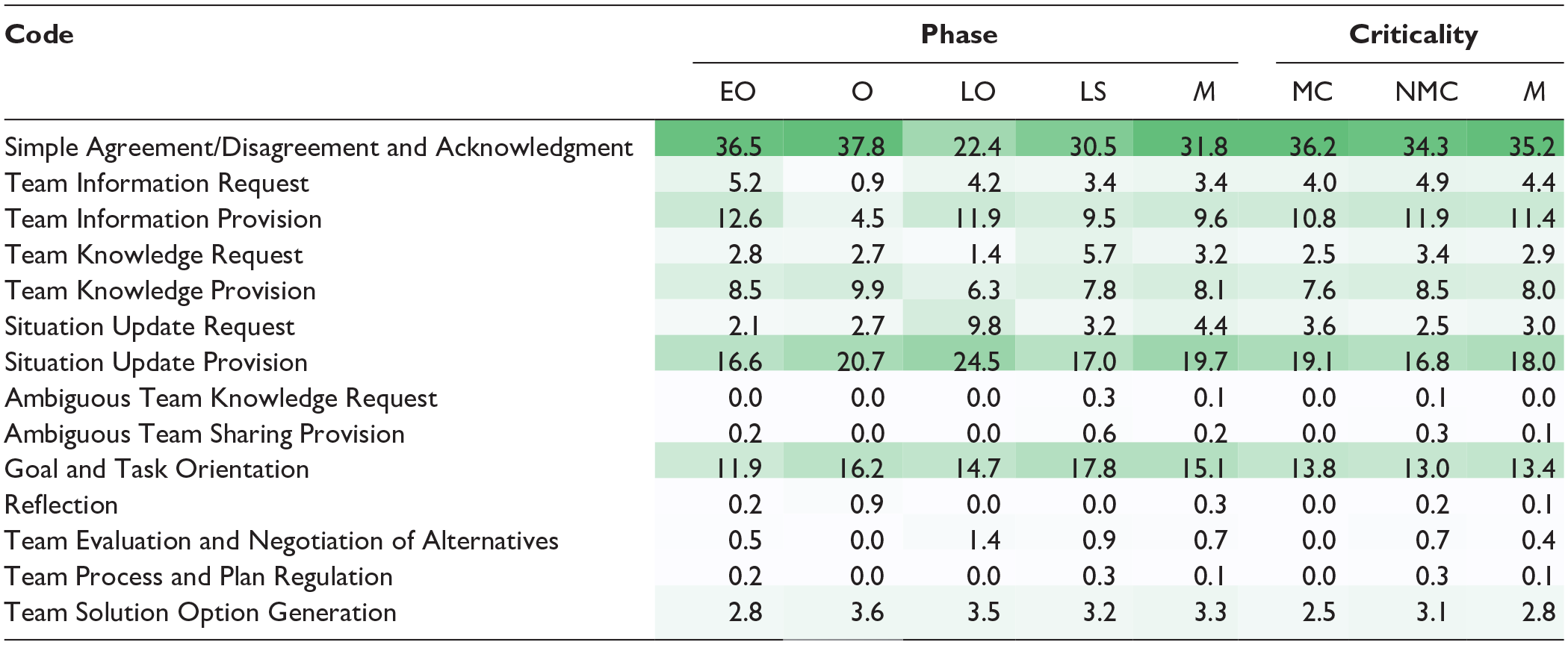
Table 1 provides an overview of our findings with a focus on the sub-processes associated with Team Knowledge Building. To improve interpretability across different missions and mission phases (e.g., critical/non-critical events, Lunar surface), a standardized value (codes per 100 coded utterances) of extracted Team Knowledge Building processes was calculated. These standardized values were transformed into percentages for easier comparison across event types and MITM processes. First, looking across these, it appears that across mission phases and criticality, overall, approximately one-third (31.8% by phase and 35.2% by criticality) represented simple agreement, disagreement, or acknowledgment. For example, see the following sequence from Apollo 17 Docking Latch Failure incident:
Standardized Values (codes per 100 coded utterances) of Team Knowledge Building Processes Across Phases and Criticality of Events.
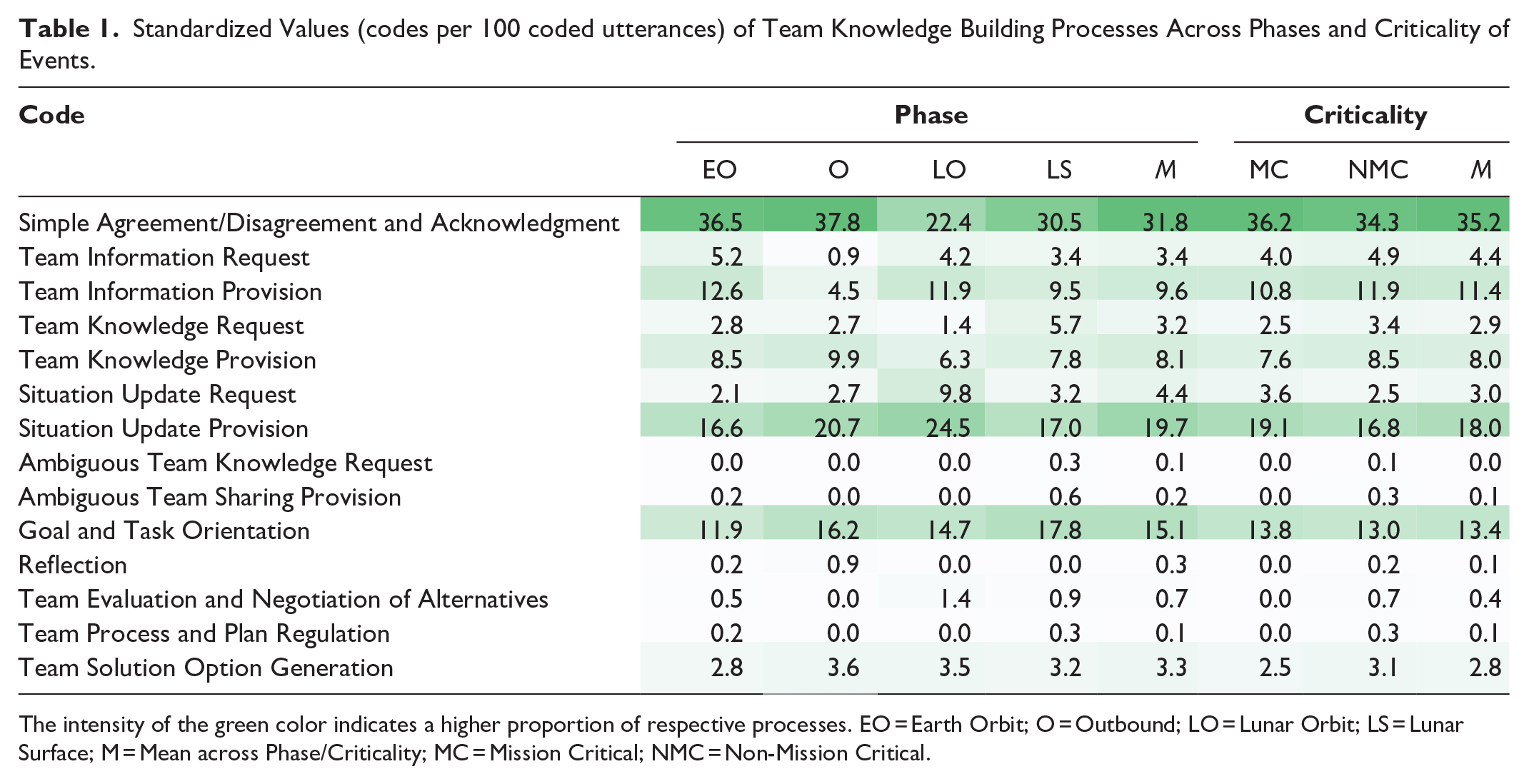
The intensity of the green color indicates a higher proportion of respective processes. EO = Earth Orbit; O = Outbound; LO = Lunar Orbit; LS = Lunar Surface; M = Mean across Phase/Criticality; MC = Mission Critical; NMC = Non-Mission Critical.
004:23:05 Cernan: Okay, 7, 9, and 10 – the handle is flush; the bungee is vertical, but the handle is not locked down, and the – and the red button is showing. And I can pull each one of them back slowly. I haven’t done anything with them. That’s 7, 9, and 10. [Situation Update Provision]
004:23:35 Overmyer: Roger. We copy that. The handle is flush; the bungees are vertical, but the handle is not locked down, and the red button is showing on 7, 9, and 10. [Simple Acknowledgment]
004:23:45 Cernan: That’s affirm. [Simple Agreement]
As is apparent from the transcript, this illustrates well the practice of closed-loop communication. This is where information is repeated to ensure that the information shared was received correctly or receiving of the information is acknowledged. Although we label this as “simple” communication it is important to recognize that this form of communication has long been recognized as crucial to effective teamwork (Cannon-Bowers et al., 1993).
Moreover, it is apparent that rather than sharing knowledge, sharing information is more prevalent in those situations (9.6%/11.4% for Information Provision and 8.1/8.0% for Knowledge Provision by phase/criticality respectively). Furthermore, most of the information and knowledge provision happened without an explicit request for the information/knowledge, as is the case with Situation Update Provisions. This likely indicates the habit of ensuring shared mental models amongst the crew members. Finally, regarding more complex processes, Goal and Task Orientation was the most prevalent process extracted. An example of this code from Apollo 15 Drilling Problem is as follows:
147:46:53 Scott: That’s where I had it, Joe. Right on top. The probe went down a couple, two out of the four. [Situation Update Provision]
[In response to Houston’s suggestion, Dave has pulled the probe far enough up that the top emerges from the top drill stem. He then starts to lower the probe back in the hole.]
147:47:05 Allen: Dave, pull the probe out all the way, and see if the rammer-jammer alone will go in, please. [Goal and Task Orientation]
147:47:13 Scott: Okay. [Simple Agreement]
And from Apollo 7 AC Bus Dropout Problem:
072:21:16 Swigert: That’s right [Simple Agreement], and that is why we just decided to go ahead and do this burn 3 and get the perigee down. [Team Knowledge Provision]
072:21:24 Schirra: Okay [Simple Acknowledgment]. We will be doing two jet here; we will have to kick it over for a while. [Goal and Task Orientation]
072:21:28 Swigert: Okay [Simple Acknowledgment]. Then we have got plenty of time to pick it up later. No problem on that. [Goal and Task Orientation]
These transcript extracts illustrate how the crew members express the next necessary steps for achieving their common goals. Related, they document how the team develops shared cognition about the sequence of subsequent tasks.
Comparing the Team Knowledge Building processes across mission phases, it is apparent that, on or closer to Earth’s orbit, crew members engage more in simple short responses (Simple Agreement/Disagreement and Acknowledgment). One potential explanation for that effect is that 6 out of 8 events in this sample of Earth’s orbit events were from the Apollo 7 mission which was the first manned Apollo mission with the main purpose of testing all the systems of the spacecraft. Because of that, Mission Control provided a substantial amount of instructions and guidance to the crew, potentially resulting in a higher percentage of Simple codes. Since two of the three mission-critical events happened in Earth’s orbit as well, this might explain a similar pattern in those processes. This type of communication indicates the potential to automate that kind of communication in the context of future long-distance missions, where quick discussions are not possible due to the long communication delay. Automating the check-ups of new technologies (e.g., a Mars mission while deploying ground habitats) would help to mitigate MTS-level communication issues and free up MCC resources.
In the case of mission-critical events, due to the severity of the events, the general communication was very direct, focused on keeping crew members aware of the evolving situation and guiding the problem-solving incident. Another explanation for the different communication styles across the phases (i.e., less structured communication farther from the Earth) could be due to increases in communication lag; that is, distance reduces the convenience of communication with MCC. While the high socio-physical distance with the MCC is the main reason for the strict communication protocol, the need for that diminishes with less communication with the MCC. Thus, the crew abandoned the militaristic communication protocol when they were talking to just each other, as shown in the following extract from the Apollo 15 Drilling Problem incident:
147:48:44 Allen: And, Jim. . .
147:48:45 Scott: That’s it, Joe, it won’t go further unless I try and force it.
147:48:46 Allen: . . .we’ve decided it’s about time you start on your Station 8 trench, if you would, please.
147:48:53 Irwin: (Deadpan) Thanks a lot.
This illustrates a stark difference in communication style on the Lunar surface compared to the communication style that was adopted in crew-ground communications (see the Apollo 17 Docking Latch Failure cut-out above) or a mission-critical incident (see Apollo 10 Flight of Snoopy cut-out below).
Another visible difference is in Team Knowledge Request. On the Lunar surface, there are significantly more knowledge requests, as well as more ambiguous utterances. Lunar surface events are the only events where the crew is physically distributed with one crew member in the Command Module orbiting the Moon and the other two on the surface. Thus, it is likely that the increase in knowledge requests indicates adaptation to this distributed team context. For example, demonstrating the need to understand what other crew members are perceiving from their varied environments related to their tasks to maintain shared mental models.
Comparing other processes across non- and mission-critical events, in the case of mission-critical events, we see no reflection, team evaluation and negotiation of alternatives, or team processes and plan regulation. But, in non-mission-critical events, although still not substantial, these processes are more readily apparent. These findings further illustrate the much more direct and problem-focused communication between the crew members in cases of a difficult situation.
The low level of discussion and negotiation of the problem-solving approaches is apparent overall, that is, the low numbers of Team Evaluation and Negotiation of Alternatives, and Team Process and Plan Regulation. While some of the problems that the crews encountered were not very complex, the issues were often also handled on the ground by separate teams in Houston. This reduced the actual problem-solving processes needed to be conducted by the astronaut crew themselves. This is another crucial issue for future missions. Specifically, with near-future long-distance space missions, the opportunity for effective problem-solving on the ground will be substantially lower (e.g., because of communication delays). As such, future mission crews will need much greater training on problem solving and/or other countermeasures need to be considered.
Another explanation for this finding could be due to the crew composition. First, these astronauts were extensively trained experts and highly professional. As such, they were very familiar with each other, their tasking, and their equipment. Second, the crews were a highly homogeneous group (e.g., Caucasian males, similar ages, military experience). In combination, this increases not simply the development of shared knowledge, but also sharedness in general perceptions. In total, then, these make it easier to communicate effectively, and reduces the need, or desire, to evaluate solutions.
Finally, in comparing the different types of MITM processes, we see, not just a high emphasis on the Simple codes, indicative of closely coordinated teamwork, but also on Situation Update Provision and Goal and Task Orientation. Relevant to understanding team cognition, this emphasis on Goal and Task Orientation indicates a heavy focus on working through the problem. That is, the astronauts and MCC teams spend time communicating about tasks needing to be executed to solve the problem. At the same time, the high emphasis on the Situation Update Provision indicates a habit of updating team members without prompting whenever there is a change in the environment. The latter pattern indicates that these experienced crew members were focused on mutual understanding of the problem space as it evolved, and knew that, for this, they had to share all problem solving task elements with team members. This, too, provides training targets to ensure LDSM teams are able to manage the complexity of problem solving without MCC support.
Discussion
The purpose of this paper was to report an analysis of complex problem solving experienced by astronauts and members of mission control during the Apollo space missions. Our goal was to understand details about the nature of the problem solving, as it represents a complex form of team cognition. From this, we can better understand how to prepare for future space missions when collaborative problem solving will be needed, but executed with less support from ground control.
The general patterns indicate a high level of task orientation of the crew and the effort to maintain high levels of shared mental models amongst the team members. Considering that these were incredibly high-performing and successful teams, in the future in the case of much less homogenous crews than the Apollo crews, it is important to consider the implications for training. Training requirements would need to ensure similar communication approaches, where, for example, individuals continuously update their crew members about task specific elements to maintain shared mental models about the environment and the evolving problem space. In addition to addressing training needs arising from more heterogeneous astronaut crews, the findings also indicate the need to consider, and gather data from, other component teams of the spaceflight multiteam system. Specifically, most of the problem-solving is currently conducted on Earth by MCC and other support teams. Because of this, we currently lack a full understanding of the MITM processes guiding space crew operations.
The findings also show that, on the one hand, depending on the phase of the mission, crews adapt different communication styles, changing to the needs of the mission and the communication structure. On the other hand, there are not many differences in communication patterns across mission-critical or non-mission-critical events. This is likely because, in early spaceflight, even non-mission critical problems had high stakes. As such, the crew was under constant pressure, and needed to maintain strong communication patterns that nurtured effective team-level problem-solving efforts throughout the missions. Because of this, given the future of longer missions venturing farther from the Earth’s orbit, training must focus on communication structures that foster efficient problem-solving.
The general implications of the study are threefold. Firstly, by studying communication transcripts of actual missions, we document a method of studying team cognition processes through unobtrusive methods. Due to the higher reliability of unobtrusive approaches and the absence of strain on crew members, this is an important effort for both our understanding of complex problem solving as well as preparation for future space missions. An additional benefit of coding these transcripts in detail, is that it lays the foundation for automated recognition of team problem-solving processes. For example, natural language processing (NLP) could be used to detect macrocognitive processes during collaborative problem-solving. This can then guide automated advice to improve inter-crew and intra-crew problem solving processes. Further, based on these analyses, information about what kind of training could be required to improve teamwork can be extracted.
Secondly, perhaps due to the high homogeneity and intense training, while showing patterns of adaptation depending on the context, the communication patterns were, overall, quite similar across phases and mission criticality. Knowing that these crews were high-performing successful crews, the current data thus establishes a potential baseline pattern for successful problem-solving in LDSM that could be used for future research and training.
Finally, while traditional lab studies on collaborative problem-solving often manipulate information in controlled settings, our analyses are on genuine communication patterns that happen in real missions. These more complex contexts provide ecological grounding to our understanding in that there is a distribution of knowledge across different parts of the team in a highly socio-physically distributed setting. This increases the validity of the findings as well as shows how patterns in MITM processes unfold in real settings, furthering development of the theory.
Footnotes
Declaration of Conflicting Interests
The author(s) declared no potential conflicts of interest with respect to the research, authorship, and/or publication of this article.
Funding
The author(s) disclosed receipt of the following financial support for the research, authorship, and/or publication of this article: Writing of this paper was partially supported by US Air Force Office of Scientific Research (AFOSR) grant FA9550-22-1-0151, awarded to Stephen M. Fiore under Contract No. W911NF-20-1-0008. Any opinions, findings and conclusions expressed in this material are those of the authors and do not necessarily reflect the views of the AFOSR or the University of Central Florida.
