



Abstract
This study explores the needs of people with spinal cord injury (SCI) in adaptive clothing in the context of activities of daily living, occupational management, and sports. Twenty participants with SCI were recruited for individual semi-structured interviews. Three themes under each of the three contexts emerged. Suggestions were made to cope with the addressed needs and concerns.
Introduction
Clothing is an essential tool in fulfilling the myriad needs of daily life. Its significance, however, expands beyond mere utility, influencing social participation, and subjective well-being. The importance of accessible and appropriate clothing becomes pronounced in the case of individuals with disabilities, as a lack of suitable options can lead to diminished quality of life, social exclusion, and heightened experiences of marginalization (Kabel et al., 2016). Previous studies highlight the struggles faced by those with disabilities in finding clothing that aligns with their needs and preferences, often leading to feelings of alienation from societal norms (Chang et al., 2014; Lamb, 2001; Martins & Martins, 2012; Rudd & Lennon, 2001). Kabel et al. (2017) further explicated this issue, showing how inappropriate clothing can induce feelings of humiliation, thereby disrupting daily activities and impacting overall well-being.
Adaptive clothing is a step toward social inclusion for individuals with disabilities (Chae, 2020; 2022). According to Kratz and Söderback (1990), adaptive garments facilitate independence in activities of daily living (ADLs), such as dressing and personal hygiene. Supporting this finding, Singh (2019) found that adaptive patterns specifically tailored for women with physical disabilities significantly improved their ability to perform ADLs independently.
Moreover, the value of adaptive clothing extends to fulfilling higher-order needs beyond routine tasks. Kabel et al. (2017) emphasized its requirement not just for everyday tasks but also for special occasions and activities, such as sports. Kratz et al. (1997) demonstrated positive experiences of wheelchair users engaging in activities like sailing, wheelchair rugby, and wheel walking while wearing adaptive clothing. Building upon this, Bragança et al. (2018) identified the needs and limitations of wheelchair rugby apparel to create adaptive patterns, finding that adaptive designs enhanced the comfort and safety of wheelchair users.
People with spinal cord injury (SCI) often encounter challenges with dressing independently due to limited upper extremity function, affecting movement time, smoothness, and grip strength (Lili et al., 2023). Additionally, designing adaptive clothing for individuals with SCI requires specific considerations, such as the impact of neurogenic bowel and bladder function on independence and quality of life (Luborsky et al., 2016). Despite these unique challenges, current literature offers limited guidance on adaptive clothing tailored to the needs of the SCI population. Previous studies utilized the Functional-Expressive-Aesthetic (FEA) model to provide adaptive clothing requirements (Chae, 2020; 2022). The FEA model covers functional emotion (mobility comfort, protection, donning/doffing), expressive emotion (roles, status, self-esteem, value), and aesthetic emotion (design principles, body-garment relationship, art elects) (Lamb & Kallal, 1992); however, it falls short in addressing the specific needs of the SCI population related to ADL performance, occupational management, and sports.
This study, therefore, seeks to explore the specific needs of individuals with SCI in relation to adaptive clothing in the context of ADL performance, occupational management, and sports participation. By doing so, we aim to illuminate potential solutions that adequately meet the needs of this population.
Methods
Study Design
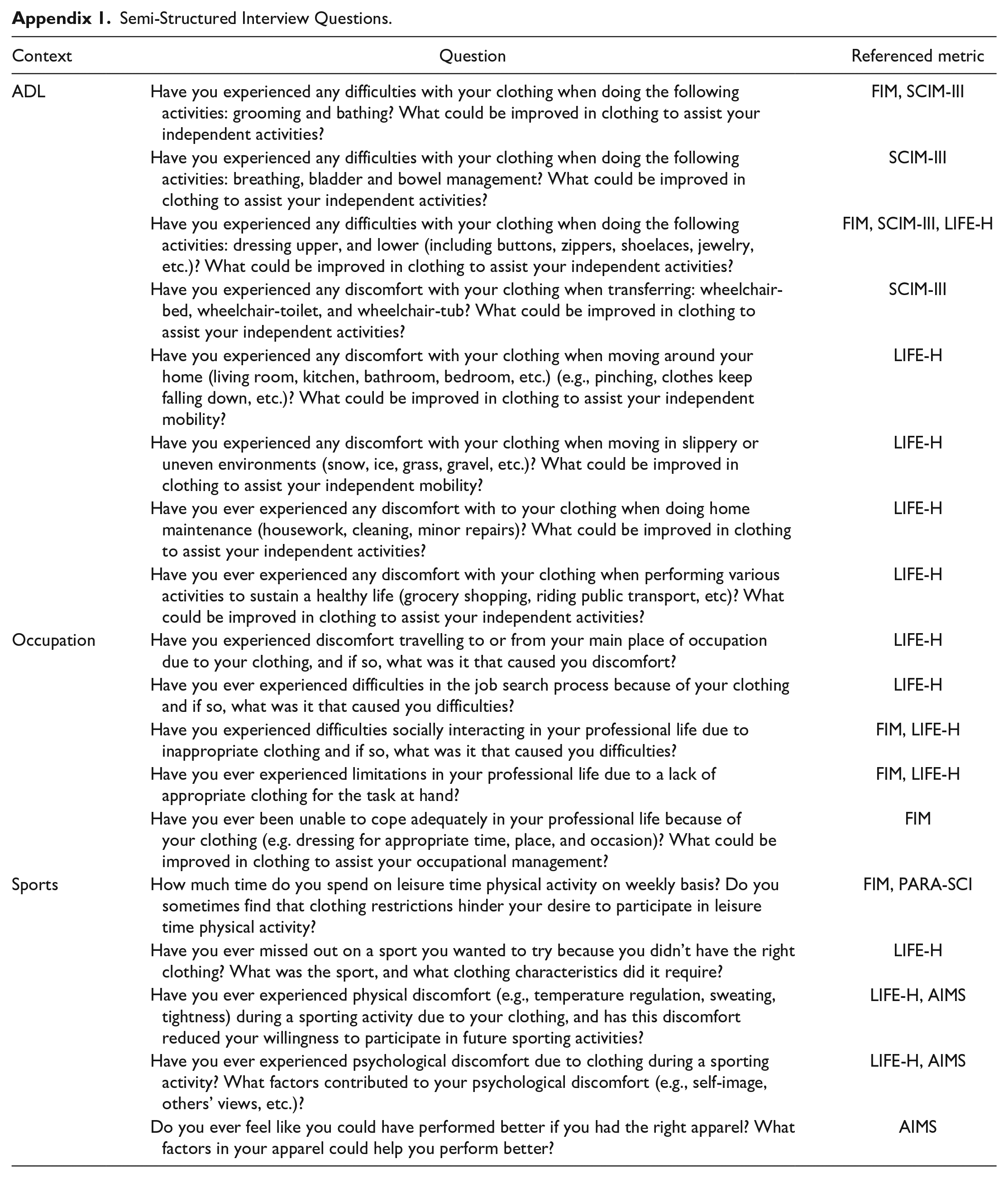
This study chose a qualitative methodology using one-to-one semi-structured interviews to excavate needs in three contexts. The semi-structured questions consist of ADLs, Occupations, and Sports. The term “Sports” was used as an umbrella term for all leisure time physical activity. Each question set was built upon the Spinal Cord Independence Measure III (SCIM-III), the Functional Independence Measure (FIM), the Assessment of Life Habits 4.0 (General Questionnaire LIFE-H 4.0) (RIPPH—Réseau international sur le processus de production du handicap, 2023), the Athletic Identity Measurement Scale (AIMS) (Brewer et al., 2012), and Physical Activity Recall Assessment for People with Spinal Cord Injury (PARA-SCI) (Latimer et al., 2006). The semi-structured interview questions are shown in Appendix 1.
Participants
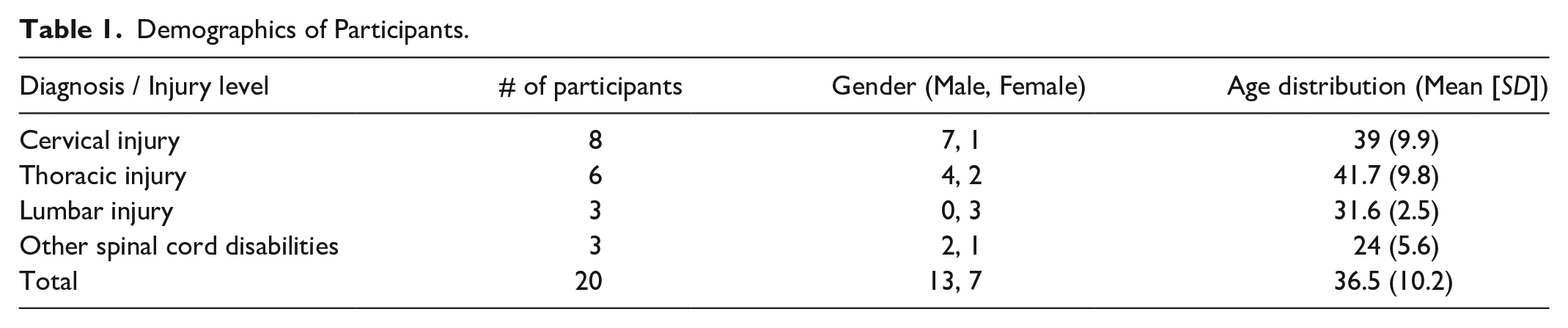
Twenty participants with SCI are recruited via Seoul Spinal Cord Injury Association and Korea Spinal Cord Injury Association. The inclusion criteria for participant recruitment were as follows: individuals with SCI who (a) successfully reintegrated into society and sustain an independent life, (b) have a job, and (c) participate in sports activities on a regular basis. The demographic information of participants is shown in Table 1.
Demographics of Participants.
Data Collection and Analysis
The participants were interviewed individually, in face-to-face or non-face-to-face (Zoom) settings. Upon consenting to participate in the research, the participants furnished their personal details, such as age, diagnosis, injury level, and onset. Then they proceeded to the interview. All interviews were audio-recorded for analysis. The participants were informed that personally identifiable information would be removed, and they could terminate their participation in the study at any time they wished.
A deductive-inductive thematic analysis was employed to organize themes in the data (Braun et al., 2016). The data were analyzed the data using a bottom-up thematic approach. Then the themes emerged into three categories: ADL, occupation, and sports contexts, using a top-down approach.
Results
The results were organized into themes under three contexts: ADLs, occupation, and sports.
Activities of Daily Living
Challenges With Personal Hygiene Management and Clothing Maintenance
One of the key issues arising from our participants’ feedback involved complications with clothing maintenance during daily personal hygiene tasks. The participants often had concerns about their clothing being damaged or soiled while engaging in hygiene-related activities such as bathing, managing bowel and bladder movements, and transfers in the bathroom. These activities typically occur on slippery surfaces and are frequently prone to contamination, contributing to the risk of clothing degradation.
Participant 14, with thoracic injury, expressed discomfort, stating, “I feel uncomfortable when urinating or defecating as the long-sleeved top gets soiled easily.” Similarly, Participant 7, who has a cervical injury, described a significant impediment to independent living. He conveyed that the act of putting on and removing pants is challenging, often necessitating reliance on others for cleaning up after bowel movements.
Increased Care Demands for Paralyzed Regions
The participants further highlighted that care for paralyzed areas goes beyond the routine, especially concerning clothing. Pressure ulcers can occur from sustained improper pressure on paralyzed areas, and friction wounds pose considerable challenges. These conditions are not only difficult to heal but require specialized care and attention.
Participant 3, with thoracic injury, voiced discomfort when dressing and undressing due to the loss of sensation from her paraplegia. She additionally reported, “I have no sensation in my feet, leading to the unnoticed tightening of shoelaces, which subsequently results in foot swelling.” Similarly, Participant 9, with a cervical injury, noted, “Due to my limited trunk range of motion, I struggle with picking up items. Consequently, I often need someone’s assistance to straighten my pants when they get bunched between the cushion and my leg.”
Furthermore, Participant 13, who also has a thoracic injury, shared an instance of nearly tripping over his pants sleeve during a transfer. He highlighted this as an example of the physical imbalance issues arising from his condition. The incident underscored that ready-made pants often necessitate alterations for suitability, which can lead to considerable expense.
Soiling and Wearing From Wheelchair Propulsion
A commonly reported discomfort among participants of varying injury levels and diagnoses related to the effects of wheelchair propulsion on their clothing. The rear wheels of the wheelchairs appeared to pose a significant issue, leading to frequent contamination of sleeves, elbows, and sagging shirts during wheelchair movement.
Participant 6, with cervical injury, by highlighting the damage inflicted due to consistent friction, especially on the sleeves. “It would be beneficial to have a thicker fabric for the sleeves, particularly at the elbows and cuffs,” he suggested, identifying these as the most frequently damaged areas. Participant 17, with other spinal cord disabilities, shared her experience of the sleeve ends touching or pinching the handrim, leading to damage and consequent shame when “good clothes go bad due to wheelchair.”
Occupational Management
Appropriate Dressing for Formal Occasions
In professional settings, appropriate presentation through the dressing is pivotal. A suit is often required in many workplaces and needs to be presented suitably. Participant 2 expressed his frustration at not being able to wear a suit “appropriately.” He explained, “When I don a suit jacket, I have to wheel around while sitting. This is uncomfortable for me as it opens up the front, looks unsightly, and severely wrinkles my clothes.”
Participant 5, also with a cervical injury, echoed these sentiments. He mentioned, “I’m compelled to pair sneakers with my suit as I cannot wear shoes that do not provide breathability. I feel bad for not looking good, although I do not think anyone is judging me.”
Clothing and Quality of Labor
Given that individuals with SCI are at a higher risk of skin damage from pressure and friction due to prolonged sitting, clothing significantly impacts labor quality. Participant 1 highlighted the lack of ventilation in clothing as a reason for diminished work performance. He said, “I have to sit as long as everyone else, and I always get pressure ulcers. I feel that I would perform better with breathable clothes.”
Participant 10, with a cervical injury, noted the mismatch between her body’s shape due to paralysis of the abdominal muscles and the design of ready-to-wear clothing. She commented, “When I sit, my stomach protrudes, my waist is unsupported, which leads to a flabby appearance. This discomfort affects my ability to work long hours.”
Affordability and Aesthetics of Adaptive Clothing
Participants expressed dissatisfaction with existing adaptive clothing options, discussing issues with aesthetics and affordability. Participant 18 criticized existing adaptive clothing brands for their aesthetic shortcomings. She declared, “I do not want to buy garments from existing adaptive clothing brands because their clothes are unattractive. The pattern of their clothing is not appealing. Moreover, one brand fails to offer variety due to having only one pattern maker.”
Meanwhile, Participant 9 voiced concerns about the high cost of custom clothing. He stated, “Most of my clothing problems could be resolved with custom clothing. However, it is costly, and I cannot afford it.” These concerns suggest the need for affordable, aesthetically pleasing adaptive clothing options.
While previous studies (Irovan et al., 2023; Sadretdinova et al., 2022) have recommended using banded pants as a potential solution, Participant 11, also with a thoracic injury, countered this proposition. She argued, “There are already enough banded pants on the market, negating the need to produce more for the sake of adaptive clothing.”
Sports
Adaptive Clothing for Aquatic Activities
Participants with cervical injuries shared their experiences of not being able to exercise in the water due to lack of clothing. Participant 3, with a cervical injury, shared the frustration of wanting to try skin scuba but not being able to because he could not fit into a suit: “I once wanted to try skin scuba but gave up because wearing a full-body suit with tight material was impossible.”
Participant 4 shared that he could not swim because he could not find a swimsuit that fit his muscle-worn legs. He stated, “I still want to swim, but none of the swimsuits on the market fit. It is supposed to be fitted, but it keeps falling. Unless you are a Paralympic athlete, it is hard to find a place that will customize a swimsuit like this.”
Implications of Pressure Ulcers and Abrasions
Pressure ulcers and abrasions resulting from inadequate clothing emerged as the predominant concern for individuals with SCI engaged in sports. Participant 1, who coached a wheelchair sports team, pointed out the common challenges experienced by para-sport athletes. He highlighted the insufficiency of ready-made functional tops, as they are often not designed with the specific needs of athletes with disabilities in mind.
Echoing these concerns, Participant 10 drew attention to the lack of functionality of the garments leading to the development of pressure ulcers and abrasions. He indicated that the accumulation of sweat caused humidity buildup, leading to skin abrasions in weaker areas. As a result, athletes often struggle with condition management, subsequently impairing their performance.
Athletic Pride Versus Body Image Concerns
Several participants reported body image issues, mainly due to the way athletic clothing clings to the body.
Participant 12 shared his concerns about showing Scoliosis and exposing the abdomen by stating, “There is a lot of technical sportswear on the market designed to hold your body tight. However, I do not like wearing them because they show my body’s deformation.”
Participants with cervical and upper thoracic injuries similarly expressed their discomfort, primarily regarding their protruding stomachs, a consequence of the lack of abdominal muscles. Their preference leaned toward loose-fitting clothing on top, particularly when provided with a tight uniform, indicating the need for more thoughtful, and adaptive designs in athletic clothing.
Discussion
This research provides insights into the need for adaptive clothing within three primary contexts: ADL performance, occupational management, and sports. In each of these domains, three significant themes surfaced. These findings contribute substantially to a deeper understanding of the unique clothing-related concerns and needs of individuals with SCI.
Through the analysis of these concerns and needs, a range of practical recommendations have been derived. These suggestions aim to alleviate some of the challenges individuals with SCI face and enhance their day-to-day experiences in terms of clothing.
One feasible strategy involves the use of antisoil finishing on clothing to minimize damage during wheelchair propulsion. Teflonization can make clothing more durable and resistant to both water and oil, ensuring clothes last longer and look better. This is particularly relevant considering the heightened exposure to potential soiling and damage that comes with wheelchair use.
Additionally, the incorporation of banding on pant hems and cuffs can counteract sleeve sagging, a common issue identified in the study. Another practical consideration includes the introduction of additional bar tacks for self-length repairs. For instance, placing a bar tack above the pant hem can prevent the unraveling of seams, even if the pants are cut down to the bottom.
A significant finding from this study is the need for alterations to conventional clothing designs to accommodate better the body shapes and postures of individuals with SCI. For instance, due to the increased inseam length in a seated position, the back crotch length of the pants’ back panel pattern could be extended. This would ensure a better and more comfortable fit when the individual is seated, a common position for those with SCI.
Further, the application of advanced technologies, such as 3D scanning, could be used to create adaptive clothing patterns. By scanning the human body in a seated position, more accurate and comfortable patterns could be developed. For example, to create a cycling suit, the body could be scanned in a cycling pose. Similarly, a speed skating pose could be used to create a tricot. This use of technology could provide a more precise fit, enhancing the comfort and functionality of the clothing for individuals with SCI.
In conclusion, this study contributes valuable insights and practical suggestions to address the clothing needs and concerns of individuals with SCI across different life contexts. The recommendations presented here could help to improve the quality of life for these individuals by making clothing more comfortable, practical, and adaptive to their specific needs.
Future research should focus on incorporating these needs and suggestions to create adaptive clothing patterns. Moreover, research should be done on the supply and demand side to make these adaptive clothes affordable.
Footnotes
Appendix
Semi-Structured Interview Questions.
| Context | Question | Referenced metric |
|---|---|---|
| ADL | Have you experienced any difficulties with your clothing when doing the following activities: grooming and bathing? What could be improved in clothing to assist your independent activities? | FIM, SCIM-III |
| Have you experienced any difficulties with your clothing when doing the following activities: breathing, bladder and bowel management? What could be improved in clothing to assist your independent activities? | SCIM-III | |
| Have you experienced any difficulties with your clothing when doing the following activities: dressing upper, and lower (including buttons, zippers, shoelaces, jewelry, etc.)? What could be improved in clothing to assist your independent activities? | FIM, SCIM-III, LIFE-H | |
| Have you experienced any discomfort with your clothing when transferring: wheelchair-bed, wheelchair-toilet, and wheelchair-tub? What could be improved in clothing to assist your independent activities? | SCIM-III | |
| Have you experienced any discomfort with your clothing when moving around your home (living room, kitchen, bathroom, bedroom, etc.) (e.g., pinching, clothes keep falling down, etc.)? What could be improved in clothing to assist your independent mobility? | LIFE-H | |
| Have you experienced any discomfort with your clothing when moving in slippery or uneven environments (snow, ice, grass, gravel, etc.)? What could be improved in clothing to assist your independent mobility? | LIFE-H | |
| Have you ever experienced any discomfort with to your clothing when doing home maintenance (housework, cleaning, minor repairs)? What could be improved in clothing to assist your independent activities? | LIFE-H | |
| Have you ever experienced any discomfort with your clothing when performing various activities to sustain a healthy life (grocery shopping, riding public transport, etc)? What could be improved in clothing to assist your independent activities? | LIFE-H | |
| Occupation | Have you experienced discomfort travelling to or from your main place of occupation due to your clothing, and if so, what was it that caused you discomfort? | LIFE-H |
| Have you ever experienced difficulties in the job search process because of your clothing and if so, what was it that caused you difficulties? | LIFE-H | |
| Have you experienced difficulties socially interacting in your professional life due to inappropriate clothing and if so, what was it that caused you difficulties? | FIM, LIFE-H | |
| Have you ever experienced limitations in your professional life due to a lack of appropriate clothing for the task at hand? | FIM, LIFE-H | |
| Have you ever been unable to cope adequately in your professional life because of your clothing (e.g. dressing for appropriate time, place, and occasion)? What could be improved in clothing to assist your occupational management? | FIM | |
| Sports | How much time do you spend on leisure time physical activity on weekly basis? Do you sometimes find that clothing restrictions hinder your desire to participate in leisure time physical activity? | FIM, PARA-SCI |
| Have you ever missed out on a sport you wanted to try because you didn’t have the right clothing? What was the sport, and what clothing characteristics did it require? | LIFE-H | |
| Have you ever experienced physical discomfort (e.g., temperature regulation, sweating, tightness) during a sporting activity due to your clothing, and has this discomfort reduced your willingness to participate in future sporting activities? | LIFE-H, AIMS | |
| Have you ever experienced psychological discomfort due to clothing during a sporting activity? What factors contributed to your psychological discomfort (e.g., self-image, others’ views, etc.)? | LIFE-H, AIMS | |
| Do you ever feel like you could have performed better if you had the right apparel? What factors in your apparel could help you perform better? | AIMS |
Correction (September 2024):
Article has been revised to include funding information.
Declaration of Conflicting Interests
The author(s) declared no potential conflicts of interest with respect to the research, authorship, and/or publication of this article.
Funding
The author(s) disclosed receipt of the following financial support for the research, authorship, and/or publication of this article: This study was supported by Korea Creative Content Agency, funded by the Ministry of Culture, Sports and Tourism [RS-2024-00396700].
