



Abstract
Recent research suggests that advanced driver assistance systems (ADAS) technologies, such as forward collision warning (FCW), have the potential to reduce rear-end and other forward collisions. The primary objective of this literature review is to provide a summary of relevant research on how the presence of FCWs may or may not impact driver perception response time (PRT) to forward hazards. Our review of the literature identified several primary variables that impact driver PRT including warning modality, inattention/distraction, and expectancy. These variables, their implications, and future research are discussed.
Keywords
Rear-end collisions accounted for approximately 29% of all collisions in 2021, 7.5% of which were fatal (National Highway Traffic Safety Administration [NHTSA], 2023). Recent research suggests that ADAS technologies, such as FCW, have the potential to reduce these numbers. For example, one analysis posits that FCW technology has the potential to prevent or mitigate approximately 1.2 million crashes, or approximately 20% of all crashes, per year (Jermakian, 2011).
As a Level 0 ADAS, FCW provides momentary assistance to the driver in the form of auditory, visual, and/or haptic warnings in order to provide information to the driver about a potential forward hazard so that the driver may respond as necessary (e.g., braking and/or steering). Level 0 ADAS describe that the driver is expected to be alert, be attentive, and to maintain control of the vehicle at all times (NHTSA, 2022; SAE International On-Road Automated Driving committee, 2021). Given that drivers maintain control of the vehicle and are responsible for responses to hazardous situations, it is important to understand whether, and how, the presence of a FCW system impacts a driver’s ability to safely operate their vehicle and respond to potential hazards.
The primary objective of this literature review is to provide a summary of relevant research on how the presence of FCWs may or may not impact driver PRT to forward hazards, as well as to look at drivers’ PRT to the FCWs themselves, including when there may not be driver responses prior to a collision. This review investigates (1) how the presence and type of FCW systems impact driver PRT, and (2) how driver factors (e.g., inattention or distraction) impact driver PRT and response when a FCW system is present.
Methods
We conducted a systematic literature search with the aim of identifying as many studies as possible that examined and reported PRTs to either FCWs or to hazards with a FCW system present. We searched multiple databases (specifically, Google Scholar, TRID, HFES, ProQuest, PubMed, SAE International, PsycInfo, and Web of Science), scanned the reference lists of papers, and used the cited by feature in Google Scholar. Typical keywords searched included “FCW,” “Forward Collision Warning,” “Rear-end Collision Warning,” “Front-to-rear Collision Warning,” “Collision Warning,” “Collision Mitigation System,” “PRT,” “Perception Response Time,” “Perception Reaction Time,” “Reaction Time,” “RT,” “Time to React,” and “Hazard Perception.” Studies had to fulfill several criteria to be selected for consideration in the review, including examining forward collision warnings, examining PRT or reaction time, and not being about design, algorithms, or non-transportation contexts.
Results
The search yielded 766 relevant abstracts, which were each reviewed by two scientists. From these, 206 potentially relevant full-text records were identified, and further reviewed for eligibility. After excluding 146 records that did not meet the criteria, 60 records remained for inclusion.
Our review of these 60 articles identified several primary variables that impact driver PRT. These variables include (1) warning modality (i.e., visual, auditory, tactile, or some combination of these), (2) inattention or non-driving related task engagement (NDRT), and (3) expectancy (e.g., expectancy of the warning, expectancy of the hazard).
Warning Modality
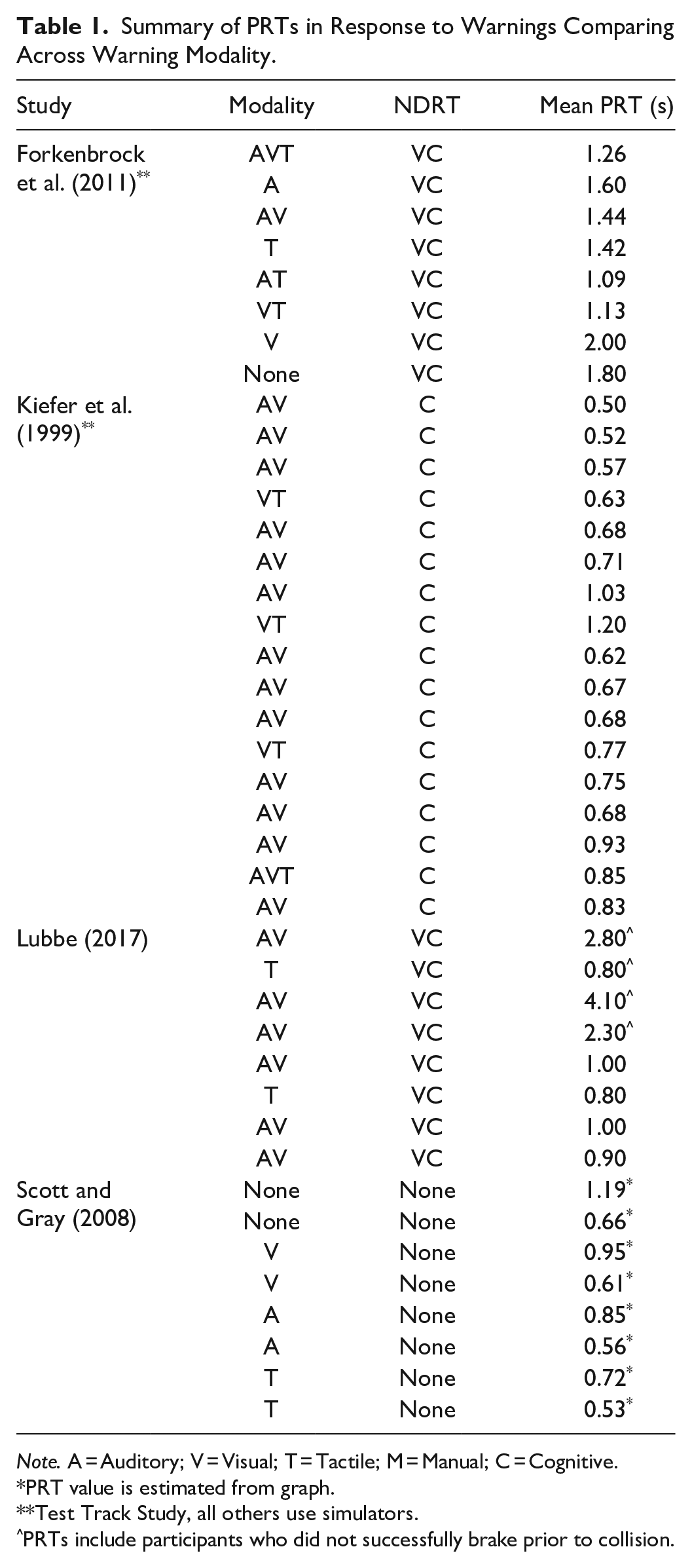
All reviewed articles provided warnings communicated through auditory, visual, tactile, and/or mixed warning signals. A total of 49 papers provided warnings with an auditory component (e.g., beeps, car horn sounds, or automated voices), 31 papers provided warnings with a visual component (e.g., lights, icons), 18 papers provided warnings with a tactile component (e.g., vibration of the pedal or seatbelt), and 30 papers provided warnings that consisted of a combination of modalities (e.g., visual icon with an auditory beep). Four of the papers compared PRTs in response to warning signals that contained some form of all three modalities (see Table 1).
Summary of PRTs in Response to Warnings Comparing Across Warning Modality.
Note. A = Auditory; V = Visual; T = Tactile; M = Manual; C = Cognitive.
PRT value is estimated from graph.
Test Track Study, all others use simulators.
PRTs include participants who did not successfully brake prior to collision.
Inattention and Non-Driving Related Task
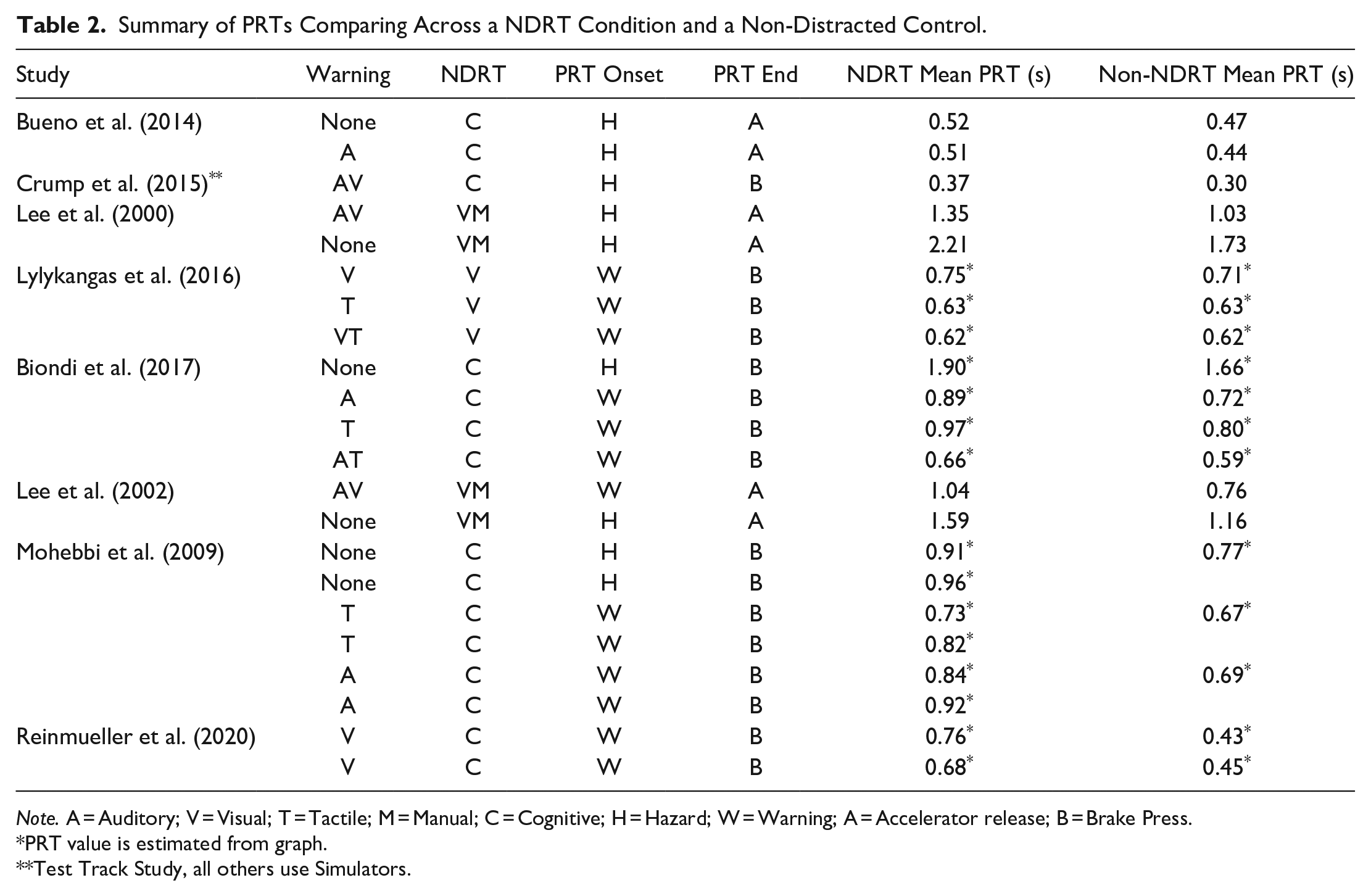
Across all of the articles, a total of 30 papers used NDRTs or other forms of inattentive driving (e.g., drowsiness) in order to distract drivers from the driving task. Of these papers, 10 defined the onset of PRT as the presence of the hazard, and 20 defined the onset of PRT as the onset of the FCW (one of which also had a condition which defined the onset of PRT as a specific time to collision). Only eight total papers compared PRTs across a NDRT condition and a non-distracted control (see Table 2). Only three papers compared different levels of NDRTs. Researchers have used a variety of different visual (e.g., navigation instructions), manual, cognitive (e.g., hands-free conversation), or some combination of tasks (e.g., texting) as distractions from the driving task (e.g., Hamilton & Grabowski, 2013).
Summary of PRTs Comparing Across a NDRT Condition and a Non-Distracted Control.
Note. A = Auditory; V = Visual; T = Tactile; M = Manual; C = Cognitive; H = Hazard; W = Warning; A = Accelerator release; B = Brake Press.
PRT value is estimated from graph.
Test Track Study, all others use Simulators.
Expectancy
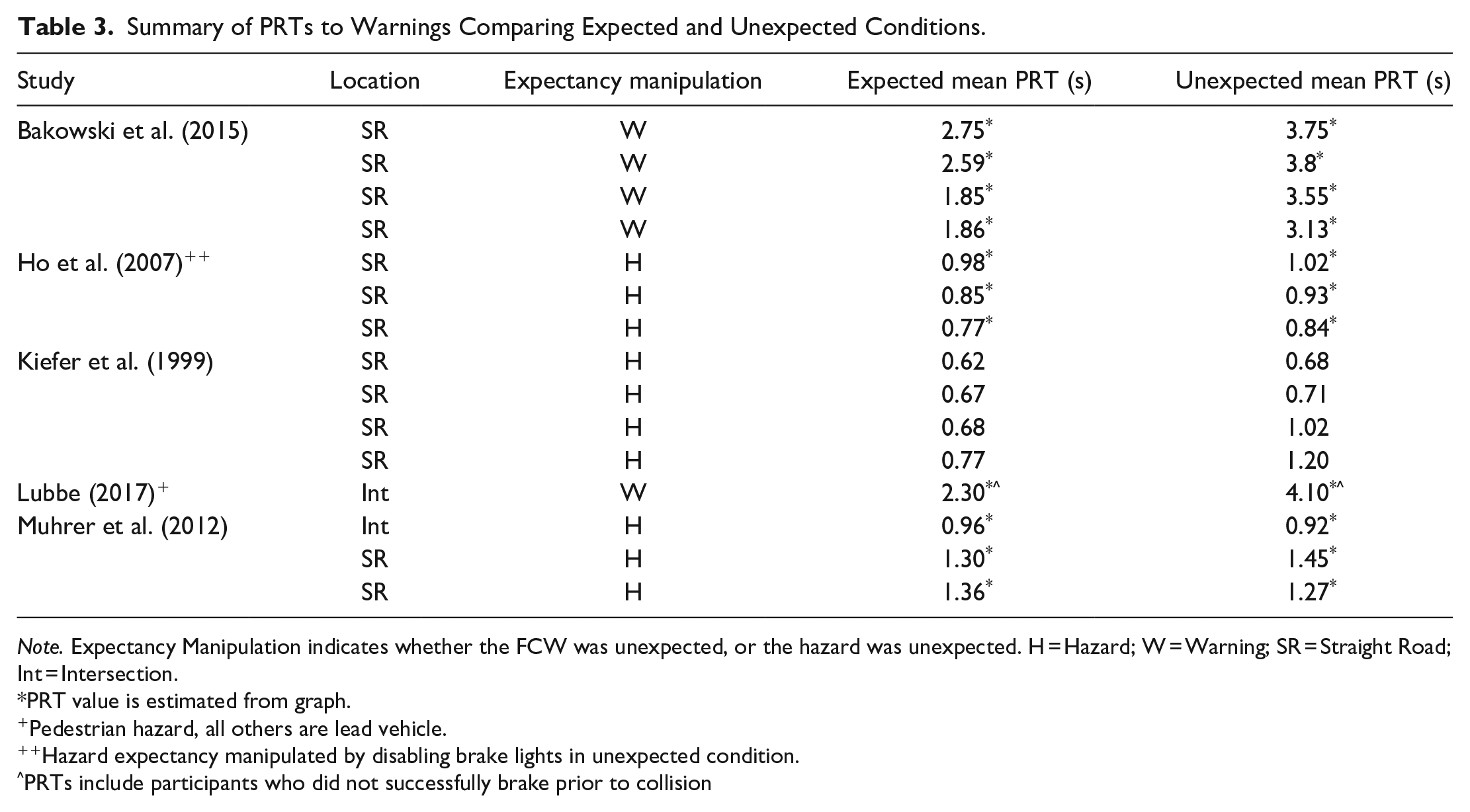
The present review identified studies that manipulated driver expectancies about FCWs, hazards, or both. There were 37 papers that provided participants with instructions that the procedure would involve FCWs. Drivers expected hazards in 16 of the papers. There were 12 papers where the brake lights on the lead vehicle were disabled during deceleration, making the need to brake less expected. Importantly, five papers included within-study manipulations of expectations (see Table 3). Moreover, hazards were generally considered expected when they occurred at intersections or pedestrian walkways, and hazards were considered unexpected when they occurred on straight roads unless otherwise indicated by the authors.
Summary of PRTs to Warnings Comparing Expected and Unexpected Conditions.
Note. Expectancy Manipulation indicates whether the FCW was unexpected, or the hazard was unexpected. H = Hazard; W = Warning; SR = Straight Road; Int = Intersection.
PRT value is estimated from graph.
Pedestrian hazard, all others are lead vehicle.
Hazard expectancy manipulated by disabling brake lights in unexpected condition.
PRTs include participants who did not successfully brake prior to collision
Discussion
Warning Modality
Review of the data from all 60 articles indicated three key findings. Firstly, warnings across all modalities (auditory visual, tactile, or a combination thereof) generally yielded shorter PRTs than non-warning control groups. Second, FCWs presented in multiple concurrent modalities (e.g., an auditory tone in conjunction with a visual HUD message) generally yielded shorter PRTs than FCWs presented in a single modality. Third, the reviewed studies showed that PRTs to FCWs with tactile components are generally shorter than FCWs without tactile components. This is consistent with research on human response times to stimuli across perceptual modalities, which has found that tactile stimuli tend to elicit shorter response times than visual and auditory stimuli (e.g., Ng & Chan, 2012). For example, Forkenbrock et al. (2011) used three types of FCW signals: an auditory beep, a visual HUD alert, and a seatbelt vibration. PRTs were shortest when alerts combined all modalities (beep + HUD + belt), combined auditory and tactile modalities (beep + belt), or combined visual and tactile modalities (HUD + belt). When isolated, PRTs were shortest for tactile-only signals compared to auditory-only or visual-only signals. Furthermore, 15 of the 17 trials in which drivers were able to avoid collision included a tactile signal.
Inattention and Non-Driving Related Tasks
Consistent with PRT research in non-FCW contexts (e.g., Krauss, 2015), research examining driver NDRT engagement suggests that participating in an NDRT increases driver PRTs when compared to attentive driving, regardless of whether a FCW is present (Biondi et al., 2017; Bueno et al., 2014; Crump et al., 2015; Lee et al., 2000, 2002; Mohebbi et al., 2009). In addition to differences in PRT depending on NDRT, many of these studies also demonstrate an overall effect of warning. Specifically, the presence of the warning results in faster PRT than the absence of the warning (Biondi et al., 2017; Lee et al., 2000, 2002; Mohebbi et al., 2009). Lee et al. (2002) concludes that this result suggests that the warning provides an overall safety benefit to drivers regardless of whether the driver is attentive or distracted. Interestingly however, many of the studies that demonstrate this overall effect of the warning measure PRT using the onset of the warning for their warning conditions, while PRT is the onset of the hazard in their no-warning condition (see Lee et al., 2000 for exception). This method does not consider any drivers that may have already begun their PRT to the hazard prior to the onset of the warning. Of the studies that measure PRT using the onset of the hazard, Bueno et al. (2014) and Lee et al. (2000) found that the warning led to faster response but did not report whether there were drivers that responded prior to the onset of the warning. In contrast, Crump et al. (2015) found that the majority of attentive drivers in their study responded prior to the warning, whereas only two drivers responded prior to the warning in their NDRT condition. Overall, they concluded that FCW is not a replacement for an alert and attentive driver.
Although eight of the 30 papers that used a NDRT compared it to non-distracted control, only three papers examined how different levels of NDRTs or inattention can impact PRT (Gaspar et al., 2019; Kiefer et al., 2005; Mohebbi et al., 2009). For example, Gaspar et al. (2019) examined the effectiveness of auditory and tactile FCWs (as compared to no warning) to a sudden reveal of a stopped vehicle for drowsy drivers. They found no effect of warning—but demonstrated that severe drowsiness results in slower PRTs than moderate drowsiness. The authors suggest that, unlike distracted drivers, drowsy drivers may already be looking toward the forward roadway at the time of the warning—and therefore would not necessarily benefit from the orienting effect of FCWs. Mohebbi et al. (2009) examined the effectiveness of auditory and tactile FCWs to a lead vehicle braking event (disabled brake lights) for drivers engaged in conversation of various complexity. They found that a simple conversation increased PRT in the no warning and auditory warning conditions, but not in the tactile warning condition, whereas the complex conversation increased PRT in all warning conditions. The authors suggest that conversation increases auditory load, so tactile warnings may be more helpful in orienting drivers who are distracted by cell phone conversation to the forward roadway.
Expectancy
Prior studies have demonstrated that expectancy can influence task speed and accuracy when driving (e.g., Krauss, 2015). When driver expectations are met, performance is enhanced relative to when they are not. Accordingly, the present review found that PRTs were shorter when drivers expected FCWs (e.g., Bakowski et al., 2015; Lubbe, 2017) and when drivers expected hazards (Ho et al., 2007; Kiefer et al., 1999; Muhrer et al., 2012). When driver expectations are violated (e.g., a hazard emerges), additional demands are placed on attention and information processing (e.g., Krauss, 2015).
Studies varied in their manipulations of expectations pertaining to both warnings and hazards. For example, Wang et al. (2023) “concisely introduced” participants to the study’s collision mitigation system and warnings, only commencing when drivers demonstrated comprehension. Abe and Richardson (2006), meanwhile, provided drivers with 10-minute practice drives to become familiar with the study’s lead vehicle decelerations. In other cases, drivers were informed about the potential for hazards before encountering lead-vehicle decelerations (e.g., Ho et al., 2006; Winkler et al., 2018a), pedestrians (Song et al., 2022; Winkler et al., 2018a) and cyclists (Puente Guillen & Gohl, 2019; Winkler et al., 2018a).
Conclusions
When considering the modalities of warnings, studies indicate that haptic signals can be efficacious as FCWs. However, these signals tend to be perceived as disruptive, which may limit market penetration (e.g., Campbell et al., 2014). Our findings show shorter PRTs associated with tactile warnings; hence, exploring the effectiveness of various tactile signals (e.g., accelerator vibration) in reducing forward collisions is warranted.
Our review suggests that NDRTs increased PRT regardless of the presence of an FCW. Crump et al. (2015) suggests that attentive drivers generally do not need assistance from ADAS to avoid preventable collisions, but this was the only study to quantify the number of drivers who responded prior to the FCW. Our results suggest that FCWs may help drivers with momentary distractions perceive and respond to the potential hazard faster than if no warning were present. Further research is needed to better understand the potential benefits of FCW for distracted drivers in real world settings, where PRTs are measured from the onset of the hazard rather than the onset of the warning.
Regarding driver expectancy, our findings are consistent with this research demonstrating that individuals tend to react more quickly to expected hazards than unexpected hazards (e.g., Krauss, 2015). Further, our review suggests that drivers may respond more quickly when they are aware of the presence of the FCW, providing evidence that educating drivers about the existence and function of FCWs may help reduce PRTs in crash or near-crash scenarios.
Overall, our results suggest that FCWs may reduce PRTs under certain circumstances, which in turn has the potential to provide a safety benefit to the driver. This is consistent with data that suggest that FCW systems have the potential to mitigate or prevent crashes (e.g., PARTS, 2022). These data show that FCW alone has the potential to reduce all front-to-rear crashes by 16% (PARTS, 2022), but many others are unavoidable. FCWs do not prevent all crashes and, in many cases where an individual crashed, PRTs would have exceeded time to collision from the warning or hazard (e.g., Crump et al., 2015; Forkenbrock et al., 2011; Kiefer et al., 2005; Lee et al., 2000).
Footnotes
Declaration of Conflicting Interests
The author(s) declared no potential conflicts of interest with respect to the research, authorship, and/or publication of this article.
Funding
The author(s) received no financial support for the research, authorship, and/or publication of this article.