



Abstract
Background:
This study evaluated the relationship between antidepressant prescription (ADP) and postoperative complications in patients undergoing ankle open reduction internal fixation (ORIF).
Methods:
A retrospective cohort study that uses multi-institutional data from the Trinetx research platform identified patients who underwent ankle ORIF on or before December 10, 2024, with at least 2 ADP doses and 2 years of follow-up using Current Procedural Terminology (CPT) and International Classification of Diseases, Tenth Revision (ICD-10) codes. Outcomes were grouped into 90-day systemic and 2-year mechanical complication families. The false discovery rate was controlled at 5% using the Benjamini-Hochberg procedure, and results are reported as risk ratios with 95% CIs.
Results:
Of 70 813 patients, 13 610 (19.2%) used antidepressants. After matching (11.071 per group), antidepressant use was associated with significantly higher rates of short-term complications, including infection, wound disruption, and hospital readmission. At 2-year follow-up, use of antidepressants was significantly associated with increased rates of mechanical complications, including higher rates of hardware failure, osteoarthritis, removal, nonunion, and amputation. The outcomes remained significant after multiple-testing adjustment.
Conclusion:
Preoperative antidepressant prescription was associated with increased postoperative and long-term complications after ankle ORIF. These observational findings support tailored perioperative management and monitoring, particularly for patients with preoperative antidepressant prescriptions.
This is a visual representation of the abstract.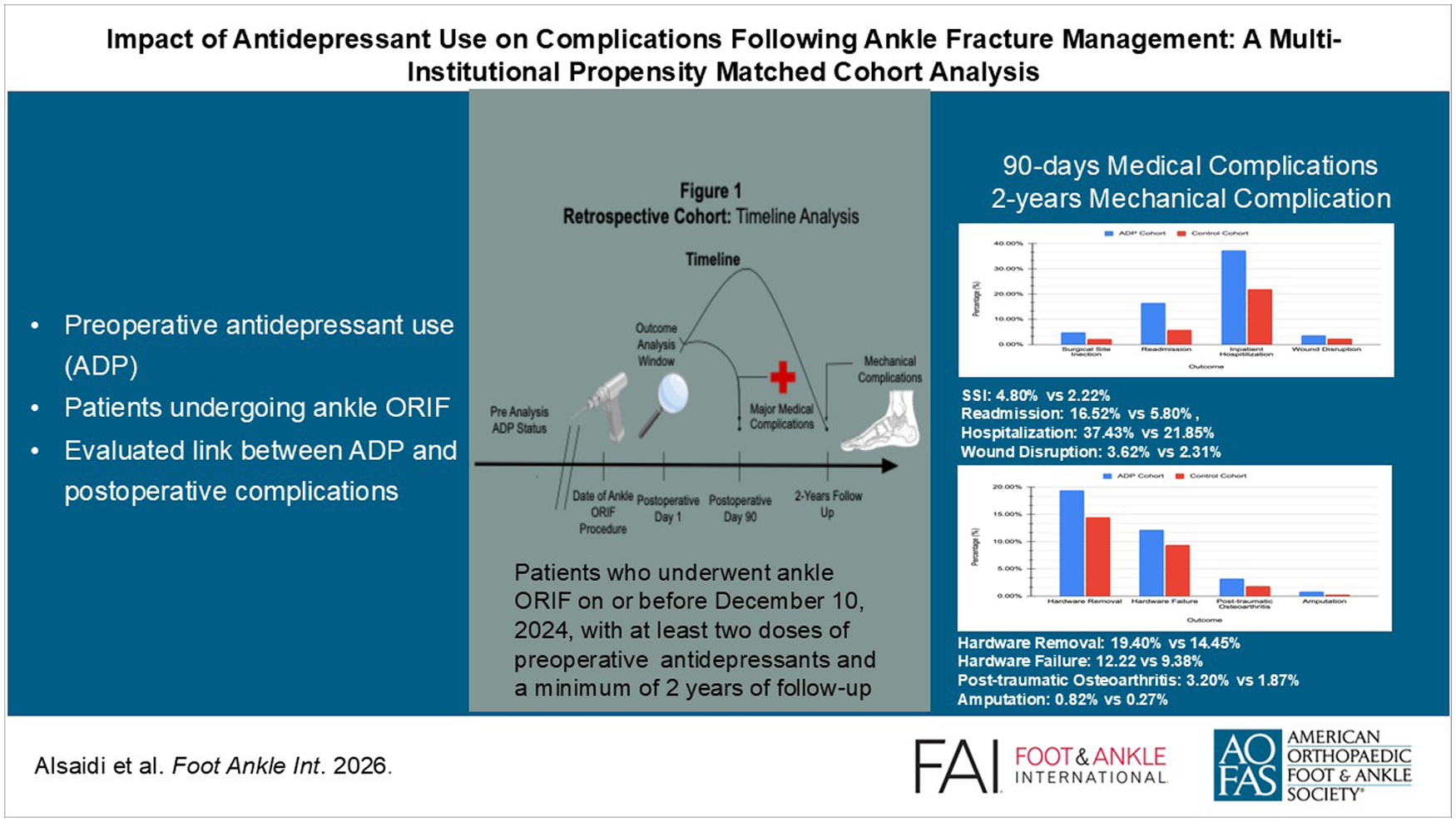
Get full access to this article
View all access options for this article.
References
Supplementary Material
Please find the following supplemental material available below.
For Open Access articles published under a Creative Commons License, all supplemental material carries the same license as the article it is associated with.
For non-Open Access articles published, all supplemental material carries a non-exclusive license, and permission requests for re-use of supplemental material or any part of supplemental material shall be sent directly to the copyright owner as specified in the copyright notice associated with the article.
