




Abstract
Background:
Assessment of hindfoot coronal alignment is essential for diagnosing and managing asymmetric ankle osteoarthritis. Although the mechanical ankle joint axis point (MAJAP) is used in surgical planning, reference values derived from nonpatient populations are lacking. This study aimed to establish MAJAP reference values using hip-to-calcaneus radiographs in older adults and to examine their associations with knee and hindfoot alignment.
Methods:
A cross-sectional study was conducted in community-dwelling Japanese adults who underwent hip-to-calcaneus radiography. Radiographic measurements included the MAJAP—defined as the intersection of the mechanical axis at the tibial plafond, expressed as a percentage from the medial to lateral edges—along with the knee varus angle, hindfoot valgus angle, tibial plafond varus angle, and ankle joint varus angle. Descriptive statistics were used to summarize the MAJAP distribution. Associations between alignment parameters and MAJAP were assessed using simple linear regression and generalized linear mixed models, adjusting for age, sex, body mass index, and laterality.
Results:
A total of 1006 limbs from 522 participants with a median age of 71 years were analyzed. The median MAJAP was 49% (25th and 75th percentiles: 34%, 63%), located near the center of the tibial plafond. In multivariate analysis, the MAJAP increased by 4.60% (95% CI, 4.50%-4.70%) for each 1-degree increase in the hindfoot valgus angle; a greater hindfoot valgus angle was associated with a more lateral MAJAP (P < .001). Conversely, a greater knee varus angle was associated with a more medial MAJAP (P < .001). Similar results were observed after excluding participants with recent lower limb pain.
Conclusion:
In community-dwelling older Japanese adults, the MAJAP was located approximately at the center of the ankle and varied systematically with hindfoot and knee coronal alignments in older Japanese adults. Future research should evaluate generalizability and clinical applicability across populations and settings.
This is a visual representation of the abstract.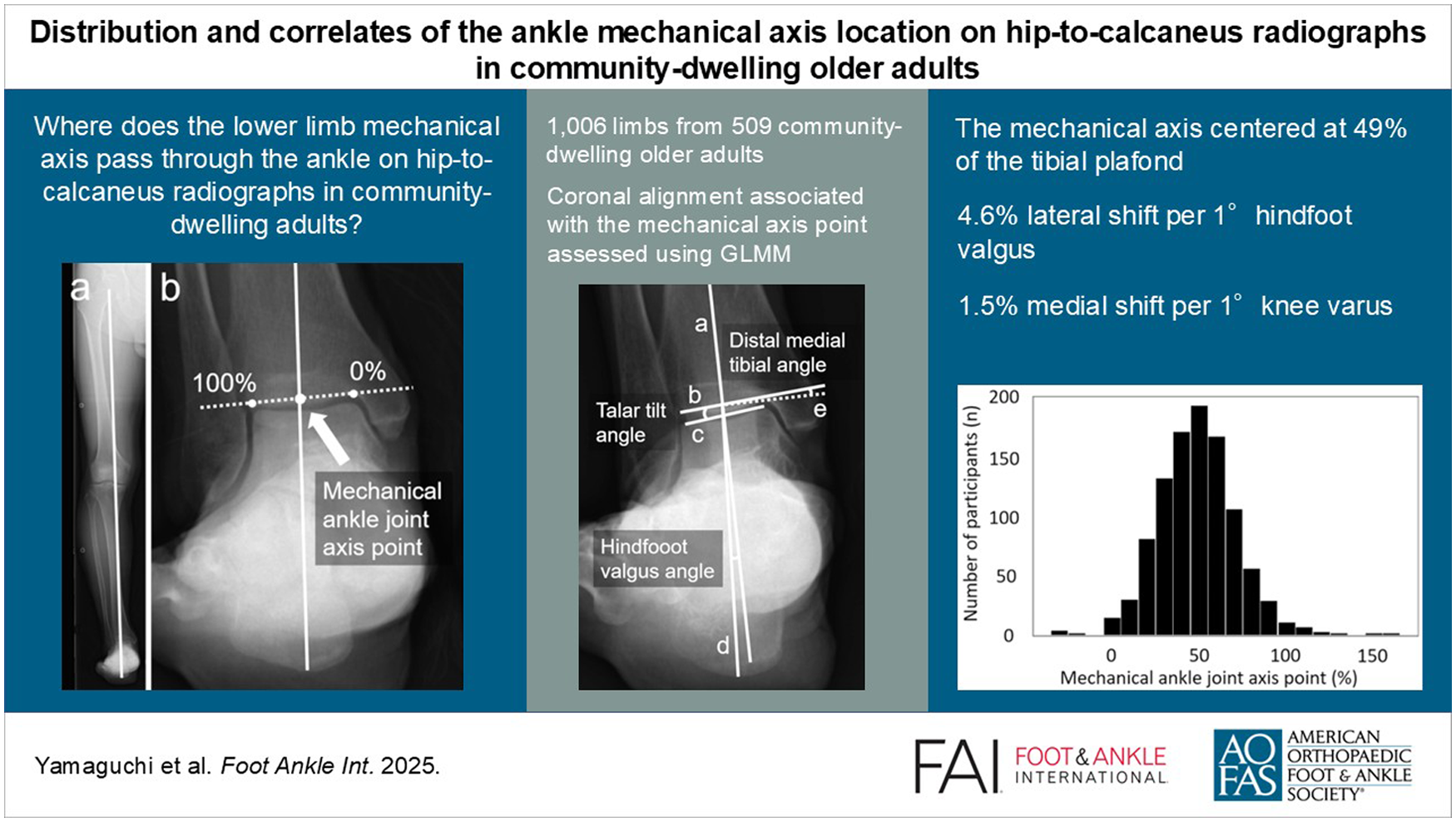
Get full access to this article
View all access options for this article.
References
Supplementary Material
Please find the following supplemental material available below.
For Open Access articles published under a Creative Commons License, all supplemental material carries the same license as the article it is associated with.
For non-Open Access articles published, all supplemental material carries a non-exclusive license, and permission requests for re-use of supplemental material or any part of supplemental material shall be sent directly to the copyright owner as specified in the copyright notice associated with the article.
