




Abstract
Background:
The acquired flatfoot, often called progressive collapsing foot deformity, frequently includes attenuation or failure of the spring ligament. Reconstruction of the spring ligament has been proposed in conjunction with other bone and soft tissue reconstruction techniques. In this study, we compared a tendon-graft reconstruction with suture tape augmentation in a cadaveric flatfoot model.
Methods:
Eight matched-pair fresh-frozen cadaver feet underwent flatfoot creation and reconstruction. The feet were cyclically loaded with 16,000 cycles from 200 N to 1.5× body weight at 1 Hz. Each foot was randomly assigned to undergo either suture tape or tendon graft reconstruction. Radiographic parameters and foot motion were measured at baseline, following creation of the collapsed arch deformity, and after repair.
Results:
The cadaveric flatfoot model was successfully created, demonstrated by significant (P < .05) changes in Meary angle (mean change = +9.4 ± 6.4 degrees), talonavicular coverage angle (mean change = +15.6 ± 9.2 degrees), medial cuneiform height (mean change = −6.6 ± 4.1 mm), and calcaneal pitch (mean change = −2.6 ± 2.2 degrees). The tendon graft repair had significant improvements compared with flatfoot in the Meary angle (mean change = −6.4 ± 3.6 degrees), talonavicular coverage angle (mean change = −6.4 ± 5.2 degrees), calcaneal pitch (mean change = +1.9 ± 1.7 degrees), and medial cuneiform height (mean change = +3.7 ± 2.4 mm). The suture tape repair had significant improvements compared with flatfoot of talonavicular coverage angle (mean change = −8.1 ± 4.1) and calcaneal pitch (mean change = +2.9 ± 0.6). Inversion and eversion data showed hindfoot motion preserved from native to repair conditions. In load-to-failure testing, the tendon graft group had 1 failure at the interference screw and 1 midsubstance failure of the tendon graft. The suture tape group had 3 failures at the interference screws and 1 failure of the suture tape.
Conclusion:
Both techniques restored arch alignment from the flatfoot condition and preserved hindfoot motion in a cadaveric flatfoot model.
Clinical Relevance:
Both techniques may provide a viable approach to restore alignment during flatfoot reconstruction. Both were mechanically stable under cyclic loading in this cadaver model; the tendon graft technique has a theoretical benefit of biological incorporation.
This is a visual representation of the abstract.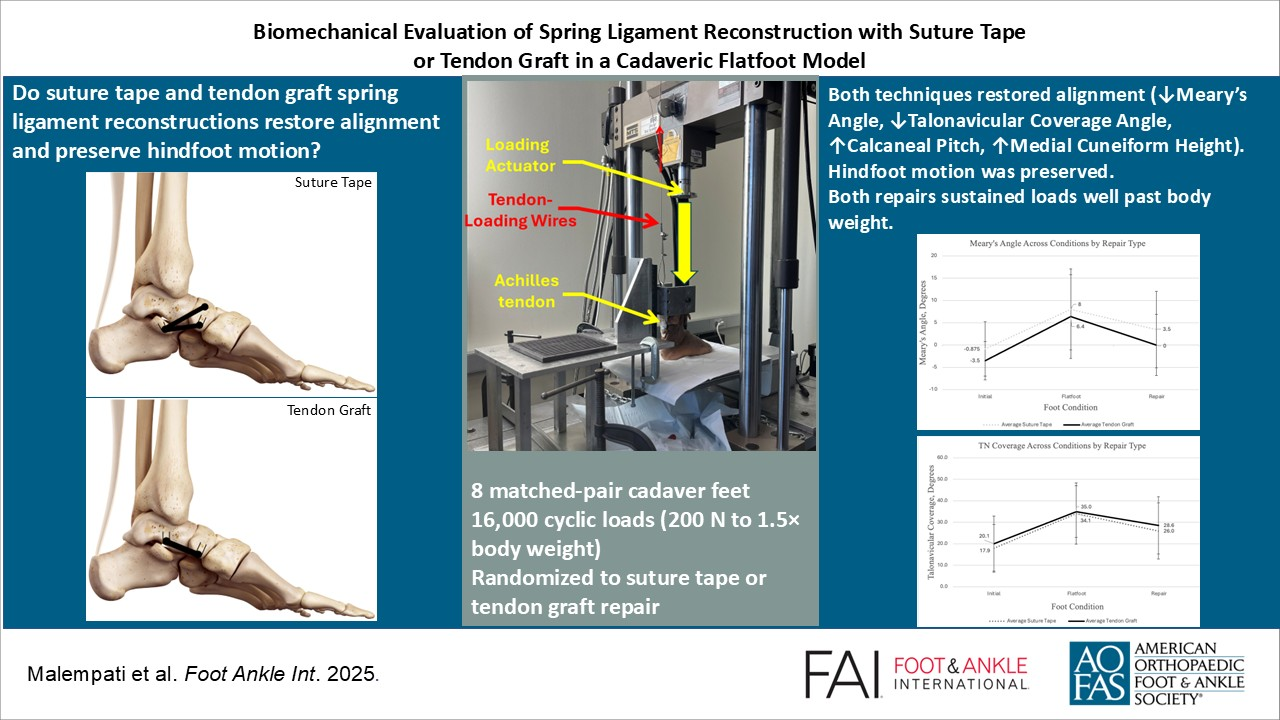
Keywords
Get full access to this article
View all access options for this article.
References
Supplementary Material
Please find the following supplemental material available below.
For Open Access articles published under a Creative Commons License, all supplemental material carries the same license as the article it is associated with.
For non-Open Access articles published, all supplemental material carries a non-exclusive license, and permission requests for re-use of supplemental material or any part of supplemental material shall be sent directly to the copyright owner as specified in the copyright notice associated with the article.
